Is Debt Resolution a Good Idea: Tax Debt Solutions
Considering if is debt resolution a good idea for your tax issues? Explore the pros, cons, and compare OIC or bankruptcy options for 2026. Get expert insights!

In this article
- The Question Behind the IRS Notice
- What the notice usually means
- Fear doesn't fix tax debt. Records do
- The Main Pathways for IRS Debt Resolution
- IRS Tax Debt Resolution Options at a Glance
- Offer in Compromise
- Installment Agreements
- Currently Not Collectible status
- Penalty Abatement
- The Real-World Pros and Cons of Tax Resolution
- Why tax resolution can be worth it
- Why it can still be a bad fit
- Tax Resolution vs Bankruptcy A Critical Comparison
- Where debt settlement and tax resolution part ways
- Bankruptcy may be better when the whole debt picture is broken
- A practical side-by-side view
- Warning Signs in the Debt Resolution Industry
- What should make you pause
- Why analysis has to come first
- How to Decide If Tax Resolution Is Right for You
- Your Next Step Taking Control of Your Tax Debt
- What to do next
You open the mailbox, see an IRS or state tax envelope, and your stomach drops. Maybe you've been meaning to deal with old returns. Maybe you knew there was a balance due, but hoped you could catch up next month. Maybe you're a business owner who used payroll taxes to keep the doors open and now the notices are piling up.
That moment is when many begin searching one question: Is debt resolution a good idea?
For tax debt, the answer isn't the same as it is for credit cards, medical bills, or personal loans. Tax debt follows different rules. The IRS can file liens, levy accounts, garnish wages, and chase business owners for certain payroll liabilities. At the same time, the IRS also offers structured programs that ordinary consumer creditors don't offer. That difference matters.
Most of the internet discussion around debt resolution is really about consumer debt settlement. That can confuse taxpayers into buying the wrong solution for the wrong problem. If your real issue is the IRS, you need a tax strategy, not a generic settlement pitch.
The Question Behind the IRS Notice
A typical client situation looks like this. A self-employed person misses estimated payments for a couple of years. Returns get filed late. Penalties stack up. Then a notice arrives that looks more serious than the last one, and the taxpayer freezes. Some people ignore it because they assume calling the IRS will make things worse. Others call the first company they find online and get told they qualify for a miracle program before anyone has reviewed a return, a transcript, or a bank statement.
That's where bad decisions start.
Tax debt isn't just another unsecured bill. As noted in this discussion of debt resolution programs and why tax debt is different, most online content focuses on consumer debts, while tax debt involves stronger collection tools and different relief options. If the problem is really IRS debt, generic debt resolution can be the wrong frame from the start.
What the notice usually means
An IRS notice doesn't automatically mean you're out of options. It usually means the IRS has moved to the next stage of its process. The key question isn't whether you can make the notice disappear. The key question is what the government thinks you owe, whether that number is accurate, and which formal resolution path fits your finances.
If you've received a final-intent type notice, it helps to understand the timeline and stakes before you react. This breakdown of the IRS CP504 notice and what it means is a useful example of how the IRS escalates collection pressure.
Practical rule: Don't buy a debt solution before you know exactly what debt you have, whether all returns are filed, and whether the balance is even correct.
Fear doesn't fix tax debt. Records do
People often assume resolution starts with negotiation. Usually, it starts with documentation. The IRS wants returns filed, financial information organized, and the facts lined up. For business owners, that may also mean cleaning up books, separating business and personal expenses, and making sure deposits and payroll records reconcile.
If you're scrambling to gather records, these actionable steps for audit preparation can help you build the habit that tax resolution also requires: organized bank records, support for deductions, and a clear paper trail.
Debt resolution can be a good idea. But with tax debt, it only becomes a good idea when it's based on a careful legal and financial analysis instead of panic.
The Main Pathways for IRS Debt Resolution
Tax debt resolution works more like choosing the right legal tool than haggling at a flea market. With credit card debt, settlement often depends on default pressure and bargaining power. With the IRS, the process is more structured. You usually need current filings, financial disclosures, and a strategy that matches the rules of a specific program.
For a broader overview of available tax debt relief options, it helps to think in terms of four main pathways.
IRS Tax Debt Resolution Options at a Glance
| Resolution Option | What It Is | Best For | Key Consideration |
|---|---|---|---|
| Offer in Compromise | A settlement with the IRS for less than the full amount owed | Taxpayers who can't realistically pay in full before the collection period expires | Eligibility is strict and based on financial facts |
| Installment Agreement | A structured monthly payment plan | People or businesses with steady income who can pay over time | The monthly amount has to fit a realistic budget |
| Currently Not Collectible | A temporary pause on active collection | Taxpayers facing serious hardship with no room to pay now | The debt doesn't vanish, and compliance still matters |
| Penalty Abatement | Removal of certain penalties when legal standards are met | Taxpayers with a reasonable basis for relief or a qualifying compliance history | It reduces part of the balance, not always the underlying tax |
Offer in Compromise
This is the option people ask about most. It's the one commonly advertised as settling tax debt for less. Sometimes that outcome is real. Sometimes it isn't even close.
An Offer in Compromise usually fits when the taxpayer has limited ability to pay, few collectible assets, and no realistic path to full payment. The IRS looks at income, necessary living expenses, equity in assets, and future collection potential. If the numbers show the government is unlikely to collect the full balance, a compromise may make sense.
What doesn't work is assuming everyone qualifies. A person with substantial disposable income, accessible equity, or noncompliance problems usually won't.
Installment Agreements
This is the most common solution because it is often the most practical. If you have steady income and can pay over time without creating a new tax problem, an Installment Agreement can stop the situation from spiraling while keeping you out of more aggressive collection activity.
For many business owners and independent contractors, this is the first serious path to stability. It doesn't promise a dramatic discount. It gives you structure, time, and a way to stay compliant going forward.
A payment plan is often a resolution, not a defeat. If the balance can be managed over time, certainty can be more valuable than chasing a low-probability settlement.
Currently Not Collectible status
If you're unable to pay anything after necessary living expenses, the IRS may place the account in Currently Not Collectible status. That means collection pressure can pause because the financial situation doesn't support payment right now.
This can be critical for taxpayers dealing with illness, unemployment, business collapse, or other hardship. But it isn't a permanent shield. The IRS can review the case later, and interest-related consequences don't automatically disappear because collections paused.
Penalty Abatement
Sometimes the smartest move isn't a full-scale resolution program. It's reducing the balance by attacking penalties that shouldn't be there or that qualify for relief. Penalty Abatement can matter a lot when the tax itself is manageable but the added charges turned a solvable problem into a crisis.
This is especially useful when the taxpayer had a specific disruption, corrected the issue, and is back in compliance. It can also be part of a larger strategy, used alongside a payment plan or other resolution path.
The Real-World Pros and Cons of Tax Resolution
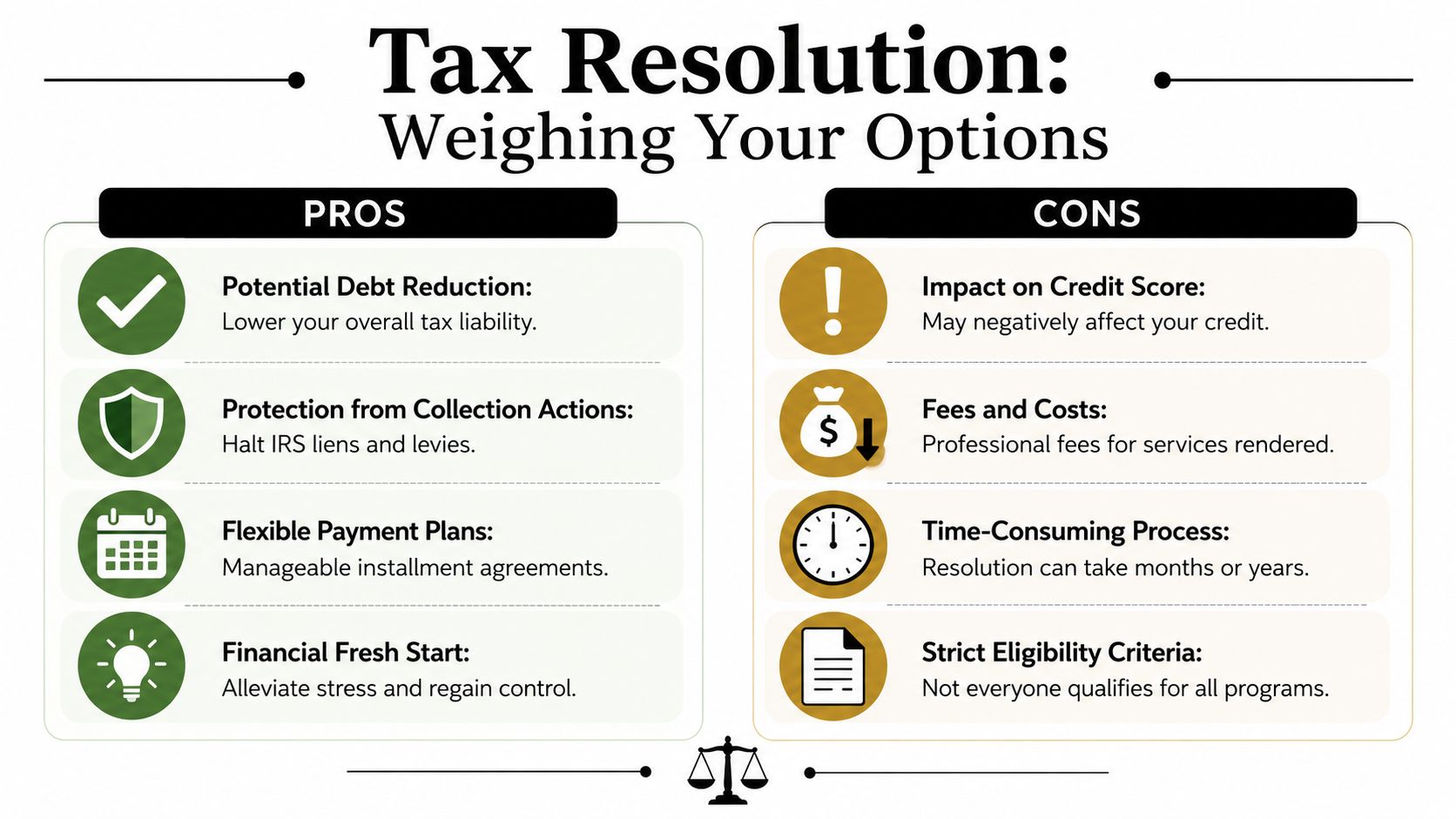
The upside of resolving tax debt goes far beyond numbers on a transcript. People sleep better when levy risk is reduced. Business owners make cleaner decisions when every deposit isn't shadowed by collection fear. Families stop treating the mailbox like a threat.
When debt relief removes a true debt overhang, the long-term impact can be meaningful. A long-run Danish study found that people granted court-ordered debt relief had 26% higher earned income, were 25 percentage points more likely to own a home, and saw those gains persist for at least 34 years after the decision, according to the IZA study on long-term outcomes after debt relief. That study wasn't about IRS programs specifically, but it supports a point I see often in practice: when overwhelming debt stops distorting a person's financial life, recovery can last.
Why tax resolution can be worth it
- Collection pressure may ease: The right program can stop or limit the practical chaos that comes with unresolved IRS debt.
- You get a defined path: Instead of reacting notice by notice, you move under a structured resolution framework.
- It can protect what matters: In many cases, preserving a business, paycheck, or home is the primary objective.
Why it can still be a bad fit
- The process is intrusive: Real resolution requires forms, records, disclosures, and consistency.
- Not every option is available to every taxpayer: A strong income stream may help with a payment plan but hurt an offer.
- Professional help costs money: Good representation isn't free, and bad representation can waste both time and money.
For some people, bankruptcy belongs in the comparison set. If you're weighing that option, this overview of whether Chapter 13 bankruptcy is right for you is a useful complement to tax-specific analysis, especially when the debt picture includes more than taxes.
Relief is valuable, but the process only works when the solution matches the facts. A good tax resolution plan is built from documents and cash flow, not slogans.
Tax Resolution vs Bankruptcy A Critical Comparison
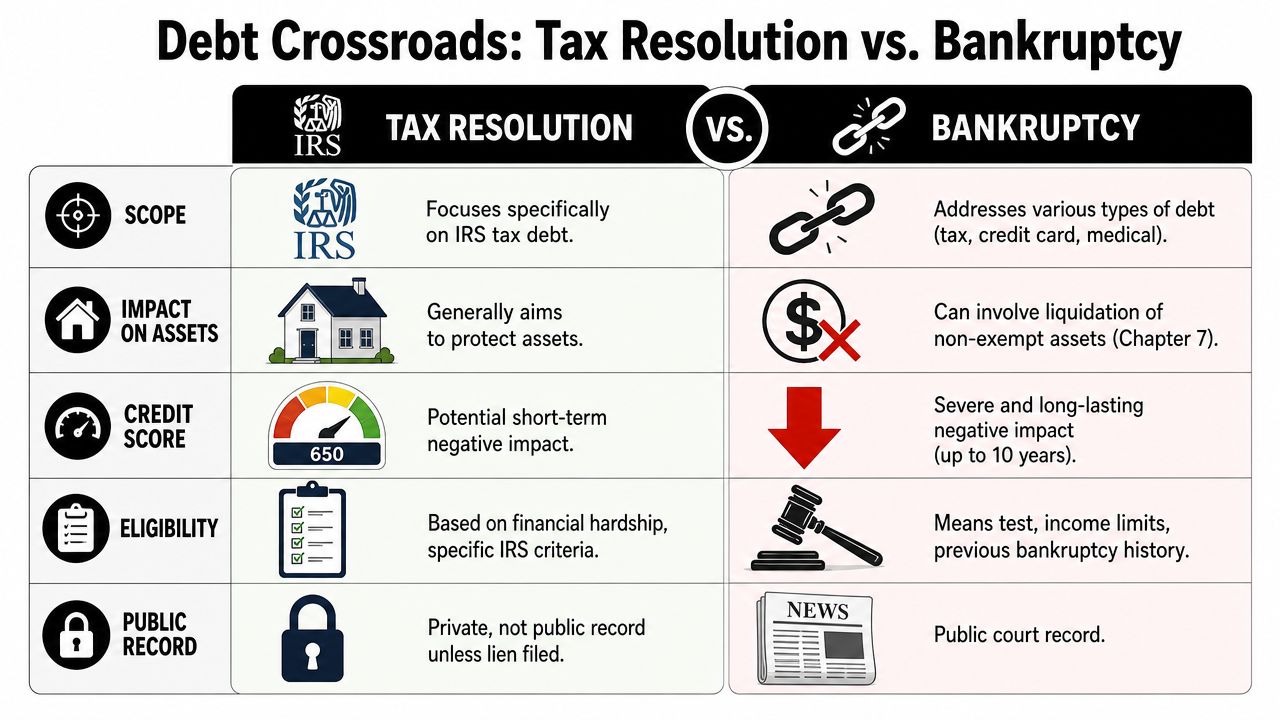
Tax resolution and bankruptcy overlap, but they aren't substitutes. One focuses on negotiating with the taxing authority under tax law and collection procedure. The other is a court-supervised insolvency process that can address a wider range of debts.
For some taxpayers, bankruptcy is more powerful. For others, it's the wrong tool because the tax debt is too new, the filing history is incomplete, or the primary goal is managing the IRS while preserving assets and operations.
Where debt settlement and tax resolution part ways
A lot of confusion comes from people blending consumer debt settlement with tax resolution. They are not the same. Consumer settlement programs often tell people to stop paying creditors so accounts become more negotiable. According to the National Consumer Law Center, participants in those programs often face more collection activity, and average credit scores reportedly fall by 161 points within six months of enrollment, as described in the NCLC issue brief on debt settlement risks and alternatives.
That matters because many taxpayers search for debt resolution and end up hearing advice designed for credit card defaults, not IRS cases.
Bankruptcy may be better when the whole debt picture is broken
If tax debt is only one part of a much larger financial collapse, bankruptcy may provide broader relief. It can address credit cards, medical debt, judgments, and other liabilities in one court process. Some tax debts may be dischargeable in some circumstances, but that analysis is technical and fact-specific. Filing dates, assessment timing, return issues, and the type of tax all matter.
By contrast, tax resolution is narrower but often more targeted. If your central problem is the IRS, and you're trying to preserve a business, a payment stream, or specific assets, an IRS-focused approach may be cleaner and less disruptive.
A practical side-by-side view
- Scope of debt: Bankruptcy can cover many kinds of debt. Tax resolution targets tax obligations.
- Asset treatment: Some bankruptcy cases put non-exempt assets at risk. Tax resolution often aims to work around the problem without liquidation.
- Privacy: Bankruptcy is a court filing. IRS resolution is generally administrative unless a lien or related proceeding puts something in the public record.
- Best use case: Bankruptcy can make sense when the entire balance sheet has failed. Tax resolution makes more sense when the tax problem is severe but still manageable through compliance and negotiation.
Chapter 13 also deserves serious attention in the right case. The same NCLC brief discusses NBER evidence showing Chapter 13 was associated with a $5,562 increase in annual earnings, a 1.2 percentage-point reduction in five-year mortality, and a 19.1 percentage-point reduction in five-year foreclosure rates. That doesn't mean bankruptcy is always better. It means the right structured legal process can outperform improvised debt fixes.
Warning Signs in the Debt Resolution Industry
The tax resolution industry has good professionals in it. It also has companies that sell hope first and analysis later. Those are the ones that usually cause the most damage.
The pattern is familiar. A salesperson says you may qualify to settle for pennies on the dollar before reviewing transcripts, filing history, current compliance, or your actual finances. Then comes a large fee quote and pressure to sign quickly.

What should make you pause
- Upfront fee demands before real work: The FTC warns against companies that charge fees before a debt is settled, and industry data showed completion rates could run as low as 35% to 50% in debt settlement programs, as described in the FTC workshop material on debt settlement outcomes. Tax cases are different from consumer settlements, but the warning sign is the same. Paying heavily before anyone has established eligibility is dangerous.
- Guaranteed outcomes: No honest professional can guarantee an Offer in Compromise, penalty removal, or collection hold without reviewing facts.
- One-size-fits-all pitches: The taxpayer with payroll tax exposure needs a different strategy than the retiree on fixed income or the contractor with unfiled returns.
- Pressure to ignore the details: If a company doesn't care whether returns are filed, whether the debt is assessed correctly, or whether you can stay compliant, that's a problem.
Why analysis has to come first
The IRS doesn't grade effort. It grades financial reality and compliance. A real resolution plan begins with transcripts, account history, required filings, income sources, necessary expenses, assets, and collection risk.
If you want to see how the IRS itself has warned taxpayers about blanket settlement marketing, this discussion of OIC mills that promise an Offer in Compromise for everyone is worth reading.
If someone promises a settlement before asking what returns are missing, what you earn, or what you own, they're selling a script, not solving a tax problem.
How to Decide If Tax Resolution Is Right for You
An IRS notice lands in the mail, cash flow is already tight, and the question starts sounding simple: should you settle this debt or look for another way out? For tax debt, that question turns on facts the IRS cares about, not the sales language used in the consumer debt world.
Start with the nature of the problem. Credit card debt, medical bills, and personal loans follow one set of rules. IRS debt follows another. The government can file liens, levy accounts, keep refunds, and demand current filing and payment compliance before it gives meaningful relief. That is why the right question is not whether debt resolution sounds good in general. The right question is whether a tax resolution process fits your actual IRS exposure.
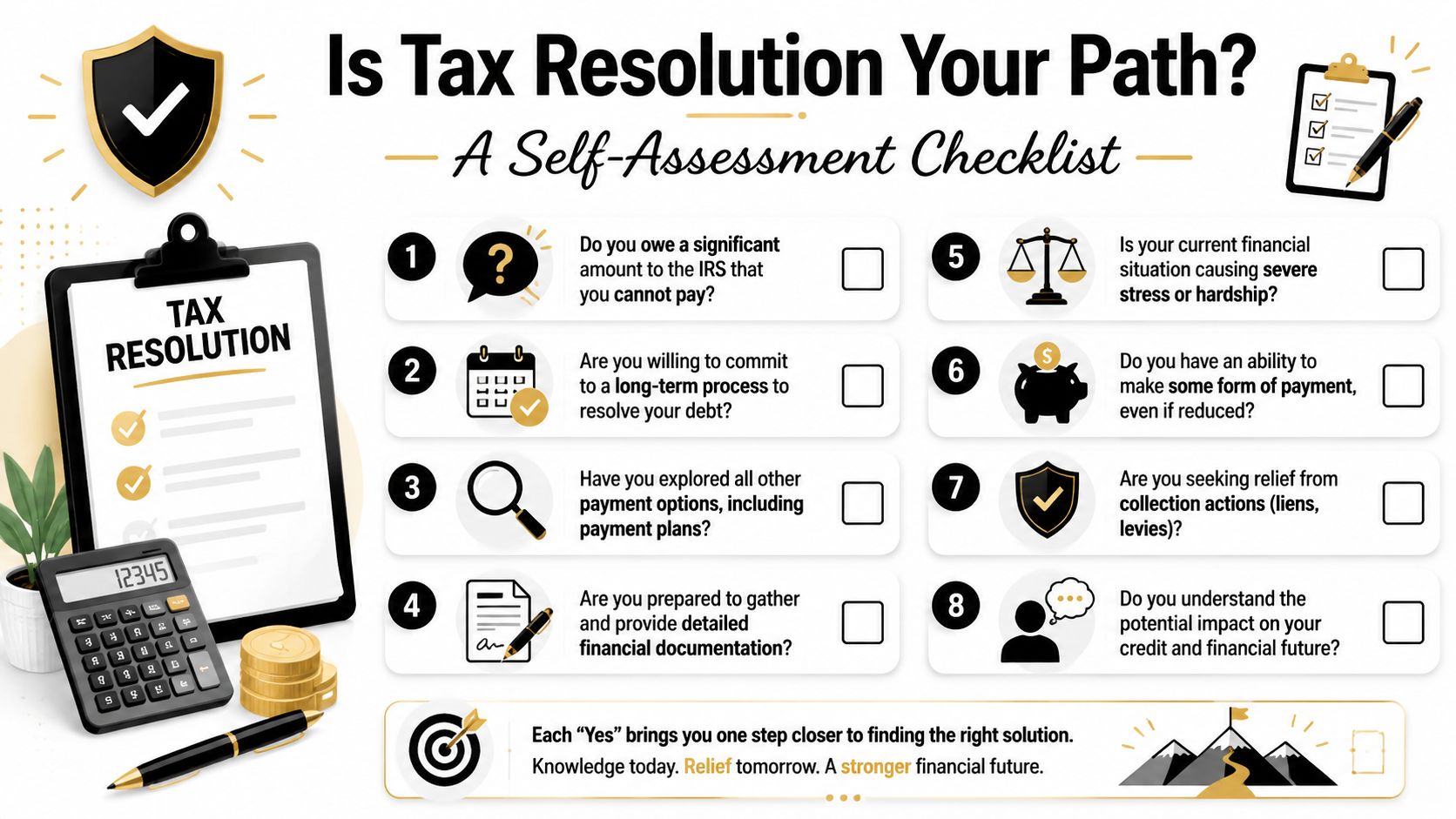
A useful self-check includes five points:
- What debt is driving the problem: If the pressure is coming mainly from the IRS or state tax agency, use a tax-specific analysis.
- Whether returns are filed: Missing returns can block relief or distort the amount owed.
- Whether the balance is accurate: Old assessments, substitute returns, or missed payments sometimes make the account look worse than it is.
- What your finances show on paper: IRS cases are decided with records, not rough estimates.
- Whether the debt is disrupting life or business: Wage levies, bank levies, payroll tax issues, and repeated notices usually mean the case needs prompt attention.
Two judgment calls matter more than anything else.
First, can the debt reasonably be paid over time without causing ongoing damage? If yes, an installment agreement may be the cleanest answer. If no, then the analysis shifts to hardship status, compromise, penalty relief, or, in some cases, bankruptcy review. Those are very different paths, and choosing the wrong one wastes time and money.
Second, can you stay compliant going forward? I tell clients this often because it decides many cases. A person who can resolve old tax debt but keeps falling behind on new filings or deposits usually will not keep the relief for long. For businesses, especially those with payroll tax issues, that risk is even higher.
If you need a practical starting point, this guide on how to settle tax debt with the IRS explains how the process works and what the IRS typically requires.
The goal here is not to chase the word "settlement." It is to choose the option that matches your income, assets, filing status, and collection risk. That is what makes tax resolution a good idea in some cases, and a costly distraction in others.
Your Next Step Taking Control of Your Tax Debt
Tax resolution is a good idea when it solves the right problem in the right way. If you're dealing with IRS debt, that usually means identifying exactly what you owe, getting compliant, and choosing the program that fits your income, assets, and risk level.
It is not a good idea to treat tax debt like ordinary consumer debt. It is not a good idea to pay a large fee because someone used the words "settle" or "fresh start." It is not a good idea to guess.
What to do next
- Get the facts first: Pull notices, transcripts, filed returns, and business records.
- Separate tax debt from other debt: If most of the pain is tax-related, keep the analysis tax-specific.
- Look at all available paths: Settlement is only one possibility. Payment plans, hardship status, penalty work, and bankruptcy review may all belong in the conversation.
- Act before collection pressure escalates: Waiting rarely improves bargaining position with the IRS.
If you're trying to understand the mechanics of resolving an IRS balance, this guide on how to settle tax debt with the IRS is a practical next read.
Some situations need qualified legal help quickly. That includes payroll tax debt, Trust Fund Recovery Penalty exposure, active levies, audits tied to proposed assessments, and any case with potential fraud or criminal concerns. In those situations, the cost of waiting can be much higher than the cost of getting real advice.
The first step shouldn't be commitment. It should be analysis. Once you know your actual exposure and your actual options, the fear usually drops, and the path gets much clearer.
If you want a clearer answer to whether tax resolution makes sense in your case, start with a case-specific review instead of a sales call. Attorney Stephen A Weisberg focuses on IRS and state tax debt matters for individuals, business owners, and companies, and offers a free tax debt analysis so you can understand your options before paying for representation.


