Is Audit Defense Worth It? a Practical Guide for Taxpayers
Is audit defense worth it? Learn what audit defense covers, what it leaves out, typical costs, and when a tax attorney beats a prepaid plan.
In this article
- The Question Most People Ask the Wrong Way
- Ask the right three questions
- What Audit Defense Actually Is
- Who usually sells it
- When coverage starts
- What Audit Defense Covers and What It Leaves Out
- The part it does well
- The part it does not cover
- Who Sells Audit Defense and How the Providers Differ
- Three models, three different ceilings
- Why credentials matter
- The Cost and Break-Even Math of Audit Defense
- Where the equation flips
- When Audit Defense Makes Sense and When It Does Not
- Makes sense
- Does not make sense
- Better Alternatives and What to Ask Before You Buy
- Questions to ask before you pay
Audit defense is worth it only when your audit probability, return complexity, or potential exposure justifies the fixed fee. For most simple W-2 filers, paying $40 to $60 a year for protection they'll probably never use is a poor bet.
Popular advice gets this backward. People ask whether audit defense is “good to have” in the abstract, when the core question is whether the product matches the kind of IRS problem they'd encounter. If your return is simple, your records are clean, and you're not already under exam, fear-based upsells are doing the selling, not the math.
A better starting point is to ask three blunt questions. How likely is an audit for your return profile, what would professional help cost if one happened, and would your issue be a simple letter audit or something more serious. For small business owners who want a practical primer on getting organized before the IRS contacts them, audit preparation advice for small businesses is a useful companion read.
Practical rule: if the plan only saves you from inconvenience, skip it. If it may help you limit assessments, penalties, or a bad conversation with the IRS, then it deserves a hard look.
The Question Most People Ask the Wrong Way
People love to ask, “Is audit defense worth it?” That's the wrong frame because it treats every return like the same risk. A W-2 employee with a standard deduction is playing a different game from a self-employed contractor, a six-figure owner, or someone who already got an IRS letter.
The issue is whether you're buying coverage for a problem you're unlikely to have, or a tool for a problem that could get expensive fast. For straightforward filers, the historical audit rate is extremely low. One source puts the overall individual audit rate at 0.4%, and another says returns under $200,000 face about 0.2% risk, roughly 1 in 500 returns, which makes a yearly add-on hard to justify for a typical wage earner. The economics only improve when the return itself becomes riskier or more complex. That's why fear-driven marketing works so well, it focuses attention on the downside without respecting the odds.
Ask the right three questions
First, ask how likely your return is to trigger scrutiny. A simple wage return with clean reporting sits in a different lane from a Schedule C return with large deductions or a business structure that invites questions. Second, ask what help would cost if the IRS did show up. Third, ask what kind of issue you're trying to solve, because a correspondence letter is not the same thing as an escalated dispute.
If you keep those three questions in view, the answer gets less emotional and more rational. That's the point. You're not buying peace of mind in the abstract, you're buying help for a specific type of audit exposure. A product that looks cheap can still be a waste if the event you're protecting against is remote.
What Audit Defense Actually Is
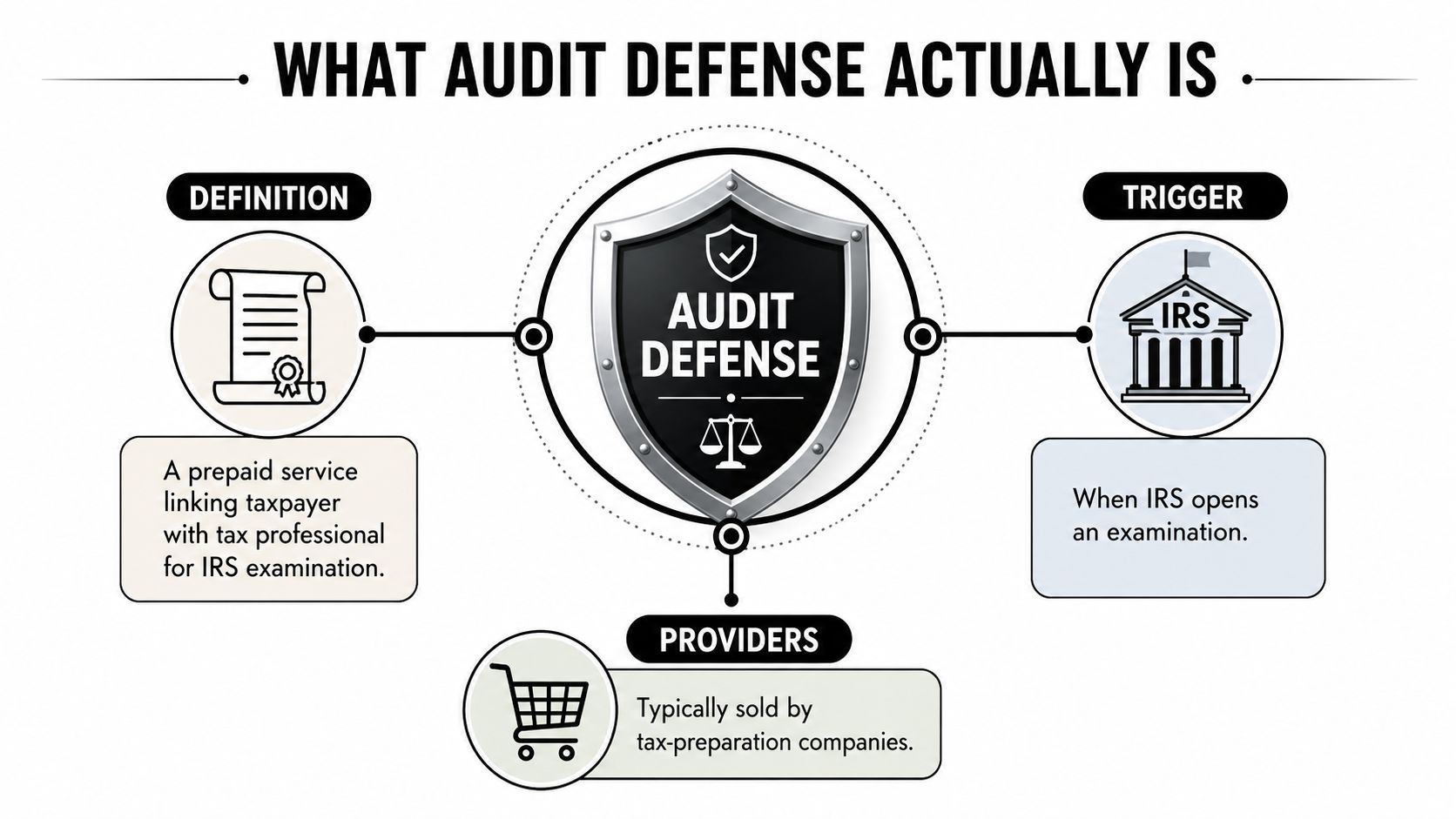
Audit defense is a prepaid service that connects you with a tax professional after the IRS opens an examination. In plain English, you pay now so someone will respond later if the IRS sends a notice that falls within the plan's scope. The product is usually sold as an add-on, not as full-blown controversy representation.
Who usually sells it
You'll see it bundled in three places. Tax-preparation software vendors sell it as an extra during filing. Insurers and membership programs package it like a warranty-style perk. Some CPAs, enrolled agents, and tax attorneys offer similar protection on a standalone basis, but the structure still tends to be narrower than full representation.
The easiest comparison is an extended warranty. You're not buying a rebuilt engine, you're buying help if a specific problem happens within a defined lane. That's why the sales pitch sounds bigger than the product. The product is not “anything tax-related,” it's usually a pre-set response service for an IRS examination that starts after filing.
When coverage starts
Coverage generally kicks in when the IRS opens an examination and sends a notice. That means the trigger is procedural, not emotional. If no exam exists, there's nothing for the plan to defend.
For a basic overview of the process and how taxpayers usually prepare for a notice, the IRS-facing checklist at Weisberg's audit preparation guide is the right kind of read. It keeps the focus on records, response discipline, and not making the mistake of treating an IRS letter like junk mail.
What Audit Defense Covers and What It Leaves Out
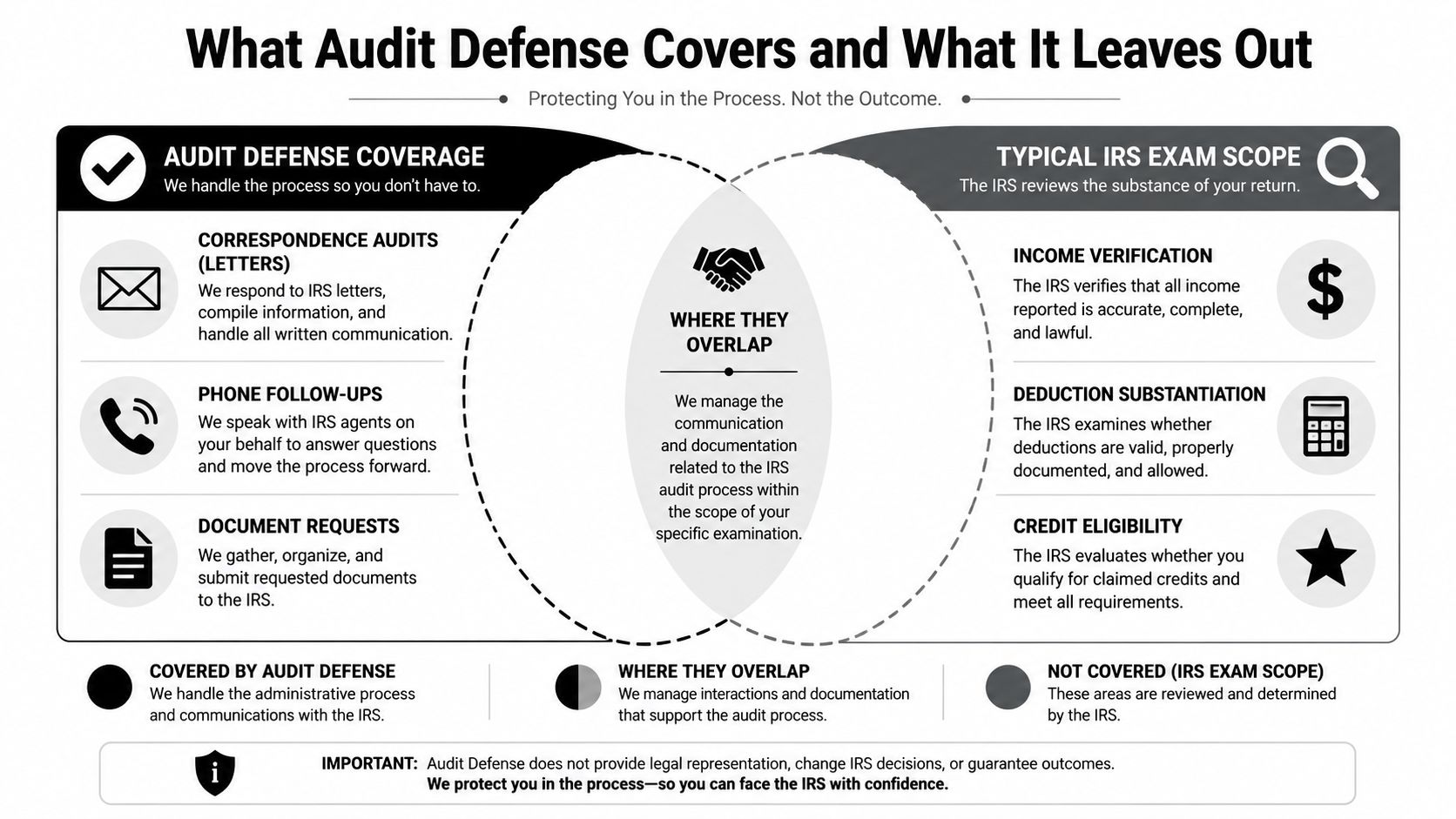
Audit defense usually handles the messy but narrow middle of an IRS exam. That means correspondence-level representation, responses to document requests, and help managing letters or follow-up questions. In practice, it's built for the kind of back-and-forth that happens when the IRS wants records, explanations, or a clarified position.
The part it does well
This is the part most buyers need if they get a routine notice. A representative can organize the paperwork, respond in a controlled way, and keep you from freelancing your way into a worse outcome. That matters because the IRS often cares less about your frustration than whether the records line up.
For taxpayers who want a broader sense of how IRS letter handling works in practice, IRS audit help guidance is useful context. It reinforces the point that the first response matters, especially when the issue is still in correspondence territory.
The part it does not cover
The ceiling matters more than the brochure. Most prepaid plans do not cover Tax Court litigation, criminal or civil fraud matters, bookkeeping cleanup, or amended-return preparation. They also don't pay the tax bill itself, and they don't erase back taxes, interest, or penalties.
Audit defense is a narrow tool. If the case has already grown teeth, don't confuse “notice response” with real controversy representation.
That limitation is why the product can feel reassuring right up until the point it matters most. If the IRS escalates beyond document exchange into a field exam or a serious dispute, the cheap add-on can stop being the right tool. At that point, you're no longer shopping for an accessory, you're shopping for a professional to manage exposure.
Who Sells Audit Defense and How the Providers Differ
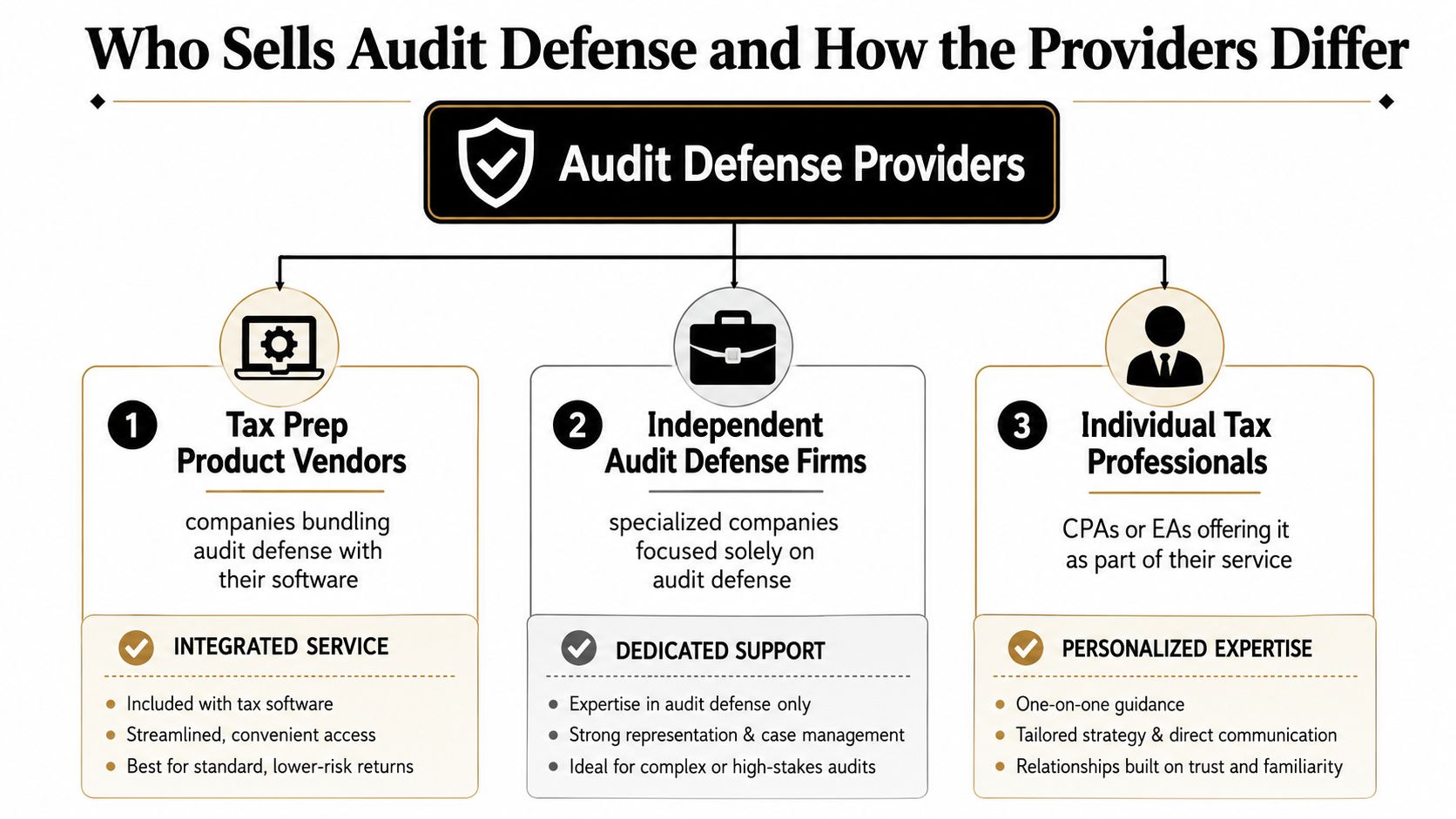
The label on the product matters less than the person who ends up handling your case. A tax-prep vendor can sell you a plan, but the representative may be a generic support team. An independent firm may offer a more focused defense function. A CPA, enrolled agent, or tax attorney may give you a direct line to the person who can think through the problem.
Three models, three different ceilings
| Provider type | How it usually works | Where it tends to fit |
|---|---|---|
| Tax prep product vendors | Bundled with software or filing add-ons | Simple returns and routine letters |
| Independent audit defense firms | Dedicated defense service with narrower scope | Taxpayers who want more structured support |
| Individual professionals | CPA, EA, or tax attorney handling the matter directly | Complex facts, higher stakes, or escalating issues |
The difference is not cosmetic. If you're buying a bundle, ask who responds when the IRS calls, not just who sold the product. If the answer is a scripted help desk, you're not buying personalized representation. You're buying process handling.
Why credentials matter
A tax attorney, CPA, and enrolled agent each bring a different toolkit. For an ordinary correspondence audit, any competent representative may be enough. For a case that could move into broader controversy, you want someone who can stay with the matter as it gets harder, not someone who disappears at the first escalation point.
That's also why I tell people to read the fine print like a skeptic, not a shopper. Coverage language often sounds broader than it is. If the provider can't explain who steps in, what happens on escalation, and where the service stops, you don't have a defense plan, you have marketing copy.
The Cost and Break-Even Math of Audit Defense
The math is straightforward. Consumer plans are commonly priced around $40 to $60 per return, and one independent guide says a $49.99 plan breaks even when audit risk exceeds roughly 1.33% (Sequenxa audit defense costs and limits). If your chance of a notice is well below that level, the fee is hard to justify on cost alone.
A standard wage earner usually does not reach that line. The earlier audit-rate figures, 0.4% overall and about 0.2% for returns under $200,000, sit below the break-even point for a low-cost plan. For a clean, simple return, you are paying to cover a low-probability event that may never happen. That is self-insurance territory, not a product you need to buy on impulse.
Where the equation flips
The calculation changes once the return carries more exposure. One source says the IRS audited 1 out of every 44 taxpayers earning over $1 million in 2022, more than 12 times the average rate, and another says taxpayers above $500,000 can face audit rates around 0.6% to 2.0%+ depending on income level (Sequenxa tax audit defense worth it). That is a different risk class, and the pricing starts to make more sense.
The downside also gets larger when the file is messy. One source reports the IRS conducts roughly 580,000 audits per year, with individual adjustments averaging $12,000 and accuracy-related penalties adding 20% on top of tax owed (Sequenxa audit defense costs and limits). Defense professionals often cut penalties by 50% to 80%. Those figures do not mean everyone should buy audit defense. They mean higher-risk taxpayers have a real economic reason to look at it seriously.
| Profile | Plan Cost | Audit Risk | Expected Cost Without Plan | Break-Even Verdict |
|---|---|---|---|---|
| Simple W-2 filer | About $40 to $60 | About 0.2% to 0.4% | Usually a few hundred dollars if anything happens | Usually not worth it |
| Higher-income filer | About $40 to $60 | About 0.6% to 2.0%+ | Higher exposure to proposed adjustments and penalties | Often worth evaluating |
| Complex return or business owner | About $40 to $60 | Risk depends on facts and filing profile | Representation costs can rise quickly if the case expands | Often worth serious consideration |
When Audit Defense Makes Sense and When It Does Not
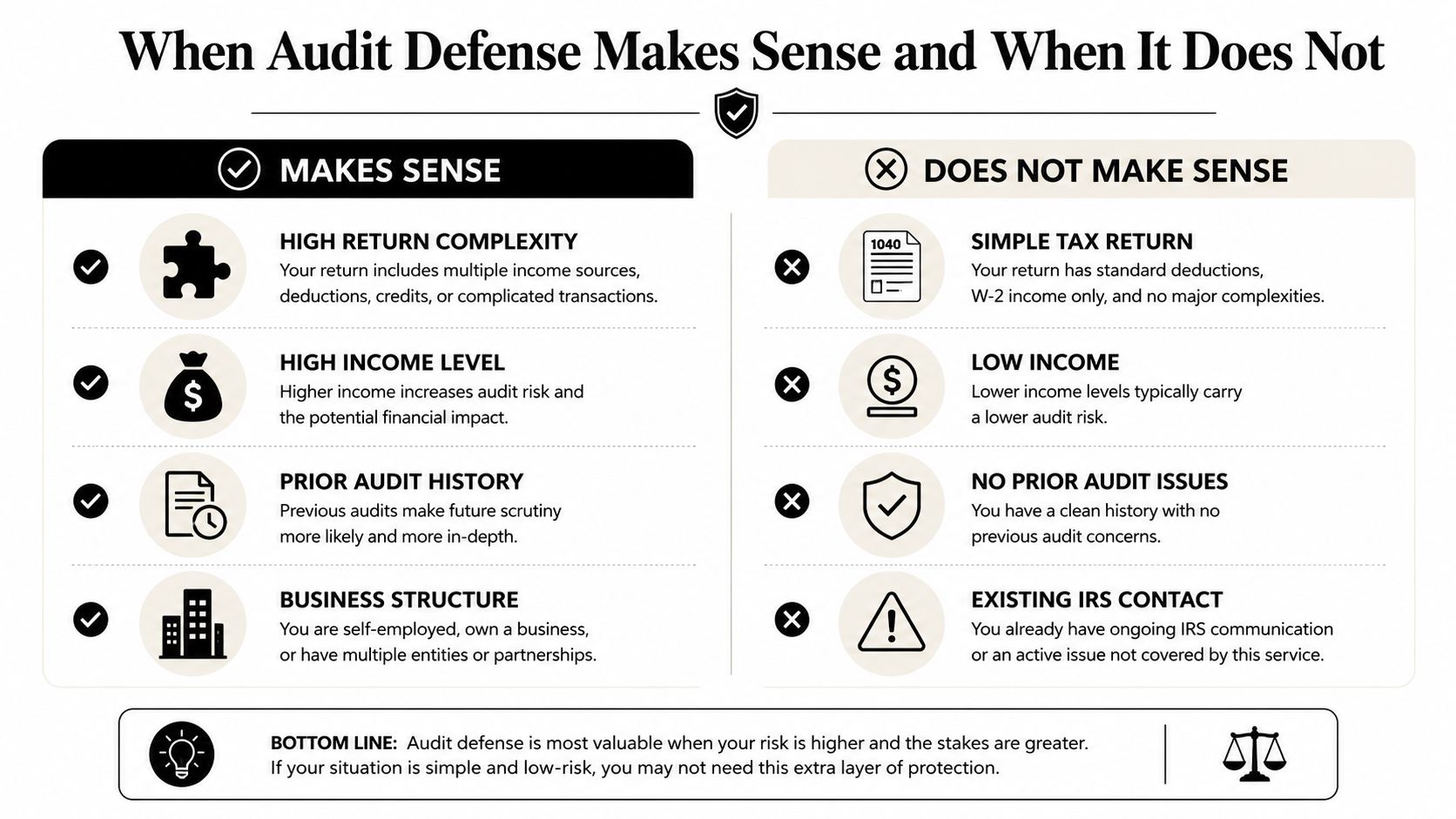
This is the practical filter I use with clients. If your return is simple, your records are clean, and no one from the IRS is already talking to you, audit defense is usually unnecessary. If your return is messy, your income is high, or the tax issue has already surfaced, the answer changes fast.
Makes sense
- High return complexity. If you have business deductions, multiple entities, or mixed income sources, a notice can turn into a document fight quickly.
- High income level. The IRS focuses more attention on higher-dollar returns, and the earlier numbers show why the risk profile changes.
- Prior audit history. A prior exam can increase your need for a measured response if the IRS comes back.
- Business structure. Self-employment and small business filings bring more moving parts, so the plan has more to do.
For a compliance-focused perspective on selection thresholds and risk screening, the Action Accountants Limited compliance guide is worth reading alongside the math.
Does not make sense
- Simple tax return. A clean W-2 return with standard deductions usually doesn't need paid protection.
- Low income. If your audit odds are already low, the fixed fee is mostly buying comfort.
- No prior audit issues. If the IRS has never contacted you and your filing is straightforward, don't let fear sell you a warranty you won't use.
- Existing IRS contact. If the problem is already active, a prepaid plan may be the wrong tool entirely.
One more point matters here. If the issue is not hypothetical but live, review what tends to trigger tax audits and compare that profile against your own return. The answer should be based on the actual problem, not the sales pitch.
Better Alternatives and What to Ask Before You Buy
If you already have an IRS notice, trust fund recovery penalty exposure, or a complicated return, stop shopping for a blanket protection product and get a real Tax Debt Analysis from a tax attorney. A prepaid plan is a weak substitute for a live issue that may need strategy, negotiation, or escalation. That's especially true when the matter has already left the safe zone of routine correspondence.
For people trying to evaluate whether they need direct professional help instead of a bundle, how to find a good tax attorney is a smarter starting point than another upsell page. The right attorney should tell you what kind of matter you have, what level of representation it needs, and whether a prepaid product would be enough or plainly insufficient.
Questions to ask before you pay
- Who responds to the IRS notice? A named professional matters more than vague “expert support.”
- What credentials stand behind the plan? Ask whether the handling professional is a CPA, EA, or attorney.
- Does the same firm handle escalation? If the matter gets harder, you need to know who stays on it.
- What is excluded from coverage? If fraud, litigation, or existing audits are out, that should be clear before purchase.
- How is out-of-pocket help priced if the case expands? You need the cost of the next step, not just the teaser price.
My blunt recommendation is simple. Match the solution to the kind of IRS problem you have. If the issue is hypothetical and your return is routine, skip the add-on. If the issue is live or your return is complex, get an attorney's read before you buy anything else.
If you want a candid assessment of whether your IRS issue needs audit defense, a notice response, or something more aggressive, Tax Attorney Stephen A Weisberg can help you sort that out with a free Tax Debt Analysis. Visit Tax Attorney Stephen A Weisberg to get a direct evaluation before you spend money on the wrong kind of protection.


