IRS Wage Garnishment Help: How to Stop It Fast
Need IRS wage garnishment help? Learn how to stop or reduce a levy, qualify for exemptions, and get a free Tax Debt Analysis from a real attorney.
In this article
- Why a Wage Levy Is Different From Other IRS Actions
- How the IRS calculates what you keep
- Reading the Notices Before You Lose the 30-Day Window
- Use the notice chain as a deadline map
- Why the hearing request matters
- Building Your Financial Picture With Form 433
- What goes into the statement
- How the levy exemption changes the analysis
- Choosing the Option That Actually Stops the Garnishment
- The fastest paths depend on your facts
- Appeals, Collection Due Process, and the Taxpayer Advocate
- What Appeals actually evaluates
- Appeals and TAS serve different purposes
- Your Documentation Checklist and When to Hire a Tax Attorney
- Build the file by purpose
- Match the response to the urgency
You open your pay stub and see that your deposit is smaller than expected. Rent, groceries, utilities, and transportation costs haven't changed, but the IRS has started taking money before your paycheck reaches you. You need IRS wage garnishment help, and you need it quickly.
An IRS wage levy won't stop because you ignore the notice or wait for the next pay period. The fastest path is to identify the levy's legal status, protect any available hearing rights, document your actual household finances, and put a formal resolution in front of the IRS. Start with a free Tax Debt Analysis before making promises to the IRS or accepting a payment amount you can't sustain.
Why a Wage Levy Is Different From Other IRS Actions
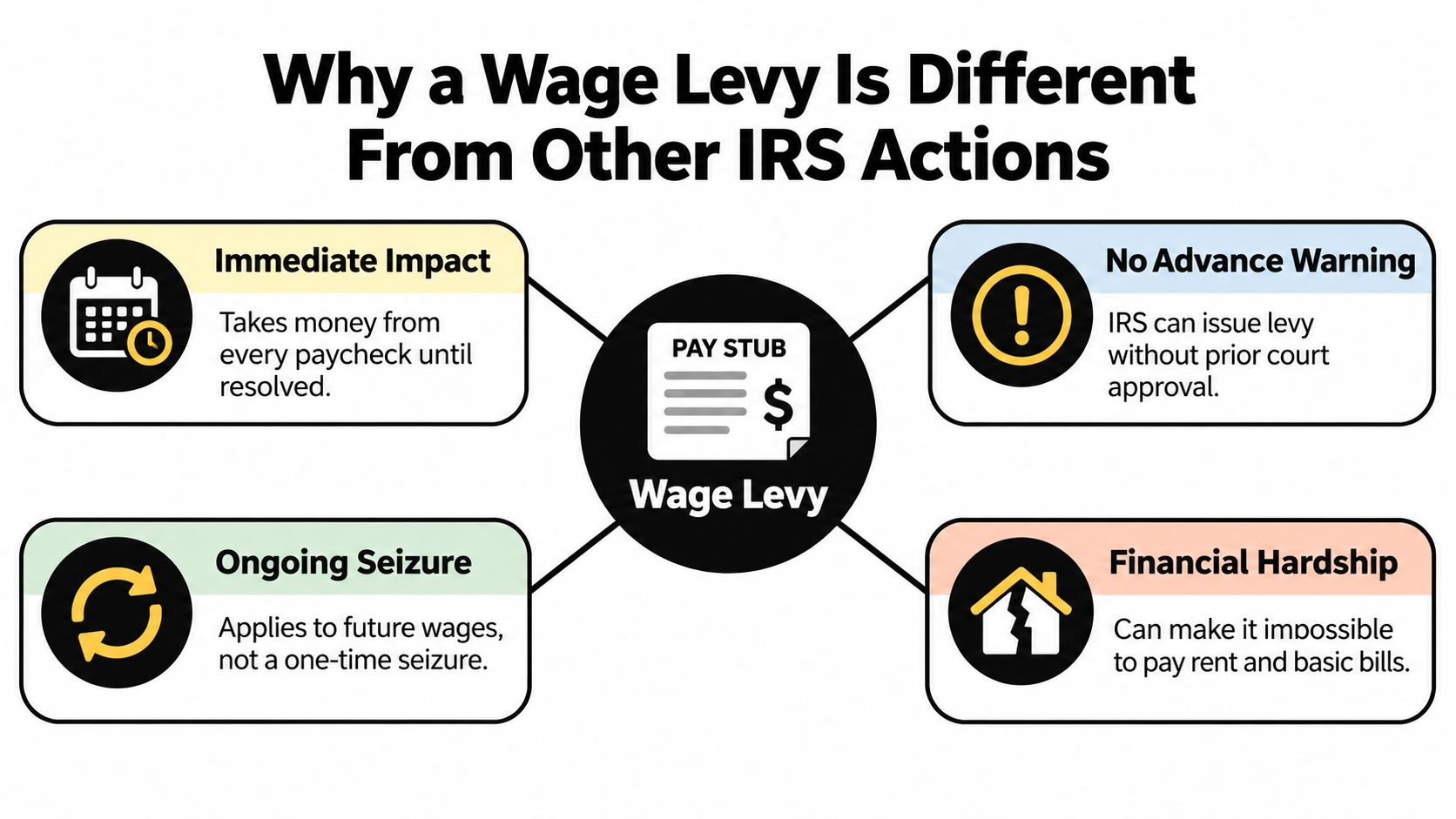
Your paycheck can shrink before you have time to adjust your budget. A lien may remain in the background, and a balance-due letter may sit unopened. A wage levy reaches your employer and changes the next payroll automatically. The IRS explains that a wage levy is a continuous collection action, so part of each paycheck may go to the government until the debt is paid, the levy is released, or another arrangement is established.
That difference determines how quickly you must act. This is not a one-time seizure that ends when funds are taken. After the employer receives the levy, payroll must withhold the required amount. Your employer cannot decide to stop it, and ignoring the levy will not produce a release. The IRS must issue the release or approve a resolution.
How the IRS calculates what you keep
The IRS does not take an arbitrary amount from every worker. Some wages remain exempt. The exempt amount depends on the standard deduction and a dependent-based calculation tied to the year the levy is served. Review how the IRS calculates the exempt amount from each paycheck before assuming payroll withheld the wrong amount.
Publication 1494 provides the exemption table for the protected base amount of weekly pay, based on filing status and dependents. Independent summaries of the 2026 Publication 1494 guidance report protected weekly amounts ranging from about $309.62 for a single filer with no dependents to $1,026.91 for married filing jointly with four or more dependents. Those figures come from the IRS payment plan resource and related Publication 1494 guidance. Your result depends on accurate household information and the applicable table.
The exemption protects part of your wages. It does not resolve the liability. If the remaining paycheck cannot cover basic living costs, document the hardship and present a formal alternative. A free Tax Debt Analysis should be your first move because it can identify whether a release, modification, or payment arrangement offers the fastest path to stopping the next reduction.
Practical rule: Do not ask payroll to interpret the levy. Ask the IRS to release or modify it, then give payroll the official release.
Private creditors follow a different process. Use this guide to protecting wages from creditors to separate ordinary garnishment issues from federal tax collection. For the IRS-specific mechanics, review IRS levy and garnishment procedures. DIY help can work when your records are complete and the levy is straightforward. Hire tax counsel when hardship evidence, inaccurate exemptions, multiple tax years, or urgent release action is involved.
Reading the Notices Before You Lose the 30-Day Window
The IRS usually communicates through a sequence of balance-due and collection notices before enforced collection becomes the central issue. The early notices often include CP14, the initial balance-due notice, followed by reminders such as CP501 and CP503. A CP504 warns that the IRS intends to seize assets if the balance remains unresolved.
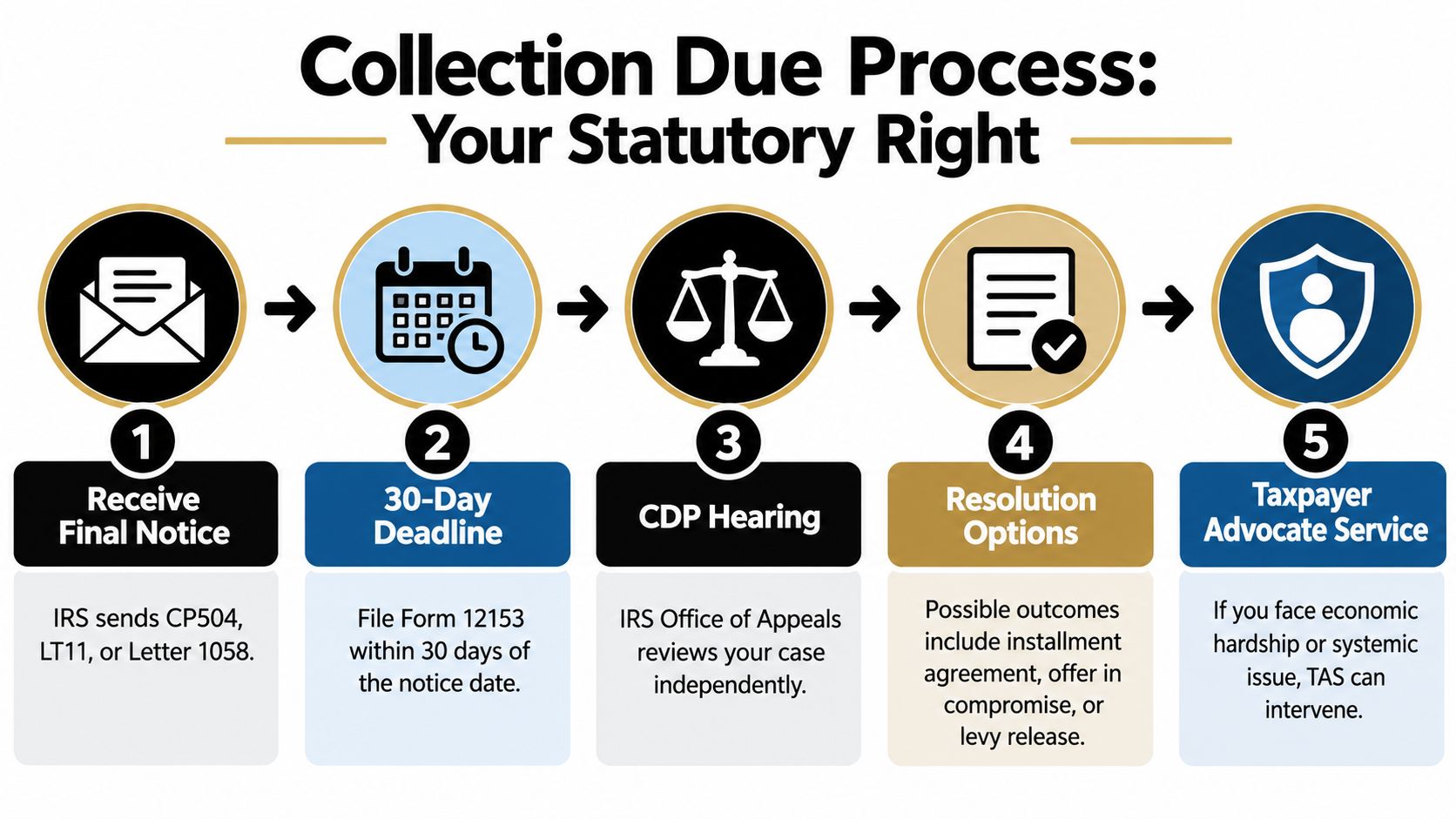
The notice that demands immediate attention is the LT11 or Letter 1058, titled the Final Notice of Intent to Levy and Notice of Your Right to a Hearing. The IRS says taxpayers generally have a 30-day Collection Due Process window after the levy notice to request an administrative hearing. Missing that deadline can eliminate the normal CDP route while the IRS continues collection activity.
Use the notice chain as a deadline map
| Notice | What It Means | Key Deadline |
|---|---|---|
| CP14 | The IRS has assessed a balance and requests payment | Review the balance and compliance immediately |
| CP501 | The IRS is reminding you that the balance remains unpaid | Check whether returns and payments are current |
| CP503 | The collection warning has escalated | Prepare a resolution before enforced collection |
| CP504 | The IRS warns of an intent to seize assets | Treat the matter as urgent |
| LT11 or Letter 1058 | Final Notice of Intent to Levy and hearing rights | Request a CDP hearing in writing within 30 days |
Look for the notice date, not the day you happen to open the envelope. Confirm the IRS telephone number printed on the notice and keep a complete copy, including the pages that explain hearing rights. If you call, state that an active or threatened levy is affecting your wages, identify the notice and its date, and ask what collection action is currently pending.
Don't make casual promises about payment. Don't guess about your ability to pay. If the deadline is approaching, send a written request for a CDP hearing using Form 12153 within the 30-day period, even if you haven't finished building your full financial package.
Why the hearing request matters
A timely CDP request gives Appeals an opportunity to review the proposed collection action. It can also create room to present a payment alternative, hardship position, liability dispute, or IRS procedural error. The IRS notice of intent to levy guidance provides additional context on why this notice deserves immediate attention.
The IRS also states that certain installment agreement requests generally suspend or prohibit levy activity while pending. That makes timing important. A pending request isn't the same as an approved resolution, so follow through until the IRS confirms the arrangement and the levy release.
Building Your Financial Picture With Form 433
A financial statement isn't a formality. It's the evidence the IRS uses to decide whether you can pay, whether a payment plan is realistic, or whether enforced collection would create hardship.
Consider a representative taxpayer who is a single parent with two children, earns $52,000, and owes $38,000 in payroll taxes and penalties. Those figures are a hypothetical example, not a reported case. The taxpayer's Form 433-A would need to show the complete household picture rather than only the paycheck affected by the levy.

What goes into the statement
For an individual, Form 433-A generally organizes the information the IRS needs about:
- Income: Wages, self-employment receipts, rental income, retirement income, and other regular sources.
- Household expenses: Housing, utilities, food, transportation, health costs, insurance, childcare, and required payments.
- Assets: Bank accounts, vehicles, real estate, investments, and valuable personal property.
- Debts: Secured loans, mortgages, vehicle financing, and other obligations relevant to cash flow.
A business generally uses Form 433-B. A sole proprietor may also need to present business income and expenses in a way that lets the IRS distinguish personal resources from operating funds.
The IRS applies allowable expense standards in many categories. That means your actual spending may not always be accepted dollar for dollar. Mortgage costs, utilities, transportation, and other household expenses need to be documented and presented within the applicable collection standards.
How the levy exemption changes the analysis
The wage exemption under Publication 1494 addresses the amount protected from the levy. The Form 433 analysis addresses the broader question of monthly ability to pay. Those are related, but they aren't interchangeable.
If the protected wage amount is insufficient to cover allowable living expenses, the taxpayer may have a hardship argument for a levy release or Currently Not Collectible status. If the financial statement shows some disposable income, the IRS may push toward an installment agreement instead.
The IRS may verify bank statements, pay stubs, tax returns, and other records. Don't hide accounts, omit income, or inflate expenses. A false statement on a tax document can create serious legal exposure under 26 U.S.C. § 7206, so accuracy matters more than making the numbers look favorable.
For additional background on preparing this type of package, see the Form 433-F guide for resolving an IRS collection case. If an amended return affects the balance, you can also find your amended return status with Cloudvara before presenting a final resolution proposal.
Submit the completed financial statement with a levy release or reduction request whenever possible. A bare claim of hardship is weak. A supported Form 433 package gives the IRS something it can evaluate.
Choosing the Option That Actually Stops the Garnishment
The best tax resolution isn't always the one that reduces the balance the most. When your paycheck is already being levied, the first question is how quickly the option can stop enforced collection.
The IRS states that a wage levy isn't an informal installment plan. If you become filing compliant and current with withholding or estimated payments, you should establish a formal installment agreement rather than treating payroll withholding as the payment arrangement. The IRS Internal Revenue Manual explains this distinction.
The fastest paths depend on your facts
Installment agreement. This is usually the cleanest answer when you can afford a sustainable monthly payment and your filing and payment compliance is current. A levy is generally released after the agreement is approved. Partial-payment, and guaranteed arrangements have different requirements, and the IRS may require financial documentation for the structure that fits your case.
Currently Not Collectible. If the levy prevents you from paying basic living expenses, request hardship status using the appropriate financial package and, where applicable, Form 53. CNC can pause active enforcement, but it doesn't erase the liability, and interest continues to accrue. It's a defensive solution when any payment would cause immediate hardship.
Offer in compromise. An OIC can be based on doubt as to collectibility or, in limited circumstances, effective tax administration. Collection activity is generally suspended while the IRS evaluates a properly submitted offer, and an accepted offer stops the levy under its terms. This is not a quick form to file casually. Incorrect financial data can delay the case and leave the levy problem unresolved.
Penalty relief. First-time abatement or reasonable-cause relief can reduce the balance. That may make a payment plan more manageable, but penalty relief alone doesn't guarantee a levy release. Treat it as a supporting strategy unless the IRS confirms a separate collection resolution.
| Option | Forms Used | Stops Levy? | Typical Time to Release | Best For |
|---|---|---|---|---|
| Installment agreement | Payment plan request, potentially Form 433 | Generally, once approved | Depends on approval and case complexity | Taxpayers with sustainable disposable income |
| Currently Not Collectible | Form 433 package and Form 53 where applicable | Can pause enforcement after approval | Depends on hardship documentation and IRS review | Taxpayers unable to meet basic living expenses |
| Offer in compromise | Form 656 and supporting financial information | Generally during evaluation, and if accepted | Depends on completeness and IRS evaluation | Taxpayers whose financial facts support compromise |
| Penalty abatement | Applicable penalty relief request | Not by itself | Doesn't independently control levy release | Taxpayers with qualifying reasonable cause or first-time relief |
For self-employed taxpayers, the financial analysis can be more complicated because business cash flow, payroll obligations, and personal resources overlap. Don't assume a Form 433 submission automatically delays seizure. A self-employed taxpayer may still pursue an OIC, appeal, payment plan, or hardship request, but the request must address current compliance.
My practical preference in severe hardship cases is to seek Currently Not Collectible status first, then pursue penalty relief if the facts support it. That combination can protect immediate cash flow while reducing the amount that later needs to be resolved. It's not a substitute for a complete plan, but it can be the fastest defensive move when the levy is making housing, food, or medical care unaffordable.
Appeals, Collection Due Process, and the Taxpayer Advocate
A final notice can trigger your right to a Collection Due Process hearing. The hearing is not a courtesy call with a revenue agent. It's an administrative review by the IRS Office of Appeals, where you can challenge the proposed levy or present a collection alternative.
The critical filing is Form 12153, submitted within the 30-day period stated in the final notice. Once the request is timely filed, levy activity is generally suspended while Appeals considers the case. That suspension gives you a chance to submit financial records and make a credible proposal, but it doesn't excuse missing returns or failing to make current tax payments.
What Appeals actually evaluates
Appeals officers generally focus on whether the IRS followed required procedures and whether the proposed collection action balances efficient collection with your legitimate ability to pay. Your submission should address specific points.
- Liability: Explain a calculation error or dispute over whether the assessment is correct.
- Collection alternatives: Show why ACS rejected, overlooked, or mishandled a viable installment agreement, CNC request, or OIC.
- Financial hardship: Document how the levy prevents payment of basic living expenses.
- Exemption errors: Show that the IRS failed to apply accurate filing-status or dependent information under Publication 1494.
- Compliance failures: Identify missing returns, incorrect withholding treatment, or other IRS processing problems.
Submit tax returns, pay stubs, bank records, Form 433 materials, expense proof, and a proposed resolution before the hearing. A clear written package often matters more than an emotional explanation.
Appeals and TAS serve different purposes
The Taxpayer Advocate Service is not a replacement for CDP. TAS helps taxpayers facing economic hardship, significant IRS delays, or systemic problems. Appeals handles the statutory hearing and reviews the collection action. If your levy is active and the CDP deadline is open, file the hearing request first.
A hearing may be conducted by telephone or in another available format. The format matters less than the quality of the evidence and the specificity of the proposal. If Appeals issues an unfavorable determination, judicial review may be available in Tax Court, subject to the applicable rules and deadlines.
Your Documentation Checklist and When to Hire a Tax Attorney
Good IRS wage garnishment help starts with documents that prove what you're saying. Gather the records before you call, because a complete package gives the IRS a basis to release, modify, or replace the levy.
Build the file by purpose
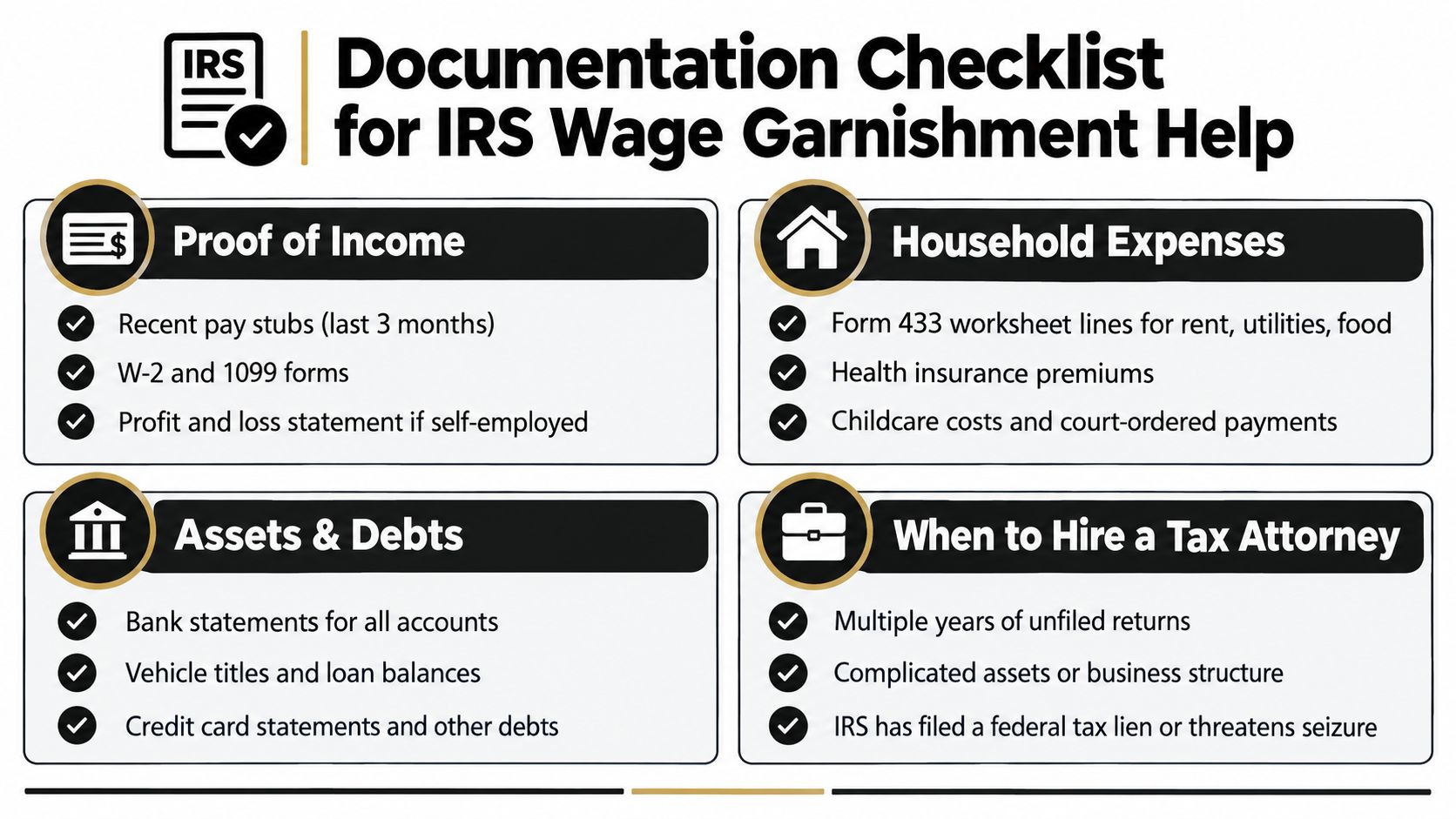
Income records should include recent pay stubs, W-2s, 1099s, retirement statements, and, for self-employed taxpayers, a current profit-and-loss statement. Include irregular income instead of pretending it doesn't exist.
Household costs require more than a handwritten total. Collect rent or mortgage records, utility bills, insurance invoices, medical expenses, childcare bills, transportation costs, and court-ordered payments. Organize them around the categories used in the Form 433 worksheet.
Assets and debts include bank statements for every account, vehicle titles and loan balances, real estate information, investment statements, credit card statements, and secured debt records. The IRS may compare these records with return information and financial disclosures.
Family and hardship evidence can include dependent information, medical bills, layoff records, divorce decrees, and documents showing a sudden loss of income or unavoidable expense.
Match the response to the urgency
Some levy matters can move quickly when the hardship is clear and the documents are complete. A simple payment plan may be established promptly when the taxpayer qualifies and the IRS accepts the request. A full financial resolution, such as a detailed OIC or complex business case, can take substantially longer.
Don't rely on promised timing from a salesperson. Ask what specific filing will be made, what information is missing, and what event causes the IRS to issue the release. Until the IRS issues the appropriate confirmation, assume the levy remains active.
You should hire a tax attorney when the garnishment is active and you can't meet basic expenses, when the case involves substantial or disputed liabilities, when you're self-employed, when payroll tax exposure or a trust fund recovery penalty is involved, or when the IRS is threatening a bank levy or seizure. Multiple unfiled returns, complicated assets, and overlapping business and personal liabilities also justify professional handling. This guide on when to hire a tax attorney can help you assess the decision.
Start with a practical action list:
- Save every notice: Keep the complete notice and record the date shown on it.
- Confirm the levy: Ask the IRS or your representative what action is active and whether the employer has received instructions.
- Protect deadlines: File a CDP request within the stated 30-day period if that right remains available.
- Gather evidence: Assemble income, expenses, assets, dependents, and hardship records.
- Choose the fastest viable remedy: Compare a formal installment agreement, CNC, OIC, penalty relief, or appeal based on your actual finances.
- Request written confirmation: Don't treat a phone conversation as a levy release.
Tax Attorney Stephen A Weisberg offers a free Tax Debt Analysis to review your notices, assess the wage levy, calculate the applicable exempt amount, and identify a workable path toward release or reduction. Visit Tax Attorney Stephen A Weisberg now so your case can be evaluated before the next paycheck is affected.


