Your Guide to the IRS Voluntary Disclosure Program
Navigate the IRS Voluntary Disclosure Program with our step-by-step guide. Learn about eligibility, penalties, and how to come into tax compliance.

In this article
- Understanding the Purpose of the VDP
- IRS Voluntary Disclosure Program at a Glance
- Who Is This Program For?
- Why Not Just Amend a Return?
- Where Did the IRS Voluntary Disclosure Program Come From?
- Early Days to a Modern Framework
- A Turning Point: The Offshore Voluntary Disclosure Program
- Determining Your Eligibility For The Program
- Understanding Willfulness
- The Importance Of Timeliness
- Profiling A Strong Candidate
- Step 1: Getting Pre-Clearance with Form 14457
- Step 2: The Full Disclosure Package
- What to Expect: Outcomes and Penalties
- Breaking Down the Civil Penalties
- VDP vs. Getting Caught: A Stark Contrast
- VDP Outcomes vs. IRS Criminal Investigation Consequences
- A Carrot and a Very Big Stick
- The Staggering Results
- Answering Your Top Questions About the VDP
- Do I Still Have to Admit I Was "Willful" on the Application?
- Can I Fight the IRS If I Don't Like Their Decision?
The IRS Voluntary Disclosure Program (VDP) is the government's official pathway for taxpayers to come forward and fix serious, intentional tax violations. It’s not for someone who made an honest mistake; it's designed for those who willfully failed to report income or pay what they owed and want a way to come clean, settle up, and—most importantly—avoid potential criminal prosecution.
Understanding the Purpose of the VDP
Think of the VDP as a structured "safe harbor" with a very specific purpose. It’s not for simple errors or math miscalculations. Those kinds of issues can usually be fixed by filing an amended tax return. The VDP, on the other hand, is built for people who knew they were breaking the law and are looking for a formal process to get right with the IRS.
The whole point of the program is to give taxpayers a strong incentive to come forward on their own. It allows them to manage the situation proactively instead of waiting for an audit notice or, far worse, a knock on the door from an IRS criminal investigator.
To give you a quick overview, here are the core components of the program.
IRS Voluntary Disclosure Program at a Glance
| Component | Description |
|---|---|
| Purpose | To provide a pathway for taxpayers who have willfully violated tax laws to come into compliance. |
| Primary Benefit | Avoids recommendation for criminal prosecution to the Department of Justice. |
| Eligibility | Must be a voluntary disclosure made before the IRS has initiated any action against the taxpayer. |
| Key Requirement | The taxpayer must provide a truthful and complete disclosure of all tax non-compliance. |
| Financial Outcome | Requires payment of all back taxes, interest, and steep civil penalties. |
| Who It's For | Taxpayers with intentional, significant tax evasion (e.g., hiding offshore accounts, not reporting business income). |
| Who It's NOT For | Taxpayers with unintentional errors, minor mistakes, or those who are already under IRS audit. |
As you can see, this program is a serious tool for a serious problem.
Who Is This Program For?
The VDP is specifically for taxpayers whose non-compliance was willful. In IRS terms, this means their actions were intentional, knowing violations of a legal duty.
Situations that might lead someone to the VDP include:
- Deliberately failing to report income from a side hustle, a rental property, or foreign assets.
- Knowingly creating and claiming fake deductions to slash a tax bill.
- Intentionally not filing tax returns for many years, even when legally required to do so.
Timing is everything. A taxpayer has to make the first move and initiate the disclosure before the IRS comes calling. If the IRS is already auditing you, has received a tip from an informant, or is otherwise aware of the issue, the door to the VDP is closed.
The central bargain of the IRS Voluntary Disclosure Program is straightforward: In exchange for a truthful, complete, and timely disclosure and payment of all owed taxes and penalties, the IRS generally agrees not to recommend criminal prosecution to the Department of Justice.
Why Not Just Amend a Return?
It's a common question: why go through this formal process instead of just filing a few amended returns? While it might seem easier, quietly filing amended returns can be incredibly dangerous for someone who intentionally broke the law.
Imagine an IRS agent seeing an amended return that suddenly reports $100,000 in previously hidden income. That's not a correction; it's a massive red flag. This kind of "quiet disclosure" can trigger a civil fraud examination or even a full-blown criminal investigation, turning a potential solution into a much bigger problem.
The VDP offers a formal, established procedure to handle these sensitive cases. It brings a level of certainty that simply sending in back-tax forms never will. For those developing their own informational materials on complex topics, understanding how to create effective 'how-to' guides can be a great asset in ensuring clarity and guiding users through intricate processes. Ultimately, the VDP is a bridge for taxpayers to resolve profound issues and finally get their peace of mind back.
Where Did the IRS Voluntary Disclosure Program Come From?
The IRS Voluntary Disclosure Program wasn't just invented out of thin air. It’s the modern-day version of a long-standing government strategy: give taxpayers a way to come clean before they get caught. For over a century, the core idea has remained the same—offer a path back into the system in exchange for a full and truthful disclosure.
This approach is rooted in simple pragmatism. It's far more efficient for the government to encourage people to step forward on their own than to pour endless resources into chasing down every last tax evader. By creating a formal, predictable process, the IRS gives people a powerful incentive to fix their past mistakes, which is a win for both the taxpayer and the U.S. Treasury.
Early Days to a Modern Framework
The concept of voluntary disclosure actually dates back to the early 20th century. The first real initiative kicked off around 1919, offering taxpayers a chance to report omissions and potentially avoid criminal charges, as long as they did so before the IRS started an investigation. The foundational principles from those early days have surprisingly stood the test of time.
While that basic framework was tweaked over the years, the most significant changes happened much more recently. As the world economy went global and digital banking made it easier to hide money, the IRS faced new and complex challenges, especially with offshore assets. This new reality demanded more targeted and widely publicized programs to tackle the problem head-on.
A Turning Point: The Offshore Voluntary Disclosure Program
The most pivotal chapter in this story was the Offshore Voluntary Disclosure Program (OVDP), which was in place from 2009 to 2018. This wasn't just another policy update; it was a massive, direct response to major international banking scandals that blew the lid off how thousands of Americans were using secret foreign accounts to dodge their tax obligations.
The OVDP was a true game-changer for a few key reasons:
- It was laser-focused: The program was built specifically to address non-compliance tied to undisclosed foreign financial accounts and assets.
- It offered predictability: The penalties were certainly tough, but they were also clearly defined. This gave taxpayers and their advisors a degree of certainty about the outcome, which is crucial when making such a big decision.
- It had teeth: The IRS didn't just ask nicely. It paired the OVDP with aggressive enforcement against foreign banks and non-compliant taxpayers. This "stick" made the "carrot" of disclosure look a lot more appealing.
The success of the OVDP was undeniable. It proved just how effective a well-designed disclosure program could be, bringing in over $11 billion in back taxes, interest, and penalties from more than 56,000 taxpayers. It was a clear demonstration that a formal program could successfully combat large-scale, international tax evasion.
The lessons learned from the OVDP directly shaped the program we have today. When the OVDP ended in 2018, the IRS took what worked and consolidated its various practices into a single, updated IRS Voluntary Disclosure Program, now managed by its Criminal Investigation division. This current program applies the same core principles to a much wider range of willful tax issues, from unreported domestic income to hidden crypto assets. Understanding this history is key to seeing why today's program works the way it does—it’s a carefully honed tool built on decades of real-world experience.
Determining Your Eligibility For The Program

Before you can tap into the IRS Voluntary Disclosure Program, ask yourself: do you hold the right “ticket”? This program isn’t a one-size-fits-all fix—it’s reserved for taxpayers who meet two non-negotiable criteria: willfulness and timeliness.
Understanding those terms will guide you to the correct path. If your misstep was an innocent slip, other solutions will serve you better. But when non-compliance was intentional—and you step forward before the IRS steps in—the VDP could be exactly what you need.
Understanding Willfulness
At its core, willfulness is about intent. Did you know you had a duty to report income or file a return and deliberately chose not to? That’s what separates an honest oversight from a conscious decision to hide information.
Consider a small business owner who keeps two ledgers—one official and one secret—underreporting 30% of cash sales. Their actions weren’t accidental; they were designed to deceive the IRS.
- Willful Violations: Deliberate omissions, falsified records, hidden income
- Non-Willful Errors: Calculation mistakes, misunderstood rules, accidental omissions
If your case falls into the latter category, a complete guide to help with unfiled tax returns offers step-by-step instructions for resolving non-willful issues.
The IRS recently removed the mandatory “willfulness checkbox” from Form 14457, thanks to advocacy by the Taxpayer Advocate Service. You still need to demonstrate intent, but you’re no longer required to check a box admitting criminal intent right out of the gate.
The Importance Of Timeliness
Even if you acted willfully, timing is everything. To qualify for the VDP, you must initiate disclosure before the IRS catches wind of your non-compliance.
Your application is considered untimely if the IRS has already:
- Initiated an audit: A civil examination of you or an affiliated party
- Launched a criminal investigation: You’re on the IRS Criminal Investigation (CI) radar
- Received third-party information: Tips, foreign bank disclosures or evidence from another taxpayer’s probe
Imagine discovering your foreign bank has been flagged by U.S. authorities—and you only decide to disclose afterward. That’s a clear example of too little, too late.
Profiling A Strong Candidate
Combining willfulness with timeliness, the ideal VDP participant meets both criteria—intentional misconduct and a voluntary disclosure window.
| Candidate Type | Intent (Willfulness) | Timing | Eligibility |
|---|---|---|---|
| Ideal VDP Candidate | Knowingly hid foreign rental income for 10 years | No IRS contact yet | Eligible |
| Poor VDP Candidate | Same intentional omission | Applied after receiving an IRS audit notice | Ineligible |
Ideal VDP Candidate Example:
A U.S. citizen intentionally failed to report rental income abroad for a decade. They’ve never heard from the IRS and choose to come forward first.
Poor VDP Candidate Example:
A small business owner, already under audit, tries to use the VDP to correct hidden income. The audit has begun, so it’s too late.
Ultimately, your best chance is to approach the IRS voluntarily—with full disclosure—before they discover any willful tax issues on their own.
So, you’ve decided the IRS Voluntary Disclosure Program (VDP) is the right path. What happens next? Thinking about the application process can feel like staring up at a mountain, but it's really a series of manageable steps. Let's walk through it.
The entire journey begins with a single, critical step: getting a "green light" from IRS Criminal Investigation (CI).
Step 1: Getting Pre-Clearance with Form 14457
Before you can lay everything out on the table, you have to ask for permission to enter the program. This is called pre-clearance, and it’s your formal request to be considered.
Think of it as a preliminary background check. The IRS needs to make sure they aren't already looking into you for the very issues you're about to disclose. If you're currently under audit, part of an investigation, or they've been tipped off about you, the VDP door is already closed.
To kick things off, you or your tax advisor will file Part I of Form 14457, Voluntary Disclosure Practice Preclearance Request and Application. This form is your ticket into the process.
Ever since the IRS closed its old Offshore Voluntary Disclosure Program (OVDP) back in 2018, everything has been standardized under this new framework run by the Criminal Investigation division. You can find more details about these updated IRS procedures on Steptoe.com, but the bottom line is that getting CI's pre-clearance via Form 14457 is now mandatory for everyone.
At this initial stage, you're just providing basic identifying information. You're not spilling all the beans yet—just letting the IRS know you have something to discuss.
IRS-CI then runs your information through their systems, looking for a few key things:
- No Active Audits: You can't be in the middle of a civil examination.
- No Criminal Investigations: There can't be an open investigation into you by IRS-CI.
- No Prior Information: The IRS can't have already learned about your tax issues from another source, like an informant or a foreign bank that shared your account details.
If you pass this initial screening, IRS-CI will send a pre-clearance letter. This is your signal to move on to the main event.
Crucial Point: Getting pre-clearance doesn't mean you're officially in the clear. It’s just the IRS confirming you're eligible to submit a full disclosure. The real work is about to begin.
Step 2: The Full Disclosure Package
Once that pre-clearance letter arrives, the clock starts. You have a firm 45-day deadline to submit Part II of Form 14457, which is your complete voluntary disclosure. This is where you put all your cards on the table.
This part of the application is a detailed narrative explaining exactly what happened. You’ll need to describe the facts of your non-compliance, where any unreported money came from, which entities were involved (like offshore trusts or corporations), and any professionals who advised you along the way.
Along with this narrative, you have to provide a comprehensive package of documents:
- Amended or late tax returns for the entire disclosure period, which is almost always the last six years.
- A check to cover the tax, interest, and penalties you've calculated. If you can't pay it all at once, you need to show you have a good-faith plan to do so.
- All the supporting financial records that back up the numbers on your amended returns.
Honestly, this is where most of the heavy lifting happens. It often means digging through years of old records with your tax professional to reconstruct your financial history and get the amended returns right. If you're unsure about that part of the process, our guide explaining how to amend a tax return is a great resource.
After you’ve sent in the full package, your case gets assigned to an IRS examiner. They will comb through everything—your story, your numbers, your returns—to verify its accuracy and calculate the final bill. If you successfully navigate this final review, the IRS will close your case. And, most importantly, you'll have peace of mind knowing you’re protected from criminal prosecution.
What to Expect: Outcomes and Penalties
So, you’ve decided to come forward through the IRS Voluntary Disclosure Program (VDP). What happens next? This is where you see the program's core bargain in action: you get protection from the worst-case scenario, but in return, you have to face significant civil penalties.
The most crucial benefit, without a doubt, is that the IRS agrees not to recommend criminal prosecution to the Department of Justice. This is the whole point of the program. It takes the threat of a felony conviction and potential prison time completely off the table, allowing you to sidestep the personal and professional ruin that comes with a criminal tax case.
Of course, this protection isn't free. You're still on the hook for all the back taxes you owe, plus interest and some hefty civil penalties. The upside is that the VDP creates a clear, structured path to financial resolution—a far better alternative than the frightening uncertainty of a full-blown IRS criminal investigation.
This infographic breaks down the journey, from your initial contact to the final agreement.
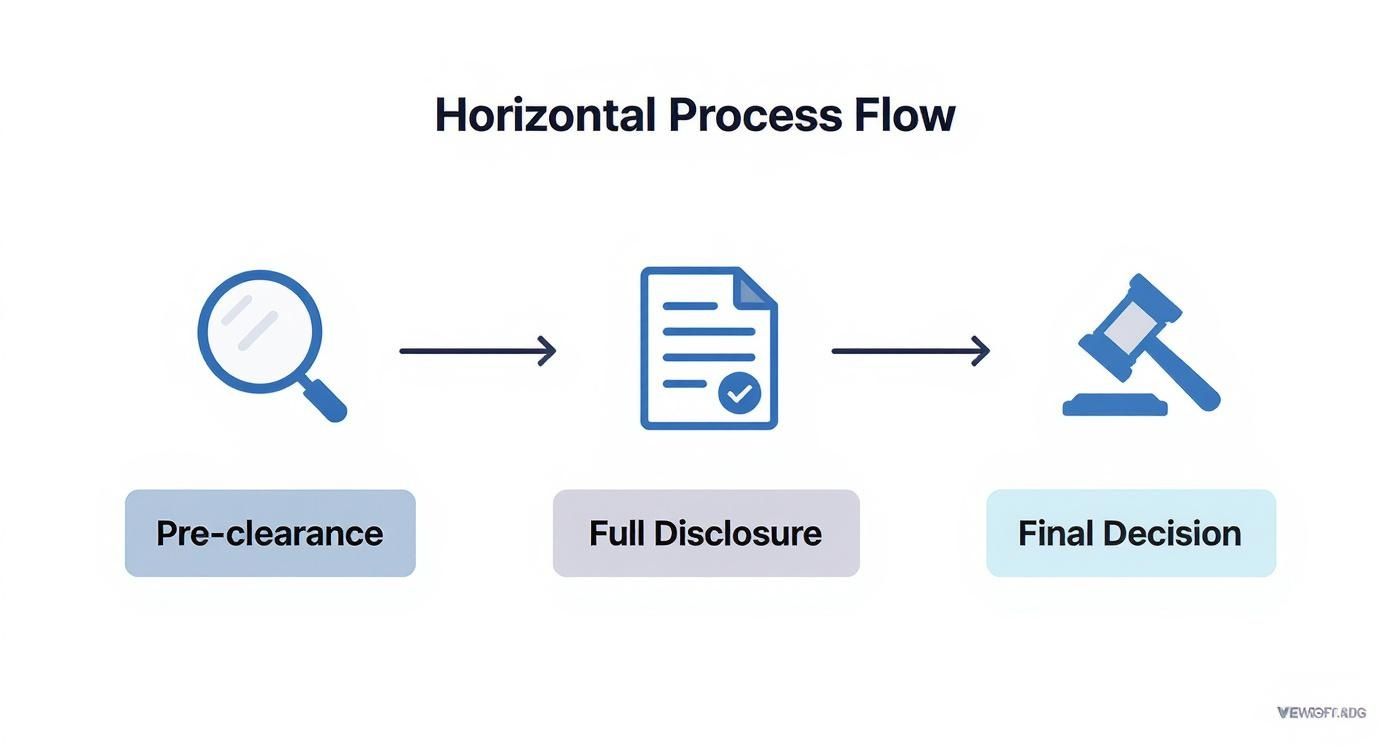
Each step here—Pre-Clearance, the Full Disclosure submission, and the Final Decision—is a key milestone on the road to getting right with the IRS.
Breaking Down the Civil Penalties
While you're avoiding criminal charges, the civil penalties are not to be taken lightly. The VDP applies a fairly rigid, "one-size-fits-all" penalty structure. It’s consistent, but it doesn't leave much room for negotiation based on individual circumstances.
Here's a look at what you can typically expect to pay:
- Back Taxes: You’ll need to pay every dollar of unpaid tax for the disclosure period, which is almost always the last six years of non-compliance.
- Interest: The IRS charges interest on all underpayments, and it's compounded daily right from the original due date.
- Accuracy-Related Penalty: A 20% penalty is commonly applied to the portion of tax that was underpaid.
- Civil Fraud Penalty: This is the big one. The IRS will levy a 75% civil fraud penalty, but they apply it to only one year in the disclosure period—specifically, the year with the highest tax bill.
Let’s put that into perspective. Say a taxpayer failed to report income for six years, and the year with the largest tax deficiency was $100,000. The civil fraud penalty for that single year would be $75,000, and that’s before adding the original tax and all the accrued interest. If you want a closer look at how these numbers stack up, our guide on the penalties for tax fraud covers this in much more detail.
It's a tough pill to swallow, there's no question about it. But this structured penalty framework eliminates the guesswork. You and your tax professional can calculate the potential costs with a high degree of accuracy, allowing for a clear-eyed decision before ever entering the program.
VDP vs. Getting Caught: A Stark Contrast
To really grasp the value of the VDP, you have to compare it to the alternative: getting caught. The difference is night and day. Without the shield of a voluntary disclosure, a taxpayer is completely exposed to unpredictable and potentially life-altering consequences.
To make this clear, let's look at the two paths side-by-side.
VDP Outcomes vs. IRS Criminal Investigation Consequences
The table below contrasts the predictable, civil resolution offered by the VDP with the chaotic, high-stakes reality of an IRS criminal investigation and conviction.
| Consequence | Via IRS Voluntary Disclosure Program | Via IRS Criminal Investigation |
|---|---|---|
| Criminal Prosecution | No recommendation for prosecution. | High risk of indictment and felony conviction. |
| Prison Time | Avoided entirely. | Potential for years in federal prison. |
| Financial Penalties | High but predictable civil penalties (e.g., 75% fraud penalty). | Potentially higher penalties, fines up to $250,000 for individuals, plus the costs of a criminal defense. |
| Public Record | Kept confidential as a civil tax matter. | Criminal conviction becomes a public record. |
| Outcome Control | Proactive process with a structured, known outcome. | Reactive process with an uncertain, high-stakes outcome determined by prosecutors and courts. |
As you can see, the VDP is far from a simple slap on the wrist. It’s a formal settlement process designed for people in serious situations.
Ultimately, the program offers a definitive route to resolving major tax liabilities and finally getting some peace of mind, all while sidestepping the catastrophic risk of criminal charges. For anyone who has knowingly failed to comply with tax laws, it’s often the best—and only—viable path forward.
To really get a handle on today's IRS Voluntary Disclosure Program, it helps to look back at its most famous ancestor: the Offshore Voluntary Disclosure Program (OVDP). This wasn't just some minor policy tweak. Running from 2009 to 2018, the OVDP was the IRS's massive, direct response to a full-blown crisis in global tax evasion.
Think back to the headlines about secret Swiss bank accounts. The OVDP was born out of those major international banking scandals, which revealed how tens of thousands of Americans were hiding money offshore to dodge their tax bills. The problem was huge, and the IRS needed an equally powerful solution.
A Carrot and a Very Big Stick
The OVDP created a formal pathway for people to come clean. It offered a deal: come forward, disclose your foreign accounts, and pay what you owe. In return for your full cooperation, you could sidestep the worst-case scenario—criminal prosecution.
But it wasn't just an open invitation. The IRS paired this offer with relentless enforcement against foreign banks that weren't playing by the rules. This one-two punch created an incredibly strong incentive for taxpayers to get into the program before the IRS found them first.
The OVDP proved that a well-structured disclosure program, backed by serious enforcement, could unravel even the most sophisticated international tax evasion schemes. It literally wrote the playbook for bringing huge numbers of non-compliant taxpayers back into the fold.
The message was loud and clear. The old days of hiding behind bank secrecy laws were over. The risk of getting caught had never been higher.
The Staggering Results
The numbers tell the story. This program wasn't a small-time effort; it was a blockbuster success that funneled billions back to the U.S. Treasury.
Between 2009 and 2018, the results were incredible:
- More than 56,000 taxpayers came forward to get right with the IRS.
- The program collected over $11 billion in back taxes, interest, and penalties.
You can dive deeper into these figures in a detailed report from the Federal Bar Association on the program's impact.
The lessons from the OVDP are baked directly into the DNA of the modern IRS Voluntary Disclosure Program. It proved the model was effective and provided the framework for the current, permanent program we have today. The OVDP’s story is the perfect real-world example of why these programs exist and the incredible results they can achieve.
Answering Your Top Questions About the VDP
When you're staring down the barrel of a serious tax problem, the IRS Voluntary Disclosure Program (VDP) can feel like a lifeline. But it’s a complex process, and it’s natural to have questions. Let's tackle a couple of the most common ones we hear from clients.
Do I Still Have to Admit I Was "Willful" on the Application?
This has always been a major sticking point for people considering the VDP. In the past, Form 14457—the key application document—had a box you had to check, admitting under penalty of perjury that your failure to comply was willful. It was a huge legal hurdle, basically forcing you to confess to criminal intent just to get in the door.
Thankfully, in a major win for taxpayers, the IRS has finally removed the willfulness checkbox from the form. This change, pushed for by the Taxpayer Advocate Service, eliminates that initial self-incriminating step.
So, what does this mean for you? You no longer have to make that damning legal admission upfront. However, don't mistake this for a get-out-of-jail-free card. The IRS examiner will still dig into the facts of your case to determine whether your actions were intentional. The big difference is that the investigation happens after you're in the program, not before.
This shift is a game-changer. It makes the VDP a much more approachable option, focusing on your genuine effort to get right with the IRS rather than trapping you with a pre-admission of guilt.
Can I Fight the IRS If I Don't Like Their Decision?
Another critical point of confusion is what happens if you disagree with the final outcome. The short answer is, you can't really fight it. The VDP doesn't come with formal appeal rights.
When you enter the program, you're essentially agreeing to accept the final tax and penalty assessment the IRS examiner lands on. If you can't pay that amount in full or work out an installment plan, the IRS can kick you out of the program. It's a "take it or leave it" situation, and that lack of flexibility is something you absolutely must consider before diving in.
For taxpayers dealing with different types of tax problems, other paths might offer more flexibility. For instance, you can explore other relief options in our guide to the IRS Fresh Start Program, which provides various solutions for handling tax debt.
At Attorney Stephen A Weisberg, we know these programs inside and out. If you're overwhelmed by tax debt or compliance issues and need a clear path forward, start with our FREE Tax Debt Analysis. See how we can help you find a resolution by visiting us at https://weisberg.tax.


