IRS Transcript Code 846: Refund Issued Explained
IRS transcript code 846 means your refund is issued. Understand what 'Refund Issued' signifies, timelines, and how to resolve common issues. Get clarity.

In this article
- Introduction The Moment of Truth on Your IRS Transcript
- The line that changes the conversation
- Why this code matters beyond a basic refund
- What is IRS Transcript Code 846 The Official Refund Issued Signal
- What the Code 846 line tells you
- The date matters, but it is not a guarantee of bank availability
- How the amount can look on the transcript
- Why professionals trust this code
- Decoding a Sample Transcript Where and How to Find Code 846
- Start with the Account Transcript, not the Return Transcript
- What the sequence usually looks like
- A practical reading example
- Why transcripts can beat public status tools
- Where people misread the transcript
- Code 846 vs Other Common IRS Codes 570 971 and 841
- The quick comparison
- What Code 570 usually means in practice
- What Code 971 adds to the story
- Why Code 841 gets immediate attention
- What works and what does not
- Your Action Plan After Seeing Code 846
- Step one, confirm the entry itself
- Step two, match the payment method to the timeline
- Step three, compare the refund to your broader IRS picture
- Step four, keep records that third parties may request
- Step five, act if the money does not arrive
- When Code 846 Gets Complicated Audits Offsets and Delays
- Offsets can shrink the refund
- Audits and review issues can change the file after apparent progress
- Business records make these problems easier to untangle
- Where appeal and collection rights enter the picture
- One professional option in complex transcript review
- When to Contact a Tax Attorney About Your Transcript
- The red flags that do justify escalation
- Why legal help is different from basic tax prep help
- Choosing the right kind of help
- Frequently Asked Questions About Code 846
- My Code 846 date passed and I still do not have the refund. What now
- Why is the Code 846 amount different from what my tax software showed
- Can the IRS reverse a refund after Code 846 appears
- Is Code 846 better than Where’s My Refund for serious tax issues
- Should I call a CPA, an accountant, or a tax attorney first
- Does Code 846 mean my tax problems are over
Many who pull an IRS transcript are not doing it for fun. They are doing it because they are waiting on money, trying to close a loan, dealing with a tax debt problem, or trying to figure out whether the IRS has finally finished with their return.
The transcript itself does not help at first glance. It looks like an internal ledger. Rows of codes. Dates that do not always line up with what the refund tracker says. Amounts that can look backward if you do not know the IRS sign conventions. Clients often come to me after checking the same transcript line three or four times, looking for one clear answer: is the refund coming or not?
That is where irs transcript code 846 matters.
If you see Code 846, Refund Issued, you are no longer guessing whether the IRS approved the refund. You have the IRS’s own transaction entry showing that the refund has been authorized. That does not solve every issue. In more complicated cases, the amount can still be reduced, offset, delayed by banking problems, or followed by another notice. But it does tell you something very important. The file has moved past suspense and into payment.
That distinction matters more than people realize. A taxpayer waiting on living expenses wants certainty. A business owner may need proof of incoming funds before making payroll decisions. A lender, realtor, bankruptcy attorney, or CPA may need to know whether the tax issue is resolved or still floating in IRS limbo. In many refund delay situations, the transcript gives a more useful answer than the public refund tool. If you have been following ongoing IRS refund delays, you already know why people end up relying on transcripts instead of broad status messages.
Introduction The Moment of Truth on Your IRS Transcript
A familiar situation lands on my desk every filing season. Someone has filed, waited, checked the IRS tracker, waited again, and then downloaded an Account Transcript because the standard answers stopped being helpful.
They are not looking for a lesson in IRS coding. They are looking for a verdict.
One client might be a self-employed contractor who needs the refund to catch up on quarterly estimates. Another might be a small business owner trying to show a lender that the IRS side of the file is clean enough to move a deal forward. Another might be a taxpayer with older liabilities who wants to know whether the refund will arrive or get absorbed into something else.
The line that changes the conversation
When Code 846 appears, the conversation changes from "is the IRS still processing this?" to "what happens next?"
That is why tax professionals focus so heavily on it. It is not just a pleasant line item. It is the transcript entry that confirms the IRS has moved from review and calculation to refund issuance.
Practical takeaway: If you want the clearest transcript-based sign that the IRS approved your refund, Code 846 is the line to find.
Why this code matters beyond a basic refund
For routine returns, Code 846 is good news and little more.
For more complex files, it is a working data point. It helps answer questions like these:
- Debt resolution: Has the IRS finished processing the year, or is the refund still tied up in a hold?
- Audit context: Did a prior freeze clear, or is the account still under review?
- Financing and underwriting: Can the taxpayer document that the refund has been issued?
- Cash flow planning: Is there a scheduled release date that a business owner can use, with caution, for planning purposes?
Clients often assume the transcript is only for tax professionals. It is not. It is one of the few places where the IRS states its account activity with specificity. Once you understand Code 846, the transcript stops looking like noise and starts reading like a timeline.
What is IRS Transcript Code 846 The Official Refund Issued Signal
IRS Transcript Code 846 means "Refund Issued." It shows that the IRS completed processing the return and authorized a refund for an overpayment. It is the clearest signal on an Account Transcript that the refund has been approved and released into the payment pipeline.
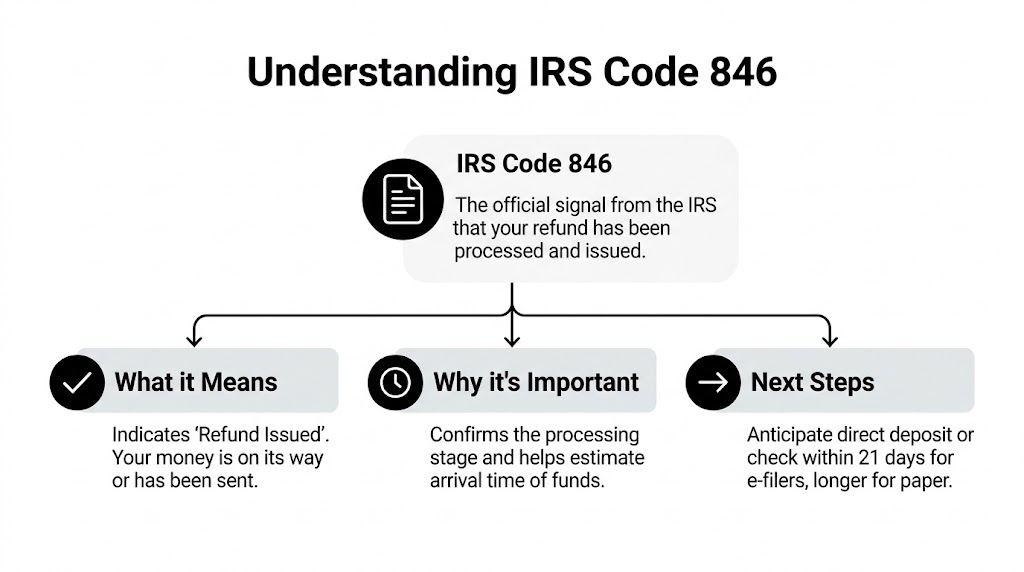
Think of it as the Treasury payment version of a shipping confirmation. Before that point, the IRS may still be reviewing credits, posting withholding, matching information returns, or holding the file for another action. After Code 846 posts, the refund has moved to issuance.
In fiscal year 2023, the IRS issued over 117 million refunds totaling $373.1 billion, averaging $3,186 per refund, and TC 846 posted for each one, according to this explanation of IRS transcript codes.
What the Code 846 line tells you
A Code 846 entry usually gives you three useful pieces of information:
| Part of the entry | What it means |
|---|---|
| 846 | The transaction code for refund issuance |
| Refund Issued | The IRS description of the action |
| Amount and date | How much was issued and the scheduled release date |
If a transcript shows an entry such as Code 846 with a refund amount and a date, the IRS is telling you that it approved that amount and scheduled it for release on that date.
The date matters, but it is not a guarantee of bank availability
The date next to Code 846 is the IRS scheduled release date to Treasury. In practice, that functions as the direct deposit date for many taxpayers. If you chose direct deposit, the money may show up on that date or within a short period after, depending on your bank’s processing. If the refund is going out by paper check, mailing time adds another layer.
That distinction matters because clients often read the date as "money in account by morning." Sometimes that happens. Sometimes the bank takes longer to post it.
How the amount can look on the transcript
Transcript amounts can confuse people because IRS formatting does not always read like a normal bank statement.
Key points:
- Negative amounts can favor the taxpayer. On transcripts, a negative amount can reflect a credit or refund position.
- The 846 amount can include IRS-paid interest on an overpayment if interest was added.
- The number on 846 is the issued amount, not necessarily the same number you expected when you filed.
Attorney’s view: The right question is not only "do I have Code 846?" It is also "does the amount make sense in light of the rest of the transcript?"
Why professionals trust this code
When a CPA, tax attorney, lender, or business owner needs to know whether a refund has been approved, Code 846 is more useful than vague status language. It is posted on the Account Transcript, which tracks account activity. That is very different from a Return Transcript, which mainly reflects filed return data.
For clients in tax controversy matters, that difference is critical. If there is debt, a pending notice, or a transaction that depends on proof of tax status, "Refund Issued" is not just a nice update. It is evidence of what the IRS did on the account.
Decoding a Sample Transcript Where and How to Find Code 846
When clients first open an Account Transcript, they often scroll too fast and miss the pattern. The transcript is usually chronological. If you read it like a timeline instead of a form, it gets easier.

Start with the Account Transcript, not the Return Transcript
If your goal is refund status, use the Account Transcript.
That is where transaction codes appear. A Return Transcript is useful for showing what was filed, but it does not give the same running account history.
What the sequence usually looks like
Code 846 typically appears after the IRS has posted the return and the credits that support the refund.
A simplified sequence often looks like this:
| Transcript code | Plain-English meaning | Why it matters |
|---|---|---|
| 150 | Return processed | The IRS posted the return to the account |
| 806 | Withholding credit posted | The IRS credited withholding amounts |
| 766 | Additional credits applied | Refundable credits or adjustments were posted |
| 846 | Refund issued | The IRS authorized the refund |
That sequence tells a story. The return posted. The credits posted. The IRS calculated the overpayment. Then the refund was issued.
A practical reading example
Suppose a taxpayer expected a refund and sees withholding and credit entries first, then later sees Code 846 with an amount and date.
That generally means the IRS finished the processing cycle for that return. If the taxpayer had been staring at a generic "processing" message elsewhere, the transcript has already given the more useful answer.
Tip: Do not isolate Code 846 from the lines above it. The entries that come before it help explain why the refund amount is what it is.
Why transcripts can beat public status tools
Public refund tools are designed for broad consumer use. They can be helpful, but they are limited.
A transcript is often more current for people whose returns update on weekly processing cycles. In practice, many professionals check the transcript first because it shows the actual transaction history instead of broad status labels.
That matters in real files:
- A lender may want proof that refund issuance is no longer speculative.
- A CPA may need to confirm whether the IRS posted withholding before discussing an amended return.
- A taxpayer with prior debt may want to know whether the refund has posted before worrying about offsets.
Where people misread the transcript
The most common mistakes are simple:
- Looking at the wrong transcript type
- Assuming the date equals same-day bank receipt
- Ignoring later codes that may affect the refund
- Focusing on the expected refund from tax software instead of the IRS account record
Once you know where to look, irs transcript code 846 is not buried at all. It is the transaction line that tells you the IRS crossed from processing into payment.
Code 846 vs Other Common IRS Codes 570 971 and 841
Code 846 is the good-news code. The problem is that very few real-world transcripts are that clean.
A lot of taxpayers see 570, 971, or sometimes 841 near the same time and assume the worst. That is understandable. These codes often show up in files that involve delays, review, corrections, offsets, or notice activity. But they do not all mean the same thing, and they do not all carry the same level of danger.
The quick comparison
| Code | Official Name | What It Really Means | Impact on Refund |
|---|---|---|---|
| 846 | Refund Issued | The IRS authorized and scheduled the refund | Strong sign payment is moving |
| 570 | Additional Account Action Pending | The IRS placed the account on hold for review or another internal action | Usually delays the refund until resolved |
| 971 | Notice Issued | The IRS generated a notice or letter | May explain a delay, adjustment, or next step |
| 841 | Refund Cancelled | A previously issued refund was reversed or cancelled | Can stop or unwind expected payment |
What Code 570 usually means in practice
Code 570 is the transcript equivalent of a pause.
It does not automatically mean fraud, audit, or wrongdoing. It means the IRS has not let the refund move forward yet. Sometimes the issue resolves on its own. Sometimes the taxpayer receives a notice. Sometimes the file needs identity verification, income matching, or another internal check.
If a transcript shows 570 first and 846 later, that usually means the hold was resolved and the refund then moved forward.
What Code 971 adds to the story
Code 971 means the IRS sent or generated a notice. That notice may matter a lot, or it may document an administrative step.
The important point is timing. If 971 appears around the same period as a hold or adjustment, the letter often explains what the IRS wants, what changed, or what it intends to do next. Taxpayers get into trouble when they rely on the transcript code alone and ignore the actual notice.
Introduced as part of the IRS computerized master file transaction code system in the 1970s, TC 846 standardized refund tracking. Unlike manual refunds under TC 840, TC 846 handles automated high-volume issuance. Practitioners also watch for post-issuance notice activity such as TC 971, which they estimate occurs in 5% to 10% of cases, as discussed in this review of transcript codes 570, 971, 806, and 846.
Why Code 841 gets immediate attention
Code 841 is different. It is not a mere pause or letter. It indicates a cancellation of a refund.
That can happen for different reasons, including payment problems or later account action, but the practical effect is the same. If a taxpayer was expecting money based on a prior 846 entry, Code 841 tells you to stop assuming the refund is still on its way.
Key point: Code 846 tells you the refund was issued. It does not mean the rest of the transcript no longer matters.
What works and what does not
What works:
- Read the codes in sequence.
- Match Code 971 to the actual notice when it arrives.
- Treat Code 570 as a hold, not a final denial.
- Treat Code 841 as a serious follow-up item.
What does not work:
- Panicking at 971 without reading the letter.
- Assuming 570 means permanent loss of the refund.
- Assuming 846 wipes out all later transcript issues.
- Relying only on tax software or a public tracker once conflicting transcript codes appear.
For tax professionals and business owners, the value is in reading the account as a narrative. A transcript is not a single message. It is a chain of events.
Your Action Plan After Seeing Code 846
Seeing Code 846 is good news. It is not the end of your job.
If you stop at "great, refund approved," you may miss timing issues, amount discrepancies, account offsets, or planning opportunities that matter for the next quarter or the next deal.

Step one, confirm the entry itself
Read the Code 846 line carefully.
Check these items:
- Amount: Is it the figure you expected, or is it smaller?
- Date: Is it the scheduled release date?
- Transcript context: Are there nearby codes that suggest a hold, notice, or later change?
This sounds basic, but it prevents a lot of bad assumptions.
Step two, match the payment method to the timeline
A direct deposit and a paper check are different events.
With direct deposit, taxpayers often receive funds on the 846 date or shortly after, depending on the bank. With a mailed check, you need to allow for delivery time. In either case, the transcript is showing that the IRS issued the refund, not promising instant possession.
Practice point: When clients need certainty for cash flow, I tell them to treat the 846 date as a release date, not a spending date.
Step three, compare the refund to your broader IRS picture
In this context, taxpayers and professionals focusing on broader financial strategy gain value from the transcript.
If you have had prior balance-due years, payroll tax issues, or installment agreement discussions, a refund issuance entry should prompt bigger questions:
- Did the refund satisfy part of another liability?
- Does the account now show a cleaner tax profile for lending or underwriting?
- Should estimated tax payments be adjusted so this overpayment does not repeat?
For taxpayers managing debt, the next move may not be celebration. It may be account review. If you still owe for another year, it may also be time to evaluate options such as an IRS payment arrangement. A practical overview of that process appears in this guide on how to set up payment plan with IRS.
Step four, keep records that third parties may request
Refund transcripts often become support documents in non-tax settings.
You may need them for:
| Situation | Why the transcript helps |
|---|---|
| Mortgage or lending | It shows account activity and refund issuance |
| Business financing | It helps document that the year processed through the IRS |
| Divorce or bankruptcy matters | It can clarify whether refund funds were issued or redirected |
Step five, act if the money does not arrive
If the 846 date passes and nothing shows up, do not stay passive.
Start with the practical checks:
- Was the direct deposit information on the filed return correct?
- Did the bank reject or delay the deposit?
- Was the payment method changed?
- Has another transcript code posted after 846?
If the payment still cannot be located, the issue may require a refund trace or direct IRS follow-up. At that point, the transcript remains your best starting document because it shows exactly what the IRS says it issued and when.
When Code 846 Gets Complicated Audits Offsets and Delays
Code 846 sounds simple. In many files, it is not.
The easy version is a clean return, a clean transcript, and a refund that lands without incident. The harder version is what I see more often in controversy work. A taxpayer sees Code 846, but the amount is lower than expected. Or the refund never lands because another debt intercepted it. Or the account shows a notice pattern that suggests an adjustment is coming even after the refund entry posted.

Offsets can shrink the refund
A taxpayer may file expecting one number and then see a smaller 846 amount.
That often means the refund did not survive the full gauntlet intact. The IRS or Treasury can apply available funds against certain debts before the taxpayer receives anything. In practice, that is one of the first things to investigate when the issued amount is lower than expected.
Audits and review issues can change the file after apparent progress
Some taxpayers assume Code 846 closes the door behind it. That is too optimistic.
If the transcript later reflects additional notice activity or reversal-type action, the account may still be moving. In serious review situations, the account narrative matters more than any single line item. This is why business owners with payroll tax exposure, trust fund issues, or unresolved balance-due years should not rely on a single code in isolation.
Business records make these problems easier to untangle
Small business owners are especially vulnerable to transcript confusion because they often have overlapping issues. Personal refunds, business payroll deposits, estimated taxes, and prior-year liabilities all pull on the same financial picture.
If you are trying to reduce transcript surprises in future years, a disciplined records process helps. A practical resource I often recommend for organizing the underlying paperwork is this small business tax preparation checklist. It is useful because many transcript disputes start long before the transcript appears. They start with incomplete records, mismatched withholding, or credits that cannot be substantiated quickly.
Practical warning: A refund issue is rarely just a refund issue for a taxpayer who already has notices, balances due, or an active controversy file.
Where appeal and collection rights enter the picture
If the refund is caught up in a broader collections problem, the transcript is only part of the story.
The taxpayer may also need to understand notice rights, collection posture, and whether the IRS is taking or threatening other action. That becomes much more important when offsets, liens, or active collection notices enter the picture. For that reason, I often tell clients to review the broader framework of IRS notices collection appeal rights instead of treating the refund as a stand-alone event.
One professional option in complex transcript review
For taxpayers and professionals who need a controversy-focused review, one option is Attorney Stephen A Weisberg, whose practice includes obtaining and reviewing IRS transcripts and account history in tax debt and audit-related matters. That is most useful when the transcript is part of a larger dispute, not when the only issue is ordinary waiting.
When to Contact a Tax Attorney About Your Transcript
Not every Code 846 issue needs a lawyer.
A routine delay after the scheduled date, a bank posting lag, or mild confusion about transcript formatting usually does not justify legal intervention. Those are practical problems first.
The red flags that do justify escalation
A tax attorney becomes useful when the transcript points to a dispute, not just a wait.
Consider escalating when:
- The refund was offset for a debt you do not recognize.
- The amount issued is materially different and no simple explanation appears on the account.
- A hold or notice pattern has dragged on without a clear resolution.
- The transcript suggests audit, collection, lien, or reversal activity.
- A major transaction depends on fast clarification of your IRS status.
That last point matters more than people think. Realtors, lenders, bankruptcy counsel, and family law attorneys often need more than "the taxpayer says the refund is coming." They need a professional reading of what the IRS account shows.
Why legal help is different from basic tax prep help
A preparer can often explain what a code means.
A tax controversy attorney is more useful when the issue moves from interpretation to rights, exposure, strategy, or direct interaction with the IRS over a disputed matter. That is especially true when the refund intersects with old liabilities, trust fund recovery penalty exposure, pending collection activity, or a transaction deadline.
Useful rule: If the problem is "what does this code mean," start with transcript review. If the problem is "what can I do about what the IRS is doing," legal help becomes more relevant.
Choosing the right kind of help
Not all tax professionals handle transcript disputes the same way. If the issue is serious, look for someone who deals with IRS controversy and tax debt matters, not just return preparation.
A practical place to start is this guide on how to find a good tax attorney. It helps separate routine tax assistance from the kind of representation needed when a transcript points to a deeper IRS problem.
Frequently Asked Questions About Code 846
My Code 846 date passed and I still do not have the refund. What now
Start with the basics. Confirm whether the refund was supposed to be direct deposit or check. Then check for bank processing issues, rejected deposit information, or later transcript activity. If nothing explains the delay, the next step may be a refund trace or direct IRS follow-up.
Why is the Code 846 amount different from what my tax software showed
Because the IRS account controls the outcome. The IRS may have adjusted credits, applied an offset, included interest, or changed the refund amount during processing. The transcript amount is the issued amount.
Can the IRS reverse a refund after Code 846 appears
Yes, transcript activity can continue after 846. If the account later shows a cancellation, reversal, or notice pattern tied to an adjustment, do not assume the original issuance line tells the whole current story.
Is Code 846 better than Where’s My Refund for serious tax issues
For detailed account analysis, yes. The transcript usually gives better insight because it shows transaction-level activity. For a quick consumer-facing check, the public tool is simpler.
Should I call a CPA, an accountant, or a tax attorney first
It depends on the problem. If you need help reconciling the numbers or comparing the transcript to the filed return, a CPA or one of these Tax Accountants may be the right first stop. If the issue involves offsets, audits, collection action, or disputed IRS treatment, a tax attorney is often the better fit.
Does Code 846 mean my tax problems are over
Not necessarily. It means the refund was issued. It does not guarantee that unrelated tax years, notices, or collection matters are resolved.
If your transcript shows Code 846 but the surrounding facts still do not make sense, Attorney Stephen A Weisberg can review the account history, identify what the IRS has done, and help determine whether the issue is routine or part of a larger tax controversy. Learn more at weisberg.tax.


