Your Guide to IRS Tax Problem Help and Lasting Relief
Facing an IRS issue? Get expert IRS tax problem help with our guide on notices, payment plans, OICs, and when to hire an attorney for the best outcome.

In this article
- What to Do When You Get an IRS Notice
- Decoding Common IRS Notices and Their Urgency
- Assess the Urgency and Gather Your Documents
- Why Acting Promptly Is So Important
- Evaluating Your IRS Tax Relief Options
- The Most Common Solution: An Installment Agreement
- The Fresh Start: An Offer in Compromise
- Removing Penalties with Penalty Abatement
- When You Didn't Know: Innocent Spouse Relief
- Resolving Complex Business Tax Problems
- Understanding the Trust Fund Recovery Penalty
- Who Is a "Responsible and Willful" Person?
- Protecting Your Business and Personal Assets
- When to Hire a Tax Attorney for Your IRS Problem
- Red Flags That Signal You Need an Attorney
- Attorney vs. CPA vs. Enrolled Agent: What's the Difference?
- The Right Way to Get Help
- The Investigation and Strategy Phase
- The Art of Negotiation (and Patience)
- Working with Your Other Advisors
- Can the IRS Actually Take My House or Garnish My Paycheck?
- Will My Tax Debt Just Go Away After a Certain Number of Years?
- Offer in Compromise vs. Payment Plan: What's the Real Difference?
- How Do You Help My Client if I Refer Them to You?
It’s a feeling anyone can relate to: seeing that official-looking envelope from the IRS in your mailbox. Your heart rate probably jumps a bit, and a wave of anxiety hits. But the absolute worst thing you can do is let it sit unopened.
Your first move isn't to panic—it's to calmly open the letter, figure out exactly what it's about, and then make a plan. This is how you turn that initial fear into forward momentum.
What to Do When You Get an IRS Notice
Think of an IRS notice not as a summons, but as a communication. It’s a message that requires a smart, timely response. Ignoring it is the single most expensive mistake you can make. Penalties and interest just keep piling up, turning a manageable issue into a much bigger, more complex problem down the road.
The key is to understand what the IRS is actually telling you. Are they just asking for a missing document? Proposing a change to your tax return? Or is it a formal demand for payment? The answer is usually in the notice number, typically located in the top-right corner of the first page.
For example, a CP2000 notice means the IRS has data from someone else—like your employer or a bank—that doesn't quite match what you reported on your return. It’s not a full-blown audit, but it is a proposal to adjust your tax bill, and you need to respond.
On the other hand, a CP504 notice is a "Notice of Intent to Levy." This one is far more serious. It's a final warning that the IRS is getting ready to take collection action. Knowing the difference dictates how quickly you need to act and what your next steps should be. We break down many of these codes in our guide to understanding IRS letters and notices.
To help you get started, this table breaks down some of the most common notices we see and what they mean for you.
Decoding Common IRS Notices and Their Urgency
| IRS Notice Code | What It Usually Means | Urgency Level | First Action to Take |
|---|---|---|---|
| CP2000 | The income/payment info the IRS has doesn't match your return. | Medium | Gather W-2s, 1099s, and other income documents to verify. |
| CP504 | This is a final notice of intent to levy your assets (bank accounts, wages). | High | Immediately review your options or contact a tax professional. |
| Letter 5964 | You may be eligible for the Earned Income Tax Credit but didn't claim it. | Low | Review your eligibility and file an amended return if applicable. |
| CP14 | You have a balance due on your taxes. | Medium | Pay the balance or explore payment options if you can't pay in full. |
| Letter 3219 | "Notice of Deficiency" – you have 90 days to petition the U.S. Tax Court. | Very High | This is a critical deadline. Seek professional advice immediately. |
This isn't an exhaustive list, but it shows how different notices carry different weights. Your response should always be tailored to the specific letter you've received.
Assess the Urgency and Gather Your Documents
Once you know what kind of notice you have, find the deadline. Most IRS letters give you a specific window to respond—usually 30, 60, or 90 days. Mark this date on your calendar immediately. If you miss it, you could lose your right to appeal and the IRS will move forward with collections.
Next, it’s time to pull your records together. If the notice is about income, find your W-2s, 1099s, and bank statements for that year. If it’s questioning a deduction, you'll need the receipts and documentation to back it up. Having everything organized from the start makes building your response so much easier.
This flowchart breaks down the initial steps you should take the moment a notice arrives.
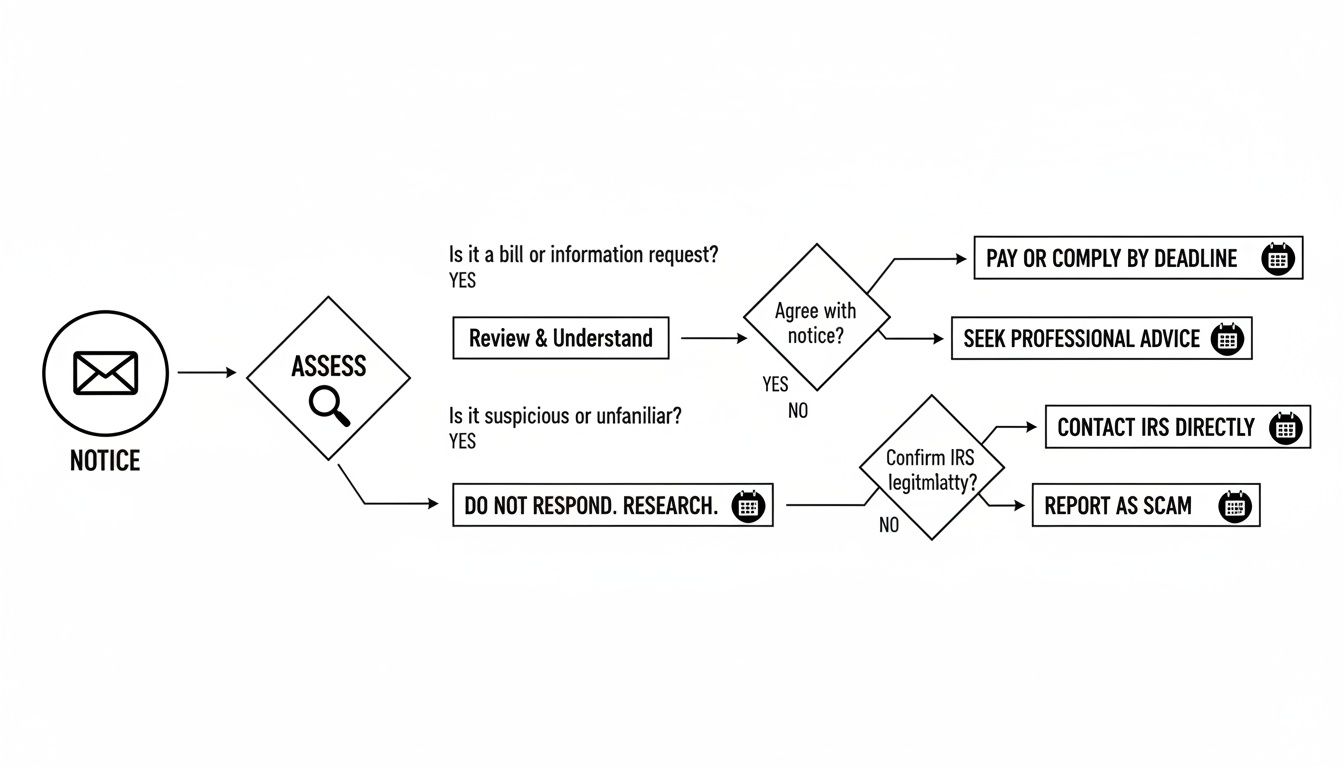
As you can see, the process is logical: get the notice, assess what it says and when it's due, and then take deliberate, informed action.
Why Acting Promptly Is So Important
Ignoring the problem won't make it go away; it just makes it worse. The IRS has powerful tools for collecting tax debt, but they almost always send a series of written warnings first. These notices are your chance to resolve the issue before it escalates to a tax lien on your property or a levy on your bank accounts and wages.
Procrastination is the IRS's best friend. Every day you wait, interest accrues, penalties compound, and your options for a favorable resolution may begin to shrink. A swift, informed response is your strongest defense.
Believe it or not, the IRS system is massive and prone to errors. For the 2023 filing season, the IRS processed over 165 million individual tax returns. But during that process, it had to suspend more than 33.5 million returns for manual review due to errors or potential identity theft.
For taxpayers who were victims of identity theft, the average time to get their issue resolved stretched to 21 months. These numbers show just how important it is to get experienced IRS tax problem help early on. A professional can help you navigate the bureaucracy, avoid costly delays, and protect your financial well-being.
Evaluating Your IRS Tax Relief Options
Once you have a handle on what the IRS notice is actually saying, it's time to figure out a game plan. So many people see a big tax bill and just freeze, thinking their only choice is to somehow come up with the full amount right away. The good news is, that's almost never the case. The IRS has several established programs to help taxpayers get back on their feet.
The trick is figuring out which solution actually fits your life and your finances. The right path for a W-2 employee with a stable income is going to look very different from the right path for a small business owner with unpredictable cash flow. Let's walk through the main options.
The Most Common Solution: An Installment Agreement
For a lot of folks, the most straightforward way to tackle a tax debt is with an Installment Agreement (IA). In simple terms, this is a monthly payment plan you set up directly with the IRS. You agree to pay off the entire debt—including all the interest and penalties that have built up—over a set period.
If you owe less than $50,000 total (tax, penalties, and interest combined), you can often get a streamlined agreement online, sometimes in just a few minutes. These plans typically give you up to 72 months to pay everything off.
But what if you owe more, or if your financial picture is complicated? Then you'll need to negotiate a more tailored payment plan. This involves submitting a financial disclosure, usually Form 433-F, which gives the IRS a detailed look at your income and living expenses. They use this to determine a monthly payment you can realistically afford.
An Installment Agreement is a serious commitment. You absolutely must make your payments on time and stay current on all future tax returns. If you miss a payment or forget to file next year's taxes, the IRS can default your agreement and restart aggressive collections immediately.
Keep in mind, while an IA will stop scary actions like bank levies, interest and penalties don't stop. They continue to pile up on your remaining balance until it's paid in full. It’s a trade-off you need to be comfortable with.
The Fresh Start: An Offer in Compromise
You’ve seen the ads on TV and radio promising to settle your tax debt for "pennies on the dollar." What they're talking about is a program called an Offer in Compromise (OIC). This is an agreement where the IRS accepts less than the full amount you owe to settle your debt completely. It sounds fantastic, but it's also one of the most difficult programs to qualify for.
The IRS doesn’t do this out of the kindness of its heart. An OIC is a cold, hard business decision. They will only accept your offer if their own calculations show it's the most they can ever hope to collect from you before the time to collect your debt expires.
They figure this out using a rigid formula to determine your Reasonable Collection Potential (RCP). This formula is based on two key things:
- Your monthly disposable income: What’s left over after you subtract IRS-allowed living expenses from your gross income.
- The equity in your assets: The value of things like your house, cars, bank accounts, and retirement funds, minus any loans against them.
The IRS essentially adds the value of your assets to a multiple of your monthly disposable income to arrive at your RCP. To have any chance of success, your offer must meet or exceed that number. It's a high bar to clear—in recent years, the IRS has accepted fewer than 40% of OIC applications. For a deeper look, check out our guide on the full range of tax debt relief options.
Removing Penalties with Penalty Abatement
Sometimes the original tax isn't the killer—it's the mountain of penalties that have been added on top. If there's a legitimate reason you filed or paid late, you might be able to get those penalties wiped away through Penalty Abatement.
The most common way to get penalties removed is to show "reasonable cause." This isn't just an excuse; it means you have to prove that you tried to do the right thing but were blocked by circumstances you couldn't control.
A few examples of what the IRS might consider reasonable cause include:
- Serious Illness or Death: A major medical crisis involving you or an immediate family member.
- Destruction of Records: Your home or office was destroyed in a fire, flood, or other disaster, taking your tax records with it.
- Bad Advice from the IRS: You were given incorrect information by an IRS employee and you relied on it.
- System Outages: You were prevented from filing or paying on time due to widespread, documented IRS system failures.
To make your case, you'll need to write a detailed letter explaining exactly what happened and provide proof. Things like hospital records, death certificates, or insurance reports are critical. The IRS runs on paper, and a well-documented request is the only kind that gets approved.
When You Didn't Know: Innocent Spouse Relief
What if the tax debt isn't even your fault? It's a painful but common scenario: you file a joint return, and you're now on the hook for a tax bill created entirely by your spouse (or ex-spouse) without your knowledge. Innocent Spouse Relief is designed specifically for this situation.
There are a few different types of relief available:
- Innocent Spouse Relief: This can get you off the hook completely if you can show you had no idea there was an error on the return and that it would be unfair to hold you accountable.
- Separation of Liability: This option is for divorced or separated couples. It splits the tax debt, making you responsible only for the portion related to your own income or errors.
- Equitable Relief: A sort of last-chance option if you don't qualify for the other two, but can still prove that, under all the circumstances, it would be fundamentally unfair to force you to pay the debt.
Applying for this relief involves filing a detailed Form 8857. The IRS will look closely at all the facts, especially what you knew (or should have known) about your household's finances when the return was filed. It's a complex process, but it's a vital escape hatch for those who have been unfairly burdened with someone else's tax problem.
Resolving Complex Business Tax Problems

For a business owner, an IRS problem is more than just a financial headache. It’s a direct threat to your company’s survival and your own personal livelihood. The stakes are simply much higher than they are for individual taxpayers, with the potential to freeze your accounts, halt operations, and put everything you've built at risk.
When a business falls behind on its taxes, the IRS responds with a different level of speed and severity. This is especially true with payroll taxes. Why? Because that money was never the business’s to begin with. You were holding those funds “in trust” for your employees and the government. The IRS sees failing to remit them as a serious breach of that trust.
Understanding the Trust Fund Recovery Penalty
The most powerful tool the IRS has against businesses is the Trust Fund Recovery Penalty (TFRP). This isn't just another penalty added to your bill. It’s a mechanism that allows the IRS to completely bypass your corporate protection (like an LLC or S-Corp) and hold you personally liable for unpaid payroll taxes.
Specifically, the TFRP targets the “trust fund” portion of your payroll—the federal income tax and FICA taxes withheld from your employees' checks. If the business doesn't pay it, the IRS will find someone who will, assessing the TFRP against any person they consider "responsible" and "willful."
The TFRP is a game-changer. Suddenly, the debt isn't just the company's problem; it's your personal problem. The IRS can pursue your personal assets—your home, your savings, your car—to satisfy the debt, even if your business is an LLC or corporation.
Navigating the nuances of payroll tax issues is critical. You can get a deeper understanding by reading our guide to navigating payroll tax debt for business owners.
Who Is a "Responsible and Willful" Person?
The IRS casts a very wide net when identifying a "responsible person." It’s not limited to the person who signs the checks or the name on the business license. It can be anyone with significant control over the company's finances.
This might include:
- Officers and Directors with authority over company spending.
- Shareholders and Employees who had the power to decide which bills to pay.
- Bookkeepers and Controllers, even if they didn't have the final say, can be targeted if they were involved in the decision-making process.
The definition of "willfulness" is an even lower bar to clear. It doesn't mean you acted with malice or intended to defraud the government. It simply means you were aware of the unpaid taxes and chose to pay other creditors instead. If you knew the payroll taxes were due but signed a check to a vendor, paid the rent, or even ran payroll for the next period, the IRS will almost certainly see that as a willful act.
To make matters worse, systemic IRS delays can turn a manageable problem into a crisis. The IRS sent 170 million paper notices in 2025 alone, which contributed to a massive backlog of 43 million tax returns. For a business owner trying to correct a payroll return (Form 941-X) or get a penalty waived, this means you could be waiting months for a response, all while penalties and interest continue to pile up.
Protecting Your Business and Personal Assets
If you're facing a TFRP investigation, immediate and decisive action is your best defense. The first step is to stop the bleeding and prevent the debt from growing. A crucial part of this is getting a handle on proper payroll compliance to prevent any future missteps while you work to resolve the past-due liability.
Once a Revenue Officer is assigned to your case, they will want to conduct interviews to determine who to hold responsible. Getting professional IRS tax problem help before that interview happens is absolutely critical.
An experienced tax attorney can represent you in the TFRP interview, help build your defense, and file an appeal if the penalty is assessed against you. Our strategy is always twofold: first, we negotiate a manageable solution for the business itself, like an Installment Agreement or an Offer in Compromise. At the same time, we work to shield your personal assets from the devastating impact of a TFRP assessment.
Don't wait for a levy to drain your business bank account. A proactive defense is the only real strategy.
When to Hire a Tax Attorney for Your IRS Problem
 Look, you can certainly try to handle some smaller IRS issues on your own. But there comes a point where self-representation becomes a huge gamble. Knowing when to call in a professional is key to protecting yourself, and certain IRS actions are blaring sirens that you need expert IRS tax problem help.
When the IRS shifts from mailing notices to taking aggressive collection action, the game has fundamentally changed. Ignoring these signs can, and often does, lead to devastating financial outcomes.
Red Flags That Signal You Need an Attorney
Some situations are simply too serious or legally complex to navigate alone. If any of the following happens, it’s time to stop and immediately find qualified legal help.
- A Revenue Officer Appears: The moment an IRS Revenue Officer shows up at your home or business, your case has officially escalated. These are the IRS's highly trained field collectors, and their sole job is to get the money you owe. Their powers are substantial.
- You Receive a Notice of Levy: This isn’t just another letter. It's a legal notice that the IRS is about to start seizing your assets. They can garnish your wages, clean out your bank accounts, and even take your property—often without needing to go to court.
- A Tax Lien is Filed: A Notice of Federal Tax Lien is a public record that announces to the world—including credit bureaus—that you owe the government money. It attaches to all your property, crippling your credit and making it nearly impossible to get a loan or sell your home.
- You Face a TFRP Investigation: As we've covered, if the IRS is trying to make you personally responsible for business payroll taxes through the Trust Fund Recovery Penalty, the risk to your personal assets is extreme. You absolutely need an attorney.
A dangerous misconception I see all the time is people thinking they can talk their way out of these situations. Once the IRS takes enforcement action, you're no longer just dealing with a simple tax dispute. You're in a legal fight for your financial future.
An experienced tax attorney can intervene immediately, often halting collection actions while they negotiate a formal, manageable resolution on your behalf.
Attorney vs. CPA vs. Enrolled Agent: What's the Difference?
While Certified Public Accountants (CPAs) and Enrolled Agents (EAs) are fantastic for preparing tax returns and handling some IRS matters, a tax attorney brings a unique and critical advantage to the table: attorney-client privilege.
This is a legal shield that keeps our conversations completely confidential. The IRS cannot force me to testify against you. This protection is non-negotiable in cases with any hint of criminal liability, like years of unfiled returns, suspected tax evasion, or a TFRP case where the IRS must prove your actions were "willful." A CPA or EA simply cannot offer this level of legal protection.
You should seriously consider hiring an attorney when:
- Your tax debt is significant, typically over $50,000.
- There's any indication of a criminal tax investigation.
- You need to take your case to the U.S. Tax Court.
- Your situation requires a sophisticated legal defense, such as for Innocent Spouse Relief or a TFRP appeal.
If you're still weighing your options, my detailed guide on how to find a good tax attorney can help you make the right choice.
The Right Way to Get Help
Many of the big, national "tax resolution" companies you see on TV will try to lock you in with a massive upfront fee before they’ve even looked at your IRS file. I fundamentally disagree with that approach. You should know exactly if and how I can help before you ever pay a dime.
That’s why I always start with a free Tax Debt Analysis. It’s a transparent, no-obligation first step where I review the specifics of your case and outline a clear roadmap of your options. This process empowers you to make an informed decision and avoid the high-pressure sales tactics of resolution factories that often overpromise and underdeliver.
So you’ve decided to hire a professional to help with your IRS problem. That’s a huge, positive step, but it’s completely normal to ask, “Okay, so what happens now?”
Let’s pull back the curtain on the tax resolution process. I want you to understand the journey from our first conversation to the final resolution, because knowing what to expect brings incredible peace of mind. It’s important to remember this is a structured process, not a magic wand.
The very first thing we do is get legal representation in place by signing a Power of Attorney (POA), which is typically IRS Form 2848. This is a crucial document, but let me be clear about what it doesn't do: it does not give me or my firm any control over your bank accounts or finances. It simply grants us the authority to speak to the IRS for you, pull your official records, and negotiate on your behalf.
Once the IRS processes that POA, all the stressful letters and calls about your case stop coming to you and start coming directly to my office. For many clients, that silence is the first real relief they’ve felt in years.
The Investigation and Strategy Phase
With the POA filed, my team and I get to work behind the scenes. We immediately contact the IRS, put a hold on any active collection efforts if we can, and request your complete administrative file. This file is the key—it contains every return you've ever filed, every notice they've ever sent, and a full history of your account.
This deep dive is non-negotiable. We have to see what the IRS sees. It’s the only way to make sure we're not just patching up the latest issue but solving the entire problem from the ground up.
We never build a strategy based on a client's memory or a single threatening IRS letter. We build it on the official IRS transcripts. This guarantees there are no hidden liabilities or surprises down the road, and ensures the solution we negotiate covers everything.
After we've thoroughly analyzed your IRS file and cross-referenced it with the financial information you've provided, we'll sit down for a strategy session. In this meeting, we’ll lay out your options and explain exactly which path—whether it’s an Offer in Compromise, an Installment Agreement, or something else—makes the most sense for your specific situation and why.
The Art of Negotiation (and Patience)
Once we’ve agreed on the right strategy, my team gets to work preparing the formal proposals for the IRS. If we’re pursuing an Offer in Compromise (OIC), this involves compiling a massive financial package to prove your offer is the most the IRS can realistically hope to collect. For a payment plan, it means presenting your financial reality in a way that justifies a monthly payment you can actually live with.
This is where your patience becomes just as important as our expertise. The IRS bureaucracy moves at its own pace. An OIC can sit on a desk for months before an examiner even opens the file. A Revenue Officer handling your case might be juggling hundreds of others. During this entire time, we act as your shield. We handle every single call, letter, and request for documentation from the IRS.
While every case is unique, here’s a general idea of what to expect on the timeline:
- Initial Investigation & Strategy (1-2 months): This covers filing the POA, receiving and analyzing all your IRS records, and holding our detailed strategy meeting.
- Negotiation Phase (3-12+ months): This is the longest part of the journey. A standard OIC negotiation often takes 9 months or more. A complex case involving a business can easily stretch beyond a year.
- Final Resolution (1 month): After we reach an agreement, it takes a little more time for the IRS to process the final paperwork and officially close out your case.
Working with Your Other Advisors
Tax problems rarely happen in a bubble. They can derail a mortgage, complicate a divorce settlement, or throw a wrench into a bankruptcy filing. A critical part of my job is to work in sync with your other professional advisors.
We frequently collaborate with real estate agents and lenders to get a tax lien subordinated or removed so a property can be sold or refinanced. We work with family law attorneys to untangle joint tax liabilities and finalize a divorce. We also coordinate with bankruptcy attorneys to handle tax debts that can’t be discharged. This integrated approach ensures your entire team is on the same page, focused on removing the tax roadblock that's holding up the rest of your life. Keeping meticulous records is foundational to this success, and knowing how to organize receipts for taxes is a skill that will serve you well long after your case is closed.
When you're dealing with the IRS, it's natural for your mind to race with worst-case scenarios and urgent questions. Let's cut through the noise and address the concerns I hear most often from my clients. Getting clear, honest answers is the first step toward finding a solution.
Can the IRS Actually Take My House or Garnish My Paycheck?
Yes, absolutely. The IRS has significant power to collect what it's owed. They can levy your bank accounts, garnish a portion of your wages, and even place a Federal Tax Lien on your property. A lien makes it nearly impossible to sell or refinance your home until the tax debt is settled.
However, these are not opening moves. The IRS follows a very specific legal process that involves sending a series of warning notices, like the CP504 and, most critically, the Final Notice of Intent to Levy. Once you receive that final notice, you have a 30-day window to appeal or get a resolution in place. The key is to act decisively within that window to prevent these aggressive collection actions from ever starting.
Will My Tax Debt Just Go Away After a Certain Number of Years?
I hear this question a lot. People often hear about the 10-year collection statute, or the Collection Statute Expiration Date (CSED), and think they can just wait it out. The reality is much more complicated.
While the IRS generally has 10 years from the date a tax is assessed to collect it, several common actions can "toll" or pause that clock, effectively extending the deadline. These include:
- Submitting an Offer in Compromise
- Requesting a Collection Due Process Hearing
- Filing for bankruptcy
- Living outside the U.S. for six months or more
Relying on the CSED to expire is a dangerous gamble. It's far better to take control of the situation and proactively resolve the debt on your own terms.
Offer in Compromise vs. Payment Plan: What's the Real Difference?
This is a crucial distinction. An Installment Agreement (IA) is essentially a payment plan. You agree to pay your tax debt in full, including interest and penalties, through monthly payments over a set period, often up to 72 months. It’s a straightforward way to stop collection actions and get compliant.
An Offer in Compromise (OIC), on the other hand, is an agreement with the IRS to settle your tax liability for less than the full amount you owe. This option is reserved for those in serious financial hardship. You must prove, using the IRS's own rigid financial calculations, that you simply don't have the assets or income to ever pay the full debt. OICs are difficult to get approved and are not a solution for everyone.
The bottom line: An Installment Agreement is about how you'll pay the debt back. An Offer in Compromise is about proving you can't pay it all back. The qualification standards are worlds apart.
How Do You Help My Client if I Refer Them to You?
My goal is to act as a seamless, expert extension of your own professional services. When a CPA, realtor, or another attorney refers a client to me, I start with a free, confidential Tax Debt Analysis. This gives the client—and you—a clear, actionable roadmap.
For my referral partners, the process is designed to remove roadblocks. For realtors and mortgage brokers, I work to get liens subordinated so a property sale can close. For bankruptcy attorneys, I tackle the specific tax debts that bankruptcy can't discharge. For family law attorneys, I untangle joint tax liabilities that are stalling a divorce settlement.
I take over all IRS communications, freeing you to focus on your primary work while I get the tax problem solved for good.
If a tax problem is creating stress and putting your life on hold, you need a clear path forward. At Attorney Stephen A. Weisberg, I begin with a free Tax Debt Analysis to show you exactly what your options are. Schedule your no-obligation analysis today at https://weisberg.tax.


