IRS Tax Lien Withdrawal: A Step-by-Step Guide for 2026
Learn how to request an IRS tax lien withdrawal. Understand eligibility, required forms, and documentation to remove the public notice from your record.

In this article
- Understanding Your Fresh Start Eligibility
- Start with the balance and the payment structure
- Use the right remedy for the right transaction
- Requirements for the Direct Debit Installment Agreement
- The payment plan has to do real work
- Use a pay-down to reach eligibility
- Filing the Required Forms and Documentation
- Build the submission around eligibility
- Organize the file before it goes out
- Differentiating Withdrawal from Lien Release
- Withdrawal removes the public notice
- Consider discharge for a property sale
- Drafting a Strong Request Letter to the IRS
- Keep the letter direct and specific
- Match the tone to the file
- Next Steps If Your Withdrawal Is Denied
- Fix the reason for denial before refiling
Your lien is already on the public record, and the deal is moving fast. The buyer wants clear title, the lender wants a clean file, and the IRS notice is sitting in the middle of both. In that moment, the wrong request wastes time, because withdrawal, release, and discharge solve different problems.
An irs tax lien withdrawal is often useful, but only when the facts line up. The key is not whether the lien feels unfair, it's whether you need the public notice removed, the lien released, or a specific property freed up for closing.
Understanding Your Fresh Start Eligibility
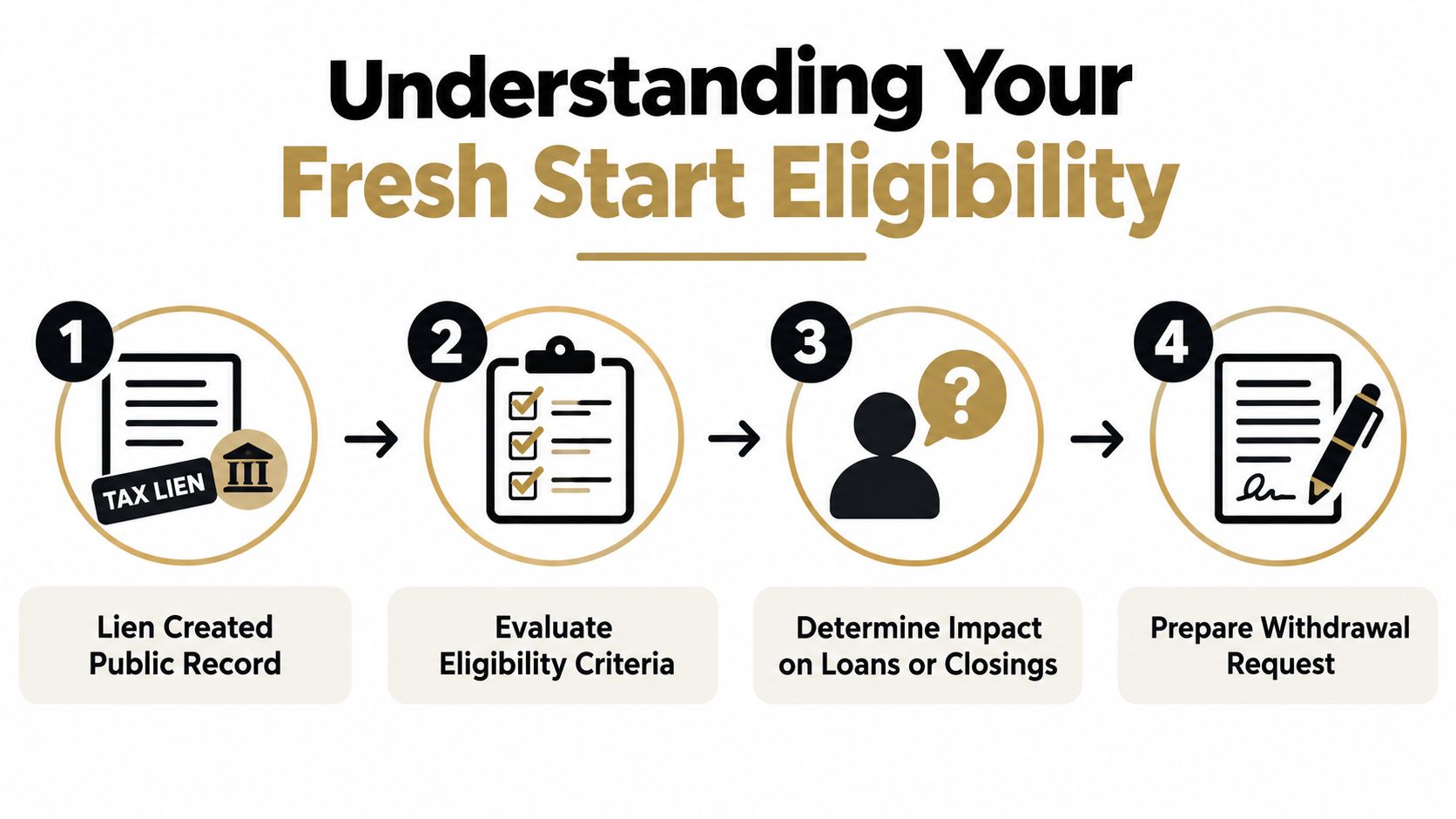
A business owner refinancing a building may have only one practical question: can the lien issue be resolved before the lender rejects the deal? The analysis begins with the IRS's Fresh Start framework, established on February 24, 2011, in its federal tax lien guidance. That framework made administrative withdrawal more available in qualifying cases, including situations where the tax has not been paid in full.
Start with the balance and the payment structure
The IRS generally permits withdrawal for qualifying taxpayers with unpaid assessments of $25,000 or less who enter a Direct Debit Installment Agreement, convert an existing agreement to direct debit, or already maintain a qualifying direct-debit arrangement. The agreement must pay the liability in full within 60 months or before the collection statute expires, whichever comes first. The taxpayer must also remain current with filing and payment obligations.
These conditions create an early decision point. A taxpayer seeking to improve the public record while continuing payments may fit the withdrawal framework. A taxpayer who needs the debt eliminated before a closing may need a different solution, depending on the transaction and the government's claim.
The payment arrangement must support the requested outcome, not merely appear on paper. A balance within the threshold does not by itself make withdrawal appropriate, and a qualifying plan does not guarantee that a lender or closing attorney will accept withdrawal as sufficient for the deal.
For a broader explanation of how the IRS's collection options fit together, review this overview of the Fresh Start program. It places lien withdrawal within the wider Fresh Start framework and helps clarify why eligibility should be assessed alongside the intended payment structure and transaction.
Use the right remedy for the right transaction
Before submitting a request, identify what the closing requires. Does the lender need the public notice removed, the lien released, or a particular property addressed? Withdrawal, release, and discharge have different effects, so the answer should guide the filing rather than follow it.
The detailed distinction between those remedies appears in the later section on withdrawal and lien release. That comparison is the right place to confirm whether withdrawal matches the deal before committing time to the request.
Requirements for the Direct Debit Installment Agreement
A withdrawal request depends on more than a plausible explanation. The IRS expects a payment arrangement that meets its requirements and remains current. For a business owner trying to close a real estate deal or obtain financing, the Direct Debit Installment Agreement must function as a reliable compliance record.
The payment plan has to do real work
The agreement must pay the liability within the permitted period, and the taxpayer must remain current with filing and payment obligations throughout the arrangement. Missed returns, missed installments, or a default can weaken the withdrawal request even when the original balance appeared eligible. The IRS's installment agreement guidance explains the payment conditions that support this process.
Three consecutive direct-debit payments are generally required before a withdrawal request can proceed. That history gives the IRS evidence that the arrangement is operating in practice rather than existing only on paper. A lender or closing attorney may also want confidence that the taxpayer can maintain the agreement after the transaction.
A clean file is usually the strongest file: current returns, regular payments, and no unexplained changes to the arrangement.
Use a pay-down to reach eligibility
A taxpayer who is above the applicable balance limit may be able to make a partial payment and bring the account within the qualifying range. For example, paying $3,000 toward a $27,500 balance would reduce it to $24,500. The payment does not itself guarantee withdrawal, but it can remove one barrier to requesting the remedy.
The practical question is whether the taxpayer can make that payment without causing a new default or weakening the remaining installment arrangement. Review the current balance, confirm that direct debit is active, and allow enough time for the payment to post before submitting the request. A rushed filing can create delay if the IRS cannot reconcile the account.
Timing matters when a closing depends on the public record. Waiting for a short, clean payment history may produce a stronger submission than filing immediately with an incomplete record. For taxpayers establishing or modifying the arrangement, this Form 9465 guidance can help confirm that the installment agreement is structured correctly before the withdrawal request is prepared.
Filing the Required Forms and Documentation
The IRS treats lien withdrawal as an administrative request, so the submission should function as a complete file. It must identify the taxpayer, the specific notice, the liability involved, and the rule supporting withdrawal. A reviewer should be able to confirm the requested remedy without reconstructing the case from scattered records.
Build the submission around eligibility
Form 12277 first, because the Application for Withdrawal of Filed Form 668(Y) is the formal request the IRS needs to identify the remedy sought. State the notice details accurately and make clear that the taxpayer seeks withdrawal, not a release of the underlying lien. That distinction matters when a lender, title company, or closing attorney is waiting for a particular result.
Attach the payment arrangement information that connects the application to the qualifying circumstances. Include the agreement terms, direct-debit details when relevant, and records showing that required payments are current. If a payment reduced the balance into the applicable eligibility range, identify that change plainly and provide documentation showing the updated account position.
The supporting records should prove the facts rather than force the reviewer to infer them. Include payment confirmations, the current balance, and any IRS correspondence that explains the taxpayer's status. Keep names, taxpayer identification details, notice numbers, and account information consistent across every document.
Organize the file before it goes out
A logical order makes the request easier to review and reduces avoidable clarification requests. Use section labels or a short index if the file contains several attachments.
- Form 12277 first, so the requested remedy is immediately clear.
- Agreement proof second, showing the arrangement on which eligibility depends.
- Payment history third, establishing compliance with that arrangement.
- Balance support last, documenting the account position and any qualifying reduction.
Check that the notice information matches the form and that every attachment supports a statement made in the request. Missing pages, inconsistent balances, or an unsigned form can delay review even when the taxpayer otherwise qualifies.
Taxpayers preparing a broader financial file for IRS collection work may also consult this Form 433-F guidance, which explains how financial documentation fits into the larger submission. The objective is a file that lets the IRS verify the requested withdrawal from the paperwork itself.
Differentiating Withdrawal from Lien Release
A real estate closing can stall when a buyer's attorney hears “the lien will be withdrawn” and assumes the title issue is resolved. Withdrawal and release produce different legal and practical results, so the remedy must match what the lender, title company, or buyer actually requires.
Withdrawal removes the public notice
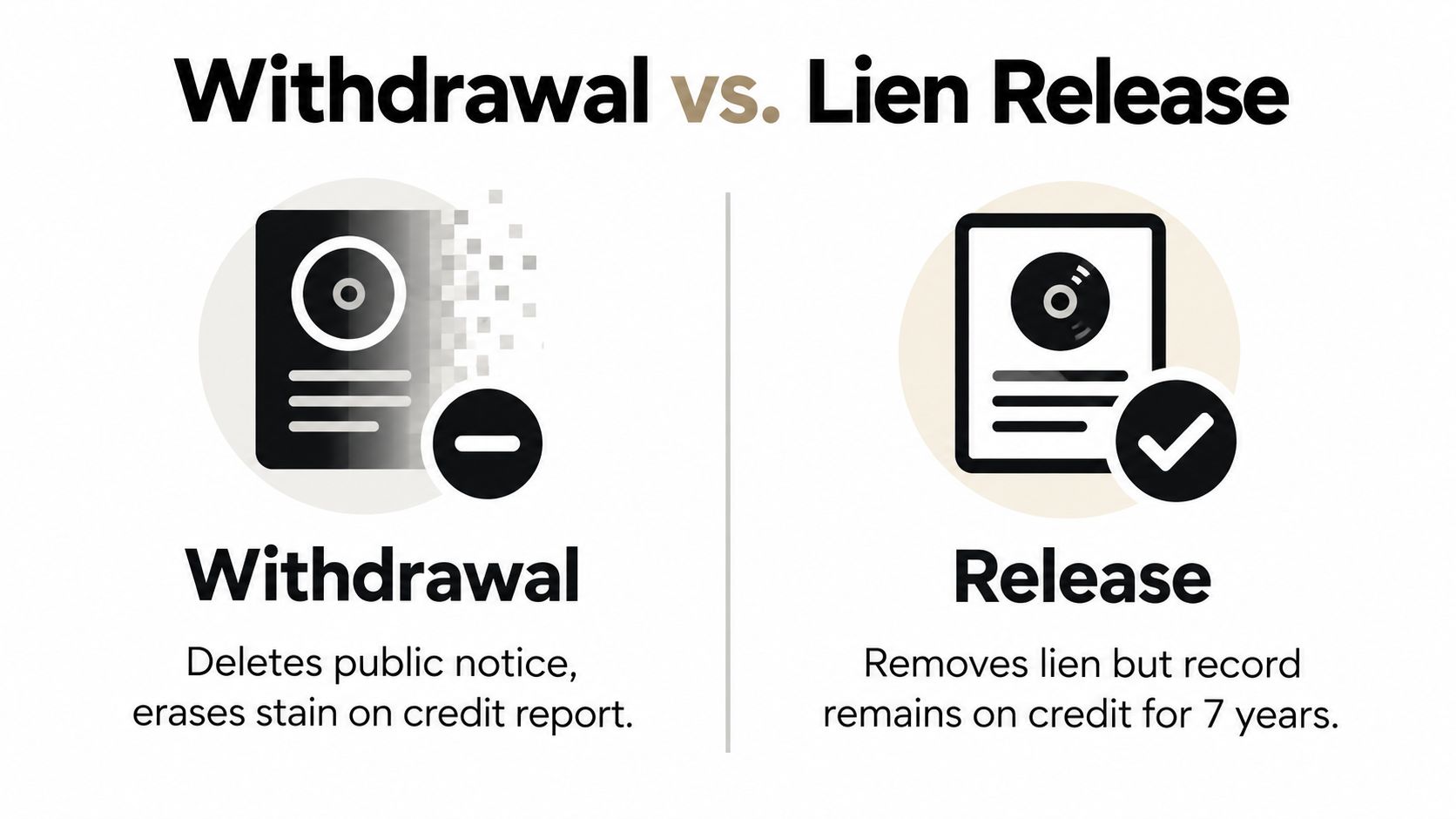
Withdrawing a Notice of Federal Tax Lien removes the filed public notice and abandons the IRS's priority against other creditors. The underlying tax debt remains, and the federal lien itself is not extinguished, as explained under IRS Publication 594.
That distinction matters in lending and real estate transactions. A withdrawal may address a recorded notice that affects underwriting or a title review, while the IRS can still retain its claim under the lien. Ask the closing team precisely what documentation it needs before selecting this remedy.
A release follows a different path. The IRS generally releases a lien within 30 days after the liability has been fully paid. Full payment may therefore provide the cleaner solution when the taxpayer can satisfy the balance and the transaction requires the lien itself to end. A taxpayer paying through an installment arrangement may instead seek withdrawal when the immediate objective is removal of the public filing.
Practical distinction: withdrawal clears the public notice while payments continue; release extinguishes the lien after full payment. Match the remedy to what the lender actually needs.
Consider discharge for a property sale
A sale may require a certificate of discharge when the tax debt exceeds the available sale proceeds. IRS discharge guidance addresses property-specific relief that can permit a parcel or other asset to transfer free of the lien under IRS conditions, while the remaining debt continues to be addressed.
The transaction determines the appropriate lane. Withdrawal may resolve a public-record concern, release follows full payment, and discharge can address one property without resolving the entire liability. Choosing the wrong remedy can leave the closing stalled while the taxpayer seeks a correction.
Drafting a Strong Request Letter to the IRS
The request letter is not a formality. It frames the file, points the reviewer to the legal basis, and shows that the taxpayer understands exactly what relief is being asked for. In a lien case, clarity is strength.

Keep the letter direct and specific
Open with the taxpayer's name, address, and the relevant IRS notice information. Then identify the request as one for withdrawal of the Notice of Federal Tax Lien and state the basis, such as qualifying direct-debit installment agreement status. If the balance was reduced to meet the threshold, say so plainly.
A strong letter usually covers four things:
- What is being requested, withdrawal of the filed notice.
- Why the taxpayer qualifies, the direct-debit arrangement and compliance history.
- What supporting records are enclosed, payment history, agreement details, and balance proof.
- What transaction is pending, refinancing, sale, or another closing-driven need.
That last point should stay factual. The IRS doesn't need a hard sell, it needs a clean reason the taxpayer is asking now. When the letter is organized, the reviewer can match it to the IRS file faster.
Match the tone to the file
Professional letters work better than emotional ones. A sentence like “The taxpayer requests withdrawal in accordance with applicable Fresh Start lien rules” does more work than a paragraph about frustration. The IRS already knows the notice exists. What it needs to see is that the request lines up with the rules and the taxpayer is still compliant.
Some taxpayers handle this themselves, while others use counsel because the transaction is tied to a sale, refinance, or business closing. In those matters, Tax Attorney Stephen A Weisberg is one option for preparing the withdrawal request and coordinating the IRS file with the transaction timeline. A good letter won't guarantee success, but it can keep an already-eligible request from getting buried in administrative confusion.
Next Steps If Your Withdrawal Is Denied
A denial doesn't always mean the door is closed. It often means one part of the file was weak, the payment history slipped, or the paperwork didn't show the IRS enough to approve the request. The response should be targeted, not emotional.
Fix the reason for denial before refiling
If the issue was incomplete documentation, gather the missing proof and resubmit a cleaner package. If the problem was noncompliance, correct the missed filing or payment issue first. If the balance no longer fits the eligibility rules, the taxpayer may need to adjust the payment structure before another request makes sense.
Denials are also a signal to reassess the remedy. A closing that can't wait may need a different tool, and a transaction that depends on title clearance may need discharge or release instead of withdrawal. That is usually the moment to revisit the whole file rather than keep pushing the same request.
For taxpayers who need a formal challenge path, this IRS tax appeals resource is a practical next stop because some collection decisions can be reviewed through administrative channels. The important thing is to act quickly and keep the file moving.
If the IRS says no, read the reason first. The fastest way forward is usually correcting the defect the IRS actually cited, not re-arguing the entire case.
If you need a withdrawal request tied to a refinance, sale, or business closing, Tax Attorney Stephen A Weisberg works on IRS debt resolution, lien problems, and transaction-driven cleanup. Visit Tax Attorney Stephen A Weisberg to review your options and get help aligning the IRS remedy with the deal you need to close.


