IRS Tax Debt Help 2026: Resolve Your Tax Problems
Overwhelmed by IRS debt? Get expert IRS tax debt help in 2026. Explore solutions like OIC & payment plans to resolve your tax problems for good.

In this article
- Your First Step Toward Tax Debt Freedom
- What a Tax Debt Analysis Reveals
- What Kind of IRS Tax Debt Are You Facing?
- Individual Income Tax Debt
- Business Income Tax vs. Payroll Tax Debt
- The Trust Fund Recovery Penalty
- Comparison of IRS Tax Debt Resolution Options
- Offer In Compromise: The High-Stakes Settlement
- Installment Agreements: The Steady Repayment Plan
- Currently Not Collectible: A Temporary Pause Button
- Penalty Abatement: Forgiving The Extras
- How to Navigate IRS Collections and Audits
- The Heavy Price of Inaction
- When It All Starts with an Audit
- How to Prepare for an Audit
- Knowing When You Absolutely Need a Tax Attorney
- Clear Red Flags That Demand an Attorney
- The Unique Power of a Tax Attorney
- A Few Common Questions I Hear About IRS Tax Debt
- How Long Does It Take to Resolve IRS Tax Debt?
- Will the IRS Really Settle for Pennies on the Dollar?
- Can I Go to Jail for Not Paying My Taxes?
That formal notice from the IRS showing up in your mailbox can make your heart stop. It's a paralyzing feeling. But the most important thing to do in that moment is not to panic. The real first step is to get a crystal-clear picture of what you're actually dealing with. This is the only way to find the right IRS tax debt help and move from a state of fear to a position of control.
Your First Step Toward Tax Debt Freedom

An IRS notice isn't just a bill—it's a sign of a complex problem that gets worse over time, thanks to compounding interest and penalties. The absolute worst thing you can do is ignore it. That just opens the door for the IRS to get more aggressive with liens and levies.
Your journey out of this mess starts with one single, foundational step: a comprehensive analysis of your tax debt.
Think of it like this: you can't fix a car engine without first popping the hood to see what's wrong. You can't prescribe a cure without a diagnosis. This initial review is your diagnostic test, and it's the bedrock of any successful plan to resolve your tax problem.
What a Tax Debt Analysis Reveals
A proper analysis gets right to the heart of your situation. It's the only way to know for sure if this is something you can handle on your own or if you need to bring in a professional. Getting a handle on your options for tax debt relief starts right here.
This review will tell you:
- The Exact Amount Owed: Not just the original tax, but every penny of accrued penalties and interest.
- The Type of Debt: Is this personal income tax? Business payroll tax? Something else? Each type has its own set of rules and consequences.
- The Collection Stage: Are you just getting letters, or are they already threatening to seize your assets with a lien or levy?
Getting the facts on these three elements is non-negotiable. It gives you the clarity to evaluate your options and build a realistic plan. Without this information, you're just guessing, and that’s a terrible strategy when dealing with the IRS.
This initial diagnostic step is what separates a panicked reaction from a strategic response. Once you have this information in hand, you can start looking at real solutions that fit your specific circumstances.
To dig deeper, you can learn more about how to settle tax debt with the IRS in our detailed guide. Taking this first step demystifies the process and gives you a clear starting line for taking back your financial future.
What Kind of IRS Tax Debt Are You Facing?
When a client walks into my office with an IRS notice, the very first question I ask isn’t “How much do you owe?” It’s “What kind of tax do you owe?” It’s a distinction that most people don’t think about, but it changes everything.
Getting to the root of your tax problem is a bit like a doctor making a diagnosis. You can't just treat the symptoms; you have to know the underlying illness. The IRS has a completely different playbook for collecting individual income tax versus, say, the far more dangerous payroll tax debt. Knowing which one you’re up against is the critical first step toward a real solution.
Individual Income Tax Debt
This is the one most people are familiar with. It’s the most common type of tax debt I see, and it can happen to anyone. Maybe you’re a freelancer who fell behind on quarterly payments, you sold some stock and were surprised by the capital gains tax, or your employer simply didn't withhold enough from your paycheck.
While no tax debt should be taken lightly, the IRS generally views this type as the least severe. There are usually several well-established resolution paths available. But don't let that fool you into inaction. Ignoring it will only lead to penalties and interest piling up, and can eventually result in serious collection actions. You can learn more in our guide on how to handle an IRS tax lien.
Business Income Tax vs. Payroll Tax Debt
This is where the stakes get much, much higher for business owners. The IRS draws a hard, bright line between the tax on your profits and the tax you handle for your employees.
Business Income Tax: This is the tax owed on your company’s net income. Whether you run a sole proprietorship or an S-corp, this is essentially the business equivalent of individual income tax. Collection efforts are typically aimed at the business's assets.
Payroll Tax Debt: This is a whole different animal. This isn't your money. It's the Social Security and Medicare taxes you withheld from your employees' paychecks. You were just holding it for safekeeping before sending it to the U.S. Treasury.
The moment you fail to remit that payroll tax, the IRS stops seeing it as a debt and starts seeing it as theft. In their eyes, you've spent money that was being held "in trust" for the government. That’s why they pursue it with an intensity that surprises many business owners.
This issue is a massive contributor to the nation's "tax gap"—the staggering difference between what the IRS is owed and what's actually paid. The latest IRS estimates put that gap at $696 billion. A huge chunk of that comes from unpaid employment taxes, showing just how common and serious this problem is. You can read the government's own analysis on the IRS tax gap analysis page.
The Trust Fund Recovery Penalty
If payroll tax debt is the disease, the Trust Fund Recovery Penalty (TFRP) is the IRS’s most potent, and frankly terrifying, cure.
This is the tool the IRS uses to pierce the corporate veil. Because those payroll taxes were held in trust, the IRS can use the TFRP to hold individuals personally responsible for the business’s debt. It doesn't matter if you're an LLC or a corporation.
And it isn't just the owner who is on the hook. The IRS can designate anyone they deem a "responsible person" as liable. This could be:
- Business owners and partners
- A CEO, CFO, or other corporate officer
- An office manager or bookkeeper with check-signing authority
- Even, in some cases, a volunteer board member at a nonprofit
The TFRP makes the business’s tax problem your personal tax problem. This debt follows you, can't easily be discharged in bankruptcy, and gives the IRS the power to seize your personal bank accounts, garnish your wages, and lien your home. This is why unpaid payroll tax is a true financial emergency that requires immediate expert help.
Alright, so you know what kind of tax debt you're up against. Now what? The good news is that you have options. The IRS isn't just a faceless collection agency; it has several established programs to help taxpayers get back on solid ground.
Figuring out which path to take is where most people get stuck, but it doesn't have to be overwhelming. Think of these programs as different tools—the right one for the job depends entirely on your financial reality. Let's walk through the main options so you can see which one makes the most sense for you.
Comparison of IRS Tax Debt Resolution Options
To get a clearer picture, it helps to see these options side-by-side. Each one is designed for a different financial scenario. This table breaks down who each program is for, what it takes to qualify, and the key pros and cons.
| Resolution Option | Best For | Key Requirement | Primary Advantage | Main Drawback |
|---|---|---|---|---|
| Offer in Compromise (OIC) | Those with a proven inability to ever pay the full tax debt. | Showing the IRS you can't pay through a deep financial analysis. | Settle the debt for significantly less than what you owe. | Very low acceptance rate; intrusive and lengthy application process. |
| Installment Agreement (IA) | People who can afford to pay their debt over time. | A steady income that can cover monthly payments. | Stops aggressive collections and provides a predictable payment plan. | Interest and penalties continue to add up until the balance is paid. |
| Currently Not Collectible (CNC) | Individuals facing extreme, temporary financial hardship. | Proving that paying the tax would prevent you from covering basic living expenses. | Pauses all collection activity, including levies and phone calls. | The debt doesn't disappear and continues to grow with interest/penalties. |
| Penalty Abatement | Taxpayers with a good compliance history who have a valid reason for their tax issue. | Demonstrating "reasonable cause" or qualifying for First-Time Abatement. | Can erase thousands of dollars in penalties from your total balance. | Does not reduce the original tax owed or the interest charged on it. |
Understanding these distinctions is the first step. Each program solves a different piece of the puzzle, and knowing which one fits your situation is critical before you ever fill out a form or call the IRS.
Offer In Compromise: The High-Stakes Settlement
The Offer in Compromise (OIC) is the one everyone's heard about. It's the "pennies on the dollar" settlement that allows you to resolve your tax liability for less—sometimes much less—than what you originally owed. It sounds like the ultimate deal, but it's crucial to understand the hard truth.
An OIC isn’t for people who just find their tax bill inconvenient. It’s for taxpayers who can prove to the IRS that they will likely never be able to pay the full amount. The application is a financial colonoscopy, demanding a deep dive into your income, expenses, assets, and what you might earn in the future.
The official numbers tell the story. In fiscal year 2026, the IRS collected a staggering $120.2 billion in unpaid taxes. In that same year, taxpayers submitted 33,591 Offers in Compromise, but the IRS only accepted 7,199 of them. That’s a tough 21% acceptance rate. It's not impossible, but you're fighting an uphill battle.
Installment Agreements: The Steady Repayment Plan
If an OIC is for those who can't pay, an Installment Agreement (IA) is for those who can pay—just not all at once. This is by far the most common way people resolve tax debt. It lets you make predictable monthly payments over a period of up to 72 months.
Not all Installment Agreements are the same. For smaller debts, you might be able to set up a plan online in just a few minutes. For larger balances, the IRS will want to see more financial paperwork before they agree to a plan.
Think of an Installment Agreement as a structured loan repayment plan with the IRS. It stops aggressive collection actions like levies and garnishments as long as you make your payments on time. However, interest and penalties will continue to accrue on your remaining balance until it's paid in full.
These payment plans are often part of a larger set of relief measures. You can learn more about these options in our guide on the IRS Fresh Start Program.
The flowchart below shows how tax issues are generally classified, starting from that first notice in the mail.
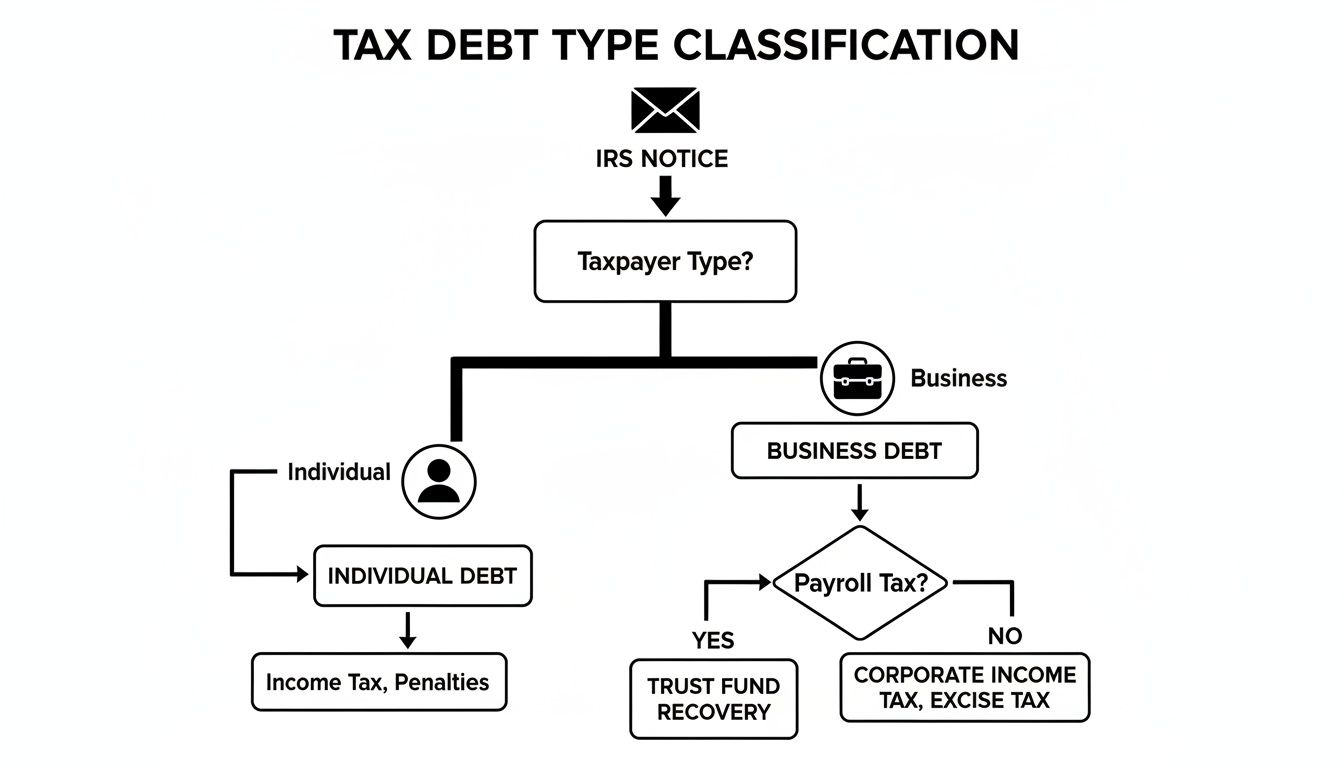
As you can see, the path forward really depends on whether the debt belongs to an individual or a business, as this distinction determines which programs are on the table.
Currently Not Collectible: A Temporary Pause Button
For taxpayers in a true financial crisis, the IRS offers Currently Not Collectible (CNC) status. This isn’t a get-out-of-jail-free card; it's a temporary pause on collections. If you can prove you can't afford basic living expenses, let alone your tax bill, the IRS will place your account in CNC status.
This means the threatening letters and collection actions will stop. However, the debt itself doesn't go away. In fact, interest and penalties keep piling up, and the IRS will check in on your financial situation periodically to see if you can start paying again.
Penalty Abatement: Forgiving The Extras
Sometimes, the original tax bill is manageable, but the penalties have made it balloon into an impossible figure. Penalty Abatement is a formal request to have the IRS remove those penalties. To get this relief, you have to show a "reasonable cause" for why you couldn't file or pay on time.
What counts as reasonable cause?
- A serious illness or death of the taxpayer or an immediate family member.
- Your records were destroyed in a fire, flood, or another disaster.
- You relied on bad advice from a tax professional who led you astray.
There's also a First-Time Penalty Abatement option for taxpayers who have a clean record. This can offer huge relief, but remember, it only removes the penalties—not the original tax you owe or the interest. Of course, in this situation, it's also fair to wonder whether federal tax debt can be written off by filing bankruptcy, which is a separate and highly complex legal strategy.
How to Navigate IRS Collections and Audits
If there’s one piece of advice I can give you, it’s this: don’t ignore letters from the IRS. Tossing those notices aside is the fastest way to escalate your problem from a simple automated warning to a full-blown collections case.
Once the computer system flags your account for non-response, your file gets handed to a real person in the IRS Collections division. Their job is simple: get the money you owe. This is the moment the abstract threat of tax debt becomes very, very real.
The Heavy Price of Inaction
When you don't respond or try to work something out, the IRS has the green light to start what they call "enforced collections." These aren't just empty threats on a letterhead; they are powerful, real-world actions that can have immediate and devastating financial consequences.
Federal Tax Lien: Think of this as the IRS putting a public claim on everything you own—your house, your car, even future assets you acquire. It’s a red flag to any lender, absolutely crushing your credit and making it nearly impossible to sell property or get a loan until the debt is settled.
IRS Levy: This is where the IRS physically takes your assets. A levy isn't a claim; it's a seizure. Most often, this takes the form of wage garnishments that take a chunk out of every paycheck or, even more jarringly, a bank levy that can freeze and empty your accounts overnight.
A levy is the most aggressive tool the IRS has. We've seen clients wake up to find their life savings completely gone from their bank account. It’s a brutal reality for people who ignore their tax debt, but it happens. Our firm has deep experience intervening to stop IRS bank account levies and protect our clients' financial stability.
The whole point of these actions is to force you to pay attention. The key is to get ahead of the problem and engage with the IRS before it gets anywhere near this stage.
When It All Starts with an Audit
For many people, a huge tax bill starts with an IRS audit. An audit is just an official review of your tax return. The IRS wants to double-check that your income, deductions, and credits are all reported accurately. Getting an audit notice doesn't mean you're a criminal, but it does mean a computer or an agent saw something that needs a closer look.
Don't underestimate the scale of IRS enforcement. In fiscal year 2026, the agency processed over 266.6 million tax returns and brought in more than $5.1 trillion in gross taxes. During that same time, it closed 505,514 audits that resulted in an additional $29.0 billion in recommended taxes. That shows just how often these reviews turn up issues that lead directly to a new, significant tax debt. You can dig into these numbers yourself by looking at the IRS's own statistical data.
How to Prepare for an Audit
If you get that dreaded audit notice in the mail, take a breath. Your first move is to read it carefully and understand exactly what the IRS is questioning. The notice will clearly state the tax year and the specific items on your return under review. Whatever you do, don't volunteer extra information or start over-explaining things they haven't asked about.
Here’s your game plan:
- Gather Your Proof: Start collecting every piece of paper that supports the items being audited. This means receipts, bank statements, invoices, mileage logs—anything that proves your numbers are correct.
- Know Your Rights: You are not powerless in this situation. As a taxpayer, you have a set of rights, including the right to have professional representation and the right to appeal any IRS decision you disagree with.
- Get Professional Help: This is not the time to go it alone. An experienced tax attorney can step in, handle all communications with the auditor for you, and build a strategy. They know how to present your case properly, avoiding costly mistakes and protecting you from an unfair outcome.
Dealing with collections and audits can feel like trying to cross a minefield. One wrong step can have disastrous financial results. Having a professional advocate who knows the terrain can make all the difference in keeping your assets safe and finding the best possible resolution.
Knowing When You Absolutely Need a Tax Attorney

Sure, you can probably set up a simple payment plan yourself if you owe a small amount. But there's a definite line you can cross where trying to DIY your tax problem becomes a massive risk. Going up against the IRS on a complex issue without legal counsel is like trying to argue a court case without a law degree—you’re outmatched from the start.
People often ask about the difference between a CPA and a tax attorney. Think of it this way: A CPA is your expert for tax preparation and financial planning, helping you file correctly. A tax attorney is your advocate and legal strategist when you’re in a real dispute with the IRS. They're trained for conflict.
Clear Red Flags That Demand an Attorney
When the IRS gets serious, you need a legal shield. While every case is different, some situations are non-negotiable—they scream "get a lawyer." In these high-stakes scenarios, professional IRS tax debt help from an attorney isn't a luxury; it's essential.
If you see any of these signs, it's time to make the call:
Your Debt Exceeds $25,000: Once your tax bill hits this threshold, the IRS starts paying much closer attention. Your resolution options get more complicated, and the risk of aggressive collection tactics like property liens and bank levies goes way up.
You Face Payroll Tax Debt: We've said it before, but it bears repeating: this is the most dangerous kind of tax debt. The IRS can hold you personally liable with the Trust Fund Recovery Penalty (TFRP). You need specialized legal expertise to navigate this minefield.
You Have Multiple Unfiled Tax Returns: This isn't just an oversight. The IRS sees a pattern of non-compliance and will act accordingly. An attorney can help you get caught up on your filings while simultaneously building a defense to manage the debt that comes with it.
You Are Facing an IRS Audit or Criminal Investigation: If you get an audit notice, especially for a business or complex individual return, an attorney can take charge of the process. If there's even a whisper of a criminal investigation, you should immediately stop talking to the IRS and hire a lawyer. Period.
The Unique Power of a Tax Attorney
Bringing a tax attorney onto your team gives you protections and leverage that no other professional can provide. These aren't just minor perks—they are fundamental to defending your rights and securing the best possible outcome.
The biggest game-changer is attorney-client privilege. This creates a legal fortress around your conversations, preventing the IRS from demanding to know what you and your lawyer discussed. You can be 100% transparent about every detail of your situation, knowing it can't be used against you. This powerful protection doesn't exist with a CPA or an Enrolled Agent.
A tax attorney does far more than just fill out forms. They are seasoned negotiators and litigators who understand the IRS appeals process inside and out. If it comes to it, they can represent you in U.S. Tax Court, a place a CPA can’t go.
Here's a quick breakdown of who does what:
| Professional | Key Strengths | Limitations |
|---|---|---|
| Tax Attorney | Attorney-client privilege, negotiation with IRS agents, representation in U.S. Tax Court, handling criminal tax matters. | Not primarily focused on routine tax preparation. |
| CPA | Expert in tax preparation, accounting, and financial planning. | No attorney-client privilege, cannot represent clients in Tax Court, limited experience in debt controversy. |
| Enrolled Agent (EA) | Licensed by the IRS to represent taxpayers. | No attorney-client privilege, cannot represent clients in Tax Court or handle criminal matters. |
At the end of the day, you hire a CPA to keep your finances in order and file your taxes correctly. You hire a tax attorney to be your defender when you're in a fight with the IRS. When the stakes are high, you don't need an accountant—you need an advocate.
A Few Common Questions I Hear About IRS Tax Debt
When you’re staring down a tax problem, the questions and what-ifs can be overwhelming. Getting professional IRS tax debt help is a critical step, but sometimes you just need a few straight answers to the worries keeping you up at night.
Let's tackle some of the most common and stressful questions I hear from clients. My goal is to clear up the confusion so you can see a way forward.
How Long Does It Take to Resolve IRS Tax Debt?
This is the big one, and the honest answer is: it completely depends. The timeline is tied directly to the solution we pursue and the complexity of your financial picture. There's no magic wand here.
For something straightforward like an Installment Agreement on a smaller balance, you might get it set up online in just a few minutes. If it requires some back-and-forth negotiation, it could take a couple of months. It’s usually the quickest path if you can afford the monthly payments.
However, more involved solutions are a marathon, not a sprint. An Offer in Compromise (OIC), for example, is an incredibly detailed and, frankly, invasive process. It can take weeks just to gather the mountain of paperwork required. Once it’s submitted, you’re looking at a 6 to 12-month wait (sometimes longer) for the IRS to make a decision. Patience is an absolute necessity.
Will the IRS Really Settle for Pennies on the Dollar?
You’ve probably seen the ads. While the "pennies on the dollar" slogan makes for great marketing, the reality is far more difficult. The program that makes this possible is the Offer in Compromise, and it's reserved for people in serious financial trouble.
The IRS isn’t interested in making a deal just to be nice. To get an OIC approved, you have to open up your entire financial life and prove that you simply do not have the money or assets to ever repay your debt in full. It’s not about what’s convenient; it’s about your provable inability to pay.
The numbers don't lie. The historical acceptance rate for OICs has hovered around 21%. It shows just how high the bar is. It's a legitimate path for those who truly qualify, but it is absolutely not the easy way out that some promoters claim it is.
Can I Go to Jail for Not Paying My Taxes?
Let's clear this up right away, because it's the fear that causes the most anxiety. For the vast majority of people with tax debt, the answer is no. Jail time is not a consequence of simply being unable to pay your taxes.
Criminal tax prosecution is reserved for willful tax evasion. To get a conviction, the government has to prove you intentionally set out to defraud them. We're talking about things like:
- Using a fake Social Security number or creating phony invoices.
- Hiding money in offshore accounts or under sham business names.
- Outright lying to an IRS agent during an audit or investigation.
If you’re an honest person who fell behind, made a mistake, or simply can’t afford to pay what you owe, the consequences are financial, not criminal. The IRS can issue penalties, place a lien on your house, or levy your bank account, but they aren't going to send you to jail.
Navigating these complex questions and finding the right path forward requires expertise. At Attorney Stephen A Weisberg, I start with a FREE Tax Debt Analysis to determine the best strategy for your specific situation before you commit to anything. Learn more and get your no-cost analysis at https://weisberg.tax.


