IRS Statute of Limitations on Collections Explained
Learn how the IRS statute of limitations on collections works, including the 10-year CSED rule, tolling events, and what to do if the clock is running out
In this article
- Why the IRS Collection Clock Matters More Than You Think
- The tax year isn't the starting point
- How the Collection Period and Assessment Period Differ
- Identify the assessment before counting
- Why older assessments need care
- Events That Pause or Extend the Collection Clock
- Put every tolling event on the timeline
- How to Reconstruct Your Real CSED from IRS Transcripts
- Build the record before choosing a strategy
- Keep one calculation per assessment
- Why Business Owners Face Multiple Independent Clocks
- Separate the entity from the individual
- Map every taxpayer and every assessment
- A Worked Example of an Adjusted CSED Calculation
- Use documented dates, not a guessed total
- Why Waiting Out the Clock Rarely Works
- Decide based on the account, not the slogan
- Your Next 30 Days and When to Call a Tax Attorney
The IRS generally has 10 years from the date each tax liability is assessed to collect it. That deadline, called the Collection Statute Expiration Date (CSED), runs separately for each assessment and may be paused or extended during events such as pending installment-agreement requests, offers in compromise, and bankruptcy.
You may be looking at a final collection notice and thinking the IRS should have given up years ago. Perhaps you remember when you filed the return, or when the tax was due, and have counted forward from there. That's a common mistake: the collection clock ordinarily starts with the IRS assessment, not the tax year or the return's filing date.
The practical question isn't whether the debt is old. It's what assessment the IRS is collecting, when it was made, and what happened to the clock afterward. Each assessment can have its own CSED, so a calendar estimate can be wrong even when you know the tax year.
Why the IRS Collection Clock Matters More Than You Think
A self-employed taxpayer gets a final notice for an old income-tax balance and assumes the IRS has run out of time. They remember owing tax for a particular year and count forward from that year, or from when they filed the return. But an audit adjustment may have been assessed later, and a separate penalty may have its own assessment date. The notice alone doesn't answer how much time remains.
Under Internal Revenue Code §6502, the IRS generally has 10 years from the assessment date to collect a tax liability through administrative levy or a court proceeding. The deadline is called the Collection Statute Expiration Date, or CSED. The text of §6502 sets the federal collection rule, but applying it to a taxpayer's account takes more than identifying the tax year.
The tax year isn't the starting point
A return's due date, filing date, and the date the IRS first sends a bill aren't interchangeable with the assessment date. If the IRS makes more than one assessment for the same tax period, each one may carry its own CSED. That can happen when an original balance is followed by an audit adjustment or another separately assessed amount.
This is why I wouldn't tell someone their debt expires on a date calculated from memory. I'd first identify each assessment on the IRS account transcript, then account for later events that may have paused or extended the collection period. The answer may differ across tax years, and it may differ within a single year.
Practical rule: Don't make a payment-plan or settlement decision based on “the IRS has had this for ten years.” Find out when the particular liability was assessed and what happened afterward.
The CSED matters because it can affect both the IRS's collection authority and your choice of response. A levy notice, a proposed payment arrangement, and a settlement offer are not just paperwork. Each should be considered against the correct assessment history and the applicable collection deadline.
How the Collection Period and Assessment Period Differ
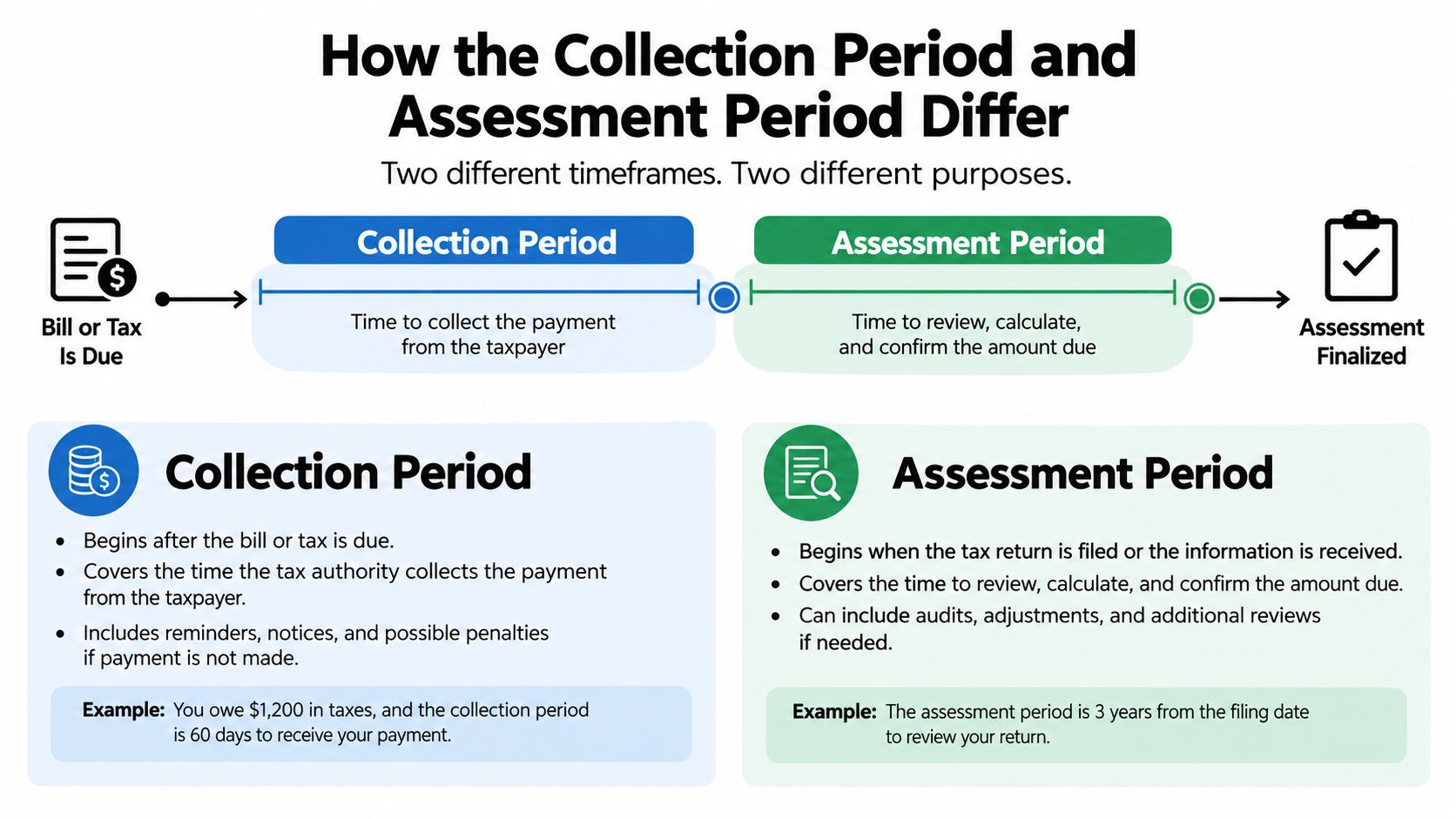
The assessment period and collection period measure different things. The assessment period concerns how long the IRS has to formally assess tax. The collection period concerns how long it generally has to collect an assessed liability. For a CSED calculation, focus on the collection period and identify each assessment separately.
Identify the assessment before counting
Use the assessment entry on the IRS account transcript, not the tax period printed on a notice. The IRS may assess tax after processing a return, then make another assessment following an audit or adjustment. A later assessment that creates additional liability may have a different CSED from the original balance. Check the date for each assessment.
The assessment date starts the general collection-period calculation. The CSED is the resulting expiration date, adjusted for any applicable suspension or extension. The IRS generally has 10 years from assessment to collect. Its collection guidance also describes the historical change to the general collection period. I would verify every assessment on the transcript before relying on a deadline.
Why older assessments need care
On November 6, 1990, federal law changed the general collection period from six years to ten years. IRS guidance states that liabilities assessed on or after that date are generally collectible for ten years from assessment. Older assessments whose six-year period had not expired by then were generally transitioned to the ten-year rule. Treat that date as a historical marker, not a shortcut for calculating an account's CSED.
For broader context on how limitation periods affect debt collection, an Athens debt relief attorney explains limitations, including state-law rules that differ from the federal assessment-by-assessment CSED analysis here. Use the IRS assessment history to work out a federal tax deadline.
Events That Pause or Extend the Collection Clock
A collection deadline can shift even when the assessment date is clear. Before relying on a CSED, identify events that suspended the clock or added time, and pin down each event's start, end, and outcome. The IRS's guidance on how long it can collect lists several events that can affect the period. A call or routine letter alone does not establish a suspension.
| Event | Effect on CSED | Rule to check |
|---|---|---|
| Pending installment-agreement request | The period is suspended while the IRS considers the request. A rejection, withdrawal, or proposed termination may add 30 days. | IRS collection-period guidance |
| Offer in compromise | The period may be suspended while the offer is pending. Record submission, processing, and appeal dates. | Offer-pending period |
| Bankruptcy | The period may be suspended during the case, with six months added after it concludes. | Bankruptcy tolling |
| Certain litigation | A timely court proceeding can affect the time available to collect. The dates and outcome matter. | Internal Revenue Code §6502 |
| Time outside the United States | Qualifying periods outside the country may suspend the collection period. | Absence from the United States |
Put every tolling event on the timeline
For an installment-agreement request, record when the IRS received it and when it was accepted, rejected, or withdrawn. If the IRS proposed termination, record that notice and the outcome too. A pending request and an approved agreement are different events; don't merge their dates or assume they affect the clock in the same way.
For an offer in compromise, keep the submission, decision, and appeal history together. For bankruptcy, use the filing and conclusion dates, then account for the additional six months. The result depends on the documented history for the specific liability, not just the event label.
These events do not all apply to every assessment. Build a separate chronology for each one, listing the event dates and the document that supports them. Keep agreement correspondence, offer records, bankruptcy docket entries, litigation papers, and travel records where relevant. For bankruptcy-related tax questions, review guidance on filing bankruptcy on tax debt with an attorney before assuming a filing pauses collection.
How to Reconstruct Your Real CSED from IRS Transcripts
A reliable CSED calculation starts with the account history. Don't estimate from the year printed on a bill, and don't rely on a single notice if the account includes an audit adjustment, amended return, penalty, or other later entry. Obtain the IRS account transcript for each relevant tax period and match every assessment to the taxpayer who owes it.
Build the record before choosing a strategy
Request the account transcripts for the periods at issue. Wage and income transcripts may help with return information, but they aren't a substitute for account transcripts when the task is to trace assessments and collection activity. If you're represented, ask your representative to obtain and review the account records before you authorize a payment plan or submit an offer.
On each account transcript, identify the assessment entries and record the dates. IRS transaction codes can help organize what happened, but don't interpret a code in isolation. Match each entry to the underlying notice or account event, then note reversals, abatements, re-assessments, payments, and other changes that could affect the balance or the applicable CSED.
Don't turn a transcript into a deadline by reading one line and stopping. Reconcile the full assessment history and the events that may have suspended the period.
Keep one calculation per assessment
For every assessment, create a separate working line with:
- Taxpayer and liability: Identify whether the assessment belongs to an individual or an entity, and whether it concerns income tax, employment tax, a penalty, or another liability.
- Assessment date: Record the actual date shown in the account history and confirm what assessment it represents.
- Potential clock events: Add agreement requests, offers in compromise, bankruptcy, litigation, time outside the United States, and any other event that needs legal review.
- Documents and open questions: Keep the supporting notice, transcript entry, court record, or correspondence beside the date. Flag any unexplained reversal or re-assessment rather than guessing.
The IRS materials describe the CSED as ending the government's right to pursue collection of a liability, but the relevant clock depends on the particular assessment and taxpayer. That's one reason a guide to reading an IRS transcript can help you understand the record without substituting for a full CSED reconciliation.
Why Business Owners Face Multiple Independent Clocks
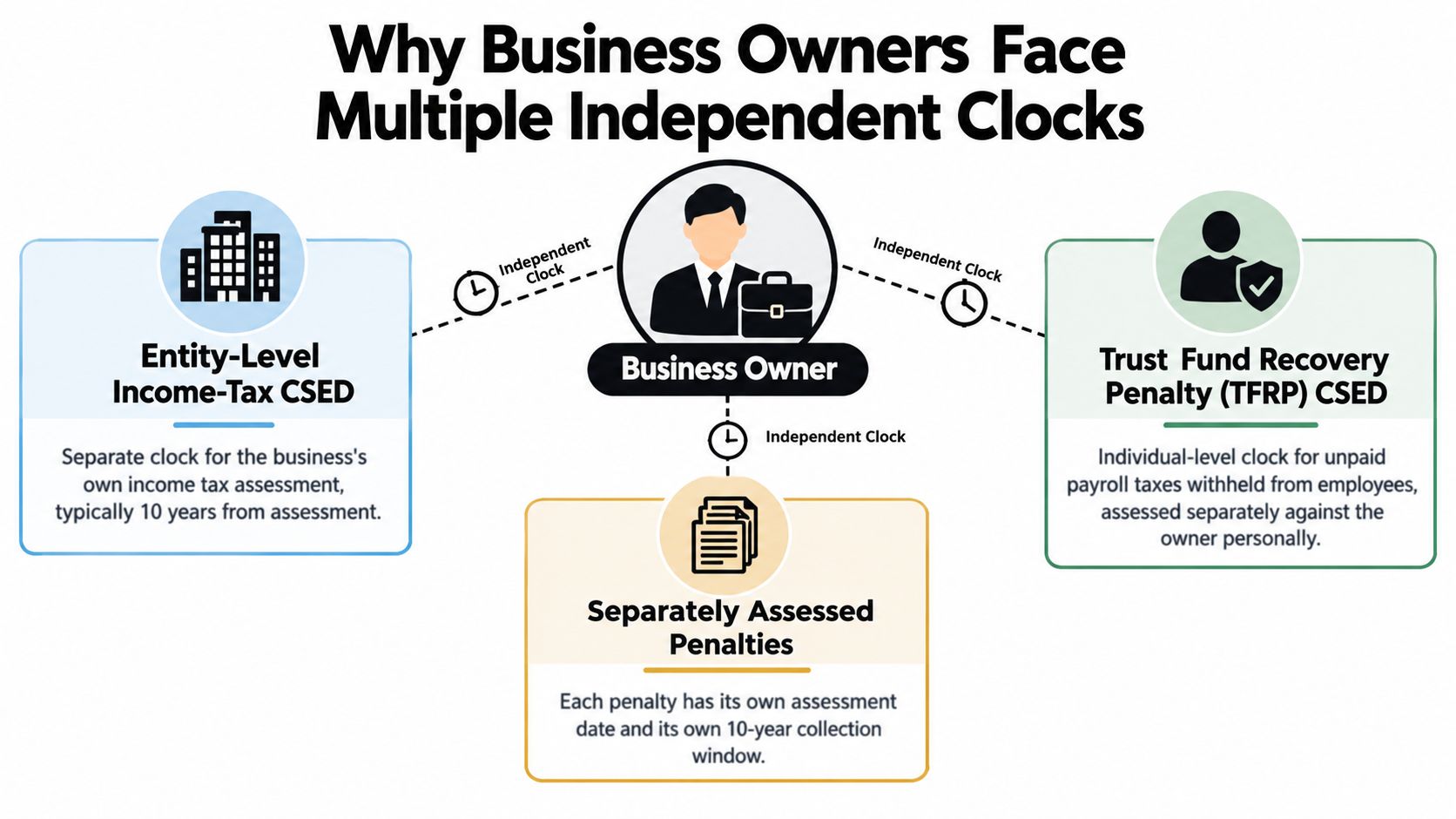
A business owner can have one collection clock for an entity's tax liability and a different clock for an individual liability arising from payroll taxes. The business's oldest unpaid return doesn't determine every deadline. The question is who was assessed, for what liability, and on what date.
Separate the entity from the individual
An entity-level income-tax assessment belongs to the business taxpayer. A Trust Fund Recovery Penalty (TFRP), by contrast, may be separately assessed against an individual responsible for collecting, accounting for, or paying withheld payroll taxes. The business and the individual shouldn't be treated as though they share one account or one expiration date.
That distinction can matter to a sole proprietor, a single-member LLC owner, an S corporation shareholder, an officer, or another person involved in payroll decisions. A company's shutdown or bankruptcy doesn't automatically establish that an individual's liability has expired. The entity and the individual may have separate assessments, separate histories, and separate collection remedies.
For an overview of the personal-liability issue, see this explanation of the Trust Fund Recovery Penalty. The label “payroll-tax debt” doesn't tell you whose assessment the IRS is pursuing. Check the taxpayer identification and assessment record before drawing conclusions.
Map every taxpayer and every assessment
| Liability being reviewed | Whose clock to check | Why it may differ |
|---|---|---|
| Business income-tax assessment | The entity named on the assessment | The entity's assessment date and collection history control its CSED analysis. |
| Trust Fund Recovery Penalty | The individual assessed | The individual's liability is not automatically synchronized with the company's assessment. |
| Separately assessed penalties | The taxpayer named for each assessment | A separate assessment may carry its own date and collection period. |
IRS materials describe the CSED as ending the government's right to pursue collection of a liability, but the relevant clock depends on the particular assessment and taxpayer, not the business's oldest unpaid return. That analysis becomes urgent when a business is being sold or closed, when an owner is refinancing, or when divorce or bankruptcy decisions could affect the records and collection strategy.
Form 9465 instructions also require proposed installment payments to satisfy the liability within 72 months or by the CSED, whichever is earlier, while noting that the deadline may be suspended or extended. Don't infer that a company payment plan resolves an owner's separate liability. Compare each taxpayer's assessment and proposed arrangement independently.
A Worked Example of an Adjusted CSED Calculation
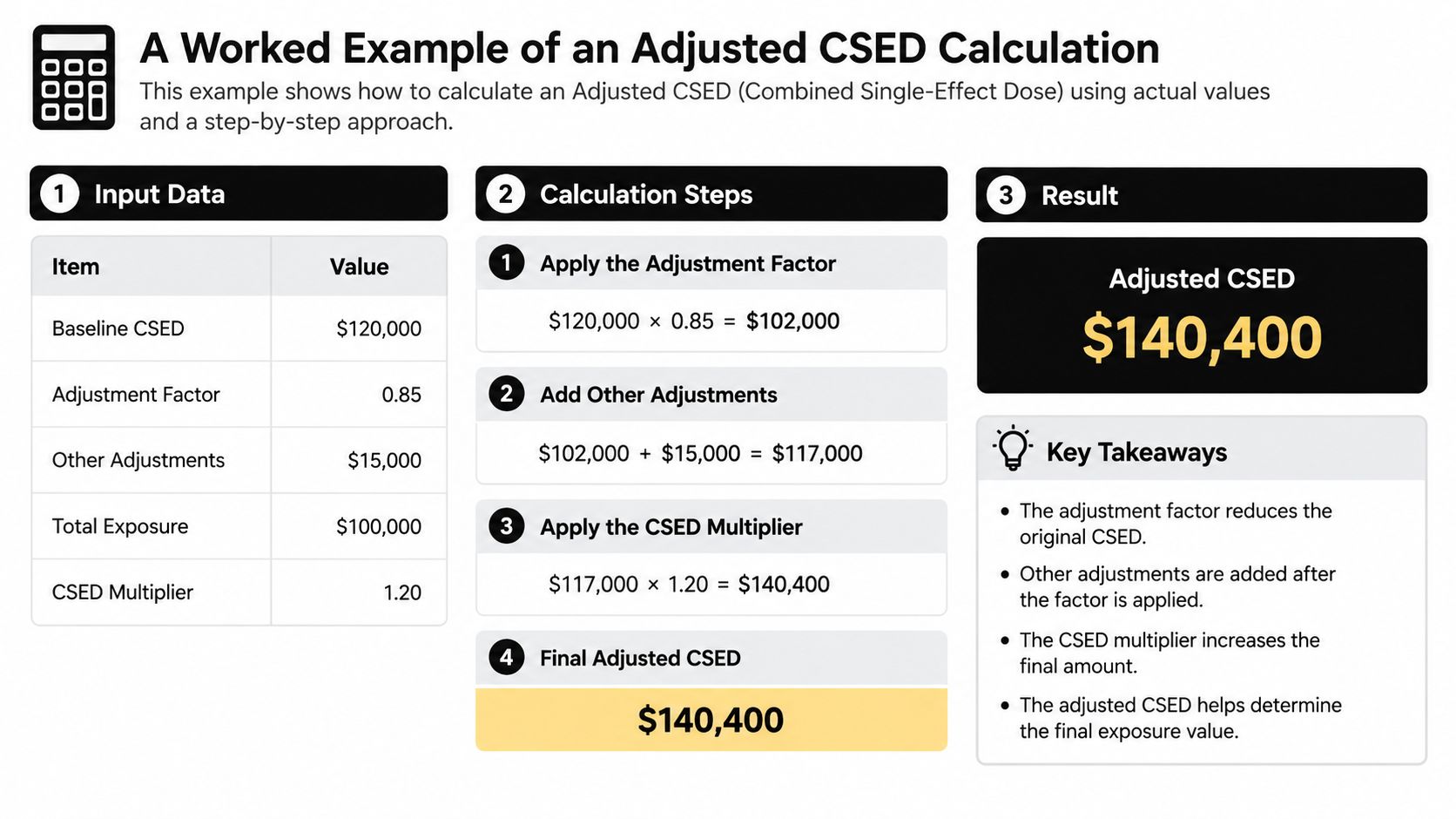
Consider a self-employed taxpayer with an income-tax assessment made in 2018. The ordinary ten-year calculation points to a 2028 CSED. The taxpayer later requests an installment agreement, and the request remains pending for a period of time. That time must be addressed in the calculation, rather than ignored because the account is still being paid or discussed with the IRS.
The supplied timeline infographic illustrates a separate hypothetical in which a two-year suspension shifts a 2028 original CSED to 2030. Treat that as an illustration of how suspended time can move an expiration date, not as a prediction about any particular taxpayer's account.
Use documented dates, not a guessed total
For an actual file, I'd start with the assessment date on the transcript and establish the ordinary CSED from that date. Then I'd identify each event that may suspend the period and calculate its effect from the documented start and end dates. If the installment-agreement request was pending, I'd include that period and check whether a withdrawal, rejection, or proposed termination added time.
If bankruptcy occurred, I'd map the case period and the additional time after the case concluded. If an offer in compromise was submitted, I'd identify when it was pending and whether an appeal followed. The record must support each interval; a taxpayer's recollection that an event “took a while” isn't enough to set an expiration date.
A clean worksheet might look like this:
| Calculation item | Record to verify |
|---|---|
| Assessment date and ordinary CSED | Account transcript and assessment history |
| Agreement-request suspension | Request, IRS decision, and any withdrawal or termination notice |
| Bankruptcy period | Court docket and case conclusion |
| Offer-in-compromise period | Submission, IRS disposition, and appeal documents |
| Adjusted CSED | Reconciled timeline, reviewed against the applicable rules |
The calculation can be different for another assessment made against the same taxpayer. It can also differ for a TFRP assessed against an officer in the same period. Don't apply one adjusted date across an entire business account unless the transcript and legal analysis support that result.
Why Waiting Out the Clock Rarely Works
“Just wait until the ten years are up” is not a plan. It assumes you know the correct assessment date, that no tolling event affected the deadline, and that the IRS hasn't started a timely court proceeding. It also overlooks the possibility of separate assessments against a business and an individual. Each assumption needs to be checked before waiting becomes a strategy.
The IRS may continue collection activity before expiration through payment demands, liens, levies, or judicial proceedings. Under §6502, a timely court proceeding can affect how long collection authority continues, so a taxpayer can't safely treat the original date as the whole story. An audit or separate penalty assessment can also create a different clock from the one the taxpayer has been counting.
Decide based on the account, not the slogan
If the CSED is close, compare realistic options before taking action. An offer in compromise may be appropriate when the taxpayer's circumstances support it, but submitting an offer can affect the collection period. A partial-pay installment agreement may be worth evaluating, but the payment terms should be compared with the CSED for each liability. Bankruptcy requires its own discharge and tolling analysis, not a blanket assumption that every tax debt disappears.
I wouldn't advise someone to ignore a levy notice or sign an agreement just because a debt feels old. I'd first verify the transcripts and event history, then weigh the collection risk against the effect of each proposed step. A payment arrangement isn't automatically helpful, and waiting isn't automatically safe. The right decision depends on the actual assessment-by-assessment timeline and the taxpayer's finances.
Your Next 30 Days and When to Call a Tax Attorney
Over the next 30 days, obtain account transcripts, list every assessment date, document each possible tolling event, and separate business liabilities from personal ones. Then compare any proposed payment plan with each verified CSED before signing. Get legal help if you have multiple periods, payroll-tax exposure, an audit, or active collection action; this guide to when to hire a tax attorney can help you assess the need. A Tax Debt Analysis should review transcripts and options before you commit.
Tax Attorney Stephen A Weisberg reviews IRS transcripts and CSED issues as part of The W Tax Group's free Tax Debt Analysis, so you can understand what the records show before paying for representation. If you need an assessment-by-assessment review of collection deadlines or help choosing a response, visit Tax Attorney Stephen A Weisberg.


