IRS Problem Resolution: A Taxpayer's Complete Guide
Navigate IRS problem resolution with this step-by-step guide. Learn about audits, liens, levies, and strategies to resolve your tax debt effectively.
In this article
- When the IRS Comes Knocking
- Understanding Your IRS Problem
- The notice tells you what lane you're in
- Why classification changes the remedy
- Navigating IRS Resolution Options
- Responding to Audits and Notices
- A disciplined response sequence
- The Reality of Offers in Compromise
- What makes an offer credible
- When to Hire a Tax Attorney
- A practical escalation test
- Taking Action for Peace of Mind
In fiscal year 2025, the IRS collected $117.5 billion in unpaid assessments, netting $73.1 billion after credit transfers, while it accepted only 5,464 Offers in Compromise totaling $98.1 million. Those figures show the practical answer: IRS problem resolution is real and substantial, but an Offer in Compromise is a narrow tool, not the default answer for every taxpayer.
You may be staring at an IRS notice on the kitchen table, wondering whether the next step is an audit, a lien, a bank levy, or a payment demand. The fear is understandable, but panic leads taxpayers toward the wrong response, often an expensive “tax debt relief” sales pitch that promises pennies-on-the-dollar results before anyone has reviewed the facts.
The IRS can escalate collection activity, including liens and levies, but most resolution pathways exist to help taxpayers address obligations through correction, payment, appeal, or negotiated relief. The right path depends on the problem in front of you: a billing error requires a different response from an active audit, and an audit requires a different response from a collection action.
When the IRS Comes Knocking
The notice usually arrives at the worst possible moment. A taxpayer opens the mailbox after a difficult week and finds an official envelope with the IRS name on it. The letter may say the agency changed a return, believes money is owed, wants documents, or intends to take collection action. The language is formal, the deadlines are easy to miss, and the consequences sound immediate.
A self-employed person might receive a balance-due notice after the IRS matched income reported by a client to a return that omitted a form. Another taxpayer might receive a notice about an audit selection, even though the return was prepared in good faith. A business owner may discover that a collection notice concerns payroll tax obligations, which can require more careful legal analysis than an ordinary individual income-tax balance.
The first practical rule is simple: don't treat every IRS letter as a tax-debt case. Read the notice number, tax period, stated issue, response deadline, and requested action. A taxpayer who responds to an assessment as though it were an audit can waste time. Someone who treats a levy warning like a routine correspondence matter can lose valuable room to act.

Practical rule: Preserve every envelope and page. The postmark, notice date, and response deadline can matter as much as the amount shown.
Collection deserves immediate attention when the notice mentions a federal tax lien, intent to levy, wage garnishment, or seizure. A levy can affect a bank account or wages, so taxpayers should understand the mechanics before assuming that a settlement advertisement is the answer. The IRS levy process for bank accounts is a useful starting point for recognizing the difference between a warning and an active collection event.
The situation is serious, but it isn't automatically hopeless. The IRS uses established procedures for correcting accounts, challenging assessments, arranging payment, requesting penalty relief, and evaluating hardship. Your first job is to identify which procedure applies before you choose who should help.
Understanding Your IRS Problem
Diagnosis comes before negotiation. IRS problems generally fall into two broad categories, examination and collection, although one taxpayer can face both at different times.
An examination, commonly called an audit, asks whether the filed return is accurate. The IRS may question income, deductions, credits, business expenses, basis, filing status, or other entries. The agency isn't necessarily saying you can't pay. It's asking whether the reported tax was calculated correctly. The proper response is evidence, explanation, and, when appropriate, disagreement supported by records.
Collection begins when the government treats an amount as due and seeks payment. That amount might come from a return you filed, an IRS adjustment that became final, a substitute assessment, or an older unresolved liability. Notices may demand payment, warn of a lien, or announce an intent to levy. The central issue is no longer just whether a deduction was valid. It's how the liability should be paid, challenged, reduced, or otherwise resolved.
The notice tells you what lane you're in
Start with four questions:
- What tax period is involved? A notice may concern one year, several years, or a particular type of tax.
- What does the IRS say happened? Look for language describing a proposed change, an amount due, a payment demand, or planned enforcement.
- What action does the IRS want? It may request records, payment, a call, a form, or a written dispute.
- What deadline controls? Missing a deadline can limit administrative options or allow collection to continue.
Don't assume the balance is correct because it appears on government letterhead. Compare the notice with your return, account transcripts, payment records, prior correspondence, and any IRS adjustment explanation. An incorrect payment application, duplicate assessment, missing credit, or substitute return can change the strategy entirely.
Why classification changes the remedy
A taxpayer facing an audit may need to defend the return before thinking about payment. A taxpayer with a correct but unaffordable balance may need a collection alternative. Someone who has both an audit dispute and an existing levy needs coordinated handling, because resolving one issue may not automatically stop the other.
The expensive mistake is choosing a program before confirming the problem.
That is why a transcript review and notice review are often more valuable than a generic eligibility quiz. They reveal what the IRS has posted, what remains open, whether returns are missing, and whether the account reflects the taxpayer's actual history.
Navigating IRS Resolution Options
There isn't one universal settlement program. The strongest strategy matches the remedy to the taxpayer's facts, including income, assets, cash flow, compliance history, disputed items, and collection posture.
An installment agreement is usually the practical choice for a taxpayer who can pay over time but can't produce the full balance immediately. In fiscal year 2025, the IRS established about 3.2 million new installment agreements and collected $17.9 billion through them, according to its Fiscal Year 2025 enforcement and service report. That scale matters. Payment plans aren't a consolation prize. They're the agency's dominant operational channel for taxpayers who have repayment capacity.
An Offer in Compromise is different. It seeks to settle for less than the full amount, but the IRS examines whether full payment is unlikely or whether special circumstances justify compromise. The application requires a defensible financial picture, not just a statement that the balance feels overwhelming.
Penalty abatement can be appropriate when penalties arose from reasonable cause, qualifying administrative circumstances, or an otherwise compliant history. It doesn't erase the underlying tax, and it shouldn't be requested as a substitute for correcting a wrong return or addressing missing filings.
An audit appeal or administrative disagreement belongs in the examination lane. If the IRS proposed an adjustment and your records support a different result, paying first may not be the best move. The response should explain the disputed items and attach organized evidence.
| Resolution Option | Best For | Timeframe |
|---|---|---|
| Installment Agreement | Taxpayers with reliable cash flow and an ability to repay over time | Ongoing payments under agreed terms |
| Offer in Compromise | Taxpayers who can document that full payment is unlikely or that compromise is justified | Review can be document-intensive and delayed |
| Penalty Abatement | Penalties caused by qualifying circumstances or administrative relief criteria | Depends on the request and supporting records |
| Audit Appeal | Taxpayers disputing an IRS adjustment with factual or legal support | Controlled by the notice and appeal deadlines |
The main IRS tax debt relief options can help you compare programs, but don't let a checklist decide the case. The IRS tracks defaults, full-pay outcomes, and dollars collected in installment inventories, which shows that payment durability and future compliance matter, not just initial approval.
A taxpayer with stable income may be poorly served by chasing an OIC when a payment agreement is achievable. Conversely, a taxpayer with limited income, little equity, and no realistic path to full payment may need a deeper compromise analysis rather than a payment amount that will fail within months.
Responding to Audits and Notices
Silence is rarely a strategy. It gives the IRS permission to proceed with the information already available, which may be incomplete or wrong.
Start by making a response file. Put the notice first, then the relevant return, schedules, statements, receipts, invoices, bank records, mileage logs, contracts, and correspondence. Separate documents by issue instead of sending an unorganized archive. A reviewer should be able to connect each document to a specific line or question.

A disciplined response sequence
- Confirm authenticity and scope. Use the contact information on the official notice and verify the tax period, issue, and requested documents.
- Calendar the deadline. Don't rely on memory. Build time for gathering records, drafting an explanation, and obtaining proof of delivery.
- Answer the question asked. Avoid volunteering unrelated theories, accusations, or unsupported conclusions.
- Explain gaps directly. If a document doesn't exist, say why and provide substitute evidence where appropriate.
- Keep a complete copy. Save the response, attachments, delivery confirmation, and notes from every call.
- Escalate when the facts become legal. A disputed assessment, summons, interview request, or potential fraud issue calls for professional judgment.
The format of the audit matters. A correspondence audit typically focuses on documents sent by mail or through an IRS response channel. An office audit involves a meeting at an IRS office, while a field audit can involve a broader review conducted at a taxpayer's home, business, or representative's office. The more expansive the examination, the more important it becomes to control the scope and presentation.
Recordkeeping isn't just an IRS issue. If you're unsure which business records support income or expenses, a practical resource such as Snyp's guide to self-assessment receipts can help clarify how receipts fit into a defensible record system, even though U.S. taxpayers must still apply the rules relevant to their own returns.
The service system itself can create delay. The National Taxpayer Advocate reported that identity theft victim assistance cases affecting hundreds of thousands of taxpayers had average waits of more than 21 months for resolution and refunds in its 2025 report to Congress, as documented by the National Taxpayer Advocate's annual report. Delay doesn't prove the IRS is correct, so keep following the case rather than assuming no news means no action. For correspondence tactics, see this guide to responding to IRS letters.
The Reality of Offers in Compromise
The tax-relief industry markets the Offer in Compromise as a golden ticket. That framing is wrong. An OIC can be powerful for a taxpayer who qualifies, but it is a demanding financial and legal submission, and the IRS accepts only a small share of applications.
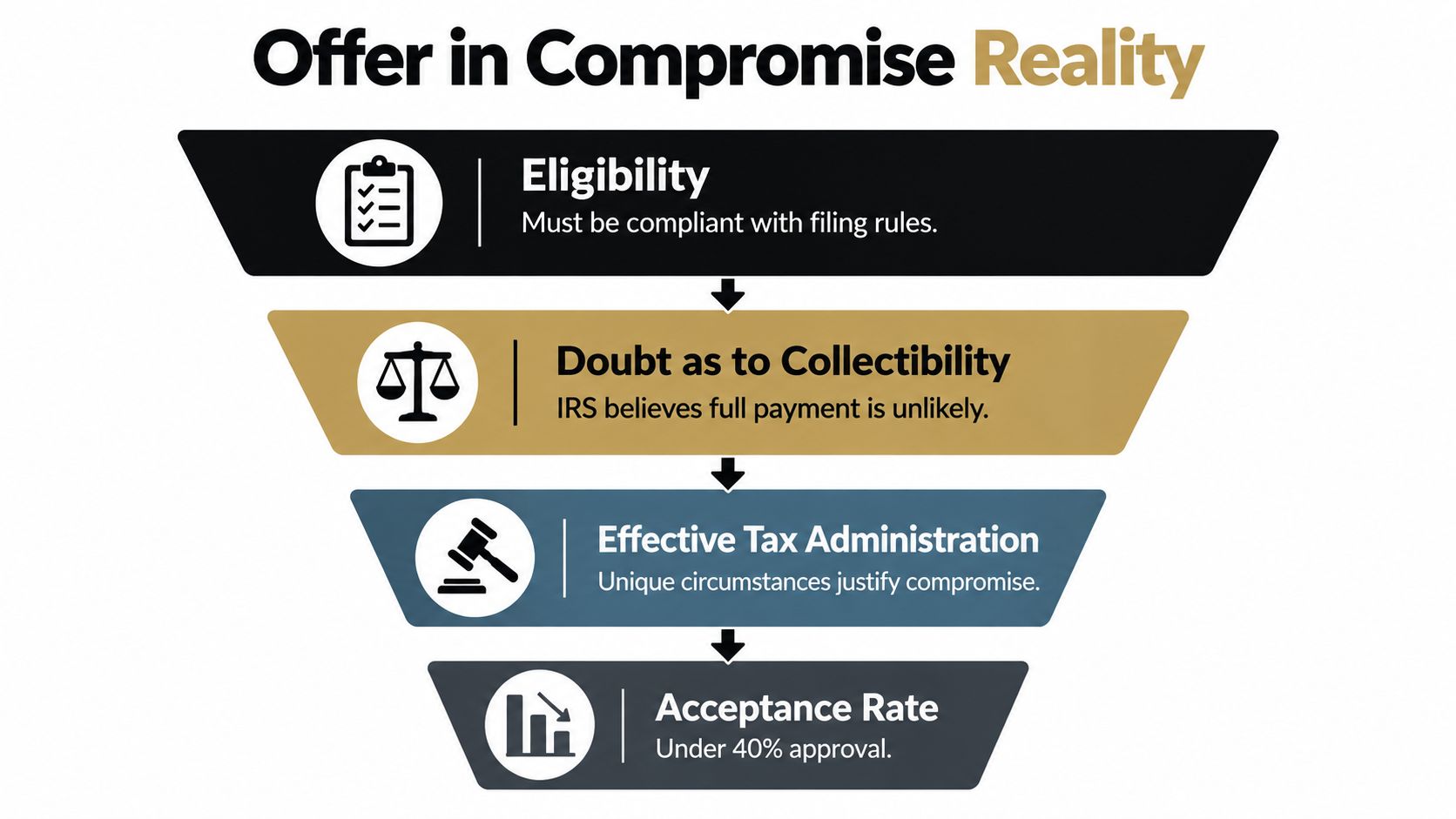
In fiscal year 2025, taxpayers submitted 38,797 Offers in Compromise, and the IRS accepted 5,464, totaling $98.1 million, according to the IRS collections, penalties, and appeals statistics. Those figures show why a sales call promising that anyone can settle for pennies on the dollar deserves skepticism.
The acceptance data also needs context. The offer process isn't merely a popularity contest. The IRS must determine whether the taxpayer is eligible, whether the proposed amount reflects the taxpayer's reasonable collection potential or qualifying circumstances, and whether accepting the compromise serves effective tax administration. A bare hardship narrative won't replace accurate financial disclosures.
What makes an offer credible
A serious OIC analysis should address:
- Compliance: Required returns and payments need review before the IRS can meaningfully evaluate the offer.
- Assets: Home equity, vehicles, accounts, investments, and business interests affect the financial picture.
- Income and expenses: The submission must distinguish necessary living costs from discretionary spending and support unusual expenses.
- Future capacity: The IRS can question whether the taxpayer's income or business cash flow makes the proposed amount unrealistic.
- Tax administration: Even when full collection is technically possible, unusual facts may support consideration under a different theory.
The underserved problem is what happens after filing. Taxpayers often focus on the eligibility checklist and overlook document requests, queue delays, inconsistent financial information, and the risk of submitting an offer that conflicts with the account record. The relevant question isn't “Can I apply?” It's “Can I prove the proposed resolution with records the IRS can verify?”
A payment plan may be better when the taxpayer has steady cash flow and enough capacity to repay. An OIC may be appropriate when full payment isn't realistic, but a failed offer can consume time and leave the underlying collection problem unresolved. Treat it as a strategic legal submission, not a discount coupon.
When to Hire a Tax Attorney
Not every IRS issue requires an attorney. A simple notice asking for one missing document may be handled by the taxpayer, especially when the return is accurate and the records are clear. Hiring counsel makes more sense when the dispute involves legal judgment, collection risk, business liability, or consequences you can't easily reverse.
Contact a tax attorney early if the IRS has issued a levy threat, filed a lien, assigned a Revenue Officer, questioned payroll taxes, raised possible fraud or criminal issues, or proposed a substantial adjustment involving a business, trust, estate, or complex ownership structure. These matters require more than filling out a form. They require a coordinated position and controlled communication.
A practical escalation test
Ask yourself:
- Can I state the issue in one sentence? If not, the account may need transcript analysis before any response.
- Do I have the records now? If key evidence is missing, a professional can help determine what substitutes may work.
- Is a deadline approaching? A short deadline combined with an appeal right or enforcement warning calls for immediate review.
- Could my statement create exposure? Never improvise about intent, payroll responsibility, omitted income, or questionable deductions.
- Will collection continue while I work? If wages, bank funds, or property are at risk, timing matters.
An attorney also serves as a buffer. Taxpayers who are frightened often overexplain, make inconsistent statements, or agree to a payment they can't sustain. Representation places the facts into a deliberate process and can keep the IRS conversation focused on the actual remedy.
Law firms themselves benefit from disciplined intake because tax controversy depends on dates, notices, entities, tax periods, and immediate collection threats. A structured Recepta.ai client intake workflow offers useful context for organizing that information before a legal consultation.
That doesn't mean every taxpayer should pay for full representation. Start with the smallest professional service that answers the risk: a notice review, transcript analysis, audit strategy, or full power-of-attorney representation. This guide on how to find a good tax attorney can help you evaluate experience, scope, communication, and fee structure.

Taking Action for Peace of Mind
IRS problem resolution becomes manageable when you stop treating the notice as a verdict and start treating it as a decision point. The sequence is straightforward:
- Secure the record. Collect notices, returns, transcripts, payment evidence, and correspondence.
- Classify the problem. Decide whether you're dealing with an error, an audit, a collection balance, missing returns, identity verification, or more than one issue.
- Protect the deadline. File the required response, request appropriate time when available, and document delivery.
- Choose the remedy. Correct the account, defend the audit, request penalty relief, arrange payments, evaluate hardship status, or analyze an OIC.
- Match the help to the risk. Handle a clean correspondence request yourself, but obtain representation when enforcement, legal exposure, or complicated records are involved.
- Build for compliance. A resolution that fails because future filings or payments are missed isn't a resolution.
The IRS's own numbers support a practical conclusion. The agency resolves liabilities at large scale, but compromise settlements represent only a narrow slice of that work. Installment agreements, accurate corrections, appeals, and sustained compliance often provide the more realistic route.
During the 2026 filing season, the National Taxpayer Advocate reported that the IRS answered only 31% of calls on the Installment Agreement/Balance Due line, with an average wait of 45 minutes, and only 19% on the Taxpayer Protection Program line, with a 20-minute wait. The same report said more than 14 million returns were suspended during processing, making it important to distinguish a service or verification backlog from genuine inability to pay. You can review those findings in the National Taxpayer Advocate's mid-year report.
Don't buy a promise before anyone diagnoses your account. Read the notice, preserve the evidence, and choose a resolution path that your finances and records can support.
Tax Attorney Stephen A Weisberg helps individuals, business owners, and professionals address IRS audits, tax debt, liens, levies, and other collection problems through account analysis and attorney representation. Visit Tax Attorney Stephen A Weisberg to request a free Tax Debt Analysis and determine what problem you're facing, which options fit, and what action should come next.


