IRS Payment Plan Options: 2026 Guide
Navigate IRS payment plan options for 2026. Learn about short-term plans, installment agreements, and OICs for individuals & businesses. Get clear guidance.
In this article
- That IRS Letter Arrived Now What
- The Two Main Types of IRS Payment Plans
- Short-term payment plan
- Long-term installment agreement
- The decision is strategic, not just administrative
- Detailed Comparison of Your Payment Options
- IRS Payment Plan Options at a Glance
- What actually matters when you choose
- Where cases become more sensitive
- The Application Process Demystified
- Gather the right information before you apply
- What the online process usually feels like
- What happens after approval
- What If You Simply Cannot Afford a Payment Plan
- Offer in Compromise
- Currently Not Collectible status
- The real issue is financial reality
- When to Stop DIY and Consult a Tax Attorney
- Frequently Asked Questions About IRS Plans
- Does interest and penalty growth stop once I enter a plan
- What happens if I miss a payment
- Can I change my plan later
- Will an IRS payment plan affect my credit score
You open the mailbox, or your IRS account, and there it is. A notice with a balance due, deadlines, and language that sounds more severe than anything else in your financial life. For a lot of people, that moment triggers the same reaction. Panic first, then avoidance.
That instinct is understandable, but it usually makes the problem harder and more expensive.
The good news is that the IRS has formal payment systems built for taxpayers who can't pay everything at once. The question isn't whether IRS payment plan options exist. They do. The question is which option fits your facts, your cash flow, and your ability to stay compliant after the agreement starts.
That's where people get into trouble. They choose the easiest application path, not the most sustainable plan. Then they miss a payment, fall behind on a new tax filing, or underestimate how hard it is to keep up when income is uneven.
A payment plan should solve a collections problem without creating a second problem six months later.
That IRS Letter Arrived Now What
A common version of this starts with a self-employed taxpayer who had a decent year on paper and a bad year in cash. Maybe a contractor had clients pay late. Maybe a small business owner used available funds to cover payroll, rent, and vendors, then filed the return and discovered there wasn't enough left for the IRS bill.
The notice arrives, and the first assumption is often wrong. Many people read it as the end of the story. It isn't. It's the beginning of a decision process.

The IRS doesn't treat every unpaid balance the same way. It has structured paths for taxpayers who need time. Some people need a short runway to pay in full. Others need a formal installment agreement. Others shouldn't be in a payment plan at all because the monthly amount would be unrealistic from the start.
Practical rule: The worst response to an IRS balance due notice is silence. The second worst is choosing a monthly payment you can't actually maintain.
What works is simpler than many assume:
- Open every notice: Dates, tax years, and balance information matter.
- Confirm all returns are filed: Payment options usually go smoother when filing is current.
- Match the solution to your cash flow: A plan that looks affordable on a worksheet may fail in real life.
- Act before collections intensify: Options are generally easier to manage earlier than later.
If you're staring at a notice right now, the main point is this: owing the IRS does not automatically mean you're out of options. It means you need to choose carefully and quickly.
The Two Main Types of IRS Payment Plans
At this stage, the choice usually comes down to two paths. You either ask for a short window to pay in full, or you set up a long-term installment agreement with monthly payments.
That sounds simple. The harder question is which option fits your actual finances well enough to survive.
Short-term payment plan
A short-term plan gives you extra time to pay the balance in full. It works best when the tax debt is a timing problem, not a budget problem. A delayed commission, year-end bonus, refinancing, asset sale, or accounts receivable collection can make this a sensible choice.
The IRS allows eligible taxpayers to use this route for certain balances and repay within a limited period, as noted earlier. The key point is practical. This is an extension, not a cure for ongoing cash flow trouble.
If the money is not clearly coming, a short-term plan can create false confidence. The deadline arrives quickly. Interest and penalties continue to build while you wait.
Long-term installment agreement
A long-term installment agreement spreads the debt into monthly payments over time. This is the standard option for taxpayers who cannot pay in full soon but can support a steady monthly amount.
For the right client, this creates order. It can stop the cycle of missed notices and last-minute payment scrambling. It also brings a new risk. Once the agreement is in place, the IRS expects consistent payments and ongoing filing compliance. A single missed payment, a bounced debit, or a new tax balance can put the agreement in default.
That is why the lowest monthly payment is not always the best answer. A payment that looks manageable on paper may fail if your income swings, your business has slow months, or you are already behind on current withholding or estimated taxes.
The decision is strategic, not just administrative
I tell clients to start with three questions.
- Is your shortage temporary or recurring? Temporary problems often fit short-term relief. Recurring shortfalls usually require a longer structure or a different resolution entirely.
- Can you make the proposed payment and stay current on new taxes? If not, the agreement is fragile from day one.
- What happens if your plan fails? Default can reopen collection pressure and leave you with a larger balance than when you started.
Taxpayers who have stable wages and a clear budget can often handle a straightforward online setup themselves. Taxpayers with uneven income, unfiled returns, prior defaults, or balances large enough to trigger closer review should be more careful. In those cases, the easiest application path is often the wrong one.
For a closer look at how a formal IRS installment agreement works, review the structure before choosing a payment amount. If you are also trying to stabilize household cash flow, a step-by-step debt reduction guide can help you test whether the IRS payment you have in mind is realistic.
Detailed Comparison of Your Payment Options
A payment plan choice should answer one practical question. Which option can you finish without falling behind again?
The IRS groups these arrangements by how fast the debt can be paid, how much you owe, and whether your case fits a more rule-based approval process or requires closer financial review. That sounds technical, but the main difference is simpler. Some plans are built for taxpayers who need time. Others are built for taxpayers who need the IRS to look closely at what they can afford.
IRS Payment Plan Options at a Glance
| Feature | Short-Term Payment Plan (STPP) | Standardized Installment Agreement | Non-Standard Installment Agreement |
|---|---|---|---|
| Core purpose | Extra time to pay in full | Monthly payments within common IRS thresholds | Monthly payments for cases outside the usual limits or with added complexity |
| Individual balance range | Often used when the taxpayer expects to pay the full balance within a relatively short period | Often available when the balance fits the IRS's standard long-term criteria | Often required when the balance is higher or the file raises additional issues |
| Business use | Less common as a long-term solution for operating businesses | More limited than the individual option | Often the path for businesses that do not fit the standard criteria |
| Repayment period | Short window to pay in full | Fixed monthly payments over an extended period | Terms depend more heavily on financial disclosures and IRS review |
| Application style | Usually simpler if you qualify | More automated if your facts fit the standard rules | More document-heavy and more likely to require back-and-forth with collections |
| Best fit | Temporary cash problem with a clear payoff source | Stable income and enough room in the budget for monthly payments | Higher balances, uneven income, prior compliance problems, or facts that need explanation |
| Main risk | Reaching the deadline without the money to pay in full | Picking a monthly payment that works for a month or two but fails over time | Giving incomplete financial information or agreeing to terms you cannot maintain |
What actually matters when you choose
Short-term relief works best when the problem has an end date. A bonus is coming. A property is being sold. Receivables are about to clear. If there is no realistic payoff event, a short-term plan can just delay the same problem for a few months while interest and penalties keep building.
A standardized long-term agreement is often the easiest option to set up. That does not make it the safest option. If the payment leaves no room for current withholding, estimated taxes, payroll deposits, or basic operating cash, the agreement is weak from the start.
I tell clients to test the payment against ordinary life, not a best-case month. If a business has seasonal dips or a household budget already depends on credit cards, the lowest acceptable IRS payment may still be too high in practice.
The better plan is the one you can keep while staying current on new tax obligations.
Where cases become more sensitive
Non-standard cases require more care because the IRS may want a fuller picture of income, assets, expenses, and cash flow. That is usually where self-prepared applications start to break down. A taxpayer may overstate what is affordable to get the case approved quickly, or understate available resources in a way that creates credibility problems.
That is also the point where the easy answer may be the wrong answer. If the numbers do not support a workable monthly payment, forcing an installment agreement can waste time and increase the balance. Some taxpayers should compare that route with other resolution options, including the IRS Offer in Compromise process.
A broader household budget review helps here too. This step-by-step debt reduction guide is not tax-specific, but it is useful for stress-testing whether an IRS payment fits with rent, payroll, loan payments, and other debts.
The right choice is rarely the one that looks easiest on the screen. It is the one that survives real cash flow, keeps you compliant going forward, and does not collapse after the first setback.
The Application Process Demystified
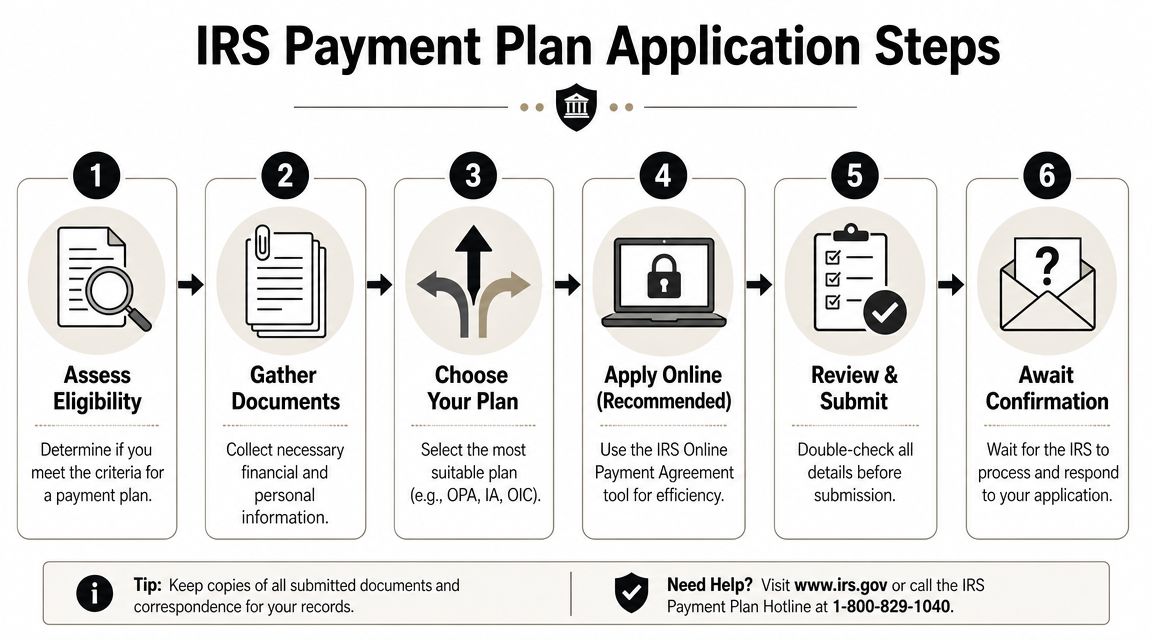
For many individual taxpayers, the application itself is less intimidating once the preparation is done first. The IRS says more than 90% of individual taxpayers qualify for its Simple Payment Plan, and eligible taxpayers can usually use an online application that gives an immediate approval decision. The main cutoff for individuals is $50,000 or less in combined tax, penalties, and interest, according to the IRS Simple Payment Plan page.
That sounds encouraging, and it is. But don't sit down at the computer and start guessing.
Gather the right information before you apply
The application goes better when you already know your numbers and your plan.
Have these items ready:
- Your IRS notice details: Match the tax year and balance information carefully.
- Your filing status: If returns are missing, fix that first or at least understand the issue.
- Your payment method decision: Know whether you'll pay manually or through automatic withdrawals if that applies.
- A realistic monthly amount: Base it on actual cash flow, not optimism.
- Your bank information: If you're choosing direct debit, have the account information ready.
Many taxpayers rush this stage and then pick a monthly number that only works in a perfect month. That's a mistake. If your income is seasonal, commission-based, or tied to self-employment cycles, build around the lean months, not the strong ones.
What the online process usually feels like
If you qualify for the simpler online route, the process is usually administrative rather than adversarial. You're entering identifying information, confirming what you owe, and choosing from available payment options.
For straightforward cases, that is often much easier than people expect.
What throws people off is not the website. It's uncertainty about the consequences of the choice they're making. A fast approval is useful only if the agreement is sustainable after approval.
Get ready first: Before you apply, decide what monthly payment still works after rent, payroll, estimated taxes, and ordinary life expenses.
What happens after approval
Approval is not the finish line. It's the beginning of maintenance.
Once the plan is active, you still need to:
- Make each payment on time
- File future returns on time
- Avoid creating new unpaid tax balances
- Monitor IRS notices instead of assuming everything is on autopilot
The IRS also makes clear that taxpayers can revise an existing plan online in some situations, while business taxpayers may need more direct interaction with the agency. If you want a more detailed practical walkthrough, this guide on how to set up a payment plan with the IRS is a useful next step.
What If You Simply Cannot Afford a Payment Plan
Some taxpayers read about monthly plans and immediately know the truth. Even a modest payment isn't realistic. That's not a planning failure. It's a signal that you may need a different resolution path.
The IRS has options for genuine financial hardship, but they are not ordinary payment plans.
Offer in Compromise
An Offer in Compromise is a settlement process where a taxpayer asks the IRS to accept less than the full balance. This is usually appropriate only when the taxpayer can show that full collection is not realistic under the IRS's standards.
That makes OIC a serious application, not a formality. It requires careful financial presentation and honest analysis. It is not something to file casually because a monthly payment feels unpleasant.
Currently Not Collectible status
Currently Not Collectible, often called CNC, is different. It is not a settlement. It is a request for the IRS to pause active collection because the taxpayer cannot presently afford to pay.
This can be appropriate when basic living expenses consume the available income and there is no room for a monthly installment payment. CNC can provide breathing room, but it does not magically erase the debt.
The real issue is financial reality
Taxpayers with irregular income often misjudge what they can sustain because they budget from good months instead of average months. That problem shows up constantly with freelancers, commission earners, and business owners.
If your income swings, practical budgeting guidance can help you pressure-test whether a payment plan is feasible at all. These Peaceful Mindful Pocket LLC insights on budgeting with irregular income are worth reviewing before you commit to a fixed tax payment.
A bad installment agreement can be more dangerous than no installment agreement for a short period, because it creates the illusion that the problem is solved when the payment was never realistic.
The point is simple. If you can't afford a payment plan, don't force yourself into one just because it seems like the standard answer.
When to Stop DIY and Consult a Tax Attorney
A lot of taxpayers start out planning to handle the IRS themselves. That can work for a basic case. It starts to break down when the choice is no longer just "how do I apply," but "which option can I keep without defaulting six months from now?"
That is usually the point where legal advice pays for itself.
Professional help makes sense when your case has more judgment than paperwork. A higher balance often means the IRS wants more financial detail and gives you less room for error. Business tax debt, especially payroll tax issues, raises the stakes because the problem can affect operations and expose owners or officers to personal risk. If you already had a payment plan fail, the next proposal needs to be built around the reason it failed, not just a lower number.
The same is true if you are weighing an Offer in Compromise or Currently Not Collectible status. Those are not forms to submit on a hunch. They depend on how the IRS will read your income, assets, expenses, and filing history.
One more sign to stop DIY is simpler. You have become so stressed by the notices that you are avoiding them.
A tax attorney does more than fill out forms. The job is to test the available options against your actual facts, spot problems before they turn into a default or enforcement action, and help you choose the plan that protects your cash flow and keeps you compliant going forward. Sometimes the fastest approval is not the best answer. Sometimes a taxpayer can handle the case alone, but only after getting clear advice on what not to say, what to disclose, and what monthly payment is realistically sustainable.
For a fuller explanation of that decision point, see this discussion of when to hire a tax attorney. Attorney Stephen A. Weisberg handles IRS and state tax debt matters for individuals and businesses.
Frequently Asked Questions About IRS Plans
The questions usually get more practical after the agreement is approved. That's where good intentions either turn into stability or start to unravel.
Does interest and penalty growth stop once I enter a plan
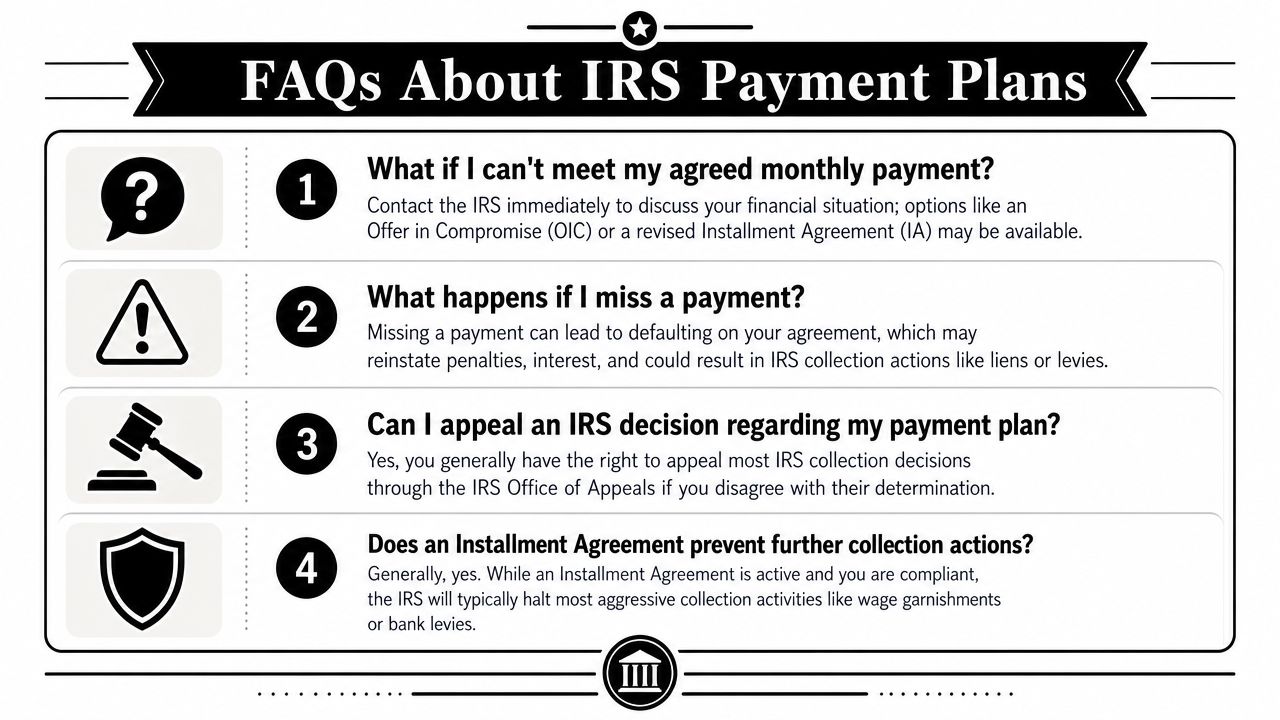
No. A critical point many taxpayers miss is that interest and penalties keep accruing until the balance is paid in full, and an installment agreement does not reduce the underlying tax debt, as the IRS explains on its payment plans and installment agreements page.
That is why a lower monthly payment is not always a better result. A longer plan can be easier to start and more expensive to carry.
What happens if I miss a payment
Missing a payment can put the agreement at risk. In practice, one missed payment often comes with another problem close behind, such as a new unpaid tax balance or an unfiled return.
If a payment is going to fail, address it early. Don't assume the IRS will sort it out in the background.
Can I change my plan later
Sometimes, yes. But the ease of doing that depends on the type of case and whether you still fit the simpler rules. The larger point is that changing a bad plan later is harder than choosing a workable one at the beginning.
Will an IRS payment plan affect my credit score
An IRS installment agreement itself is not the same thing as a consumer loan account on a credit report. But tax debt can still affect broader financial decisions, especially if it interferes with lending, business operations, or other transactions that require clean tax compliance.
If a payment plan helps you avoid escalating collection trouble and stay current going forward, it has done its job. If it only delays the next crisis, it was the wrong plan.
If you need help deciding which IRS payment plan option fits your situation, Attorney Stephen A Weisberg offers a free tax debt analysis to review the facts, identify workable resolution paths, and determine whether a payment plan, an alternative resolution, or a more customized strategy makes sense.


