Understanding the IRS Payment Plan Interest Rate
Demystify the IRS payment plan interest rate. This guide explains how it works, what it costs, and how to minimize what you owe the IRS. Learn more.
In this article
- What Goes Into Your IRS Payment Plan Costs?
- The Hidden Impact of Daily Compounding
- Key Components of Your IRS Payment Plan Costs
- How the IRS Calculates Interest on Your Tax Debt
- The Role of Penalties in Your Total Balance
- Current and Historical IRS Interest Rate Trends
- Seeing the Real Cost: IRS Payment Plan Examples
- Scenario 1: A Small Debt on a Short-Term Plan
- Scenario 2: A Larger Debt on a Long-Term Plan
- Actionable Strategies to Reduce Your Total Tax Debt
- Exploring Penalty Abatement
- Answering Your Top Questions About IRS Interest Rates
- Can My Interest Rate Change During My Payment Plan?
- Is the Interest on My Tax Debt Deductible?
- What Happens If I Miss a Payment?
When you owe the IRS, setting up a payment plan can feel like a lifeline. But it's crucial to understand that this isn't a free loan—the government charges interest on your unpaid balance, and that's just one piece of the puzzle.
Let's break down what you'll actually be paying.
What Goes Into Your IRS Payment Plan Costs?
Setting up an installment agreement means you're dealing with more than a single fee. The total cost is a combination of two separate charges that work in tandem. Getting a handle on this duo is the first step to managing your tax debt without any surprises.
The first and most obvious cost is the interest. You can think of this as a rental fee for using the government's money while you work to pay off what you owe. The rate is calculated by taking the current federal short-term rate and tacking on an extra 3 percentage points.
The second charge is the Failure-to-Pay penalty. This penalty gets applied to any tax you haven't paid by the deadline and keeps adding up until your balance is zero. The good news? Once the IRS approves your payment plan, they typically cut this penalty rate in half, which can provide some much-needed relief.
The Hidden Impact of Daily Compounding
Here's a concept that trips up a lot of people: daily compounding. This isn't like a simple car loan where interest is calculated on the original amount. With the IRS, interest is calculated on your outstanding balance every single day.
That means you're being charged interest not just on the tax you owe, but also on any penalties and the interest that was added the day before. It's a subtle mechanism, but it can make your total debt grow faster than you might think.
The IRS interest rate isn't set in stone. It gets adjusted every quarter to reflect changes in the economy. This rate applies to underpayments for both individuals and businesses.
For example, the interest rate for underpayments was set at 8% annually in early 2025. You can always find the latest quarterly rates on the official IRS website to see what the current charge is.
To help you see the full picture, here’s a quick breakdown of the costs you can expect.
Key Components of Your IRS Payment Plan Costs
| Cost Component | What It Is | How It's Calculated |
|---|---|---|
| Interest | The charge for borrowing from the U.S. Treasury to cover your tax debt. | Federal Short-Term Rate + 3%. It compounds daily. |
| Failure-to-Pay Penalty | A penalty for not paying your taxes on time. | Typically 0.5% of the unpaid tax per month, but drops to 0.25% with an approved payment plan. |
| Setup Fee | A one-time fee to establish the installment agreement. | Varies based on how you apply (online vs. mail) and your income level. |
Understanding these moving parts is key to managing your tax liability effectively. The combined costs highlight why paying off your balance as quickly as possible is always the best strategy.
To get a better handle on your options, check out our in-depth guide on IRS payment plans.
How the IRS Calculates Interest on Your Tax Debt
To get a real handle on what you'll end up paying the IRS, you need to peek behind the curtain and see how they do the math. It’s not as straightforward as applying a simple annual rate to your balance. The IRS uses a much more potent method called daily compounding.
What does that mean for you? It means they calculate interest on your outstanding tax debt every single day.
Think of it like a snowball rolling downhill. Each day, a little more interest gets tacked onto your principal balance. The very next day, the IRS calculates interest on that new, slightly bigger total. Over time, this compounding effect can make your debt grow faster and faster, which is why tackling the principal as quickly as you can is so important.
For example, say you owe $10,000. On day one, the IRS calculates a day's worth of interest and adds it on. On day two, they calculate interest not just on the original $10,000, but also on the tiny bit of interest from day one. This process repeats day after day. If you need a refresher, reviewing the concept of percentages can help clarify how these small daily additions build up.
The Role of Penalties in Your Total Balance
On top of the interest, you're also dealing with a Failure-to-Pay penalty. This penalty usually runs at 0.5% per month, which can really add up. But here's where setting up a formal payment plan gives you a serious advantage.
Once your installment agreement is officially in place, the IRS will typically cut that Failure-to-Pay penalty rate in half, down to just 0.25% per month. That reduction is a big deal and can provide some immediate relief on your total bill.
The chart below breaks down the main costs you'll see in an IRS payment plan.
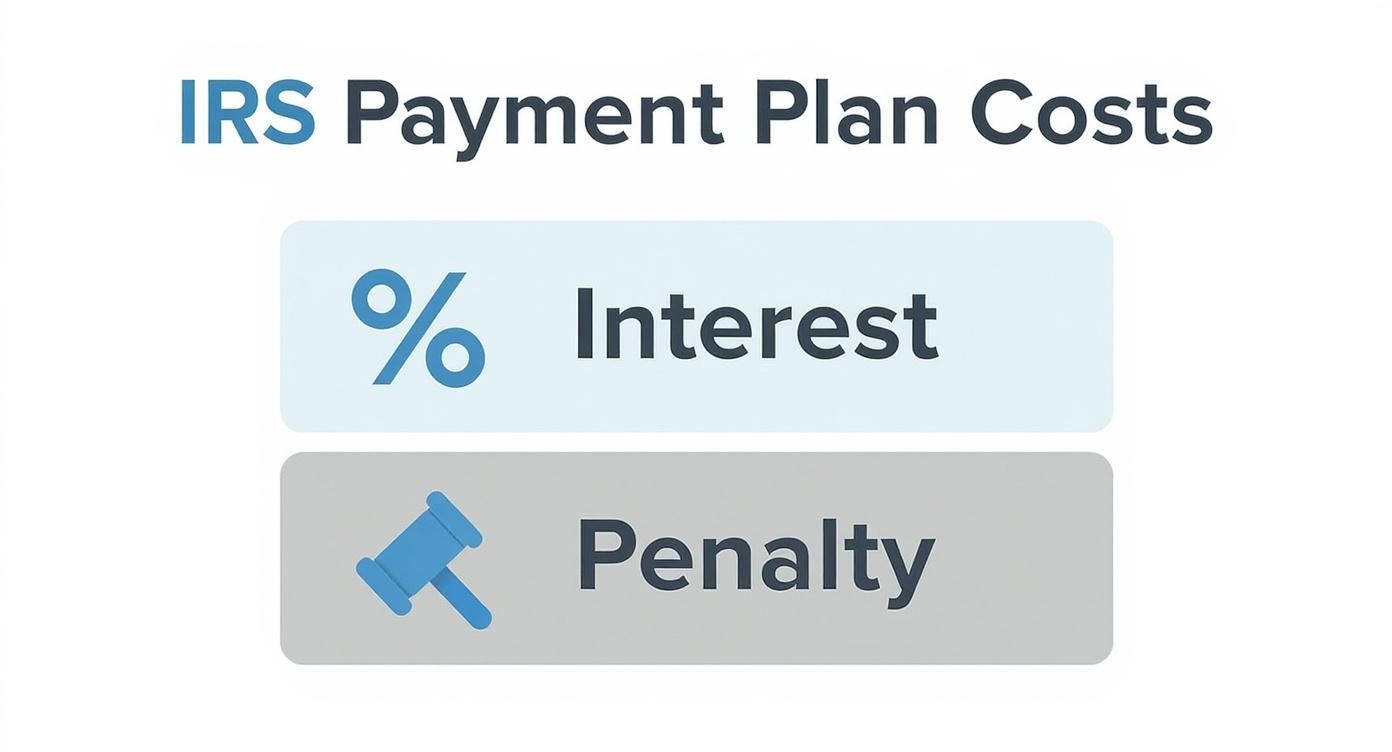
As you can see, both interest and penalties grow your balance, but an official payment plan is your best tool for cutting that penalty portion down. Getting your head around these different pieces is the first step. To see how this might play out with your own numbers, check out our IRS installment agreement calculator—it can help you model your specific situation.
Here is the rewritten section, designed to sound natural and human-written, as if from an experienced expert.
Current and Historical IRS Interest Rate Trends
The interest rate on an IRS installment plan isn't some arbitrary number they just make up. It's directly tied to the pulse of the U.S. economy, moving up and down just like the rates for mortgages or car loans. The IRS re-evaluates and adjusts this rate every quarter.
This means the rate you pay can, and often does, change several times a year. When the Federal Reserve raises rates to cool down the economy, the IRS underpayment rate almost always follows. When things slow down and rates drop, the IRS rate typically eases up too.
A Look Back at Rate Fluctuations
Looking at past rates really puts the current numbers into perspective. These aren't random jumps; they're a direct reflection of economic cycles and national fiscal policy. For instance, back in the mid-1990s, when Treasury yields were much higher, the IRS interest rate was hovering between 6.9% and 7.0%. You can dig into decades of this data by exploring the weighted average interest rates on the IRS website.
This shows that today's rate is just one point on a long, fluctuating timeline. Understanding this helps you see the bigger picture and anticipate how the cost of your tax debt might change over the life of your payment plan.
To give you a clearer idea, here's a simplified look at how rates can shift with the economic climate.
IRS Underpayment Interest Rate Snapshot (Illustrative)
| Time Period | Typical Non-Corporate Underpayment Rate | Economic Context |
|---|---|---|
| Late 1990s | 6% - 8% | Period of strong economic growth and higher federal fund rates. |
| Late 2000s (Recession) | 3% - 5% | Response to the financial crisis, with rates lowered to spur growth. |
| Early 2020s | 3% - 4% | Initial low-rate environment during the pandemic. |
| Mid 2020s | 7% - 8% | Rates increased significantly to combat high inflation. |
As you can see, the rate isn't static. It's a living number that reacts to what's happening in the broader financial world.
Think of the IRS interest rate as a reflection of the national economy. Once you see that connection, the quarterly adjustments stop feeling like a surprise and start looking like a predictable financial indicator.
This shift in perspective is powerful. It takes the uncertainty out of the equation and gives you a much better handle on managing your payment plan for the long haul.
Seeing the Real Cost: IRS Payment Plan Examples
It's one thing to talk about percentages and penalties in theory, but seeing the numbers in a real-world scenario really drives the point home. Let's break down how the IRS payment plan interest rate and associated penalties actually play out for two different taxpayers.

These examples make it crystal clear why paying off your tax debt as quickly as you can is always the best strategy. Every single payment reduces your principal balance, which means there's less for the IRS to charge interest on the next day.
Scenario 1: A Small Debt on a Short-Term Plan
Let's meet Sarah. She owes the IRS $5,000 and arranges a short-term plan to pay it off over 18 months. This works out to a monthly payment of about $290.
For this example, we'll use an 8% annual interest rate and the standard 0.25% monthly Failure-to-Pay penalty.
- Initial Tax Debt: $5,000
- Monthly Payment: Approx. $290
- Total Amount Paid: Over the 18-month term, Sarah pays a total of roughly $5,220.
The extra $220 is the price she paid in interest and penalties. It might not seem like a fortune, but it's still $220 that could have stayed in her pocket.
Scenario 2: A Larger Debt on a Long-Term Plan
Now, let's look at Mark. He's a small business owner who owes $25,000. He can’t clear that quickly, so he gets a 60-month (five-year) installment agreement, with payments around $510 per month.
When you're dealing with a bigger balance over a much longer timeframe, the power of daily compounding really starts to work against you. The interest and penalties have years, not months, to pile up, dramatically inflating the final cost.
Using the same 8% interest and 0.25% penalty rates:
- Initial Tax Debt: $25,000
- Monthly Payment: Approx. $510
- Total Amount Paid: By the end of the five years, Mark will have paid the IRS nearly $30,600.
In Mark's case, the interest and penalties added up to a staggering $5,600. This is a powerful illustration of why having solid strategies for paying off back taxes is absolutely essential to keep these extra costs from spiraling out of control.
Actionable Strategies to Reduce Your Total Tax Debt
Okay, so now you know how the interest and penalties stack up. The next logical step is to figure out how to knock them down. With the right game plan, you can seriously cut the total cost of what you owe the IRS and get your financial life back on track a lot sooner.

The single most powerful move you can make is simple: pay down your principal balance as fast as you can. Because the IRS payment plan interest rate compounds daily, every single dollar you chip away at the principal today is a dollar that can't grow interest tomorrow.
Here are a few proven ways to tackle that tax debt head-on:
- Make a Larger Down Payment: If you can swing it, paying a bigger lump sum right when you start your installment plan is a game-changer. It shrinks the principal amount that accrues interest from the very first day.
- Send Extra Payments: Anytime you get a little extra cash—a work bonus, a refund, or money from a side hustle—throw it at your IRS debt. Just be sure to specifically designate it as a payment toward the principal.
- Stay Current on Future Taxes: This one is absolutely critical. If you fall behind on your current or future tax filings, you'll just start a new cycle of penalties and interest, making it that much harder to get out of the hole you're in.
Exploring Penalty Abatement
Beyond just paying the debt down faster, you might be able to get some of the penalties waived entirely. The IRS has provisions for penalty relief if you can show you had reasonable cause for not paying on time. This usually involves circumstances you couldn't control, like a major illness, a death in the family, or a natural disaster.
You could also be eligible for First Time Penalty Abatement if you’ve had a clean tax record for the previous three years. It's definitely worth looking into, as it can save you a lot of money. The negotiation process can be tricky, but there are proven strategies to reduce tax debt that can help you navigate it. You can learn more about them here: https://www.weisberg.tax/newsletter/how-to-negotiate-with-the-irs-proven-strategies-to-reduce-your-clients-tax-debt-xbr8f-kr3hk-3rpfy
An IRS payment plan is just one tool in the toolbox. It’s always smart to compare the total cost—interest and penalties included—against other options. A personal loan from your bank or a credit union might actually offer a lower, fixed interest rate.
Finally, think bigger picture. Getting your overall financial house in order can prevent these headaches down the road. For instance, understanding concepts like effective capital gains tax strategies can help you manage your tax liabilities before they become a problem. Being proactive is always the best way to handle your finances and resolve debt for good.
Answering Your Top Questions About IRS Interest Rates
Even after you get the basics down, it's natural to have more specific questions about how the IRS payment plan interest rate works in practice. Let's tackle some of the most common things that trip taxpayers up when they're on an installment plan.
Can My Interest Rate Change During My Payment Plan?
Absolutely, and this is a crucial detail that many people miss. The interest rate on your tax debt is not locked in for the duration of your payment plan. The IRS re-evaluates its rates every quarter, basing them on the federal short-term rate.
This means the rate applied to your remaining balance can—and probably will—fluctuate while you’re paying it off. Your total cost could go up or down depending on what's happening in the broader economy. Keeping an eye on the quarterly rates the IRS publishes is a smart move.
Think of it like this: your IRS payment plan has a variable interest rate, not a fixed one. It behaves more like an adjustable-rate mortgage than a standard car loan, shifting with the financial tides.
Is the Interest on My Tax Debt Deductible?
For most of us, the answer is a straightforward no. The interest you pay on an underpayment of your personal federal income tax is classified as personal interest, which is not tax-deductible.
But there's a key exception to this rule. If the tax debt comes directly from your trade or business—like unpaid payroll taxes or underpaid business income tax—the interest you pay can often be deducted as a business expense. It's always best to talk to a tax pro to see how this rule applies to your unique situation.
What Happens If I Miss a Payment?
Skipping a payment on your installment agreement is a serious misstep. If you do, the IRS can terminate your plan, and that opens the door to a whole host of problems. For starters, the Failure-to-Pay penalty, which is normally cut to 0.25% per month while you're on a plan, can jump back up to the standard 0.5% rate.
Even worse, the IRS can restart aggressive collection efforts. This could mean filing a federal tax lien against your property or even issuing a levy to seize funds from your bank account or garnish your wages. If you think you might miss a payment, the best thing you can do is contact the IRS right away to figure out a solution.
At Attorney Stephen A Weisberg, we know just how confusing IRS rules can be. If you're struggling with tax debt, our FREE Tax Debt Analysis is the perfect place to start. We can help you explore your options and find the best path forward. Learn more and get started at https://weisberg.tax.


