IRS Partial Payment Installment Agreement Guide
Explore the IRS Partial Payment Installment Agreement with our expert guide. Learn how it works, if you qualify, and how to apply for tax relief.

In this article
- Getting A Handle On The Partial Payment Installment Agreement
- How A PPIA Stacks Up Against Other Options
- Comparing IRS Tax Relief Options
- How Do You Actually Qualify for a Partial Payment Plan?
- First Things First: The Basic Requirements
- Proving Your Financial Situation to the IRS
- The Clock is Ticking: The Role of the CSED
- How the IRS Calculates Your Monthly Payment
- Breaking Down Your Allowable Living Expenses
- A Real-World Payment Calculation Example
- The Deciding Factor: The Collection Statute Expiration Date
- Getting Your PPIA Application Across the Finish Line
- The Paperwork That Matters Most
- What Happens During the IRS Review?
- The Reality of the Biennial Review
- Benefits and Risks of a PPIA
- Key Advantages of Securing a PPIA
- Potential Drawbacks and Common Pitfalls
- Weighing the Benefits and Drawbacks of a PPIA
- When to Partner with a Tax Professional
- Signs You Need Expert Help
- Frequently Asked Questions About PPIAs
- What Happens if My Income Changes During the PPIA?
- Will a PPIA Immediately Stop an IRS Wage Garnishment?
- Can My Small Business Get a PPIA?
- How Is a PPIA Different from an Offer in Compromise?
If you're staring down a mountain of tax debt and don't see a path to paying it all off, the IRS Partial Payment Installment Agreement (PPIA) might be the lifeline you need. Simply put, it's a payment plan where your monthly payment is based on what you can actually afford, not the total amount you owe.
This isn't your typical payment plan. It’s designed specifically for people who can't pay their full tax bill before the IRS runs out of time to collect it—a period known as the Collection Statute Expiration Date (CSED), which is usually 10 years. The idea is you pay what you can each month, and once that 10-year clock expires, the remaining debt can often be wiped away for good.
Getting A Handle On The Partial Payment Installment Agreement

Let's be honest, getting a huge tax bill is stressful. The threat of bank levies or wage garnishments only makes it worse. A PPIA is a formal agreement with the IRS that immediately halts these aggressive collection tactics, giving you some much-needed breathing room.
What makes it so different from a standard installment plan is how the payment is calculated. The IRS doesn't just divide your total debt by a number of months. Instead, they look at your income and subtract your necessary living expenses. The amount left over—your "disposable income"—is what determines your monthly payment. This makes the payment genuinely manageable based on your real-life budget.
How A PPIA Stacks Up Against Other Options
It's easy to get lost in the alphabet soup of IRS programs. A PPIA is often confused with an Offer in Compromise (OIC) or a regular installment agreement, but they are worlds apart.
An OIC is a deal to settle your tax debt for less than you owe, but the eligibility rules are incredibly strict and most offers are rejected. A standard installment agreement is much easier to get, but you're on the hook for every last penny of the original debt, plus all the penalties and interest that keep piling up.
The PPIA finds a sweet spot in the middle. It’s usually easier to qualify for than an OIC but offers far more financial relief than a standard plan. If you want to get into the weeds on these different strategies, check out our ultimate guide to IRS payment plan strategies.
The magic of the PPIA really comes down to its connection with the Collection Statute Expiration Date (CSED). The IRS essentially agrees to take what you can afford, knowing that when that 10-year collection window closes, they may not get the full amount.
To make things clearer, let's compare the most common tax relief solutions side-by-side.
Comparing IRS Tax Relief Options
This table shows the key differences between a PPIA and other common tax relief solutions, helping you understand where it fits.
| Feature | Partial Payment Installment Agreement (PPIA) | Offer in Compromise (OIC) | Full Payment Installment Agreement |
|---|---|---|---|
| Payment Goal | Make affordable monthly payments until the CSED expires. | Settle the entire tax debt for a lower lump-sum amount. | Pay the full tax debt, plus penalties and interest, over time. |
| Primary Basis | Based on current disposable income after allowable expenses. | Based on your total ability to pay, including asset liquidation. | Based on the total tax liability divided over a set term (up to 72 months). |
| Asset Impact | Generally does not require you to sell assets like your home. | Often requires you to liquidate assets to fund the offer amount. | Does not require asset liquidation as long as payments are made. |
| Best For | Taxpayers with limited income who cannot pay in full before CSED. | Taxpayers with significant financial hardship and limited assets. | Taxpayers who can afford to pay their full debt over several years. |
As you can see, the right choice really depends on your specific financial situation—your income, your assets, and how much time is left on that all-important collection statute.
How Do You Actually Qualify for a Partial Payment Plan?
Getting the IRS to agree to a Partial Payment Installment Agreement (PPIA) isn't about finding a secret loophole. It's about proving you're in a legitimate financial bind. The IRS needs to see, in black and white, that you simply don't have the resources to pay your full tax debt before their time to collect runs out.
Think of it as building a case for your financial reality. You're not just asking for a break; you're laying out a detailed financial picture that shows a standard payment plan would make it impossible to cover your basic living expenses.
First Things First: The Basic Requirements
Before the IRS even looks at your bank statements, you have to clear a few mandatory hurdles. If you miss any of these, your request is dead on arrival, so it's crucial to get these right from the start.
The absolute number one rule is to be fully compliant with all your tax filings. You can't have any missing tax returns. The IRS won't even entertain a discussion about a payment plan for old taxes if you're not up-to-date on your current filing obligations. It's the most basic sign of good faith they look for.
On top of that, if you're self-employed or run a small business, you have to be current on your estimated tax payments. For employers, this means all your federal tax deposits for the current quarter must be made. The IRS sees this as your commitment to staying on track going forward while you work to resolve the past.
Proving Your Financial Situation to the IRS
Once you've checked the compliance boxes, the real work begins. Now you have to demonstrate that your financial capacity is genuinely limited. This is where the IRS gets into the weeds of your income, assets, and expenses, and they have their own rulebook for what counts.
The primary tool for this deep dive is the Collection Information Statement. This is usually Form 433-A (the detailed version for individuals) or sometimes the simpler Form 433-F. On this form, you have to lay all your cards on the table, including:
- Total Monthly Income: Every dollar from every source—wages, freelance gigs, pensions, you name it.
- Living Expenses: Here’s the catch. The IRS doesn't just take your word for it. They compare your spending to their internal Collection Financial Standards, which dictate what they consider a reasonable amount for things like housing, food, and transportation in your area.
- Assets: You'll need to list everything of value, from cash in the bank and vehicles to real estate and retirement funds.
The IRS plugs all this information into their formula to calculate your "ability to pay." If your income, minus their allowable expenses, shows there's no way you can pay the full debt before the clock runs out, you're on the right track for a PPIA.
The IRS Partial Payment Installment Agreement is a vital program for taxpayers facing hardship. In fact, the IRS collects an average of $60 billion each year through various enforcement actions, and a significant part of that comes from installment plans designed for people who can't pay in full. You can discover more insights about these collection statistics and see how they directly affect taxpayers.
The Clock is Ticking: The Role of the CSED
That clock I mentioned? It has a name: the Collection Statute Expiration Date (CSED). This is the legal deadline—usually 10 years from the date the tax was assessed—after which the IRS loses its power to collect the debt from you.
Your eligibility for a PPIA is completely tied to this date. The IRS will calculate the total amount they believe you can pay by taking your monthly disposable income (as they see it) and multiplying it by the number of months left until your CSED.
If that grand total is less than what you actually owe, a partial payment plan makes perfect sense for everyone.
Let’s use a simple example. Say you owe $60,000, your CSED is 80 months away, and after reviewing your finances, the IRS determines you can afford $250 per month. Over the remaining 80 months, you would only pay $20,000 ($250 x 80). Since that's far less than the $60,000 you owe, you’re a prime candidate for a PPIA.
How the IRS Calculates Your Monthly Payment
When it comes to your monthly payment, the IRS isn’t interested in a back-and-forth negotiation. They don’t pull a number out of thin air. Instead, they use a rigid, non-negotiable formula to figure out exactly what you can afford to pay. Think of it less like a negotiation and more like a financial deep dive, with the IRS playing the role of a very strict accountant.
The entire calculation for an IRS partial payment installment agreement comes down to one simple equation: Total Monthly Income - Allowable Living Expenses = Your Monthly Payment. The catch, and where many people get tripped up, is what the IRS considers an "allowable" expense. Their definition is often a world away from your own.
This strict formula is designed to treat everyone the same, taking the guesswork out of the equation and focusing purely on the numbers you provide.
Breaking Down Your Allowable Living Expenses
Let's be clear: the IRS doesn’t care about your Netflix subscription, your gym membership, or your daily Starbucks run. They are laser-focused on the bare essentials you need to live. To keep things consistent, they rely on a set of guidelines called the Collection Financial Standards.
These standards outline what the IRS will allow for basic living costs, which generally fall into a few key categories:
- Housing and Utilities: This covers your rent or mortgage, plus essentials like electricity, water, and heat. The IRS uses local averages, so if your housing costs are significantly higher than the norm for your area, expect them to raise an eyebrow.
- Food, Clothing, and Miscellaneous: This isn't based on your actual grocery bills. It's a flat national standard that depends on your income and the number of people in your household.
- Transportation: The IRS allows for reasonable costs to own and operate a vehicle, but these amounts are capped. They have set figures for car payments and day-to-day running costs like gas and maintenance.
- Out-of-Pocket Healthcare: This includes what you pay for health insurance premiums and any necessary medical costs that your insurance doesn't cover.
Anything that falls outside of these strict categories is typically considered a luxury. The IRS will disallow those expenses, which means more of your income is considered "disposable" and available to pay down your tax debt.
A Real-World Payment Calculation Example
Let's walk through a scenario to see how this plays out in the real world.
Meet Alex, a freelance graphic designer who owes the IRS $75,000. The clock is ticking—the legal deadline for the IRS to collect this debt expires in 70 months.
Alex carefully fills out Form 433-A, laying out his entire financial picture:
- Total Monthly Income: Alex consistently brings in $5,000 a month.
- Allowable Living Expenses: After scrutinizing his spending, the IRS approves $4,700 in allowable expenses based on their national and local standards. This covers his rent, a standard food allowance, his car payment, and health insurance.
- Calculate Disposable Income: The IRS does the simple math: $5,000 (Income) - $4,700 (Expenses) = $300.
That $300 is Alex's required monthly payment. Since he has 70 months left before his debt expires, he will pay a total of $21,000 ($300 x 70 months). The remaining $54,000 of his debt will be wiped clean.
Because the total he can pay ($21,000) is less than what he owes ($75,000), he's a prime candidate for a PPIA. If you want to run your own numbers, our IRS installment agreement calculator can give you a solid estimate.
The Deciding Factor: The Collection Statute Expiration Date
If there’s one thing that makes or breaks a PPIA, it's the Collection Statute Expiration Date (CSED). This is the absolute deadline—usually 10 years from the date the tax was assessed—that the IRS has to collect what you owe. After that date, they can't touch you for that debt.
The entire PPIA calculation hinges on this date.
Your approved monthly payment is simply multiplied by the number of months left until your CSED. If that grand total is less than what you owe, you're on track for a PPIA. If it’s more, the IRS will expect every last penny, likely through a standard installment agreement.
This is why proving your financial hardship with meticulous documentation is so crucial. Your ability to get a PPIA approved comes down to whether your finances, under the IRS microscope, show you simply can't pay the full amount before that CSED clock runs out.
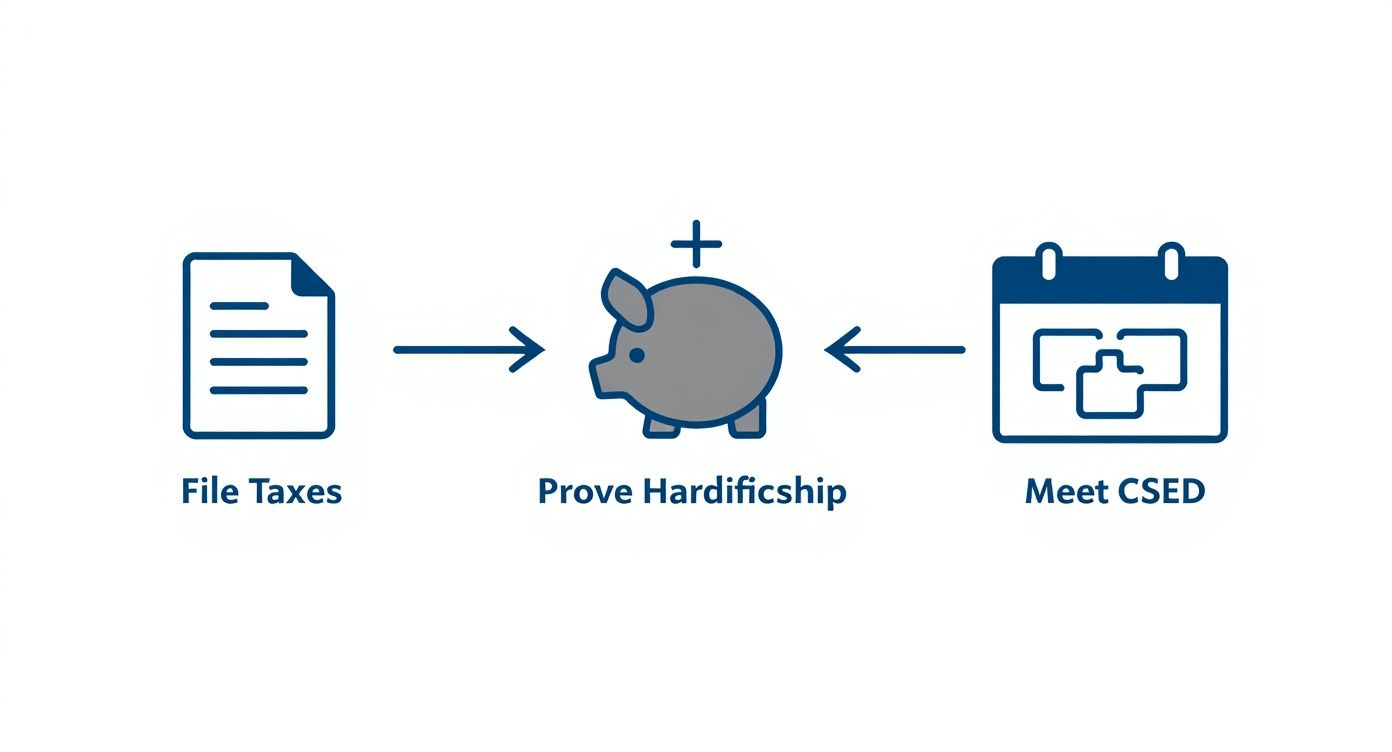
As you can see, qualifying is a structured process, not a game of chance. Each step, from getting into compliance to the final math, is a necessary hurdle on the path to a partial payment plan.
Getting Your PPIA Application Across the Finish Line

Applying for a Partial Payment Installment Agreement might feel like a mountain to climb, but it's really a step-by-step process. Think of it as painting a detailed, honest picture of your finances for the IRS. When you provide the right documents and tell a clear story, you put yourself in the best position for approval.
It all starts with two foundational documents. These forms are how you officially kick off the process and give the IRS the numbers they need to evaluate your request.
The Paperwork That Matters Most
At the core of any IRS partial payment installment agreement is a full financial disclosure. This is your proof that you simply can't afford to pay your tax debt in full. The IRS has specific forms for this to ensure they get the same information from everyone.
You'll almost certainly need to tackle one of these:
- Form 433-A or 433-F: This is the Collection Information Statement, and it’s a deep dive into your financial world. It covers everything from your income and living expenses to your assets (like cars and homes) and other debts. Being completely accurate and honest here is non-negotiable; the IRS will be checking.
- Form 9465: This is the Installment Agreement Request. It's the more straightforward part of the application where you formally ask for a payment plan. You'll file this right alongside your more detailed financial statement.
Pulling together the information for these forms is where most of the heavy lifting happens. You'll need to dig up pay stubs, bank statements, and records of your mortgage or rent payments. Some handy online tools can help you convert bank statements to Excel, which can make organizing this data a whole lot easier.
What Happens During the IRS Review?
Once you’ve sent in your application, your part is done for now. But for the IRS, the work is just getting started. A revenue officer or agent will be assigned to your case, and their job is to scrutinize the financial picture you’ve provided. They don't just take your word for it.
The agent will cross-reference your Form 433 information with data from third parties. They can see what property you own from public records, verify your wages with your employer, and comb through bank statements to see if your spending habits match your claimed expenses.
A huge mistake people make is trying to hide income or pad their expenses. The IRS is incredibly good at spotting these things. Your best strategy is always total transparency. It builds trust and dramatically improves your chances of getting the agreement approved.
Getting a final answer can take anywhere from a few weeks to several months. It really depends on how complex your finances are and how backed up the IRS is. Stay patient, and be ready to respond quickly if they ask for more information.
The Reality of the Biennial Review
Getting a PPIA isn't a "set it and forget it" solution. It’s the start of an ongoing relationship with the IRS, and a key condition of that relationship is the biennial review. Every two years, you’ll be required to submit an updated financial statement.
The purpose is simple: the IRS wants to see if your financial situation has improved. If you're earning more money or your essential living costs have gone down, they have the right to increase your monthly payment. This ongoing check-in is just part of the deal.
This makes it critical to stay on top of your payments and all your future tax filings. A single misstep can put the whole agreement at risk.
Benefits and Risks of a PPIA
A Partial Payment Installment Agreement, or PPIA, can feel like a godsend when you're staring down a mountain of tax debt. It provides a clear, structured way to pay what you can afford. But let's be clear—any deal with the IRS has its own rulebook, and a PPIA is no exception. Before you jump in, it's crucial to understand both the good and the bad.
The biggest win? Instant relief. The moment your PPIA is approved, the IRS has to back off. Those menacing letters stop. The threat of a surprise bank levy or wage garnishment vanishes. That alone can bring an incredible sense of peace. Most importantly, the payment is based on what you can actually afford, not on what the IRS wishes you could pay.
Key Advantages of Securing a PPIA
The real beauty of a PPIA lies in its design. It's built for taxpayers who are in a genuine financial bind, offering a realistic path forward instead of demanding the impossible.
Here’s what makes it so appealing:
- Truly Affordable Payments: Your monthly payment isn't tied to your total debt. It’s calculated based on your disposable income, which keeps your household finances from collapsing under the strain.
- Stops Aggressive Collections: Think of it as a protective shield. As long as you stick to the plan, the IRS can't legally seize your assets or garnish your wages.
- Potential for Major Debt Forgiveness: This is the headline benefit. When the Collection Statute Expiration Date (CSED) arrives, any tax debt left over—including all the penalties and interest—is wiped clean. Forgiven. Gone.
- Keeps Your Assets Safe: Unlike an Offer in Compromise, a PPIA typically doesn't force you to cash out your 401(k) or sell your home to pay down the debt. You get to keep what you’ve worked for.
Potential Drawbacks and Common Pitfalls
While the upsides are significant, a PPIA is a long-term commitment governed by very strict rules. One of the first things to prepare for is the potential filing of a Notice of Federal Tax Lien. This is a public claim against your property that can seriously ding your credit score and make it tough to get a loan for a car or a house.
On top of that, interest and penalties don't stop. They continue to pile up on your outstanding balance every single day until the debt is either paid off or the CSED clock runs out. So, even as you're making payments, your total debt is still growing.
The IRS doesn't just set it and forget it. They conduct a biennial review, checking in on your finances every two years. If your income has gone up or your essential living expenses have dropped, they have every right to increase your monthly payment.
And finally, you must stay compliant. One missed payment or failure to file and pay future taxes on time can trigger an immediate default. If that happens, the agreement is off, and you're right back where you started, facing the full force of IRS collections.
Weighing the Benefits and Drawbacks of a PPIA
To truly decide if a PPIA is the right move for you, it helps to see everything laid out side-by-side. This table breaks down what you gain versus the risks you're taking on.
| Pros of a PPIA | Cons and Risks of a PPIA |
|---|---|
| Payments are based on your actual ability to pay. | A Federal Tax Lien may be filed against your property. |
| Halts stressful IRS collection actions like levies. | Interest and penalties continue to add up on the unpaid balance. |
| The remaining balance is forgiven when the CSED expires. | Your finances are reviewed every two years, and payments can go up. |
| You can keep your assets, such as your home and 401(k). | Defaulting on the plan brings back aggressive collections. |
At the end of the day, a PPIA is a powerful tool for many people, but it’s not a magic wand for every situation. For some taxpayers experiencing severe financial hardship, it might make more sense to first see if their account can be declared Currently Not Collectible, which puts a temporary pause on all payments.
When to Partner with a Tax Professional
You can absolutely try to negotiate an IRS partial payment installment agreement on your own. But for some people, it’s like trying to fix your own transmission after watching a YouTube video—the risk of a costly mistake is just too high. Knowing when to call in a professional is often the most important step you can take.
Think of a good tax professional as your personal translator and advocate. They speak the IRS's language fluently and know the unwritten rules that can make or break a deal. Their experience is priceless in high-stakes situations where one wrong move could get your application denied or leave you with a much higher monthly payment.
Signs You Need Expert Help
Certain situations are clear signals that going it alone is a bad idea. If any of these sound familiar, it’s time to seriously consider bringing in an expert:
- You Owe a Lot of Money: Once your tax debt goes over $50,000, the IRS microscope comes out. The scrutiny gets intense, and the paperwork gets more complicated. A pro knows exactly what the IRS is looking for in these larger cases.
- Your Finances Aren't Simple: Are you a business owner? Do you have income from multiple sources, or own assets like rental properties? Presenting a complex financial picture in a way that helps your case is an art form.
- The IRS Is Already Taking Action: If you’re already facing a wage garnishment or a bank levy, you’re past the DIY stage. This is an emergency. A tax professional can often step in immediately and get the collection activity paused while they negotiate a real solution.
- You've Been Rejected Before: If the IRS has already turned you down for a payment plan or an Offer in Compromise, something in your initial application raised a red flag. An expert can figure out what went wrong and put together a much stronger case the second time around.
A seasoned tax attorney or Enrolled Agent doesn't just fill out forms for you. They become a shield, handling the stressful phone calls and letters from IRS agents. They negotiate from a place of experience, not emotion.
A tax professional's real value isn't just getting the deal approved. They look at your whole financial situation to help you stay on track for the long haul, preventing new tax problems down the road.
Beyond getting your PPIA set up, they can offer crucial advice for keeping your finances clean, including things like practical small business bookkeeping tips. At the end of the day, hiring a pro is about giving your application the best possible shot at success, which could save you an enormous amount of money and stress.
Frequently Asked Questions About PPIAs
When you're staring down a big tax bill, diving into the details of an IRS partial payment installment agreement can feel overwhelming. It’s natural to have questions. Let's clear up some of the most common ones people ask when they're exploring this option.
What Happens if My Income Changes During the PPIA?
Life happens, and your financial situation isn't set in stone. The IRS knows this, which is why a PPIA isn't a "set it and forget it" deal.
The IRS will take a look at your finances every two years. If you've gotten a big raise or your income has jumped, they can—and likely will—increase your monthly payment. On the flip side, if you lose your job or your income takes a hit, you can request a reduction. The payment is meant to reflect what you can actually afford.
Will a PPIA Immediately Stop an IRS Wage Garnishment?
Yes, but not instantly. Once your PPIA is officially approved by the IRS, they are legally required to stop collection actions. That means any wage garnishments or bank levies have to be released.
The keyword here is "approved." The protection doesn't start the day you mail in your application. That’s why it's so important to move fast if you've already received a levy notice from the IRS—the clock is ticking.
Can My Small Business Get a PPIA?
It's possible, but the rules get a bit trickier. If you're a sole proprietor, your business and personal finances are essentially one and the same, so you can often qualify based on your total financial picture.
For corporations and LLCs, it's a much tougher road. The IRS will put the business's finances under a microscope. More importantly, the business has to be 100% current on all its tax filings and deposits—especially payroll taxes. Given the extra hurdles, this is definitely an area where getting professional help is a smart move.
How Is a PPIA Different from an Offer in Compromise?
This is a really important question, and the difference is huge. I like to explain it this way:
Think of an Offer in Compromise (OIC) as a one-shot settlement. You're offering the IRS a single lump sum to settle your entire debt for less than you owe. It's tough to get approved. A PPIA, on the other hand, is a long-term payment plan based on what you can afford each month, with the remaining balance forgiven only when the time limit for collection runs out.
An OIC is a sprint to the finish line for a lower amount, while a PPIA is a marathon that gives you a manageable payment. For most people, a PPIA is far more attainable than the notoriously difficult OIC.
Feeling overwhelmed by your tax situation? At Attorney Stephen A Weisberg, I start with a FREE Tax Debt Analysis to find out exactly how I can help before you ever pay a fee. Get your free analysis today and find a clear path forward.


