Received IRS Notice CP59? Here Is Your Action Plan
Received an IRS Notice CP59? Don't panic. Our guide explains what it means, why you got it, and the exact steps to take to resolve it and avoid penalties.

In this article
- What Is an IRS Notice CP59?
- Common Reasons for Receiving an IRS Notice CP59
- Understanding the IRS Non-Filer Compliance Campaign
- The Sheer Scale of This New Push
- Who Is Being Targeted First
- Your Step-By-Step Action Plan for a CP59 Notice
- Step 1: Don't Ignore the Letter
- Step 2: Gather Your Financial Records
- Step 3: Confirm if You Were Required to File
- Step 4: Verify if You Already Filed
- Step 5: Choose Your Response Strategy
- The Consequences of Ignoring a CP59 Notice
- The Substitute for Return (SFR)
- The Critical 90-Day Letter
- From Assessment to Enforced Collection
- When You Should Hire a Tax Professional
- Scenarios That Demand Expert Help
- The Value a Tax Attorney Brings to the Table
- Common Questions About IRS Notice CP59
- What if I Cannot Afford to Pay the Taxes I Owe?
- Could I Go to Jail for Not Filing a Tax Return?
- Why Did I Get a CP59 for an Old Tax Year?
- I Filed an Extension, So Why Did I Get This Notice?
That sinking feeling when you see an official-looking envelope from the IRS is something most people can relate to. If you've just opened one and found an IRS Notice CP59 inside, take a deep breath. It's not a bill, and it’s not an accusation.
Think of it as the IRS tapping you on the shoulder to say, “Hey, our records show you made some income last year, but we can't find a tax return from you. Did we miss something?”
What Is an IRS Notice CP59?

The CP59 notice is an automated letter sent when the IRS's computers spot a mismatch. The system sees income reported under your Social Security Number from sources like a W-2 from an employer or a 1099 from a client. It then checks if you filed a tax return for that year. If it doesn't find one, it automatically generates and sends you a CP59.
It's just an initial inquiry. The IRS isn't jumping to conclusions or assessing penalties right away. It's giving you a chance to clear things up by either filing the return they believe is missing or explaining why one wasn't required.
Common Reasons for Receiving an IRS Notice CP59
Getting a CP59 can be jarring, but the trigger is often a simple administrative issue—sometimes on the IRS's end, not yours. Before you panic, it's helpful to know the common reasons this notice shows up in mailboxes.
For example, by mid-2025, a wave of taxpayers reported receiving these notices for their 2024 tax returns, even though they had already filed. The IRS later acknowledged that internal processing delays and issues logging properly filed extensions caused these mistaken notices. It's a perfect example of how the system's own complexities can create confusion. You can read more on how the IRS has addressed these widespread notice issues on their official site.
This table breaks down the most frequent triggers for a CP59 notice, helping you quickly identify your potential situation.
| Trigger Scenario | Explanation | Initial Action to Consider |
|---|---|---|
| Simple Forgetfulness | Life happens! It's entirely possible you just forgot to file your tax return for the year in question. | Gather your tax documents (W-2s, 1099s) and prepare to file the return as soon as possible. |
| Return Is Still Processing | You filed on time, but the IRS is backlogged. Your return is sitting in their queue but wasn't logged before the CP59 was mailed. | Check the "Where's My Refund?" tool or your IRS online account to see if there's any status update. |
| You Filed a Proper Extension | You filed Form 4868 for an extension, but the automated system sent the notice before your extension was fully registered. | Find your copy of the filed Form 4868 or the e-file confirmation. You'll need this as proof. |
| Return Was Lost or Rejected | A mailed return can get lost. More commonly, an e-filed return might have been rejected for a small error (like a typo) and you missed the notification. | Log into your tax software to check the status. Look for an "accepted" confirmation, not just "submitted." |
Remember, a rejected e-file is a non-file in the eyes of the IRS.
A rejected e-filed return is not considered filed. It’s crucial to confirm that your return was not just submitted, but officially accepted by the IRS.
Knowing these common causes can help you shift from a state of panic to proactive problem-solving. This notice isn't the final word; it's the starting point of a conversation. Your job now is to figure out which scenario applies to you and respond accordingly.
Understanding the IRS Non-Filer Compliance Campaign
Getting an IRS Notice CP59 can feel like you’ve been singled out, but it’s crucial to see the bigger picture. Your notice isn't a random shot in the dark; it's almost certainly part of a massive, systematic enforcement effort known as the IRS Non-Filer Compliance Campaign. This is a major shift in how the agency finds and contacts people who haven't filed their taxes.
Think of it this way: the IRS used to cast a wide, slow net. Now, thanks to a huge injection of funding and much better data-matching technology, it’s using a high-powered sonar to pinpoint specific targets. The CP59 in your hand is a clear signal that you’ve appeared on the screen of a very well-organized and well-funded compliance program.
The Sheer Scale of This New Push
This isn’t just a minor administrative update. It’s a complete overhaul of their enforcement intensity. Starting in early 2024, the IRS massively ramped up its outreach to potential non-filers, using new resources from the Inflation Reduction Act to fuel its operations.
During this time, the agency began mailing between 20,000 and 40,000 CP59 notices every single week—an unprecedented volume. Knowing this can help you shift your mindset from "Why me?" to "Okay, what's my plan?" To get a better sense of this major compliance push, you can explore the details of the IRS non-filer crackdown in our related coverage.
The campaign's initial focus has been laser-sharp, prioritizing high-income individuals and business owners. These are exactly the taxpayers who have the most at stake.
Who Is Being Targeted First
The IRS isn’t being shy about its strategy. The first wave of non-filer notices is squarely aimed at those with the highest reported incomes, allowing the agency to get the biggest bang for its enforcement buck.
In the first few months of this initiative alone, the IRS sent over 25,000 letters to people who earned more than $1 million between 2017 and 2021. Another 100,000+ notices went out to those with incomes between $400,000 and $1 million for the same period.
If you’re a freelancer, consultant, business owner, or have a high net worth, this data should get your attention. The IRS is actively cross-referencing third-party information returns—like Forms 1099-K, 1099-NEC, and W-2—to find high earners who appear to have a filing requirement but have no tax return on record.
This targeted approach tells you a few important things if you've received a CP59:
- Your notice is not a mistake. It’s the direct result of a data-driven process designed to find you.
- The stakes are higher than ever. By focusing on high-income taxpayers, the potential tax bills, penalties, and interest can be substantial.
- A strategic response is non-negotiable. Knowing you’re part of a major campaign means a deliberate, professional response is far better than a hasty or emotional one.
Understanding that your CP59 is just one small piece of a huge, nationwide program should underscore the seriousness of the letter. This isn't a casual inquiry you can just set aside. It is a formal demand for action from an agency that now has more tools and resources than ever before to make sure you comply.
Your Step-By-Step Action Plan for a CP59 Notice
Getting an official letter from the IRS can be nerve-wracking, but an IRS Notice CP59 isn't a reason to panic. It’s simply a prompt for action. Let's walk through how to turn that initial confusion into a clear, manageable plan so you can respond correctly and with confidence. The key here is a structured approach.
This simple decision tree gives you a peek into how the IRS has been prioritizing its non-filer campaign, which is a common trigger for the CP59 notice.
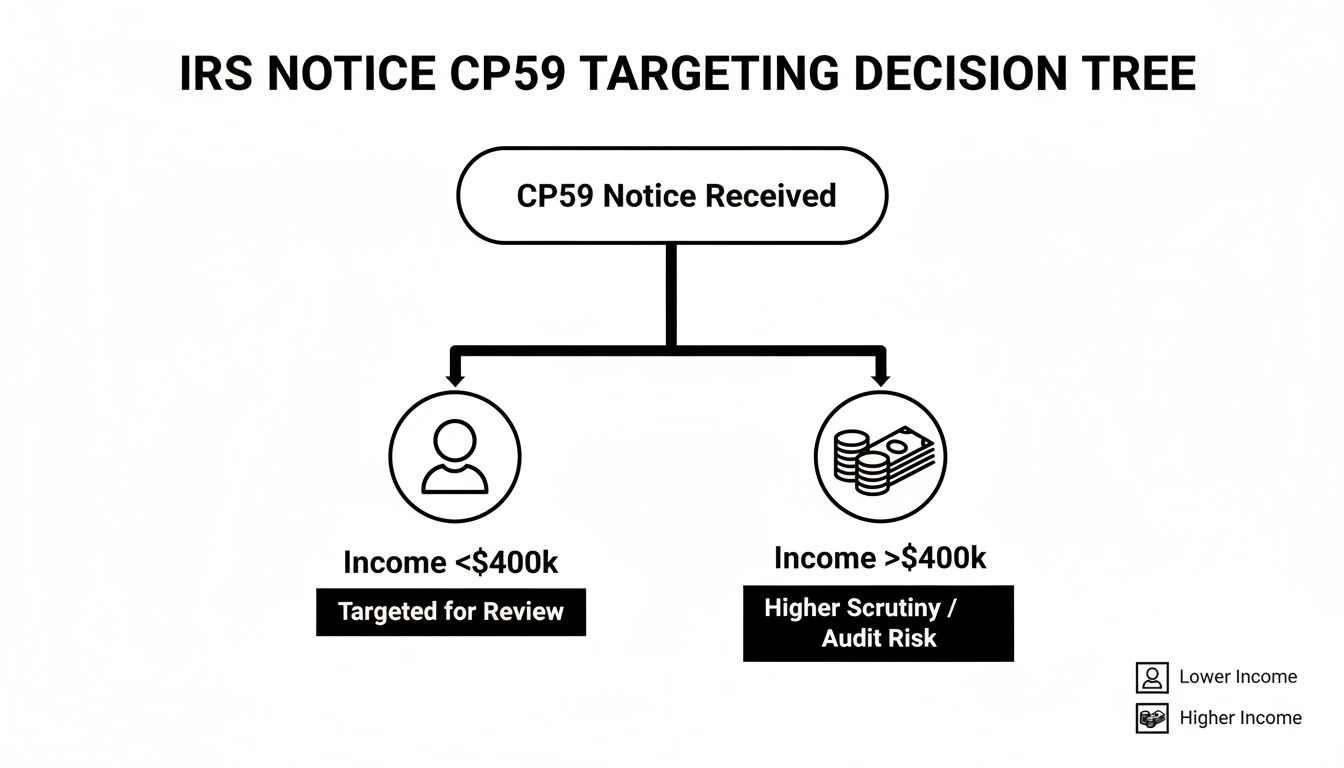
As you can see, while anyone can get this notice, taxpayers with incomes over $400,000 have been an initial focus of the IRS's non-filer compliance campaign. This signals that this group is under higher scrutiny right now.
Step 1: Don't Ignore the Letter
The single most important thing you can do is act. Tossing the notice in a drawer and hoping it goes away is the worst possible strategy. Ignoring a CP59 notice starts a clock on a series of automated IRS actions that can lead to some serious financial consequences, like a much higher tax bill and enforced collections.
Think of it like a warning light on your car's dashboard. It doesn’t mean the engine has failed, but it definitely means you need to pull over and see what’s wrong before a small problem becomes a major one. Acknowledging the notice is your first, most crucial move.
Step 2: Gather Your Financial Records
Before you can figure out the right response, you need to pull together all the necessary documents for the tax year mentioned in the notice. This means finding every record of your income and any potential deductions. A big part of this is knowing how to organize receipts for taxes and other financial paperwork to back up your filing.
Here's a quick checklist of what you'll need:
- Income Statements: This includes W-2s from employers and all your 1099 forms (like 1099-NEC, 1099-MISC, 1099-K, and 1099-DIV) from clients or financial institutions.
- Business Records: If you're self-employed, get your profit and loss statements, expense receipts, and bank statements together.
- Investment Activity: Grab any forms from brokerage accounts showing capital gains or losses.
- Proof of Payments: Find records of any estimated tax payments you made or taxes that were withheld from your paychecks.
Having these documents ready will make the next steps much smoother and will be absolutely essential if you end up needing to file a return.
Step 3: Confirm if You Were Required to File
Here’s something many people don't realize: not everyone is required to file a tax return every year. Your filing requirement depends on your gross income, filing status (like single or married), and age. The IRS sets specific income thresholds that trigger this requirement.
For example, for the 2023 tax year, a single individual under age 65 generally had to file if their gross income was at least $13,850. If your income was below the threshold for your specific filing status, you may not have been required to file at all.
Key Insight: If you figure out you weren't required to file, your response is simple. You'll check a box on the notice's response form, sign it, and mail it back to the IRS to let them know.
Step 4: Verify if You Already Filed
An IRS Notice CP59 is often just the result of a processing delay or a mix-up. If you're pretty sure you already filed, you need to find the proof.
- If you filed electronically: Dig up your email confirmation showing your return was accepted, not just submitted. A rejected e-file is the same as not filing in the eyes of the IRS.
- If you mailed a paper return: Hopefully, you have your proof of mailing, like a certified mail receipt. This is your golden ticket.
- If a tax preparer filed for you: Call them right away. Ask them for confirmation that the return was successfully filed and, most importantly, accepted by the IRS.
If you can confirm the return was accepted, you can typically disregard the notice. Still, it's smart to keep a copy of your filing proof stapled to the CP59 notice for your records, just in case.
Step 5: Choose Your Response Strategy
Your final step is to respond based on what you've found. Your situation will fall into one of three buckets:
- You haven't filed but were required to: Your path is clear—you need to prepare and file the missing tax return as soon as you can. If you need a little guidance, our guide on how to file back taxes offers a detailed roadmap.
- You already filed and have proof: Great. Just check the corresponding box on the response form, attach a copy of the front page of the return you filed, and mail it back.
- You disagree with the notice (because you weren't required to file): Simply check the box stating this, sign the form, and send it back to the IRS.
By breaking the process down into these five manageable steps, you can tackle the CP59 notice methodically and avoid a lot of unnecessary stress.
The Consequences of Ignoring a CP59 Notice
Tossing an IRS Notice CP59 in a drawer and hoping it goes away is a mistake. While it starts as a simple reminder to file a missing tax return, ignoring it kicks off a predictable and painful series of events that can put your finances in serious jeopardy.
Think of the CP59 notice as the first, gentle knock on your door. It's your easiest and best chance to open it and sort things out on your own terms. If you don’t answer, the next knock will be a lot louder.

When the IRS doesn't hear from you, they don't just give up. They take matters into their own hands and start the process of filing a tax return for you. This is the point where you begin to lose control of the situation.
The Substitute for Return (SFR)
If you continue to ignore the notice, the IRS will eventually create something called a Substitute for Return (SFR). This isn't a friendly gesture; it’s an official, one-sided calculation designed to establish how much you owe. The IRS prepares this return using only the income information it has received from third parties, like the W-2 from your employer or 1099s from your clients.
Here’s the catch: the SFR is essentially a worst-case-scenario tax return.
- It almost always uses a filing status like "Single" or "Married Filing Separately," which come with the highest tax rates and the lowest standard deductions.
- It completely ignores any of the deductions or credits you’re entitled to. Business expenses, charitable donations, education credits—none of it is included.
- The result is an inflated tax bill that is almost always significantly higher than what you would have owed if you had filed an accurate return yourself.
You can think of it like a court case where only the prosecution gets to present evidence. The SFR is based purely on your income, with none of the offsetting factors that would have lowered your tax liability.
The Critical 90-Day Letter
After creating the SFR, the IRS will send you a Notice of Deficiency, also known as a CP3219N notice. This is often called the "90-day letter," and its arrival signals a serious escalation. This formal letter details the tax, penalties, and interest the IRS has calculated for you based on their SFR.
You have exactly 90 days from the date printed on that letter to take action. Your options are to either file your own, correct tax return or to petition the U.S. Tax Court to challenge the IRS's numbers. This is a hard, statutory deadline.
This 90-day window is your last opportunity to dispute the proposed tax debt in Tax Court before it becomes legally binding. If you miss this deadline, you forfeit that right, and the IRS can move forward with collection actions.
From Assessment to Enforced Collection
If that 90-day window slams shut without you taking action, the IRS officially assesses the tax against you. The amount is no longer a proposal; it's a legal debt you owe the U.S. Treasury. From there, the IRS will issue a Final Notice of Intent to Levy, which is the last warning before they begin powerful collection actions.
These aren't polite requests. The IRS has aggressive, legally-sanctioned tools to seize assets and satisfy the debt. These can include:
- Wage Garnishment: The IRS can command your employer to send a large chunk of your paycheck directly to them.
- Bank Levies: They can seize funds straight from your checking and savings accounts, often without any further warning.
- Federal Tax Liens: A tax lien is a public claim against your property, like your house or car. It wrecks your credit and prevents you from selling the asset until the debt is paid.
Each of these steps can turn your life upside down. As we've detailed in our guide to the IRS Final Notice of Intent to Levy, the consequences are severe. This entire cascade of problems starts with one simple misstep: ignoring that initial CP59 notice. Responding quickly is your best and only defense.
When You Should Hire a Tax Professional
It's one thing to handle a simple, straightforward IRS Notice CP59 on your own. But some situations are just too complex and high-stakes to go it alone. Deciding to call in a professional isn't a sign of defeat; it's a smart, strategic move to protect your financial well-being. The right expert can be the difference between a quick, manageable fix and a drawn-out, expensive fight with the IRS.
Think of it like this: most of us can probably change a flat tire. But if the engine starts making a terrifying noise, you’re calling a mechanic. A CP59 notice can be a simple flat tire, or it can be the first warning sign of major engine trouble. A tax pro can help you figure out which it is and ensure it gets fixed correctly the first time.
Scenarios That Demand Expert Help
Certain red flags should tell you that a DIY approach is too risky. If your situation involves more than just filing one forgotten return, it's time to seriously think about bringing in an expert. The level of complexity and the potential financial damage in these cases really call for professional guidance.
Here are a few specific times when hiring a tax attorney is the smartest play you can make:
- You Owe a Large Tax Debt: If filing the missing return is going to create a tax bill you have no way of paying, an expert is a must. They can negotiate directly with the IRS for you, working to set up a payment plan or explore other settlement options.
- You Have Multiple Years of Unfiled Returns: One unfiled return is a headache; several years of them is a major problem. This pattern of non-compliance puts you on the IRS's radar for much more serious enforcement. It requires a careful, comprehensive strategy to get you back into good standing.
- You Run a Business: Business taxes are a different beast entirely. Things like payroll taxes, correctly deducting business expenses, and reporting income can get complicated fast. A professional makes sure your business returns are filed properly to minimize what you owe and protect your company.
- You Feel Completely Overwhelmed: Don't underestimate the stress that comes with an IRS issue. If you’re feeling anxious, confused, or just plain intimidated by the whole process, hiring a pro lets you hand that burden over to someone who deals with this stuff every single day.
The Value a Tax Attorney Brings to the Table
Bringing in an experienced tax attorney does more than just get your tax return filed. They step in as your representative, your negotiator, and your shield. They manage all the communication with the IRS so you don’t have to. If you've ignored a CP59 and now have a growing tax bill, exploring options for tax debt relief becomes critical, and an attorney is the person to guide you through that maze.
Key Takeaway: A tax attorney’s main job is to solve your tax problem while getting you the best financial outcome possible. This often involves working to get penalties reduced and stopping aggressive collection actions like wage garnishments or bank levies.
Their value shines through in a few critical ways:
- Strategic Communication: They know precisely what to say to the IRS—and, just as importantly, what not to say. By handling all the phone calls and letters, they keep you from accidentally making a costly mistake.
- Negotiation Power: A seasoned attorney knows all the resolution options the IRS offers, like Installment Agreements or an Offer in Compromise. They can negotiate for the most favorable terms that fit your specific financial situation.
- Accurate Filing and Future Prevention: They’ll make sure your past-due return is prepared perfectly, claiming every single deduction and credit you are legally entitled to. This not only minimizes what you owe now but helps you avoid future notices and audits.
Deciding to hire help can feel like a big step, but it's an investment in your peace of mind and financial security. If you're starting your search, it’s helpful to understand how to find a good tax attorney who's the right fit for you. In complex cases that start with an IRS Notice CP59, getting the right expert on your team is the single most important step you can take.
Common Questions About IRS Notice CP59
Getting a CP59 notice from the IRS can open a floodgate of "what if" questions. You might have a general idea of what to do, but the practical side of things—money, legal risks, and timing—is where the real anxiety kicks in. Let's tackle some of the most common questions that come up the moment this letter lands in your mailbox.
What if I Cannot Afford to Pay the Taxes I Owe?
This is the number one fear for most people facing an unfiled tax return. The thought of a huge tax bill you can't possibly pay is paralyzing. But here’s the good news: the IRS has structured programs designed for this exact situation. You have options.
The most important thing you can do is be proactive. Don't let the fear of what you might owe stop you from filing. Once you file the return and know the total amount due, you can officially ask for help.
- IRS Installment Agreement: This is the go-to solution for many taxpayers. It lets you make manageable monthly payments for up to 72 months. If you owe under a certain amount, you can often set this up yourself right on the IRS website.
- Offer in Compromise (OIC): Think of this as a last resort for those in serious financial trouble. An OIC allows you to settle your tax debt for less than you originally owed, but it's a tough path. You'll have to prove significant financial hardship with extensive documentation.
Ignoring the problem is what triggers harsh collection actions like liens and levies. The IRS is far more willing to work with you if you just communicate and show you're trying to get back on track.
Could I Go to Jail for Not Filing a Tax Return?
Let me put your mind at ease: it is extremely unlikely. The fear of prison for tax mistakes is common, but it’s crucial to understand the huge difference between a civil mistake and a criminal act. The overwhelming majority of non-filing cases, including those that start with a CP59 notice, are civil matters.
Crucial Distinction: Simply failing to file a return is a civil issue. The consequences are purely financial—penalties and interest. To cross into criminal territory, the government has to prove willful tax evasion, meaning you intentionally and knowingly tried to cheat the system.
For a case to become criminal, the IRS would need to find a pattern of deliberate deception. We're talking about things like using fake Social Security numbers, hiding money in offshore accounts, or creating shell companies to conceal income. Simply forgetting to file or not having the money to pay doesn't come close to that high standard. So, while you need to take this seriously to avoid financial pain, jail time is reserved for the most blatant cases of fraud.
Why Did I Get a CP59 for an Old Tax Year?
It can be a shock to get a notice about a tax return from three, four, or even more years ago. This happens because the IRS has a very long memory when it comes to unfiled returns. While you may have heard about a statute of limitations for taxes, it works differently for non-filers.
Here's the key: the statute of limitations—typically three years for the IRS to assess tax and ten years to collect it—does not begin until you actually file a tax return.
That means for any unfiled tax year, the clock has never even started ticking. The IRS can technically pursue you for an unfiled return from a decade ago. A CP59 for an old year is simply a sign that their system has finally flagged that missing return, and you're still on the hook for it.
I Filed an Extension, So Why Did I Get This Notice?
This is a frustrating but incredibly common scenario. You did what you were supposed to do—you filed Form 4868 for an automatic extension—but a CP59 notice showed up anyway. Nine times out of ten, this is just an internal timing glitch at the IRS.
The IRS's automated system that churns out CP59 notices probably sent your letter before it had a chance to process your extension. Its computer just saw "no return filed" by the April deadline and automatically triggered the notice, completely unaware that you have a valid extension until October 15th.
If this happens to you:
- Confirm your extension went through. Log into your IRS online account or check your tax software's confirmation to be sure the extension was accepted.
- Keep your proof. Hold onto your e-file receipt or certified mail confirmation for the extension.
- Don't panic. As the notice itself often says, you can disregard it if you've already filed or have a valid extension. Just be absolutely certain that your extension is on record with the IRS.
Navigating an IRS Notice CP59 and the potential tax debt that comes with it can feel like you're in over your head. You don’t have to do it alone. At The W Tax Group, we offer a FREE, no-obligation Tax Debt Analysis to diagnose your exact situation and lay out a clear path forward. We believe in giving you honest answers and effective strategies before you ever pay us a dime. If you’re ready to resolve your tax issues with confidence, visit us at weisberg.tax to get started.


