What an IRS Notice CP504 Means for Your Assets
Received an IRS Notice CP504? Understand this urgent final warning and the immediate steps you must take to prevent asset seizure and resolve your tax debt.

In this article
- Why an IRS Notice CP504 Demands Your Immediate Attention
- Understanding the Urgency of Your IRS Notice CP504
- Translating the Terms on Your Notice
- The Immediate Action You Must Take
- What Really Happens if You Ignore a CP504 Notice
- Bank Levies and Wage Garnishments: The Immediate Hit
- When Your Tax Debt Goes Public: The Federal Tax Lien
- For Business Owners: A Levy on Your Accounts Receivable
- How to Immediately Stop an IRS Levy
- The Power of Collection Due Process Rights
- Your Immediate Action Plan
- Your 30-Day CP504 Response Timeline
- Finding the Right Tax Debt Resolution Strategy
- For Those Who Can Pay Over Time
- For Those Who Cannot Pay in Full
- For Those Experiencing Severe Financial Hardship
- When the Debt Isn't Your Fault
- Hidden Dangers: Why This Notice Threatens More Than Your Bank Account
- The Fast Track to Having Your Passport Revoked
- Beyond Travel: How Your Career Could Be on the Line
- It’s Time to Take Control
- Your Solution Starts Here
- Frequently Asked Questions About IRS Notice CP504
- Is a CP504 a Final Levy Notice?
- Can the IRS Take My House?
- What if the Amount on the Notice Is Wrong?
- Can Bankruptcy Stop a CP504 Action?
Receiving a letter from the IRS can be unsettling, but an IRS Notice CP504 is one you absolutely cannot ignore. This isn't just another reminder; it's the government's final, official warning that they intend to seize your assets to cover an unpaid tax debt.
Think of it this way: this notice is a legally significant step that gives the IRS the green light to start garnishing your wages, levying your bank accounts, and even putting liens on your property. If you want to protect your financial stability, ignoring this letter simply isn't an option.
Why an IRS Notice CP504 Demands Your Immediate Attention

If earlier IRS notices were a polite knock on your door, the IRS Notice CP504 is the sound of a legal notice being tacked to it. It marks a serious escalation in the IRS collection process. The time for waiting and hoping the problem goes away is officially over.
This letter is your last real chance to get ahead of the situation and resolve your tax debt before the IRS takes matters into its own hands with aggressive, enforced collection actions. It's only sent after previous letters, like the CP501 or CP503, have been ignored.
Understanding the Urgency of Your IRS Notice CP504
To understand just how serious the CP504 is, it helps to see how it stacks up against earlier notices.
| Notice Type | What It Means | Required Action |
|---|---|---|
| CP501 / CP503 | These are initial balance-due reminders. Think of them as a "heads up" that you owe money. | Review the notice, and either pay the balance or contact the IRS to make arrangements. |
| CP504 | This is your Final Notice and Intent to Levy. It's a legally required warning before asset seizure. | Immediate action is required. You have 30 days to respond and prevent levies. |
| Letter 1058 / LT11 | This is the Final Notice of Intent to Levy and Notice of Your Right to a Hearing. | This is your last chance to request a Collection Due Process (CDP) hearing. Act now. |
As you can see, the CP504 is the critical turning point where the IRS's approach shifts from asking to telling.
Translating the Terms on Your Notice
Opening a CP504 and seeing all the figures can be overwhelming. Let's quickly break down what you're looking at in plain English:
- Tax Due: This is the base amount of tax the IRS says you owe for a specific year or period.
- Penalties: These are extra charges the IRS tacks on for things like filing late or not paying on time. The failure-to-pay penalty can grow surprisingly fast.
- Interest: The IRS charges interest not just on the unpaid tax but on the penalties, too. It compounds daily, which is why the total you owe can snowball.
The real message behind the CP504 is blunt: your time to voluntarily fix this is running out. The IRS has done its legal duty by warning you, and the next step is taking your money and assets directly.
The Immediate Action You Must Take
Once you receive a CP504, a critical 30-day clock starts ticking. This isn't necessarily a deadline to pay in full, but it is a hard deadline to respond and get a resolution in motion.
Your very first move should be to get a professional assessment of your case. Ignoring this notice gives the IRS the legal authority to start seizing your state tax refund or levying other assets without any further warning.
A proper analysis will identify the best path forward for you, whether that's a manageable payment plan, an Offer in Compromise, or another tax resolution strategy. Taking this step immediately halts the collection machine and protects you from the severe financial fallout of an unanswered CP504. To learn more, you can start by decoding the IRS CP504 notice in our detailed guide. Acting now puts you back in the driver's seat.
What Really Happens if You Ignore a CP504 Notice
Getting an IRS Notice CP504 might feel like just another piece of mail, but ignoring it has very real, very damaging financial consequences. This isn't a simple warning shot; it's the IRS formally announcing it's ready to bring out its most powerful collection tools. That 30-day window mentioned in the letter is your last chance to get ahead of the problem before things get incredibly difficult.
Once that clock runs out, the IRS has the legal authority to stop asking and start taking. Let’s break down exactly what that means for your money, your property, and your reputation.
Bank Levies and Wage Garnishments: The Immediate Hit
The first and most shocking actions the IRS will take are bank levies and wage garnishments. A bank levy isn't a polite request for a partial payment. The IRS can freeze and seize every single dollar in your bank accounts—checking, savings, you name it—up to the full amount of your tax debt. Imagine trying to pay your mortgage or buy groceries only to find your account has been completely wiped out overnight.
A wage garnishment is just as aggressive, but it hits your income before you even see it. The IRS will send a legal order to your employer, requiring them to divert a substantial chunk of your paycheck directly to the government. This isn't a one-time thing; it happens every single payday until your debt is gone, leaving you with a fraction of your income to live on.
A bank levy is a single, powerful seizure, but the IRS can hit you with them again and again. A wage garnishment is a continuous drain on your income that can last for months or even years. Both are designed to get your immediate attention.
These actions can also go after other assets. The IRS has the power to seize retirement funds, and understanding if the IRS can take your 401k is crucial for anyone facing a large tax bill.
When Your Tax Debt Goes Public: The Federal Tax Lien
Beyond taking your money directly, the IRS can file a Notice of Federal Tax Lien (NFTL). This is a public document that stakes the government's claim to all your property, including assets you acquire in the future. It’s essentially a public announcement to the entire financial world—banks, lenders, everyone—that the IRS gets paid first.
A tax lien triggers a cascade of problems:
- Crushed Credit Score: The lien gets reported to the major credit bureaus, causing severe and long-term damage to your credit score.
- Blocked Access to Credit: Getting a mortgage, refinancing your home, buying a car, or even qualifying for a new credit card becomes next to impossible.
- Frozen Assets: You can't sell or transfer property, like your house, without first settling the debt to clear the lien.
The CP504 is the final warning before these collection powers are unleashed. Once that 30-day period is up, the IRS can snatch your state tax refunds, file that NFTL, and put your financial life on public display. For professionals whose clients rely on their financial stability, a public lien can be devastating, derailing everything from real estate closings to business deals.
For Business Owners: A Levy on Your Accounts Receivable
If you’re self-employed or run a business, the IRS has another tool that can be even more crippling: a levy on your accounts receivable. They will contact your clients and customers directly and order them to send payments owed to you to the IRS instead.
This move is a double-edged sword. Not only does it choke off your business's cash flow, but it also broadcasts your financial troubles to the very people you depend on to stay in business. It sends a clear signal that you're in a tough spot, which can destroy your professional reputation and cause clients to look elsewhere. What started as a tax problem can quickly become a business-ending catastrophe.
How to Immediately Stop an IRS Levy
Getting an IRS Notice CP504 can make your stomach drop. It feels final, and it's designed to. But this isn't the time to panic—it's the time to act. The single most important thing you can do right now to stop a levy in its tracks is to re-engage with the IRS. Ignoring them guarantees they’ll seize your assets; responding, especially with a professional on your side, opens up a path to resolution.
Think of the CP504 as the last warning shot before the real countdown begins. This notice is the IRS telling you that the next letter you get will likely be the "Final Notice of Intent to Levy and Notice of Your Right to a Hearing" (often a Letter 1058 or LT11). That next letter is the one that officially triggers your Collection Due Process (CDP) rights—your legal right to an appeal.
By acting now, you're getting ahead of the game. Contacting the IRS proactively shows you’re serious about fixing the problem, and that alone can often pause the most aggressive collection tactics. It buys you breathing room to figure out a real solution, all without the immediate threat of a frozen bank account or garnished wages.
The Power of Collection Due Process Rights
Don't underestimate your CDP rights—they are your most powerful defense. Once you get that final notice (the one after the CP504), you have 30 days to request a CDP hearing. Filing this request puts an official hold on most levy actions while your appeal is being considered.
A CDP hearing is your chance to make your case. You can:
- Dispute whether you actually owe the tax or if the amount is correct.
- Propose a more manageable solution, like a payment plan.
- Raise specific defenses, such as requesting Innocent Spouse Relief.
This formal process forces the IRS to stop, listen, and review your situation. Understanding this timeline is everything. The CP504 is your cue to get your documents and your strategy ready for when that final notice arrives.
The flowchart below shows just how quickly things can escalate if you do nothing.
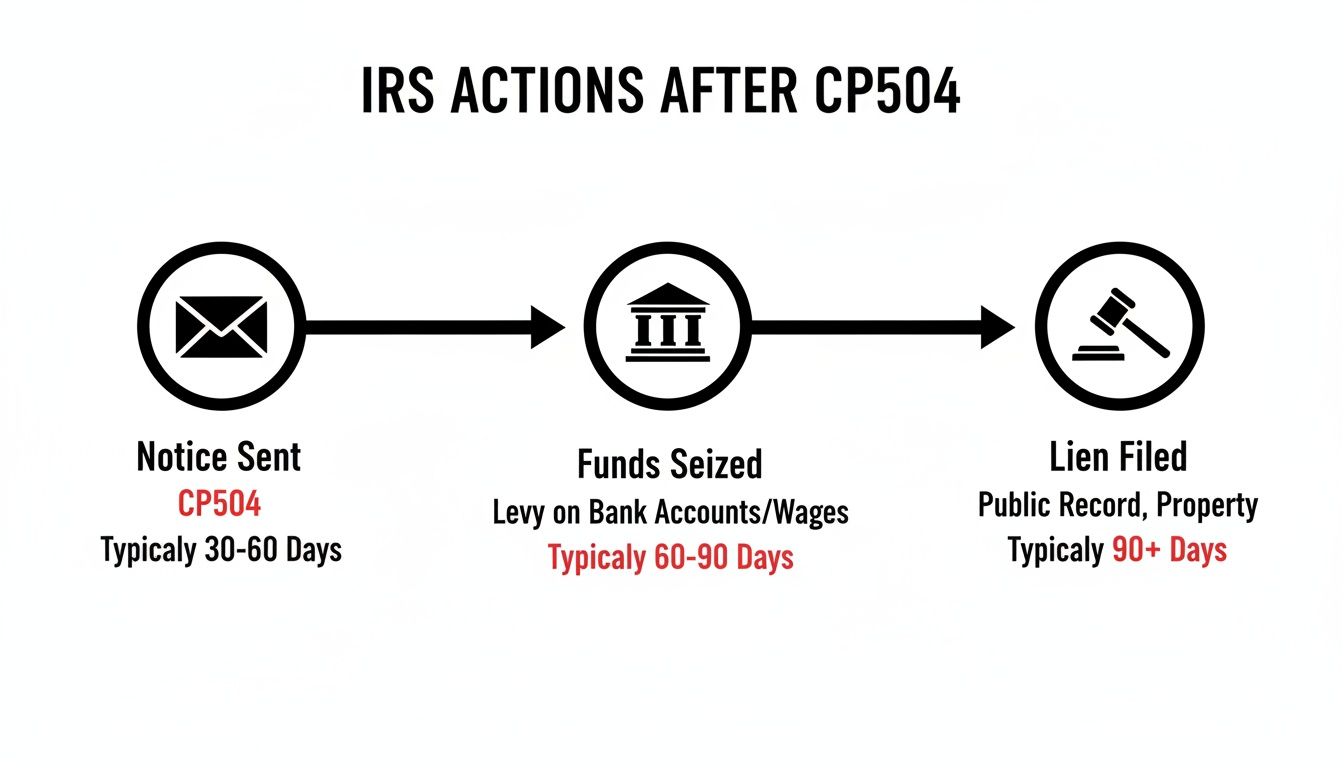
As you can see, that 30-day clock to protect your assets starts ticking the second the final notice hits your mailbox.
Your Immediate Action Plan
Don't sit around waiting for that final levy notice. You can take back control starting today. The goal here is to switch from being on the defensive to playing offense—setting the terms for a resolution instead of just reacting to the IRS's next move.
Here's what you need to do, starting now:
- Don't Ignore Your Mail: Keep a close eye on everything that comes from the IRS. The very next letter could be the one that starts your 30-day appeal clock.
- Get Your Paperwork Together: Start gathering your old tax returns, any prior IRS notices, and basic proof of your current income and living expenses. Having this ready will make everything go much faster.
- Find Professional Representation: A tax professional knows how to navigate the IRS maze and speaks their language. They can get on the phone for you, figure out the best strategy, and often get the immediate threat of a levy removed.
The most effective way to stop a levy is to engage the system before it fully engages you. A timely and professionally handled response can halt enforced collections and create the breathing room needed to find a permanent solution.
By taking these steps, you interrupt the IRS's automated collection machine. You're replacing their assumptions with the actual facts of your financial life, which is the only way to negotiate a fair outcome. If you're in this situation, you can learn more about how to stop an IRS levy with professional help and protect what’s yours.
The 30-day window after you receive your CP504 is absolutely critical. To help you visualize what needs to happen, here’s a sample timeline of the most important actions to take.
Your 30-Day CP504 Response Timeline
| Timeframe | Action Item | Purpose |
|---|---|---|
| Day 1-3 | Receive CP504. Contact a qualified tax professional. | Get an expert assessment immediately. A pro can confirm the notice's validity and start building a defense strategy. |
| Day 4-10 | Gather financial documents and sign a Power of Attorney. | Provide your representative with tax returns, bank statements, and pay stubs so they can negotiate with the IRS on your behalf. |
| Day 11-20 | Representative contacts the IRS. | Proactively opens a line of communication to potentially place an informal hold on collection activity while exploring resolution options. |
| Day 21-30 | Analyze resolution options and prepare for the next notice. | Determine the best path forward (e.g., payment plan, OIC) so you're ready to file an appeal the moment the final levy notice arrives. |
Following a clear plan like this removes the panic and replaces it with proactive steps. It ensures you use every available day to build the strongest possible case and prevent the IRS from seizing your assets.
Finding the Right Tax Debt Resolution Strategy
Alright, so you’ve managed to stop the immediate threat of a levy after getting that CP504 notice. Take a breath. That’s a huge first step, but it's important to understand it's a temporary pause, not a permanent solution. The IRS collection machine has been halted for now, but the underlying tax debt is still there, and it won't just vanish.
Think of it like getting a flat tire on the freeway. Putting on the spare gets you off the dangerous shoulder and back on the road, but you know you can't drive on it forever. You still have to get to a tire shop for a real fix. Stopping a levy is your spare tire—it buys you precious time to figure out the right long-term strategy for your tax problem.
The good news is, the IRS has several established pathways to resolve tax debt. They aren't one-size-fits-all, because everyone's financial situation is different. The key is to honestly assess your circumstances and find the path that makes the most sense for you.
For Those Who Can Pay Over Time
If you have a reliable income but just can't write a check for the full amount right now, an Installment Agreement (IA) is often the most direct route. It’s exactly what it sounds like: a formal payment plan that lets you chip away at your tax debt with manageable monthly payments.
There are a few different kinds of these agreements. If your debt is under a certain amount, you might get a "streamlined" agreement without having to bare your entire financial soul to the IRS. This is usually the fastest way to get back in good standing and keep them from taking further action.
- The upside: You get predictable monthly payments and stop worrying about aggressive collection tactics.
- The catch: Interest and penalties keep adding up until the balance is zero.
For Those Who Cannot Pay in Full
What happens when your income and assets don't even come close to covering what you owe? For situations like this, the IRS has a program called an Offer in Compromise (OIC). An OIC allows certain taxpayers to settle their tax debt for less—sometimes much less—than the original amount.
Let's be clear, though. This isn't like haggling at a flea market. The OIC program is notoriously tough, and the IRS uses a rigid formula to calculate your "reasonable collection potential"—what they think they can realistically squeeze out of you over time. To even be considered, you have to prove that paying in full would cause you a genuine financial hardship. The application is intense and requires you to lay all your financial cards on the table.
An Offer in Compromise isn't about what you feel is fair. It’s a cold, hard calculation based on the IRS’s analysis of your income, expenses, and assets. A successful OIC depends on building a solid, well-documented case.
For Those Experiencing Severe Financial Hardship
In the toughest of circumstances, even a small monthly payment is out of the question. If your financial situation is truly dire, the IRS might place your account in Currently Not Collectible (CNC) status.
This means the IRS officially agrees you can't afford to pay anything right now and will pause all collection efforts—no levies, no wage garnishments. CNC isn't a get-out-of-jail-free card, however. The IRS will check in on you periodically to see if your financial picture has improved. All the while, interest and penalties continue to stack up, and they will absolutely keep any tax refunds you’re due.
When the Debt Isn't Your Fault
Sometimes, a tax bill shows up because of a joint return filed with a spouse or ex-spouse who played fast and loose with the numbers. If you were kept in the dark about understated income or bogus deductions, you shouldn't have to pay for their mistakes. This is where Innocent Spouse Relief comes in.
This powerful provision can release you from the responsibility of paying the tax, interest, and penalties tied to your spouse's actions. There are a few different types of relief, each with its own strict rules:
- Innocent Spouse Relief: Essentially separates your tax liability from your spouse's.
- Separation of Liability Relief: Divides the total tax debt between you and your ex-spouse.
- Equitable Relief: A last resort for when you don't qualify for the other two, but it would be fundamentally unfair to make you pay.
Whether you're aiming for a straightforward payment plan or a complex Offer in Compromise, proving your case requires a deep dive into your finances. The IRS is going to want to see everything—your income, your assets, your essential living expenses—to decide what you can truly afford. This is why the most critical step you can take after getting a CP504 notice is to get a professional tax debt analysis. It’s how you turn a crisis into a proactive plan for getting your financial life back on track.
Hidden Dangers: Why This Notice Threatens More Than Your Bank Account

A bank levy or wage garnishment is bad enough, but an ignored IRS Notice CP504 can unleash a whole other level of problems. Think of this notice as the final warning before the IRS starts pulling levers that can affect your freedom of movement and even your ability to earn a living—especially if your job involves travel or government work.
One of the most jarring moves the IRS can make is to have your U.S. passport revoked or your renewal application denied. This isn't just an intimidation tactic; it's a very real and powerful tool they use to get taxpayers with large debts to the table.
The Fast Track to Having Your Passport Revoked
So how does this happen? The process kicks off when the IRS officially labels your account with a "seriously delinquent tax debt." If you've received a CP504 and don't take action, you're on a direct path to getting this label. From the government's perspective, it's simple: if you owe them a lot of money, they can make it impossible for you to leave the country until the debt is handled.
The threshold for this is quite specific. A "seriously delinquent tax debt" is defined as owing more than a certain amount—currently over $60,000 when you add up the tax, penalties, and interest. This number is adjusted for inflation, so it can change.
Once a taxpayer hits that amount and the IRS has already filed a federal tax lien or issued a levy, they can certify your debt to the U.S. State Department. The State Department then has the legal right to deny your passport application or, worse, revoke your current one. In 2019 alone, over 400,000 taxpayers were flagged for this process, which shows you just how seriously the IRS takes this.
For business owners, consultants, or anyone whose work depends on international travel, a revoked passport is a professional catastrophe. It literally grounds you, cutting off your ability to meet clients, manage supply chains, and earn a living.
Beyond Travel: How Your Career Could Be on the Line
The trouble doesn't stop at the airport. That same Notice of Federal Tax Lien that triggers passport problems is a public record. This means anyone—including professional licensing boards and government contracting officers—can see it.
This can create some serious professional roadblocks:
- Professional Licenses: Many state boards for lawyers, doctors, accountants, and other licensed professionals require members to be in good financial standing. A public tax lien could lead to disciplinary action or prevent you from renewing your license.
- Federal Contracts: If you own a business that bids on federal contracts, an outstanding tax debt is a massive red flag. It can get you disqualified from new work and may even put your current contracts at risk.
- Security Clearances: Unresolved debt is often seen as a security risk, potentially making it impossible to get or keep a security clearance.
The bottom line is that an IRS Notice CP504 is a threat to much more than just your money. It can put your career, your business, and your freedom to travel in serious jeopardy. Don't make the mistake of thinking it can't happen to you, because the IRS can and will revoke your passport if the debt remains unresolved.
It’s Time to Take Control
Getting an IRS Notice CP504 is a gut-wrenching moment, and it’s meant to be. This is the IRS’s final warning before they start taking your money and property. But as we've walked through, it's a warning, not a final verdict. You now know what’s at stake, but more importantly, you know there are clear paths forward. The key is to act now.
The best first step is to get a professional, objective look at your situation. A thorough Tax Debt Analysis will pinpoint exactly where you stand with the IRS and map out the most effective strategy to stop the collection machine in its tracks.
Waiting for the next letter to show up in your mailbox isn't a strategy—it's a gamble. The only way to protect your assets and dictate the outcome is to engage with the IRS proactively.
This is how you get back in the driver's seat, halt the threat of levies, and move toward resolving this for good.
Your Solution Starts Here
Trying to figure out the IRS maze on your own is a frustrating, and often costly, experience. But you don't have to do it alone. Our team lives and breathes this stuff, helping people and business owners navigate these exact challenges every single day.
We always start with a free, no-obligation Tax Debt Analysis. Think of it less as a sales call and more as a strategy session. We'll dig into the details of your case to find the best possible resolution. Let's put an end to the stress and uncertainty. Contact us today to schedule your confidential analysis and take that first real step toward getting your peace of mind back.
Frequently Asked Questions About IRS Notice CP504
Getting a letter from the IRS can be confusing and more than a little stressful. Let’s clear up some of the most common questions people have when a CP504 notice shows up in their mailbox. Knowing exactly what you're dealing with is the first step toward getting it resolved.
Is a CP504 a Final Levy Notice?
This is a really common point of confusion, so let's be crystal clear: The CP504 is not the final notice that gives you formal appeal rights.
Think of it as the IRS's last major warning shot across the bow. It's a serious letter that says, "We intend to levy your assets." The truly critical notice—the one that legally starts the clock—is what comes next. That letter, usually a Letter 1058 or an LT11, is the one that officially gives you 30 days to request a Collection Due Process (CDP) hearing and formally stop the levy in its tracks.
Can the IRS Take My House?
The thought of the IRS seizing your home is understandably terrifying. The good news is that this is an incredibly rare and difficult step for them to take. Forcing the sale of a primary residence requires a court order and is something the IRS reserves for only the most extreme cases.
What's far more likely—and still very serious—is a Notice of Federal Tax Lien. This is a public claim against all your property, including your house. A lien doesn't kick you out, but it effectively holds your property hostage. You won't be able to sell or refinance your home until the tax debt is paid, making it a powerful collection tool for the IRS.
What if the Amount on the Notice Is Wrong?
If you open your CP504 and know for a fact that the balance is wrong, you absolutely cannot ignore it. This is a critical mistake. The IRS will move forward with collections based on the numbers they have, regardless of whether they're accurate.
You have to act within that 30-day window. The best move is to get a tax professional involved immediately to help you challenge the amount. This might mean filing an amended return or gathering records to prove your case, but quick, proactive communication is the only way to stop the IRS from acting on a faulty balance.
Ignoring a notice with an incorrect balance is one of the fastest ways to lose your rights. The IRS assumes the amount is correct until you proactively prove otherwise, and their collection process will continue moving forward.
Can Bankruptcy Stop a CP504 Action?
Yes, filing for bankruptcy can put the brakes on things—and fast. The moment you file, something called an "automatic stay" goes into effect. This legal protection temporarily forces most creditors, including the IRS, to halt all collection activities, which includes the levy threatened by a CP504.
But bankruptcy isn't a silver bullet for tax debt. It's a complex process, and whether your specific tax liability can be discharged (wiped out) depends on several strict rules, like the age and type of the tax. It's absolutely essential to talk with a tax resolution specialist and a bankruptcy attorney to figure out if this is the right long-term strategy for you.
At Attorney Stephen A Weisberg, we know how overwhelming an IRS notice can feel. That’s why we start every case with a free, confidential Tax Debt Analysis to map out the best path forward for your specific situation. Take control of your tax situation by scheduling your free analysis today at weisberg.tax.


