Your Guide to Understanding an IRS Notice CP49
Received an IRS Notice CP49? Don't panic. Our guide explains why your tax refund was offset, how to respond, and ways to resolve your tax debt for good.
In this article
- What an IRS Notice CP49 Actually Means for You
- Decoding the Numbers on Your Notice
- A Common and Automated Process
- The Debts That Trigger a Tax Refund Offset
- The Most Common Culprit: Federal Tax Debt
- Beyond the IRS: Other Debts That Can Seize Your Refund
- How to Confirm the Debt on Your CP49 Is Correct
- Pull Your IRS Account Transcript
- Contact the Right Agency
- Your Strategic Options After Receiving a CP49 Notice
- Pay Any Remaining Balance
- Dispute the Debt If It Is an Error
- Request Relief and Set Up a Payment Plan
- Comparing Your CP49 Response Options
- Explore All Avenues for Debt Resolution
- The Hidden Costs of Penalties and Interest
- How a Small Debt Snowballs
- Stopping the Financial Bleed
- When You Should Get Professional Tax Help
- Clear Signs You Need an Expert
- The Strategic Advantage of Professional Guidance
- Frequently Asked Questions About Notice CP49
- Can I Stop the IRS from Taking My Refund Next Year?
- How Do I File an Injured Spouse Claim?
- Will an IRS Notice CP49 Hurt My Credit Score?
- I Have an IRS Payment Plan, Why Was My Refund Still Taken?
An IRS Notice CP49 is the official letter the government sends when it takes your tax refund to pay off an old federal tax debt. It’s not a bill for a new tax. Think of it more like an automatic bank transfer—your deposit (the refund) was used to cover an outstanding loan (the old tax debt).
What an IRS Notice CP49 Actually Means for You

Let's be honest, no one likes getting a letter from the IRS. But if you have to get one, the CP49 is one of the more straightforward ones. It doesn't create a new problem; it just tells you about an action the IRS already took. It’s essentially a receipt confirming that your tax refund was applied to a balance you owed from a previous year.
This whole process is called a refund offset, and it’s completely automated. When you file your taxes and are due a refund, the IRS computers do a quick check to see if you owe them money from any prior tax years. If they find a debt, they automatically intercept the refund to pay it down.
Decoding the Numbers on Your Notice
The notice itself is designed to give you a clear, simple breakdown of where your money went. When you look at your CP49, you’ll want to find these four key numbers:
- Your Original Refund Amount: This is how much you were expecting back from your latest tax return.
- The Amount Applied to Your Debt: This line shows exactly how much of your refund was used to cover your old tax bill, including any penalties and interest that had built up.
- Your Remaining Refund (if any): If your refund was bigger than your tax debt, this is the amount you’ll still get, either by check or direct deposit.
- Your Remaining Debt (if any): On the flip side, if your refund didn't cover the entire debt, this shows the balance you still owe the IRS.
Here’s a look at the top section of a typical IRS Notice CP49, which shows the financial summary at a glance.
As you can see, it clearly itemizes the overpayment (your refund), how much was applied to your other taxes, and the final result. It’s all about tracking the transaction.
A Common and Automated Process
It’s important to know that this is an incredibly common and routine procedure. The IRS Notice CP49 is one of the most frequent refund offsets, impacting thousands of taxpayers every year who were anticipating a refund. The IRS has the legal authority to do this under Internal Revenue Code (IRC) §6402, which lets them apply overpayments to outstanding liabilities without asking for your permission first. You can learn more about how the IRS handles these notices and letters to see the full picture of their collection power.
At its core, the CP49 notice is about transparency. It’s the IRS’s way of saying, “You were owed a refund for $X, but you had an old debt for $Y. We used your refund to pay that debt, and here’s what’s left.”
Ultimately, receiving a CP49 notice is a clear signal that an old tax problem still needs your full attention. While the refund offset happened automatically, it's a powerful reminder that an underlying debt is still there, and it will keep growing with penalties and interest if you don't resolve it. Consider this your wake-up call to get proactive about your tax situation.
The Debts That Trigger a Tax Refund Offset
Getting a CP49 notice from the IRS can feel like a punch to the gut. You were expecting a refund, and instead, you get a letter saying the government kept it. The natural assumption is that you must have owed the IRS money from a prior year, and while that's often true, it's far from the only possibility.
The federal government has a powerful tool called the Treasury Offset Program (TOP). Think of it as a master list of everyone who owes a government agency money. If you're on that list, and another agency (like the IRS) is about to send you money, TOP can step in and reroute your refund to pay off that old debt first. This means the debt that triggered your IRS Notice CP49 might not have anything to do with taxes at all.
The Most Common Culprit: Federal Tax Debt
Let's start with the most common reason you'd see a CP49. More often than not, it's because you have an outstanding federal income tax bill from a previous year. The IRS is simply paying itself back with the refund you were due this year.
This can happen for a few reasons:
- Underpayment: Maybe you were a freelancer two years ago and didn't set aside enough for your quarterly estimated taxes.
- Audit Adjustment: An IRS audit might have found you owed more tax than you originally paid, and that balance was never settled.
- Unfiled Returns: If you didn't file a return, the IRS may have created a Substitute for Return (SFR) for you, generating a tax bill that collected penalties and interest without you even realizing it.
In these situations, the CP49 is just the IRS closing the loop on a debt you already owed them.
Beyond the IRS: Other Debts That Can Seize Your Refund
But here’s the twist that catches so many people by surprise. The Treasury Offset Program allows completely different government agencies to get in line and claim your tax refund. It's crucial to understand this because the solution to your problem depends entirely on who you actually owe.
Key Insight: While the IRS sends the CP49 for federal tax offsets, the Treasury Department's Bureau of the Fiscal Service (BFS) is the agency that actually manages the broader offset program. This means your refund can be applied to a wide range of government debts, not just taxes. The Taxpayer Advocate Service provides great details on how these offset notices work and the authority behind them.
Some of the most common non-IRS debts that trigger a refund seizure include:
- Past-Due Child Support: If you're behind on court-ordered child support, the state can request your federal refund to cover the arrears. This is one of the most frequent non-tax offsets.
- Federal Agency Non-Tax Debts: This is a big category. It could be anything from a defaulted federal student loan to an unpaid Small Business Administration (SBA) loan or even an overpayment of Social Security benefits.
- State Income Tax Obligations: Owe money to your state’s department of revenue? They can partner with the Treasury to collect that debt from your federal refund.
- State Unemployment Compensation Debt: This often happens if a state determines you were overpaid in unemployment benefits and you never paid that money back.
If your refund was intercepted for one of these non-IRS debts, you should also receive a separate, more detailed letter from the Treasury's Bureau of the Fiscal Service (BFS). That notice will name the agency that took the money and provide their contact information. Knowing that your tax problem might not be a tax problem at all is the first step to getting to the bottom of it.
How to Confirm the Debt on Your CP49 Is Correct

When an IRS notice lands in your mailbox, the natural impulse might be to panic and pay. But hold on. Before you even think about sending money, your very first step is to confirm the numbers are actually correct.
Think of it this way: the IRS is a massive organization, and mistakes happen. Blindly accepting the figure on a CP49 Notice could mean you’re overpaying or even settling a debt that isn't really yours. It's time to put on your detective hat and make sure the government's claim is legitimate. This simple step puts you back in the driver's seat.
Pull Your IRS Account Transcript
For any federal tax debt, your most valuable piece of evidence is your IRS Account Transcript. This isn't just a summary; it's the IRS's own detailed ledger for your account in a given tax year. It shows every single transaction, from the original tax assessed to penalties, interest, and any payments you've already made.
Getting your transcript is free and can be done right on the IRS website. Once you have it, cross-reference it with your CP49 notice. Look specifically for these items:
- Original Tax Assessed: Does this base amount match what you thought you owed?
- Penalties and Interest: You’ll see codes for things like failure-to-pay or failure-to-file penalties. This is often where a small tax bill balloons into something much larger.
- Payments and Credits: Double-check that every payment you sent has been properly recorded.
If the transcript lines up with your CP49 notice, you’ll at least understand how the IRS arrived at its number. But if you find a discrepancy, you've just found the key to challenging the offset.
Contact the Right Agency
Things get a bit trickier if the debt that triggered the refund seizure isn't from the IRS at all. Your CP49 notice might be vague, but it’s usually accompanied by a separate letter from the Treasury’s Bureau of the Fiscal Service (BFS) if a non-tax debt is the culprit.
Important Takeaway: If your refund was taken for something like federal student loans, child support, or another non-tax federal debt, calling the IRS is a dead end. They were just the collection agent. You have to contact the agency that holds the original debt.
Follow this game plan depending on your situation:
- For Federal Tax Debt: The phone number you need is right on the CP49 notice. When you call, have the notice and your Social Security number handy. Ask the IRS agent to give you a full breakdown of the debt, including the principal, penalties, and interest for each tax year involved.
- For Non-Tax Debt: If you know or suspect a different agency is behind this, you’ll need to contact the Treasury Offset Program (TOP). You can call their automated line at 800-304-3107. The system will identify which agency requested the offset and give you their specific contact information.
Once you’ve tracked down the right agency and verified the numbers, you'll have the clarity you need to decide your next move—whether that's paying the balance, disputing an error, or exploring other resolution options.
Your Strategic Options After Receiving a CP49 Notice
Alright, you've confirmed the numbers on your IRS Notice CP49 are accurate. What now? The IRS’s action of seizing your refund was automatic, but your next move shouldn't be. Think of this as a critical decision point. You have several paths forward, and choosing the right one depends entirely on your financial reality and whether you truly owe the debt.
Let's walk through your options, from the simplest to the most complex, so you can regain control of the situation.
Pay Any Remaining Balance
The most direct route is to simply pay off whatever debt is left. If your tax refund wasn't enough to cover the entire amount, your CP49 notice will clearly show the remaining balance due.
This is the best option if you:
- Agree that you owe the money.
- Have the funds to pay the balance in full without causing financial hardship.
- Want to stop interest and penalties from piling up and resolve the matter for good.
Paying it off closes the book on this specific tax debt. It stops the clock on penalties and ensures the IRS won't be taking future refunds or escalating to more aggressive collection tactics for this balance.
Dispute the Debt If It Is an Error
What if you’ve dug through your records and you're confident the IRS got it wrong? You absolutely have the right to challenge the debt. This is crucial if you believe the tax was calculated incorrectly, you've already paid it, or the debt isn't even yours.
To start a dispute, you need to call the IRS using the number on your notice. Before you pick up the phone, get your ducks in a row. Have all your proof—like bank statements, cancelled checks, or previous IRS letters—organized and ready to go. This isn't a conversation for vague feelings; you need to present a clear, fact-based case.
A very common reason for a dispute happens with joint tax returns. If your shared refund was taken to pay off a debt that belongs only to your spouse (like student loans or back taxes from before your marriage), you can fight to get your portion back. This is done by filing Form 8379, Injured Spouse Allocation.
Filing as an Injured Spouse effectively tells the IRS to separate your finances from your spouse's for that refund, protecting your share from a debt that has nothing to do with you.
Request Relief and Set Up a Payment Plan
For many people, the debt is real, but coming up with the cash to pay it all at once just isn't possible. If that's you, the strategy shifts from immediate payment to manageable payments. The good news is the IRS has several programs designed for exactly this situation.
First, look into Penalty Abatement. If you've been a good taxpayer in the past (filed and paid on time), you can often ask the IRS to waive the penalties. This alone can significantly shrink your total bill.
For the actual tax debt, you should proactively set up a payment arrangement. This is always better than ignoring the notice. Our guide on how to set up a payment plan with the IRS provides a detailed roadmap for this process.
Here’s a quick look at your main options for managing the debt over time.
Comparing Your CP49 Response Options
This table provides a quick overview of the main response strategies, outlining the best-case scenario and key considerations for each to help you choose the right path.
| Response Option | Best For... | Key Consideration |
|---|---|---|
| Pay in Full | Taxpayers who agree with the debt and can afford to pay the remaining balance immediately. | This is the fastest way to stop penalties and interest from accumulating. |
| Dispute (Injured Spouse) | Taxpayers whose joint refund was taken for a debt that belongs solely to their spouse. | Requires filing Form 8379 and providing clear documentation to separate finances. |
| Installment Agreement | Those who owe the debt but need to pay it off in smaller, monthly payments over time. | Interest and penalties continue to accrue until the balance is paid in full. |
| Offer in Compromise (OIC) | Individuals facing significant financial hardship who cannot pay the full amount owed. | The IRS has very strict eligibility requirements; not everyone qualifies. |
| Currently Not Collectible | People who can prove they cannot afford basic living expenses, let alone pay tax debt. | This is a temporary pause on collections; the debt does not go away. |
As you can see, you have choices that go far beyond just writing a check. It’s about finding the one that fits your specific circumstances.
Explore All Avenues for Debt Resolution
When looking at your options, it's smart to consider everything on the table. For taxpayers with a large and overwhelming amount of debt, it's also worth investigating if you can clear tax debt through bankruptcy, as some income tax debts can be discharged if they meet very specific criteria.
The most important thing is to take action. By choosing a plan, you are telling the IRS that you are serious about resolving your debt, which protects you from more severe actions like a wage garnishment or a levy on your bank account.
The Hidden Costs of Penalties and Interest
Getting an IRS Notice CP49 can feel like a punch to the gut, but what many people don't realize is that the notice itself is just the tip of the iceberg. The refund the IRS just took is only a down payment on a debt that's quietly growing bigger every single day, thanks to the relentless pressure of penalties and compounding interest.
Think of an old tax debt like a small crack in a dam. At first, it's just a tiny trickle. But if you ignore it, the pressure builds, the crack widens, and soon you're facing a full-blown flood. That's exactly what penalties and interest do—they can turn a manageable tax bill into a financial disaster over time.
This flowchart lays out the main roads you can take after getting a CP49 notice, helping you see the path from problem to resolution.
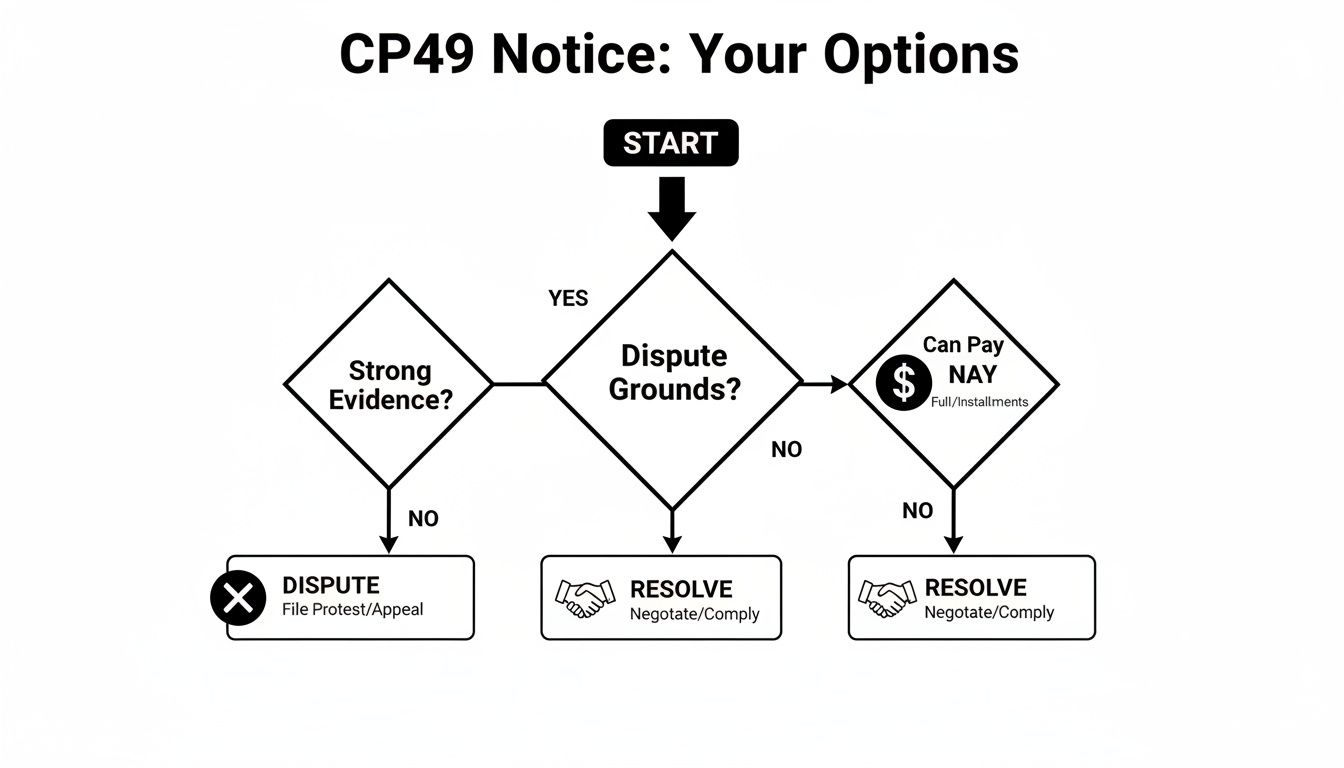
As you can see, your choices boil down to three core strategies: pay what they say you owe, dispute the debt, or work out another formal resolution with the IRS.
How a Small Debt Snowballs
Let's look at how this plays out in the real world. Say you had a $5,000 tax debt from a few years back that you weren't able to pay. The IRS doesn't just wait patiently. They immediately start tacking on a Failure to Pay penalty, which is usually 0.5% of the unpaid tax for each month it goes unpaid, capping out at a hefty 25% of your original debt.
But it gets worse. On top of the penalties, the IRS charges interest on everything—the original tax and the penalties themselves. Since this interest compounds daily, you’re literally paying interest on your interest. In just a few short years, that $5,000 debt could easily swell to $7,000 or more, all without you lifting a finger.
Even after the IRS seizes your refund, the underlying debt continues to rack up these charges. Sometimes, the refund only covers the new penalties and interest, barely making a dent in the original tax owed. This cycle of escalating debt is why delaying a solution only makes things more expensive in the long run.
Stopping the Financial Bleed
When the IRS takes your refund, they're just treating a symptom. The root problem—the tax debt—is still there, and it will continue to grow and put every single one of your future refunds at risk. It’s a vicious cycle that makes it impossible to get ahead financially. The only way out is to stop being reactive and start being proactive.
The smartest financial move is to tackle the entire debt. It stops the bleeding, protects your future income, and finally gets you out of the IRS's collection cycle.
Ignoring tax rules, whether for personal or business finances, almost always leads to bigger problems. For business owners, understanding payroll compliance is just one example of how staying on top of regulations can prevent the kind of issues that attract unwanted IRS attention.
By facing the core debt head-on, you’re not just resolving this year's IRS Notice CP49; you're preventing a stack of them from showing up in the future. You may even be able to have some of those crushing penalties forgiven. Our guide on IRS penalty abatement walks you through how to ask for this relief and potentially slash your total bill.
When You Should Get Professional Tax Help
You can certainly handle minor tax questions on your own, but an IRS Notice CP49 is rarely a minor issue. It’s usually a signpost for a bigger, more tangled financial problem that’s been brewing for a while. Knowing when to stop the DIY effort and call in a professional is one of the most important decisions you can make.
It’s a bit like a home repair. You might patch a small hole in the drywall yourself, but you wouldn't try to rewire the entire house. A seasoned tax attorney is the master electrician for your tax problems—they know the code, see the hidden dangers, and can fix the root cause, not just the symptom.
Clear Signs You Need an Expert
If you're on the fence about hiring help, look over these common situations. If any of these hit close to home, it’s a strong signal that you need a professional in your corner.
- The Debt is Large or Complex: When the total you owe—including penalties and interest—feels crushing, it's time for an expert. A tax professional can unpack options you probably don't even know exist, many of which are tough to negotiate on your own.
- You Need an Offer in Compromise (OIC): An OIC is a powerful tool that lets you settle your debt for less than you owe. But the IRS is notoriously strict and rejects most applications. An experienced attorney knows exactly how to frame your financial situation to build a convincing case that the IRS will actually consider.
- You're Dealing with Business or Payroll Tax Issues: The IRS takes these debts extremely seriously. They often pursue trust fund recovery penalties, which can make you, the business owner, personally responsible for the debt. The stakes are just too high to navigate this alone.
- You Need to File an Injured Spouse Claim: Filing Form 8379 seems straightforward, but if your finances are complicated or the IRS denies your initial claim, an attorney can be instrumental in proving your case and getting your share of a joint refund back.
- You Have Multiple Years of Unfiled Returns: This isn't just a paperwork headache; it's a serious compliance and legal issue. A professional can guide you back into good standing while strategically protecting you from the harshest collection actions.
The Strategic Advantage of Professional Guidance
Trying to fight the IRS by yourself is an uphill battle. You’re learning the rules as you go, while the agent on the other side of the table has spent years mastering them. It's an unfair fight from the start.
Attorney Stephen A. Weisberg’s client-first approach begins with a FREE Tax Debt Analysis. This isn't a sales pitch; it's a genuine assessment to determine if and how he can help, providing a clear action plan before you ever pay a fee.
This no-obligation analysis takes the guesswork out of your next move. Instead of feeling overwhelmed and cornered by your IRS Notice CP49, you can get immediate clarity from an expert with over a decade of experience. Understanding how to find a good tax attorney is the first step toward taking back control.
If your tax debt feels out of hand, don't let the problem fester. Get an expert on your side.
Frequently Asked Questions About Notice CP49
Once you get a handle on what an IRS Notice CP49 means, the practical, real-world questions usually start to pop up. Let's walk through some of the most common concerns we hear from people right after their tax refund has been seized.
Can I Stop the IRS from Taking My Refund Next Year?
Absolutely. The most straightforward way to prevent a future refund grab is to get the tax debt paid off entirely. Once that balance is zero, the IRS has no reason to offset your refund.
If paying it all off right away isn't realistic, you can play a bit of defense with your paycheck. By giving your employer a new Form W-4, you can adjust your tax withholding. The goal is to withhold less throughout the year, leading to a much smaller refund—or even owing a small, manageable amount. After all, if there’s no refund to begin with, there’s nothing for the IRS to take.
How Do I File an Injured Spouse Claim?
This is a big one for married couples. If you filed a joint return and the whole refund was taken for a debt that only belongs to your spouse (think student loans or back taxes from before you were married), you have a remedy. You can file Form 8379, Injured Spouse Allocation.
This form essentially asks the IRS to untangle your finances from your spouse's on that joint return. It calculates what portion of the refund is rightfully yours based on your income and tax payments. You can file Form 8379 on its own right after you get the CP49, or you can attach it to your tax return if you know an offset is coming. It’s your way of proving which part of the refund is yours and protecting it.
Will an IRS Notice CP49 Hurt My Credit Score?
Receiving the CP49 notice itself will not directly harm your credit score. The IRS doesn't report its refund collection activities to credit bureaus like Equifax, Experian, or TransUnion. This is strictly between you and the government.
Key Distinction: While the notice is private, the situation can escalate. If the underlying tax debt remains unpaid, the IRS might eventually file a Notice of Federal Tax Lien. That lien is a public record and will almost certainly show up on your credit report, which can seriously damage your score and your ability to get a loan.
I Have an IRS Payment Plan, Why Was My Refund Still Taken?
This is a common point of frustration, but unfortunately, it’s how IRS Installment Agreements are designed to work. Buried in the terms of nearly every payment plan is a clause stating that the IRS will continue to apply any future refunds to your tax debt until it's paid in full.
Think of your monthly payments as what keeps you in good standing and stops more aggressive collection actions, like a bank levy. However, the IRS still reserves the right to use any "found money," like your refund, to pay down the balance faster. This will keep happening every year you have a refund until the entire debt is finally cleared, even if you never miss a single monthly payment.
Feeling overwhelmed by your tax situation after an IRS Notice CP49? You don't have to navigate this alone. At Attorney Stephen A Weisberg, we start with a FREE, no-obligation Tax Debt Analysis to give you a clear and honest assessment of your options. Take the first step toward resolving your tax issues for good by visiting https://weisberg.tax to schedule your analysis today.


