IRS Liens Statute of Limitations: How Long They Last
Learn how the IRS liens statute of limitations works: the 10-year collection clock, what pauses or extends it, and how to find your CSED date.

In this article
- IRS Lien Deadlines at a Glance
- IRS deadlines, start points and governing rules
- Build separate records for separate questions
- Why the Assessment Date Starts the Clock
- One tax period can contain separate assessments
- Later paperwork doesn't create a fresh collection period
- How Long a Federal Tax Lien Lasts
- Why older documents can look different
- Check the recording history, not just the latest notice
- Events That Pause or Extend the Ten-Year Clock
- Events that suspend or extend the CSED
- Reconstruct events using documents
- How to Calculate Your Collection Deadline
- Build an assessment-level worksheet
- Preserve the reasoning behind the date
- What Changes When the Collection Deadline Passes
- Expiration affects the particular assessment
- A record problem needs a record solution
- Removing a Lien After the Deadline Passes
- Match the remedy to the transaction
- Assemble a reviewable file
- Confirm Your Deadline Before You Choose a Fix
- Choose based on both time and exposure
The IRS generally has 10 years from the assessment date to collect a tax debt, and a federal tax lien generally stays enforceable for that collection period, with suspensions able to extend both. Why, then, can a lien notice show a date that doesn't tell you when the IRS must stop collecting?
The answer is that the collection deadline and the recorded lien notice serve different purposes. A notice documents the government's claim against property. The collection deadline limits its authority to pursue the underlying assessment. Confusing those dates can lead you to wait when action is needed, or pay without first checking whether the debt remains collectible.
For anyone researching the IRS liens statute of limitations, the useful starting point isn't the age of the tax year. It's the assessment history for each account.
IRS Lien Deadlines at a Glance
The IRS doesn't use one universal expiration date for everything connected with unpaid taxes. Assessment, collection, and public lien records involve separate questions. Before calculating anything, identify which deadline your document describes.
An assessment deadline limits when the IRS can formally record additional tax. A collection deadline addresses how long the government can pursue an amount already assessed. A lien notice concerns the government's recorded security interest and the rules for preserving its priority against other creditors.
IRS deadlines, start points and governing rules
| Deadline | Clock starts | Length | Governing rule |
|---|---|---|---|
| Assessment deadline for additional tax | Determined under the applicable return-filing rules | Apply the assessment statute and its exceptions, not the collection period | Federal assessment rules |
| Collection Statute Expiration Date (CSED) | Date of assessment | Ordinary collection period, adjusted for legally recognized events | Internal Revenue Code §6502 |
| Notice of Federal Tax Lien | Assessment date anchors the notice's ordinary period | Notice period subject to timely refiling | IRS lien guidance |
| Assessments under the former collection framework | Date of assessment | Historical transition rules determine the applicable period | IRS guidance for older assessments |
The distinction matters because a deadline for assessing additional tax doesn't tell you whether an existing balance is collectible. Likewise, a lien document's recording date doesn't establish when the IRS originally assessed the debt.
A single notice may describe only part of the account. It may concern a particular assessment, a particular filing, or a balance that includes several liabilities. You shouldn't assume every amount listed shares the same expiration date.
Build separate records for separate questions
Keep an account worksheet for assessment and collection dates, and a separate lien worksheet for recording and refiling information. Connect them by identifying which assessment each lien notice covers.
Practical rule: Before relying on an expiration date, identify the liability it belongs to and the legal event that produced it.
For a business owner, this means avoiding a single handwritten expiration date beside the total IRS balance. Income tax, payroll tax, and later adjustments need an account-specific review rather than a conclusion based on the oldest tax year.
Why the Assessment Date Starts the Clock
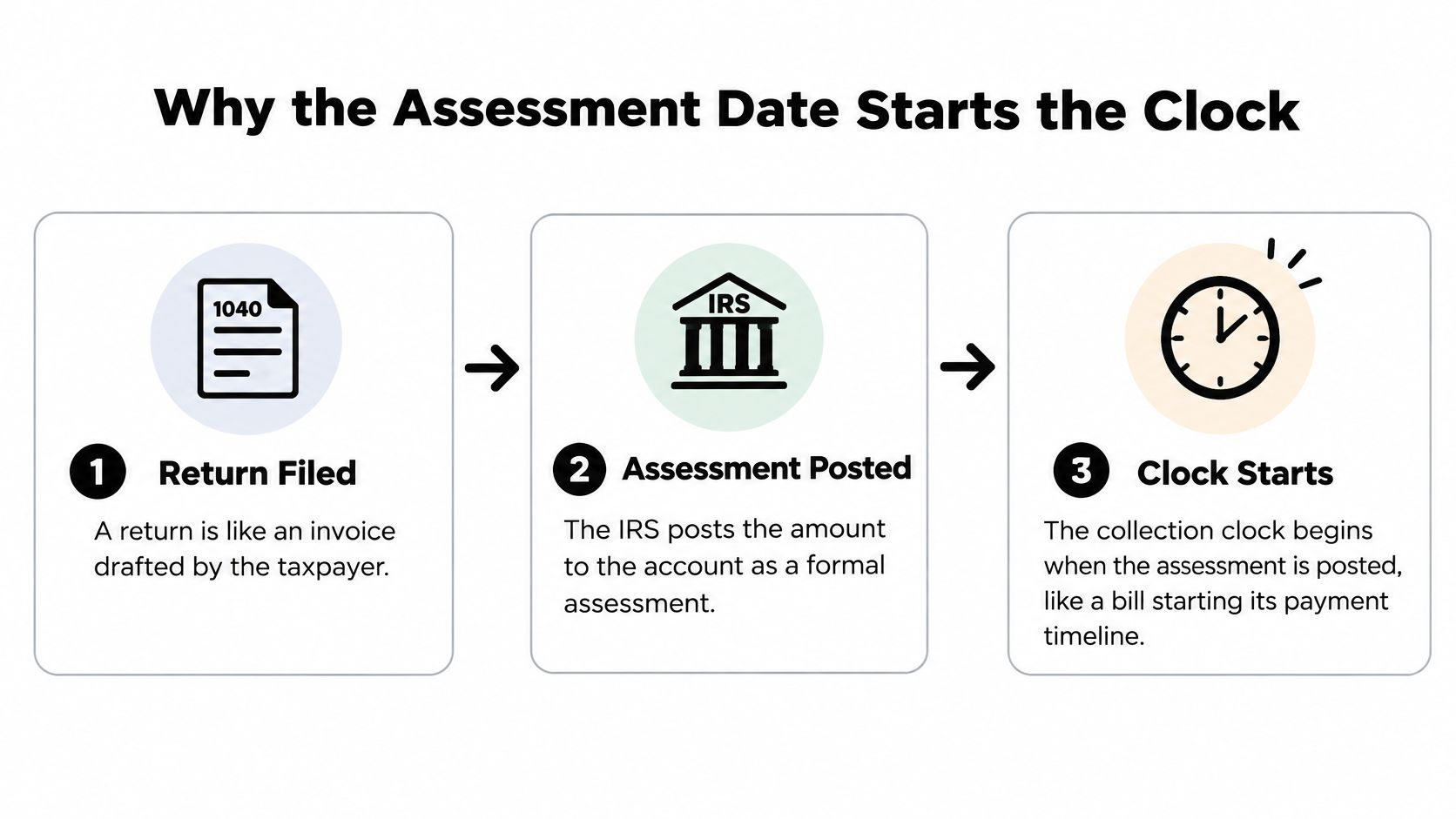
Think of a return as an invoice drafted by the taxpayer. Filing reports the tax, but assessment is the IRS's formal entry of the liability on its account records. The collection clock starts with that recorded assessment, much as a billing timeline starts when the charge is formally posted.
Under Internal Revenue Code §6502, the ordinary collection period is 10 years from assessment, not generally from filing, notice issuance, or lien recording, as the IRS explanation of its collection period states. The deadline is called the Collection Statute Expiration Date, usually shortened to CSED.
One tax period can contain separate assessments
The original return isn't necessarily the end of the assessment history. A later adjustment can add a separately assessed amount with its own collection deadline.
Watch for these assessment sources:
- Original return: The IRS records the liability reported on the return.
- Amended return: A reported change may produce an additional assessment.
- Substitute for return: The IRS may assess a liability through its process for an unfiled return.
- Audit adjustment: An examination may result in an additional assessed balance.
Hypothetical illustration: A taxpayer has an original-return balance assessed earlier and an audit adjustment assessed later for the same tax period. Even though both concern the same return, their collection deadlines begin with their respective assessment dates.
That's why a tax-year label alone isn't enough. It identifies the reporting period, not necessarily when the IRS recorded every component of the debt.
Later paperwork doesn't create a fresh collection period
A collection letter can arrive long after assessment. The IRS may also record a Notice of Federal Tax Lien later in the account's history. Neither event, by itself, restarts the collection clock.
The notice gives public notice of the government's security interest. It isn't a new assessment merely because it has a newer date or appears more prominently in your records.
Write each assessment date beside its tax period before making any expiration calculation. If the account includes a supplemental assessment, give that assessment its own worksheet entry rather than folding it into the original balance.
How Long a Federal Tax Lien Lasts
A Notice of Federal Tax Lien is generally active for 10 years and 30 days from assessment, and timely refiling may preserve its effectiveness for an additional 10 years, according to the IRS federal tax lien publication. That notice period must not be mistaken for an independent grant of collection authority.
The underlying lien is the government's security interest in property. The Notice of Federal Tax Lien publicly records that interest. Refiling concerns preserving the lien's effectiveness and priority; it doesn't, by itself, give the IRS a fresh collection period.
Why older documents can look different
The same IRS publication explains that the former six-year collection period gave way to the modern rule for assessments on or after November 6, 1990. Qualifying earlier assessments whose collection period remained open also came within the newer framework.
Older paperwork therefore needs a historical review rather than an assumption that today's ordinary rule always applied unchanged. For most readers, however, the immediate task is matching the lien record to the correct assessment and adjusted collection deadline.
A lien also isn't the same as a seizure. Our explanation of a tax lien versus a levy distinguishes the government's property claim from an action that takes money or property.
Check the recording history, not just the latest notice
Suppose the IRS recorded a lien notice well after the assessment. The recording date may look recent, but you still need the assessment history, any refiling documents, and any events that preserved collection authority.
A title search may continue to show a recorded notice even when enforceability requires further review. A visible record isn't conclusive proof that the IRS can still collect, just as an old-looking notice isn't conclusive proof that the claim has expired.
Pull these details together:
- Assessment identification: The tax period and assessment covered by the notice.
- Original recording: The filing date, recording office, and instrument reference.
- Refiling history: Every later filing that purports to preserve the notice.
- Release information: Any document showing release or other action affecting the record.
Events That Pause or Extend the Ten-Year Clock
A printed expiration date is a starting point for review, not a final legal conclusion. A suspension stops the clock temporarily and adds the suspended time to the end. An extension adds time beyond the ordinary collection period under an applicable agreement or legal rule.
The IRS Internal Revenue Manual's collection-period guidance describes technical extension restrictions, including a general five-year limit beyond the original CSED for qualifying installment-agreement waivers, subject to specified adjustments. The same review must account for statutory suspensions and litigation rather than treating every account as a simple calendar calculation.
Events that suspend or extend the CSED
| Event | Effect on the CSED | What to verify |
|---|---|---|
| Bankruptcy case | Suspends the clock during the applicable bankruptcy period, with any additional statutory time requiring review | Petition, discharge, dismissal, closing, and relevant stay records |
| Pending collection due process hearing | Qualifying proceedings suspend the clock | Request date, eligibility, determination, and final disposition |
| Qualifying continuous residence outside the United States | Suspends the clock for the qualifying period | Complete travel and residence records |
| Pending offer in compromise | Requires review of suspension while pending and applicable post-decision or appeal periods | Pending status, disposition, and appeal dates |
| Installment agreement waiver | Can extend the CSED under restricted rules | Signed waiver, authorized terms, and stated expiration date |
| Timely lawsuit to reduce the liability to judgment | May preserve collection until the liability or judgment is satisfied or becomes unenforceable | Suit filing date, judgment, and current enforceability |
Reconstruct events using documents
For bankruptcy, don't rely on the date you remember receiving a discharge. Obtain the docket and identify the legally relevant beginning and ending events. Whether bankruptcy can eliminate a tax liability is a different question from whether it pauses collection time; our guide to filing bankruptcy on tax debt explains that distinction.
For a hearing or settlement application, keep the request, acknowledgment, disposition, and appeal documents together. Submission, acceptance for processing, and final disposition aren't interchangeable dates.
Residence abroad also deserves a complete timeline. A passport stamp may establish travel without resolving where you continuously resided or whether the statutory conditions apply.
Don't add every event's duration mechanically. Overlapping suspensions and event-specific rules require a legal calculation, not just calendar arithmetic.
Litigation deserves particular attention. A timely government lawsuit and resulting judgment can change the expiration analysis. Before concluding that a balance is nearly uncollectible, check whether a case was filed and what the court ordered.
How to Calculate Your Collection Deadline
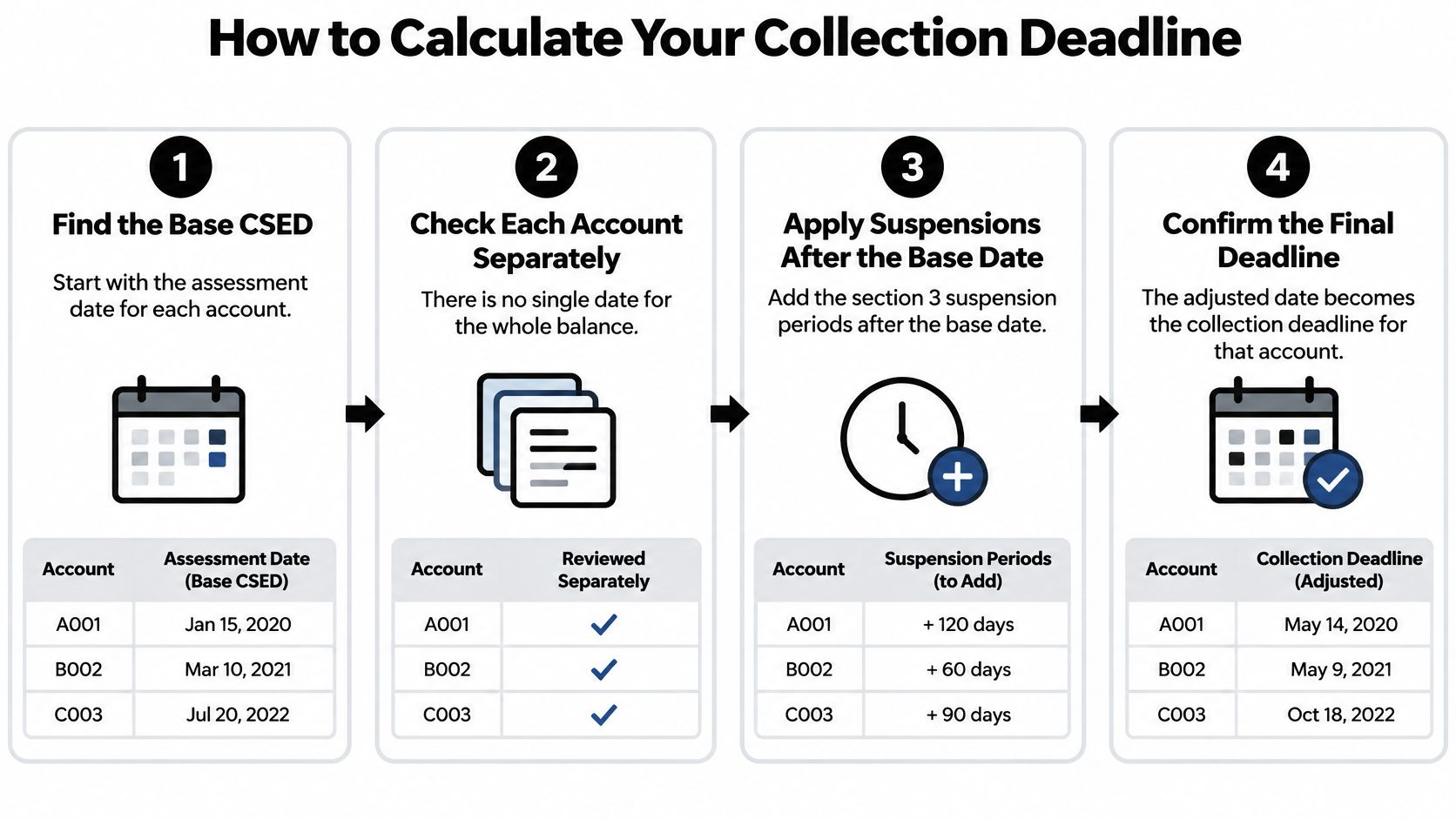
Calculate the deadline assessment by assessment, then reconcile the result with the IRS's records. Don't assign a single expiration date to the total amount shown on a balance summary.
The Taxpayer Advocate Service's explanation of collection expiration describes the ordinary 10-year period from assessment and the need to distinguish assessment dates from filing and notice dates. Your worksheet should preserve that distinction while documenting every adjustment.
Build an assessment-level worksheet
Obtain the full account history. Request IRS account transcripts for every relevant tax period, not merely a balance summary. We obtain clients' IRS and state transcripts to review every penalty, every payment, and how long remains until the debt is written off; the common mistake is overlooking an assessment hidden behind the current total.
Identify each assessment transaction. Record the assessment date and distinguish the original liability from later adjustments. Use our guide to reading an IRS transcript to orient your review; the mistake is substituting the return's filing date for the assessment date.
Establish the base CSED. Apply the ordinary collection period to each assessment and label the result unadjusted. The mistake is calculating from the tax year rather than the actual assessment entry.
Document every potentially relevant event. Match bankruptcy records, hearing documents, settlement records, residence information, waivers, and lawsuits to the assessments they affect. The mistake is ignoring a completed proceeding because it's no longer active.
Calculate the adjustments. Record each event's legal effect, relevant dates, and supporting document before calculating the adjusted deadline. The mistake is double-counting overlapping periods or assuming every event follows the same rule.
Reconcile the lien history separately. Match original notices, refilings, and release documents to the covered assessments. The mistake is treating a recording date as either a new collection start date or proof of continuing enforceability.
Resolve discrepancies before relying on the result. Compare your calculation with the IRS's current CSED information and request an explanation of any difference. The mistake is accepting either an automated date or your own worksheet without checking the underlying events.
Preserve the reasoning behind the date
A useful worksheet contains more than a final answer. Include the tax period, assessment entry, base deadline, event chronology, adjustment method, and source documents.
Keep state balances separately identified. Obtaining state transcripts helps reconstruct the broader debt history, but it doesn't make the federal collection deadline govern a state liability.
The calculation should be reproducible. Another reviewer should be able to follow your documents and understand why the adjusted date differs from the unadjusted date.
What Changes When the Collection Deadline Passes
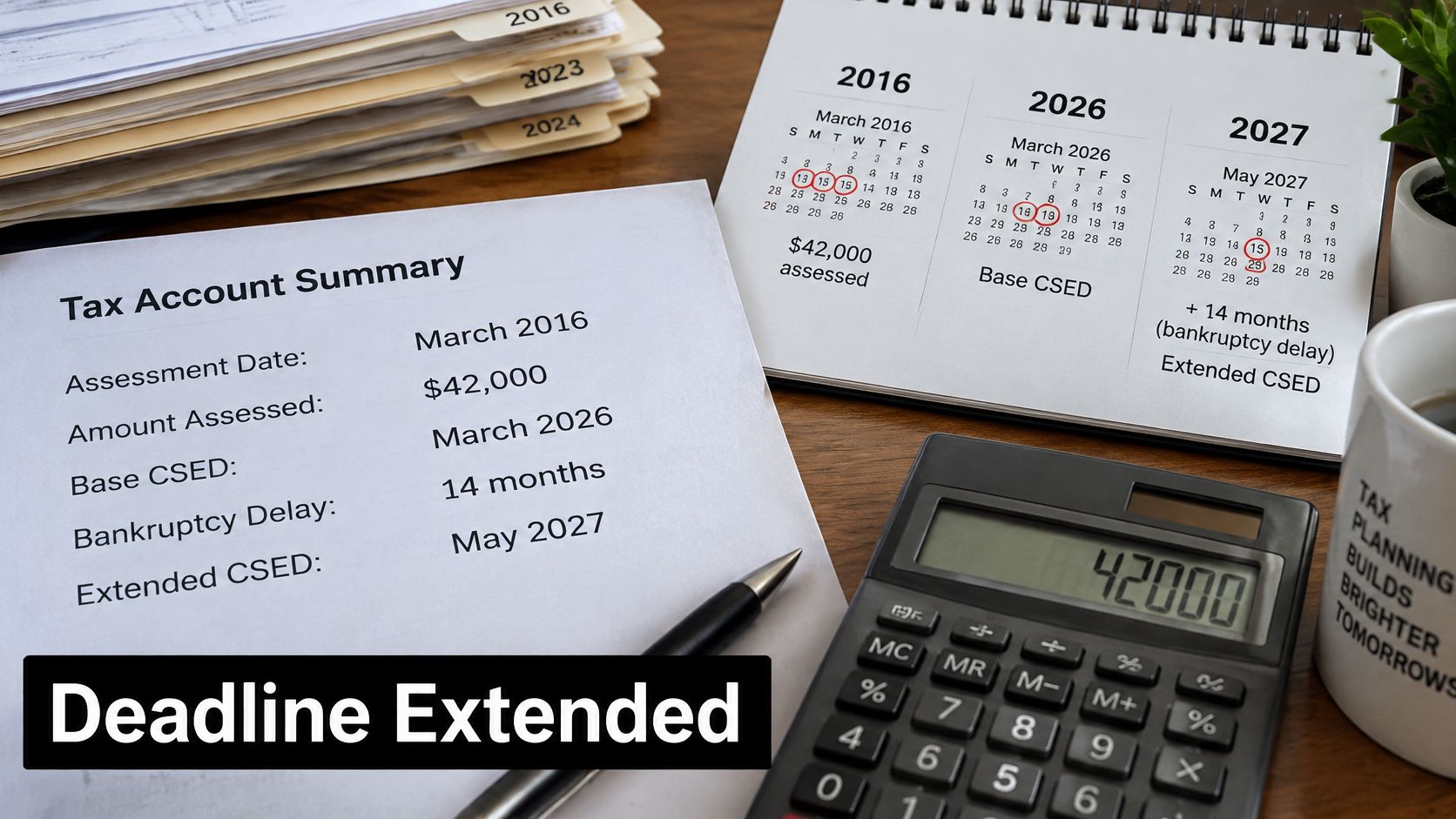
Consider a hypothetical taxpayer whose account appears close to expiration. The taxpayer remembers a bankruptcy but assumes it no longer matters because the case has closed. Reviewing the docket shows that the applicable suspension moved the collection deadline later.
The transcript and court records answer different parts of that problem. The transcript identifies the assessment and account activity. The docket establishes the bankruptcy chronology that must be analyzed before deciding whether the account has expired.
Expiration affects the particular assessment
Now consider a different hypothetical taxpayer with a verified expired assessment and a lien notice still visible in the county records. The continued appearance of that notice doesn't necessarily mean the underlying debt remains enforceable.
Once the applicable CSED passes, the IRS generally loses administrative collection authority for that assessment. But don't assume every existing collection arrangement or judicial right ends identically. Bankruptcy, litigation, restitution, and other specialized circumstances can change the result.
A review should distinguish:
- Expired liability: The particular assessment whose collection period has ended.
- Remaining balances: Other assessments that may still be collectible.
- Recorded documents: Lien notices that remain visible and need appropriate documentation.
- Special legal rights: Judgments or other circumstances requiring separate analysis.
A record problem needs a record solution
If collection continues despite a verified expiration, identify the affected assessment and ask for an account-specific explanation. Don't tell the IRS that the tax year is old.
Similarly, a buyer or lender may need documentation establishing the status of a recorded lien. Legal unenforceability and a clean title record aren't the same administrative task. Preserve the expiration calculation and obtain the appropriate lien documentation rather than assuming the public record will answer the question by itself.
Removing a Lien After the Deadline Passes
After verifying expiration, identify what needs to change: the account, the recorded notice, or a claim affecting particular property. Release, discharge, and withdrawal aren't interchangeable remedies, and requesting the wrong one can leave the practical problem unresolved.
A release addresses the lien's status. A discharge concerns particular property rather than necessarily eliminating the entire liability. Withdrawal concerns the filed notice and has its own eligibility requirements; it shouldn't be treated as automatic merely because you believe the collection period has ended.
Match the remedy to the transaction
If you're selling or refinancing property, identify exactly what the title company or lender needs. Ask for the recorded instrument reference and a written description of the title objection so counsel can evaluate the appropriate remedy.
For a general cleanup of the record, first check whether the notice contains operative release language and whether later filings affect it. Our guide to removing an IRS tax lien explains the available routes and why the requested result matters.
Documentation first: Establish expiration before asking a recording office, lender, or buyer to rely on it.
Assemble a reviewable file
Bring the documents that prove both the debt history and the property-record issue:
- Account transcripts: Every relevant period and supplemental assessment.
- Court records: Bankruptcy dockets, collection suits, and judgments.
- Lien documents: Original filings, refilings, and any release records.
- Residence evidence: Travel and residence records where absence from the country matters.
- Calculation worksheet: The adjusted deadline, supporting reasoning, and reviewer's sign-off.
An open bankruptcy or pending lawsuit can affect both enforceability and the available remedy. Resolve those questions before representing to a buyer or lender that a lien is no longer effective.
Confirm Your Deadline Before You Choose a Fix
If the adjusted deadline is still distant, evaluate an active resolution rather than accepting continued collection risk. Available IRS debt tools include Offers in Compromise, installment agreements, penalty abatement, and Currently Not Collectible status. The appropriate choice depends on your finances, the account history, and the immediate threat.
If expiration is near, preserving the remaining collection period may be part of a defensible strategy. But waiting isn't the same as ignoring notices, and submitting an application without understanding its clock effect can undermine that strategy.
Choose based on both time and exposure
A deadline review should answer more than whether the IRS can collect today. It should also identify whether assets are exposed, whether collection activity is imminent, and whether a proposed resolution changes the expiration analysis.
Professional help is particularly advisable in these situations:
- Debt size: You owe more than $5,000, or total liability exposure exceeds $1,000,000.
- Enforcement involvement: An IRS revenue officer is assigned or valuable assets face seizure.
- Complexity: Foreign accounts, complicated finances, or several connected business liabilities require review.
- Criminal concerns: An investigation requires advice beyond an ordinary payment-plan calculation.
Those are reasons to obtain advice, not statutory collection thresholds.
Bring your transcripts, assessment worksheet, lien recording history, and relevant court documents to the consultation. With those records, counsel can assess the deadline and immediate collection threats together rather than recommend a settlement or payment arrangement without understanding the account.
Tax Attorney Stephen A Weisberg offers a free Tax Debt Analysis to determine whether the firm can help and how before charging for resolution work. Visit Tax Attorney Stephen A Weisberg to discuss your collection deadline, and bring your transcripts, lien records, and calculation worksheet so the review starts with the dates that control your options.


