IRS Lien Removal: How to Clear Federal Tax Liens
Learn every lawful path to IRS lien removal, from full payment and withdrawal to discharge and subordination. Practical steps, forms, and timelines explained.
In this article
- What a Federal Tax Lien Actually Means for You
- How a Tax Lien Disrupts Your Financial Life
- Property and business pressure
- Enforcement context
- Every Lawful Path to Remove or Neutralize a Lien
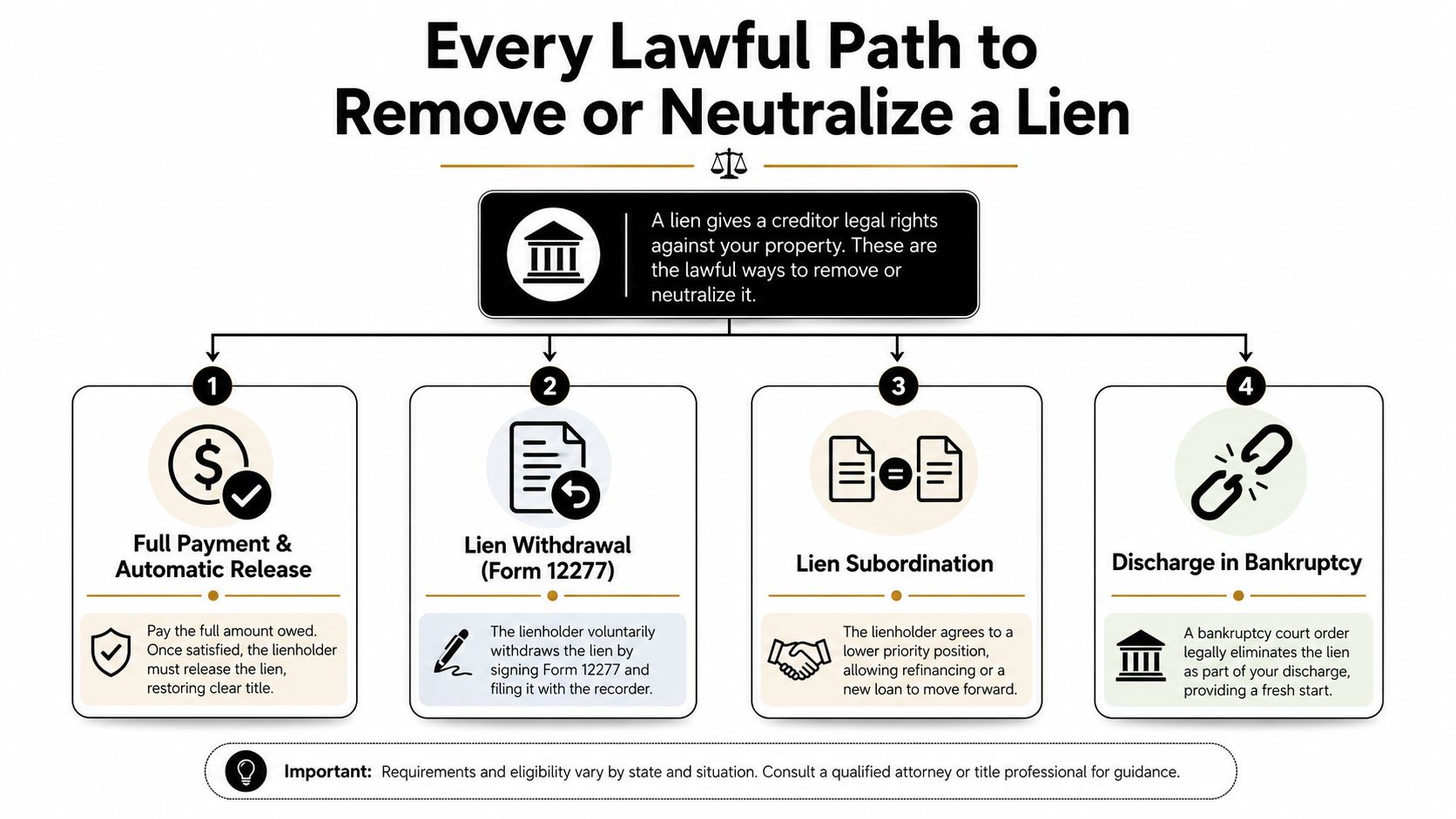
- Full payment and automatic release
- Withdrawal through Form 12277
- Discharge for one property
- Subordination for refinancing
- Release Versus Withdrawal and Why the Difference Matters
- Required Forms and Documentation Checklist
- Match the form to the remedy
- Build the file before submitting
- When to Handle It Yourself and When to Call an Attorney
- Your Action Plan for Clearing the Lien
You're at the bank, expecting to sign your refinance documents, when the title search raises a problem you didn't know existed: a Notice of Federal Tax Lien. Or you're selling a business asset and the buyer's lender wants an explanation before moving forward. The immediate fear is often that the IRS will seize your house or empty your accounts. That isn't what a lien notice means, but it can still create a serious obstacle if you don't identify the correct form of relief.
The phrase IRS lien removal covers several different outcomes. A release ends the lien after the liability is satisfied or otherwise becomes unenforceable. A withdrawal removes the public notice without erasing the debt. A discharge removes the lien from a particular property, while subordination changes priority so another creditor can proceed. Paying the debt may solve the collection issue, but it may not produce the public-record result you need.
What a Federal Tax Lien Actually Means for You
A federal tax lien is the government's legal claim against property because federal tax remains unpaid. It can reach property you own now and property you acquire later, which is why the issue can affect more than the asset that first brought the lien to your attention. The IRS's explanation of federal tax liens and lien notices distinguishes the lien from the public notice used to alert creditors and other interested parties.
The distinction matters during an ordinary financing transaction. Suppose a self-employed contractor applies for a mortgage refinance. The lender's title search finds a recorded Notice of Federal Tax Lien, and the lender asks whether the IRS must be paid before closing. The contractor may still own and occupy the home, but the IRS has asserted a claim that the lender and title company must account for before they can finalize the transaction.
Practical rule: A Notice of Federal Tax Lien is a public warning about the government's claim. It isn't the same thing as an IRS levy, which is the act of taking property or funds.
A lien and a levy serve different functions. The lien protects the government's legal interest in assets. A levy is an enforcement action that can take money from a bank account or property. Receiving a lien notice doesn't mean the IRS is changing the locks tomorrow, but ignoring it can leave fewer orderly options later.
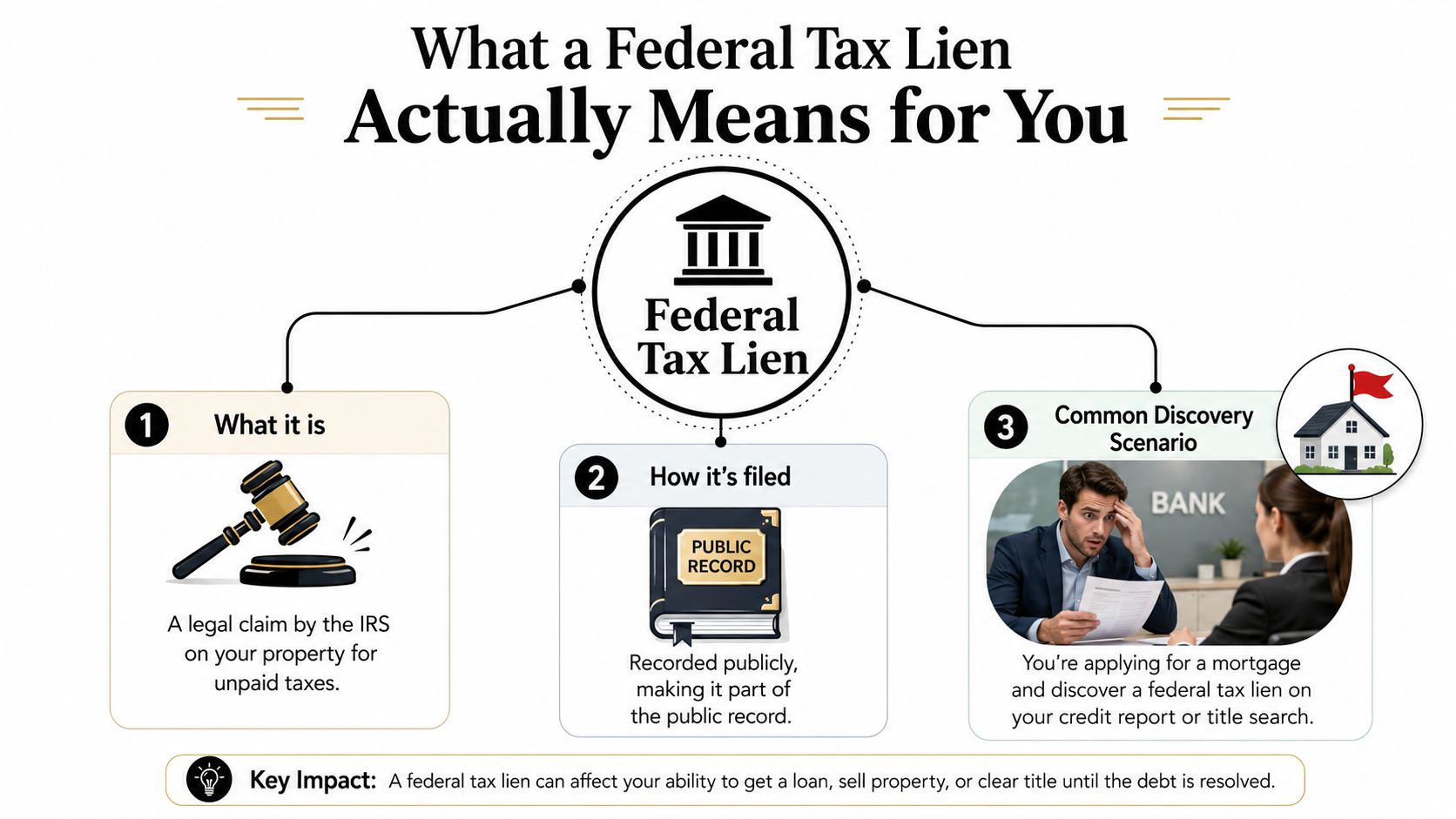
The underlying tax debt and the public filing are also separate problems. A taxpayer can owe money without needing the same public-record remedy as someone whose Notice of Federal Tax Lien is interfering with a sale, refinance, or commercial credit application. That's why reviewing the Notice of Federal Tax Lien process is useful before choosing a response.
Under IRS rules, the lien generally must be released within 30 calendar days after the liability is fully satisfied, becomes legally unenforceable, or the IRS accepts a bond, as described in the IRS guidance linked above. A withdrawal is different. It removes the public notice but does not erase the underlying liability, so the legal outcome and the financial objective must be matched carefully.
How a Tax Lien Disrupts Your Financial Life
A filed lien turns a private collection problem into information that may be found through public-record searches. That can matter to a title company, mortgage lender, commercial lender, equipment financier, or business partner even when the taxpayer is making current payments. The practical impact depends on the transaction, the creditor's review process, and whether the lien has been released, withdrawn, discharged, or subordinated.
Property transactions are especially sensitive. A seller may have a willing buyer, but the title company still needs to determine how the IRS claim will be addressed. A refinance can face the same obstacle because the new lender wants a clear understanding of priority. The solution may involve paying from closing proceeds, obtaining a discharge for the property, or seeking subordination, rather than abandoning the transaction.
Property and business pressure
For a sole proprietor, a lien can affect the home, vehicle, tools, and business equipment used to generate income. For a small company, it can complicate a line of credit, equipment financing, vendor terms, or a sale of business assets. Payroll tax debt creates additional urgency because the business may also face questions about responsible individuals and continuing compliance.
A lender doesn't need to view the lien as an immediate seizure to treat it as a risk. The IRS claim can compete with the lender's expected security position, and the business owner may need to explain how tax debt will be paid while preserving operating cash. If broader liabilities are involved, a resource on how to negotiate business debt can help organize the non-tax obligations that may affect the overall resolution strategy.
Enforcement context
Lien activity has changed substantially across enforcement periods. Notices of federal tax lien filings peaked at 1,096,376 in fiscal year 2010, declined to 157,323 in fiscal year 2022, and then rose to 214,099 in fiscal year 2025, according to IRS collections figures summarized by historical federal tax lien filing data. The figures show why lien resolution remains a recurring issue for individuals, self-employed taxpayers, and businesses, even though filing volume has moved sharply over time.
The filing itself doesn't automatically mean your bank account has been levied. It does mean you should identify the assets and transactions that are most exposed, then choose a remedy that addresses the actual obstacle. Paying the debt may resolve the government's claim, while a withdrawal may be necessary to address the visibility of the notice.
Every Lawful Path to Remove or Neutralize a Lien
The right path depends on three questions: Is the debt fully payable, does the IRS claim attach to a particular asset, and is the main problem public notice or creditor priority? Start by obtaining the account information, confirming the tax periods and balance, and checking whether all required returns have been filed. Then select the remedy instead of submitting forms in a sequence that doesn't fit the facts.
Full payment and automatic release
Full payment is the cleanest way to satisfy the underlying liability. After the tax liability is fully satisfied, the IRS generally releases the lien within 30 calendar days, as explained in the IRS lien guidance. A release ends the lien's enforceability, but it doesn't automatically mean the original public notice disappears.
An offer in compromise can also resolve the liability if the IRS accepts the offer and the taxpayer completes its terms. The practical result must be reviewed against the taxpayer's transaction goal. A settlement may solve the debt, but a separate withdrawal request may still be relevant if a lender or title company needs the public notice addressed.
Withdrawal through Form 12277
Withdrawal is the remedy most directly aimed at the public notice. Taxpayers use Form 12277, Application for Withdrawal of Filed Form 668(Y), Notice of Federal Tax Lien. The IRS may consider withdrawal when the notice was filed contrary to procedure, when a qualifying installment agreement is in place, when withdrawal would help the taxpayer pay faster, or when the National Taxpayer Advocate agrees it serves the government's best interest.
For a direct-debit installment agreement, the IRS publication describes eligibility conditions that generally include a balance at or below $25,000, three consecutive direct debit payments, full compliance with filing and payment obligations, and payoff within 60 months or before the collection statute expires, whichever comes first. Meeting the conditions doesn't turn approval into an automatic result. The application still needs accurate account information and a credible explanation of why withdrawal is appropriate.
Discharge for one property
A discharge doesn't remove the lien from every asset. It removes the lien from a specified property so that a sale or other transaction can proceed under the IRS's certificate requirements. This path is useful when the property must be transferred but the taxpayer can't obtain a full release of the entire lien.
The request typically uses Form 14135, Application for Certificate of Discharge of Property from Federal Tax Lien. The IRS will need property and transaction information, including enough documentation to evaluate the government's interest. A discharge is therefore an asset-specific solution, not general IRS lien removal.
Subordination for refinancing
Subordination leaves the lien in place but changes priority. A lender may be unwilling to refinance while the IRS has priority, yet the refinance may improve cash flow or create funds that help resolve the tax debt. Form 14134, Application for Certificate of Subordination of Federal Tax Lien, is used for this type of request.
Bankruptcy can affect tax liens and dischargeability, but it requires a separate legal analysis. The tax type, tax period, filing history, timing, and lien status all matter. Don't assume bankruptcy will eliminate either the tax debt or the lien without reviewing the specific account and the proposed bankruptcy case. For related resolution planning, the discussion of tax debt relief options can help frame the choices, while separate guidance on removing collection items from a credit report addresses a different credit-record issue that shouldn't be confused with an IRS lien filing.
Release Versus Withdrawal and Why the Difference Matters
A lien release and a lien withdrawal answer different questions. Release asks whether the IRS's legal claim remains enforceable. Withdrawal asks whether the public Notice of Federal Tax Lien should remain visible as a filed notice. A taxpayer who only wants the debt resolved may focus on release, while someone trying to refinance, sell property, or restore confidence with a commercial lender may need to pursue withdrawal too.
The IRS and the Taxpayer Advocate Service recognize that withdrawal can be available even while a balance remains owed, provided the taxpayer meets an applicable basis. They also state that there's no legal bar to withdrawing a Notice of Federal Tax Lien after the underlying lien has already been released. That overlooked possibility can matter after payoff, because a released notice may still appear in a public-record search even though the debt has been satisfied.
| Criteria | Lien Release | Lien Withdrawal |
|---|---|---|
| Primary function | Ends the lien after the liability is satisfied, becomes legally unenforceable, or another qualifying event occurs | Removes the public Notice of Federal Tax Lien |
| Underlying debt | Usually addressed through payment or another resolution | May remain owed |
| Public-record effect | Shows that the lien was released | Removes the filed notice from public notice records |
| Timing | Generally due within 30 calendar days after the qualifying event | Requires a separate request and IRS consideration |
| Typical form | Release documentation follows satisfaction or another qualifying event | Form 12277 |
| Best fit | Ending the government's legal claim | Addressing the visibility of the notice |
The exact public-record handling can vary by recording office and by the records a lender searches. Don't promise a lender that a withdrawal will instantly repair every database. Instead, obtain the IRS documentation, provide it to the title company or lender, and confirm how the relevant records will be updated.
The public-record problem may survive the debt problem. Paying in full can produce a release, but withdrawal is the additional remedy to examine when visibility is blocking the next financial step.
If you've already paid, don't assume the analysis ends there. Review the IRS lien withdrawal process and determine whether Form 12277 could produce a more useful result for your transaction.
Required Forms and Documentation Checklist
A strong application is built around the requested outcome. The IRS needs to know what you're asking for, why the request fits an available rule, and how the supporting documents prove the facts. A bare form with a vague explanation often creates avoidable questions.
Match the form to the remedy
- Form 12277: Use this for an application to withdraw a filed Notice of Federal Tax Lien. State the qualifying basis clearly and connect it to the account records.
- Form 14135: Use this when requesting a certificate discharging a specific property from the lien. Include the property details and transaction documents.
- Form 14134: Use this for subordination when another creditor needs priority for a refinance or related financing.
- Release documentation: Keep proof of payment, account transcripts, IRS correspondence, and any evidence showing that the liability was fully satisfied or otherwise resolved.
- Financial support: For installment agreements, compromise proposals, or collection-based withdrawal arguments, gather income records, bank information, expenses, assets, liabilities, and proof that required returns and payments are current.
The IRS publication describing collection options confirms that a direct-debit installment agreement has eligibility conditions involving the balance, payment history, filing compliance, and expected payoff period. Don't rely on a payment plan label alone. Verify that the specific agreement type and account facts support the withdrawal theory.
Build the file before submitting
Include a copy of the filed notice, the taxpayer's identifying information, relevant account transcripts, and documentation tied to the requested remedy. For a property request, add the purchase contract, settlement statement or refinance proposal, title information, valuation support, and details about other encumbrances when applicable.
Submit Form 12277 through available IRS online tools or by mail, as the IRS and Taxpayer Advocate Service explain. Keep a complete copy of everything submitted, record the delivery method, and monitor the account for follow-up requests. The Form 433-F guide for resolving an IRS collection case can also help taxpayers understand the financial information often required in broader collection matters, though it isn't a substitute for the lien-specific form.
Common mistakes include using Form 12277 to request a discharge, failing to identify the correct tax periods, omitting proof of compliance, and submitting a property request without transaction evidence. Each error can delay review or lead the IRS to reject a request that might have been viable with a properly documented record.
When to Handle It Yourself and When to Call an Attorney
A straightforward, fully paid liability with clear IRS records may be manageable without representation. You'll still need to confirm that the payment was applied correctly, obtain the release documentation, and determine whether a withdrawal request is worth pursuing. If the issue is tied to a pending closing, even a simple matter benefits from early coordination with the title company and lender.
Professional help becomes more valuable when the facts don't fit a single form. Several red flags deserve attention:
- Multiple tax years: Different periods may have different balances, assessments, collection issues, or filing defects.
- Payroll tax debt: Trust fund recovery penalty exposure can place personal liability questions alongside the business lien.
- Business entities: A lien involving an S corporation, partnership, single-member LLC, or related owner requires careful separation of entity and individual obligations.
- Property deadlines: A sale or refinance can fail if the IRS request isn't prepared around the closing schedule.
- Bankruptcy or divorce: Other proceedings can change ownership, priority, dischargeability, and negotiation power.
- Active collection enforcement: A revenue officer, levy threat, or unfiled return makes casual conversations and unsupported promises risky.
An attorney can review account transcripts, identify whether the notice was properly filed, prepare a withdrawal, discharge, or subordination package, and communicate with an IRS revenue officer when one is assigned. The attorney can also coordinate with a bankruptcy lawyer, mortgage lender, title company, accountant, or family-law counsel so that one solution doesn't create a separate problem.
Tax Attorney Stephen A Weisberg offers a free Tax Debt Analysis before charging clients to determine whether he can help and how. His practice works with individuals, businesses, and professionals who need IRS tax debt issues addressed alongside financing, bankruptcy, accounting, or other legal matters. That's one option to consider, not a substitute for comparing the strategy, scope, and cost of representation.
Your Action Plan for Clearing the Lien
Start with the records, not the sales pitch. Obtain the Notice of Federal Tax Lien, account transcripts, tax periods, current balance, payment history, and status of every required return. Confirm whether the lien is active, released, or attached to a particular asset involved in a pending transaction.
Then choose the outcome you need:
- Need the government's claim ended? Determine whether full payment, an accepted compromise, expiration of enforceability, or another qualifying event supports a release.
- Need the public notice removed? Analyze Form 12277 and the applicable withdrawal basis, including whether a qualifying direct-debit installment agreement or post-release withdrawal argument is available.
- Need to sell one property? Evaluate a discharge for that property rather than assuming the entire lien must disappear.
- Need to refinance? Consider subordination if changing creditor priority can make the transaction workable.
- Facing bankruptcy, payroll tax exposure, or enforcement? Get legal advice before making promises or filing a form that could narrow your options.
Prepare the evidence before submission, especially payment records, compliance proof, account transcripts, and transaction documents. If the IRS denies the request, read the reason carefully, correct factual gaps, and determine whether a revised application, different remedy, administrative review, or broader collection strategy is appropriate. Don't file the same form again without addressing the stated deficiency.
The most effective IRS lien removal strategy isn't always the one that eliminates the debt fastest. It's the one that matches the legal remedy to the problem blocking your property, credit, financing, or business plans.
Tax Attorney Stephen A Weisberg helps individuals and businesses analyze federal tax liens, pursue releases, withdrawals, discharges, and subordinations, and coordinate IRS resolution with property or financing deadlines. Visit Tax Attorney Stephen A Weisberg to request a free Tax Debt Analysis and discuss the facts before choosing your next step.


