IRS Letter 12C: A Step-by-Step Guide to Your Response
Received an IRS Letter 12C? Don't panic. Our guide explains what it is, why you got it, and how to respond correctly to avoid refund delays and further issues.
In this article
- That IRS Letter in Your Mailbox
- What Exactly Is IRS Letter 12C
- Think of it as a paused return
- What it is not
- The practical takeaway
- Common Triggers and Required Documentation
- The most common situations I see
- What to gather, and when DIY stops making sense
- A Step-by-Step Guide to Responding Correctly
- Follow this response sequence
- What works and what doesn't
- What not to do
- When You Should Hire a Tax Attorney
- Cases that are often safe to handle yourself
- Red flags that should push you toward professional help
- Why early advice often costs less
- Guidance for Businesses and Tax Professionals
- For business owners
- For CPAs, EAs, and other advisors
- Frequently Asked Questions About IRS Letter 12C
- Is IRS Letter 12C an audit
- Should I file Form 1040-X to fix it
- What if I miss the deadline
- Can I respond if I disagree with the notice
- Should I call the IRS before mailing anything
- Does responding increase audit risk
- What's the best way to send my response
You open the mailbox, see the IRS seal, and your stomach drops. That reaction is normal. Individuals generally don't sort IRS letters into neat categories. They see “IRS” and assume audit, penalty, or a problem that's already getting worse.
In many cases, IRS Letter 12C is less dramatic than it feels. It usually means the IRS tried to process your individual return, hit a missing piece, and paused the file until you send what it asked for. That's stressful, especially if you're waiting on a refund, but it's usually fixable.
The harder part isn't understanding that the IRS wants something. The harder part is deciding whether this is a straightforward paperwork response you can handle yourself, or an early warning that you need a professional before a small processing issue turns into a much bigger tax problem. That's the decision I want to make clear.
That IRS Letter in Your Mailbox
A typical client story starts the same way. They filed, expected things to move along, and then a government envelope showed up instead. By the time they call, they've often already run through the worst possibilities in their head. Is this an audit? Did they do something wrong? Is the refund gone?
Usually, with Letter 12C, the answer is more manageable. This notice is generally a request for information the IRS says it needs before it can finish processing the return. It isn't a bill, and it isn't an accusation. It's the IRS saying, in effect, “We can't complete this filing with what we have.”
That doesn't mean it should be ignored. A processing hold can drag on, and a sloppy response often creates a second round of delay. The smartest move is to slow down, read exactly what the notice asks for, and avoid the common mistakes that make a simple issue harder.
If you're mailing anything back to the IRS, use a trackable method and keep complete copies. If you've never done that before, this guide on sending certified mail to the IRS successfully is worth reviewing before you send your response.
Practical rule: Treat Letter 12C like a processing problem with deadlines, not like a personal accusation.
What Exactly Is IRS Letter 12C
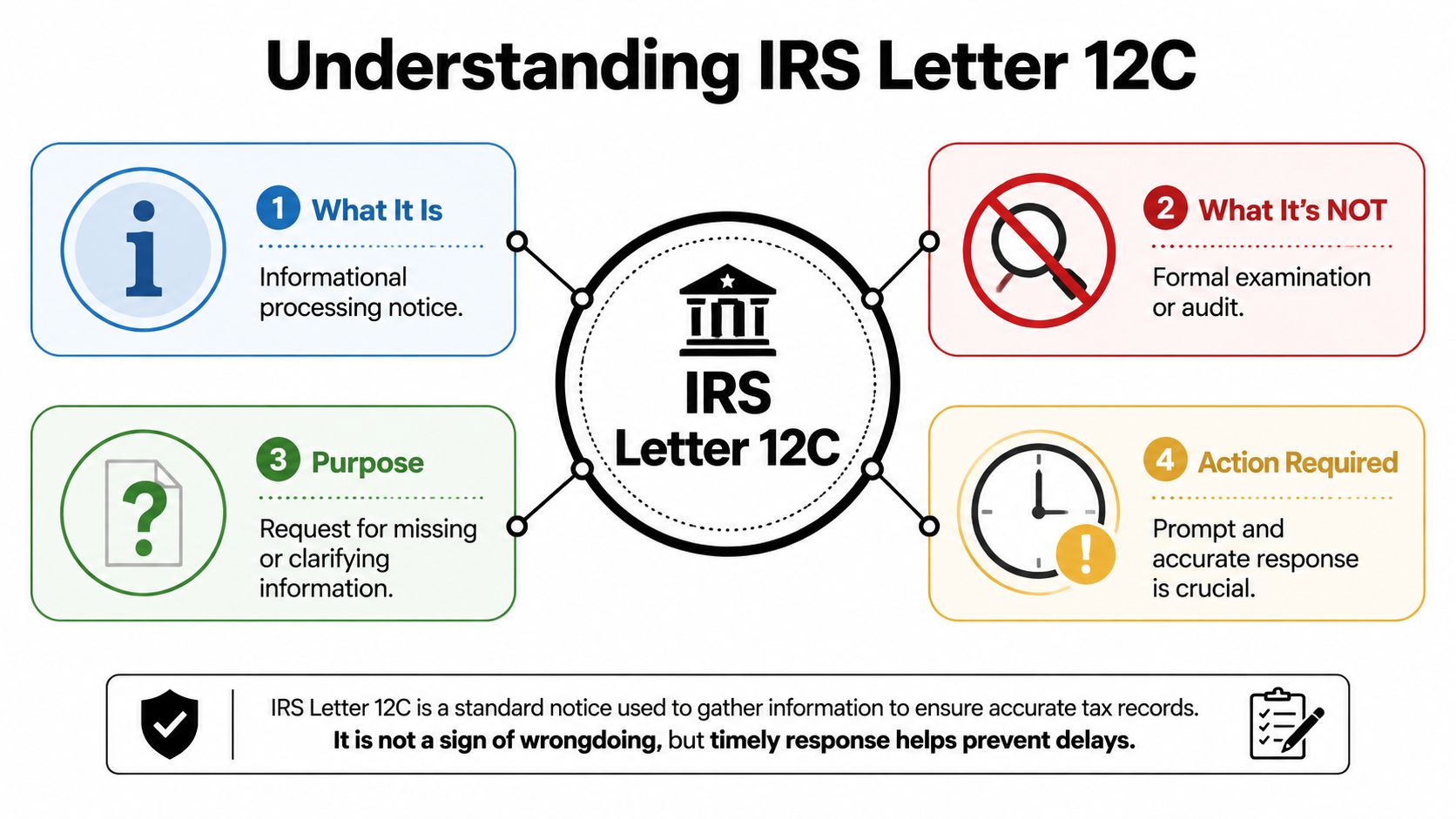
IRS Letter 12C is an informational processing notice. The IRS says it sends this letter when it needs more information to complete an individual income tax return, instructs taxpayers to respond within 20 days, and specifically says not to file Form 1040-X just to answer the notice because the original return is on hold, according to the IRS's Letter 12C explanation.
Think of it as a paused return
The easiest way to understand this notice is to think of your tax return as a file moving through an intake system. The IRS reviewed the submission, noticed something it couldn't verify or something that was missing, and stopped the file until you supply the missing piece.
A librarian analogy works well here. If you show up to check out materials and the librarian asks for ID, that doesn't mean you're under suspicion. It means the transaction can't be completed until they confirm the information. Letter 12C works much the same way.
That's why this notice matters even though it isn't an audit. Your return isn't finished. If a refund depends on the IRS finishing that return, the refund can't move until the hold is cleared.
What it is not
People often confuse this notice with a formal examination. That's a mistake. A Letter 12C is not the same as an audit notice, and it isn't the same as a balance-due demand.
That distinction matters because it changes how you should respond. With a 12C, the goal is usually precision, not argument. Send the exact information requested, in the form requested, to the place listed on the notice.
A lot of unnecessary trouble starts when taxpayers respond emotionally instead of procedurally. They send an amended return the IRS didn't ask for. They attach extra paperwork to “explain everything.” They bury the requested document inside a stack of unrelated records. That almost never helps.
The practical takeaway
Letter 12C belongs in the “processing and verification” category of IRS notices. If you want a broader sense of where it fits among other notices, this overview of IRS letters and notices helps put it in context.
When the issue is simple, a clean response can resolve it. When the issue is tied to identity information, missing schedules, or disputed reporting, that same notice can be the first sign that the matter isn't simple at all.
Common Triggers and Required Documentation
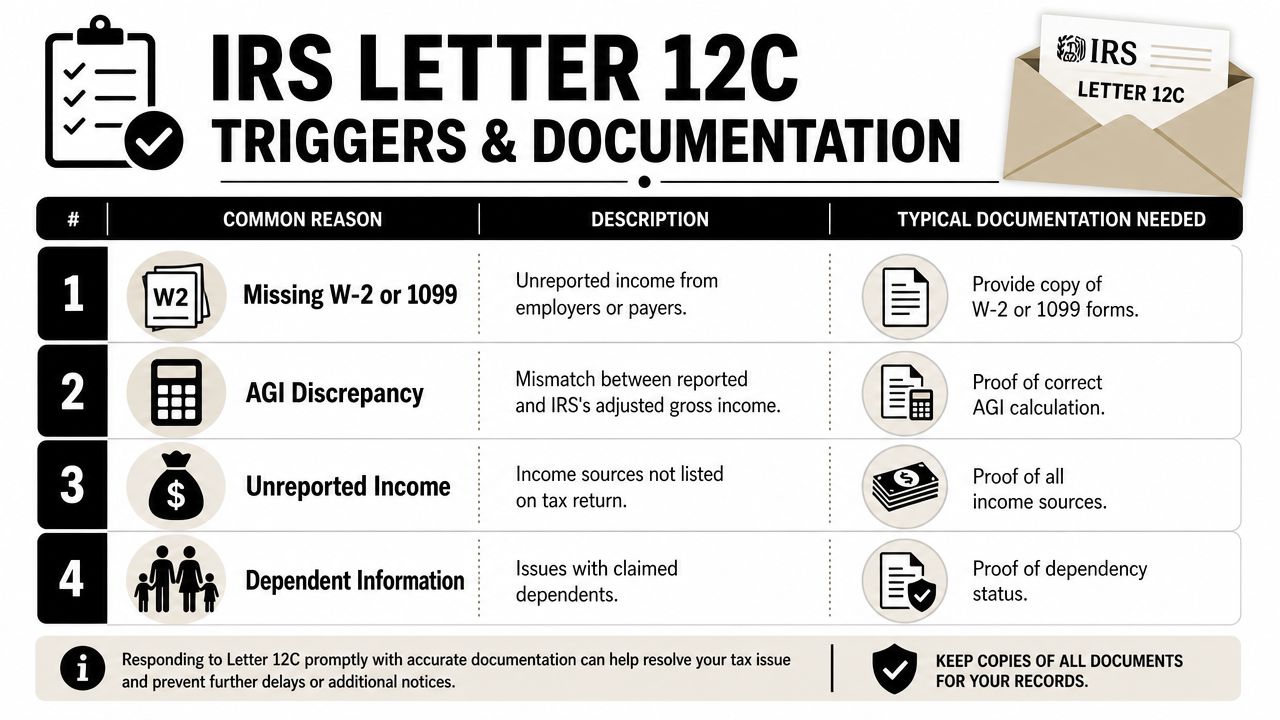
Letter 12C usually shows up when the IRS cannot finish processing a return without one missing piece. In practice, I see two patterns again and again. The first is a missing form or schedule that should have been attached to the return. The second is a mismatch between what the return says and what the IRS or a third party already has on file.
One of the most common triggers involves the Affordable Care Act premium tax credit. H&R Block notes that Letter 12C often asks taxpayers to reconcile Marketplace coverage by providing Form 1095-A and Form 8962, and that the response should include the exact requested forms within the 20-day period listed in the notice, as described in its Letter 12C guidance.
The most common situations I see
Marketplace coverage is the first place to check. Many taxpayers had exchange coverage, received Form 1095-A, and either never filed Form 8962 or entered figures that do not match the Marketplace statement. That is often a manageable DIY response if the notice clearly asks for those forms and nothing else.
Other triggers call for more caution. Missing schedules, unreadable attachments, Social Security number mismatches, and withholding questions all show up in 12C cases. A simple missing schedule can often be fixed without help. Identity issues or conflicting income records are different. Those are the cases where I tell clients to slow down before sending anything.
Here is the short list of what tends to trigger the notice:
- Marketplace coverage issues: Missing Form 1095-A, missing Form 8962, or a mismatch tied to advance premium tax credit information.
- Missing schedules or attachments: The return refers to a form or schedule that was left out or was not readable when filed.
- Identity data problems: Social Security number errors, taxpayer identification issues, or other verification gaps.
- Income or withholding verification: The IRS wants support for wages, withholding, or other amounts reported on the return.
What to gather, and when DIY stops making sense
A good response package is tight and easy to process. IRS employees are usually looking for one missing item, not a full explanation of your tax year.
Include:
- A copy of the notice: Put it on top or directly behind a short cover sheet.
- The exact requested forms: If the letter asks for Form 1095-A and Form 8962, send those forms. Do not replace them with a narrative.
- Clear identifying information: Include the taxpayer's name, identifying number, and any reference number shown on the notice.
- Only relevant support: If the notice asks for one schedule, send that schedule and the documents that directly support it.
Send what the letter asks for, not the full file.
This is where judgment matters. If the notice is limited to a missing ACA form, a missing schedule, or a clean clerical fix, many taxpayers can handle it themselves if they follow the instructions exactly. If the records are disorganized, tax receipt organization strategies can help sort the documents before anything is mailed or faxed.
Call a professional early if any of these are true: the IRS request does not match what you filed, the figures on your wage or withholding documents conflict with the return, the notice points to identity information, or you no longer have the records needed to confirm what was submitted. Those facts usually mean the problem is bigger than one missing attachment.
If you are missing wage or income records altogether, you may need transcripts before you respond. In that situation, it helps to understand what a 4506-T form does, especially if you need IRS transcript information to confirm the source of a mismatch.
A Step-by-Step Guide to Responding Correctly
When taxpayers handle a 12C well, they usually do three things right. They read carefully, answer narrowly, and document what they sent. When they handle it poorly, they rush, over-explain, or send the wrong thing to the wrong address.
The Taxpayer Advocate Service says that if the IRS doesn't receive a response to Letter 12C within the timeframe given, it will make an adjustment to the return based on the information it has, which can delay or reduce a refund, as explained on the Taxpayer Advocate's Letter 12C page.
Follow this response sequence
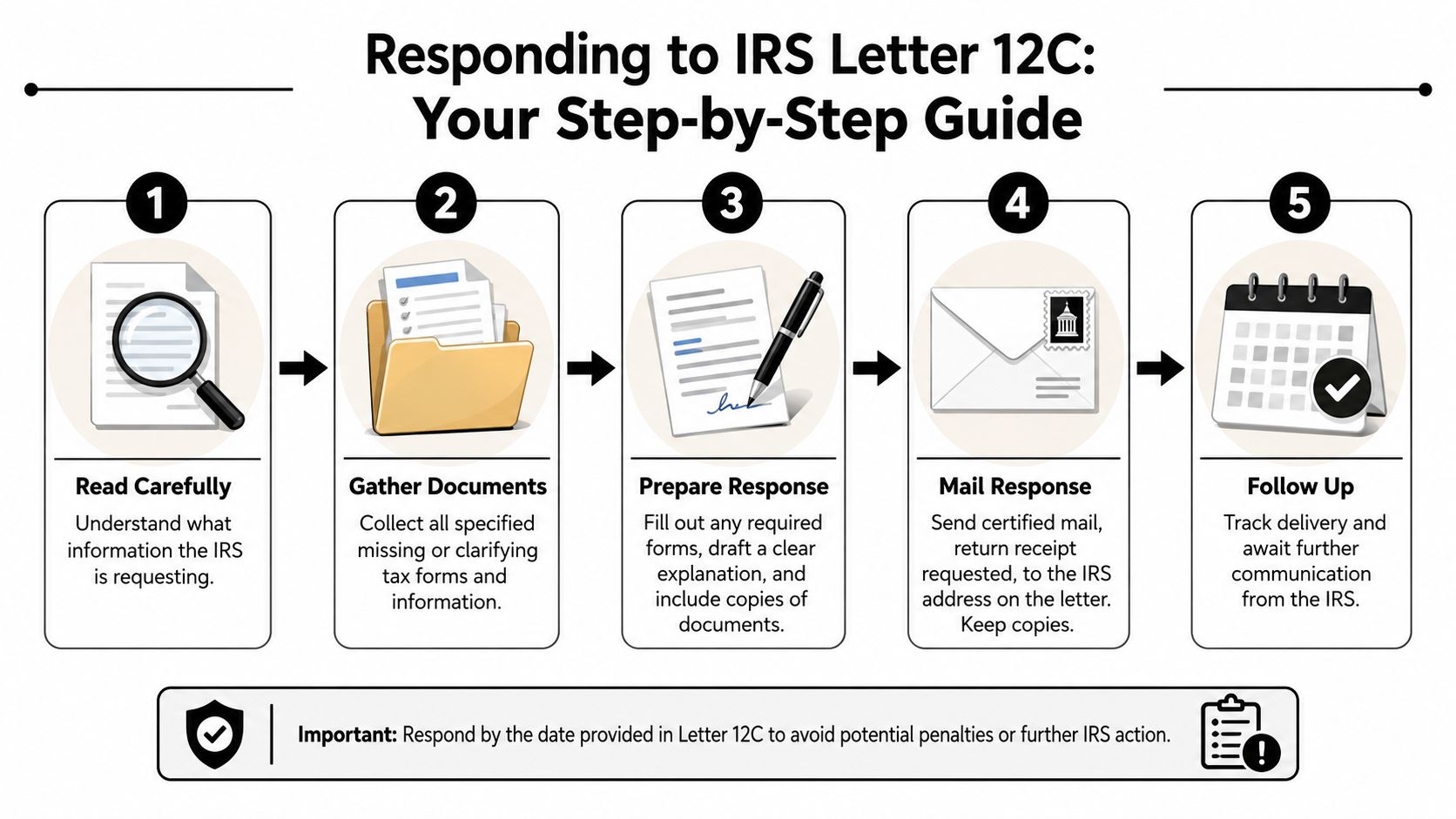
Read the notice line by line
Don't skim for the bold text and stop there. Find the exact item the IRS says is missing or needs correction. The request is often narrower than people think.
Pull the requested documents only
If the notice asks for Form 1095-A and Form 8962, start there. If it asks for a corrected schedule or identity verification support, gather that exact material. Don't start with a general explanation of your tax situation.
Prepare a short cover sheet
A simple cover sheet helps. Identify the taxpayer, list the notice number, state that the enclosed documents respond to Letter 12C, and list what you're enclosing. Keep it short and readable.
Copy everything before sending
Keep a complete file. Save a copy of the notice, your cover sheet, every attachment, and proof of mailing or fax transmission. If the IRS later says something wasn't received, your records matter.
Send it exactly as directed
Use the mailing address or fax number shown on the notice. Don't send it to a generic IRS address from another form or another website.
What works and what doesn't
A comparison helps because many 12C problems come from avoidable habits.
| Better approach | Approach that causes trouble |
|---|---|
| Send the exact requested forms | Send your entire return package again |
| Use the address or fax on the notice | Use an old IRS address from prior correspondence |
| Include a copy of the notice | Omit the notice and assume the IRS will match it |
| Keep copies and delivery proof | Mail originals and keep nothing |
| Write a short cover sheet | Write a long emotional explanation |
What not to do
Some mistakes are so common that they're worth calling out directly.
- Don't file an amended return just to answer the notice: That usually creates confusion instead of solving the hold.
- Don't send original records if copies will do: Keep your originals unless the IRS specifically demands otherwise.
- Don't ignore a partial disagreement: If part of the notice is wrong, respond anyway and explain the disagreement clearly.
- Don't improvise the response address: Use only the contact method shown on your notice.
Working standard: A good 12C response helps the IRS finish processing. A bad one creates a second problem.
If you send a complete, clean package and the issue is limited to missing documentation, many cases end there. If you can't assemble that package with confidence, that's the point where DIY starts getting expensive.
When You Should Hire a Tax Attorney
You open the mailbox expecting a refund update and find Letter 12C instead. The notice asks for one more item, and at first glance it looks manageable. Sometimes it is. Sometimes that “one more item” is the first sign that the return has a larger problem behind it.

The practical question is not whether you can mail papers to the IRS. It is whether your response requires judgment. If all the IRS needs is a clean copy of a form you already have, a careful DIY response is often enough. If the notice touches identity information, business reporting, or facts that do not match your records, the cost of guessing goes up fast.
Cases that are often safe to handle yourself
DIY usually makes sense when the issue is narrow and you can answer it without interpretation.
That generally means all of the following are true:
- The notice is specific: You know exactly what document or correction the IRS wants.
- Your records are complete: You already have the requested form or can get it quickly from a reliable source.
- The facts are not in dispute: You are not trying to argue with the IRS about income, filing status, withholding, or dependency.
- The return is simple: There is no business activity, no K-1 reporting, no rental issues, and no related filing problem waiting in the background.
In those cases, the job is mostly procedural. Send exactly what was requested, keep proof, and avoid turning a document request into a bigger file.
Red flags that should push you toward professional help
I tell clients to pause and get advice when the response could shape the IRS record in a way that is hard to correct later.
Hire a tax attorney promptly if any of these are true:
- You cannot get the requested document without recreating records or making assumptions.
- You believe the IRS notice is based on incorrect information.
- The notice involves Social Security numbers, identity details, or mismatched taxpayer information.
- The missing item connects to self-employment income, a Schedule C, a partnership interest, or an S corporation.
- You already responded once and the problem is still not resolved.
- The delayed refund is creating pressure from payroll, rent, estimated taxes, or other cash flow needs.
- You suspect the response may expose another filing error.
Those are the files where a short, careful response matters more than a fast one. A lawyer can decide what to send, what to explain, and what not to volunteer. That judgment can keep a routine notice from turning into an adjustment, an amended return problem, or a longer dispute.
Why early advice often costs less
Many taxpayers wait because they assume hiring counsel means the case is already serious. In practice, I see the opposite. The easiest cases to fix are often the ones that come in before the taxpayer sends an incomplete response, misses the deadline, or contradicts the original return.
A good attorney does more than mail documents. The attorney checks whether the notice is really about a missing form or whether it points to a reporting issue underneath, then builds a response that solves the immediate problem without creating a new one. If you are weighing that decision, this guide on when hiring a tax attorney makes sense will help you decide whether to handle the notice yourself or bring in help now.
Guidance for Businesses and Tax Professionals
Letter 12C is addressed to an individual return, but that doesn't mean the issue is purely personal. For sole proprietors, single-member LLC owners, partners, and S corporation owners, the “missing piece” on the Form 1040 side often traces back to business-related reporting.
For business owners
If you run a business, read the notice with your full filing picture in mind. A personal return may depend on information coming from a Schedule C, a K-1, withholding support, or records that were maintained partly through the business and partly through personal accounts.
That mixed-document problem shows up often with self-employed taxpayers. They may have the right information somewhere, but not in a clean form that matches what the IRS is requesting. A rushed DIY response can then create an inconsistency between the original return, the business books, and what gets mailed to the IRS.
A better approach is to ask three questions before responding:
- Does the requested item tie back to business records?
- Will the response need support from bookkeeping, payroll, or ownership documents?
- Could the answer reveal a separate reporting issue outside the notice itself?
If the answer to the second or third question is yes, pause before sending anything.
For CPAs, EAs, and other advisors
For tax professionals, Letter 12C often starts as a compliance issue and then crosses into controversy work. That line matters.
A straightforward request for Form 1095-A and Form 8962 is usually still administrative. A notice involving identity data, inconsistent schedules, or a client who can't produce the requested support is different. At that point, the advisor isn't just gathering forms. The advisor is managing legal and procedural risk.
A useful referral point is when the response requires advocacy, not just documentation.
For referral partners, the handoff is usually best when the client is still in the response stage, before an avoidable adjustment or larger dispute develops. That protects the preparer relationship and gives the client a better chance at a clean resolution.
Frequently Asked Questions About IRS Letter 12C
Is IRS Letter 12C an audit
No. It's generally a processing notice requesting information needed to complete your return.
Should I file Form 1040-X to fix it
Usually, no. Letter 12C is typically handled by sending the information requested in the notice, not by filing an amended return just to get the IRS's attention.
What if I miss the deadline
That creates real risk. If you miss the response window, the IRS may process the return based on the information it already has, which can lead to an adjustment and can affect refund timing.
Can I respond if I disagree with the notice
Yes. If you disagree, respond anyway. The better approach is to send the requested response package and include a clear explanation of what you believe is incorrect, instead of ignoring the notice.
Should I call the IRS before mailing anything
Sometimes, but don't let a phone call replace a written response if the notice requires one. A call can help clarify what the IRS is asking for, but the core job is still to send the requested material to the address or fax listed on the letter.
Does responding increase audit risk
A proper response to a processing notice doesn't turn it into an audit by itself. The main risk comes from sending incomplete, inconsistent, or contradictory information.
What's the best way to send my response
Use the delivery method listed on your notice. If you mail it, use a trackable method and keep complete copies of everything sent.
If you received an IRS Letter 12C and you're not sure whether it's a simple document request or the start of a bigger tax problem, Attorney Stephen A Weisberg offers a FREE Tax Debt Analysis to help determine whether he can help and what the right next step looks like. He represents individuals, business owners, and professionals dealing with IRS issues, and he focuses on practical resolution before small notice problems grow into larger disputes.


