IRS Installment Agreement While in Chapter 13 Explained
Can you keep an IRS installment agreement while in Chapter 13? Learn how Chapter 13 plans handle IRS debt, stays, and next steps.

In this article
- Introduction to IRS Debt and Chapter 13 Choices
- The timing controls the treatment
- Why your bankruptcy attorney and tax professional need to talk to each other
- How Chapter 13 Works as Your Repayment Framework
- The plan starts with a proposal
- One payment replaces separate collection pressure
- Why an IRS Installment Agreement Pauses During Chapter 13
- The filing creates a legal handoff
- Post-petition liabilities are different
- How Tax Claims Are Treated Inside Your Chapter 13 Plan
- A practical comparison
- The IRS proof of claim deserves scrutiny
- Why classification affects planning
- Your Options Before During and After Chapter 13
- Before filing
- During the case
- After discharge or dismissal
- Common Misconceptions About IRS Payment Options in Bankruptcy
- Misconception one
- Misconception two
- Misconception three
- Misconception four
- Misconception five
- Next Steps to Resolve IRS Debt With the Right Help
- What to bring to a tax debt analysis
If you file Chapter 13, pre-petition IRS debt is generally paid through the Chapter 13 plan, not a parallel IRS installment agreement. An existing IRS installment agreement is suspended during the bankruptcy case, and Chapter 13 plans normally run 36 to 60 months, with 60 months the maximum and most common payment period.
You may be asking this after receiving an IRS notice, or after spending months making direct payments and still falling behind elsewhere. Perhaps the IRS agreement was current, but mortgage arrears, credit cards, medical bills, or a reduction in income made the entire budget impossible. Chapter 13 changes the question from “Can I keep sending the IRS the same payment?” to “How will the bankruptcy plan handle each tax liability?”
Core rule: Chapter 13 usually becomes the repayment framework for tax debt that existed before filing. The old IRS agreement doesn't continue as a separate track.
That distinction matters to taxpayers, bankruptcy attorneys, CPAs, enrolled agents, and financial professionals referring clients for help. The timing of the tax debt, the IRS claim filed in the case, the trustee's distributions, and new tax obligations after filing all affect the practical answer. Before filing, a taxpayer may have an ordinary IRS payment arrangement. During the case, the bankruptcy plan controls pre-petition debt. After dismissal or discharge, the IRS may review surviving liabilities and determine whether an agreement should be reinstated or revised.
For a basic explanation of how direct IRS payment arrangements work before bankruptcy, review this guide to setting up a payment plan with the IRS. The important point is not that taxes disappear when Chapter 13 begins. The point is that the legal system handling the payment changes.
Introduction to IRS Debt and Chapter 13 Choices
Maria has an IRS balance and an existing installment agreement. She has made each scheduled payment, but her household budget can no longer cover the IRS, credit cards, a vehicle loan, and overdue housing costs together. Her question is understandable: can she file Chapter 13 and keep paying the IRS directly?
For the old tax debt, the practical answer is generally no. Filing Chapter 13 creates a court-supervised repayment structure for the debtor's broader obligations. The IRS installment agreement is usually suspended, and pre-petition tax liabilities are handled through the bankruptcy process rather than through a separate direct-payment track.
For a basic explanation of how direct IRS payment arrangements work before bankruptcy, see this guide to setting up a payment plan with the IRS.
The timing controls the treatment
A tax liability that existed before the bankruptcy filing is a pre-petition debt. It belongs in the Chapter 13 analysis even if the IRS had already approved an installment agreement. A liability that arises after filing is separate. The original case does not automatically cover it, so it requires prompt attention.
This timing works like sorting documents by filing date. Pre-petition taxes go into the bankruptcy case for evaluation and claim treatment. Post-petition taxes must be tracked separately. Confusing those categories can lead a taxpayer either to assume bankruptcy erases every tax balance or to keep paying an old IRS agreement as though filing changed nothing.
The plan, the IRS proof of claim, and the court's orders determine how pre-petition tax debt is handled.
Why your bankruptcy attorney and tax professional need to talk to each other
Your bankruptcy attorney may need tax records to identify when each liability arose and what kind of tax it represents. Your tax professional may understand the IRS account but need the bankruptcy documents to assess the plan and claim process. Sharing information helps expose missing returns, incorrect account balances, and new tax obligations after filing.
Bring both professionals the same core records, including IRS notices, account information, filed and unfiled returns, and Chapter 13 documents. That gives them a common timeline instead of two separate versions of the debt.
The key change is the payment framework. Before filing, the IRS agreement may govern direct payments. After filing, Chapter 13 generally governs pre-petition tax debt, while post-petition obligations remain a separate responsibility.
How Chapter 13 Works as Your Repayment Framework
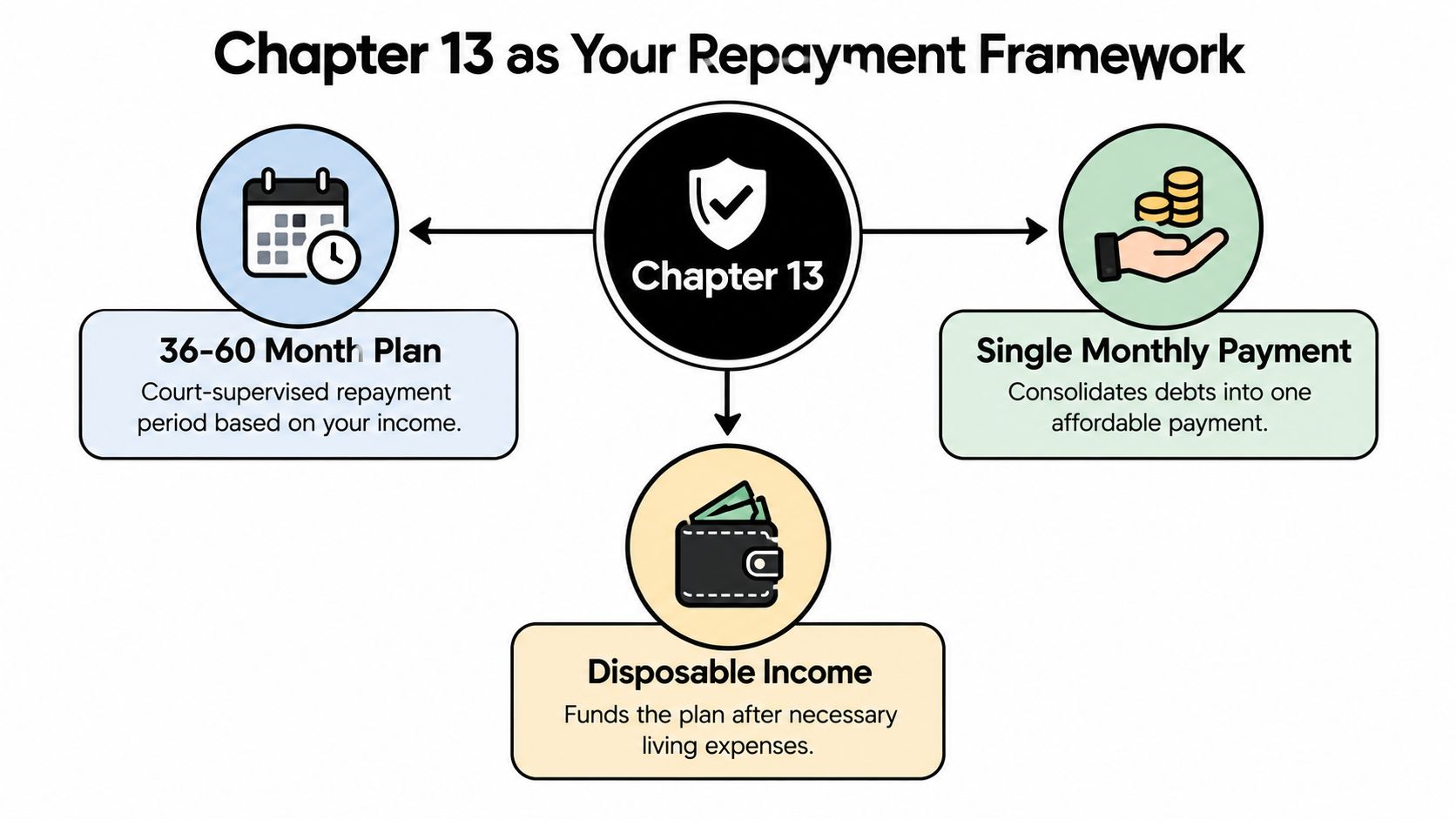
Chapter 13 is a court-supervised reorganization for individuals with regular income. Under IRS bankruptcy guidance, the debtor proposes monthly payments over a plan period that normally runs 36 to 60 months, and 60 months is the maximum and most common payment period. The exact plan depends on the debtor's income, expenses, assets, debts, and applicable bankruptcy rules. IRS bankruptcy guidance describes the plan as a monthly repayment structure administered through the bankruptcy case.
A useful analogy is a payment funnel. Before filing, each creditor may demand payment through a separate account, agreement, or collection process. After filing, eligible debts are gathered into one court-approved framework. The debtor makes the required plan payment, and the Chapter 13 trustee distributes funds according to the confirmed plan and allowed claims.
The plan starts with a proposal
The debtor proposes a payment based on the household's financial circumstances. The court and trustee review whether the plan satisfies applicable requirements, including treatment of creditors and the debtor's available income. Once the plan is confirmed, its terms become the operating instructions for the case.
That structure explains why an old IRS agreement generally can't remain the controlling arrangement for pre-petition tax debt. The IRS is one creditor inside a case that must account for the debtor's other obligations as well. Directly paying the IRS outside the plan could disrupt the intended distribution and create unequal treatment.
One payment replaces separate collection pressure
The Chapter 13 payment isn't merely a renamed IRS installment payment. It may address tax claims along with other debts and required case obligations. The debtor's monthly payment therefore reflects the total plan structure, not just the amount previously negotiated with the IRS.
This doesn't mean every tax claim receives identical treatment. The classification of the IRS claim matters, and the trustee distributes funds under the confirmed plan. A taxpayer should compare the IRS account transcript, filed returns, notices, and bankruptcy schedules before assuming the proposed plan reflects the complete tax picture.
For readers evaluating whether bankruptcy can address tax liabilities, this overview of filing bankruptcy on tax debt offers useful background. The central lesson is straightforward: Chapter 13 doesn't create a second payment lane. For pre-petition liabilities, it generally becomes the lane.
Why an IRS Installment Agreement Pauses During Chapter 13
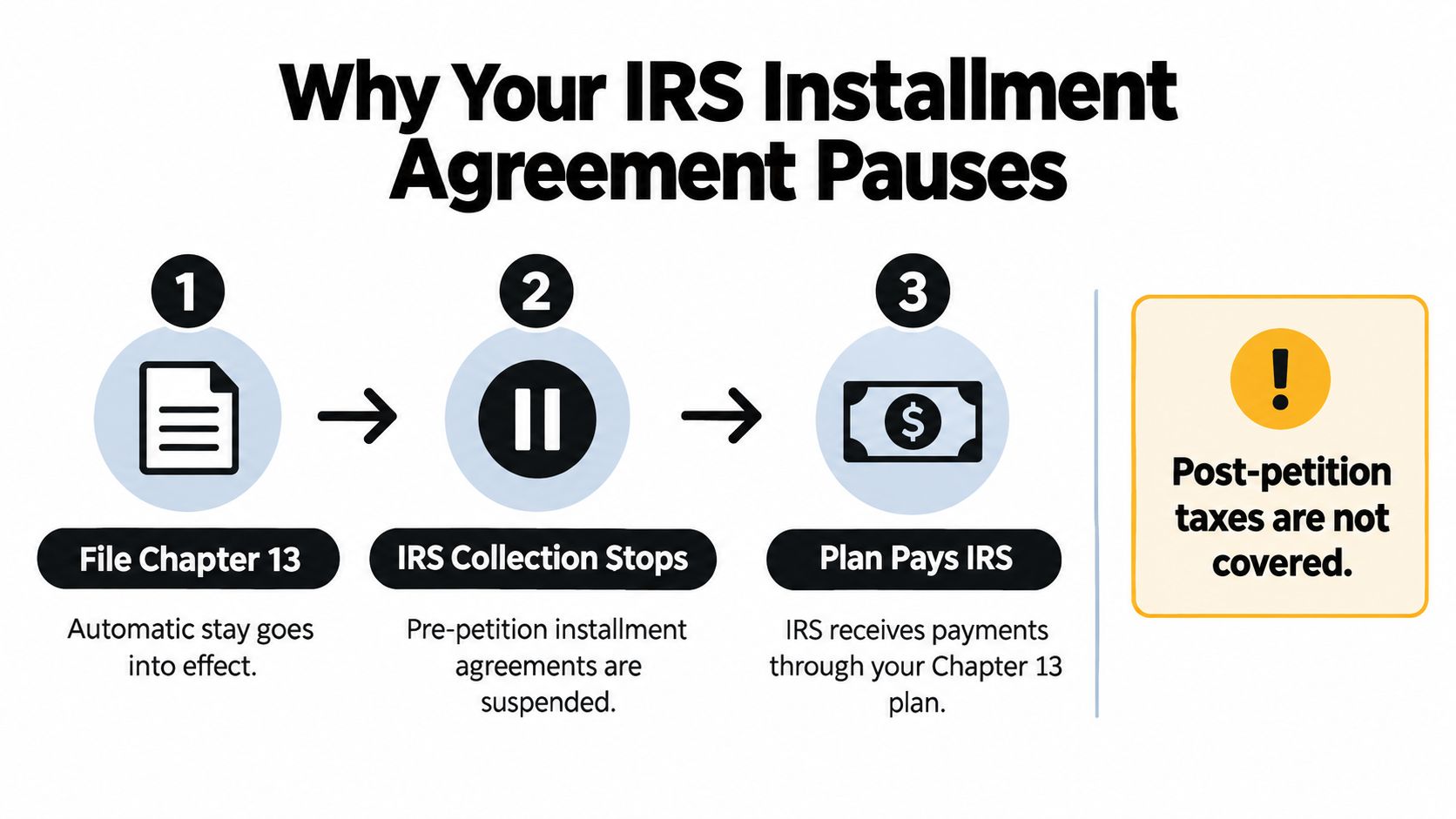
Suppose you have been sending the IRS a monthly payment and then file Chapter 13. The agreement usually does not disappear, but it stops operating while the bankruptcy case is active. The IRS describes this status as suspension, not termination. Filing bankruptcy alone does not end the agreement, yet the old direct-payment arrangement no longer controls the pre-petition tax debt.
The IRS bankruptcy frequently asked questions explain that, after dismissal or discharge, the IRS reviews any liabilities that remain. Depending on that review, the prior agreement might be reinstated or changed. The taxpayer should not assume that its former terms restart automatically.
The filing creates a legal handoff
An IRS installment agreement is a private payment arrangement between the taxpayer and the IRS. Chapter 13 places the debtor's broader obligations under court supervision. Once the case begins, the confirmed plan and bankruptcy protections govern collection of pre-petition debt.
That change creates a handoff. A taxpayer might keep paying the IRS directly to show good faith, while the plan requires that same debt to be paid through the trustee. Direct payments can therefore produce accounting problems or conflict with the plan. The practical question is whether the payment is allowed and matches the confirmed plan, not whether the taxpayer wants to continue it.
Post-petition liabilities are different
Taxes arising after the petition date belong to a different category. The IRS generally does not enter a separate installment agreement for post-petition liabilities unless the narrow guaranteed-installment-agreement exception under IRC 6159(c) applies, as described in its bankruptcy guidance. An active Chapter 13 case therefore usually does not provide a parallel IRS payment plan for new tax debt.
Ordinary IRS plan thresholds do not carry into bankruptcy. They describe collection options outside the Chapter 13 framework, not a way to preserve a pre-petition agreement after filing.
Keep the distinction clear: the old agreement is paused, while the case remains active. Pre-petition debt must be addressed through the bankruptcy process, and post-petition tax obligations still require monitoring and timely handling.
The agreement is paused, not erased. The case is active, and the IRS account still needs to be monitored.
How Tax Claims Are Treated Inside Your Chapter 13 Plan
Suspension answers what happens to the old IRS agreement. It doesn't answer how the IRS claim is treated once it enters the bankruptcy case. That question depends on the claim's legal classification, the existence of liens, and the information presented in the IRS proof of claim.
Tax claims are commonly discussed as priority, secured, or general unsecured claims. These labels aren't interchangeable. They can affect whether a claim must be paid in full, whether a lien affects property, and how the trustee distributes plan funds.
A practical comparison
| Claim Type | Treatment in Chapter 13 Plan |
|---|---|
| Priority tax claim | Usually receives special treatment under bankruptcy law and may need to be paid in full through the plan, depending on the specific liability and applicable rules. |
| Secured tax claim | May be treated as secured to the extent a valid tax lien attaches to property. The lien and valuation issues require careful review. |
| General unsecured tax claim | May be treated with other unsecured claims under the confirmed plan, subject to the facts and applicable discharge rules. |
The table provides a working framework, not a substitute for reviewing the actual IRS claim. Tax periods, return filing dates, assessments, liens, penalties, and the bankruptcy petition date can change the result.
The IRS proof of claim deserves scrutiny
The IRS typically participates by filing a proof of claim in the bankruptcy case. That document identifies the amount and classification the IRS asserts. The debtor and counsel should compare it with filed returns, account transcripts, payment records, prior agreements, and notices.
If the proof of claim appears inaccurate, the issue may require an objection or another formal response in the bankruptcy case. A taxpayer shouldn't rely only on the balance shown in an old installment agreement because that agreement may include interest, penalties, payments, or periods that don't match the current claim.
For broader context on the treatment and possible discharge of tax liabilities, readers can review can tax debt be discharged in bankruptcy. Another discussion of bankruptcy and IRS debt is available through consult Morgan Morgan Attorneys at Law P, which can help readers compare bankruptcy chapters and tax-debt questions.
Why classification affects planning
A taxpayer may see one total IRS balance, but the bankruptcy case may divide that balance into distinct claims. The trustee doesn't distribute funds based solely on the taxpayer's preferred payment order. The confirmed plan and allowed claims govern the process.
That makes accurate records essential before confirmation and whenever the IRS files or amends a claim. The practical goal is to know which tax liabilities must be addressed through the plan, which may have lien implications, and which may receive unsecured treatment.
Your Options Before During and After Chapter 13
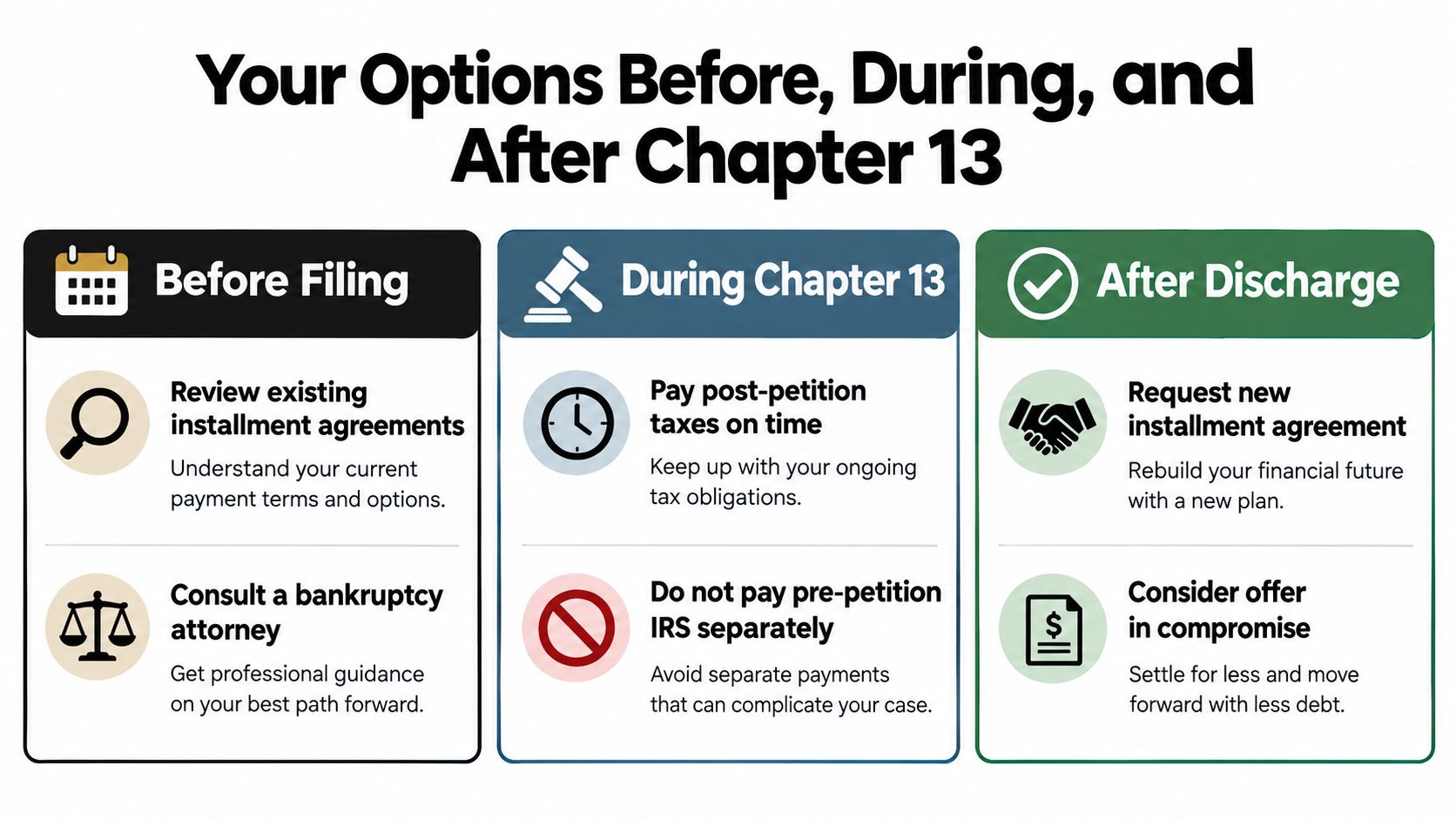
The correct response changes with the case timeline. Before filing, the goal is to build an accurate record and choose a workable repayment framework. During Chapter 13, the focus shifts to plan compliance and current taxes. After the case ends, the remaining IRS debt must be reviewed before any new collection arrangement is discussed.
Before filing
Collect the records showing what the IRS claims you owe and what you have paid. Gather installment agreement notices, account transcripts, filed returns, IRS correspondence, wage records, business records, and payment proof. These documents give your bankruptcy attorney and tax professional the same factual starting point.
Disclose any existing installment agreement before filing the petition. The agreement will generally be suspended once the bankruptcy case begins, but the underlying account still must be listed accurately and examined against the IRS claim. The old agreement is a historical record, not the controlling repayment structure.
You can compare Chapter 13 with the ordinary IRS options available outside bankruptcy. The ordinary $50,000 and $100,000 plan limits covered earlier help show when a direct IRS arrangement may be available. Review the IRS payment plans and installment agreements page for eligibility and application details.
During the case
Treat every new tax obligation as a current responsibility. File required returns, maintain appropriate withholding or estimated payments, and send IRS notices to bankruptcy counsel or your tax professional. Pre-petition debt belongs in the bankruptcy process, so do not make separate payments on that old balance unless counsel confirms the payment fits the case.
The practical distinction is simple. Chapter 13 provides the repayment structure for covered pre-petition claims, while post-petition taxes arise after that structure was established and require prompt attention.
If income or necessary expenses change, ask counsel whether a plan modification is appropriate. A revised budget may affect the plan's feasibility, and ignoring a change can leave you unable to make the confirmed payment or address new tax liabilities.
After discharge or dismissal
Once the case ends, identify which tax liabilities survived and request an updated IRS account review. The IRS may determine whether the suspended agreement can be reinstated or needs revision. A new arrangement does not arise automatically, so prepare current financial information and payment records.
Dismissal and discharge produce different results. Review the final bankruptcy order and the surviving account balances before discussing collection options with the IRS. That sequence helps separate debt resolved through the case from debt that still requires a direct arrangement.
Common Misconceptions About IRS Payment Options in Bankruptcy
The phrase “IRS installment agreement while in Chapter 13” often produces answers that blur separate rules. The following corrections focus on the assumptions most likely to cause trouble.
Misconception one
“I can keep paying the old IRS agreement separately, so the Chapter 13 plan doesn't need to handle that debt.”
For pre-petition tax debt, that approach is generally inconsistent with the bankruptcy framework. The existing agreement is suspended during the case, and the tax claim must be addressed through the Chapter 13 process. A direct payment may also create confusion about whether the debtor is favoring one creditor outside the plan.
Misconception two
“Bankruptcy means all future tax obligations are protected.”
New liabilities aren't automatically covered just because the taxpayer is in Chapter 13. Post-petition taxes require attention, and failure to file returns or pay current obligations can threaten the feasibility of the case. The debtor should tell counsel about new balances as soon as they appear.
Misconception three
“An offer in compromise replaces the need to follow the plan.”
An offer in compromise is a separate IRS collection tool, not a substitute for complying with an active Chapter 13 plan. Bankruptcy status, claim treatment, and the IRS's authority to consider a compromise all require individualized analysis. A taxpayer shouldn't submit an offer or stop plan payments based on an assumption that the IRS will settle the debt.

Misconception four
“Trust fund recovery penalty issues disappear in Chapter 13.”
They don't disappear automatically. Payroll tax issues can involve personal liability, business records, responsible-person questions, and liabilities that receive different treatment from ordinary individual income taxes. A taxpayer or business owner should have the IRS account and assessment reviewed rather than assuming the bankruptcy filing resolves every payroll-tax concern.
Misconception five
“Missing a post-petition return is a paperwork problem, not a bankruptcy problem.”
Current filing compliance matters. A missed return can lead to a new tax liability, notices, and questions about whether the debtor can complete the plan. The safest response is prompt disclosure and correction, not silence.
Next Steps to Resolve IRS Debt With the Right Help
The decision usually begins with one question: is the taxpayer trying to manage an IRS balance, or is the IRS balance part of a broader financial crisis? A direct installment agreement may fit someone who can maintain current filing compliance and afford the required payment. Chapter 13 may be the more relevant framework when the taxpayer needs court-supervised coordination of tax debt and other obligations.
The answer can't be determined from the IRS balance alone. Review the tax periods, return status, claim classifications, liens, current income, necessary expenses, existing agreement, and any post-petition liabilities. A bankruptcy attorney and tax controversy professional may need to work together, especially when the IRS claim doesn't match the taxpayer's records.
What to bring to a tax debt analysis
Prepare a focused file before meeting counsel:
- IRS notices: Include collection letters, lien notices, installment agreement correspondence, and recent account information.
- Tax filings: Gather filed and unfiled returns, supporting schedules, and records explaining disputed amounts.
- Payment history: Show prior IRS payments and any evidence that the account balance changed.
- Household budget: Document income, essential expenses, secured debts, and the proposed Chapter 13 payment.
- Business records: If you own a business or have payroll obligations, bring records that identify withholding and responsible-person issues.
CPAs and other tax professionals may handle preparation, accounting, and compliance while referring collection or bankruptcy coordination to tax counsel. This plain-language overview of what CPAs actually do for taxes can help clients understand where accounting support ends and controversy representation may begin.
Taxpayers seeking counsel should also review how to find a good tax attorney. Look for someone who will examine the IRS account, bankruptcy posture, and practical budget before recommending a solution. Tax Attorney Stephen A Weisberg offers a free tax debt analysis to determine whether help is appropriate and how an IRS or bankruptcy-related issue should be approached before charging for resolution work.
The next step is to stop treating the old IRS agreement as the entire answer. Gather your records, confirm whether the debt is pre-petition or post-petition, and have the proposed plan and IRS claim reviewed together.
Tax Attorney Stephen A Weisberg can review how your IRS debt, existing installment agreement, and Chapter 13 filing interact through a free tax debt analysis. Visit Tax Attorney Stephen A Weisberg to discuss the facts of your case and identify the appropriate next step before paying for representation.


