IRS Installment Agreement Business Guide
Step-by-step IRS installment agreement business guide covering eligibility, Form 9465, Form 433-B, payroll tax rules, fees, and alternatives for 2026.
In this article
- What an IRS Installment Agreement Actually Does for a Business
- What changes after approval
- Who Qualifies and What Disqualifies You Fast
- Screen the account before requesting terms
- Choosing the Right Type of Business Payment Plan
- Payment method affects default risk
- Applying the Right Way and Building Your Documentation Package
- Match the channel to the case
- Assemble the 433-B package in review order
- Real-World Scenarios and Common Pitfalls to Avoid
- Errors that turn a workable plan into a collection case
- Fees Interest and the True Cost of Stretching Out Payment
- Why a five-year projection needs actual terms
- Alternatives Worth Considering Before You Sign the Agreement
- Compare the available resolutions
You've just opened an IRS notice between payroll runs. The business has enough revenue to survive, but not enough cash to pay the federal balance in one check. You search for an online payment plan, expect the same process available to individual taxpayers, and discover that the IRS usually sends businesses to a phone line or a notice-specific channel instead.
That operational snag is where many otherwise viable businesses lose time. A business installment agreement can protect cash flow and create a structured path forward, but only if the company is current on filings, chooses the right program, and submits documentation that matches the IRS transcripts. The rules also changed materially in 2026, with older business categories folded into newer Simple Payment Plan procedures. Generic advice written before that shift can send an owner down the wrong path.
What an IRS Installment Agreement Actually Does for a Business
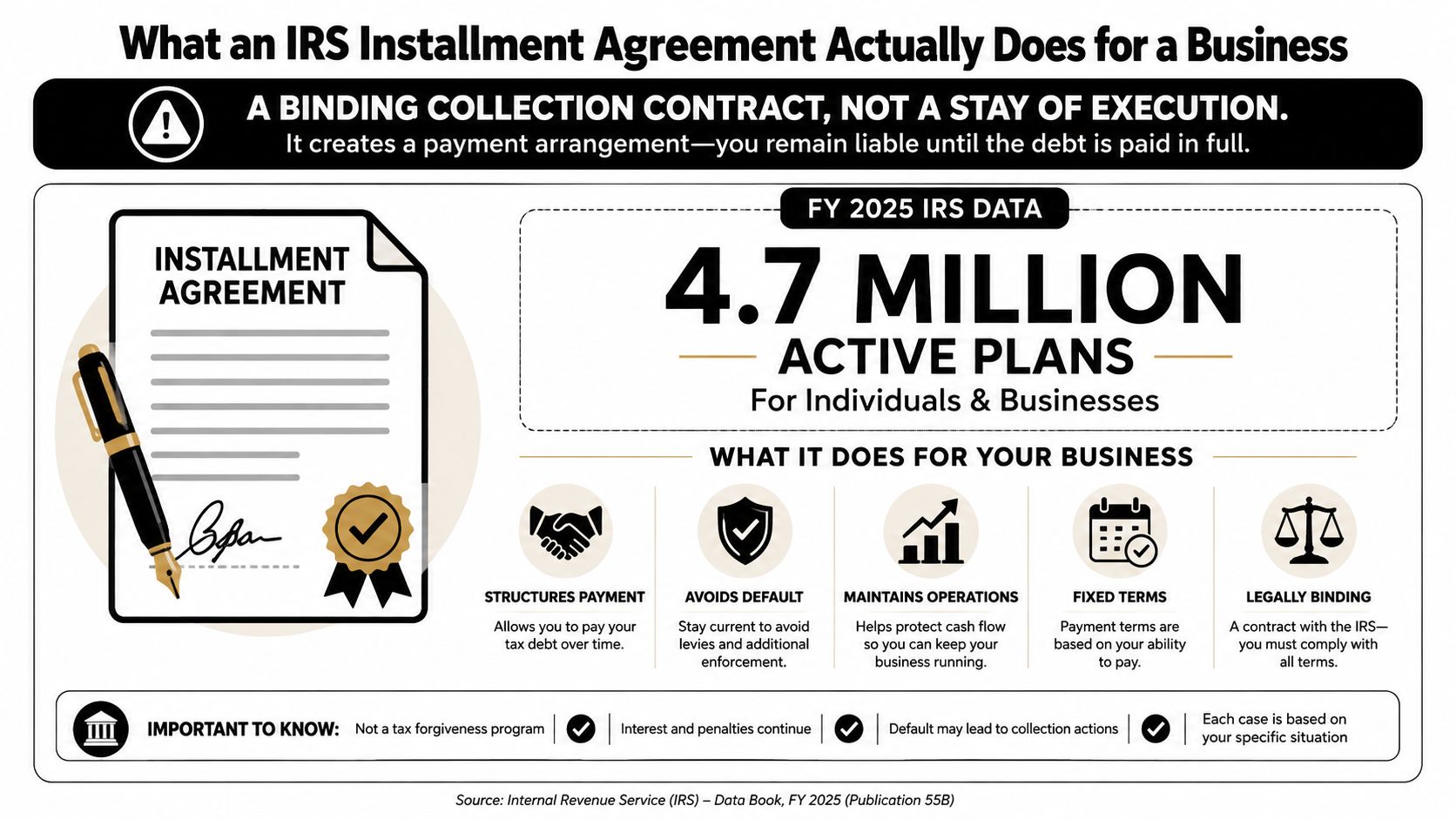
An IRS installment agreement is a binding collection arrangement, not a cancellation of the debt and not a permanent shield from enforcement. The business agrees to pay an assessed balance through scheduled payments, while interest and applicable penalties continue under federal collection rules. The IRS expects the business to honor the agreement and remain compliant with every new tax obligation.
The scale matters. In FY 2025, taxpayers established 3.2 million new installment agreements and paid $17.9 billion toward all installment agreements, according to the IRS Data Book for FY 2025. The IRS also reported that almost 1.8 million installment agreements were established or revised online during that fiscal year. Payment plans aren't an obscure workaround. They're a mainstream federal collection channel.
What changes after approval
Once the agreement is accepted and maintained, the IRS generally stops pursuing active enforced collection on the liabilities covered by the arrangement. That doesn't mean every collection consequence disappears. A federal tax lien can still move through its notice process, and the IRS can act if the agreement defaults or the taxpayer fails to meet its terms.
Your monthly payment reflects the assessed balance, accrued interest, penalties, and the period the IRS permits for repayment. The agreement doesn't forgive principal. It also doesn't erase exposure for withheld payroll taxes or automatically eliminate a Trust Fund Recovery Penalty assessed against a responsible owner or manager.
Practical rule: Treat the agreement as a compliance contract. It buys structured time, not permission to create new tax debt.
The most important obligation is forward-looking. The business must file every required return on time, make required federal tax deposits, and keep current estimated payments where applicable. A company that pays its old balance but misses current payroll deposits can default even while the installment payment clears each month.
The IRS's FY 2025 data also show why default management matters. The agency tracks initiated agreements, default rates, full-pay rates, inventory, and dollars collected in its installment-agreement reporting, making successful completion and continued compliance operational outcomes rather than paperwork details. A payment amount that looks manageable today is a poor plan if it leaves no room for current tax deposits.
Who Qualifies and What Disqualifies You Fast
Business owners should self-screen before calling the IRS. The practical question isn't just, "Can I make a payment?" It's whether the business has a clean compliance record, an accurately stated balance, and a liability that fits the applicable 2026 Simple Payment Plan category.
The IRS's published business guidance confirms that an active business with trust fund liabilities of $25,000 or less may qualify for the In-Business Trust Fund Express Installment Agreement, provided the balance is fully paid within 24 months or before the Collection Statute Expiration Date, whichever comes first. The IRS business express-agreement guidance directs businesses that don't qualify to submit Form 433-B and contact the IRS promptly.
Current business procedures have changed how these categories are handled. Older business-specific routes were folded into Simple Payment Plan rules, and qualifying non-trust-fund business balances can receive terms tied to the collection statute rather than the former fixed repayment structure. Because the IRS applies the rules to assessed balances and actual account data, don't rely on an old article or a balance copied from internal bookkeeping.
Screen the account before requesting terms
| Eligibility Criterion | Threshold for 2026 | Common Disqualifier |
|---|---|---|
| Trust fund express route | Assessed liability of $25,000 or less, paid within 24 months or before the collection deadline | Unpaid current payroll deposits or failure to meet the express terms |
| Business Simple Payment Plan | Qualifying assessed business balances up to $50,000, subject to the collection statute | Unfiled returns, inaccurate transcripts, or a liability outside the qualifying category |
| Financial disclosure route | No streamlined assumption, financial capacity must be documented | Incomplete Form 433-B or unsupported expense claims |
| Account status | Returns filed and required deposits current | Open bankruptcy, pending Offer in Compromise, levy or seizure activity |
Some problems trigger rejection or escalation quickly. Open bankruptcy proceedings, a pending Offer in Compromise, unfiled returns, missing payroll tax deposits in the current quarter, and active levy or seizure action can prevent a routine approval. The IRS may also pull real-time transcripts and uncover an old balance tied to a closed entity, a late return, or a filing that never posted correctly.
The Trust Fund Recovery Penalty requires separate analysis. An agreement covering the business's underlying Form 941 liability doesn't automatically resolve a personal assessment against a responsible individual. Before submitting financial information, review the business account and each owner's individual account. For owners preparing a disclosure package, the Form 433-B business collection information statement guide can help identify the financial categories the IRS will examine.
Choosing the Right Type of Business Payment Plan
The right payment plan depends on tax type, assessed balance, repayment capacity, and compliance history. Don't choose a program based only on the number printed on the latest IRS notice. A company may have several modules, separate entities, payroll liabilities, and personal assessments that change the collection picture.
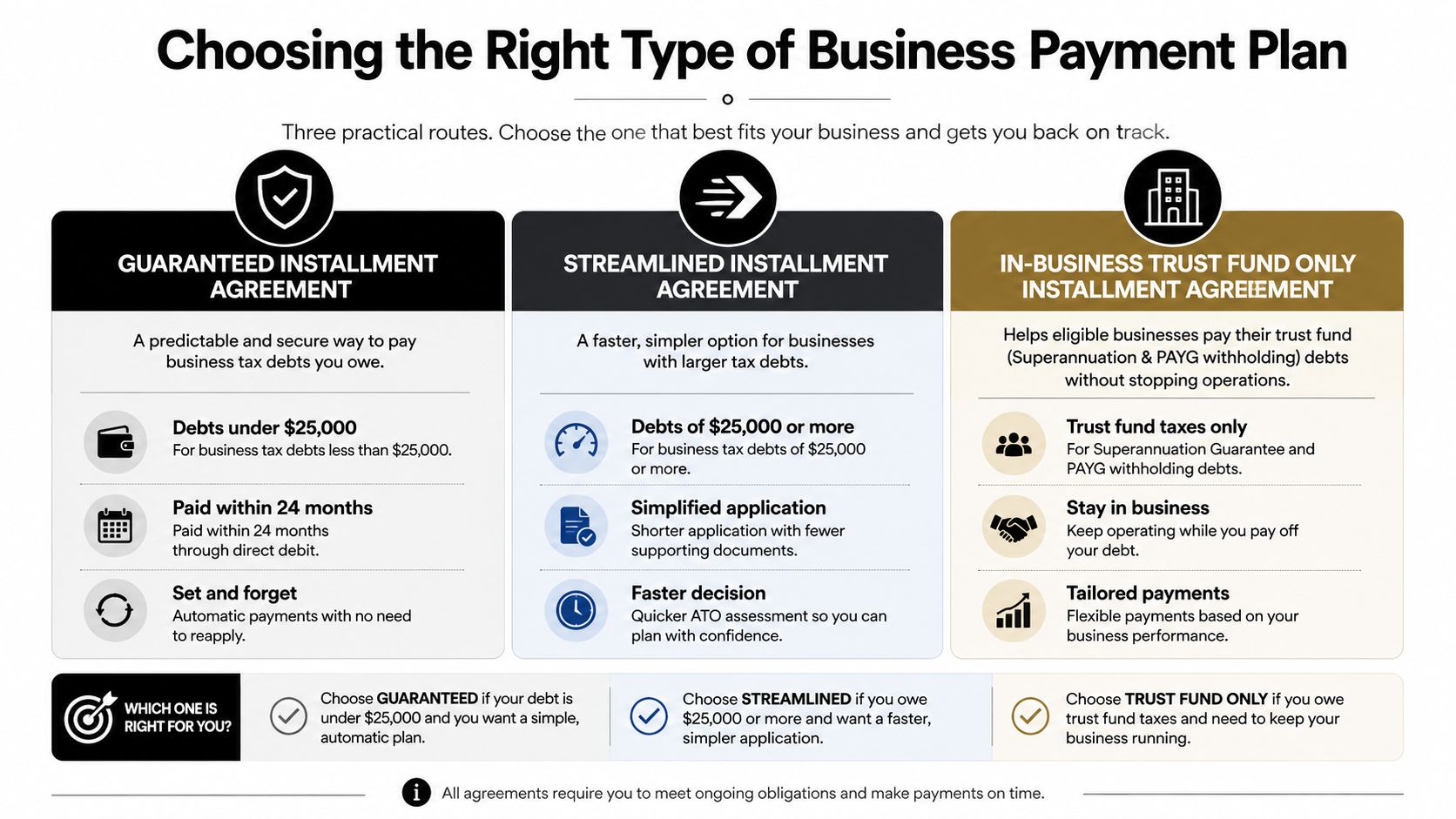
For a small business with qualifying debt, the decision usually falls into one of three routes:
| Route | Best use | Financial disclosure | Payment mechanics |
|---|---|---|---|
| Guaranteed or express arrangement | Qualifying debt under $25,000 that can be paid promptly | Limited | Direct debit is commonly required for qualifying balances in the upper part of that range under the express rules |
| Streamlined or Simple arrangement | Qualifying combined business balances up to $50,000 | Limited compared with a full financial review | Terms follow the applicable Simple Payment Plan and collection deadline |
| Standard Form 433-B agreement | Larger balances, complex payroll exposure, unstable cash flow, or nonqualifying accounts | Full Collection Information Statement | Payment is based on documented ability to pay and may involve partial-pay analysis |
A sole proprietor with one Schedule C balance and stable deposits may fit a simple route. A C corporation with several payroll quarters, related entities, fluctuating receivables, or a pending trust fund issue usually needs the Form 433-B route. The IRS will want to see what the business owns, what it owes, what customers owe it, and how much cash remains after allowable operating expenses.
Payment method affects default risk
Direct debit is usually the cleanest choice when the business account has predictable cash flow. It reduces the risk of forgetting a due date and may qualify for a lower setup fee. Payroll deduction can work for an owner or individual taxpayer, but it doesn't solve the business's need to fund payroll taxes and operating expenses. Manual remittance gives more control, yet it creates another recurring administrative task and can fail when cash flow becomes erratic.
A payment that consumes every available dollar is not conservative planning. Build the agreement around a payment the business can make while depositing current payroll taxes and paying necessary operating costs. If the balance can't be fully repaid under the applicable terms, a partial-payment analysis may be more appropriate. The partial payment installment agreement resource explains why the IRS may require a deeper financial review when full repayment isn't realistic.
Applying the Right Way and Building Your Documentation Package
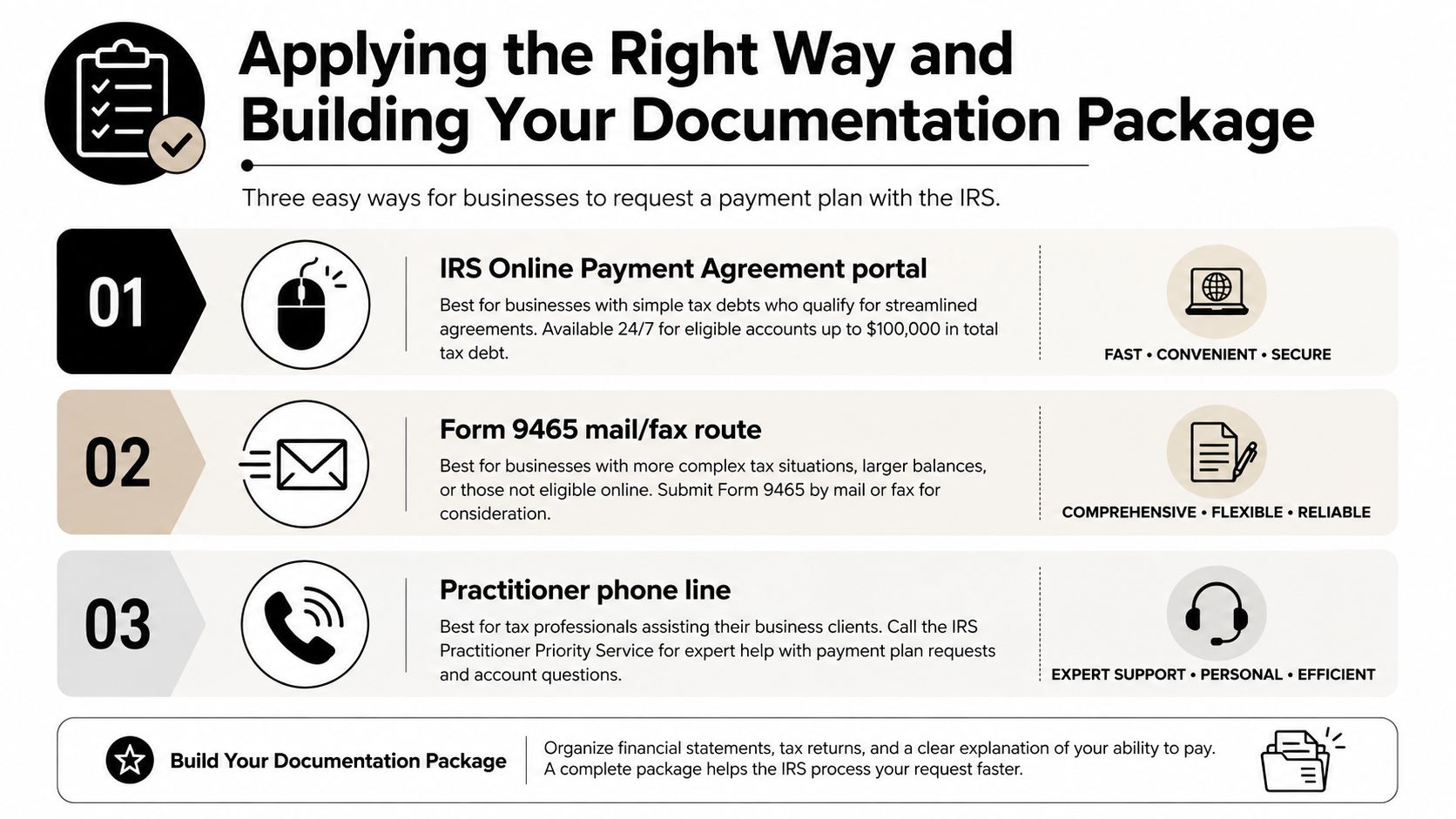
Businesses often begin in the wrong place. Individual taxpayers may use the IRS Online Payment Agreement portal, but the IRS says business taxpayers generally can't use the same online self-service process and instead must call 800-829-4933 or follow the channel identified on the notice. The IRS payment-plan page for business taxpayers should be checked before you submit anything because procedures and categories have changed.
Match the channel to the case
The online portal can be useful for taxpayers and situations the IRS has made eligible for online processing, but it isn't a universal business doorway. A business should call when the account involves payroll tax, multiple modules, a notice demanding immediate contact, or a balance that doesn't fit a simple request.
Form 9465 may be used through the mail or fax route where the IRS instructions and notice permit it. The form must match the IRS account. Common avoidable errors include a payment total that doesn't reconcile with the proposed terms, a missing EIN, and an unsigned officer line. The Form 9465 instructions for installment requests are useful for checking the filing mechanics before transmission.
The fastest application is the one that agrees with the IRS transcript before an agent reviews it.
A case above the threshold, or any case involving substantial trust fund exposure, can be routed to a revenue officer. At that point, expect a full Form 433-B Collection Information Statement rather than a quick approval.
Assemble the 433-B package in review order
Organize the package so the examiner can trace every figure:
- Identity and liability summary: Include the legal name, EIN, entity status, tax periods, notices, and a reconciliation of the balance.
- Bank evidence: Provide recent business bank statements and identify transfers between related accounts.
- Operating results: Add the current profit and loss statement, balance sheet, and general ledger support for unusual items.
- Receivables and payables: Include aging reports and explain which receivables are collectible, disputed, or pledged.
- Debt structure: List loans, lines of credit, equipment financing, collateral, and payoff information.
- Compliance proof: Show filed returns, payroll deposits, and a plan for staying current.
Accurate bookkeeping matters because the IRS compares the package against transcripts and account activity. Teams that need to organize transaction records before preparing a statement may find accounting data entry automation useful for reducing manual classification work. Automation doesn't replace legal analysis, but it can make the financial package easier to verify.
Real-World Scenarios and Common Pitfalls to Avoid
A Schedule C owner owes $42,000 in back income tax and has steady revenue. The balance may fit a Simple route, but a missed quarterly estimated payment can undermine the request. The owner isn't solving the problem by paying the old balance while continuing to underpay the current year. The application should include a current-payment plan, not just a proposed monthly amount.
A five-employee S corporation has payroll tax debt and enters a direct-debit arrangement. The owner then assumes the agreement covers future payroll. It doesn't. Every new payroll run creates new deposit obligations, and the business can default if it diverts those funds to the old balance or operating expenses.
An owner personally assessed with a Trust Fund Recovery Penalty submits Form 433-B with the company and expects the IRS to streamline everything together. The business liability and the individual assessment are separate collection problems. The Trust Fund Recovery Penalty resource explains why responsibility and collection exposure must be analyzed at the individual level.
Errors that turn a workable plan into a collection case
- Skipping current deposits: Never use the installment payment as a substitute for payroll withholding deposits.
- Selling business assets: Notify the IRS when a significant asset sale changes the company's ability to pay or removes collateral.
- Treating approval as permanent: An agreement remains conditional on timely filing and payment compliance.
- Ignoring related accounts: A closed entity, owner account, or old tax module can stall approval when the IRS transcript doesn't match the request.
- Assuming default is harmless: Default can reopen enforced collection, including liens and levies, rather than merely canceling a monthly arrangement.
The practical lesson is simple. An installment agreement works only when the business treats tax compliance as a recurring operating expense.
Fees Interest and the True Cost of Stretching Out Payment
A payment plan's monthly amount is only part of its cost. Setup charges, daily interest, and the failure-to-pay penalty can make a long repayment period materially more expensive than using reserves, refinancing, or another resolution option.
The plan notes identify 2026 setup fees of $69 for online direct debit, $107 for online non-direct debit, and $178 for phone or paper processing, with a $43 reduction available to qualifying low-income taxpayers. Those figures should be confirmed against the IRS fee schedule when applying because the agency can update administrative charges.
Interest continues at the applicable federal short-term rate plus 3%, calculated daily. The failure-to-pay penalty is generally 0.5% per month, reduced to 0.25% while an installment agreement is in effect under the cited IRS rate change. These are not interchangeable costs. Interest compounds daily, while the penalty accrues under its own monthly rule.
Why a five-year projection needs actual terms
A precise five-year table for a $90,000 liability cannot be calculated responsibly from the supplied facts alone. The federal short-term rate may change, the payment amount determines how much principal falls each year, and the applicable tax periods can carry different penalty histories. Inventing a single interest total or balance schedule would give the owner false precision.
Use this worksheet with the current IRS rate, the approved payment, and the actual account transcript:
| Year | Balance Start | Interest Accrued | Principal Paid | Balance End | Cumulative Cost |
|---|---|---|---|---|---|
| 1 | $90,000 | Calculate from daily rate | Enter scheduled payments less interest | Calculate | Add interest, penalties, and fees |
| 2 | Prior balance | Recalculate daily | Enter scheduled payments less interest | Calculate | Update cumulative total |
| 3 | Prior balance | Recalculate daily | Enter scheduled payments less interest | Calculate | Update cumulative total |
| 4 | Prior balance | Recalculate daily | Enter scheduled payments less interest | Calculate | Update cumulative total |
| 5 | Prior balance | Recalculate daily | Enter scheduled payments less interest | Calculate | Update cumulative total |
The right comparison isn't “Can I afford the payment?” It's “What will this plan cost compared with paying from reserves, obtaining business financing, submitting an Offer in Compromise, or requesting Currently Not Collectible status?” Tax interest and penalties may not produce the same tax treatment as ordinary business financing, so have the company's tax adviser review deductibility rather than assuming the carrying cost is deductible.
Alternatives Worth Considering Before You Sign the Agreement
An installment agreement is often the practical floor, not the ceiling. If the business can repay the liability within the permitted period without sacrificing current compliance, the plan can provide certainty. If the proposed payment would force the company to miss payroll deposits, the agreement is poorly designed and another resolution path deserves attention.
Compare the available resolutions
| Resolution Path | Typical Timeline | Upfront Cost | Best Fit When |
|---|---|---|---|
| Installment agreement | Based on approved terms and the collection deadline | Setup fee depends on channel and payment method | The business can pay while remaining current |
| Offer in Compromise | Review can take 12 to 24 months under the supplied planning notes | $205 application fee in 2026, subject to applicable rules | Reasonable collectible value is below the full liability |
| Currently Not Collectible | Continues while financial hardship prevents payment | No specific amount supplied here | Allowable expenses consume available cash and liquid assets are limited |
| Chapter 11 | Depends on the restructuring case | Bankruptcy costs vary by case | The operating business needs court-supervised restructuring |
| Chapter 7 | Used when the entity is winding down | Bankruptcy costs vary by case | The entity is shutting down, with no assumption that tax debt disappears |
An Offer in Compromise may be based on doubt as to collectibility or effective tax administration. It isn't a quick discount request. During the review period, interest and penalties can continue to accumulate, and the IRS will examine assets, income, expenses, and future payment capacity.
Currently Not Collectible status fits a business that can't make a meaningful payment after allowable expenses and has no liquid assets the IRS can reasonably seize. It isn't forgiveness. The IRS can review the account later, and the business must still file returns and meet current tax obligations.
Bankruptcy requires a careful distinction. Chapter 11 can allow an operating company to restructure while continuing to trade. Chapter 7 is generally associated with closing the entity, and business owners must not assume that federal tax debts will be discharged just because the company files.
Use the installment agreement when the business can pay within the approved horizon and wants predictable collection terms. Consider an OIC when the liability exceeds reasonable collectible assets, CNC when even a modest monthly payment would disrupt payroll, and bankruptcy when liens and creditor pressure block operations while a viable restructuring path remains.
Tax Attorney Stephen A Weisberg helps business owners analyze IRS payment plans, Form 433-B disclosures, payroll tax exposure, and alternatives before they commit to an unaffordable agreement. Visit Tax Attorney Stephen A Weisberg to request a free Tax Debt Analysis and determine which resolution path fits the business's actual account and cash flow.


