Your Guide to an IRS Installment Agreement in 2026
Learn how to set up an IRS installment agreement. This guide covers eligibility, fees, the application process, and alternatives for your tax debt.
In this article
- That IRS Notice Arrived Now What
- First, stop guessing
- The goal is control, not speed
- Understanding the Types of IRS Payment Plans
- The four main categories
- Comparison of IRS Installment Agreement Types
- What each plan is really for
- Determining Your Eligibility for an Installment Agreement
- Calculating the True Cost Fees and Interest
- What an agreement actually changes
- The number that matters is total cost
- Larger balances create hidden costs
- Setup method still matters
- My advice
- How to Apply Step by Step Options
- Option one online
- Option two by phone
- Option three by mail
- The setup details that matter
- Common Pitfalls and How to Avoid Default
- Default usually starts with optimism
- The lien issue many business owners miss
- How to stay out of trouble
- When an Installment Agreement Is Not Your Best Option
- Two alternatives that deserve serious attention
- Strategic considerations
You open the envelope, scan the first paragraph, and your stomach drops. The IRS says you owe more than you can pay. Maybe you already knew it was coming. Maybe you hoped the number would be manageable. Either way, the problem is now official.
Individuals often make one of two mistakes at this point. They freeze, or they rush into the first payment option that sounds tolerable. Both are expensive mistakes. An IRS installment agreement can be a solid tool, but it's not a magic shield, and it's not always the right answer.
What it does do is turn chaos into a process. Instead of reacting to notices one at a time, you move into a formal arrangement with the IRS to pay over time. That can stop the situation from getting worse in the near term and give you a structured path forward. But structure is not the same thing as strategy.
I've handled enough tax debt cases to say this plainly. The right payment plan can buy you time and control. The wrong one can lock you into a payment you can't sustain, extend the pain, and create problems you didn't see coming. If you're self-employed, own a business, or have uneven income, that risk is even higher.
That IRS Notice Arrived Now What
A typical client scenario goes like this. Someone gets a balance-due notice, reads just enough to panic, then starts searching for a way to “get on a plan.” That instinct isn't wrong. It's just incomplete.
An IRS installment agreement is a monthly payment arrangement. It does not reduce the tax by itself. It doesn't erase interest. It doesn't automatically prevent every collection consequence. It establishes a payment structure around a debt you still owe.
First, stop guessing
Before you agree to anything, confirm what notice you received, what tax years are involved, and whether the balance is even accurate. If you need help decoding the paperwork, this guide to IRS letters and notices is a useful starting point.
The reason this matters is simple. I've seen taxpayers rush into payment plans on balances that still had unresolved issues behind them. Once you start treating the debt as fixed, you may miss opportunities to challenge part of it, reorganize the resolution, or choose a better path.
Practical rule: Don't treat the first IRS notice as a payment instruction. Treat it as the beginning of a case review.
The goal is control, not speed
If you owe and can't pay in full, doing nothing is the worst move. But moving too fast can also backfire. A good first response usually includes:
- Checking filing status: Make sure all required returns have been filed.
- Reviewing the balance: Confirm which years and amounts are assessed.
- Looking at cash flow: Decide what you can pay consistently, not what sounds respectable.
- Comparing options: An installment agreement is only one tool.
That last point matters more than most websites admit. If you can pay over time without wrecking your finances, an installment agreement may fit. If you can't, then forcing yourself into one can create a second problem on top of the first.
Understanding the Types of IRS Payment Plans
Think of tax debt like a formal obligation with several repayment tracks. The IRS isn't asking whether you'd like to pay. It's deciding how it will allow you to pay, based on the amount owed, the time available to collect, and whether your finances justify a reduced monthly obligation.
Not all IRS installment agreements work the same way. Some are straightforward. Some require financial disclosure. Some are strategically useful only in narrow situations.
The four main categories
The first category is the short-term payment plan. That's for people who need extra time but expect to clear the balance quickly. It's a practical option when the problem is timing, not long-term affordability.
The second is the long-term installment agreement. It's often what individuals mean when they say they want a payment plan with the IRS. It's the standard monthly plan for taxpayers who fit within the IRS's qualification criteria.
The third is the Partial Payment Installment Agreement, often called a PPIA. This is very different from a normal plan. It's built for taxpayers who can't fully pay the balance before the IRS collection period runs out. If that may apply to you, this overview of a partial payment installment agreement is worth reading.
The fourth is the complex installment agreement. For these agreements, the process gets more serious. These cases often involve higher balances, more scrutiny, and terms that many taxpayers don't understand until they're already committed.
Comparison of IRS Installment Agreement Types
| Agreement Type | Total Debt Limit | Max Payment Term | Financial Disclosure Needed? |
|---|---|---|---|
| Short-term payment plan | Qualitative only | Up to 180 days | Usually no |
| Streamlined long-term installment agreement | Under $50,000 | Up to 72 months | Usually no, if streamlined requirements are met |
| Partial Payment Installment Agreement | Qualitative only | Based on ability to pay and collection period | Yes |
| Non-streamlined installment agreement | Up to $250,000 for certain proposed long-term arrangements by individuals and sole proprietors, within the IRS collection framework discussed in this explanation | Can extend within the collection window discussed in that same explanation | Often more review, depending on the arrangement |
What each plan is really for
Short-term plans are for taxpayers who need breathing room, not negotiation. If you expect incoming receivables, a pending sale, or a temporary cash crunch, this can work.
Simplified plans are the workhorse option. They're clean, predictable, and often the easiest route when the balance is manageable under IRS rules.
PPIAs are strategy-driven. They require a hard look at your actual ability to pay. They can be useful, but they're not “cheap payment plans.” They're collection-based resolutions built around limited affordability.
A payment plan isn't a settlement. If your real issue is that you can't ever full-pay the debt, choosing the wrong plan only delays the real conversation.
More involved plans sit in the uncomfortable middle. They can help taxpayers with larger balances who don't fit the easy categories, but the hidden tradeoffs are real. I'll get to the biggest one later because many business owners don't see it coming.
Determining Your Eligibility for an Installment Agreement
You open the IRS notice, see a balance due, and assume the only question is whether you can afford a monthly payment. That is not how the IRS looks at it. Eligibility usually turns on two things first: whether you are compliant and whether your balance fits the type of agreement you want.
Start with compliance. If you have unfiled returns, the IRS will usually stop right there. If you are self-employed or own a business, the IRS also wants current deposits and estimated payments handled before it gives you a long leash on old debt. A payment plan fixes yesterday's balance. It does nothing for a taxpayer who is still falling behind today.
The next issue is the type of plan you are trying to get. Small balances generally face less scrutiny. Larger balances bring financial disclosure, harder questions, and less room for sloppy numbers. That is why I tell clients not to ask, "Can I get a payment plan?" Ask, "Which plan fits my facts, and what will the IRS demand in return?"
One category gets a lot of attention because it sounds easy. If your assessed income tax is low enough and you meet the statutory conditions, the IRS must accept a guaranteed agreement. The catch is that the conditions are stricter than many taxpayers expect. Prior compliance history matters. So does your ability to show you cannot full-pay immediately. "Guaranteed" describes the legal standard, not a free pass.
Once your balance gets large enough, the tone changes. The IRS may require a Collection Information Statement and a closer review of income, expenses, bank accounts, and assets. That review is where many taxpayers make avoidable mistakes. They propose a payment they cannot sustain, disclose numbers that invite more questions, or apply before fixing the underlying problem that created the debt.
Use this checklist before you file anything:
- All required returns filed. If not, fix that first.
- Current year withholding or estimated taxes corrected. An agreement fails fast if new debt keeps building.
- Balance size matched to the right plan. The wrong application can trigger more review than necessary.
- Monthly payment based on reality, not optimism. A plan you cannot keep is worse than waiting a week to prepare it correctly.
- Prior IRS history reviewed. Earlier defaults or broken agreements can make approval harder.
Paperwork matters here. If you are preparing to request a plan yourself, review these Form 9465 instructions for requesting an IRS payment plan before you submit anything. The form looks simple. The strategy behind it is not.
One more point gets overlooked. Eligibility is not the same as best option. Some installment agreements, especially on larger balances, can come with a federal tax lien or financial disclosure that creates problems you did not anticipate. If you have equity in assets, uneven income, or other IRS exposure, get the full picture before you commit. Taxpayers who want broader context on how debt resolution fits into their overall planning sometimes look at outside financial services for tax, but the first move should be a real tax debt analysis based on your filings, cash flow, and collection risk.
That is the attorney's view of eligibility. It is a screening process, not a green light. If the numbers and compliance history support an installment agreement, use it. If they do not, forcing one into place usually makes the case more expensive and harder to fix later.
Calculating the True Cost Fees and Interest
You agree to a monthly payment that looks manageable. Six months later, the balance has barely moved, interest is still stacking up, and the IRS is less flexible than you expected. That is the part taxpayers miss.
An installment agreement buys time. The IRS charges for that time.
What an agreement actually changes
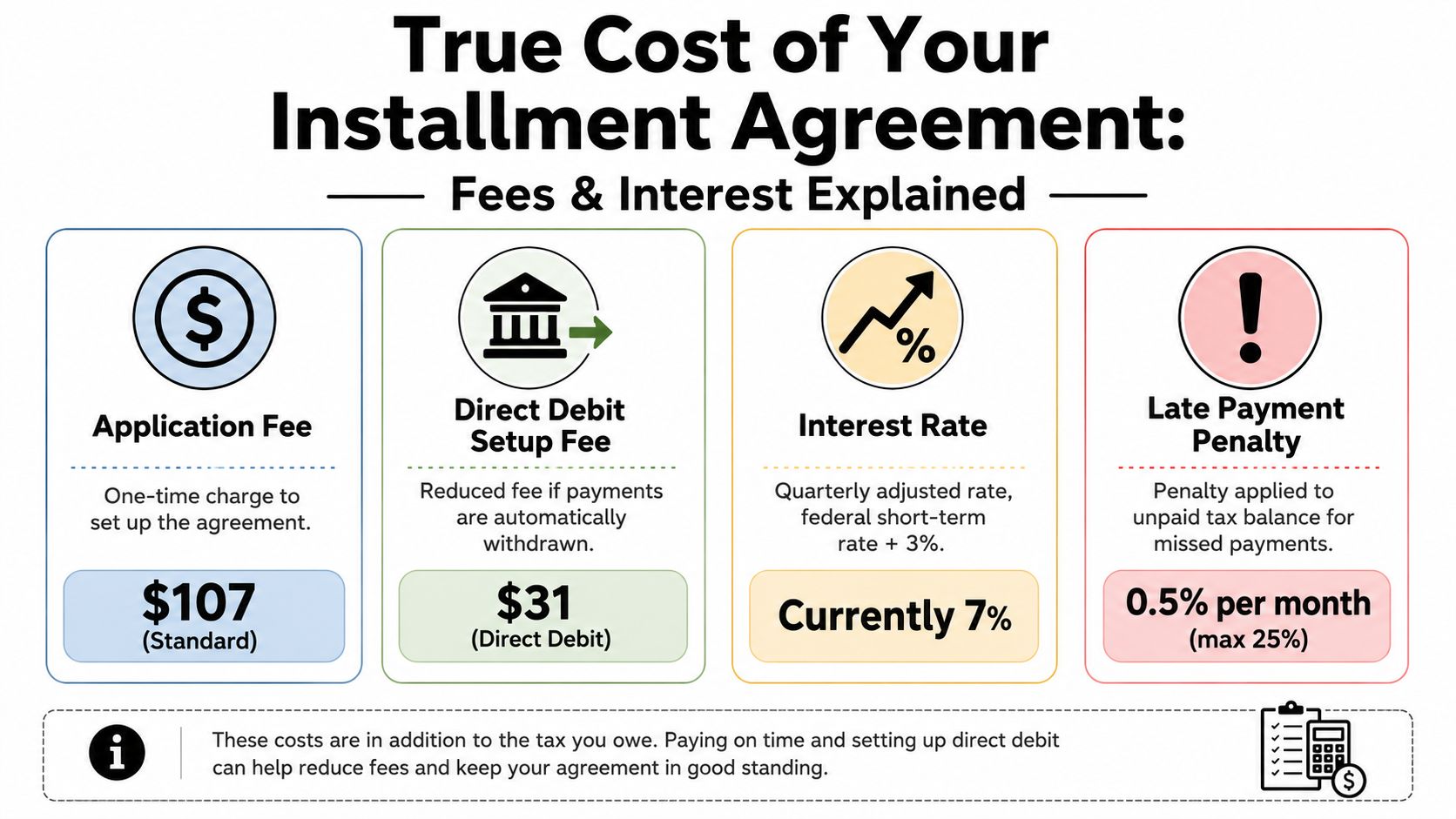
The main cost benefit is narrow but real. Once the IRS accepts an installment agreement, the failure-to-pay penalty is reduced, and the agency charges a setup fee that depends on how you apply and whether you use direct debit. The IRS also explains on its payment plans and installment agreements page that some certain plans use a payment structure tied to a 72-month payoff period.
That helps, but it does not make the debt cheap.
Interest continues to accrue. Penalties continue until the balance is paid in full. A lower monthly payment often means you stay in debt longer and pay more overall.
The number that matters is total cost
Taxpayers fixate on the monthly payment. That is a mistake.
You should look at four things together. The setup fee, the continuing interest, the continuing penalties, and the length of the agreement. If the payment is too low, the case drags on and the IRS keeps adding charges. If the payment is too high, you increase the odds of default, bounced drafts, and a rejected future request. I see that problem constantly in cases involving common reasons the IRS rejects installment agreements.
As discussed in the source analysis cited earlier, the IRS can be stricter on allowable expenses than taxpayers expect. Your personal budget is not the same thing as the IRS collection standard. That gap is where many “affordable” plans become bad plans.
Larger balances create hidden costs
Here, strategy matters more than math.
On certain larger balances, the IRS may require more financial disclosure and may file a federal tax lien. That lien issue gets overlooked far too often. A lien can affect refinancing, business borrowing, and asset sales even if you are making every payment on time. So the true cost is not just fees and interest. It can include damage to your flexibility.
That is why I do not treat an installment agreement as the automatic answer. If the projected payoff is too slow, or the lien and disclosure consequences are too expensive, another resolution path may make more sense.
Setup method still matters
The cheapest structure is usually online with direct debit. Other methods and payment setups can cost more and create more room for missed payments.
Use the same discipline you would use to calculate small business loan expenses. Focus on the full repayment cost, not the sales pitch of a smaller monthly number.
My advice
If you can pay the balance aggressively, do it. If you need a plan, choose one that clears the debt as fast as your real cash flow allows without setting you up to fail.
Before you sign onto years of accruals, get the numbers reviewed properly. A free tax debt analysis should come first, because the right question is not whether the IRS will accept a payment plan. The right question is whether this payment plan is the smartest resolution available in your case.
How to Apply Step by Step Options
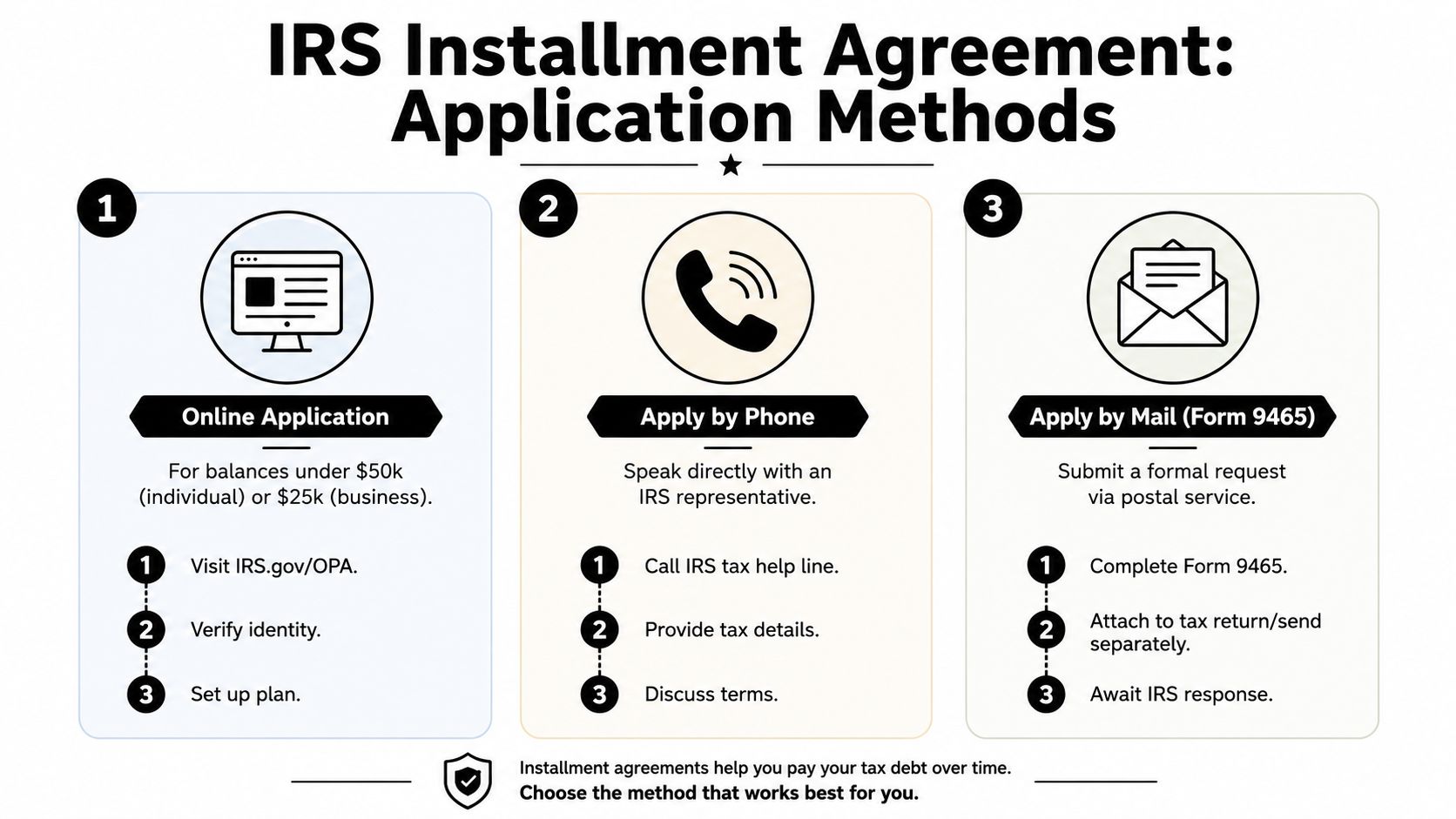
When clients ask me how to apply, my answer is simple. Use the method that gives you the cleanest approval path with the least chance of avoidable mistakes. For many taxpayers, that means online first.
Option one online
The IRS Online Payment Agreement system is usually the fastest route for people who fit the simpler approval categories. It's direct, efficient, and easier to document.
Have these ready before you start:
- Your identifying information: Social Security number or business tax identification details.
- Your current balance details: Know what years and amounts are involved.
- Banking information: Especially if you plan to use direct debit.
- A realistic monthly amount: Don't improvise this while staring at the screen.
For certain balances, the IRS can issue immediate approval through the online payment system, as discussed earlier in this article.
Option two by phone
Phone applications make sense when the situation isn't clean enough for a straightforward online request, or when you need to discuss terms with a representative. The downside is predictable. Calls take time, and misunderstandings happen.
This route works better if you prepare like you're going into a meeting, not making a casual call. Know your proposed payment, filing status, and whether any returns are still outstanding.
Option three by mail
Mail is slower, but it still has a place. If you need to submit a paper request, Form 9465 is the key document. If you need help with the paperwork, use these Form 9465 instructions.
The mail-in process tends to make sense when there are supporting documents, disclosure issues, or a more developed strategy behind the request.
The setup details that matter
For long-term plans, the setup fee is $22 if established online with direct debit, and $178 if set up by phone or mail without direct debit. Also, for agreements when total debt is between $25,000 and $50,000, the taxpayer must agree to direct debit or payroll deduction using Form 2159, with full payment within 72 months, as stated in the IRS guidance already cited in the cost section.
That should influence your application choice. Online plus direct debit is often the most practical route when you qualify. It reduces friction and usually reduces the setup cost.
If the case is more complicated, one option is working with counsel who handles IRS collection matters. Attorney Stephen A Weisberg's practice includes analyzing installment agreement options, Form 9465 filings, and related IRS payment plan strategy for taxpayers and businesses. In the right case, that kind of review can prevent you from choosing a plan that looks acceptable but fails in practice.
Common Pitfalls and How to Avoid Default
The biggest myth about an IRS installment agreement is that once you're approved, you're safe. You're not. You're conditionally protected, and that protection lasts only as long as you comply.

Default usually starts with optimism
Most defaults don't happen because someone intended to ignore the IRS. They happen because the monthly payment was too aggressive, future taxes weren't handled, or the taxpayer assumed one missed step wouldn't matter.
That's the wrong assumption. If you fail to meet the terms, the IRS can move back toward collection action.
Under the IRS rules discussed on its payment plan page, levy action is generally paused while an installment agreement is pending and not in default, and the collection statute is suspended during that period. If the taxpayer fails to meet the agreement terms and doesn't cure the problem within the required period, that protection can end. I'm not linking that page again here because it was already cited earlier, but the rule matters.
The lien issue many business owners miss
Here's the hidden risk I wish more taxpayers knew before they applied. A Regular Installment Agreement for debts up to $250,000 can avoid full financial disclosure in some cases, but the IRS will automatically file a federal tax lien, which cuts directly against the common belief that installment agreements prevent liens, as explained in this discussion of regular IRS installment agreements.
That's not a technical footnote. For business owners, a federal tax lien can interfere with financing, transactions, and general operations.
Don't judge an installment agreement only by whether the IRS says yes. Judge it by what you have to give up to get that yes.
How to stay out of trouble
Use this checklist:
- Choose a payment you can make: Not your aspirational number. Your real one.
- Stay current going forward: A new unpaid year can wreck the old agreement.
- Use automatic payment if possible: It reduces avoidable defaults.
- Read every follow-up notice: Problems usually announce themselves before they explode.
- Challenge bad fits early: If a proposed plan doesn't match your finances, don't force it.
If your request is denied or structured poorly, study the common IRS installment agreement rejection reasons before you reapply or appeal. A rejected or unstable agreement is often the result of a predictable issue, not bad luck.
When an Installment Agreement Is Not Your Best Option
You open the IRS notice, decide a payment plan sounds manageable, and move fast to get one in place. That is often a mistake. An installment agreement can solve the collection problem while making the larger tax problem worse.
A payment plan works only if it fits your facts, your cash flow, and your next few years of filing and paying on time. If it does not, you are buying time at a high price while penalties and interest continue to build. In some cases, you also expose yourself to a federal tax lien or give the IRS financial information that points them toward assets you hoped to protect.
Two alternatives that deserve serious attention
An Offer in Compromise makes sense when full collection is not realistic. The IRS may accept less than the balance, but the process is document-heavy and unforgiving. If your income, assets, and future earning capacity support it, this can be far better than locking yourself into years of payments that never solve the debt.
Currently Not Collectible status serves a different purpose. It does not reduce the balance, but it can stop active collection when paying the IRS would prevent you from covering basic living expenses. For taxpayers with unstable income, recent hardship, or no room in the budget, that can be the correct move.

Strategic considerations
Start with the right question. Ask which resolution gives you the best overall outcome, not which form gets you approved fastest.
That means looking at the full file. Review the balance due, filing status, current income, self-employment or business volatility, available equity in assets, lien exposure, and whether the proposed monthly payment leaves you enough room to stay compliant next year. If the tax debt intersects with a mortgage application, sale of property, divorce, bankruptcy issue, or business transaction, the choice becomes even more strategic.
That is why a personalized review matters before you commit. If you want a clear answer based on your actual numbers, talk to Attorney Stephen A Weisberg for a Free Tax Debt Analysis to see whether an IRS installment agreement, an Offer in Compromise, or Currently Not Collectible status fits your situation.


