Your Complete Guide to the IRS ID Verification Letter
Received an IRS ID verification letter like the 5071C? Our guide explains why you got it, how to respond, and what happens next to secure your tax refund.
In this article
- Why You Received an IRS ID Verification Letter
- Common Triggers for an ID Verification Letter
- How to Confirm Your IRS Letter Is Legitimate
- Identifying Genuine IRS Correspondence
- Key Red Flags of a Scam
- A Step-by-Step Guide to Verifying Your Identity
- Preparing Your Documents: A Crucial First Step
- Option 1: Verifying Online with ID.me
- Option 2: Verifying Over the Phone
- Option 3: Verifying in Person
- What Happens After You Verify Your Identity?
- The Post-Verification Timeline
- How to Track Your Refund Status
- Potential Outcomes and What to Do Next
- The Risks of Ignoring an ID Verification Letter
- Your Refund Will Be Frozen Indefinitely
- Penalties and Interest Can Start Piling Up
- When to Get Professional Help with IRS Verification
- Signs You Need to Call a Tax Professional
- How an Expert Simplifies the Process
- The W Tax Group Advantage
- Frequently Asked Questions About IRS ID Verification
- What Should I Do If I Lost My IRS Verification Letter?
- How Long Do I Have to Respond to the Letter?
- Does an ID Verification Letter Mean I Am Being Audited?
Getting a letter from the IRS in the mail is enough to make anyone’s heart skip a beat. But if it’s an IRS ID verification letter, you can take a deep breath. This isn't a sign of trouble. It’s actually a safety measure, kind of like when your credit card company texts you to confirm a strange-looking purchase. The IRS is just making sure you’re really you before they process your tax return and send out your refund.
Why You Received an IRS ID Verification Letter
While no one likes opening mail from the IRS, this specific letter is a good thing. It means their automated fraud detection systems are doing their job to protect you. The notice comes from the IRS's Taxpayer Protection Program (TPP), and it simply means something on your tax return looked a little different from the usual.
Let me be clear: this is not an audit. It’s not an accusation. The IRS has just put a temporary hold on your return until you can confirm that you were the one who filed it. This is one of their most important defenses against the ever-present threat of identity theft during tax season.
Common Triggers for an ID Verification Letter
The IRS doesn't publicize its secret sauce for flagging returns, as that would give criminals a roadmap. However, years of experience show us that certain changes in your financial life are common triggers.
You might get a letter if:
- Your income changed dramatically: A huge raise or a sudden drop in income from last year can catch the system's eye.
- You filed from a new address: Moved recently? Filing from a new location for the first time is a classic reason for a verification check.
- Your filing status is different: Going from "Single" to "Married Filing Jointly," for example, is a significant change that the IRS wants to confirm.
- You're a first-time filer: If the IRS has no history with you, they often take this extra step as a baseline security measure.
Key Takeaway: Think of this letter as a security checkpoint, not a penalty. Its only goal is to stop a thief from getting a refund in your name and to protect your financial identity.
This process is far more common than most people realize. In a recent tax season alone, the IRS flagged over 1.9 million tax returns for identity verification. That number shows just how seriously they take this, even though it means a temporary delay for a lot of honest taxpayers.
At the end of the day, responding promptly is the only way to get your return back on track and your refund issued. It might feel like a hassle, but it’s a small step in a much larger fight to keep the tax system secure. For a deeper dive into other kinds of IRS mail, you can explore our guide on https://www.weisberg.tax/irs-letters-and-notices.
How to Confirm Your IRS Letter Is Legitimate
Getting a letter from the IRS can make your heart skip a beat, and with so many convincing scams out there, it's smart to be a little suspicious. Before you do anything else, the very first step is to take a breath and make sure the IRS ID verification letter you're holding is the real deal. Scammers are getting frighteningly good at creating fake documents to trick you into giving up your personal information.
A genuine IRS letter is a specific tool for a specific job: confirming it's really you who filed that tax return. The IRS will never use it to demand immediate payment, threaten you with jail time, or ask for your credit card number over the phone. Those high-pressure tactics are dead giveaways of a scam.
Identifying Genuine IRS Correspondence
The IRS doesn't just send out one generic letter; they have a few different versions, and the one you receive tells you exactly what to do next. Look in the top right corner of the notice for a letter number.
To help you figure out what you've received and what it means, here’s a quick breakdown of the most common letters the IRS sends for identity verification.
Common IRS ID Verification Letters and Their Purpose
| Letter Number | Official Name/Purpose | What It Means for You |
|---|---|---|
| 5071C | Identity and Tax Return Verification | This is the most common one. It gives you two options: verify online through the IRS portal or call the Taxpayer Protection Program (TPP). |
| 4883C | Identity Verification | This letter requires you to call the TPP hotline to verify your identity. The online tool won't work for this notice. |
| 5747C | In-Person Identity Verification | This is a less common letter that asks you to schedule an appointment and verify your identity in person at an IRS Taxpayer Assistance Center (TAC). |
| 5447C | Identity Verification (Foreign Address) | Sent to taxpayers living abroad, this notice provides instructions for verifying your identity by phone or mail. |
Knowing which letter you have is crucial. Trying to use the online portal when you've received a 4883C, for example, is just going to lead to a dead end and a lot of frustration.
Key Red Flags of a Scam
Scammers can mimic the look of official mail, but they almost always slip up in their methods. When you're looking at the letter, keep an eye out for these tell-tale signs of a scam.
A legitimate IRS notice will always direct you to the official IRS.gov website or an official IRS phone number. Any links pointing elsewhere or phone numbers you don't recognize are a massive red flag.
A fraudulent notice might:
- Demand Payment: The ID verification process is never about collecting money. If a letter asks for payment with gift cards, a wire transfer, or cryptocurrency, it’s 100% a scam.
- Use Threatening Language: The IRS has a formal, bureaucratic tone. Phrases that threaten you with arrest, lawsuits, or deportation are just scare tactics used by criminals.
- Request Personal Data via Email or Social Media: The IRS initiates contact through the U.S. Postal Service. They will not slide into your DMs or send an unsolicited email asking for your Social Security number. To learn more about how the IRS handles official mail, check out our guide on understanding IRS certified mail.
By carefully checking the letter number and looking for these red flags, you can confidently tell a real IRS request from a fake one. This protects you from fraud and lets you move forward with the actual verification process.
A Step-by-Step Guide to Verifying Your Identity
Once you’ve confirmed the IRS ID verification letter in your hands is the real deal, it’s time to actually complete the process. The IRS gives you a few different ways to do this, so you can pick the one that works best for you. The key is to act fast—this is the last hurdle before the IRS will process your return and send any refund you’re due.
Think of it like getting a new credit card in the mail. The bank has sent you the card (your tax return), but you can't use it until you call or go online to prove you're the rightful owner. The IRS is doing the exact same thing here, just making sure the return they received really came from you.
You'll generally have three options to get this done: online, by phone, or in person. Your specific letter will tell you which routes are available, so read it carefully.
Preparing Your Documents: A Crucial First Step
Before you dive in, do yourself a favor and get your paperwork in order. It’s like gathering all your ingredients before you start cooking; it saves you from scrambling and getting frustrated later. No matter which verification method you choose, you'll need the same core documents.
Have these items ready to go:
- The IRS ID Verification Letter: This is the most important piece. It has a unique Control Number you’ll need, especially for the online process.
- A copy of the tax return for the year on the letter: You'll be asked specific questions about this return, like your Adjusted Gross Income (AGI) or the exact refund amount.
- A copy of a prior year’s tax return: Having last year's return handy is a good idea, as they might ask questions from it to cross-reference your identity.
- Your supporting income documents: This means your W-2s, 1099s, Schedule C, or any other forms you used to prepare your tax return.
Having everything laid out will make answering the IRS's questions a smooth, stress-free experience.
Option 1: Verifying Online with ID.me
The online route is usually the fastest and most common method, particularly if you received a 5071C letter. This process runs through a trusted third-party service called ID.me that securely confirms who you are.
- Visit the Official IRS Website: Go to the specific IRS identity verification page listed in your letter. Never, ever click a link from an email or text message.
- Enter Your Information: You'll start by plugging in financial details from the tax return in question, including your Social Security Number (SSN) or Individual Taxpayer Identification Number (ITIN) and the Control Number from your letter.
- Create an ID.me Account: From there, you'll be sent over to the ID.me website. You’ll need to upload photos of a government-issued ID (like a driver's license or passport) and take a quick selfie with your phone or webcam.
- Answer Security Questions: ID.me will then ask a few questions based on public records to double-check that you are who you say you are.
- Possible Video Call: If the automated system has any trouble, don't panic. You may just need to hop on a brief video call with a trained ID.me agent to finish up.
This process often comes up for filers who use an Individual Taxpayer Identification Number (ITIN). ITINs were created back in 1996 to help individuals without an SSN file their taxes, but the verification rules can be tight. Processing times for ITIN-related applications can drag on for 7 to 11 weeks, especially during the busy tax season.
Option 2: Verifying Over the Phone
If your letter specifically tells you to call (like the 4883C letter often does), or if you’re just not a fan of the online process, verifying by phone is a solid choice.
You’ll need to call the Taxpayer Protection Program (TPP) hotline number printed right on your letter. The main number is 800-830-5084. An IRS agent will walk you through a series of detailed questions from your current and prior-year tax returns to confirm your identity.
Pro Tip: We all know IRS phone lines can be a nightmare. To save your sanity, try calling first thing in the morning or later in the week (Wednesday through Friday) when wait times are often shorter. Make sure you have all your documents in front of you before you dial.
Option 3: Verifying in Person
In some rare situations, the IRS will send a 5747C letter, which requires you to verify your identity face-to-face at a local Taxpayer Assistance Center (TAC). This is definitely the most hands-on method, and you'll need to make an appointment.
You can't just show up. You have to call 844-545-5640 to schedule a time. When you go, bring your verification letter, all the documents listed above, and two forms of identification.
This decision tree gives you a great visual for that very first step: making sure the letter is legitimate before you do anything else.
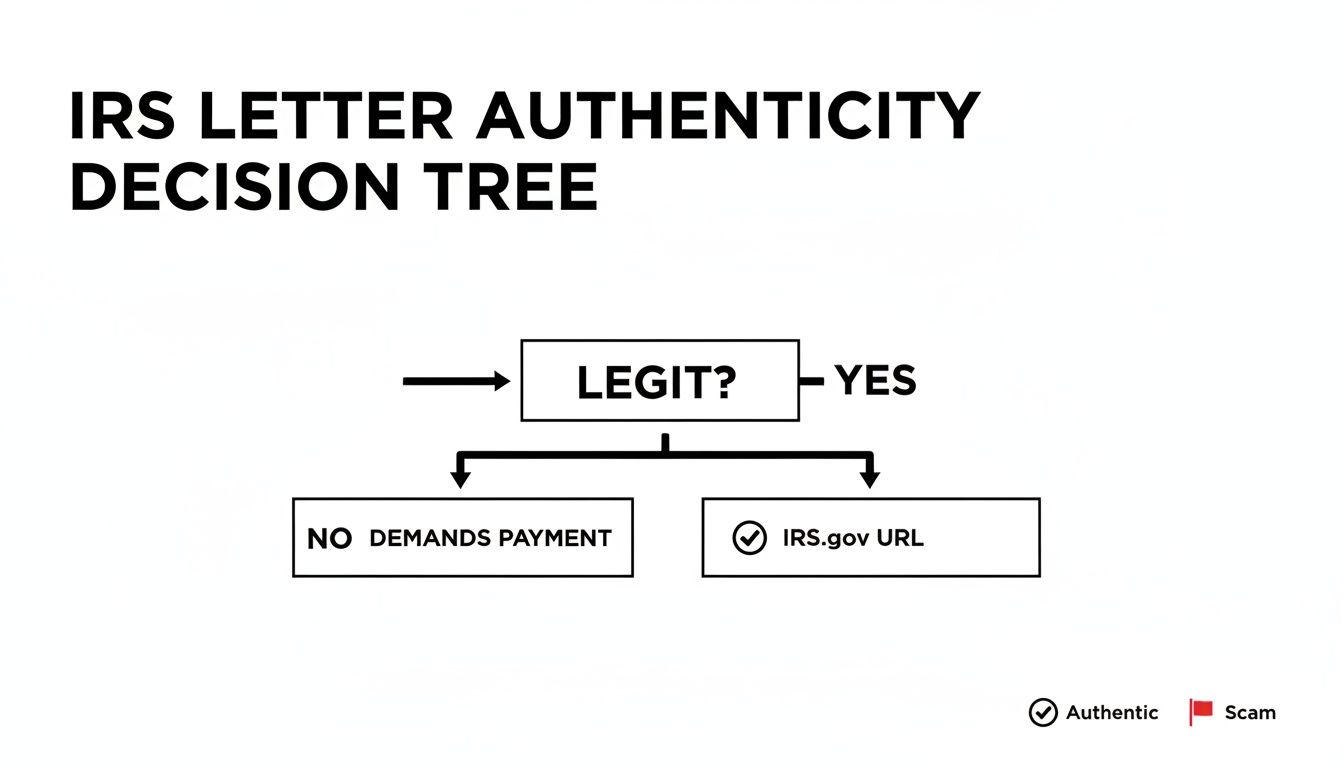
As the chart shows, a real IRS letter will never demand immediate payment and will always point you to an official government website.
Ultimately, the right method depends on your letter's instructions and what you're comfortable with. If you're worried this might be tied to a bigger identity theft issue, it's smart to learn more about how to handle those situations. Our team shares more insights in our guide on navigating IRS identity theft, which can provide some extra peace of mind. Whichever path you choose, getting the verification done is the crucial final step to get things moving again.
What Happens After You Verify Your Identity?
You've successfully jumped through the hoops and verified your identity with the IRS. That's a huge weight off your shoulders. Think of it like this: your tax return was stuck in a security checkpoint, and you’ve just shown your credentials and gotten the all-clear. Now, it can get back in line for processing.
But what does that actually mean for your refund, and how long will you have to wait? Let's break down the post-verification timeline and what you can expect.
The Post-Verification Timeline
This is the big question everyone asks: "So, when do I get my money?" Once you’re verified, the IRS says to expect your refund within nine weeks. While many people get their money sooner, it's smart to mentally prepare for the full nine-week wait.
Why so long? This period gives the IRS the runway it needs to:
- Finish its standard review of your return to check for accuracy.
- Cross-reference your account for other issues, like outstanding tax debts.
- Formally approve your refund and schedule the payment.
You’ve done your part by responding to the IRS ID verification letter. Now, the process is back in the IRS’s hands. Patience is definitely a virtue at this stage.
It’s frustrating, I know, especially when you're counting on that refund. But this deliberate pace is how the IRS ensures everything is squared away, preventing bigger headaches for you later on.
How to Track Your Refund Status
Thankfully, you're not left completely in the dark while you wait. The best way to keep tabs on your refund is by using the official "Where's My Refund?" tool on the IRS website.
To check your status, you'll need three key pieces of information:
- Your Social Security Number (SSN) or Individual Taxpayer Identification Number (ITIN)
- Your filing status (like Single or Married Filing Jointly)
- The exact refund amount you claimed on your tax return
Don't panic if the tool doesn't update immediately after you verify. It can take a week or two for the system to catch up. At first, it might still show a delay, but once your verification is logged, you should see the familiar status bar progress through its three stages: Return Received, Refund Approved, and Refund Sent.
Potential Outcomes and What to Do Next
In most cases, everything goes smoothly from here, and your refund arrives via direct deposit or a paper check. But there are a couple of other possibilities.
Sometimes, the IRS might find a small math error or adjust your return for another reason. If this happens, you’ll get your refund along with a separate notice (often a CP12 Notice) that explains the change. This is usually nothing to worry about; it just clarifies why the amount is different from what you expected.
But what if nine weeks have come and gone with no refund and no updates? Don't just sit back and hope for the best. It's time to be proactive. Your first move should be to call the IRS. When you do, make sure you have a copy of your tax return in front of you—it will make the conversation much more productive.
The Risks of Ignoring an ID Verification Letter

It’s tempting to toss that official-looking IRS envelope into the "deal with it later" pile, but treating an ID verification letter like junk mail is a huge financial mistake. While it’s not an audit, ignoring it has serious, immediate consequences that can throw your finances into chaos for months, if not longer. Think of it as a mandatory security checkpoint from the IRS—you can't proceed without it.
Failing to respond brings everything to a dead stop. Seriously. The IRS will not process your tax return until they confirm you are who you say you are. Your return essentially gets stuck in administrative limbo, just sitting in a queue, unresolved.
Your Refund Will Be Frozen Indefinitely
The most immediate and painful result of ignoring this letter is a frozen refund. If you're expecting money back, the IRS will hold onto every last penny until you complete the verification process. This isn't a short, temporary delay that fixes itself; those funds are locked up indefinitely.
For the millions of Americans who count on their tax refund for major purchases, paying down debt, or boosting savings, this can be a real blow. That money simply won't be released. Your inaction is the lock on the vault, and responding to the letter is the only key.
Key Takeaway: The IRS will not process a tax return flagged for verification without your cooperation. Ignoring the letter means you are choosing to forfeit your refund for the foreseeable future, creating a completely avoidable financial hardship.
This can create a massive cash flow problem. A small business owner might suddenly be unable to make payroll or pay a key supplier. For a family, it could mean postponing a necessary car repair or falling behind on rent. The ripple effects are real.
Penalties and Interest Can Start Piling Up
Things get even worse if you happen to owe the IRS money. While your return sits there unprocessed, the clock on your tax liability keeps ticking. From the IRS's perspective, it’s as if you never filed at all, even if you submitted everything on time.
This can trigger a couple of hefty penalties:
- Failure-to-File Penalty: This is what you get for not filing your return by the deadline.
- Failure-to-Pay Penalty: This is charged for not paying the tax you owe on time.
These aren't just small slaps on the wrist. The failure-to-file penalty can be as high as 5% of your unpaid taxes for each month your return is late, up to a maximum of 25%. On top of that, interest starts compounding daily on whatever you owe.
This is exactly how a small, manageable tax bill can spiral into a much larger debt. What started as a simple verification request becomes a growing financial burden, all because one letter was ignored. The only way to protect yourself is to act quickly.
When to Get Professional Help with IRS Verification
Look, for most people, verifying your identity with the IRS is a straightforward, if annoying, process. You can usually handle it yourself. Think of it like a standard security check at the airport—a necessary hassle, but manageable.
But what happens when that routine check flags something more serious? Suddenly, you're being pulled aside for a much more intense screening. That's when a simple verification letter can signal a much bigger problem, like identity theft or other unresolved tax issues. When that happens, you don't want to go it alone.
Trying to untangle a complicated tax situation without professional help can quickly turn into a nightmare. You could face months of delays, escalating penalties, and a whole lot of unnecessary stress. Knowing when to call in an expert is key.
Signs You Need to Call a Tax Professional
If your situation involves more than just confirming you are who you say you are, it's time to bring in a pro. Here are a few clear signs that you should pick up the phone and talk to a tax attorney or enrolled agent.
You're a Victim of Identity Theft: If you think a scammer filed a bogus tax return with your information, this letter is just the first domino. You'll probably need to file an IRS Form 14039, Identity Theft Affidavit. This isn't just another form; it's a legal document. One mistake can haunt you for years. A tax pro will make sure it’s done right and will handle all the back-and-forth with the IRS to get your account secured.
The Verification Process Keeps Failing: Are you locked out of the online portal after trying a few times? Have you been stuck on hold with the IRS for hours, only to get nowhere? When you keep hitting a wall, it’s usually because of a deeper issue, like a data mismatch in the IRS systems. Instead of banging your head against the wall, let a professional figure out what's really going on and fix it.
You Have Other Unresolved Tax Issues: An ID verification can put a spotlight on any other skeletons in your tax closet. If you have unfiled returns, owe back taxes, or are already dealing with collections, this letter could trigger more scrutiny. A tax attorney can manage the verification while also building a strategy to tackle your other tax debts, resolving everything at once.
Key Insight: A good tax professional does more than just help you verify your identity. They act as your advocate, protecting your rights and looking at your entire financial picture to make sure this one letter doesn't snowball into a much bigger problem.
How an Expert Simplifies the Process
Hiring a tax professional is really about buying peace of mind and getting a strategic partner on your side. They lift the burden from your shoulders, handling all the calls and correspondence with the IRS. They know the system, so they can ensure every document is filed correctly and on time, avoiding the simple slip-ups that can delay your refund for months.
They're also experts at cutting through the bureaucratic red tape that drives most taxpayers crazy. Interestingly, for those looking for help with different IRS notices, new tools are even available that can generate an AI reply to income tax notices, showing how technology is offering new ways to manage these communications.
The W Tax Group Advantage
At The W Tax Group, we know that an IRS ID verification letter is often just the tip of the iceberg. Our team, led by attorney Stephen A. Weisberg, focuses exclusively on resolving complex tax problems. We don't just help you tick a box on a government form; we dig into your complete tax history to safeguard your financial future.
We’ll take over the entire verification process for you, deal with any underlying issues like identity theft or back taxes, and fight to get your refund released as quickly as possible. If you’re feeling overwhelmed or your situation feels messy, don't try to handle it yourself. Learning more about finding a good tax attorney is the best first step you can take toward putting this behind you.
Frequently Asked Questions About IRS ID Verification
It’s completely normal to have a few more questions rattling around even after you’ve got a handle on the main process. Let’s tackle some of the most common "what if" scenarios that come up with an IRS ID verification letter so you can move forward with confidence.
What Should I Do If I Lost My IRS Verification Letter?
It happens. Losing the letter is a pain, but it's definitely something you can fix. The most important thing on that letter is a unique Control Number, which you absolutely need for online verification. Without it, you can't use the website.
Your best bet is to pick up the phone and call the Taxpayer Protection Program (TPP) hotline. Let them know you’ve misplaced your letter. Make sure you have your tax return for the year in question handy, along with the previous year's return and all your supporting documents (W-2s, 1099s, etc.). An IRS agent will walk you through a series of questions based on those documents to verify you are who you say you are.
How Long Do I Have to Respond to the Letter?
The letter itself will give you a firm deadline, which is almost always 30 days from the date printed on the notice. It's really important to act within that timeframe.
Blowing past the deadline won't make the problem go away. The IRS will just leave your tax return in limbo, and your refund will be stuck there right along with it. If you owe taxes, the delay can start a whole new set of problems, like failure-to-file and failure-to-pay penalties that pile up with interest.
If you know you can't meet the 30-day deadline for whatever reason, don't just let it slide. This is a big red flag that it's time to call a tax professional to figure out your next steps and avoid making things worse.
Does an ID Verification Letter Mean I Am Being Audited?
Nope, not at all. Let's clear this up right away: getting one of these letters has nothing to do with an audit. An audit is when the IRS digs into your financial records to make sure your income and deductions are all correct.
ID verification is a totally different ballgame. Think of it as a security checkpoint. The IRS is just trying to stop identity thieves in their tracks by making sure the person who filed the tax return was actually you. It’s about who you are, not what you filed.
If you're stuck on a tricky verification problem, dealing with the fallout of identity theft, or just feel in over your head, you don't have to go it alone. The W Tax Group is here to offer expert help and be your voice with the IRS. Schedule a free consultation with us today to find a clear path forward.