A Fiduciary's Guide to IRS Form 56 Instructions
Master the IRS Form 56 instructions with our expert guide. Learn how to file, avoid common pitfalls, and manage fiduciary duties with confidence.

In this article
- What It Really Means to Be a Fiduciary for the IRS
- Who Is Required to File This Notice?
- The Legal Standing of Form 56
- Common Fiduciary Roles That Require Filing Form 56
- How to Complete Form 56 With Line-by-Line Guidance
- Part I: Identification and Your Authority
- Section B: Defining Your Responsibilities
- Part IV: Finalizing With Your Signature
- Critical Mistakes to Avoid When Filing Form 56
- Failing to Attach Sufficient Proof of Authority
- Using an Outdated Form Version
- Being Vague About Your Authority and Responsibilities
- Where and When to File Your Completed Form 56
- Determining the Correct IRS Mailing Address
- Strategic Filing Timelines and Methods
- Properly Closing Out Your Fiduciary Notice with the IRS
- How to Complete the Termination Notice on Form 56
- The Most Important Attachment: Proof of Termination
- Frequently Asked Questions on IRS Form 56
- Does a Power of Attorney Replace Form 56?
- What Are the Risks of Not Filing Form 56?
- Can I E-File IRS Form 56?
- How Long Does a Fiduciary Notice Last?
When you're tasked with managing someone else's tax affairs, IRS Form 56, the Notice Concerning Fiduciary Relationship, is your most critical first step. Filing this form correctly lets the IRS know you have the legal standing to act for another taxpayer, whether it's an individual, an estate, or a trust. Getting this right is the key to receiving vital tax notices and handling financial matters without hitting frustrating and costly roadblocks.
What It Really Means to Be a Fiduciary for the IRS
Before you even look at the form, you need to understand what the IRS considers a "fiduciary." Filing Form 56 isn't just paperwork; it's a formal declaration that you now hold the legal authority—and responsibility—for someone else's tax life. It officially reroutes all of their tax mail, from simple notices and refund checks to serious audit warnings, directly to you.
In practice, this looks like:
- An executor stepping in to file a deceased parent’s final Form 1040 and the estate’s tax returns.
- A trustee who is now responsible for a family trust, including filing its annual Form 1041.
- A court-appointed guardian managing the taxes for a minor or an adult who can no longer handle their own finances.
In each of these situations, you are effectively stepping into the taxpayer's shoes for all dealings with the IRS. You don't have to be an attorney or a CPA to do this; it's very common for a family member to find themselves in this role for the first time.
Who Is Required to File This Notice?
Simply put, if you’ve taken on a fiduciary role for an individual, estate, trust, or even a business, you need to file Form 56. This isn't just a suggestion; it's a requirement.
Filing is about protecting both the taxpayer and yourself. When you establish your authority with the IRS, you ensure that critical notices don’t get lost or mailed to an old address. Missing this step is one of the most common—and expensive—mistakes I see new fiduciaries make. It can quickly lead to blown deadlines, escalating penalties, and a mountain of legal headaches.
Key Takeaway: Filing Form 56 gives you control. It makes sure you, the person in charge, are the first to know about any tax issues. This allows you to act quickly and correctly. Without it, you’re trying to manage someone's tax obligations with one hand tied behind your back.
The Legal Standing of Form 56
This form is a long-standing fixture in tax administration, established under Internal Revenue Code sections 6903 and 6036. Over the years, from its 2011 version to the latest 2024 revision, its purpose has remained the same: to create an official line of communication.
This is especially important when dealing with business entities like S corporations or sole proprietorships facing tax debt. If the business is under scrutiny from an IRS revenue officer, Form 56 ensures the fiduciary is the one negotiating, not an uninformed party.
Once the IRS processes the form, which usually takes 4-6 weeks, they will send all future correspondence for the tax periods you've specified to your address. Think about it—mail sent to a deceased person’s last known address will just pile up, unanswered. This simple document is what officially redirects that flow of information to the right person.
Common Fiduciary Roles That Require Filing Form 56
To help you figure out if this applies to your situation, I've put together a quick reference table. It breaks down the most common fiduciary roles and the types of tax responsibilities they usually handle.
Common Fiduciary Roles That Require Filing Form 56
| Fiduciary Role | Taxpayer Entity Example | Key Tax Responsibility |
|---|---|---|
| Executor/Administrator | Deceased Individual's Estate | Filing final personal tax returns (Form 1040) and estate income tax returns (Form 1041). |
| Trustee | Family or Business Trust | Managing trust assets and filing annual trust income tax returns (Form 1041). |
| Guardian/Conservator | Minor or Incapacitated Person | Handling all tax matters, including filing personal income tax returns (Form 1040). |
| Receiver | Business in Receivership | Managing a company's finances and tax obligations, such as payroll taxes (Form 941), during legal proceedings. |
If you see your title in this table, filing Form 56 should be at the top of your to-do list. It’s the foundational step for properly executing your duties and protecting the assets you're responsible for.
How to Complete Form 56 With Line-by-Line Guidance
Filling out IRS Form 56 demands precision. This isn't just another piece of paperwork; it's a formal notice to the IRS, and any mistakes can cause frustrating delays that drag on for months. I’ve seen simple errors on this form grind an entire estate or trust administration to a halt. Let's break down how to get it right the first time.
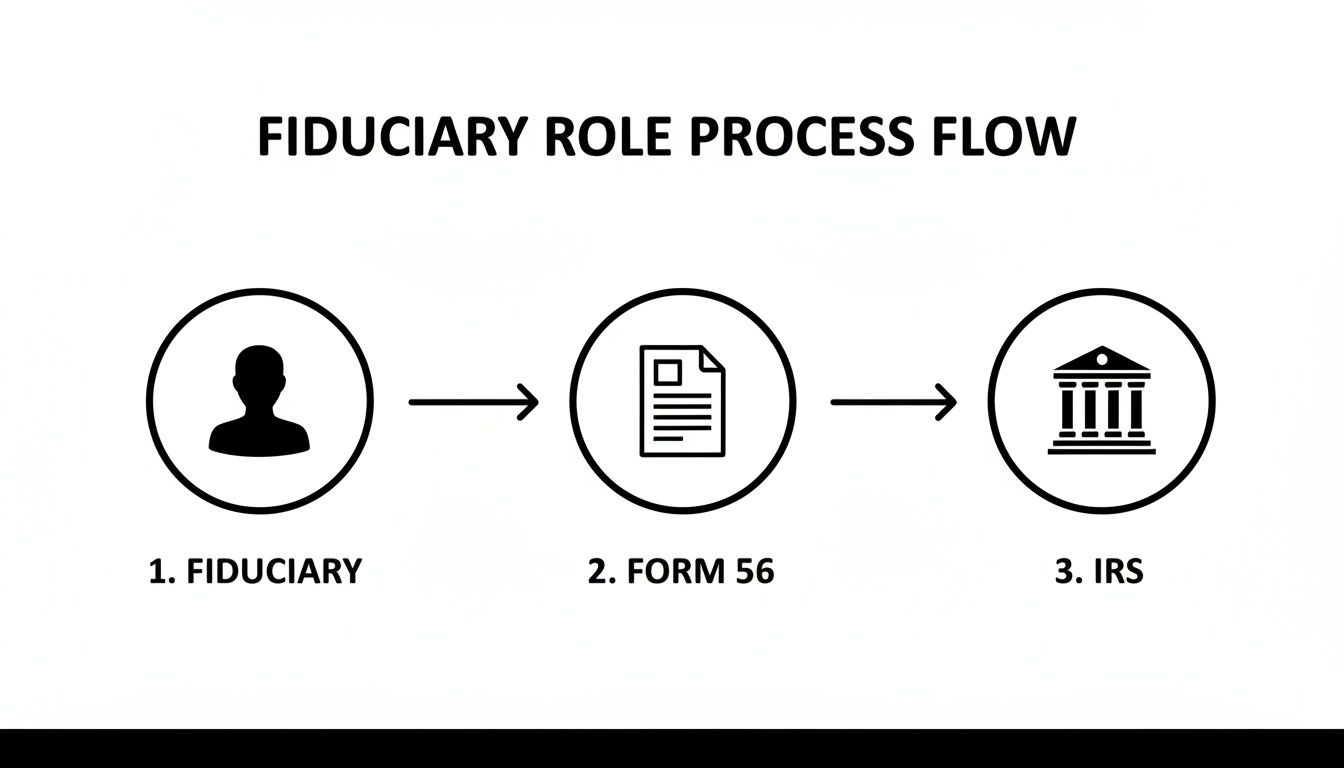
As you can see, the process starts with you. It’s your responsibility to proactively file this form to get the IRS to officially recognize your authority.
Part I: Identification and Your Authority
This first section is where most of the easy-to-avoid mistakes happen. The IRS is a stickler for details here, and its computer systems will automatically reject a form if a name or number doesn't perfectly match what’s on file.
- Name of Person for Whom You Are Acting: Enter the complete, legal name of the taxpayer, estate, or trust. No shortcuts. For a deceased individual, this name must match their Social Security card exactly. For an estate, use the name as it was established in probate court.
- Identifying Number: This will be the person's Social Security Number (SSN), an Individual Taxpayer Identification Number (ITIN), or an Employer Identification Number (EIN) for an estate or trust. I can't stress this enough: double- and triple-check this number. I once worked on an estate case that was stuck in limbo for three months simply because two digits in the EIN were swapped.
The second half of Part I is where you prove you have the right to act. This is not the place for ambiguity.
A Tip from Experience: When you fill out Section A to specify your role (like executor or trustee), you have to attach supporting documents. Don't just mail the entire 50-page trust agreement. Instead, send a certified copy of just the critical pages—usually the first page, the signature page, and the specific section that names you as the fiduciary. This makes the reviewer's job much easier and can get your form processed faster.
Section B: Defining Your Responsibilities
In Section B, you must clearly state which tax forms and tax periods fall under your authority. Many people either rush through this part or skip it, which is a significant mistake.
You need to think about every possible tax obligation you're taking on. For a typical estate, that list might include:
- Form 1040: For the decedent's final income tax return.
- Form 1041: For the income tax returns of the estate itself.
- Form 706: For the federal estate tax return (if the estate is large enough to require one).
- Form 941: If the person owned a business with employees and had payroll responsibilities.
For each form, you also need to list the tax years or periods. For instance, you could specify "2023 and all prior years" for Form 1040, and then "2024 and all future years" for the estate's Form 1041. Being specific here creates a clear record of your duties and protects you from being held liable for tax matters outside your control.
Properly completing Form 56 is just the beginning. If your role also involves hiring a tax professional to represent the estate or trust before the IRS, you'll need a different form. You can learn more in our guide on Form 2848 instructions.
Part IV: Finalizing With Your Signature
Your last step is to sign and date the form in Part IV. This is an old-school requirement: Form 56 must have a physical "wet" signature. A digital or stamped signature is a common error that will get the form rejected immediately.
Make sure you also print your name and list your official title, such as "Executor," "Trustee," or "Receiver." By signing, you are certifying under penalty of perjury that you have the authority you claim and have notified the taxpayer (if applicable). Always keep a signed copy for your files, along with proof of when you mailed it, like a certified mail receipt.
Critical Mistakes to Avoid When Filing Form 56
Filing Form 56 seems simple on the surface, but I’ve seen the same handful of mistakes trip people up time and time again. These aren't just minor typos; they're the kinds of errors that can get your filing rejected outright, leading to frustrating delays and a lot of needless back-and-forth with the IRS. Knowing what to watch out for is half the battle.

The undisputed champion of Form 56 errors is a mismatched Taxpayer Identification Number (TIN). This could be an SSN, ITIN, or EIN. The IRS has automated systems that will kick your form out instantly if a number doesn’t perfectly match their records. Even a single digit being off is enough.
This isn't a small problem. Incorrect TINs can hold up a filing for weeks, a major headache for thousands of fiduciaries every year who are trying to manage tax issues for clients. The form even tells you to enter the nine-digit number without dashes, but it’s still the top mistake. Some tax pros estimate that this one issue affects a staggering 25-40% of all submissions.
Failing to Attach Sufficient Proof of Authority
Another common blunder is forgetting to attach proof of your fiduciary authority. Just checking a box in Part I isn't enough—the IRS needs to see the legal documentation that backs up your claim.
But don’t just dump a 100-page legal document on them. That's almost as bad as sending nothing. The IRS reviewer is looking for something specific.
- Executors: You'll need a court-certified copy of your Letters Testamentary.
- Trustees: A copy of the relevant pages from the trust agreement will do. You don’t need to send the whole thing.
- Guardians: You must provide a certified copy of the court order that appointed you.
Pro Tip: Here’s a little trick that works wonders: when you attach a trust document, take a highlighter and mark the exact clause that names you as the trustee. You're making the reviewer's job easier by pointing them directly to the proof they need. This small step can shave significant time off the approval process.
Using an Outdated Form Version
Believe it or not, this happens all the time. The IRS updates its forms periodically, and using an old version is a guaranteed rejection. The layout, the required information, and even the instructions can change.
Make it a habit to download a fresh copy of Form 56 directly from the IRS website every single time you need to file one. Don’t use a version you saved last year or one a colleague emailed you. A quick search on IRS.gov takes five seconds and can save you weeks of headaches.
Being Vague About Your Authority and Responsibilities
When you get to Part I, Section B, you have to be very clear about which tax forms and tax periods your authority covers. Many fiduciaries get this wrong by being too general or just leaving it blank.
Vagueness is your enemy here. If you’re an executor, for instance, you need to be explicit about what you're responsible for. A good entry would look something like this:
- Form 1040 (U.S. Individual Income Tax Return): Covers the decedent's final tax year and any prior unfiled years.
- Form 1041 (U.S. Income Tax Return for Estates and Trusts): For the current tax year and all future years until the estate is formally closed.
Being this precise does more than just satisfy the IRS. It clearly defines the legal scope of your responsibilities, protecting you from being on the hook for tax matters outside of your duties. If you ever face a challenge to your authority, this kind of specific documentation can be a lifesaver, especially if the situation escalates into the complex world of IRS tax appeals.
Where and When to File Your Completed Form 56
You've meticulously filled out Form 56. Now comes the part that trips up even experienced preparers: getting it to the right place at the right time. A simple mistake here can cause major delays. Unlike most modern tax forms, Form 56 is still a bit old-school—it requires a physical signature and a trip to the post office.

Here’s the most important rule to remember: the correct mailing address depends on the taxpayer's last known address, not your own. It's a classic mistake to send it to the IRS center closest to you, but doing so will guarantee your form gets lost in the shuffle for a while. You have to send it to the specific service center that handles the tax returns for the state where the individual, estate, or trust is legally based.
Determining the Correct IRS Mailing Address
Thankfully, the IRS doesn't make you guess. The official Form 56 instructions include a chart that maps states to their designated service centers. One word of caution: these addresses do change from time to time, so I always recommend double-checking the location on the most recent version of the instructions before you seal the envelope.
Here is a table based on the current IRS guidance. Use this to pinpoint the right service center for your Form 56 filing.
IRS Form 56 Mailing Addresses by Taxpayer Location
| If the Taxpayer's Address Is In... | Mail Form 56 to This IRS Center |
|---|---|
| Florida, Georgia, North Carolina, South Carolina, West Virginia | Department of the Treasury, Internal Revenue Service, Kansas City, MO 64999-0048 |
| District of Columbia, Illinois, Indiana, Kentucky, Maryland, Michigan, Minnesota, New Jersey, Ohio, Pennsylvania, Virginia, Wisconsin | Department of the Treasury, Internal Revenue Service, Kansas City, MO 64999-0048 |
| Alabama, Arkansas, Iowa, Kansas, Louisiana, Mississippi, Nebraska, Oklahoma, Tennessee, Texas | Department of the Treasury, Internal Revenue Service, Ogden, UT 84201-0048 |
| Alaska, Arizona, California, Colorado, Hawaii, Idaho, Montana, Nevada, New Mexico, Oregon, South Dakota, Utah, Washington, Wyoming | Department of the Treasury, Internal Revenue Service, Ogden, UT 84201-0048 |
| Connecticut, Delaware, Maine, Massachusetts, Missouri, New Hampshire, New York, North Dakota, Rhode Island, Vermont | Department of the Treasury, Internal Revenue Service, Kansas City, MO 64999-0048 |
| All APO and FPO addresses, American Samoa, non-permanent residents of Guam or the Virgin Islands, Puerto Rico (or if excluding income under section 933), a foreign country, U.S. possession, or U.S. territory | Department of the Treasury, Internal Revenue Service, Austin, TX 73301-0048 |
Again, always pull up the latest instructions from the IRS website for final verification before mailing. Addresses can and do get updated.
Strategic Filing Timelines and Methods
Knowing when to file involves both rules and a bit of strategy. There isn't one single deadline that fits every situation. For example, receivers and assignees for the benefit of creditors are on a tight clock—they must file Form 56 within 10 days of their appointment. For most others, like executors or trustees, the guidance is simply to file as soon as your role becomes official.
You generally have two ways to submit the form:
- Attach it to a tax return. This is my preferred method for efficiency. If you're filing the decedent's final Form 1040 or the estate's first Form 1041, you can just staple Form 56 right to the front.
- Mail it separately. If there's no tax return due anytime soon but you need to establish your authority with the IRS, you should mail Form 56 on its own to the correct service center from the chart above.
A key thing to know is that the IRS won't send you a confirmation letter. You can expect it to take about 4-6 weeks to process. Your first clue that it's been accepted will be when you start receiving the taxpayer's official mail, like any IRS letters and notices, at your address.
When you do mail it, I strongly advise using a trackable service like USPS Certified Mail. This gives you a receipt and proof of delivery for your records. And while some other IRS documents can be faxed, for sensitive financial forms, it’s wise to research the best secure online fax service if you go that route for other correspondence, but stick to certified mail for the initial Form 56.
Properly Closing Out Your Fiduciary Notice with the IRS
When you take on a fiduciary role, there's a clear starting line. But crossing the finish line is just as critical, and that means officially telling the IRS your job is done. If you skip this final step, you could be on the hook for tax matters—and receiving confidential notices—long after you’ve moved on.
A clean exit isn't just good practice; it's essential for your own protection.
I’ve seen this happen more times than I can count: an executor works diligently to settle an estate, distributes every last asset, and receives a final discharge from the probate court. They think they're finished. But two years down the road, a terrifying audit notice for the estate lands in their mailbox. Why? Because they never officially terminated their fiduciary status, so as far as the IRS is concerned, they're still the one in charge.
This isn't some rare, fluke event. Filing that final notice is your shield.
How to Complete the Termination Notice on Form 56
Ending your fiduciary relationship starts with the same document you used to begin it: a fresh IRS Form 56. This time, however, you’ll skip Part I and head straight for Part II, Section B, which is dedicated to the "Revocation or termination of notice."
Here's what you need to do:
- Check Box 6: This little box, labeled "Termination of notice," is your main goal. Checking it formally signals to the IRS that your duties are over for all the tax matters you were handling.
- Explain Why: The form then asks for the reason. You have to pick the one that fits your situation:
- 6a. Court Order: Select this if a court has officially discharged you, which is common for executors after an estate is closed.
- 6b. Trust/Plan Termination: This is your option if the trust or plan you managed has been formally terminated and no longer exists.
- 6c. Other: This is a catch-all for other scenarios, like the dissolution of a business or the final distribution of all managed assets.
It’s astonishing how often this final filing gets overlooked. Fiduciaries are required to file a second Form 56 to close out their responsibilities, but so many simply forget. In fact, this oversight is a factor in up to 35% of extended fiduciary disputes because it leaves the IRS sending crucial notices to the wrong person. For a deeper dive into this, check out this comprehensive Form 56 guide.
The Most Important Attachment: Proof of Termination
Just like when you started, you can't just tell the IRS your role has changed—you have to prove it. Your termination notice is basically incomplete without the right legal paperwork attached.
Key Takeaway: Filing a new Form 56 to terminate your role without attaching proof is like telling the IRS your job is done but providing no evidence. They will likely ignore the notice, and you will remain the point of contact.
The document you need to attach directly corresponds to the reason you selected in Section B.
- If you checked Box 6a, you absolutely must attach a certified copy of the final court order that releases you from your duties.
- For Box 6b, you'll need a copy of the certificate of trust termination or a similar legal document proving the trust is no more.
- If you selected Box 6c, provide the relevant documentation, like a certificate of dissolution for a corporation or partnership.
Submitting this final Form 56 with the correct attachments is the only way to officially close the loop. It severs your responsibility, stops future tax notices from showing up at your door, and creates a clean legal record that protects you from liability down the road. Always keep a copy of this final filing and your proof of mailing for your own permanent records. You'll be glad you did.
Frequently Asked Questions on IRS Form 56
When you step into a fiduciary role, you're bound to have questions. It’s a position with a lot of responsibility, and the IRS paperwork can be confusing. Here are some quick answers to the questions I hear most often from fiduciaries, based on years of hands-on experience.
Does a Power of Attorney Replace Form 56?
That’s a common point of confusion, but the answer is a firm no. These two forms have completely different jobs.
Think of it this way: a Power of Attorney, like Form 2848, gives someone the authority to represent a taxpayer. This is what you’d use to let a CPA or attorney speak to the IRS on your behalf during an audit. They are acting as your agent.
Form 56, however, tells the IRS that you are the fiduciary. You have legal control over the assets and the ultimate responsibility for all tax matters. The IRS sees you as the acting taxpayer for all official notices. Many times, a fiduciary will first file Form 56 to establish their authority and then file a Form 2848 to hire a tax professional for the technical side of things.
What Are the Risks of Not Filing Form 56?
The risks are huge, and frankly, not worth taking. If you don't file the form, the IRS has no idea you exist. They will keep sending important tax notices to the taxpayer's last known address. If that person has passed away, those letters will just pile up unanswered.
I’ve seen this oversight lead to a cascade of expensive problems:
- Missed deadlines for filing returns or responding to IRS inquiries.
- Hefty penalties and interest that can balloon out of control.
- Surprise liens or levies placed on bank accounts or property because you never received the warning notices.
Failing to file Form 56 can turn a manageable tax situation into a nightmare. Worse, it could open you up to personal liability for failing to properly manage the estate’s or trust's affairs.
Can I E-File IRS Form 56?
Unfortunately, no. As of today, you cannot e-file Form 56. It’s still an old-school paper form that you have to physically sign and mail. Don’t forget to attach copies of your supporting legal documents (like court orders or trust documents) to the form before you send it off.
Important Reminder: While the IRS has made great strides in moving things online, Form 56 isn't one of them yet. Always double-check the latest official instructions on the IRS website before filing, but for now, you’ll need a stamp and an envelope.
How Long Does a Fiduciary Notice Last?
The fiduciary relationship established by Form 56 is effective indefinitely. It doesn’t expire after a year or two. The IRS will continue to recognize you as the responsible party until you actively tell them your duties have ended.
Whether your role lasts for a single tax season or for a decade, that notice stays on file. The only way to officially pass the baton or end your responsibility is to file a second, final Form 56 to terminate the relationship.
Navigating IRS issues as a fiduciary can be complex, and getting it right is crucial. At Attorney Stephen A Weisberg, I start with a FREE Tax Debt Analysis to determine exactly how I can help you resolve your unique situation before you ever pay a fee. If you're facing tax challenges, let's talk.


