Your Guide to IRS Form 4852 for 2026
Missing a W-2 or 1099-R? Learn how to use IRS Form 4852 to file your 2026 taxes accurately and on time. Avoid common mistakes with our step-by-step guide.
In this article
- Understanding IRS Form 4852 and When You Need It
- Specific Scenarios for Using Form 4852
- The Importance of Documentation and Validity
- Gathering Your Proof Before You File
- Your Primary Evidence: The Final Pay Stub
- Building Your Supporting Documentation
- A Line-by-Line Walkthrough of Form 4852
- Getting Your Numbers Right: The Estimation Section
- Line 10: Telling the IRS Your Story
- Avoiding the Most Common Filing Mistakes
- Ensuring Your Estimates Are Defensible
- Correcting Your Return Post-Filing
- What Happens After You File Your Return
- Handling Delayed Documents and Discrepancies
- Responding to IRS Notices
- Frequently Asked Questions About Using Form 4852
- Can I Use Form 4852 if My W-2 Is Just Incorrect?
- What if My Employer Went Out of Business and I Have No Pay Stubs?
- Will Filing Form 4852 Automatically Trigger an IRS Audit?
- What Happens if My Refund Is Different Than What I Expected?
Tax season is stressful enough without the headache of a missing or incorrect W-2 or 1099-R. When you find yourself in this situation, the IRS doesn't expect you to just wait around. That's where IRS Form 4852, titled Substitute for Form W-2, Wage and Tax Statement, or Form 1099-R, Distributions From Pensions, Annuities, Retirement or Profit-Sharing Plans, IRAs, Insurance Contracts, etc., comes into play.
Think of it as your ace in the hole. It allows you to use your own records—like your final pay stub—to report your earnings and withholdings so you can still file your taxes on time.
Understanding IRS Form 4852 and When You Need It
When you file your taxes, your W-2 or 1099-R is the official proof of income that the IRS uses to verify what you report. Without it, you’re missing a key piece of the puzzle. Form 4852 is the tool the IRS gives you to create a substitute piece when the original is missing or broken.

But let's be clear: this form is a fallback plan, not your first option. You absolutely must make a good-faith effort to get the correct documents from your employer or payer before you even consider filling out a Form 4852.
Specific Scenarios for Using Form 4852
So, when is it actually appropriate to use this form? The IRS has very specific circumstances in mind. You should only use it if you've hit a dead end:
- Your employer or payer sent you a W-2 or 1099-R with incorrect information, and they are unwilling or unable to issue a corrected version (Form W-2c or a corrected 1099-R).
- You never received your W-2 or 1099-R by the tax filing deadline. Crucially, you must have already contacted the employer and the IRS for help and come up empty.
- The company you worked for has gone out of business, making it impossible to get your wage and tax statement.
Filing a Form 4852 is not a step to be taken lightly. It effectively sends a signal to the IRS that there’s a discrepancy with your official tax records. This makes it absolutely vital that your estimates for income and withholdings are as precise and well-documented as you can possibly make them.
We saw a real-world stress test of this system during the economic upheaval of the 2020 pandemic. With over 100,000 small businesses closing, many workers were left without their W-2s, leading to a staggering 47% surge in Form 4852 filings. You can see more details in this report on substitute tax forms from the IRS.
The Importance of Documentation and Validity
When you submit a Form 4852, you're essentially asking the IRS to accept your version of the facts over (or in place of) an official document. To do this, you need to back up your claims with solid evidence. Your final pay stub for the tax year is the gold standard here, as it contains all the year-to-date figures you'll need.
In a way, you are creating a document with real legal weight. Thinking about the elements of an enforceable legal agreement helps put into perspective why your accuracy and honesty are so critical. Submitting a Form 4852 with unsupported or wildly inaccurate numbers is a surefire way to invite scrutiny, cause delays, and potentially trigger an audit.
Gathering Your Proof Before You File
Filing IRS Form 4852 isn't something you do lightly. Think of it as telling the IRS, "My employer didn't give me a W-2, but I did the work, earned this much, and paid these taxes." To make that statement stick, you need solid proof to back up every number you claim.
Before you can even think about filling out Form 4852, the IRS requires you to take two specific actions. It's all about showing you made a good-faith effort to get your official documents first.
First, you have to contact your employer and ask for your W-2 or 1099-R. Make a note of when you called or emailed and who you spoke with. If that doesn't work, the second step is to call the IRS directly (after February 15th). Let them know you never received your form, and they'll reach out to your employer on your behalf. Only after you've checked both of these boxes can you turn to Form 4852.
Your Primary Evidence: The Final Pay Stub
When it comes to proving your income and withholdings, one document stands above all others: your final pay stub for the year. This is your holy grail.

Why is it so critical? Because it almost always includes year-to-date (YTD) totals. These YTD figures summarize your gross earnings, Social Security tax, Medicare tax, and federal and state income taxes withheld for the entire year. These are the exact numbers you'll need to transfer onto Form 4852, making it your most accurate source.
Building Your Supporting Documentation
What if you can't find your final pay stub? Don't panic. It just means you have a bit more detective work to do. Your goal is to piece together a clear and verifiable record of your earnings and tax payments from other sources.
To prepare for filing, you'll want to gather as many supporting documents as possible. The more evidence you have, the stronger your position will be if the IRS has questions.
Here's a checklist of documents that can help you accurately estimate your figures and substantiate your filing.
Essential Documents for Your Form 4852 Filing
| Document Type | What It Proves | Why It's Critical |
|---|---|---|
| Final Pay Stub | Year-to-date (YTD) earnings and all tax withholdings. | This is the most comprehensive single document and your best source for accurate figures. |
| Other Pay Stubs | A pattern of consistent earnings and withholding rates. | Helps you calculate YTD totals if the final stub is missing. |
| Bank Statements | Proof of direct deposit amounts and dates. | Corroborates your gross income by showing the net pay you actually received. |
| Employment Contract | Your official salary or hourly wage. | Establishes the agreed-upon pay rate that forms the basis of your earnings. |
Having this paperwork ready before you file is your best defense. It ensures every number you report is backed by evidence, significantly reducing the chances of a lengthy back-and-forth with the IRS.
Crucial Takeaway: The IRS computer system is designed to match the income your employer reports against what you report. Using figures from your final pay stub gives you the best shot at an exact match, which helps you avoid an automatic discrepancy notice.
If you've tried everything and still can't get your W-2, remember that you can request a wage and income transcript directly from the IRS. This transcript shows data already in their system from employers. For more on this, see our guide on what a 4506-T form is and how it can help you get the records you need.
A Line-by-Line Walkthrough of Form 4852
Tackling a tax form can feel intimidating, especially when you’re already missing a key piece of the puzzle like a W-2. The good news is that IRS Form 4852 is one of the more straightforward forms you’ll encounter. Let's walk through it step-by-step. If you’ve gathered your documents, you have everything you need.
First, you'll handle the basics at the top: your name, Social Security number, and address, just like on your main 1040 return. You'll also fill in your employer's or payer's name and address. Don't worry if you can't find their Employer Identification Number (EIN); you're allowed to leave that field blank.
Getting Your Numbers Right: The Estimation Section
This is where the magic happens. You’ll use the numbers you've carefully pieced together to report your earnings and taxes paid. Your final pay stub is the single most valuable document here, as its year-to-date (YTD) totals should map directly to these lines.
- Line 7: Estimated Wages, Tips, Other Compensation: This is your total gross income from this job for the entire year. Grab your final pay stub and find the YTD gross pay amount—that’s your number.
- Line 8: Estimated Federal Income Tax Withheld: Same process here. Look for the YTD federal tax withholding on that last pay stub and write it in.
What if you don't have that final stub? It just means a little more legwork. You'll need to add up the gross pay and federal withholdings from every pay stub you do have. If you’re digging through bank records to fill in the gaps, the ConvertBankToExcel tax documentation guide has some great tips for isolating the right figures from your statements. Just be methodical and keep a record of your math.
You’ll do the same for Social Security wages, Medicare wages, and the taxes withheld for each, which are also listed on your pay stubs.
Key Insight: Remember, the whole point of Form 4852 is to provide a reasonable substitute for a missing W-2 or 1099-R. The IRS doesn't expect perfection down to the penny. What they want to see is a sincere, well-documented effort to be as accurate as possible with the proof you have.
Line 10: Telling the IRS Your Story
Line 10 is your opportunity to explain everything. It specifically asks how you figured out your numbers and what you did to try and get the official form from your employer. Whatever you do, don't leave this section blank. An empty Line 10 is a huge red flag for an IRS reviewer.
Your explanation needs to be clear, factual, and straight to the point. Imagine you’re leaving a short, helpful note for the agent who will eventually look at your return.
Sample Explanation for Line 10
Feel free to use this as a template and adjust it for your own situation:
"Wage and withholding figures were determined using my final pay stub for the 2025 tax year, dated December 29, 2025. I contacted my employer, ABC Company, via phone on February 5, 2026, and spoke with Jane Doe in HR. She stated my W-2 would be mailed. When it did not arrive, I called the IRS for assistance on February 20, 2026."
This simple paragraph works perfectly because it:
- Identifies the source of your numbers (the final pay stub).
- Proves you made a good-faith effort to contact the employer, with specifics (date and person).
- Shows you followed the correct procedure by also contacting the IRS (date of your call).
Once the form is complete, you just attach it to your tax return. If you're filing on paper, you'll physically clip it behind your Form 1040. If you’re e-filing, your tax software will have a specific prompt for you to upload or attach the form electronically.
Avoiding the Most Common Filing Mistakes
When a W-2 goes missing, Form 4852 is your go-to solution. But be careful. Small, easy-to-make mistakes on this form can lead to big headaches, including processing delays and unwelcome letters from the IRS. Knowing the common tripwires ahead of time is the best way to make sure your return sails through smoothly.
One of the biggest mistakes we see is jumping the gun. It's natural to want to get your taxes filed and finished, but the IRS won't even start helping you find a missing W-2 until after February 15th. Filing Form 4852 before you've properly documented your efforts to get the original is a procedural foul that can get your return flagged right out of the gate.
Ensuring Your Estimates Are Defensible
Another critical mistake is using weak or poorly supported estimates. Your job here isn't to guess; it's to reconstruct your income and withholdings with as much accuracy as possible. A number that looks like it was plucked from thin air is a huge red flag for an IRS agent.
Your best source is always your final pay stub for the year. If you don't have it, you'll need to do some detective work with bank statements and earlier pay stubs. Whatever you do, keep your calculations organized and ready to show your work.
And this might sound obvious, but you'd be surprised how often it happens: people forget to actually attach Form 4852 to their tax return. Whether you file electronically or by mail, it has to be included with your main Form 1040. Without it, the IRS has no idea where your numbers came from, which almost guarantees a discrepancy notice.
This infographic breaks down the core steps to getting Form 4852 right.
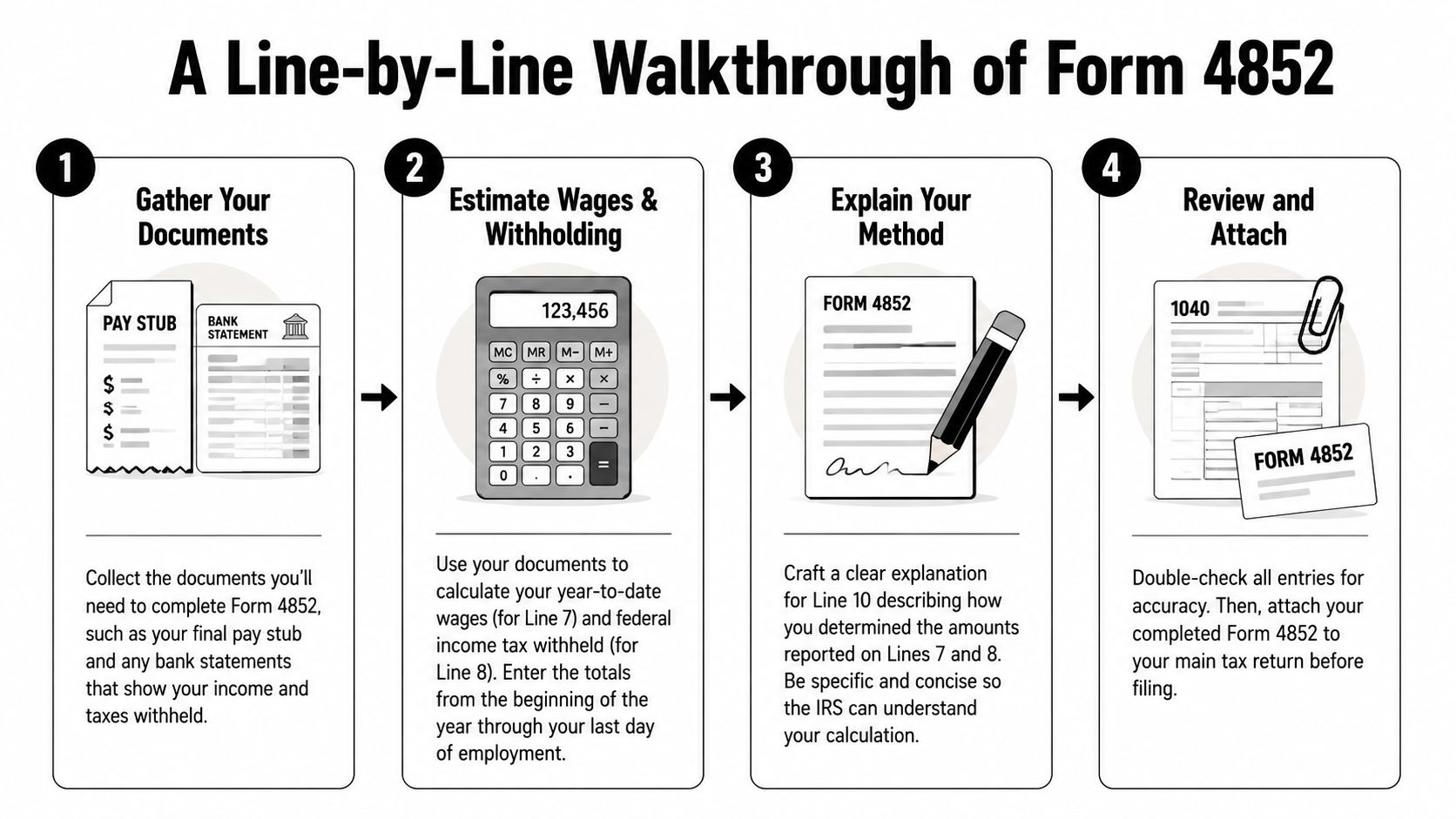
As the visual shows, a successful filing really comes down to methodical documentation, careful calculation, and providing a clear explanation for your situation.
The consequences for getting this wrong are very real. Looking at historical IRS data, we know that discrepancies from Form 4852 estimates can trigger serious scrutiny. In 2018 alone, the IRS sent out over 500,000 CP2000 notices—also known as underreporter inquiries—tied to these kinds of issues. Those notices resulted in $3.2 billion in extra taxes. You can see the full breakdown in the IRS public data on tax enforcement.
Correcting Your Return Post-Filing
So, what if you do everything right, file with Form 4852, and then your official W-2 finally shows up with different numbers? You can't just ignore it. You have to set the record straight.
You are required to file an amended return using Form 1040-X, Amended U.S. Individual Income Tax Return. Attach the newly received W-2 and the 1040-X to report the correct numbers.
Failing to amend your return means you're leaving a known error on your tax record, which can open you up to penalties and interest later on. Dealing with it proactively demonstrates good faith and keeps your account in good standing. Knowing how to handle these curveballs is a key part of tax planning and can help you prepare for an IRS audit if you ever face one.
What Happens After You File Your Return
So, you've filed your return with IRS Form 4852 attached. Now what? The first thing to do is manage your expectations. A return with a substitute form isn't like a standard e-filing; it gets flagged for manual review by an actual IRS agent.
This human touch means one thing for sure: your tax return will take longer to process. Be patient. While you can still use the IRS's "Where's My Refund?" tool to check your status, don't be surprised if it seems stuck for a while as the IRS works to verify your numbers.
Handling Delayed Documents and Discrepancies
Life has a funny way of delivering things right after you don't need them anymore. What happens if your official W-2 or 1099-R shows up in the mail after you’ve filed? This is a common situation, but you can't just toss the form in a drawer and forget about it.
Your next step is to compare the figures on the official document with the estimates you reported on Form 4852.
- If the numbers match: Perfect! No further action is needed. Simply file the official form away with your tax records for the year.
- If the numbers are different: You have to file an amended return. This isn't optional. Ignoring a known discrepancy can lead to penalties and interest down the line, and nobody wants that headache.
To make the correction, you'll need to file Form 1040-X, Amended U.S. Individual Income Tax Return. On this form, you will report the correct numbers from your W-2 or 1099-R and be sure to attach a copy of that official document.

Responding to IRS Notices
It’s also entirely possible you'll get a letter from the IRS about your return. First, don't panic. More often than not, it’s a notice like a CP2000, which isn't a full-blown audit. It’s simply the IRS’s way of saying, "The numbers we have don't match the numbers you reported, and we think an adjustment is needed."
Any time you receive a letter from the IRS, read it carefully and respond before the deadline. A timely and professional response can make all the difference. For more detailed guidance, check out our article on how to properly respond to IRS letters.
We're seeing an interesting trend with these substitute forms. Projections indicate a potential 19% increase in Form 4852 filings for the 2025 tax year, often a symptom of wider economic shifts. For example, ongoing payroll struggles in the small business sector have already contributed to $2.8 billion in disputed local taxes, a situation that often necessitates using Form 4852. You can learn more about these developing trends and how expats use Form 4852 in different economic climates.
Frequently Asked Questions About Using Form 4852
Even with a guide, stepping into the world of substitute tax forms can feel a little unnerving. It's completely normal to have questions, especially when it feels like you're deviating from the standard filing process with IRS Form 4852.
Let's clear up some of the most common concerns and "what-if" scenarios that pop up. My goal here is to give you the confidence to handle your situation correctly, whether you're dealing with a defunct employer or just worried about getting on the IRS's bad side.
Can I Use Form 4852 if My W-2 Is Just Incorrect?
Yes, absolutely. Form 4852 isn't just for a missing W-2; it's also the right tool for an incorrect one. This happens more often than you'd think—an employer might have botched your reported wages, tips, or tax withholding and is now dragging their feet on issuing a corrected Form W-2c.
Your first move must be to try and get a corrected form from your employer. Be sure to document your efforts—make a note of who you spoke to and when. If they won't cooperate, you can proceed with Form 4852. You'll use your own records, like pay stubs, to report the correct figures. On Line 10 of the form, you simply explain that you received an incorrect W-2 and detail the steps you took to get it fixed.
What if My Employer Went Out of Business and I Have No Pay Stubs?
This is a tricky spot to be in, but it’s not a dead end. When your employer disappears and you don't have pay stubs, you have to play financial detective. The mission is to reconstruct your income and withholdings as accurately as you possibly can with whatever evidence you can find.
Here are the best places to start looking for clues:
- Bank Statements: Check for consistent direct deposits from your employer. Tallying these up is a great way to figure out your net pay for the year.
- Employment Contract or Offer Letter: These documents usually list your salary or hourly rate, giving you a baseline for calculating your gross earnings.
- Previous Year's W-2: If you worked for the same company last year at a similar pay rate, that form can give you a reasonable estimate for your tax withholding percentages.
The most important part is to explain your estimation method on Line 10. Be clear that the employer is out of business and that you used bank records, your employment contract, or other documents to reconstruct your income.
The IRS understands that perfect records aren't always possible. What they really care about is seeing a reasonable, good-faith effort to report your financial information accurately based on the evidence you have.
Will Filing Form 4852 Automatically Trigger an IRS Audit?
This is probably the biggest fear people have, but the short answer is no, using Form 4852 doesn't automatically put you on the audit list. It does, however, guarantee your return will get a second look. Because your numbers are a substitute for official ones, your return is flagged for a manual review.
An IRS agent will simply compare your figures to any data they eventually receive from the employer. If your estimates are well-documented and your explanation on Line 10 makes sense, the process is usually smooth. An audit becomes more likely only if your numbers seem way off or if you leave Line 10 blank, leaving the IRS to guess what happened.
What Happens if My Refund Is Different Than What I Expected?
If you file with Form 4852 and the IRS adjusts your refund, it’s almost always because they eventually received the official W-2 from your employer and the numbers didn't quite match your estimate. When this happens, you'll get an official notice in the mail explaining the changes. If you have proof that your numbers were right and the IRS is wrong, you have every right to challenge their adjustment.
On the other hand, what if your official W-2 finally shows up and it turns out you were owed a larger refund? In that case, you'll need to file an amended return to claim the difference. You can learn more about that process in our guide on how to amend a tax return.
Dealing with missing documents and IRS forms can be a major source of stress. At Attorney Stephen A Weisberg, we specialize in helping individuals and businesses resolve complex tax issues with the IRS. If you’re facing tax debt or an IRS problem that feels overwhelming, start with our FREE Tax Debt Analysis to see how we can help. Find your path to resolution by visiting us at https://weisberg.tax.