IRS Failure to Pay Penalty: A Guide to Relief & Removal
Confused by the IRS failure to pay penalty? Learn how it's calculated, how to stop it, and your options for relief like first-time abatement. Get clear steps.
In this article
- That IRS Notice Just Arrived What Now
- How the IRS Calculates This Penalty
- Penalty, interest, and late filing are different charges
- Proactive Steps to Stop Penalties from Growing
- Choose the tool that matches the debt
- Your Options for Penalty Abatement and Relief
- Automatic relief changes the first review
- Reasonable cause requires a factual explanation
- Documentation Forms and Deadlines to Know
- Build the evidence around the timeline
- Treat deadlines as legal issues
- When to Consult a Tax Attorney for Help
You open your mailbox to find an IRS notice showing a balance you expected, but the added charge is far higher than anticipated. Respond promptly. The IRS failure-to-pay penalty is an administrative charge, and relief usually depends on reviewing the account, choosing a workable payment path, and documenting facts that support abatement.
The figures put the issue in context. An IRS Data Book-based analysis reported 17,048,457 failure-to-pay penalty entries in fiscal year 2021 and 24,251,980 for fiscal year 2025, an increase of roughly 42% over four fiscal years (IRS penalty trend analysis). An IRS notice is a problem to address, not proof that the debt has become a financial dead end.
This guide treats the penalty as a manageable process. You will identify the balance, control further growth, and assess payment or penalty-relief options in a defined sequence. Acting early gives you more practical choices than leaving the account unanswered.
That IRS Notice Just Arrived What Now
You open your mailbox and find an IRS notice showing a balance you expected, but the added charge is much higher than anticipated. Start with the document, not the fear. Identify the tax period, unpaid tax, penalty type, interest, response date, and payment instructions. The IRS may send several notices as an account progresses, and each can carry different consequences. The newest letter may not show the account's full history.

First determine whether you agree with the underlying tax. A penalty request addresses an added charge. It will not correct an inaccurate return, an uncredited payment, missing withholding, or a balance caused by an IRS processing error. Gather the filed return, payment confirmations, prior notices, bank records, and correspondence with your preparer before asking for relief.
Practical rule: Never ignore an IRS notice because you can't pay the full balance. Set up a payment arrangement, request relief, or challenge an account error. Silence leaves the problem unresolved.
If the balance is accurate, choose a way to control the account. You may pay it, apply for an installment agreement, assess whether an Offer in Compromise fits your facts, or request penalty relief based on your compliance history or circumstances beyond your control. Your finances and the reason for the late payment determine the appropriate route.
Read the notice before calling the IRS. Record dates, representative names, confirmation numbers, and submitted documents. For help interpreting the letter, use this guide on responding to IRS letters. Then protect the deadline and pursue a defined resolution strategy.
The failure-to-pay penalty is common, but it still requires prompt action. Penalties may be adjusted after the IRS reviews an abatement request or corrects the account. Treat the notice as a sequence of manageable decisions: verify the claim, prevent avoidable delay, and match the relief request to documented facts.
How the IRS Calculates This Penalty
The IRS failure-to-pay penalty begins with the unpaid tax shown on the account. The standard charge is 0.5% of the unpaid tax for each month or part of a month that the balance remains unpaid, up to 25% of the tax owed, as explained in IRS Topic 653.
Use this sequence to review the calculation:
- Identify the unpaid tax. The penalty applies to the unpaid tax balance, not automatically to every amount printed on the notice.
- Apply the monthly rate. At the standard rate, the IRS applies 0.5% for each month or part of a month covered by the penalty.
- Account for payments. Each payment reduces the unpaid balance, so later penalty calculations generally use the amount still outstanding.
- Check the statutory ceiling. The failure-to-pay penalty cannot exceed 25% of the unpaid tax under the applicable rule.
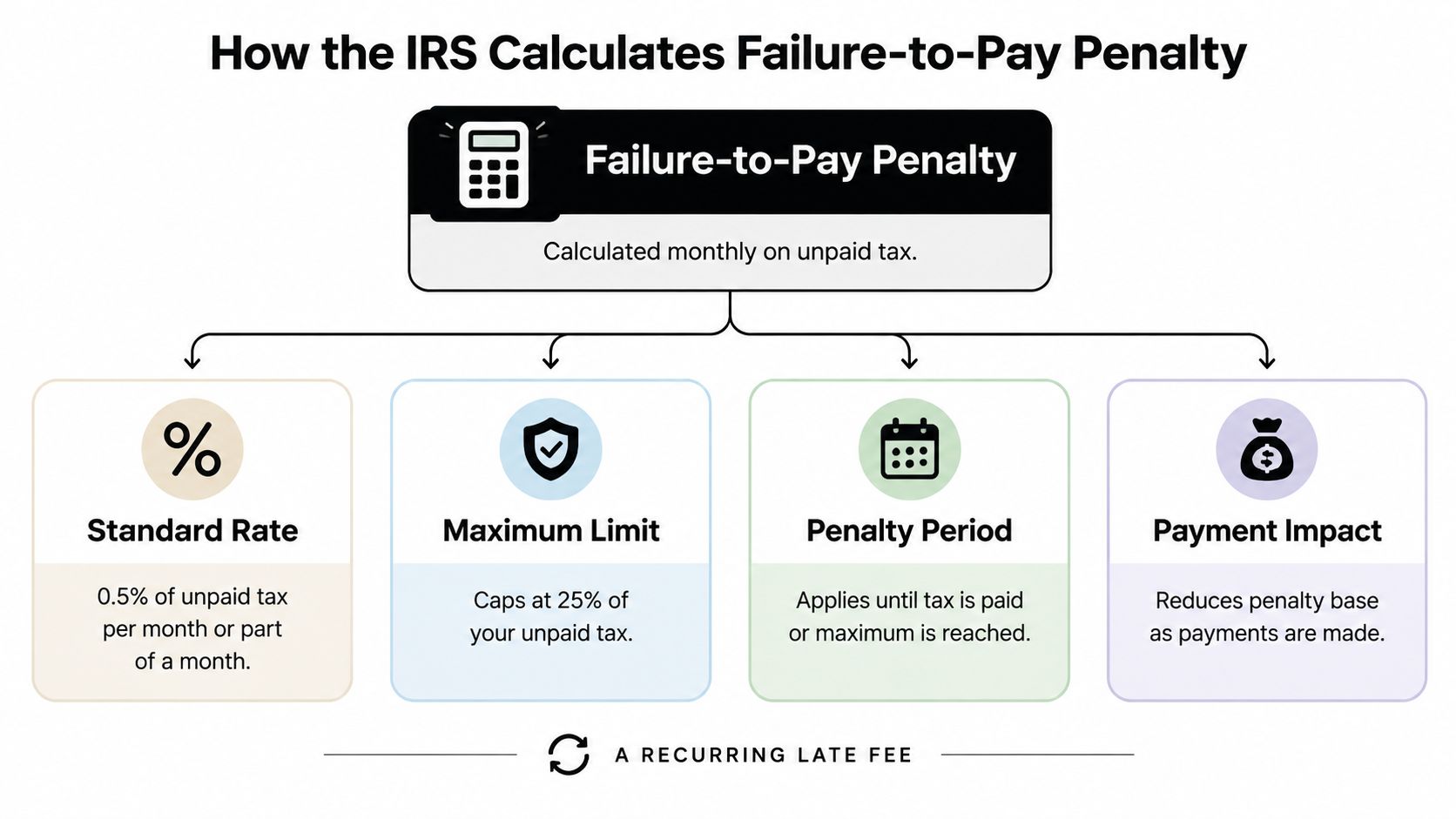
A $10,000 unpaid balance produces $50 per month at the standard rate before interest is added. A $61,200 balance produces about $306 per month before interest. These examples do not calculate your liability. They show why prompt action matters even when the monthly percentage looks small.
The rate can change based on the taxpayer's situation. It may fall to 0.25% per month for some taxpayers with approved installment agreements and rise to 1% in certain notice-and-demand situations. Review the account transcript and notice history instead of assuming that every month used one rate. The IRS provides further details in its failure-to-pay penalty guidance.
Penalty, interest, and late filing are different charges
The failure-to-pay penalty is separate from the failure-to-file penalty. The first addresses paying tax after the due date. The second addresses filing the return late. One notice may show both charges, along with interest, so request an itemized account breakdown before disputing or paying the amount.
Interest is a separate cost. It can accrue on unpaid tax and assessed penalties, which means a later notice may exceed a simple multiplication of the original tax by the monthly penalty rate. For a broader review of filing and payment compliance, use this tax penalty compliance playbook.
The cap limits the penalty, not the need to act. The failure-to-pay penalty can continue for up to 50 months before reaching the 25% maximum. Start a payment plan or relief request well before the account reaches that limit, and use the transcript to confirm whether the IRS applied the correct rate and dates.
Proactive Steps to Stop Penalties from Growing
Your first objective is to control the account. The IRS doesn't need a perfect financial story before you take action. It needs a documented resolution path that addresses the tax balance and keeps future filings current.
An Installment Agreement is often the practical starting point when you can pay the debt over time. It lets eligible taxpayers make scheduled payments rather than demand that the entire balance be paid immediately. The agreement doesn't erase tax, interest, or every penalty, but an approved arrangement can change the applicable failure-to-pay rate for some taxpayers, as explained in the IRS guidance cited earlier.
Before applying, calculate a payment you can sustain. A plan that fails because the payment is unrealistic can leave you with a larger problem. Review income, necessary living expenses, business cash flow, assets, other liabilities, and upcoming filing obligations. Taxpayers who need a formal application can review the IRS payment-plan process through setting up a payment plan with the IRS.
Choose the tool that matches the debt
An Offer in Compromise is different. It may allow a taxpayer who can't realistically pay the full liability to settle for less than the total amount owed. The IRS examines the taxpayer's financial circumstances and ability to pay, so this isn't a discount request based only on hardship or frustration. It requires accurate financial disclosure and a payment proposal supported by the facts.
A payment plan usually fits a taxpayer with reliable ability to pay over time. An Offer in Compromise deserves attention when the full balance is not realistically collectible under the taxpayer's circumstances. Don't submit either application casually. An incomplete financial picture can produce a denial, waste time, or create avoidable compliance problems.
For business owners, prevention starts before the notice. Owners of SaaS companies and other businesses should review tax planning insights for SaaS companies to improve estimated-tax planning and cash-flow forecasting. Better planning won't erase an existing penalty, but it can prevent a temporary cash shortage from becoming a recurring tax debt.
The strongest resolution strategy addresses both sides of the account: the existing liability and the next filing or payment obligation.
Gather current records before choosing a program. That includes filed returns, IRS account transcripts, recent bank statements, payroll information where relevant, and a realistic household or business budget. If the tax itself is wrong, correct the return or account first. If the tax is right, move quickly toward a payment arrangement or compromise analysis.
Your Options for Penalty Abatement and Relief
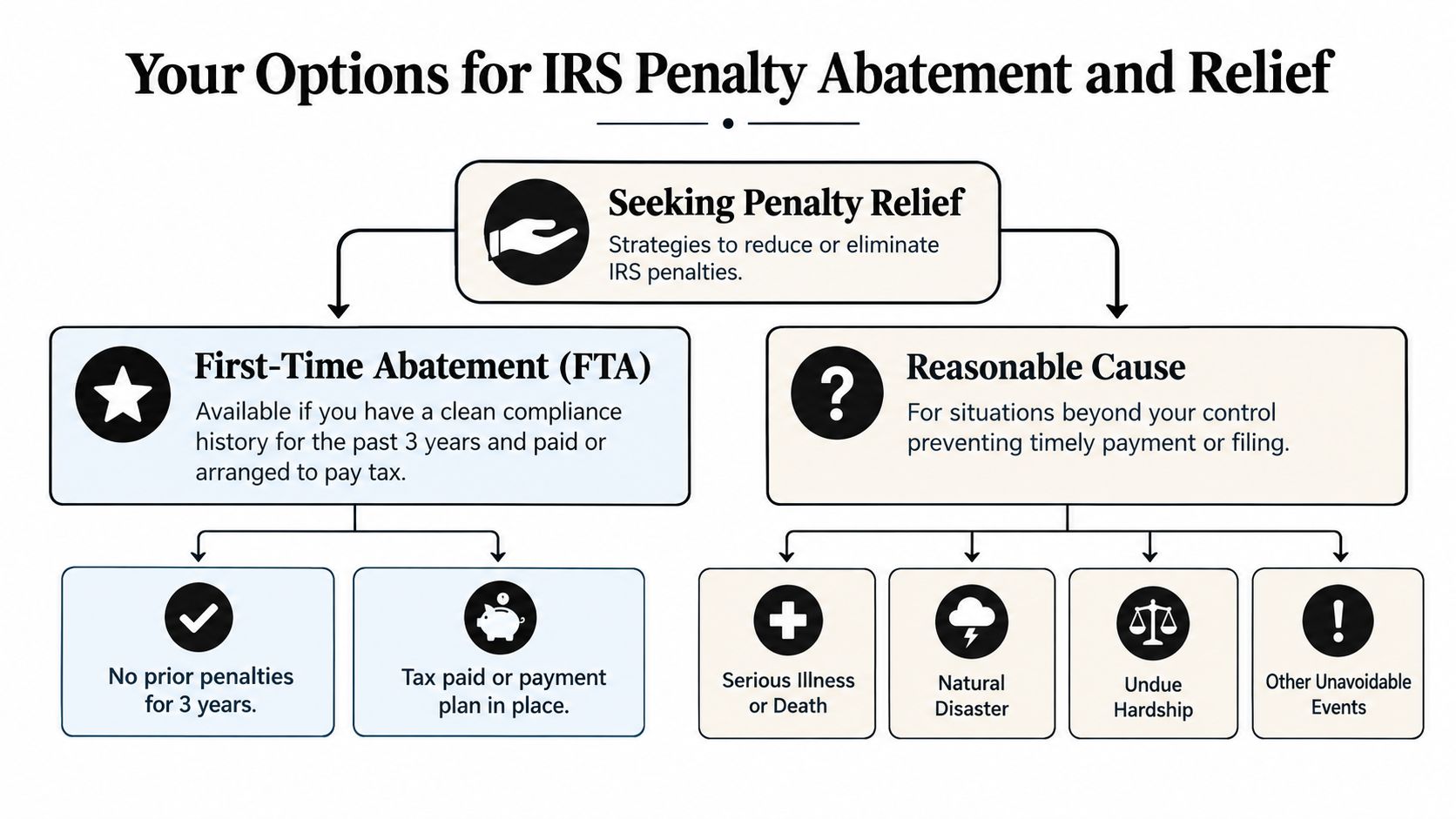
Penalty abatement means asking the IRS to remove some or all of an assessed penalty. It doesn't automatically erase the underlying tax or interest, and approval depends on the specific relief route and the facts supporting it. Two major paths are First-Time Abatement and reasonable cause.
First-Time Abatement is designed for taxpayers with an otherwise clean compliance record. The central question is whether you've filed required returns and maintained timely filing and payment history during the relevant prior period. You also need to address the tax, either by paying it or arranging an acceptable payment solution. Don't treat FTA as a general waiver for any penalty. It has eligibility limits and applies to particular penalty categories.
Automatic relief changes the first review
The IRS announced an Automatic Exemption from Penalty program in 2026 for eligible original returns beginning with tax year 2025 and for 2026 quarterly returns. The program applies to failure-to-pay, failure-to-file, and failure-to-deposit penalties for taxpayers with three prior years of timely filing and payment history (IRS automatic penalty relief announcement).
That update changes the order of operations. Before preparing a lengthy manual abatement request, check whether the taxpayer falls within the automatic process. Confirm the relevant return, filing history, payment history, and penalty category. If the expected relief doesn't appear, preserve the notices and account records and address the omission directly.
Reasonable cause requires a factual explanation
Reasonable cause applies when circumstances beyond your control prevented timely filing or payment, and you acted responsibly once the obstacle ended. The IRS evaluates the complete story, not just a label such as “hardship” or “emergency.”
Potential facts may include:
- Serious illness: Explain who became ill, how the condition affected the taxpayer's ability to act, and the relevant period.
- Death in the family: Show how the death disrupted the taxpayer's ability to manage the filing or payment obligation.
- Natural disaster: Connect the event to the loss of records, access to funds, communications, or the ability to operate.
- Erroneous professional advice: Identify what advice was given, why the taxpayer reasonably relied on it, and what happened after the error was discovered.
- Other unavoidable events: Describe the specific event, its duration, the taxpayer's response, and why timely compliance wasn't practical.
A good request follows a timeline. State the deadline, describe the event, identify the action the taxpayer could not take, explain the corrective steps, and attach corroborating records. A vague apology is weak. A precise narrative supported by contemporaneous evidence is much stronger.
For additional discussion of penalty relief options and strategy, review the firm's penalty abatement guidance. The request should also address payment of the tax or a workable arrangement. Relief arguments are more credible when the taxpayer has corrected the underlying compliance problem.
Documentation Forms and Deadlines to Know
A relief request succeeds only when the paperwork matches the remedy. Choose the form for the action you want, then organize the records so an IRS reviewer can confirm the facts without piecing together a scattered file.
| Objective | Common IRS form or record | What to prepare |
|---|---|---|
| Request an Installment Agreement | Form 9465 | Current financial information, filing history, and a payment amount you can maintain |
| Submit an Offer in Compromise | Form 656 | Financial disclosures, supporting records, and a realistic settlement proposal |
| Request penalty abatement | Form 843, where appropriate | A factual explanation, penalty periods, and evidence supporting the relief ground |
| Review the account | IRS account transcript and notices | Copies of assessments, payments, penalties, and prior correspondence |
Form 9465 supports an Installment Agreement request. Form 656 is used with an Offer in Compromise. Form 843 may be appropriate for penalty abatement when you are asking the IRS to adjust an assessed charge rather than disputing the underlying tax. Review the account transcript before filing. It can reveal whether the IRS credited payments correctly, assessed the penalty for the correct period, and recorded all required returns.
Build the evidence around the timeline
For reasonable cause, prove the event and its effect on your ability to comply. Medical records can document a serious illness. A death certificate and related records can support a death in the family. Insurance claims, disaster declarations, repair records, and correspondence may establish how a natural disaster affected access to records, funds, communications, or business operations. Emails or letters from a tax professional may support a reliance argument, but your explanation must identify the advice, show why you relied on it, and connect it to the missed obligation.
Submit only relevant records. Label each attachment and cite it in the narrative. The reviewer should be able to connect every document to a date, event, and missed action. A short, organized file is more useful than a large batch of unexplained documents.
The failure-to-pay penalty has a statutory ceiling. It is assessed at 0.5% of unpaid tax for each month or part of a month and capped at 25%, so it can continue accruing for up to 50 months before reaching that maximum. Verify when the penalty began, whether payments were credited correctly, and whether any assessed periods should be removed. For the governing details, consult the IRS failure-to-pay penalty guidance.
Treat deadlines as legal issues
An abatement request may involve refund claim timing rules. If you already paid the penalty, the available claim route can depend on when the return was due and when the tax or penalty was paid. Read every notice carefully and calendar its response deadline immediately. Missing that date can restrict your options, even when another relief path may remain available.
Keep proof of delivery and a complete copy of everything submitted. If the IRS denies the request, analyze the stated reason before responding. A stronger submission may require additional evidence, a different relief theory, or professional review. This process is manageable when the account history, form, timeline, and supporting records all point to the same requested result.
When to Consult a Tax Attorney for Help
A straightforward notice with a correct balance and a manageable payment plan may not require counsel. A disputed balance, repeated notices, multiple tax periods, or a complicated relief argument is different. At that point, the cost of an incorrect response can exceed the cost of getting advice before the account escalates.
You should strongly consider tax attorney assistance if any of these conditions apply:
- Substantial tax debt: The balance, penalties, and interest could affect your home, business, retirement plans, or ability to obtain financing.
- Business or payroll taxes: Payroll liabilities can involve separate enforcement issues, including the Trust Fund Recovery Penalty, and require more careful analysis than an individual income-tax balance.
- Several unfiled returns: You need a filing strategy before negotiating payment or compromise terms.
- A rejected abatement request: A denial often means the IRS found the evidence or legal theory insufficient. Repeating the same submission rarely solves that problem.
- A complex reasonable-cause claim: Illness, disaster, professional advice, business disruption, or overlapping events require a documented timeline and a persuasive explanation.
- Conflicting IRS records: Uncredited payments, incorrect assessments, or missing returns should be resolved at the account level.
- Active collection pressure: A levy threat, lien issue, or other enforcement action calls for prompt review of available remedies.
A tax attorney can separate the tax problem from the penalty problem, verify the account transcript, identify the right relief theory, and coordinate filings with collection action. That work matters because the IRS generally responds to the arguments and documents a taxpayer submits. The agency won't build every possible defense for you.
A notice is a decision point. It isn't a verdict on your financial future.
Organization also makes a major difference. Administrative support, such as tax preparation assistance from Approved Lux Personal Assistant, can help gather records and keep filing materials organized. That support doesn't replace legal analysis, but it can make it easier to provide complete information to your attorney or tax professional.

Tax Attorney Stephen A Weisberg offers a free Tax Debt Analysis to determine whether he can help and how to approach an IRS failure-to-pay penalty, payment-plan, or penalty-abatement issue. Visit Tax Attorney Stephen A Weisberg to review your options, organize the next step, and address the IRS before the account becomes harder to resolve.


