IRS Criminal Investigation: Your 2026 Guide
Facing an IRS criminal investigation? Our 2026 guide explains the process, penalties, and defenses. Learn your rights and what to do now.
In this article
- Answering the Door to IRS Special Agents
- What Is IRS Criminal Investigation And What It Is Not
- The people involved are different
- What taxpayers often get wrong
- Common Triggers That Turn Audits into Criminal Cases
- What willfulness looks like in practice
- Why some cases stay civil
- How an IRS Criminal Investigation Unfolds Step by Step
- Early development of the case
- Formal investigative steps
- Where cases are won or lost
- Civil Audits vs Criminal Investigations Compared
- The side-by-side comparison
- Why the strategy changes
- Potential Penalties and Realistic Defense Strategies
- Start with the real defense questions
- Practical defense work is not glamorous
- What not to do
- What to Do Immediately and How to Find the Right Help
- Your first moves
- What the right advisor should do
Two people show up at your home or office, identify themselves as IRS special agents, and ask if they can talk. Individuals often make the same mistake in that moment. They try to explain. They think cooperation means talking immediately. They assume this is just a misunderstanding they can clear up in ten minutes.
That instinct can do real damage.
An IRS criminal investigation is serious, but it isn't the time for panic. It's the time for discipline. The right response is calm, short, and deliberate. You need to understand who these agents are, how a civil tax problem becomes a criminal one, and what steps protect you before you say a word.
If you've dealt with other tax authorities before, the basic lesson is similar. Once a matter shifts from routine compliance into enforcement, your response has to change. Even in a different system, the practical mindset in this guide for businesses facing HMRC scrutiny is useful. Stop improvising, preserve records, and get advice before you start explaining facts you haven't organized.
Answering the Door to IRS Special Agents
The classic fact pattern is simple. Two agents arrive unannounced. They say they just have a few questions. They may be polite, measured, and patient. That doesn't make the situation informal.
These are not auditors dropping by to fix a paperwork issue. They are law enforcement officers investigating potential criminal violations. The IRS's own reporting shows why that matters. In its Fiscal Year 2025 annual report, IRS-CI said it identified $10.59 billion in financial crimes, up 15.7% from the prior year, and devoted 64% of investigative time to tax crimes during FY25, according to the IRS-CI FY25 annual report announcement.
Your first job is not to persuade them. Your first job is to avoid making your situation worse.
Immediate rule: Be polite, confirm their names and cards, say you won't answer questions without counsel, and end the conversation.
Don't invite them in unless they have legal authority requiring entry. Don't start narrating your history with a return, payroll issue, business dispute, cash problem, or offshore account. Don't guess. Don't fill silence because it feels awkward.
A lot of criminal tax cases don't begin with a dramatic arrest. They begin with voluntary statements. The taxpayer thinks, "I have nothing to hide." The government hears inconsistencies, minimization, or admissions it can test against bank records and third-party data.
If agents have contacted you, the crisis-management phase has started. From that point forward, every decision matters. Preserve documents. Stop casual conversations with employees, partners, and return preparers about "what we should say." Get qualified defense counsel involved before there is a second interview, a document production, or a badly handled phone call.
What Is IRS Criminal Investigation And What It Is Not
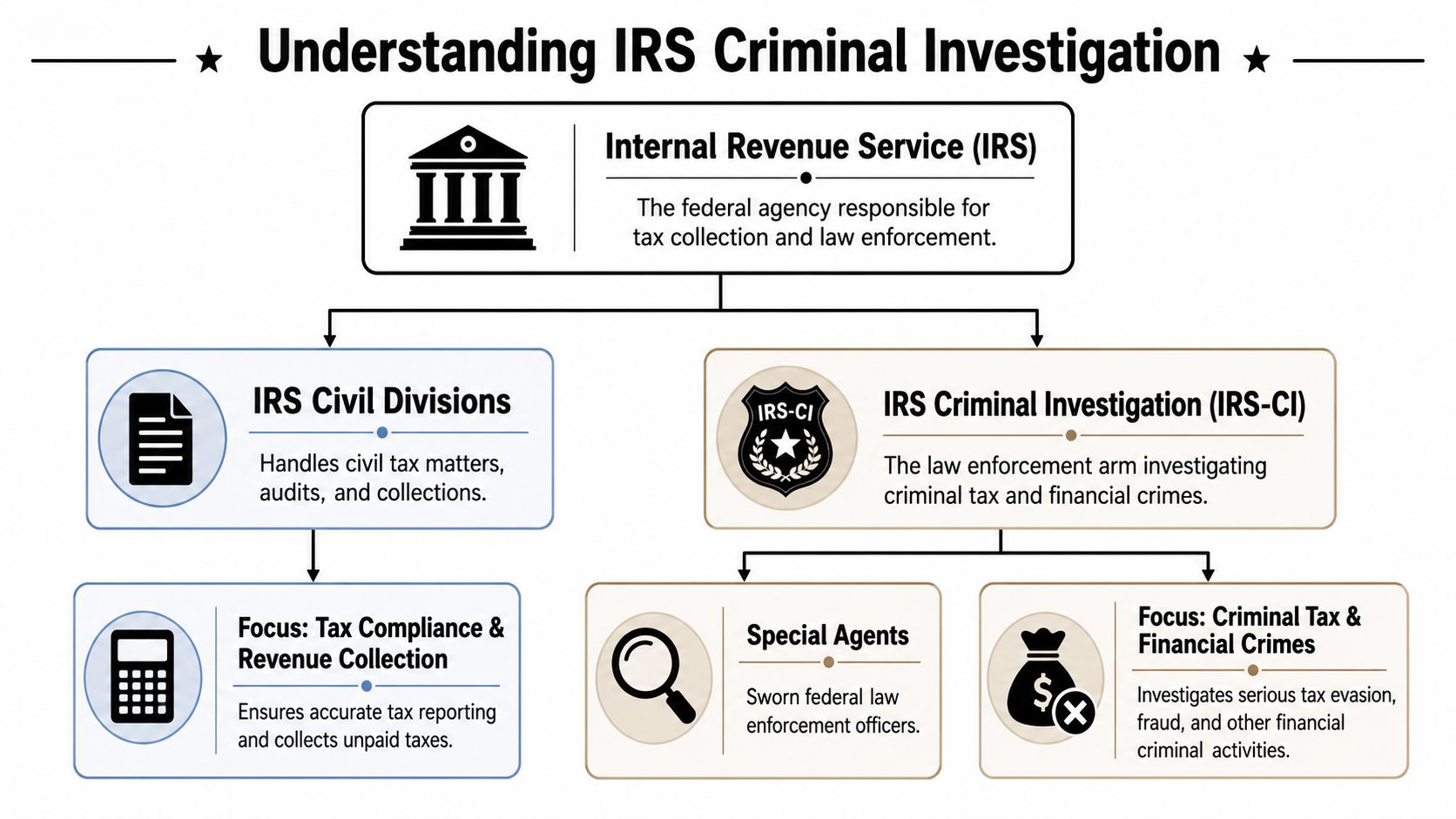
IRS Criminal Investigation, usually called IRS-CI, is the IRS's criminal law-enforcement arm. Think of it as the detective bureau inside the tax system. Its job isn't to adjust deductions or set up installment agreements. Its job is to investigate whether someone committed a tax crime or a related financial crime.
The key legal point is this. IRS-CI is the only federal law enforcement agency with jurisdiction over violations of the Internal Revenue Code, and it historically spends more than 70% of investigative time on tax matters, with nearly 64% devoted to tax crimes in FY25, as the IRS explains on its about Criminal Investigation page.
The people involved are different
A Revenue Agent handles civil audits. That person is trying to determine the correct tax.
A Revenue Officer handles collection. That person is trying to collect assessed tax debt.
A special agent works criminal cases. That person is building evidence of willfulness, intent, concealment, and false statements.
That distinction changes everything. In a civil case, you may argue over substantiation, timing, characterization, and valuation. In a criminal case, the government is asking a different question: did you knowingly break the law?
What taxpayers often get wrong
Many people hear "IRS investigation" and assume every IRS inquiry is criminal. That's wrong. Most tax problems remain civil. But the opposite mistake is more dangerous. People assume an interview request is routine because no one has said the word "criminal."
That's also wrong.
If a special agent contacts you, the issue is no longer "How much do I owe?" It's "What evidence is the government gathering, and what should I stop saying right now?"
A civil tax dispute is about liability and payment. An IRS criminal investigation is about proof, intent, and exposure beyond money alone. That's why your CPA may remain important, but your response has to be directed by counsel who understands criminal tax procedure.
Common Triggers That Turn Audits into Criminal Cases
Criminal referrals usually don't come from one sloppy line item. They come from patterns. The IRS describes the shift from civil to criminal as driven by badges of fraud, including concealment, falsified records, and false statements suggesting willfulness rather than negligence, as noted on the IRS Criminal Investigation compliance page.
What willfulness looks like in practice
The dividing line is often intent. A taxpayer who misclassifies an expense may face a civil adjustment. A taxpayer who creates fake invoices to support the same expense has a criminal problem.
Common trigger patterns include:
- Repeated underreporting over multiple years: One bad return may be defensible. The same omission year after year looks deliberate.
- False records: Altered QuickBooks files, fabricated receipts, backdated agreements, or dummy invoices are classic fraud facts.
- Concealment: Moving receipts to undisclosed accounts, using nominees, or routing business income through someone else raises the temperature fast.
- False statements to the IRS or a preparer: A lie told in an interview can be more damaging than the underlying tax issue.
- Payroll tax behavior: Businesses that withhold taxes from employees and don't remit them often attract close scrutiny when the facts suggest choice, not inability.
- Commingling and unexplained cash: Sole proprietors and closely held businesses create risk when business and personal funds blur together and no one can trace sources clearly.
A broader discussion of civil audit risk factors appears in this overview of what triggers a tax audit, but criminal exposure is narrower and more serious. The issue isn't just that the IRS found an error. It's that the facts may support an inference of concealment.
Why some cases stay civil
Plenty of ugly files still remain civil. Poor bookkeeping isn't automatically criminal. Late filing isn't automatically criminal. An aggressive tax position isn't automatically criminal.
What tends to hold a case in the civil lane is the absence of deceptive conduct. If the records are messy but real, if the taxpayer corrected problems when confronted, and if the explanation is consistent with negligence rather than intent, the government may pursue tax, penalties, and collection instead of prosecution.
The IRS doesn't need a confession to infer willfulness. It looks at behavior over time.
That's why taxpayers and advisors should stop thinking in isolated transactions. Criminal tax risk usually grows out of a narrative. Multiple years, multiple accounts, multiple false explanations, and multiple opportunities to correct the problem create the kind of story prosecutors like.
How an IRS Criminal Investigation Unfolds Step by Step
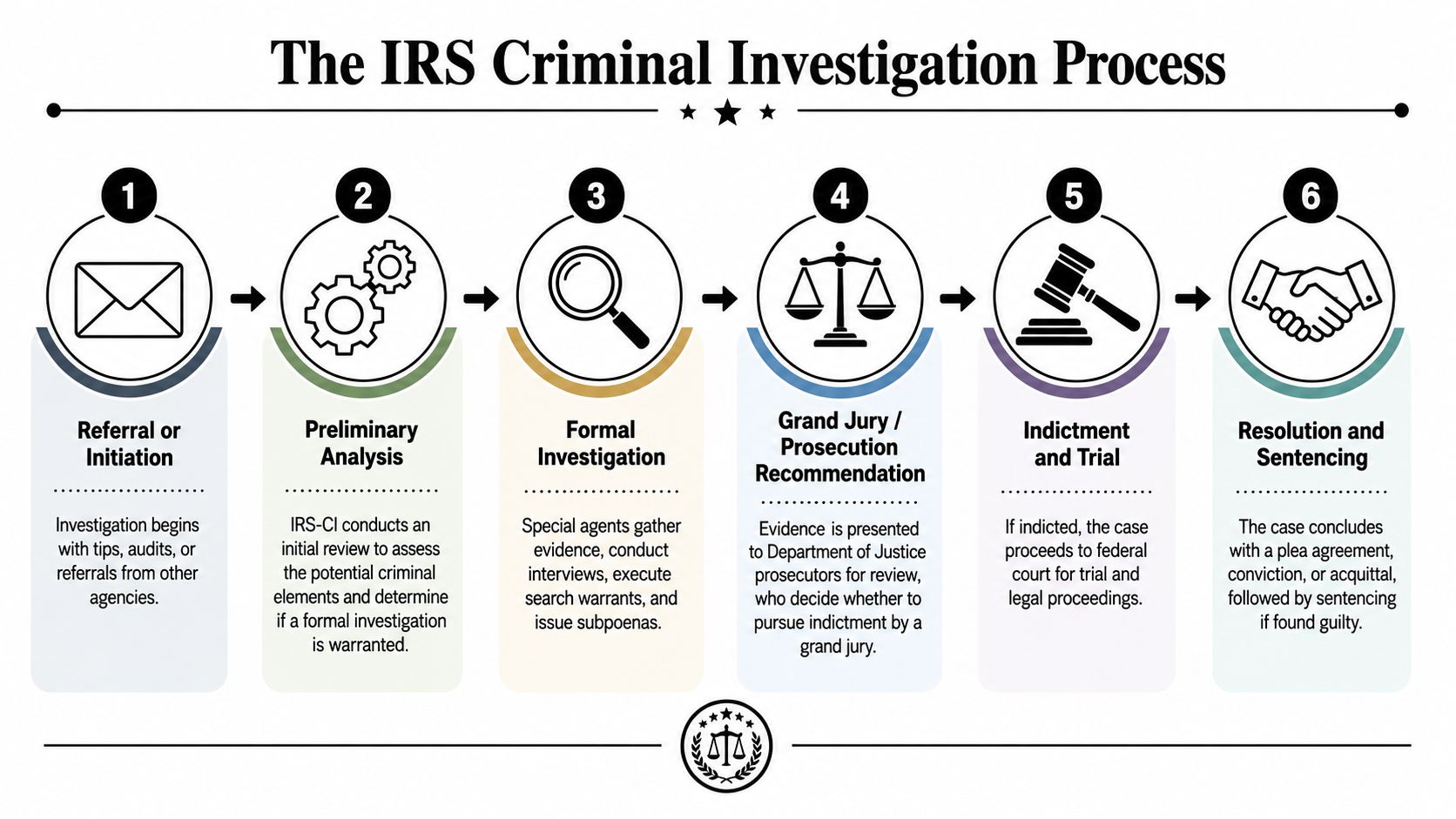
An IRS criminal investigation usually starts before the target knows it exists. A civil audit can produce a referral. A bank record can draw attention. A former employee, former spouse, business partner, or other agency can put facts in motion. By the time agents make contact, they may already know far more than you think.
Early development of the case
At the front end, agents and analysts assess whether there are credible criminal indicators. They don't need a complete case to begin digging. They need enough to justify using criminal investigative tools and time.
That can include reviewing filed returns, business structures, public records, and third-party information. It can also include interviews of people around you before anyone contacts you directly.
Formal investigative steps
Once a matter becomes active, special agents start building proof. They may interview employees, customers, vendors, bookkeepers, preparers, family members, and banking contacts. They may issue summonses, gather account records, compare filings across years, and test whether your story matches the paper trail.
One of the most practical tools in unreported-income cases is the bank deposits method. IRS-CI special agents are trained to total bank deposits and compare them to reported income, treating excess deposits as potentially taxable unless the taxpayer can prove a non-taxable source such as a loan or gift, as described in the IRS Criminal Investigation overview on Wikipedia.
That matters because many small businesses and self-employed taxpayers don't keep source documentation in a way that survives scrutiny. Transfers between accounts, reimbursements, loans from family, and owner infusions all get harder to explain later if the records are weak.
If you're already receiving IRS correspondence, this practical guide to responding to IRS letters can help you avoid basic mistakes. But once criminal indicators appear, routine letter-writing logic no longer controls the strategy.
Where cases are won or lost
The government doesn't just add up numbers. It tries to prove intent. That's why agents care about inconsistent explanations, destroyed records, side books, hidden accounts, and who said what during interviews.
Defense counsel usually focuses on a short list of priorities early:
- Control communications: No more unscripted calls or meetings.
- Preserve evidence: Don't "clean up" files. Preservation helps. Alteration destroys credibility.
- Map the facts: Identify entities, years, preparers, accounts, and people who may already have been contacted.
- Build traceability: Match deposits to non-taxable sources where possible.
- Assess exposure: Separate bad optics from provable crimes.
The most dangerous response is a half-prepared explanation. It gives the government a statement to compare against records you haven't reviewed yet.
If the investigation advances, agents may prepare a prosecution recommendation for internal review and potential referral to the Department of Justice. From there, the matter can move toward grand jury activity, charges, negotiations, or closure without prosecution. The point isn't that every IRS-CI case ends in court. It doesn't. The point is that your window to shape the outcome opens early and can close quickly.
Civil Audits vs Criminal Investigations Compared
A lot of taxpayers get into trouble because they use a civil-audit playbook in a criminal matter. That's the wrong framework. The two processes may overlap factually, but the goals and rules are different.
The side-by-side comparison
| Factor | IRS Civil Audit | IRS Criminal Investigation |
|---|---|---|
| Primary goal | Determine the correct tax and assess additional liability if needed | Investigate whether a tax crime or related financial crime occurred |
| Main personnel | Revenue Agent or civil examiner | IRS special agent, often working with prosecutors or other law enforcement |
| Core question | Was the return accurate under tax rules | Did the taxpayer act willfully, deceptively, or fraudulently |
| Typical evidence focus | Records supporting income, deductions, credits, basis, and reporting positions | Concealment, false statements, falsified records, hidden accounts, and reconstructed income |
| How contact often feels | Document requests, interviews, notices, and technical follow-up | Surprise visits, witness interviews, subpoenas or summonses, coordinated evidence gathering |
| Common outcome | Additional tax, penalties, interest, appeals, and collection action | Potential prosecution, plea discussions, trial, restitution, fines, and collateral consequences |
| Best immediate response | Organized factual response through counsel or qualified representative | Stop talking, preserve evidence, and get criminal tax counsel involved immediately |
Why the strategy changes
In a civil audit, broad cooperation often helps if the records are clean and the issue is technical. In an IRS criminal investigation, broad unsupervised cooperation can hand the government the missing piece of intent.
That's why "I just want to explain" is usually a bad instinct. Explanations are evidence. If you give one too early, before the facts are fully reviewed, you may lock yourself into a version of events that doesn't survive contact with bank records, payroll filings, email traffic, or witness statements.
The practical test is simple. If the case has signs of fraud, concealment, or false statements, don't treat it like an ordinary exam. Change posture immediately.
Potential Penalties and Realistic Defense Strategies
You don't need inflated scare tactics to understand the stakes. A criminal tax case can threaten liberty, reputation, professional licenses, business relationships, and future IRS treatment. Even if no charges are filed, the investigation itself can disrupt a company, fracture partnerships, and create parallel civil exposure.

Start with the real defense questions
The government usually needs more than a tax problem. It needs proof of willfulness. That is often the pressure point.
A strong defense may focus on questions like these:
- Was this intentional: Bad records and bad judgment aren't the same as a deliberate scheme.
- What did the taxpayer know at the time: Confusion, delegation, language issues, illness, or disorganization may matter if they undercut intent.
- Did the taxpayer rely on a professional: Reliance isn't automatic immunity, but it can matter where the taxpayer made full disclosure and followed advice in good faith.
- Can deposits be traced to non-taxable sources: Loans, gifts, transfers, capital contributions, and reimbursements should be documented and mapped carefully.
- Did the government overread the facts: Investigators often see suspicious patterns. Defense work tests whether those patterns have innocent explanations supported by records.
Practical defense work is not glamorous
Real defense isn't movie-lawyer drama. It's document control, witness management, chronology building, and careful decisions about whether to speak, when to produce records, and how to frame disputed facts.
That can also include evaluating timing issues. In some cases, the applicable limitations period matters, and this discussion of the statute of limitations for tax evasion is a useful starting point for understanding timing arguments.
There is also a reputation angle people ignore until it's too late. If an investigation becomes public or results in an arrest record, the online fallout can affect financing, employment, and business deals long after the legal case changes. For that separate problem, this strategic guide to removing arrest records is worth reviewing.
A good defense doesn't begin with "How do we talk our way out of this?" It begins with "What can the government actually prove, and what documents support a different conclusion?"
What not to do
Don't create records after the fact and pretend they're contemporaneous. Don't pressure employees to "get on the same page." Don't assume amending returns fixes criminal exposure by itself. Sometimes corrective action helps. Sometimes it looks reactive and self-protective. The context matters.
And don't hire someone whose entire pitch is fear. You need judgment, not theatrics.
What to Do Immediately and How to Find the Right Help
Two IRS special agents leave a card at your home or office. Your next 24 hours matter more than any explanation you feel tempted to give on the spot.
Start with control. Do not answer factual questions. Do not guess. Do not try to sound helpful. Be polite, take their contact information, and tell them your attorney will respond. Then stop talking and start protecting the record.
Your first moves
- Say as little as possible. Courtesy is fine. Substantive answers are not.
- Do not make any false statement. A bad explanation can create a separate problem even if the tax issue is defensible.
- Preserve documents and data immediately. Keep emails, texts, accounting files, payroll records, bank statements, cloud records, and phone data intact.
- Stop internal discussions about the facts. Do not call employees, partners, family members, or your preparer to compare memories or align stories.
- Get defense counsel before the next contact with the government. That includes calls, interviews, summons responses, and any meeting framed as informal.
If you have never hired this kind of lawyer, use a screening process instead of hiring the first person who sounds confident. This guide on how to find a good tax attorney gives a practical way to vet experience, judgment, and fit.
What the right advisor should do
You need a lawyer who handles tax controversy and criminal tax matters. A return preparer, general business lawyer, or ordinary tax debt resolution firm is not enough for this stage.
The right attorney should take control of communications, identify what records exist, assess whether the problem is still civil or has clear criminal exposure, and set rules for who can speak and what can be produced. They should also coordinate carefully with the CPA or enrolled agent already involved, because accounting help and legal defense serve different functions.
Ask direct questions. Has the lawyer handled IRS-CI matters before? Who reviews the documents? How do they assess referral risk and interview risk? What is the plan for the first week?
Attorney Stephen A. Weisberg offers a Free Tax Debt Analysis through his firm website. That kind of early case assessment is useful because you need a concrete plan, not a sales pitch.
A good lawyer will not promise a quick fix. They will give you an organized response plan that covers immediate silence, document preservation, fact review, and a disciplined approach to every contact with the government.


