IRS Collection Procedures: What Small Businesses Must Know
Understand IRS collection procedures from first notice to levy. Learn timelines, enforcement actions, resolution options, and when

In this article
- How IRS Collection Procedures Actually Begin
- The notice sequence creates the first deadlines
- The Three Phases of IRS Collection Enforcement
- Phase one begins with notices
- Phase two brings phone-based collection
- Phase three involves direct collection
- Understanding Tax Liens and Levies
- Tax liens versus levies
- Collection Alternatives for Taxpayers Who Cannot Pay in Full
- Installment agreements
- Offers, non-collectible status, and penalties
- Your Rights Under Collection Due Process
- What to include in the request
- The cost of missing the window
- Statute of Limitations and Timing Strategies
- Build the timing decision around the actual account
- How to Respond and When to Get Professional Help
- Use a deadline-based response plan
- Know when self-representation becomes risky
You open a CP501 notice between customer calls and payroll tasks. The balance looks wrong, the language sounds formal, and your first instinct is to set it aside until you have time to investigate. That's the mistake. By the time the IRS sends a collection notice, the liability has already been assessed and remains unpaid. The question is no longer whether the IRS knows about the debt. The question is which procedural gate comes next, and whether you act before the next gate opens.
IRS collection procedures follow a recognizable sequence. Notices come first, phone-based collection usually follows, and in-person enforcement can come later if the account remains unresolved. The IRS described this three-phase structure in a GAO-referenced overview of its collection activities, which also documents the scale of the system. In fiscal year 2007, the IRS sent more than 16 million first notices, and revenue collected through the collection process rose from about $33 billion in FY2002 to $43 billion in FY2007, an increase of roughly 30%. Those figures show that collection isn't a rare final maneuver. It's an administrative pipeline designed to move large volumes of accounts toward payment, payment arrangements, liens, levies, or non-collectible status.
How IRS Collection Procedures Actually Begin
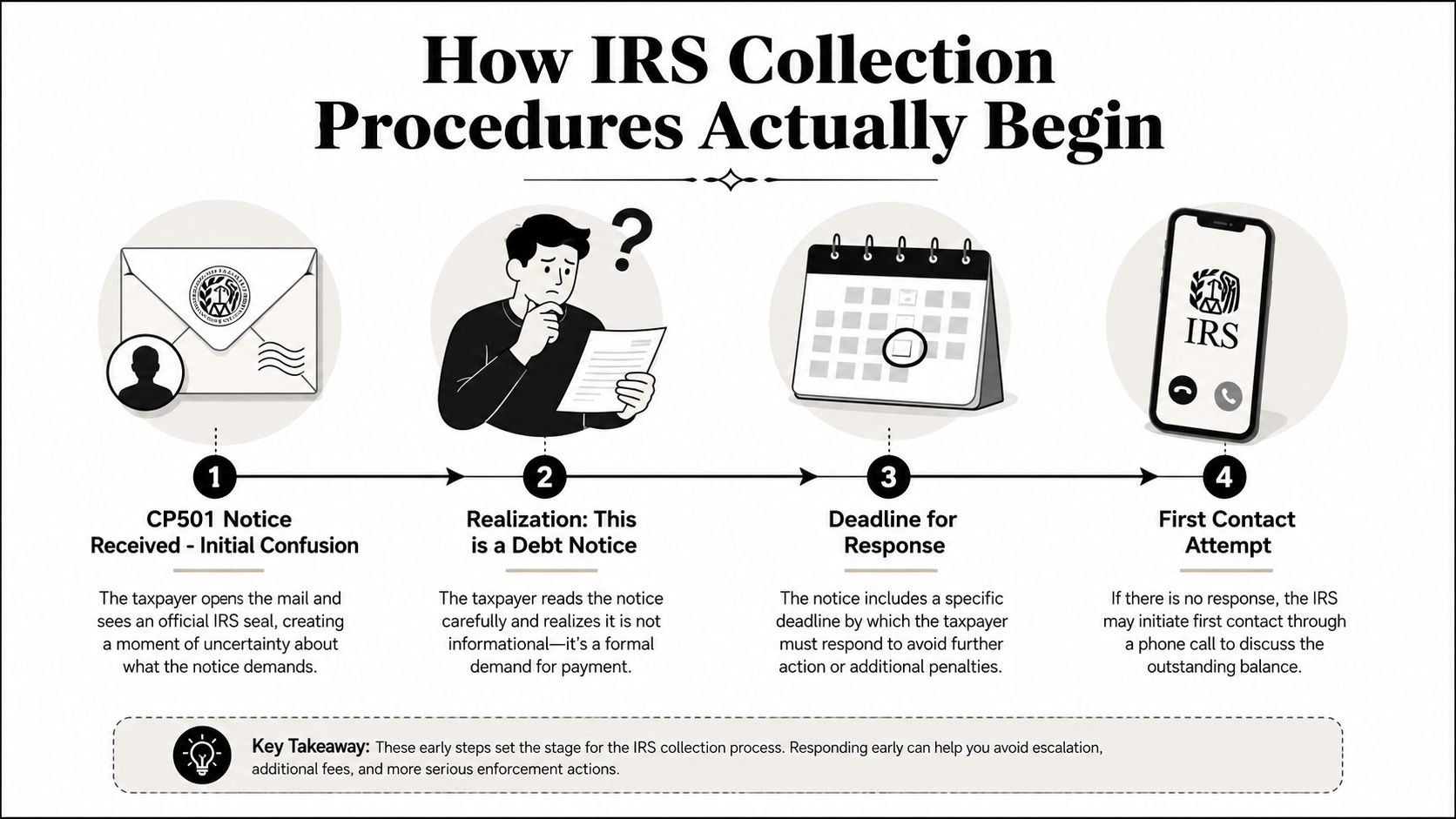
The business owner who receives a CP501 usually experiences the same sequence. First comes confusion. The owner checks the return, wonders whether a payment was misapplied, and assumes the notice can wait. Then comes the uncomfortable realization that the IRS isn't merely asking for clarification. It's documenting an unpaid balance and beginning collection activity.
The IRS generally starts collection after it assesses a tax liability and sends a balance-due notice that functions as a demand for payment. The notice should identify the tax period, the assessed balance, accrued additions, payment history, and instructions for resolving or disputing the account. A balance due notice isn't the same thing as an immediate levy notice, but it still matters because the taxpayer's response rights and later enforcement options depend on the notice received.
The notice sequence creates the first deadlines
The IRS commonly sends increasingly urgent notices as an account remains unresolved. A CP501 may be followed by additional notices such as CP503 and CP504. The language becomes more serious, the response period narrows, and the agency moves closer to assigning the account for direct collection.
Don't treat those letters as duplicates. Compare the tax period, balance, payment credits, response instructions, and stated consequences. If the balance is wrong, gather proof immediately. If the balance is correct but unaffordable, start evaluating a payment plan or another collection alternative before the account reaches a more aggressive stage. The practical guidance in this explanation of IRS collection notices can help you identify what each notice is asking you to do.
Practical rule: Never respond to an IRS collection notice with an unsupported promise to pay. Respond with a verified balance, a realistic proposal, and the documents that prove your numbers.
A taxpayer who ignores the first letter usually hasn't lost every option, but has surrendered control over the timeline. Each notice can carry a distinct deadline or appeal right. Missing it may leave you defending against a levy after the IRS has already completed the steps that would have allowed you to challenge or redirect the action earlier.
The Three Phases of IRS Collection Enforcement
The IRS collection pipeline moves from low-contact administration to direct enforcement. The GAO-described collection framework identifies three broad phases: notices, telephone contact, and in-person action.
Phase one begins with notices
The first phase is paper-based collection. The IRS sends notices demanding payment and explaining available responses. The letters may direct the taxpayer to pay, contact the IRS, dispute the balance, or request a collection alternative.
This is the least disruptive point in the process, but it isn't a harmless stage. The account can continue accumulating interest and penalties, and the IRS can move forward if the taxpayer provides no meaningful response. Review every notice against the account transcript and the underlying return. A bookkeeping error, missing estimated payment, or unfiled return can change the correct resolution strategy.
Phase two brings phone-based collection
If the account doesn't resolve through notices, it may move to the Automated Collection System. ACS personnel communicate by phone and can pursue collection actions, including lien filings and levies, subject to required procedural notices and restrictions.
Treat an ACS call as a negotiation with consequences, not as a customer-service conversation. Ask for the employee's identification information, confirm the liabilities being discussed, and avoid agreeing to a monthly payment before preparing a cash-flow analysis. A small business owner with steady revenue may fit an installment agreement, while an owner with irregular income may need a different proposal supported by a complete financial disclosure.
The Automated Collection System guidance provides useful context for understanding this transition.
Phase three involves direct collection
Revenue Officers handle cases that need personal attention, including complex accounts, serious delinquency, business assets, and potential trust fund recovery penalty issues involving unpaid payroll taxes. A Revenue Officer can request detailed records, interview responsible individuals, inspect assets, and evaluate whether the business is complying with current filing and deposit obligations.
The response changes at this point. You need a defensible financial package, not a general explanation of why the business fell behind. Assemble returns, bank records, payroll information, profit and loss statements, debt schedules, asset information, and a forecast showing how the business can remain current while addressing the old balance.
The earlier you respond, the more choices you preserve. Waiting for a Revenue Officer to force the issue usually makes the same proposal harder to present.
Understanding Tax Liens and Levies
A federal tax lien and an IRS levy are different actions with different consequences. Confusing them can cause a business owner to misjudge the danger.
A lien is the government's legal claim against property securing an unpaid tax debt. It can affect real estate, equipment, business interests, and other property rights. A levy is the actual seizure of property or rights to property, which can include bank funds, wages, or accounts receivable. The lien clouds ownership and priority. The levy takes control of money or assets.
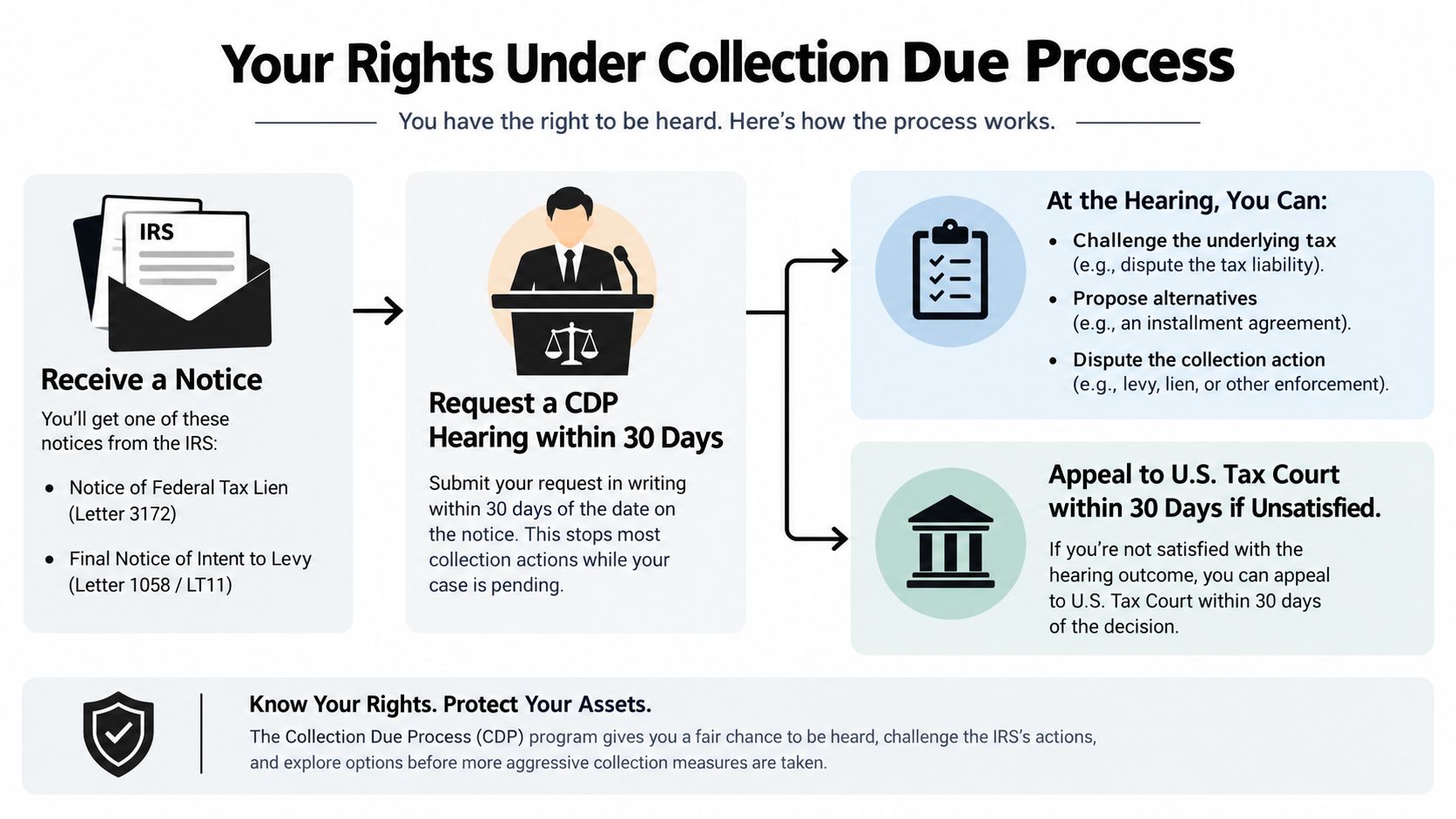
The IRS generally must issue a Final Notice of Intent to Levy and Notice of Your Right to a Hearing before levying. The taxpayer has 30 days to request a Collection Due Process hearing with Form 12153. The IRS explains these procedural distinctions in its Collection Due Process frequently asked questions.
A federal tax lien can arise earlier as a public claim securing the debt. The IRS typically sends a lien CDP notice within five business days after filing a Notice of Federal Tax Lien, according to the same IRS guidance. That timing matters because the lien may affect financing and title before the IRS seizes anything.
Tax liens versus levies
| Feature | Federal Tax Lien | IRS Levy |
|---|---|---|
| Basic effect | Creates a public claim securing the tax debt | Seizes property or payment rights |
| Common business impact | Can interfere with financing, title, and creditor priority | Can remove operating cash, wages, or receivables |
| Procedural position | May be filed before asset seizure | Requires a final levy notice and hearing rights |
| Immediate cash impact | Usually indirect | Direct and potentially severe |
| Primary response | Challenge, subordinate, withdraw, release, or resolve the debt | Request release, appeal, or establish a resolution that stops collection |
Consider a self-employed contractor whose business bank account receives a levy. The bank may restrict the funds and send them through the levy process. The contractor should immediately identify the tax periods, determine whether the levy notice and CDP deadline remain open, and contact the IRS or representative with a concrete resolution proposal. The contractor can also request release when the levy causes economic hardship or when an arrangement makes continued levy inappropriate. The IRS states that a levy may be released when releasing it helps the taxpayer pay, an installment agreement prevents continued levy, or the levy creates economic hardship, among other circumstances, in its guidance on getting a levy released.
Businesses that routinely handle notices, filings, and lien records may also benefit from operational support. For example, some owners choose to outsource lien administration to Attorney Assistant so administrative tracking doesn't distract from the legal resolution strategy. That service doesn't replace a tax analysis, but it can help keep lien-related tasks organized.
For a focused explanation of which action affects your property, review the distinction between a lien and a levy.
Collection Alternatives for Taxpayers Who Cannot Pay in Full
The right resolution option depends on cash flow, assets, compliance, and the realistic ability to pay. Don't choose an offer in compromise because it sounds like a discount, and don't choose an installment agreement merely because it's familiar. The IRS evaluates whether the proposal protects collection and fits the taxpayer's financial circumstances.
The IRS reported that it collected $117.5 billion in unpaid assessments on returns filed with additional tax due in FY2025, with $73.1 billion net after credit transfers, and assessed $29.6 billion in additional taxes for returns not filed timely while collecting almost $3.5 billion from delinquent returns. It also received 38,797 offers in compromise and accepted 5,464, totaling $98.1 million, according to its collection process guidance. The lesson is straightforward. An offer is a real path, but it's a selective one that requires evidence.
| Alternative | Eligibility Criteria | Required Forms | Typical Timeline | Best For |
|---|---|---|---|---|
| Installment agreement | Ability to make sustainable payments while staying compliant | Form 9465, and sometimes Form 433-A, Form 433-B, or related financial forms | Depends on the agreement and IRS review | Businesses with reliable cash flow |
| Offer in compromise | Doubt as to liability, doubt as to collectibility, or effective tax administration | Form 656, Form 433-A or Form 433-B, and supporting records | Review depends on completeness and complexity | Taxpayers whose documented ability to pay is below the full balance |
| Currently Not Collectible | Collection would prevent payment of basic allowable living or operating expenses | Form 433-A or Form 433-B with financial support | Requires financial review and later monitoring | Owners with insufficient disposable income |
| Penalty abatement | Reasonable cause or another recognized basis for removing penalties | Written request or applicable IRS form, with supporting explanation | Varies with the request and account | Taxpayers whose penalties arose from qualifying circumstances |
Installment agreements
An installment agreement fits a business that can pay over time. The proposal must account for current tax obligations, payroll deposits, estimated payments, and the old balance. Interest and penalties generally continue during the agreement, so a low payment that prolongs the debt may cost more and can fail if the taxpayer defaults.
A pending processable installment request generally restricts levy action while the IRS reviews it. The IRS explains that levy is generally prohibited while the request is pending, during the agreement, and for 30 days after rejection or termination. A timely appeal can extend the levy restriction during the appeal period, as described in the IRS payment plan guidance. This protection is valuable, but it doesn't erase lien risk or stop the underlying balance from growing.
Use the installment agreement resource for taxpayers to organize the proposal around actual affordability rather than an arbitrary monthly figure.
Offers, non-collectible status, and penalties
An offer in compromise requires a complete financial picture. The IRS may examine bank statements, assets, equity, income, expenses, and future earning capacity. Submitting Form 656 without credible Form 433-A or Form 433-B support is a common way to create delay and rejection.
Currently Not Collectible status can pause active collection when the taxpayer lacks the ability to pay after allowable expenses. It doesn't cancel the debt, and the IRS can review the financial situation later. Penalty abatement is narrower. It addresses qualifying penalties, not the underlying tax, and it requires a coherent explanation supported by records.
For broader context on business obligations outside IRS programs, see Capital Express business debt guidance. Commercial debt settlement isn't a substitute for an IRS resolution, but understanding the distinction helps prevent a business owner from applying a private-credit solution to a federal tax problem.
Your Rights Under Collection Due Process
A CDP notice creates a procedural opportunity that many taxpayers waste. If the IRS files a Notice of Federal Tax Lien or sends a Final Notice of Intent to Levy, the taxpayer generally has 30 days to request a hearing using Form 12153. The request goes to the IRS Independent Office of Appeals, not to the collection employee who issued the notice.
What to include in the request
A CDP request should identify the taxpayer, notice, tax periods, and proposed collection alternative. It should also explain the specific issue, such as an incorrect balance, an inappropriate levy, a financial hardship, or a workable installment proposal.
The Appeals settlement officer will generally want evidence that the taxpayer is filing and paying current obligations, along with a financial statement and supporting records. For a business, that may include:
- Current compliance: Filed returns, payroll deposits, estimated payments, and other required filings.
- Cash-flow evidence: Recent bank statements, accounts receivable, accounts payable, and profit and loss records.
- Asset detail: Real estate, vehicles, equipment, investments, and available equity.
- Expense support: Operating costs and personal living expenses used in the financial analysis.
- Resolution proposal: Payment amount, funding source, payment schedule, and contingencies.
The hearing isn't a place to repeat hardship without proposing a path forward. Appeals generally considers whether the collection action is appropriate and whether another option, such as an installment agreement or offer, better balances collection with the taxpayer's circumstances.
The cost of missing the window
A timely CDP request generally prevents levy action while the hearing is pending. It can also preserve the right to seek judicial review in Tax Court if the taxpayer disagrees with the Appeals determination. Missing the deadline can leave an equivalent hearing as a narrower fallback, but the taxpayer may lose the same judicial review rights available through a timely CDP request.
Use the window strategically. Filing without documents can buy time, but it can also create avoidable delay if the settlement officer asks for records that should have been assembled before the request. Prepare a concise case summary, attach the notice, state the requested outcome, and submit a financial package that matches the proposal.
Statute of Limitations and Timing Strategies
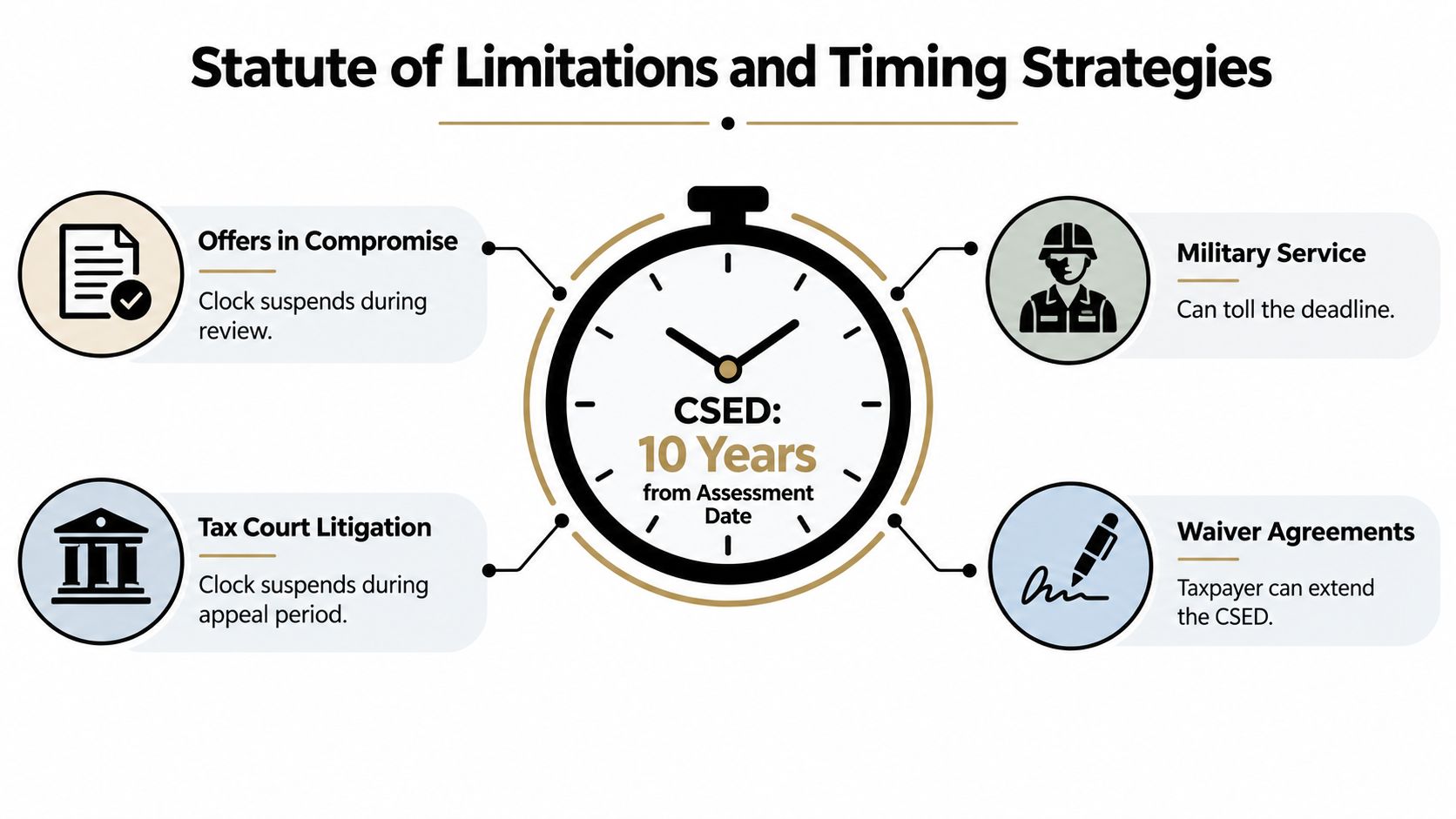
The IRS generally has a 10-year collection period measured from the assessment date, subject to events that suspend or extend the collection period. This period is commonly referred to as the Collection Statute Expiration Date, or CSED. The practical issue isn't only knowing that a deadline exists. It's determining the correct date for each tax period and understanding which procedural actions change the remaining time.
A pending installment agreement can suspend enforced collection, while the collection statute is extended during the stay. The IRS payment-plan guidance explains that delay may protect operating cash in the short term, but it can also prolong exposure to interest and penalties. That's why a payment proposal should be accurate before filing, not improvised after enforcement begins.
Build the timing decision around the actual account
A taxpayer near the end of the collection period may have a different strategy from a business facing an immediate bank levy. The owner should compare the remaining collection window with the cost of compliance, interest, penalties, financing, asset liquidation, and operational disruption.
| Account position | Sensible focus |
|---|---|
| Long remaining collection period and steady cash flow | Pursue a sustainable installment agreement or full-pay plan |
| Limited ability to pay and strong financial evidence | Evaluate an offer in compromise |
| No disposable income after allowable expenses | Consider Currently Not Collectible status |
| Imminent enforcement and open CDP rights | Use the hearing window to contest or redirect collection |
| Date uncertain or records incomplete | Obtain account transcripts and calculate each CSED before making a strategic choice |
Don't assume the CSED from memory or from the date on a notice. Request transcripts, reconcile assessments and payments, and identify periods in which collection may have been stayed or extended. Don't sign a waiver or submit a defective offer without understanding its effect on the collection period.
Timing is a legal and financial decision. Delaying can preserve cash in some cases, but delay can also invite a lien, levy, or Revenue Officer assignment. Early engagement is usually the better choice when the business needs predictable cash flow, financing, or protection from seizure.
How to Respond and When to Get Professional Help
Start with the notice, not the solution you heard about online. Confirm the tax periods, balance, notice date, response deadline, and whether the IRS has identified a lien, levy, hearing right, or assigned collection employee.
Use a deadline-based response plan
Within 48 hours, preserve the notice and gather the account records. Pull prior-year returns, payment confirmations, IRS transcripts, bank statements, payroll records, current profit and loss statements, accounts receivable, accounts payable, and an asset schedule.
Within 14 days, reconcile the balance and determine whether all required returns are filed and all current payroll or estimated payments are being made. Create a cash-flow forecast that separates business operating needs from personal expenses. Decide whether the facts support an installment agreement, offer in compromise, Currently Not Collectible request, penalty abatement request, or a challenge to the liability.
Before the notice deadline, submit the appropriate response. Form 9465 may support an installment agreement. Form 656 and Form 433-A or Form 433-B may be required for an offer in compromise. Financial disclosure forms must be complete, consistent, and supported by records. A missing return, unexplained bank deposit, understated asset value, or unrealistic expense can undermine an otherwise valid proposal.
Know when self-representation becomes risky
Professional representation is especially important when the balance is substantial, trust fund recovery penalty exposure exists, a Revenue Officer has contacted the business, or a levy threatens payroll or operating funds. Those cases require more than filling out a form. They require managing communications, protecting procedural rights, and presenting financial facts in a way the IRS can verify.
Choose a tax attorney, enrolled agent, or CPA who regularly handles IRS controversy and collection work. Ask who will communicate with the IRS, whether the professional will review transcripts, what documents are required, and how the proposed resolution affects liens, levies, interest, penalties, and the collection period. Tax Attorney Stephen A Weisberg offers a free tax debt analysis before taking on representation, and his practice works with individuals, business owners, and professionals handling IRS collection problems.
Tax Attorney Stephen A Weisberg can review your IRS notices, assess levy and lien exposure, and match your financial facts to a workable collection strategy. Visit Tax Attorney Stephen A Weisberg to request a free tax debt analysis and determine what should happen before your next IRS deadline.


