IRS Code 9001: A Tax Attorney's Guide to What It Means
Panicked by IRS Code 9001? Our expert guide explains what this common refund error means, why it’s not an audit, and how to fix it in seconds. Learn more.
In this article
- The Moment of Panic You See IRS Code 9001
- Why this code spooks people
- What IRS Code 9001 Actually Is
- A useful comparison
- What works and what does not
- What this code does and does not tell you
- What IRS Code 9001 Is Not An Audit Flag
- How real IRS trouble usually shows up
- Identity theft fears
- The Simple Fix and When It Gets Complicated
- The clean fix
- When the story changes
- What not to do
- Your Next Steps for Real Tax Problems
- False alarms versus action items
- Resolution paths that may apply
- What works in the real world
- When You Should Call a Tax Attorney
- Situations that call for legal help
- Cost concerns are real
- Frequently Asked Questions About IRS Errors
- Does irs code 9001 delay my refund by itself
- Can my CPA or tax preparer fix irs code 9001 for me
- If I correct the login and the code disappears, am I in the clear
- Should I order a transcript just because I saw 9001 once
- Is 9001 ever the sign of an audit
You check Where’s My Refund? because you want one simple answer. Is the refund coming, or isn’t it? Instead, the screen gives you a cryptic message: IRS Code 9001.
A common reaction is to assume the IRS has flagged the return, frozen the refund, or found something wrong. That reaction is understandable. IRS notices and codes rarely feel harmless, and when money is involved, a vague portal message can ruin your afternoon fast.
In practice, this is one of those moments where panic usually outruns the facts. IRS code 9001 often looks serious and isn’t. The useful question isn’t just what the code means. The useful question is whether you’re looking at a false alarm in the refund tool or the beginning of a real tax problem that shows up somewhere else.
The Moment of Panic You See IRS Code 9001
A typical version of this starts with a joint return. One spouse files, both expect a refund, and later the other spouse checks the status on a phone during lunch or after work. The IRS tool rejects the login and flashes 9001. From there, people jump to the worst conclusions. Audit. Fraud. Offset. Rejection.
That fear makes sense because the IRS doesn’t write these messages for ordinary people. It writes them for systems. Taxpayers are left to decode a number without context, and that’s why a routine portal issue can feel like a legal emergency.
Why this code spooks people
The problem is the mismatch between the message and the actual situation.
- It appears suddenly: You aren’t warned that you may be using the wrong identifier.
- It looks official: Any IRS reference number feels like it carries legal weight.
- It shows up during a high-stress moment: You’re checking on money you may already be counting on.
Serious IRS problems usually come with clearer follow-up than a refund portal code. If you’re getting letters, compare them against this guide to IRS letters and notices.
A calm reading helps. Code 9001 is usually not the story. It’s the screen telling you that the inquiry was made the wrong way. The primary task is figuring out whether that’s all that happened, or whether you also have a separate issue that belongs on a transcript or in the mail.
What IRS Code 9001 Actually Is
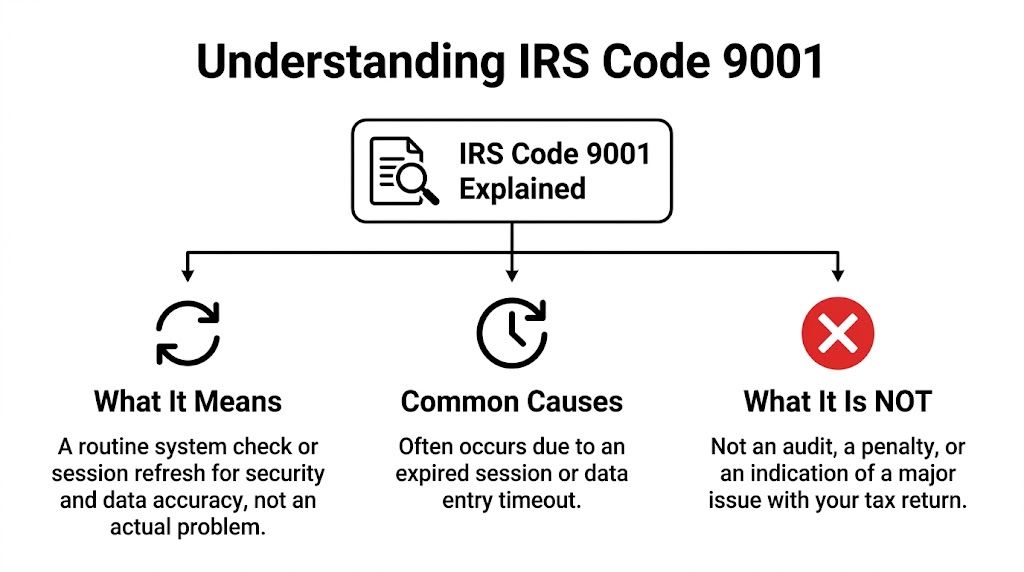
IRS code 9001 is a refund status lookup error, not a tax determination. It usually appears in Where’s My Refund? or IRS2Go when the status check is made with a secondary TIN or SSN instead of the primary one listed on the filed return. The Internal Revenue Manual language, quoted in this explanation of IRS code 9001, puts it this way: “Taxpayer accessed Refund Status using a secondary TIN. Refund Status could not be returned. Get a Primary TIN, analyze account and follow appropriate IRM.”
In plain English, the system is rejecting the way the inquiry was entered. It is not issuing a legal conclusion about the return itself.
A useful comparison
Online banking is the easiest comparison. A married couple may share the same money, but the portal still expects the login tied to that account view. Use the wrong credential, and the site blocks access even though the account itself may be perfectly fine.
That is usually what is happening with code 9001.
- On a joint return, the taxpayer listed first is generally the primary taxpayer for refund lookup.
- A dependent’s information will not pull up the return.
- The tool also requires the filing status and exact refund amount to match what was filed.
What works and what does not
The fix is mechanical. Enter the primary taxpayer’s identifying number, use the filing status exactly as it appears on the return, and enter the exact refund amount without guessing.
Problems start when people use the spouse listed second, round the refund number, or rely on memory instead of the filed copy.
Practical rule: On a joint return, check which Social Security number appears first before assuming there is any deeper IRS problem.
What this code does and does not tell you
Code 9001 tells you something about the access attempt. It does not tell you whether the return was accepted, whether the refund was approved, or whether the IRS has raised an enforcement issue.
That distinction matters. I often have to separate a harmless portal problem from a genuine tax issue, and they do not show up in the same place. If your concern is audit exposure rather than refund access, review the common tax audit triggers instead of treating 9001 as proof that the IRS has singled out your return.
What IRS Code 9001 Is Not An Audit Flag
Clients often read far too much into this code because it appears on an IRS-branded tool. That is understandable. A screen message feels official, and people assume it carries the same weight as a notice, hold, or transcript entry.
It does not.
Code 9001 is not an audit selection code, not a penalty notice, not a lien warning, and not a transcript code. If you pull your account transcript or return transcript, you are looking for actual account activity such as processing freezes, notice issuances, or refund holds. A refund portal message is a different category entirely. The IRS’s own taxpayer guide to understanding your transcript explains where official transcript codes appear, and 9001 is not one of them.
The practical point is simple. Treat 9001 as a website access or matching problem unless you also have something more concrete.

How real IRS trouble usually shows up
Serious tax issues usually arrive through records the IRS stands behind, not through a vague refund lookup error.
Mail from the IRS
A letter or notice usually means the agency wants verification, proposes a change, or is asking for a response by a deadline.Transcript codes or account holds
Processing delays, refund freezes, and account reviews generally show up on transcripts. That is where I look when I need to separate a harmless portal problem from a real tax administration issue.Requests tied to a specific return problem
If your return needs correction, the IRS will usually communicate that directly. In some cases, the better fix is to amend a tax return to correct the filing, not to keep retrying the refund tool.
Audit anxiety also tends to outrun the facts. The IRS Data Book reports relatively low audit coverage for most individual filers. For returns with total positive income under $200,000, the audit rate was 0.4% in fiscal year 2023, according to the IRS Data Book Table 9a. That statistic does not prove any one return is safe, but it does help put a generic portal code in perspective.
Identity theft fears
Identity theft is a separate issue, and code 9001 by itself does not prove it.
If the IRS suspects a genuine identity verification or fraud problem, it typically communicates that through a letter, a specific account action, or a verification process tied to the return. A standalone refund lookup error is weak evidence. I tell clients to avoid jumping from "the tool rejected my entry" to "someone stole my identity" unless other facts support it.
The useful distinction is this. A benign portal error is annoying. A transcript hold, a notice deadline, or a fraud letter needs action. Knowing which one you have keeps you from wasting time on the wrong problem.
The Simple Fix and When It Gets Complicated
The simple fix is usually immediate. Exit the refund tool, start over, and enter the information from the return exactly as filed. The most common correction is using the primary taxpayer’s SSN or TIN instead of the secondary one.

The clean fix
Try this in order:
Use the first-listed taxpayer’s SSN On a joint return, that usually resolves the issue.
Match the filing status exactly Don’t rely on memory if you filed under a different status than usual.
Enter the exact refund amount Exact means exact. Don’t round.
If the portal opens normally after that, the problem was likely limited to the access attempt. That’s the end of it for many people.
When the story changes
Things get more complicated when the portal issue is only happening alongside a genuine processing delay. Code 9001 can sometimes appear at the same time as more meaningful transcript codes such as 570 and 971. As explained in this breakdown of 9001 with verification holds, those codes often point to a verification hold that can push a refund beyond the standard 21-day timeline.
Here’s the practical distinction:
| Situation | Likely meaning | Best next move |
|---|---|---|
| 9001 appears, then normal refund access works with the primary SSN | Portal access mistake | Stop troubleshooting |
| 9001 appears and refund status still doesn’t progress | Could still be a routine delay | Check transcript or wait for mail |
| 9001 appears and transcript shows 570 or 971 | Verification or account action may be pending | Review transcript carefully and respond to notices |
What not to do
Don’t assume a portal error requires an amended return. Don’t rush to “fix” the tax return itself unless you know something is wrong with it. Filing an amendment when the primary issue is only a refund lookup error can create confusion instead of solving anything. If you need to correct a filed return, use a guide focused on how to amend a tax return, not a refund-status code.
A transcript can turn anxiety into facts. If 9001 is the only problem, the answer is usually simple. If other codes appear, you’ve moved into a different category of IRS issue.
Your Next Steps for Real Tax Problems
If you’ve ruled out the simple login issue and found a real tax problem, the goal changes. You’re no longer trying to decode a portal message. You’re deciding how to respond to the IRS in a way that protects your refund, your bank account, your business, or all three.
Some taxpayers need only patience and a response to a verification request. Others need a larger resolution plan because the refund issue uncovered a debt, a filing problem, or an account balance they didn’t fully understand.
False alarms versus action items
Here’s the practical sorting framework.
| Code | What It Looks Like | What It Means | Your Action |
|---|---|---|---|
| 9001 | Refund tool error message | Portal access issue tied to the wrong taxpayer identifier | Retry using the primary taxpayer information |
| 570 | Transcript entry | Additional account action pending | Read the transcript closely and watch for IRS mail |
| 971 | Transcript entry | Notice issued | Wait for the notice, then respond to the issue raised |
Resolution paths that may apply
If a real issue exists, these are the tools practitioners usually consider:
Installment agreement Useful when the IRS is primarily looking for payment over time and the account is otherwise manageable.
Offer in Compromise This can be appropriate in narrower situations where the taxpayer qualifies and the numbers support settlement. It is not a general shortcut. It’s a detailed application process that succeeds only in the right cases.
Penalty abatement Sometimes the core tax is valid, but penalties may be challenged or reduced depending on the facts.
Return correction or document response In some cases the problem isn’t debt at all. The IRS may want verification, missing information, or clarification.
A smaller but common practical issue involves signature and filing workflow. Taxpayers sometimes don’t remember exactly what was authorized or signed at filing time. If you need a refresher on the e-file authorization process, this overview of IRS Form 8879 is a helpful reference because that form often answers who approved electronic filing and how.
What works in the real world
The best results usually come from narrowing the issue before taking action. Get the transcript if available. Read every IRS letter carefully. Match the dates and tax years. Don’t blend a refund delay, an old balance due, and a filing-status question into one giant mystery.
What works is sequence. Identify the issue first, then choose the response. What fails is reacting to the loudest symptom on the screen.
When You Should Call a Tax Attorney
A Code 9001 screen can scare people into treating a portal glitch like a legal emergency. The opposite mistake is the one that causes real damage. Taxpayers ignore the items that actually matter, such as a mailed notice, a payroll tax problem, or account action that reaches beyond one refund.
Call a tax attorney when the problem has legal exposure, personal liability, or a deadline you do not fully understand. That is the dividing line.
Situations that call for legal help
You received an IRS notice and cannot tell what it requires A notice deserves more attention than an online error code. Proposed changes, collection letters, identity verification requests, and deadline-driven responses can affect your rights if handled late or handled casually.
Your refund issue is tied to older tax debt, offsets, or multiple tax years At that point, the question is no longer "Why won’t the tool load?" Account status is the issue, and that often requires strategy, not just patience.
Your business has payroll tax trouble Payroll tax cases are where I tell clients to stop guessing. Unpaid employment taxes can trigger the Trust Fund Recovery Penalty, which allows the IRS to pursue certain individuals personally, not just the business. The IRS explains that process in its guidance on the Trust Fund Recovery Penalty.
You may be a responsible person for a company with unpaid payroll taxes Owners, officers, bookkeepers, and anyone with authority over payments or tax filings can be at risk. Titles matter less than actual control. If you had the power to decide which bills got paid, get legal advice early.
You are close to ignoring the problem because it feels too big That is a real warning sign. Missed response dates can turn a fixable tax matter into liens, levies, or a much harder negotiation.
Cost concerns are real
Many people wait too long because they assume even one call to a lawyer will be unaffordable. Fee structures vary. Some firms charge for an initial review, some credit that amount toward later work, and some offer limited-scope consultations. This guide on how much is a lawyer consultation fee gives a useful general overview.
Choose carefully. Tax controversy work is different from return preparation, and it is different from general business law. If you start looking, use a practical screening process instead of hiring the first firm with the loudest marketing. This article on how to find a good tax attorney is a solid place to start.
Frequently Asked Questions About IRS Errors
Does irs code 9001 delay my refund by itself
Usually, no. The code itself is generally a refund-status access problem, not the cause of the delay. The important question is whether a separate transcript issue or mailed notice exists at the same time.
Can my CPA or tax preparer fix irs code 9001 for me
A preparer can often help you understand what likely happened. But the actual refund lookup still depends on entering the correct taxpayer information into the IRS tool. If the issue expands beyond that into notices, holds, or disputes, the answer may require more than return preparation.
If I correct the login and the code disappears, am I in the clear
Often yes, but not automatically in every case. If the refund continues processing normally, that’s a strong sign the issue was limited to access. If timing drags on or you receive mail, look deeper.
Should I order a transcript just because I saw 9001 once
Not always. If the code disappears after using the correct primary SSN and the refund tool starts working, a transcript may not be necessary. If the refund remains stuck, or if you already suspect another issue, a transcript becomes much more useful.
Is 9001 ever the sign of an audit
By itself, no. Audits and other serious IRS actions are communicated through different channels, especially official notices and transcript activity.
If you’re dealing with more than a simple refund lookup problem, Attorney Stephen A Weisberg offers a free Tax Debt Analysis to determine whether he can help and what path makes sense before charging for representation.