Your Complete Guide to Understanding IRS Code 826
Seeing IRS Code 826 on your tax transcript? Learn what this code means, why it's there, and what your next steps should be. Your expert guide is here.

In this article
- What IRS Code 826 Really Means on Your Transcript
- The Two Faces of Code 826
- Quick Reference for IRS Code 826 Scenarios
- How the IRS Uses Code 826 to Track Your Income
- The Automated Matching Game
- Why Timing Matters
- Real-World Examples of IRS Code 826 in Action
- Scenario 1: The Sole Proprietor and Payroll Tax Debt
- Scenario 2: The S-Corp Owner and Unreported Interest
- Scenario 3: The Trust Fund Recovery Penalty
- Your Step-by-Step Action Plan for Code 826
- Step 1: Gather Your Financial Documents
- Step 2: Cross-Reference Your Records
- Step 3: Respond to Any IRS Notices Promptly
- How to Resolve Problems Triggered by Code 826
- Explore Your IRS Resolution Options
- Special Cases for Individuals and Businesses
- When You Should Call a Tax Attorney About Code 826
- Red Flags That Signal You Need an Attorney
- The Value of Personalized Legal Counsel
- Frequently Asked Questions About IRS Code 826
- Will IRS Code 826 Always Take My Entire Refund?
- Does Seeing IRS Code 826 Mean I Am Being Audited?
- What if I Disagree with the CP2000 Notice I Received?
- How Long Until I Receive My Refund After Code 826 Appears?
Seeing an unfamiliar code on your IRS transcript can definitely make your heart skip a beat. But when you spot IRS Code 826, take a deep breath. It’s not a penalty or a sign that you’re in trouble.
Think of it as an internal memo from the IRS. It simply signals that they've moved some money around within your account. The key is figuring out why they moved it.
What IRS Code 826 Really Means on Your Transcript

Transaction Code (TC) 826 is purely informational. It’s the IRS’s way of documenting a transaction that has already happened. It can mean one of two very different things, and the context on your transcript is what tells the story.
To get that context, you'll need to look at your full tax records. Pulling your official tax transcript is the best first step, and you can learn how to get your IRS transcript online to see exactly what’s going on.
The Two Faces of Code 826
Once you have your transcript, you’ll see that TC 826 almost always points to one of two scenarios.
First, and most commonly, it means the IRS used an overpayment or refund from one tax year to pay off a debt from a different year. Let's say you're due a $2,000 refund for 2023, but you still owe $1,500 from your 2021 taxes. The IRS won't send you the full $2,000.
Instead, they will automatically apply $1,500 of that refund to your old debt. Code 826 will appear on your transcript showing that transfer. You’ll then receive the remaining $500. It's just the IRS squaring things up internally.
The Bottom Line: Code 826 is just a bookkeeping entry. It’s not a new tax, a penalty, or an audit flag. It’s simply the IRS showing its work as it moves money between your tax accounts to settle a balance.
The second reason for seeing Code 826 is much more routine and usually requires no action from you at all. The IRS uses it to document that it has cross-referenced interest income reported on a Form 1099-INT from a bank or financial institution.
This is part of their Automated Underreporter (AUR) program, which automatically matches the income you report against what third parties report for you. If the numbers don't line up perfectly, you might receive a CP2000 notice proposing changes to your tax return.
Understanding what these communications mean ahead of time can be a huge help. It’s always a good idea to familiarize yourself with the most common IRS letters and notices so you’re prepared for any follow-up.
To make things clearer, this table breaks down the two main reasons you'd see Code 826 on your transcript.
Quick Reference for IRS Code 826 Scenarios
| Scenario | What It Means for You | Recommended Action |
|---|---|---|
| Overpayment Applied to Debt | You had a refund from one year that the IRS used to pay off a tax debt from a different year. The code documents this transfer. | Review your transcript to confirm the amount transferred and the tax year it was applied to. Ensure your remaining refund amount is correct. |
| Interest Income Cross-Reference | The IRS is noting that it received a Form 1099-INT reporting interest income in your name. This is a standard matching process. | If the interest income on your tax return matches the 1099-INT, no action is needed. If it doesn't match, anticipate a notice and be ready to explain the discrepancy. |
By identifying which of these situations applies to you, you can quickly understand what the code means and decide what, if anything, you need to do next.
How the IRS Uses Code 826 to Track Your Income
Seeing IRS code 826 on your tax transcript can be confusing, but it’s really just a digital footprint left by one of the IRS’s most powerful automated systems. It signals that the agency is running your numbers through its massive income-matching program.
Think of it like this: every time a bank, employer, or payment processor sends you a form like a W-2 or 1099, they send an identical copy to the IRS. The IRS feeds all this third-party data into a system called the Information Returns Processing (IRP) program.
From there, another program, the Automated Underreporter (AUR), takes over. The AUR’s only job is to compare the income reported by those third parties directly against the income you reported on your tax return. It’s a high-tech game of “match the numbers.”
The Automated Matching Game
Let’s say you earned some interest from a savings account. Your bank sends you a Form 1099-INT and sends the same form to the IRS. When you file your return, the AUR system checks to see if the interest income you reported matches what the bank reported. If it does, you'll never hear a thing.
But what if you forgot about that account? The system will immediately flag the mismatch. This discrepancy is the number one reason people receive a CP2000 notice, which is the IRS’s way of saying, “We think you underreported your income, and here’s our proposed change to your tax bill.”
This is especially critical for business owners and freelancers who might juggle dozens of 1099s. It’s incredibly easy to miss one. The rules around this are always shifting, particularly with the new 1099-K reporting rules, which you can learn more about here: https://www.weisberg.tax/newsletter/the-1099-k-mess-the-irs-just-changed-the-rules-again-y7ksr-52e7f-nm22z.
Why Timing Matters
You’ll often see IRS code 826 pop up on your transcript about 30-60 days after the tax filing deadline. Don't panic; this is completely normal. It simply reflects the time it takes for the IRS’s systems to process the hundreds of millions of information returns filed each year.
The appearance of TC 826 is an internal marker for the IRS, letting them know that the income verification process for your account has begun.
Key Insight: The IRP and AUR programs are the IRS's front-line defense for closing the "tax gap"—the massive difference between what taxpayers owe and what they actually pay. This automated matching identifies billions in unreported income every year without requiring a full, person-to-person audit.
When you see IRS code 826, it’s often tied to third-party interest income from sources like a Form 1099-INT. The sheer volume is immense. When a mismatch is found and a CP2000 notice is sent, a proper response is crucial. In fact, about 65% of these cases can be resolved without you owing more tax, but this often requires a professional touch to navigate the process correctly.
Understanding this system demystifies why IRS code 826 appears on your record. More importantly, it underscores just how vital meticulous record-keeping is for every single taxpayer.
Real-World Examples of IRS Code 826 in Action
So, what does IRS Code 826 actually look like when it shows up on your tax transcript? It’s one thing to talk about codes and definitions, but it’s another to see how this simple number can signal a major financial shift for taxpayers, especially business owners.
Think of it as the IRS's internal bookkeeping note. It pops up when the system takes money from one pile (like a refund you’re owed) and moves it to another pile (a debt you haven't paid). Let’s walk through a few common situations where this happens.
Scenario 1: The Sole Proprietor and Payroll Tax Debt
Take a freelance graphic designer, operating as a sole proprietor. She's always been great about filing her personal 1040 taxes. But a few years ago, she hired her first employee and quickly fell behind on the quarterly Form 941 payroll taxes, racking up a $4,000 liability.
This year, things went well, and she was due a personal tax refund of $5,500. She filed her return, expecting a nice direct deposit. Instead, she got a notice in the mail and saw only $1,500 land in her bank account.
Confused, she pulls her IRS account transcript. There it is: Transaction Code 826, with an entry for $4,000. The IRS simply took the money it owed her for her personal refund and used it to pay off her old business payroll debt. Code 826 was just the record of that automatic transfer.
Scenario 2: The S-Corp Owner and Unreported Interest
Here's another one. The owner of a small S-Corporation opened a new high-yield business savings account. At year-end, the bank sent a Form 1099-INT showing $950 in interest income. During the chaos of tax season, that form got lost in the shuffle and the interest was never reported on the business return.
Months later, a CP2000 notice arrives from the IRS, proposing to increase his tax bill and tack on penalties and interest. When he checks his transcript to figure out what happened, he spots IRS Code 826.
In this case, the code wasn't about a refund seizure. Instead, it was the internal flag that started the whole process. The IRS’s automated matching system saw the 1099-INT from the bank, compared it to his tax return, and found the missing income. Code 826 was the first domino to fall, triggering the review that led to the CP2000 notice.
Scenario 3: The Trust Fund Recovery Penalty
A business owner is facing one of the most serious IRS actions: a Trust Fund Recovery Penalty (TFRP). Her company couldn’t keep up with payroll taxes, and now the IRS is holding her personally responsible for the money withheld from her employees' paychecks. This massive debt is now tied directly to her Social Security Number, not the business's EIN.
She’s expecting a personal tax refund this year. But because of the TFRP, the IRS automatically applies her entire refund toward that high-priority debt. On her personal transcript, Code 826 documents the seizure, showing her refund was moved to pay down the penalty.
This really drives home how seriously the IRS treats trust fund taxes. The TFRP pierces the corporate veil, allowing the IRS to collect from your personal assets—including tax refunds—to satisfy a business debt. It’s a situation every business owner needs to avoid or resolve immediately.
This automatic offset is a fundamental tool for the IRS. In fact, IRS Code 826 is a critical marker in their internal systems for all sorts of adjustments. When a penalty is removed, for instance, the IRS has to manually recalculate interest to make sure the taxpayer is only credited for what they actually paid. Mismatches flagged by systems using TC 826 are a huge contributor to the estimated $688 billion tax gap. If you want a deep dive into these procedures, you can actually explore the official IRS manual to see just how complex these calculations get.
Your Step-by-Step Action Plan for Code 826
Seeing a strange code pop up on your IRS transcript can definitely be jarring. But when you see IRS Code 826, take a breath—it’s a signal to investigate, not to panic. It simply marks a transaction on your account, not an audit.
Think of it like getting a text from your bank about a transfer. Your first move isn't to worry, but to log in and see exactly what happened. We're going to do the same thing with your tax records.
Step 1: Gather Your Financial Documents
Before you can figure out the "why," you need to get all your paperwork in one place. Getting organized now will save you a massive headache later. Take a few minutes to pull together these key documents:
- Your IRS Account Transcript: This is your most important piece of evidence. It shows a complete history of activity for a specific tax year, including where Code 826 fits into the timeline.
- All Form 1099-INTs: Round up every 1099-INT you received for that tax year. These are the forms from banks and other financial institutions that report your interest income directly to the IRS.
- Your Filed Tax Return: Grab a copy of the tax return you actually filed for that year. This is your side of the story—what you reported to the government.
Having these documents ready turns a confusing code into a simple matching game.
Step 2: Cross-Reference Your Records
Now it's time to play detective. With your documents in hand, you can compare the records to pinpoint why IRS Code 826 appeared. You're essentially looking for one of two things: a refund being moved or a mismatch in your reported income.
- To Check for a Refund Offset: Scan your account transcript. Does Code 826 show up right next to a refund code (Code 846)? If so, you’ll likely see that your overpayment was used to pay off a debt from another tax year. The transcript will list the exact dollar amount that was transferred.
- To Check for an Income Discrepancy: Add up the interest income from all your 1099-INT forms. Now, compare that total to the interest income you reported on your tax return. If those numbers don't match, Code 826 is probably the IRS's automated system flagging the difference.
This simple cross-referencing process will almost always tell you exactly what triggered the code.
Crucial Tip: It's incredibly common for people to forget about interest earned from a new savings account or a small CD. Even a few dollars of unreported interest can create a mismatch and trigger a notice.
Step 3: Respond to Any IRS Notices Promptly
If your detective work points to an income discrepancy, you can expect a CP2000 notice to arrive in the mail. This isn’t a bill. It's a proposal from the IRS suggesting changes to your tax return based on the information they have from third parties.
Do not ignore this notice. If you don't respond, the IRS assumes you agree with their proposed changes. You must reply by the deadline, which is usually 30 days. Your response needs to clearly state whether you agree or disagree, provide proof (like copies of your 1099s), and explain your position.
Failing to respond allows the IRS to automatically assess the extra tax, plus penalties and interest. If the amount is large or you're not sure how to proceed, it’s always best to get professional advice. For simpler cases where you just need to pay the difference, our guide on how to set up a payment plan with the IRS can walk you through your options.
How to Resolve Problems Triggered by Code 826
Seeing IRS Code 826 on your account transcript can feel like a punch to the gut. It's an official-looking code that signals a previous action on your account has been reversed, and frankly, that's rarely good news. It’s the IRS’s way of saying, “We gave you a credit, but we’re taking it back.”
While the code itself is just an internal marker, it’s often the first sign of a much larger issue brewing. Think of it less like a final diagnosis and more like a concerning lab result. It doesn't tell you the whole story, but it’s a clear warning that you need a plan—and fast. The good news is, the IRS has several well-defined paths you can take to get your financial footing back.
This flowchart maps out your immediate game plan after spotting Code 826 on your transcript.
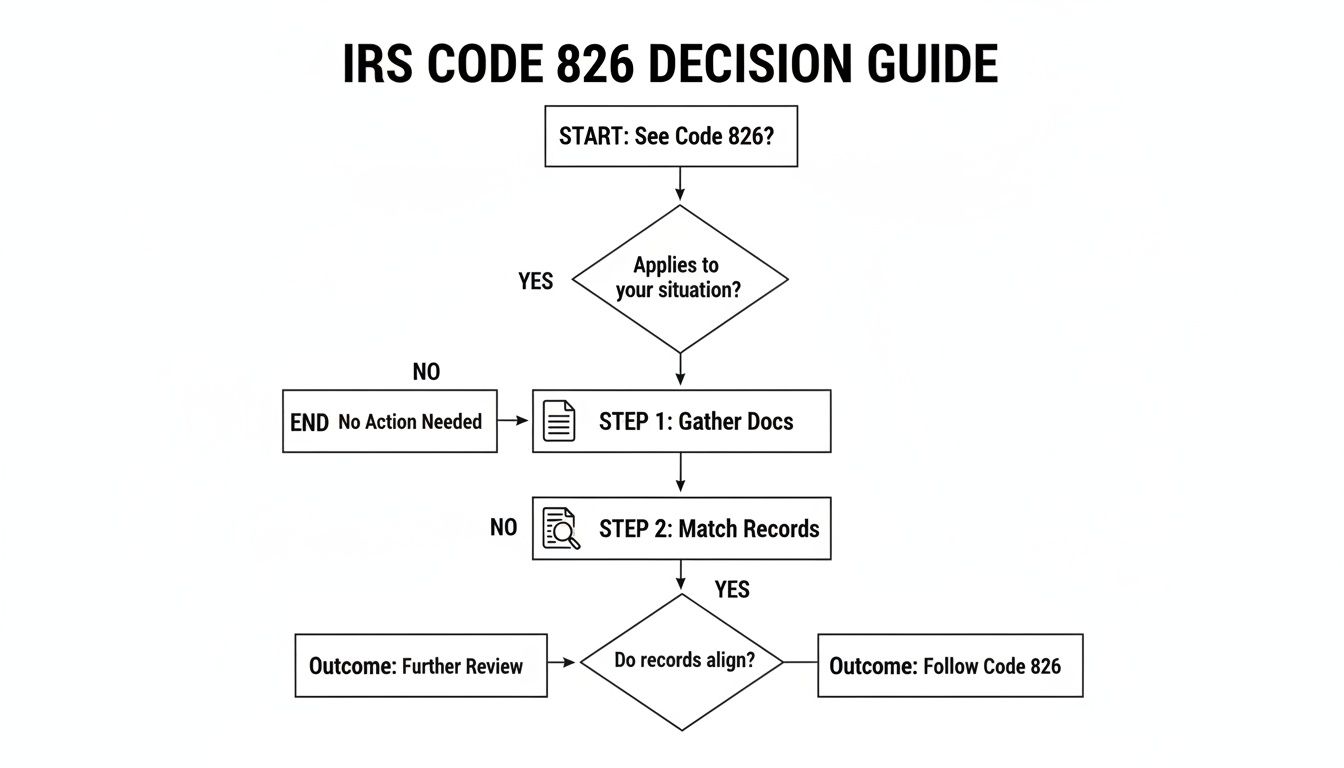
As you can see, the first move isn't to panic; it's to gather your records and compare them to what the IRS has on file. You can't fix a problem until you understand its true scope.
Explore Your IRS Resolution Options
Once you've confirmed the debt and know what you're up against, it's time to choose the right strategy. Each resolution has its own strict rules, and what works for one person might be a complete non-starter for another. Your financial reality—income, assets, and overall ability to pay—will determine the best path forward.
Penalty Abatement
Did the IRS hit you with hefty penalties for failing to file, pay, or deposit on time? You might not have to pay them. Through Penalty Abatement, the IRS can agree to remove those penalties if you can prove you had a reasonable cause for the lapse.
This isn’t just about having a good excuse. You need a compelling story backed by hard evidence. A serious illness, a death in the family, a natural disaster, or even relying on bad advice from a tax preparer could all qualify, but you have to document everything.
Offer in Compromise (OIC)
You’ve probably heard of taxpayers settling their debt for "pennies on the dollar." That’s an Offer in Compromise (OIC). It allows you to settle your tax liability for less than the full amount owed, but it’s far from a sure thing. You must convince the IRS that paying what you owe in full would create a legitimate financial hardship. They will scrutinize your income, expenses, and assets to make that call.
Important Note: The OIC program is notoriously tough. In recent years, the IRS accepted only about 31% of the OICs submitted. It’s a high-stakes application where professional guidance can make all the difference between acceptance and rejection.
Installment Agreement
If you simply need more time to pay, an Installment Agreement is your most direct route. This is a formal payment plan with the IRS that lets you pay down your debt in monthly chunks over a period of up to 72 months. Getting an agreement in place is one of the fastest ways to stop more aggressive collection actions, like bank levies or wage garnishment.
Special Cases for Individuals and Businesses
Sometimes, the standard solutions don't quite fit. A couple of more specialized situations often come up.
- Innocent Spouse Relief: This is a lifesaver if you're on the hook for tax debt created by your spouse (or ex-spouse) without your knowledge. To qualify, you must prove you were unaware of the errors on a joint tax return and that holding you responsible would be fundamentally unfair.
- Trust Fund Recovery Penalty (TFRP): This is a big one for business owners. The IRS can personally hold you liable for unpaid payroll taxes, piercing the corporate veil. If Code 826 appears in a TFRP context, it likely means the IRS has reversed a credit and is coming after you. Resolving it often means proving you weren't a "responsible person" with control over the finances or that your failure to pay wasn't "willful." In these cases, you’ll need to know how to dispute a tax assessment effectively.
Trying to figure out which forms to file, which deadlines to meet, and which legal standards apply can be overwhelming. If you need more clarity, our guide on how to dispute a tax assessment is a great starting point. An experienced tax professional can cut through the complexity, analyze your situation, and build the right strategy to protect you and your assets.
When You Should Call a Tax Attorney About Code 826
Look, I get it. The instinct for many people is to try and handle an IRS notice on their own. And sometimes, for a minor issue, that can work out. But when it comes to IRS code 826, a DIY approach can be like trying to perform your own surgery—it’s incredibly risky when the stakes are this high.
It’s really a matter of scale. You might be able to handle a notice about a hundred dollars in unreported interest yourself. But when the IRS proposes a massive tax increase or targets your business, that’s not a small leak under the sink; it’s a burst water main threatening to flood your entire financial life. Handling that requires a professional.
Red Flags That Signal You Need an Attorney
If any of the situations below sound familiar, it’s a clear sign that you need to stop and seek legal counsel immediately. Hesitating now can trigger automated collection actions from the IRS and severely limit your options down the road.
These aren't minor speed bumps; they are serious problems that demand a strategic legal response.
- You Received a CP2000 Notice Proposing a Large Tax Increase: If the IRS is suddenly proposing thousands of dollars in new tax, penalties, and interest, you need a professional to dive into the details, challenge the IRS's position, and build your defense. Don't just accept it.
- You're Facing a Trust Fund Recovery Penalty (TFRP): The TFRP is one of the most powerful and aggressive tools the IRS has. If they are attempting to make you personally liable for your company's payroll taxes, you need an attorney fighting to protect your personal home, savings, and other assets.
- You Have Tax Debts Spanning Multiple Years: Trying to manage tax liabilities from several different periods is like fighting a war on multiple fronts. An experienced attorney can consolidate your problems into a single, cohesive strategy, giving you a clear path forward instead of just reacting to one crisis after another.
A word of caution: don't assume that the huge, heavily-advertised "tax resolution" companies offer the same level of service as a dedicated tax attorney. Many of those places operate like massive call centers, where your file gets passed around and you rarely speak to the same person twice—let alone an actual lawyer.
The Value of Personalized Legal Counsel
Choosing the right professional is everything. When you work with an attorney like Stephen A. Weisberg at The W Tax Group, you get direct, one-on-one counsel. You have a lawyer who knows you and the specific details of your situation, whether you’re a business owner struggling with payroll or a professional with a complex income structure.
Instead of being pushed into a one-size-fits-all "program," a real attorney develops a strategy tailored to you. It all starts with a deep-dive review, like the free Tax Debt Analysis offered by The W Tax Group, to get a full picture of your finances and identify the best possible outcome—before you ever pay a fee. Think of it as a strategic investment in protecting your financial future.
Frequently Asked Questions About IRS Code 826
After digging into the technical side of things, you're probably wondering what IRS code 826 actually means for your bank account. Let's walk through some of the most common questions we hear from taxpayers.
Will IRS Code 826 Always Take My Entire Refund?
Not always, but it's a definite possibility. It all comes down to a simple math problem: is your tax debt bigger or smaller than your refund?
If you owe the IRS more than your refund is worth, they will apply the entire amount to your outstanding balance. But if your debt is smaller, Code 826 will only reflect the portion of your refund used to clear that debt. The IRS will then send you the rest as a separate payment.
Does Seeing IRS Code 826 Mean I Am Being Audited?
No, you can breathe a sigh of relief on this one. Seeing IRS Code 826 on its own does not mean you're being audited. This code is just a marker in the IRS's automated system—it's a digital flag that either shows a refund was used to pay a debt or that your income needs a second look.
An official audit is a whole different ballgame. That process kicks off with a formal letter from the IRS that will explicitly state your return is under examination. Code 826 is just a transaction code, not the start of a full-blown review.
What if I Disagree with the CP2000 Notice I Received?
Whatever you do, don't just set it aside and hope it goes away. If you get a CP2000 notice—often triggered by an income discrepancy that Code 826 flagged—and you believe it's wrong, you must respond in writing by the deadline, which is usually 30 days.
Your written response needs to clearly lay out why you disagree. Be sure to include copies of any documents that back up your side of the story, like a corrected 1099 form or bank statements. For anything more than a simple error, getting a tax professional involved is your best bet to make sure your response is solid and your rights are protected.
It's a common misconception that a CP2000 is a final bill. It's actually a proposal. A strong, well-documented response can often resolve the issue without you owing anything more.
How Long Until I Receive My Refund After Code 826 Appears?
If IRS Code 826 only took a piece of your refund to cover a debt, you should see the remaining balance within one to three weeks. That said, timelines can get stretched, especially during the chaos of peak tax season. The best way to know for sure is to use the "Where's My Refund?" tool on the IRS website for the most up-to-date status.
Trying to make sense of IRS Code 826 and the notices that can follow is tough, and it's easy to feel overwhelmed. If you're dealing with a substantial tax debt, a Trust Fund Recovery Penalty, or a confusing CP2000 notice, you don't have to face it by yourself. Attorney Stephen A Weisberg and the team at The W Tax Group provide a free, no-obligation Tax Debt Analysis to assess your situation and map out a clear strategy. Protect your financial future by getting expert advice today at https://weisberg.tax.


