How to Resolve an IRS Business Lien A Step-by-Step Guide
Facing an IRS business lien? Learn what it means for your company, its impact on your credit, and the strategic options you have for removal and resolution.

In this article
- The Critical Difference Between a Silent Lien and a Public Notice
- From Private Claim to Public Crisis
- IRS Lien vs Public NFTL: What's the Difference?
- How an IRS Lien Can Paralyze Your Business Operations
- The Automated Trigger Behind the Notice
- The Real-World Consequences for Your Operations
- Strategic Options for Removing an IRS Business Lien
- Lien Release: The Most Direct Path
- Lien Withdrawal: Erasing the Public Record
- Subordination: Making Room for New Financing
- Discharge of Property: Freeing a Single Asset
- Key IRS Lien Resolution Options at a Glance
- How to Negotiate a Payment Solution with the IRS
- The Installment Agreement
- The Offer in Compromise
- Currently Not Collectible Status
- Distinguishing Between Business and Personal Tax Liens
- Federal vs. State Tax Liens
- The Critical Difference Unpaid Payroll Taxes Make
- Why the IRS Lien System Feels So Aggressive
- A Decade of Escalating Enforcement
- More Pressure Didn't Mean More Collections
- Common Questions Business Owners Have About IRS Liens
- Can The IRS Come After My Personal Assets For My Business’s Tax Debt?
- How Long Will This Tax Lien Mess Up My Credit?
- Can I Just File For Bankruptcy To Get Rid Of The Lien?
When the IRS slaps a lien on your business, it’s not just a piece of paper—it's a legal claim against everything you own. Think of it as the government placing a mortgage-like hold on your company's property, equipment, and even your accounts receivable until the tax debt is settled.
The crucial thing to understand is that this initial lien is 'silent.' It happens automatically behind the scenes, but the real trouble starts when the IRS decides to go public with it.
The Critical Difference Between a Silent Lien and a Public Notice

Most business owners have no idea an IRS business lien exists long before they ever get a formal notice. This initial, private claim is called a statutory lien. It springs into existence automatically by law as soon as three things happen:
- The IRS officially assesses your tax liability.
- They send you a bill, formally known as a Notice and Demand for Payment.
- You don't pay the full amount on time.
At this point, the lien is just between you and the IRS. It secures the government’s interest in your assets but doesn’t immediately wave a red flag to the outside world. The real crisis begins when the IRS files a Notice of Federal Tax Lien (NFTL).
From Private Claim to Public Crisis
An NFTL is a public document, filed with local authorities like your county recorder's office. Its sole purpose is to put everyone else on notice—banks, suppliers, lenders, and potential buyers—that Uncle Sam has a claim on your property.
This public filing is a complete game-changer, and not in a good way. It can instantly hamstring your financial operations. Getting a loan, opening a line of credit, or even selling off old equipment becomes nearly impossible. To lenders, an NFTL is a massive warning sign, tanking your business's credit and reputation overnight.
An IRS business lien establishes the government's claim, but the Notice of Federal Tax Lien is what broadcasts that claim to the world. Understanding this distinction is the first step in protecting your business from financial ruin.
IRS Lien vs Public NFTL: What's the Difference?
The difference between the internal lien and the public notice is night and day. One is a serious but private issue, while the other is a public financial emergency. The table below breaks down the key distinctions.
| Aspect | IRS Business Lien (Statutory Lien) | Notice of Federal Tax Lien (NFTL) |
|---|---|---|
| Visibility | Private. Known only to you and the IRS. | Public. Filed with local government offices and visible to everyone. |
| Creation | Automatic. Arises by law after non-payment of a tax assessment. | Deliberate. A separate action taken by the IRS to publicize their claim. |
| Immediate Impact | Limited. Secures the debt for the IRS but doesn't alert outside parties. | Severe. Damages business credit, freezes access to loans, and alerts all creditors. |
| Purpose | To secure the government's interest in your assets. | To establish the government's priority against other creditors. |
Ultimately, a statutory lien is like the IRS quietly adding its name to the deed of your assets in its private ledger. Filing the NFTL is like them taking out a full-page ad in the financial newspaper, announcing that claim to everyone and ensuring they get paid first if things go south. You can dive deeper into the mechanics and consequences of a Notice of Federal Tax Lien in our dedicated guide. This public move is precisely what gives an IRS business lien its fearsome power.
How an IRS Lien Can Paralyze Your Business Operations
It's one thing to know what an IRS business lien is. It's something else entirely to understand why and how it suddenly becomes a public record, creating a crisis for your company. Many business owners are shocked to learn that the decision to file a Notice of Federal Tax Lien (NFTL) isn't always made by a human being.
Often, it's a computer.
The IRS relies heavily on its Automated Collection System (ACS) to manage the sheer volume of tax debt cases. When a business tax liability hits a certain amount—typically $10,000 or more—the system is programmed to automatically generate and file that crippling public notice. No revenue officer reviews your file; no one considers your specific circumstances.
This automation is what makes the process feel so abrupt and ruthless. You could be in the middle of securing a new contract or waiting on a large receivable, thinking you have a handle on things, only to find out an NFTL has been filed. Overnight, your financial world is turned upside down.
The Automated Trigger Behind the Notice
This reliance on automation has huge implications for business owners. A computer algorithm can't see the context behind the numbers. It doesn't know you're waiting on a client who's 30 days late on a huge invoice, or that you just landed a project that will clear your entire tax debt in a few months.
The system only sees a liability that has crossed a pre-programmed threshold and pulls the trigger.
The scale of this is hard to fathom. The Taxpayer Advocate Service once found that in a single fiscal year, the IRS filed 515,247 liens. A staggering 202,127 of those were initiated directly by the ACS. Even more troubling, over 21% of those automated liens were filed without any human review at all. You can dig into the full findings in the Taxpayer Advocate Service report.
What this means is that an algorithm can put your business's future in jeopardy. It’s a powerful reason to get ahead of tax problems before they hit that critical automated tipping point.
The Real-World Consequences for Your Operations
Once that NFTL becomes public record, the damage is immediate and it spreads like wildfire. These aren't theoretical problems; they are very real, day-to-day obstacles that can bring your company to a dead stop.
Here’s a glimpse of what happens when a business lien goes public:
- Your Credit Gets Frozen: Your business credit score takes a nosedive. Suppliers who gladly gave you 30- or 60-day terms will suddenly switch to demanding cash on delivery, putting an immense strain on your cash flow.
- Financing Dries Up: Forget about getting a business loan or a line of credit. Lenders see the federal government as a super-creditor with first dibs on your assets and won't risk their capital.
- Contracts and Bonding Are Denied: If you're in a business like construction, a tax lien is often a death sentence. You'll almost certainly be denied the performance bonds required to bid on or accept new jobs.
- Investors Run for the Hills: Trying to raise capital? The NFTL will pop up instantly during any due diligence process. It screams financial instability, and potential investors will almost always walk away.
The filing of an NFTL is like pouring concrete into your business's financial gears. Everything that requires trust and credit—from supplier relationships to bank loans—grinds to a halt.
Think about it this way: You run a successful retail shop, but a payroll tax mistake leads to an unexpected NFTL. Your main supplier sees the public notice and immediately cuts off your credit. Now you can't restock your shelves for the busy holiday season, torpedoing your most profitable quarter. That's the tangible, destructive power of an IRS business lien.
Strategic Options for Removing an IRS Business Lien
Seeing a Notice of Federal Tax Lien filed against your business can be a gut-wrenching moment. It feels final, but it’s not a dead end. Think of it as a serious problem that has several potential solutions. The trick is figuring out which path makes the most sense for your business’s financial reality and operational needs.
You have options ranging from simply paying what you owe to negotiating more complex arrangements. These strategies can give you the breathing room you need to get back on solid ground. Let's walk through the four main ways to tackle a federal tax lien.
Lien Release: The Most Direct Path
The cleanest and most straightforward way to get rid of an IRS lien is to secure a Lien Release. This is exactly what it sounds like: you pay the tax debt in full, and the IRS releases its claim on your assets. Once your balance is zero, the law requires the IRS to issue a release within 30 days.
A release wipes the government’s claim off the books, giving you the clean slate every business owner wants. Keep in mind, "paying in full" doesn't always mean writing a single check. It can also happen after you've successfully completed an Offer in Compromise or when the collection statute on the debt simply expires.
Lien Withdrawal: Erasing the Public Record
A release is good, but a Lien Withdrawal is even better. While a release confirms the debt is paid, the original Notice of Federal Tax Lien (NFTL) can still linger on your public record. A withdrawal, on the other hand, pulls that public notice down, making it as if it was never filed at all. For your business's credit score and reputation, this is a huge win.
So, how do you get one? The most common route is by setting up a Direct Debit Installment Agreement (DDIA). Generally, if your business owes less than $25,000 and you commit to automatic payments, the IRS will often agree to withdraw the lien. It’s a powerful signal to lenders and creditors that you took control of the situation and resolved it responsibly.
For a step-by-step breakdown of the forms and process, our comprehensive guide on how to remove a tax lien is an invaluable resource for business owners.
Subordination: Making Room for New Financing
What happens when you need a loan to make the money you need to pay the IRS? It's a classic catch-22. This is where Lien Subordination comes into play. Subordination doesn't get rid of the lien, but it cleverly allows another creditor—like a new lender—to jump ahead of the IRS in the repayment line.
Imagine your logistics company has a golden opportunity to land a massive contract, but you need to finance a new fleet of trucks to handle the work. No bank will touch that loan if the IRS has first dibs on those brand-new assets.
By requesting subordination, you're asking the IRS to take a backseat. The IRS will often agree to this if they can be convinced that the new loan will ultimately improve your ability to pay them back.
It’s a strategic play that uses new financing to solve an old tax problem, unlocking capital that would otherwise be completely off-limits.
Discharge of Property: Freeing a Single Asset
Sometimes you don't need a broad new loan; you just need to sell one specific asset that's trapped under the lien's umbrella. A Discharge of Property is the tool for this job. It removes the federal tax lien from a single piece of property, allowing you to sell it with a clear title.
Let’s go back to that logistics company. Say you have a few old, inefficient trucks you want to offload to raise cash. A discharge lets you sell them free and clear, with one big condition: the net proceeds from the sale must go directly to the IRS to pay down your tax debt.
The process is pretty straightforward:
- You pinpoint the asset: A warehouse, a piece of equipment, or a vehicle.
- You line up a buyer: You agree on a fair sale price.
- You apply for the discharge: You prove to the IRS that the price reflects fair market value and that they will get the proceeds.
This is the perfect strategy for liquidating non-core assets to chip away at your tax bill without hamstringing your main operations.
To help you choose the right path, here is a quick comparison of these key resolution strategies.
Key IRS Lien Resolution Options at a Glance
| Resolution Method | Primary Goal | Best For Businesses That... |
|---|---|---|
| Lien Release | To fully satisfy the debt and remove the IRS's claim. | Have the funds to pay the tax liability in full or have completed an OIC. |
| Lien Withdrawal | To remove the public Notice of Federal Tax Lien. | Can enter a Direct Debit Installment Agreement, especially for debts under $25,000. |
| Subordination | To allow another creditor to take priority over the IRS. | Need to secure new financing (e.g., a business loan) to generate revenue. |
| Discharge of Property | To remove the lien from a specific asset before its sale. | Want to sell a single piece of property and use the proceeds to pay down tax debt. |
Each of these options serves a distinct purpose. Understanding them is the first step toward taking decisive action and putting the lien behind you.
The visual below shows why acting quickly is so important. Much of the IRS lien process is automated, especially once the debt hits a certain threshold.
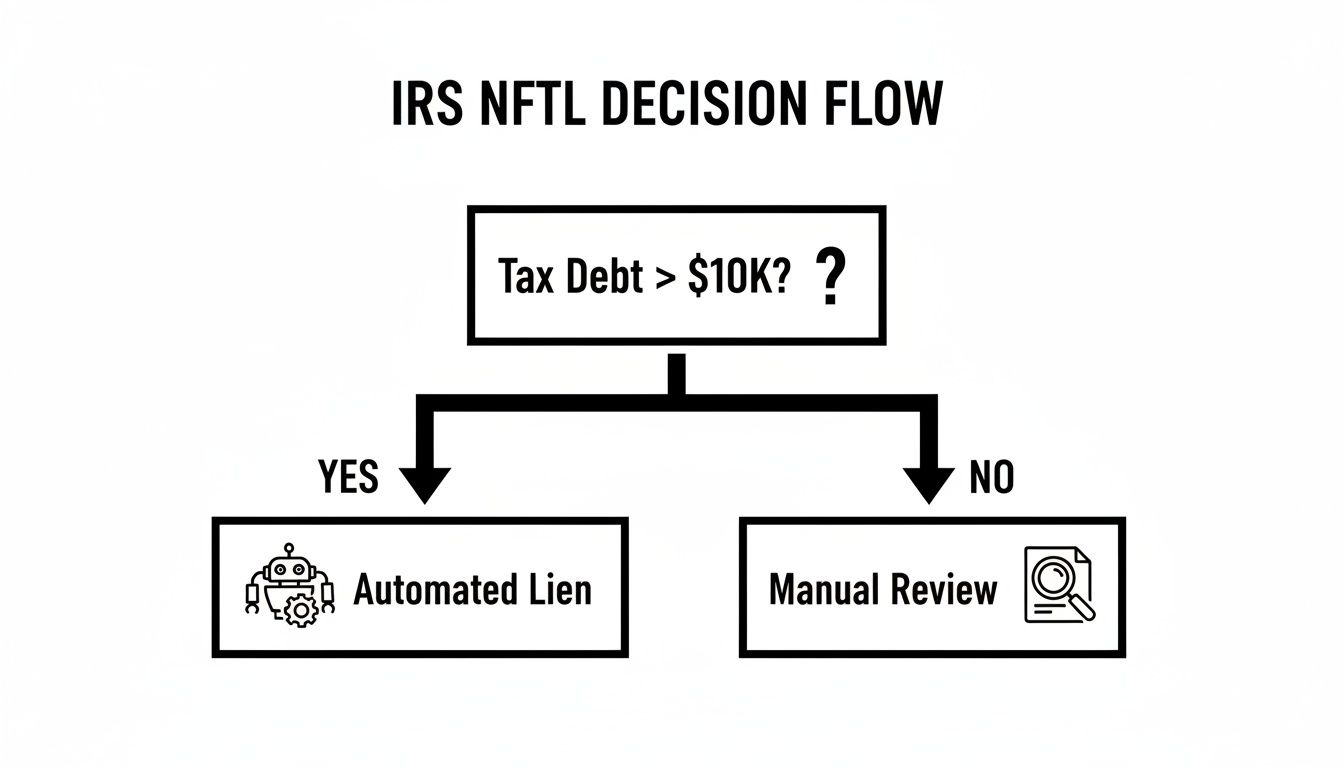
As this flowchart shows, once a tax debt crosses the $10,000 mark, the system can automatically trigger a lien filing. This automation underscores the need to be proactive and engage with the IRS using one of the strategies we've just covered.
How to Negotiate a Payment Solution with the IRS
Staring down an IRS tax bill you can't pay in full is a gut-wrenching experience for any business owner. But here’s the thing: it doesn't have to be the end of the road. The IRS knows businesses hit rough patches, and they’ve created official channels to work things out. The absolute worst thing you can do is ignore them. Being proactive is your best defense and the first step toward a workable solution.
You have more options than you might realize. The key is to open a direct line of communication with the IRS and give them a straightforward, honest assessment of your company's financial health. Let's walk through the most common routes to resolving the debt.
The Installment Agreement
The most common and direct path for many businesses is the Installment Agreement (IA). Think of it as a formal payment plan for your tax debt. You agree to make consistent monthly payments over a specific period until the balance is cleared.
Setting up an IA is a powerful move. It signals to the IRS that you’re serious about paying what you owe, which can immediately stop more aggressive actions like bank levies or asset seizures. For smaller business tax debts, you can often apply online and get a decision quickly. More significant debts will require a deeper dive into your financials. The ultimate goal is to land on a monthly payment that you can actually sustain without crippling your business operations.
An Installment Agreement is more than just a payment schedule; it's a formal truce with the IRS. By sticking to the plan, you can halt aggressive collection efforts and may even become eligible for a lien withdrawal, which removes that damaging public notice from your record.
The Offer in Compromise
What if your business is in truly dire straits? For companies facing severe financial hardship, an Offer in Compromise (OIC) can be a lifeline. An OIC allows you to settle your tax debt for less than the full amount you owe. But make no mistake—this is a high bar to clear.
The IRS will only accept an OIC if they're convinced it’s the absolute most they could ever hope to collect from you. To even be considered, you'll need to submit exhaustive documentation proving your business has neither the income nor the assets to pay the debt in full, now or in the foreseeable future. The application process is intense, and every number will be scrutinized. But for a business on the brink, a successful OIC can be the difference between closing your doors for good and getting a genuine fresh start.
You can learn more about how to make payment arrangements with the IRS, including the detailed requirements for both IAs and OICs, in our guide.
Currently Not Collectible Status
But what if you can't even afford a small monthly payment right now? For businesses in extreme situations—maybe a natural disaster wiped out your inventory or a key client went bankrupt—you can request Currently Not Collectible (CNC) status.
CNC is essentially a temporary timeout from collections. The IRS acknowledges that you can't pay anything at the moment and agrees to pause their collection activities. Here’s what that means in practice:
- It's Temporary: This isn't a permanent solution. The IRS will circle back periodically, usually every year or two, to review your finances.
- Debt Still Grows: Your tax bill doesn't vanish. Interest and penalties will continue to pile up while you're in CNC status.
- The Lien Stays: The federal tax lien remains firmly in place, securing the government's claim on your assets in case your financial situation improves.
Even so, CNC status can provide the critical breathing room a business needs to get back on its feet without the immediate threat of a levy.
Navigating any of these solutions successfully comes down to meticulous documentation and clear communication. When you present your case, being organized is non-negotiable. Professionals managing complex tax settlements often find it helpful to understand the basics of document redlining during negotiations, as this practice ensures all parties are on the same page about the final terms. By approaching the IRS with a realistic, well-supported plan, you can transform a financial crisis into a manageable path forward.
Distinguishing Between Business and Personal Tax Liens

When the IRS files a lien against your business, the first and most critical question is: what’s at risk? Is it just the company's assets, or can they come after your personal home and savings? The answer depends entirely on the type of tax you owe, and understanding this distinction is the most important line in the sand for any business owner facing tax trouble.
It’s a common mistake to think that forming an LLC or S-Corp creates an impenetrable shield between your business and personal finances. For some tax debts, that's true. But for others, the IRS can step right over that line, and what starts as a business problem quickly becomes a very personal one.
Federal vs. State Tax Liens
Before we dive into the IRS specifics, it’s important to remember that you can have tax liens from multiple sources. A federal tax lien is the IRS’s claim on your property for unpaid federal taxes, like income or payroll taxes. On the other hand, a state lien comes from your state’s revenue department for things like unpaid sales tax or state income tax.
They both act as a legal claim against your assets, but they follow completely different playbooks. Each has its own rules, statutes of limitations, and resolution pathways. While this guide focuses on the IRS, a state lien can be just as, if not more, damaging to your financial health.
The Critical Difference Unpaid Payroll Taxes Make
This is where the game completely changes for business owners. The type of federal tax your company owes determines exactly what the IRS can seize.
Income Tax Lien: If your business owes corporate income taxes, the IRS lien typically attaches only to the business's assets. Think company bank accounts, equipment, real estate, and accounts receivable. While this is a serious threat to your business’s ability to operate, the problem usually stops at the company's door.
Payroll Tax Lien & the TFRP: Things get much more serious when your business fails to pay its payroll taxes—the Social Security, Medicare, and federal income taxes you withhold from your employees' paychecks. The IRS doesn’t see this as your money. They view it as "trust fund" money that you were simply holding for the government.
Because these are considered trust funds, the IRS has a powerful weapon called the Trust Fund Recovery Penalty (TFRP). This penalty allows them to hold the individuals who were responsible for paying the tax personally liable for the entire debt.
The TFRP is designed to pierce the corporate veil. Suddenly, it’s not just a business debt; it’s your personal debt. The IRS can assess this penalty against any "responsible person," which could be an owner, a C-suite executive, or even a bookkeeper with signature authority on the company bank account.
This means if your business has a $50,000 unpaid payroll tax liability, the IRS can file a lien against the business and a separate lien against your personal property. Your house, your car, your kids' college fund—it’s all on the table. For a deeper dive, you can learn more about how liability for payroll taxes is not limited to the business and can follow you for years.
Let's look at two real-world scenarios to see the difference:
- Scenario A (Income Tax): A consulting firm owes $30,000 in back corporate income taxes. The IRS files a lien. This tanks the firm's credit and puts its bank account at risk, but the owner’s personal residence is safe.
- Scenario B (Payroll Tax): The same firm fails to remit $30,000 in payroll taxes. The IRS hits the owner with the TFRP. Now, the IRS can place a lien on the business assets and the owner's personal home, car, and savings account.
This is exactly why tax professionals consider payroll tax debt to be the most dangerous financial threat a business can face. It's the one that follows you home.
Why the IRS Lien System Feels So Aggressive
If you’re facing an IRS business lien, the whole process can feel impersonal, relentless, and frankly, punitive. But it's important to understand that you're not being singled out. You've simply been caught in a large, automated system that has a very specific history.
The way the IRS handles liens today wasn't born overnight. It’s the result of a major strategic shift that took place back in the 2000s. The agency decided to lean heavily into an automated, high-pressure model for collections, casting a much wider net to catch taxpayers with outstanding debts.
A Decade of Escalating Enforcement
This new strategy caused a dramatic explosion in the number of liens filed. The statistics from that period paint a clear picture of a system that started prioritizing volume over a more personal, case-by-case approach.
In fiscal year 1999, the IRS filed about 168,000 liens. By fiscal year 2009, that number had skyrocketed to nearly a million—965,618, to be exact. That’s a staggering 475% increase in just ten years.
The goal behind this massive surge was simple: put enough pressure on business owners that they would have no choice but to pay. More liens, the thinking went, would equal more money collected. But as the data rolled in, it revealed a critical flaw in this aggressive strategy.
More Pressure Didn't Mean More Collections
Despite the astronomical jump in lien filings, the expected revenue boom never happened. In fact, when you adjust for inflation, the numbers tell a completely different story.
Total collections actually dropped by 7% in real terms, falling from $29.4 billion in 1999 to $27.2 billion in 2009. You can dig into the numbers yourself in the 2009 Annual Report to Congress.
What this tells us is that the lien process became far more punishing than it was effective. It often ended up crippling businesses without actually bringing in more tax dollars for the government.
Knowing this history can be empowering. It helps you see that an IRS business lien is usually the product of a massive, automated enforcement machine, not a personal attack on you or your company. This context is key to facing the problem with a calm, strategic mindset, so you can focus on finding a solution instead of being weighed down by fear and panic.
Common Questions Business Owners Have About IRS Liens
When you're hit with an IRS business lien, the questions come fast and furious. It's a stressful situation, and you need clear, straightforward answers. Here are some of the most common concerns we hear from business owners just like you.
Can The IRS Come After My Personal Assets For My Business’s Tax Debt?
This is often the first question people ask, and the answer depends on the type of tax debt.
If the debt is from corporate income tax, the lien usually sticks to the business's assets. However, payroll taxes are a completely different story. The IRS can invoke the Trust Fund Recovery Penalty (TFRP), which pierces the corporate veil and holds the responsible individuals personally liable. If that happens, the IRS can absolutely place a lien on your personal property—your house, your car, your personal bank accounts.
How Long Will This Tax Lien Mess Up My Credit?
Here's some good news and some bad news. The good news is that a Notice of Federal Tax Lien (NFTL) won't show up on your personal credit reports from the big three bureaus (Equifax, Experian, TransUnion) anymore.
The bad news? The NFTL is still a public record. Anyone can find it, including business credit agencies and potential lenders. It will absolutely make getting a business loan, a line of credit, or even favorable terms with a supplier incredibly difficult.
Even though it's off your personal credit report, the public NFTL is a massive red flag for any lender. It effectively freezes your ability to get new financing for your business.
Can I Just File For Bankruptcy To Get Rid Of The Lien?
It's not that simple. While bankruptcy can eliminate certain types of tax debt, a federal tax lien that the IRS filed before you file for bankruptcy is a stubborn thing. It often survives the bankruptcy process.
This means that even if the underlying tax debt is discharged, the lien can stay attached to any business assets you owned at the time of the bankruptcy filing. Navigating this requires serious legal strategy, so it's critical to speak with a tax attorney who also understands bankruptcy law before making any moves.
Facing an IRS business lien isn't something you should do on your own. At the law office of Attorney Stephen A Weisberg, we begin with a free, no-obligation Tax Debt Analysis to map out the best resolution for your unique circumstances. Get the professional guidance you need. Visit https://weisberg.tax to schedule your free consultation today.


