IRS Bank Levy Release: How to Get Your Funds Back
Learn how to get an IRS bank levy released: the 21-day deadline, hardship and ownership proof, the forms to file, and when to call a tax attorney.

In this article
- IRS Bank Levy Release Options at a Glance
- How to Respond Inside the 21-Day Hold Period
- Five moves that actually stop the remittance
- What each date demands
- Prove Economic Hardship With the Right Documents
- How to package the file
- Release Only the Funds You Need From a Deposit
- Build a partial-release request
- Keep the Levy From Returning After Release
- If the release is denied
- The month after the bank posts it
- Decide Whether to Hire a Tax Attorney Now
You opened the banking app on a Tuesday and the balance you counted on was gone. A letter from the bank says the IRS served a levy, the money is frozen, and payroll or rent is due before the hold ends. That is the moment an IRS bank levy release has to be built from documents, not from a hopeful phone call.
The bank will send the frozen money unless a release reaches it in time. The tax bill stays either way. Match a legal ground to proof the IRS can check, and do it while the hold is still open.
IRS Bank Levy Release Options at a Glance
Say the freeze hits a business checking account that also holds a spouse's deposit and next week's payroll. The IRS levy guidance treats a bank levy as a legal seizure of funds to satisfy unpaid federal tax. After the bank receives the levy, it generally freezes the available funds, holds them for 21 days, and then sends them to the IRS.
That hold is the bank's compliance clock. It is not a promise that the IRS will give the money back, and it does not erase the tax debt. Use the number on the levy notice and send financial or ownership proof as soon as you can.
A levy is not limited to your personal checking balance. IRS levy authority can reach property or rights to property held by third parties, including bank accounts, wages, retirement accounts, dividends, rental income, commissions, and accounts receivable. Money in a parent's or spouse's name can still be hit if your name is on the account. The IRS may ask for documents proving someone else owns the funds.
| Release ground | Evidence to submit | Typical result |
|---|---|---|
| Full payment of the liability | Payment confirmation | Release issued once the balance is cleared |
| Approved installment agreement that bars levy | Signed agreement and payment record | Release while the agreement stays active |
| IRS error | Notice or transcript showing the error | Release after IRS review |
| Funds belong to a third party | Bank statements tracing the money and proof of ownership | Release of the owner's funds |
| Collection period expired before levy | Assessment date and collection statute expiration date from transcripts | Release required |
| Economic hardship, bank account | Income, expenses and account statements | Release may be granted |
| Economic hardship, wages | Pay stubs and expense records | Release must be granted |
| Release will help collection | Workable payment proposal | Release may be granted |
Match your facts to a row, not to the dollar figure printed on the notice. A large balance does not block a release if the ground is real, and a small balance does not create one. Pick the row you can prove this week.
How to Respond Inside the 21-Day Hold Period
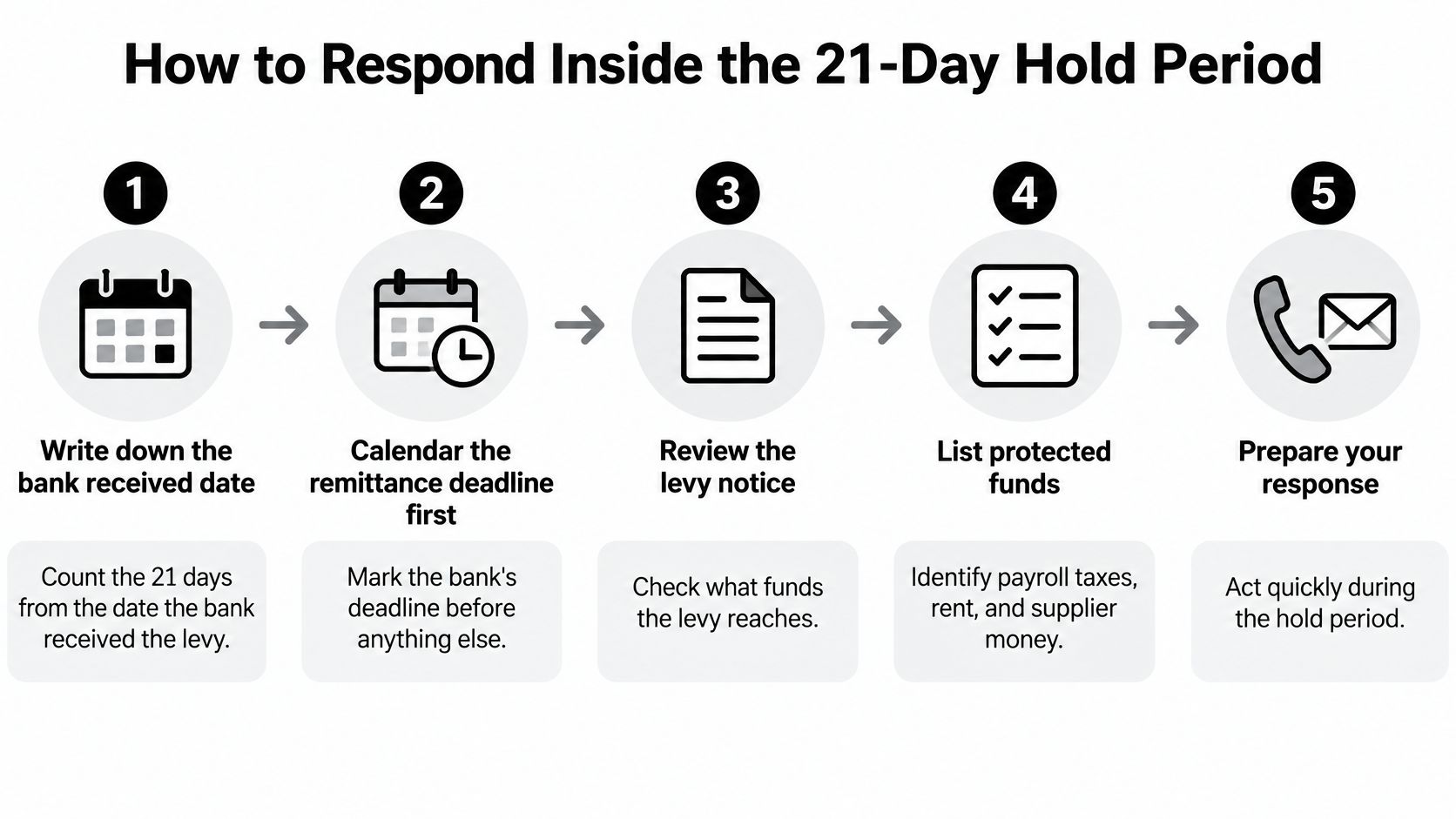
The bank's receipt date starts the 21-day hold, not the day you opened the IRS notice. Ask the bank's levy desk when it received the levy and how much it froze. Put the hold's end date on your calendar.
The bank generally freezes the funds in the account when the levy arrives. After the 21-day hold, it must surrender those funds unless the IRS sends a release or extension. Later deposits are a separate question. For more on the notice itself, read this guide to an IRS notice of levy.
Five moves that actually stop the remittance
- Record the dates. Write down when the bank received the levy and when the 21-day hold ends. If the receipt date is unclear, ask the bank to confirm it.
- Call the IRS using the number on your notice. Ask for the collection employee assigned to your case. The bank's copy of Form 668-A is not a substitute for your IRS notice.
- Identify the ground for release. It may be full payment, an installment agreement that bars levy, an IRS error, third-party ownership, an expired collection period, or economic hardship. Focus on the ground you can document.
- Send supporting records promptly. Depending on the issue, provide payment confirmation, ownership records, bank statements tracing the funds, or current financial information. A statement without documents may not give the IRS enough to act.
- Confirm the release reached the bank. Get the release in writing or electronically, then call the bank to confirm it has recorded the release against this levy.
Practical rule: A verbal promise does not stop the levy. Unless the bank receives a release or extension, it generally must surrender the funds after the hold, without another notice.
What each date demands
Act promptly so the IRS has time to review your request before the hold ends.
| Milestone | When it happens | What you do |
|---|---|---|
| Levy received | Day 0, the bank's receipt date | Record the date and contact the IRS |
| Hold period | Days 1 to 21 | Submit evidence and request a written release |
| Hold ends | Day 21 | Confirm whether the bank received a release or extension |
| Funds surrendered | After the 21-day hold, unless a release or extension arrives | Contact the bank to confirm the status |
If you are only a signatory on a parent's account, explain that promptly and provide records tracing who owns the funds. Don't wait for the bank to resolve ownership on its own.
Prove Economic Hardship With the Right Documents
A frozen balance can look like available cash even when it is committed to payroll, rent, or other basic expenses. The IRS tests hardship against current financial records, not a verbal account of what you owe. Its levy release guidance focuses on whether collection prevents payment of basic, reasonable living expenses.
List verified income, expenses, assets, and debts on Form 433-A for an individual or Form 433-B for a business. Those forms provide the financial basis for negotiations. For a practical guide to documenting financial hardship for the IRS, match each claimed expense to a current record and show how the levy affects your ability to pay it.
The test differs by levy type. A bank-account levy that causes hardship may be released; a wage levy that causes immediate economic hardship must be released. Other grounds for release include full payment, an expired collection period, a finding that release will help collection, or an installment agreement that bars continued levy.
| Expense category | Proof to attach | Example |
|---|---|---|
| Payroll for employees | Payroll register and tax deposit receipts | Staff wages due this week |
| Rent or mortgage | Lease or mortgage statement | Monthly rent due on the 1st |
| Utilities | Recent electric, water, and gas bills | Utilities due before the next pay cycle |
| Food and medical | Receipts or itemized bills | Prescriptions and grocery costs |
| Insurance | Premium notices | Health insurance premium |
| Necessary transportation | Loan statement and fuel costs | Vehicle needed to get to work |
How to package the file
Organize records by expense category and label each file with the month it covers. A lease, utility bills, and payroll records in one unlabeled PDF make it harder for the reviewer to connect the documents to your financial statement.
After submitting the evidence, confirm that the release was transmitted. Record the recipient and fax number, then ask the bank whether it processed the release against the frozen amount.
A release addresses the levy, not the underlying tax debt. The balance remains due unless it is resolved separately.
Release Only the Funds You Need From a Deposit
A week of sales lands on Monday. The levy takes the whole balance on Tuesday, including money already spoken for: payroll taxes, rent, and the supplier invoice due Friday. The account looked healthy. The cash was already committed.

IRS internal guidance defines economic hardship by whether the levy blocks basic, reasonable living expenses, and it requires financial information to test the claim. Levy decisions also look at financial condition, responsiveness, compliance history, payment efforts, and whether current taxes are being paid. If hardship is verified, the levy should not be issued.
That standard is where small-business accounts get misread. A large balance the day before the levy can still be payroll, rent, taxes, or household bills. The IRS recognizes that an entire deposited paycheck can create hardship because all available funds may be seized, and release in whole or in part can be required.
Build a partial-release request
- Start with the levied balance. Use the figure the bank froze on the receipt date, not today's available balance.
- List each committed outflow for the next 30 days. Put the payee, the amount, and the due date on one line.
- Separate whose money it is. Trace business deposits apart from an employee's wage deduction or a family member's funds sitting in the account.
- Tie every line to a statement. A partial release asked for in writing is easier to approve when each dollar points at a bank line and a due date.
Ask the bank for an itemized list of what it is holding so your request matches the frozen figure, not a guess from the app. A release still does not settle the balance. Pair it with a payment plan, a temporary collection delay, or another collection status you can keep.
Keep the Levy From Returning After Release
A release ends this levy. It leaves the balance on the account. Without an approved arrangement, the IRS can levy again, often the same bank.
The path I would start with is an installment agreement. Monthly payments let you clear the balance in amounts you can sustain, and assets stay protected from levies while the agreement remains active. Send the proposed monthly amount with Form 433-A or Form 433-B, and use Form 9465 to request the agreement. If you cannot pay anything now, ask for a temporary collection delay and be ready to show why a payment would fail basic expenses. For the mechanics of that request, read how setting up a payment plan with the IRS works.
If the release is denied
You can appeal before or after the levy through IRS Appeals. Attach the same hardship documents, not a shorter retelling. If the levy threatens immediate hardship and the assigned employee is not responding, Form 911 asks the Taxpayer Advocate Service to step in. That form does not replace the financial statement.
The month after the bank posts it
- Confirm the posting. Ask the bank, in writing, that the release hit the right account and amount.
- Keep the approval letter. You will need it if a second levy notice appears.
- Calendar every installment. One missed payment can put levy authority back in play.
- Pull the account transcript after 30 days. Confirm the agreement is recorded, not just promised.
Currently Not Collectible status is the other stop on collection when paying would cause serious hardship. It is a status you have to qualify for, not a label you choose.
Decide Whether to Hire a Tax Attorney Now
A levy notice has arrived, and the bank is holding money needed for payroll or rent. The first days matter: gather the records that show what the funds are committed to, and decide promptly whether the tax problem needs legal help.
Consider hiring a tax attorney if you owe more than $5,000, a revenue officer is assigned, or the IRS has opened a criminal investigation. Complex finances, foreign accounts, assets at risk of seizure, a levy on a business or payroll account, or liability exposure over $1,000,000 are also reasons to seek advice.
The balance alone does not determine the right solution. An attorney can review IRS and state transcripts to trace the debt history, including penalties, payments, and how long remains before the debt is written off. After reviewing transcripts, the attorney can identify immediate threats such as levies, garnishments, and liens. The right resolution depends on the taxpayer's circumstances and the amount owed.
Bankruptcy may not resolve the tax problem. Many tax debts are not discharged, especially more recent debts and trust fund liabilities such as payroll taxes. For more guidance on when to hire a tax attorney, consider the complexity and urgency of your situation. If organizing records is a bottleneck, hire virtual paralegals to assemble statements, payroll registers, and notice copies.
Gather the levy notice and its date, recent bank statements, payroll and expense records, and IRS letters. Call the number on the notice, and decide within the first week whether you need outside help while the bank is still holding the funds.
Tax Attorney Stephen A Weisberg represents individuals and businesses with IRS and state tax problems, including levies and unpaid balances. A focused review can help separate the immediate frozen-funds issue from the broader tax debt. Learn more about Tax Attorney Stephen A Weisberg.


