irs automated collection system: How It Works and What to Do
Discover the irs automated collection system: what triggers notices, how the process works, and practical options to resolve tax debt.
In this article
- Decoding the IRS Automated Collection System
- The Scope and Power of the ACS
- Key Stages of the ACS Process
- How You End Up in the ACS System
- The Most Common Trigger: Unpaid Tax Balances
- When You Don't File a Tax Return at All
- Other, Less Common, Pathways
- Your Step-by-Step Journey Through the ACS Process
- The Automated Notice Cascade
- The ACS Phone Call and What to Expect
- When Automation Leads to Enforcement
- Your Rights and Options When Facing the ACS
- Exploring Your Payment Solutions
- When Financial Hardship Is a Factor
- Comparing Tax Debt Resolution Options
- When Your Case Moves Beyond Automation
- Triggers for Escalation to a Revenue Officer
- ACS Agent vs. Revenue Officer: The Critical Differences
- Getting Ahead of the ACS—And Getting Out of It
- Staying Off the Radar: Prevention is Key
- Your Action Plan for an ACS Notice
- Answering Your Top Questions About the IRS ACS
- Can I Just Ignore the ACS Notices?
- Is a Phone Call From the ACS Legitimate?
- What Is the Difference Between ACS and a Revenue Officer?
- Can the ACS Take My Social Security Benefits?
- How Can I Stop ACS Collection Actions?
Think of the IRS Automated Collection System (ACS) as the IRS's high-tech, automated call center. It’s the computer-driven system designed to handle millions of overdue tax accounts through a series of official notices and phone calls. This is the IRS's first move, long before a human revenue officer might knock on your door.
Decoding the IRS Automated Collection System

It works a lot like the automated billing department for a huge company. If you're late on a payment, you'll get letters and maybe some automated calls before you ever talk to a real person. The ACS runs on that same idea, using technology to manage a massive caseload that would be impossible to handle otherwise. Its whole purpose is to get tax debts settled without having to assign a field agent.
It’s crucial to understand this isn't a person making judgment calls; it's a sophisticated algorithm following a script. When your tax account flags an unpaid balance, it usually gets dropped into the ACS queue. From there, the system kicks into gear, sending out a predictable series of notices that get more serious over time.
The Scope and Power of the ACS
The irs automated collection system is an absolute behemoth, handling the lion's share of the agency's collection work. By the end of fiscal year 2018, for example, the ACS was managing a caseload worth about $47 billion. It successfully brought in around $3.4 billion that year through payments and installment agreements.
Getting a letter from the ACS is definitely unnerving, but it’s just the start of the process—not the final word. The system is programmed to take specific steps:
- Send a series of notices: Each letter is a progressively stronger reminder of your tax debt and a request for you to respond.
- Make automated phone calls: ACS staff might call to discuss your options for payment and get the account resolved.
- Initiate collection actions: If you ignore the initial warnings, the system has the power to start bank levies or wage garnishments automatically.
The key takeaway is that an ACS notice is your cue to take action. Ignoring it allows the automated process to advance, potentially leading to more severe consequences. Responding promptly gives you the opportunity to regain control.
Here’s a look at how a case typically moves through the system.
Key Stages of the ACS Process
This table breaks down the typical journey of an account once it enters the Automated Collection System.
| Stage | What Happens | Typical Timeframe |
|---|---|---|
| Notice CP14 | This is the first official bill for unpaid taxes, penalties, and interest. It marks the start of the collection process. | Sent shortly after a tax return is filed with a balance due. |
| Follow-Up Notices | You'll receive a series of letters (CP501, CP503, CP504) that become increasingly urgent, mentioning intent to levy. | Every 4-6 weeks after the initial notice. |
| Final Notice | The LT11 or Letter 1058 arrives. This is the Final Notice of Intent to Levy and a notice of your right to a hearing. | Several months into the process. |
| Enforcement | If you don't respond or make arrangements, the ACS can issue levies on bank accounts, wages, and other assets. | Can begin 30 days after the Final Notice is issued. |
Understanding this is a system-driven process can take some of the fear out of it. These are standardized communications, and you have specific rights and pathways to fix the problem. You can get a better handle on what these letters mean by checking out our guide to IRS collection notices. By engaging with the process, you can almost always find a workable solution before things get any more serious.
How You End Up in the ACS System
Contrary to popular belief, landing in the IRS Automated Collection System isn’t like winning some unlucky lottery. It's a highly predictable process, set in motion by very specific triggers. Think of it less like a random audit and more like a security system—the alarm only goes off when a door is forced open or a window is broken.
For the IRS, those "broken windows" are almost always unpaid tax bills and unfiled tax returns. These events are red flags that tell the IRS's automated systems an account needs immediate attention. The ACS is that first line of response. Getting a handle on these triggers is the first step to finding a solution and keeping things from getting worse.
The Most Common Trigger: Unpaid Tax Balances
The most straightforward way to get tangled up with the ACS is by filing your tax return but not paying the full amount due. As soon as the filing deadline passes, the IRS logs the outstanding balance, creating a discrepancy its system is programmed to catch.
This is where the automation really kicks in. Shortly after, the system will fire off its first notice, usually a CP14, which is the official bill for your unpaid taxes. If you don't respond to that initial letter, your account is officially dropped into the ACS queue. From there, you can expect a predictable series of computer-generated reminder letters to follow, each one a programmed step in the collection timeline.
When You Don't File a Tax Return at All
The second major trigger is simply not filing a tax return when you were supposed to. The IRS doesn't just forget you exist. Its computers are constantly crunching data, receiving income information from your employers (W-2s) and clients (1099s), and cross-referencing it with the returns it has on file.
When the system sees you earned income but didn't file, it can create a Substitute for Return (SFR) for you. This is the IRS’s version of your tax return, but there's a huge catch: it's calculated without any of the deductions or credits you were likely entitled to claim.
As a result, the tax bill from an SFR is almost always much higher than what you would have actually owed. Once the IRS creates this substitute and sends you the bill, your account has a balance due, and you're funneled straight into the ACS.
If this is your situation, taking action is critical. You can learn more about getting back into compliance in our guide on filing unfiled tax returns, which walks you through the necessary steps.
Other, Less Common, Pathways
While unpaid balances and unfiled returns are the superhighways into the ACS, a few other issues can get you there too.
- Audit Adjustments: If an IRS audit determines you owe more tax, that new liability will trigger the collection process if you don't pay it right away.
- Incorrectly Applied Payments: Sometimes human error is to blame. A payment might get misapplied to the wrong tax year or even the wrong Social Security number, leaving an unpaid balance on the account you intended to pay.
- Trust Fund Recovery Penalties: This is a big one for business owners. If you fail to hand over payroll taxes withheld from employees, the IRS can personally assess a massive penalty against you, which then becomes a personal debt subject to collection by the ACS.
At the end of the day, any unresolved tax debt that fits the system's criteria will kickstart the automated collection machine. Your best bet is always to respond to that very first notice, as it's your best chance to resolve the matter before the system moves on to more serious actions like bank levies and wage garnishments.
Your Step-by-Step Journey Through the ACS Process
Once your account lands in the IRS Automated Collection System, the process becomes surprisingly predictable. This isn't a series of random, chaotic actions; it's a methodical, software-driven sequence. Understanding this journey can take away the fear of the unknown and give you a clear roadmap of what to expect and when you need to act.
The process usually kicks off for common reasons, like an unfiled return or an unpaid tax bill, which then triggers the first in a series of automated notices.
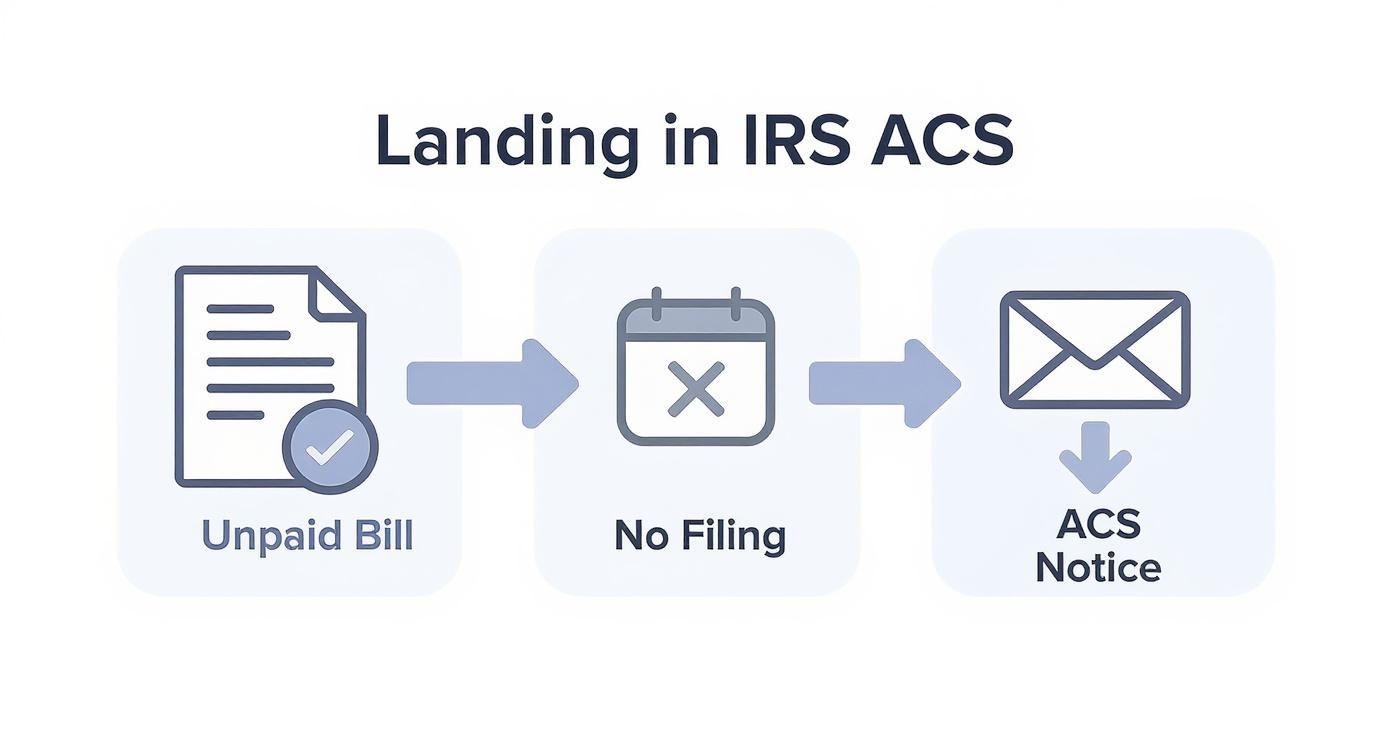
As you can see, simple issues are the most common entry points. From there, the notice-and-call cycle begins.
The Automated Notice Cascade
The ACS process nearly always starts with a series of letters mailed to your last known address. You can think of it as an automated drip campaign, where each notice ramps up the urgency. It’s the system’s way of getting your attention before things get more serious.
The most common letters you'll see are:
- CP501 Notice: This is typically the first reminder you’ll get after the initial bill. Its tone is firm but still focused on simply requesting payment. It's a clear signal that the IRS is aware of the debt.
- CP503 Notice: If you don't respond to the CP501, the system automatically sends this one next. The language gets more direct, making it clear the IRS is serious about collecting what you owe.
- CP504 Notice: This notice is a critical turning point. The CP504 is a Notice of Intent to Levy. While it's not the final legal notice before seizure, it explicitly warns you of the IRS's right to take your state tax refunds to cover your federal tax debt. It’s a sign that your window for an easy resolution is closing fast.
Getting these notices is stressful, no doubt. But they also represent a crucial opportunity to get things sorted out before the situation escalates further.
The ACS Phone Call and What to Expect
Besides letters, the ACS also uses an automated dialer to make outbound calls. If an IRS agent from the ACS calls you, see it as a chance to talk directly and figure out your options. That agent is trained to work within the system's rules to help you find a solution.
To have a productive call, you need to be ready to talk about your finances. The agent will likely ask you questions to fill out a Collection Information Statement, which is just a financial disclosure. It’s a huge help to have recent pay stubs, bank statements, and a list of your monthly expenses on hand. For a deep dive into the information you'll need, check out our complete guide to IRS Form 433-F, as this is the form they often use.
Remember, while the process is automated, the goal is compliance. An ACS agent’s main job is to help you get on a payment plan or find another way to take care of the tax debt.
When Automation Leads to Enforcement
If the letters and phone calls are ignored, the irs automated collection system is programmed to do exactly what it’s designed for: enforcement. The system automatically scans federal and state databases to find your assets and income streams.
This isn’t a person manually digging into your life. The software simply pings databases, looking for matches to your Social Security Number or Employer Identification Number. It can quickly pinpoint:
- Where you have bank accounts.
- Who your employer is.
- Any sources of 1099 income.
Once it finds this information, the system can issue a levy on your bank account or garnish your wages without any more human input. This is the raw efficiency of the ACS. However, it's worth noting that even with these powerful tools, a Taxpayer Advocate Service analysis found that the IRS has had limited success in promoting future compliance, no matter which collection method they use. This just goes to show how important it is to deal with tax debt proactively instead of waiting for forced collection.
Your Rights and Options When Facing the ACS

Getting a notice from the IRS Automated Collection System is enough to make anyone's stomach drop. It feels intimidating, but it's critical to remember this isn't a dead end. You have clearly defined rights and a surprising number of ways to resolve your tax debt. The trick is to stop reacting and start acting, turning that initial panic into a clear plan.
Your first line of defense is the Taxpayer Bill of Rights. This isn't just some vague mission statement—it’s a set of ten fundamental rights baked directly into the tax code. Among the most important for this situation are your right to be informed, your right to challenge the IRS, and your right to a fair system. That notice from the ACS is the IRS fulfilling its duty to inform you, which is your cue to exercise your other rights.
Exploring Your Payment Solutions
For many people, the most straightforward path is simply finding a way to pay what’s owed over time. The IRS is often far more flexible than you might think, especially when you communicate openly and don't ignore their letters. The ACS is actually designed to help set up these kinds of arrangements.
Two of the most common solutions are:
- Short-Term Payment Extension: If you can pay the full amount within 180 days, you can usually get a short-term extension online or with a quick phone call. This is perfect if you’re just waiting on a commission check, a bonus, or some other expected cash infusion.
- Installment Agreement (IA): This is a formal plan to make monthly payments for up to 72 months (six years). If you owe under a certain amount, you can often set up a "streamlined" agreement right on the IRS website without having to hand over piles of financial documents.
When Financial Hardship Is a Factor
But what if you genuinely can't afford to pay, even in monthly chunks? The IRS has programs specifically for people facing real financial hardship. To qualify, you’ll need to prove that paying the tax debt would keep you from affording basic living expenses like rent, food, or medical care.
The system is built on a core principle: paying your taxes shouldn't leave you unable to meet your family's essential needs. Proving this hardship takes some work and detailed financial records, but it opens the door to powerful relief.
The two main options here are:
- Offer in Compromise (OIC): An OIC is an agreement to settle your tax debt for less than you actually owe. These are tough to get and are usually only approved when there's serious doubt the IRS could ever collect the full amount.
- Currently Not Collectible (CNC) Status: If you can show you have no ability to pay right now, the IRS can place your account in CNC status. This hits the pause button on collection efforts—no more ACS notices, no levies—until your financial situation gets better.
It's worth noting that the need for this kind of relief has grown. Between fiscal years 2006 and 2010 alone, the total dollar value of accounts declared CNC shot up by 78 percent, from $16.2 billion to $28.9 billion. The Taxpayer Advocate's annual report dives deep into this trend, highlighting just how common this situation is.
If CNC sounds like it might apply to you, it's crucial to understand the details. You can learn more by reading our guide about what Currently Not Collectible IRS status means for you.
Comparing Tax Debt Resolution Options
Choosing the right strategy comes down to your personal financial reality. This table breaks down which option is best suited for different situations, helping you see where you might fit.
| Resolution Option | Best For | Key Requirement |
|---|---|---|
| Short-Term Extension | Taxpayers who can pay in full soon but just need a little more time (up to 180 days). | Confidence you can pay the full balance within the extension period. |
| Installment Agreement | Taxpayers who can afford reasonable monthly payments over a longer period. | Consistent income to make monthly payments on time. |
| Offer in Compromise | Taxpayers with no realistic way to pay the full debt now or in the future. | Proving limited income and assets through detailed financial disclosure. |
| Currently Not Collectible | Taxpayers who cannot afford any payment without suffering economic hardship. | Demonstrating that your monthly expenses exceed your monthly income. |
Looking at these options can help you find a starting point. But no matter which path seems right, the first step is always the same: do not ignore the notice. Open the letter, mark the deadline on your calendar, and start gathering your financial documents. Taking that first step is how you put yourself back in control.
When Your Case Moves Beyond Automation
The IRS’s Automated Collection System is a powerhouse, built to churn through millions of straightforward tax debt cases with very little human touch. But it has its limits. Think of it like a self-checkout lane at the grocery store—perfect for a few simple items, but if you have a complicated order or need special assistance, you're going to need a store manager.
When a tax situation gets too tangled, the dollar amount gets too high, or the IRS needs boots on the ground, the case gets booted from the ACS queue. This is a pivotal moment. Your case moves from an impersonal, automated process to a hands-on investigation by a human IRS Revenue Officer (RO).
Triggers for Escalation to a Revenue Officer
Certain red flags are programmed to send a case straight from the ACS system to a Revenue Officer's desk. The system knows when a situation calls for a level of judgment and authority that a computer algorithm just doesn't have.
Here are some of the most common triggers that get a case escalated:
- High-Dollar Tax Debts: While the exact number can shift, tax bills topping $100,000 almost always get a second look from a human. The larger the debt, the more likely an RO will be assigned to personally manage the file.
- Chronic Non-Compliance: If you have a pattern of falling behind on your taxes year after year, especially with payroll taxes, it signals a bigger problem. The ACS isn't designed to solve chronic issues; that’s a job for an RO.
- Complex Financial Situations: Do you own multiple businesses, hold assets in trusts, or have a complicated financial life? The automated system can struggle to see the full picture, prompting a manual review.
- Trust Fund Recovery Penalty (TFRP) Cases: This is a big one. Unpaid payroll taxes are seen by the IRS as money that was held "in trust" for employees and the government. These cases are taken very seriously and almost always land on an RO’s desk for a full investigation.
Knowing what raises a red flag makes one thing clear: it’s always better to sort out your tax issue while it's still in the more predictable ACS environment. Once a Revenue Officer is assigned, the game changes entirely.
ACS Agent vs. Revenue Officer: The Critical Differences
The difference between dealing with the ACS and a Revenue Officer is night and day. It’s like getting a standardized speeding ticket in the mail versus being pulled over by a state trooper who's now asking to see your license and registration.
An ACS agent is a call-center employee following a script with a defined set of options. A Revenue Officer is a field agent with a badge, broad investigative powers, and the authority to show up at your home or business unannounced.
Let's break down how their roles and powers really stack up:
| Aspect of Collection | Automated Collection System (ACS) | Revenue Officer (RO) |
|---|---|---|
| Primary Contact | Automated notices by mail and phone calls from a call center. | Direct, in-person visits, personal phone calls, and direct letters. |
| Authority Level | Can execute standard bank levies and wage garnishments. | Can seize physical property (real estate, vehicles, inventory), issue summonses, and conduct interviews under oath. |
| Investigation | Runs searches on existing databases to find your assets. | Conducts deep-dive financial investigations, often interviewing your bank, employer, or clients. |
| Flexibility | Operates under rigid guidelines for setting up payment plans and offers. | Has significant discretion to negotiate and tailor a resolution based on your specific circumstances. |
The jump from the IRS Automated Collection System to a Revenue Officer means your case is no longer just a number in a database. It's now a personal, investigative file. This escalation is exactly why it's so crucial to tackle your tax problem the moment that first ACS notice arrives—it keeps the process more manageable and far less invasive.
Getting Ahead of the ACS—And Getting Out of It
Dealing with the IRS Automated Collection System can feel like you're up against a wall, but you actually have more power than you think. The trick is to be proactive. Taking the right steps can keep you from ever landing on the ACS's radar, or give you a clear roadmap out if you're already there. It's about swapping that feeling of dread for a concrete plan.
Honestly, the best defense is a good offense. Staying out of the collection system in the first place boils down to good financial habits and clear communication. It’s always simpler to handle your taxes correctly from the get-go than to untangle a collection mess later on.
Staying Off the Radar: Prevention is Key
If you want to avoid triggering an ACS case, it all comes down to a few fundamental practices. Think of these as the foundation for keeping your relationship with the IRS on solid ground.
- File On Time, No Matter What: This is huge. Even if you know you can't pay a dime of what you owe, file that return by the deadline. The penalty for failing to file is almost always much steeper than the penalty for failing to pay.
- Pay Something—Anything: When you file, pay as much as you can afford. Every dollar you send reduces the principal, which in turn cuts down on the interest and penalties that will pile up on the rest.
- Open That IRS Envelope: It’s tempting to let that official-looking mail sit on the counter, but that's one of the quickest ways to let a small problem spiral. Open every letter from the IRS right away so you know exactly what they're asking for and when you need to act.
Your Action Plan for an ACS Notice
Okay, so a notice has already arrived. Don't panic. You have a clear path forward. Just follow this checklist to get through the crucial first steps.
- Acknowledge It. Don't Ignore It. The problem won't just vanish. Ignoring the letters simply tells the automated system to kick things up a notch, which could mean a levy on your bank account or a garnishment of your wages.
- Double-Check the Numbers. Before you do anything else, make sure you actually owe what the IRS says you do. Pull out your own records and compare them against the notice. Mistakes happen, and you need to catch them.
- Get Your Financials in Order. It's time to gather your documents. Collect recent pay stubs, bank statements, and a quick list of your essential monthly expenses. Having this ready makes the conversation about your options much, much smoother.
- Know Your Options. As we’ve covered, you might be eligible for a payment plan, an Offer in Compromise, or even be declared Currently Not Collectible. A little research here will help you figure out which solution truly fits your situation.
A sobering finding from the Taxpayer Advocate Service revealed that an estimated 36% of people in streamlined ACS payment plans were likely putting themselves in a state of economic hardship. This stat is a powerful reminder to explore every avenue—especially Currently Not Collectible status—before committing to a payment plan you simply can't afford.
By taking these deliberate steps, you shift from being reactive and stressed to being in control. Whether you’re trying to prevent a problem or solve one, a proactive mindset is your single best asset.
Answering Your Top Questions About the IRS ACS
When you're dealing with the IRS Automated Collection System, it’s easy to feel overwhelmed. Let's break down some of the most common questions and concerns that come up when that first notice or phone call arrives.
Can I Just Ignore the ACS Notices?
In a word: no. Ignoring mail from the IRS is probably the worst move you can make. The ACS isn't a person you can hope will forget about you; it’s a systematic, automated process.
If you don't respond, the system is designed to automatically kick things up a notch. That means bank levies and wage garnishments can happen quickly, often without any more warning.
Is a Phone Call From the ACS Legitimate?
It might be, but you have to be incredibly careful here. The IRS does make phone calls, but so do sophisticated scammers trying to exploit your fear.
A real IRS agent will never demand immediate payment over the phone, especially not with a gift card, wire transfer, or cryptocurrency. They also won't threaten you with immediate arrest. If you have any doubt, hang up. Call the IRS back using a phone number from their official website to verify.
What Is the Difference Between ACS and a Revenue Officer?
Think of the ACS as the IRS's massive, automated call center. It handles millions of straightforward tax debt cases primarily through letters and phone calls. A Revenue Officer (RO), on the other hand, is a field agent assigned to more complex or high-dollar cases.
An RO has much more power and can show up at your home or business to seize physical assets. Your case will likely stay with the ACS as long as the IRS views it as a simple collection matter.
The key takeaway is this: ACS actions are systematic and predictable. A Revenue Officer's actions are investigative and personal. It's always better—and far less stressful—to resolve your tax issue while it's still in the ACS system.
Can the ACS Take My Social Security Benefits?
Yes, they absolutely can. The IRS has the power to levy Social Security benefits under the Federal Payment Levy Program (FPLP).
The system can automatically take up to 15% of your monthly benefits to apply toward your federal tax debt. This is just one more urgent reason to respond to those initial notices and protect your income.
How Can I Stop ACS Collection Actions?
The only way to stop the process is to engage with it directly. You can put a halt to collection actions by taking a formal step to resolve the debt. This usually involves one of the following:
- Paying the tax bill in full.
- Setting up an official Installment Agreement.
- Submitting an Offer in Compromise (OIC).
- Qualifying for Currently Not Collectible (CNC) status.
When you take one of these proactive steps, you're signaling to the IRS that you’re working on a solution. This is usually enough to pause any further aggressive collection efforts.
If you're facing notices from the irs automated collection system and aren't sure what to do next, you don't have to figure it out alone. At Attorney Stephen A Weisberg, I start with a FREE Tax Debt Analysis to determine the best path forward for your specific situation. Take the first step toward resolving your tax issues by visiting weisberg.tax today.


