IRS Audit Statute of Limitations Corporation: 3 to 6 Years
IRS audit statute of limitations corporation rules explained: 3-year default, 6-year exceptions, unlimited fraud cases, S corp and extension tips.

In this article
- The Default Three-Year Rule at a Glance
- Corporate assessment periods by situation
- An audit look-back isn't assessment authority
- Why the Filing Date Starts the Clock
- Compare the filing date with the statutory due date
- Build a defensible date calculation
- The Six-Year Rule for Omitted Income
- Separate missing income from disputed expenses
- Reconcile the income before arguing about the deadline
- Fraud and Unfiled Returns
- A filed return for another period doesn't fill the gap
- Intentional evasion differs from an honest mistake
- Special Rules for S Corporations and Consolidated Groups
- S corporation and shareholder records must be matched
- Consolidated filing changes the document review
- Employment Taxes and Criminal Exposure Run on Separate Clocks
- Clock start and length by liability
- The owner's exposure is easy to overlook
- Extending or Pausing the Clock
- Evaluate what the consent actually covers
- Events that extend or pause the assessment period
- Preserve the limitations defense
- Build Your Retention Plan Before the Next IRS Letter
- Assemble a usable defense file
The IRS generally has 3 years from the date a corporation files its return, or its due date if later, to assess additional income tax, extended to 6 years for qualifying substantial income omissions and with no fixed limit for fraud or an unfiled required return. But which deadline protects you if the corporation filed its income-tax return while payroll returns remain missing?
That question exposes the weakness in treating a business as having one audit clock. Each liability needs its own deadline analysis, including corporate income tax, employment taxes, potential criminal charges, and shareholder-level assessments.
An owner searching for the IRS audit statute of limitations for a corporation needs more than a number. You need the return, proof of filing, the type of liability, and any document that changed the deadline.
The Default Three-Year Rule at a Glance
For corporate federal income tax, assessment means the IRS formally records a tax liability. It isn't the same as opening an audit, requesting records, or collecting an amount already assessed.
The Internal Revenue Code's assessment rules establish the ordinary three-year period, the early-filing treatment, and exceptions for substantial omissions, fraud, and missing returns. Start by identifying the legal situation rather than counting from the end of the business's tax year.
Corporate assessment periods by situation
| Situation | Period | Legal basis |
|---|---|---|
| Standard return filed on time or early | Three years from filing, or the due date if later | IRC 6501(a) and 6501(b)(1) |
| Gross income omitted by more than 25% | Six years from filing, subject to applicable filing rules | IRC 6501(e) |
| Substantial error identified by the IRS | IRS may examine up to six years, but an applicable legal rule must support an assessment | IRS audit guidance |
| Income attributable to specified foreign financial assets omitted over $5,000 | Six years from filing, subject to applicable filing rules | IRC 6501(e) |
| Fraudulent return filed to evade tax | No fixed assessment limit | IRC 6501(c)(1) |
| Required return never filed | No limit while unfiled; filing generally starts the ordinary period, subject to exceptions | IRC 6501(c)(3) |
| Collection after a timely assessment | Generally ten years from assessment, subject to extensions and suspensions | IRC 6502(a) |
| Willful failure to pay over employment taxes, criminal exposure | Six years under the separate criminal limitations rules | IRC 7202 and applicable criminal limitations provisions |
Not every row describes an assessment deadline. The substantial-error row describes examination practice. The collection row concerns an existing assessment. The criminal row concerns prosecution, not an ordinary civil income-tax adjustment.
An audit look-back isn't assessment authority
An examiner may ask about older transactions because they affect an item on an open return. That request doesn't, by itself, establish that the IRS can assess additional tax for every older year mentioned.
Likewise, an audit starting before a deadline doesn't automatically give the IRS unlimited time to finish. The agency needs a timely assessment, a valid extension, or an applicable exception or suspension.
Practical rule: Ask which return and which liability the IRS proposes to adjust before asking whether the deadline has expired.
Pull the filed return and its filing acknowledgment. Identify the relevant row, then check whether a consent, missing return, or other exception changes your preliminary conclusion.
Why the Filing Date Starts the Clock
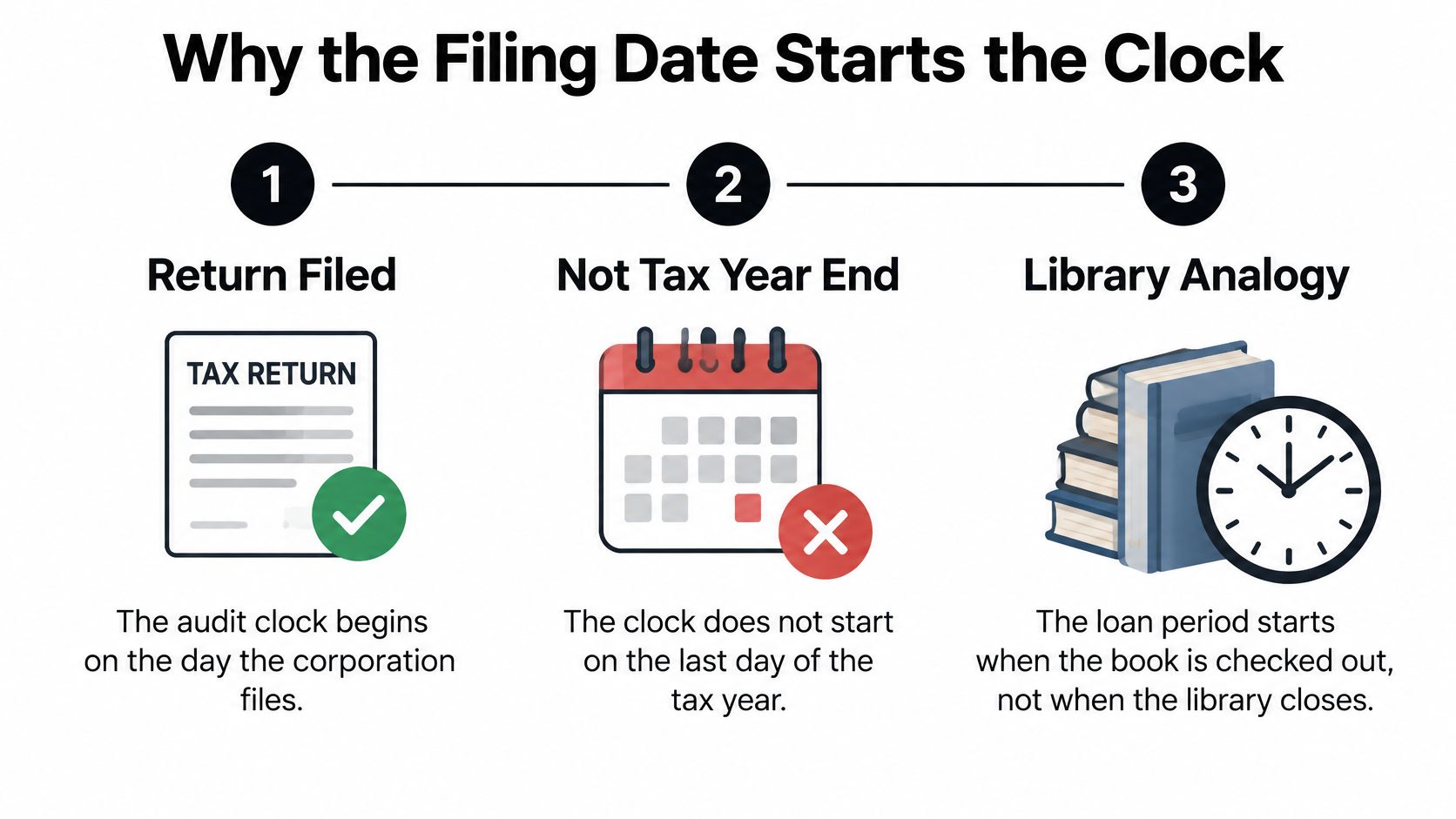
The last day of a corporation's tax year tells you which reporting period ended. It doesn't establish when the IRS received the return needed to start the ordinary assessment period.
Think of a library loan. The borrowing period starts when you check out the book, not when the library closes for the month. Corporate tax timing follows a similar idea, with an important adjustment for returns filed early.
Compare the filing date with the statutory due date
For an early return, use the applicable statutory due date rather than assuming early delivery accelerates expiration. For a late return, the actual filing date generally controls the starting point.
Consider two hypothetical corporations with the same statutory deadline. One submits its return before that deadline; the other submits it afterward. The early filer uses the statutory deadline as its starting point, while the late filer generally uses its later actual filing date.
That distinction also matters for fiscal-year corporations. Don't use a calendar-year corporation's deadline just because it appears in an online example. Confirm the due date for the corporation's own reporting period and distinguish the original statutory deadline from an extension to file.
Build a defensible date calculation
Use this sequence when reviewing the file:
- Identify the return. Confirm the entity, tax type, and reporting period.
- Find proof of filing. Preserve the accepted electronic filing acknowledgment or reliable mailing evidence.
- Verify IRS account records. Compare the documents with the account transcript.
- Apply the relevant period. Check exceptions and deadline-changing events before recording a final expiration date.
Our guide to reading an IRS transcript can help you understand the account history. A transcript is useful, but a disputed filing date may require the original acknowledgment or mailing records too.
An amended return doesn't automatically restart the original assessment period. Nevertheless, amendments can raise special timing questions, particularly when they disclose additional tax near expiration. Keep the original and amended submissions together rather than replacing the original filing date in your records.
The calculation is therefore more than adding time to a date. You must first establish which date legally counts.
The Six-Year Rule for Omitted Income
The extended period for omitted income isn't a general rule allowing the IRS more time whenever an examiner finds a sizable adjustment. The question is whether the return meets the statutory gross-income omission test.
Under the Treasury regulation governing substantial income omissions-1), omitting an amount exceeding 25% of reported gross income can permit assessment within six years; if reported gross income is $2,000,000, an omission greater than $500,000 can meet that threshold.
Separate missing income from disputed expenses
Say a corporation deposits customer payments into a bank account that its bookkeeper never reconciles with the sales ledger. If those payments never reach the return, counsel must evaluate them as potentially omitted gross income.
Now consider a corporation that reports its sales but claims an expense the examiner rejects. That adjustment may increase taxable income substantially, yet it doesn't automatically establish the required gross-income omission.
Don't compare the proposed adjustment with net profit. The statutory test uses gross income as defined for this purpose, and business receipts, cost-of-goods-sold treatment, and disclosures can affect the analysis. A percentage calculated from the wrong return line can produce a convincing but incorrect answer.
A large tax bill and a substantial omission of gross income aren't interchangeable findings.
Basis disputes also deserve careful treatment. Don't assume every disagreement over asset basis is merely a deduction issue, or rely on an older court decision without checking the statute applicable to the return.
Reconcile the income before arguing about the deadline
Give counsel a reconciliation that connects:
- Customer receipts to sales records and bank deposits.
- Reported income to the general ledger and return workpapers.
- Unusual deposits to loans, capital contributions, transfers, or other documented explanations.
- Foreign-source items to the relevant account records and disclosures.
Income attributable to specified foreign financial assets can invoke a separate extended-period rule. That inquiry requires identifying the asset and the associated income, not deciding only whether the corporation has an overseas bank account.
If the reconciliation reveals a material gap, preserve the records immediately. Don't assume a missing amount is harmless because an examiner hasn't identified it yet, and don't concede an extended period without checking the legal test.
Fraud and Unfiled Returns
A missing required return isn't an old compliance problem. It can leave the IRS without the ordinary filing event that starts the assessment timer.
Think of a timer that hasn't been switched on. Paying estimated tax, maintaining accounting records, or filing returns for neighboring reporting periods doesn't necessarily substitute for filing the required return itself.

A filed return for another period doesn't fill the gap
Suppose a corporation files the returns immediately before and after a missing reporting period. The gap doesn't disappear because the business later became compliant.
Before concluding that a return is missing, check the actual submission history. A rejected electronic filing, an unsigned draft, and an accepted return are different documents. An owner's belief that the accountant handled filing isn't proof that the IRS received a legally sufficient return.
A properly filed late return generally starts an assessment period that nonfiling left open. Fraud requires a separate analysis, however. Filing a later, accurate document doesn't necessarily erase the consequences of an earlier fraudulent return.
Intentional evasion differs from an honest mistake
A bookkeeping error doesn't automatically establish fraud. A fraud allegation concerns intentional tax evasion, so counsel must examine what happened, who knew about it, and what the supporting records show.
Our explanation of the statute of limitations for tax evasion discusses why civil assessment and criminal exposure shouldn't be treated as the same question.
Before submitting corrective paperwork, gather the relevant materials:
- Return history showing what was submitted and accepted.
- Source documents explaining the transactions at issue.
- Preparation communications identifying how the entries were created.
- IRS correspondence showing whether an examination or investigation has begun.
Don't destroy documents, backdate records, or invent an explanation for an entry you can't support. If a return is missing or contains known false statements, obtain legal advice before choosing how to correct it.
Special Rules for S Corporations and Consolidated Groups
A business owner may see a single operating company, while the tax system involves several taxpayers and returns. That difference is especially important for S corporations and affiliated corporate groups.
For an S corporation, an adjustment to a pass-through item can affect shareholders' personal tax liabilities. Closing the entity's file doesn't automatically establish that every shareholder's assessment period has expired.
S corporation and shareholder records must be matched
Suppose an S corporation reports income to its owners through Schedule K-1. A shareholder files a personal return later than the entity files its return, and another shareholder has a separate extension agreement.
Those owners don't necessarily share the same expiration date. Counsel must examine the entity return, the affected shareholder returns, and any individual exceptions or consents.
Create a working schedule with these fields:
| Record | What to identify |
|---|---|
| Entity return | Filing evidence and affected pass-through items |
| Each shareholder return | Filing date and treatment of those items |
| Shareholder correspondence | Notices, amendments, and consent agreements |
| Basis support | Contributions, distributions, and other relevant adjustments |
An entity-level audit can produce shareholder-level consequences. Keep the records coordinated without assuming that one deadline resolves every taxpayer's position.
Consolidated filing changes the document review
A consolidated group requires a different starting point. The common parent generally handles the consolidated filing and acts for the group in relevant tax matters, so counsel must identify the consolidated return and the parent's authority.
A subsidiary's membership history matters too. Joining or leaving a group can produce separate reporting periods, and a separately filed return may require its own limitations analysis.
For example, a subsidiary may have records covering both a period included in the group's return and a separate period outside the group. Treating its entire accounting year as one tax filing can obscure the relevant deadline.
Map the taxpayer to the return before assigning an expiration date.
Gather group organization charts, acquisition or disposition documents, separate returns, and consolidated filings. Then identify who signed any extension agreement and which entities, taxes, and periods it covers. A group-wide conclusion should come from that document review, not merely from the parent's filing date.
Employment Taxes and Criminal Exposure Run on Separate Clocks
Payroll issues require their own analysis even when a corporation's income-tax examination is nearly finished. The IRS Criminal Investigation manual identifies a six-year criminal limitation period for willful failure to collect, account for, or pay over employment taxes, while certain information-return and recordkeeping violations generally carry three-year periods.
Those are criminal rules. They don't establish the civil assessment deadline for every payroll return or responsible person.
Clock start and length by liability
| Liability | Period | Clock starts |
|---|---|---|
| Civil income tax, Form 1120 or 1120-S | Ordinary assessment period, extended when an applicable exception applies | Filing date, adjusted for early-filing rules |
| Employment tax, Form 941 quarterly return | Ordinary civil assessment period, subject to special employment-tax filing rules and exceptions | Legally applicable filing date, including deemed-filing rules |
| Willful failure to pay over employment taxes, IRC 7202 | Separate criminal limitation period | Determined from the offense and applicable criminal timing rules |
Don't calculate payroll expiration by adding the ordinary period to each quarterly submission date. Special deemed-filing rules can align timely employment-tax returns to a common starting point. The date printed on an electronic acknowledgment isn't always the legal starting date.
The owner's exposure is easy to overlook
The Trust Fund Recovery Penalty can expose an individual responsible person to liability separate from the corporation's own payroll-tax balance. Counsel must examine both responsibility and willfulness, along with the assessment history.
Preserve evidence showing who controlled payments, signed checks, accessed bank accounts, and decided which creditors were paid. Payroll registers alone may not answer those questions.
Our guide to small-business payroll taxes explains the underlying obligations. For deadline review, keep payroll returns, deposit confirmations, bank records, and responsible-person correspondence together.
If intentional nonpayment or a criminal investigation is possible, involve counsel early. Attorney-client privilege generally protects confidential communications seeking legal advice, but it doesn't automatically protect underlying business records or every communication involving an attorney.
Ask counsel how to preserve confidentiality before forwarding legal advice to accountants, employees, or other third parties.
Extending or Pausing the Clock
An IRS request to sign Form 872 deserves a decision, not an automatic signature. A consent can preserve assessment authority beyond the deadline that would otherwise apply.
The IRS audit guidance explains that taxpayers may agree to extend the assessment period and that declining can require the IRS to act on the information available. A written extension can give the corporation time to substantiate deductions, but it also gives the IRS more time to assess.
Evaluate what the consent actually covers
Read the tax type, reporting period, scope, and termination language. Confirm whether the agreement uses a fixed expiration date and whether counsel should seek restrictions.
Declining an extension doesn't make the examination disappear. The IRS may issue a notice of deficiency sooner to protect its position, leaving less time for an administrative resolution.
Events that extend or pause the assessment period
| Event | Effect on the period |
|---|---|
| Signed written consent, Form 872 | Extends the period according to the agreement's terms |
| Notice of deficiency and Tax Court petition | Can suspend assessment timing during the statutory prohibition and related court proceedings, with an additional statutory period |
| Taxpayer outside the United States for an extended continuous period | Requires identifying the applicable rule; absence rules shouldn't automatically be treated as a corporate assessment suspension |
| Bankruptcy proceeding | Can suspend assessment timing while assessment is legally prohibited, with an additional statutory period |
An extension and a suspension work differently. A fixed-date consent supplies an agreed deadline. A suspension requires calculating excluded time under the controlling statute.
Be particularly careful with foreign-absence rules. Rules affecting collection from an individual aren't interchangeable with rules governing assessment against a corporation.
Preserve the limitations defense
If a notice appears untimely, don't ignore it. Give counsel the notice, original return, filing evidence, amendments, and every consent so the defense can be evaluated and raised properly.
A corporation may challenge a deficiency through the Tax Court process when the requirements are met. Tax attorneys can represent clients in U.S. Tax Court and federal court, subject to the applicable admission requirements.
The response deadline printed on a notice deserves separate attention from the disputed assessment deadline. A potentially valid limitations defense doesn't excuse missing the deadline to seek review.
Calendar both dates, retain the envelope and delivery evidence, and obtain a written calculation identifying every adjustment to the assessment period.
Build Your Retention Plan Before the Next IRS Letter
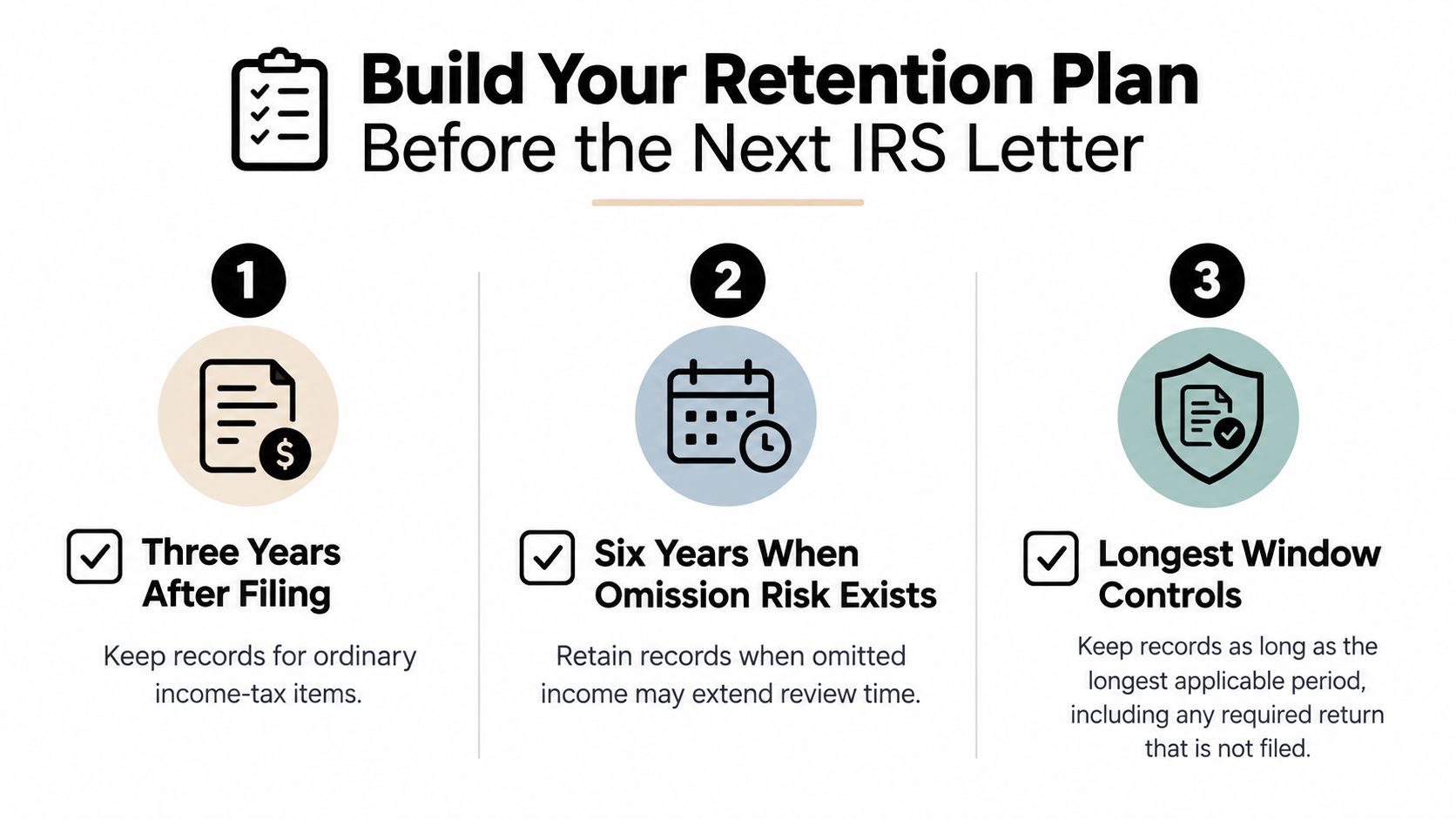
Build retention around the longest applicable exposure, not a single company-wide destruction date. Keep records supporting open returns, unresolved assessments, asset basis, and related shareholder items until their continuing relevance has been evaluated.
Fraud concerns need special handling. Don't assume filing a corrective return creates a routine destruction date for documents connected to an earlier fraudulent filing.
Assemble a usable defense file
- Filed returns and acceptance evidence, including electronic acknowledgments.
- General ledgers and bank statements that reconcile to the returns.
- Invoices, sales receipts, and contracts supporting reported income.
- Payroll returns, registers, and deposit evidence, retained through the relevant payroll and responsible-person review periods.
- Shareholder schedules and basis records needed to support pass-through reporting.
- Consents, amendments, extension requests, and IRS notices, preserved with their delivery records.
Cloudvara's explanation of why audit trails matter for compliance provides useful context for preserving a traceable record of changes. Pair that approach with our guide on preparing for an IRS audit.
Seek counsel promptly for a criminal investigation, foreign-account issues, revenue officer involvement, or valuable assets at risk of seizure. Large liability exposure over $1,000,000 is another practical reason to obtain attorney-led review.
We file the appropriate power of attorney to establish representation and direct covered IRS communications through counsel. Before responding substantively to an IRS letter, identify the controlling statute for each liability and preserve the documents needed to prove your dates.
Tax Attorney Stephen A Weisberg offers IRS audit representation and reviews of filing histories, assessment deadlines, and extension agreements, with work directed toward reducing tax liability and removing applicable penalties. Visit Tax Attorney Stephen A Weisberg to request a free Tax Debt Analysis and discuss your corporation's IRS notice, filing records, and next steps.


