IRS Audit Penalties Explained and How to Reduce Them
Learn IRS audit penalties, rates, interest stacking, and how to contest or abate them. Practical steps to minimize exposure and when to call a tax attorney.

In this article
- What Happens After an IRS Audit Notice Arrives
- The first financial shock
- What usually comes next
- How IRS Audit Penalties Work and When They Apply
- Think of the penalty as a label, not just a bill
- What the IRS looks for
- Where taxpayers often have a defense
- The Main IRS Penalties You May Face After an Audit
- Common IRS audit penalties at a glance
- Accuracy-related penalties
- Filing and payment penalties
- Payroll and trust fund problems
- Why taxpayers often underestimate the bill
- Why Penalties and Interest Stack Into a Bigger Bill
- The stacking problem
- A plain-language example
- Why this hits small businesses especially hard
- How Penalties Are Assessed and How to Contest Them
- The procedural path
- What evidence helps most
- Where taxpayers lose ground
- Options to Reduce or Remove Penalties After an Audit
- Reasonable cause relief
- First-time relief and the coming 2026 shift
- Side-by-side view
- Choosing the right request
- Practical Steps to Minimize Penalty Exposure Going Forward
- A short checklist that matters
- When to bring in a tax attorney
The envelope shows up, or the IRS notice appears in your online account, and your first thought is usually simple: how much more tax do they say I owe?
That's the right first question, but it's not the full one. In many audit cases, the tax adjustment is only the base layer. IRS audit penalties can sit on top of that amount, and interest can keep running while the matter is being worked out. For a business owner, freelancer, or self-employed taxpayer, that's often the part that turns a manageable problem into a cash flow crisis.
I see the same confusion again and again. People assume every audit adjustment automatically brings a penalty. It doesn't. Others focus only on the percentage listed on a notice and miss the larger issue, which is how different penalties can overlap and how interest can keep increasing the total bill.
Calm analysis matters. You don't need to memorize Internal Revenue Code sections. You need to understand what the IRS is accusing you of, which penalties match that accusation, where defenses fit, and which forms of relief may still be available after the audit ends.
What Happens After an IRS Audit Notice Arrives
A common real-world scenario goes like this. A sole proprietor gets an audit notice about business deductions, contractor income, or a Schedule C issue. An S corporation owner gets questions about payroll, shareholder distributions, or missing records. A landlord gets asked to support losses or expenses.
At that moment, most taxpayers read the notice as a dispute about math. The IRS often sees it differently. The agency may be testing whether the return position was merely unsupported, or whether it reflects negligence, disregard of rules, or a substantial understatement that could justify a penalty.
That distinction matters because an audit isn't just about whether the IRS adjusts the return. It's about the character of the adjustment. If the issue is only a correction, the case may end with added tax. If the IRS says the adjustment fits a penalty statute, the financial picture changes.
The first financial shock
Many taxpayers don't realize that the eventual bill may include three moving pieces:
- Additional tax: The amount the IRS says should have been paid originally.
- Penalties: Amounts tied to the type of error or to filing and payment problems.
- Interest: A running charge that can continue to grow while the balance remains unpaid.
A tax audit often costs more than the proposed adjustment on page one of the notice.
That's why responding early matters. The first response often shapes the record the IRS agent sees. If you can organize receipts, bank records, payroll reports, engagement letters, or other documents quickly, you improve your chances of limiting the adjustment before it hardens into a penalty issue.
What usually comes next
Most audit notices start with a request for documents or an explanation. Then the examiner reviews the records and decides whether to propose changes. If you've never been through that process, this plain-English guide on what happens during an IRS audit is a useful companion.
Here's the practical mindset I want worried taxpayers to adopt:
- Read the notice slowly: Identify the tax year, deadline, and items under review.
- Separate facts from fear: The notice may raise issues. It hasn't necessarily proven them.
- Start building the file: Gather contemporaneous records, not just summaries you prepared later.
- Watch for penalty language: If the IRS mentions negligence, understatement, or missing returns, the consequences are higher than the tax adjustment alone.
If you treat an audit notice like a parking ticket, you can miss the penalty exposure entirely. If you treat it like a solvable financial dispute, you can usually make better decisions.
How IRS Audit Penalties Work and When They Apply
Not every audit adjustment creates a penalty. That point sounds small, but it changes how you should read an IRS notice.
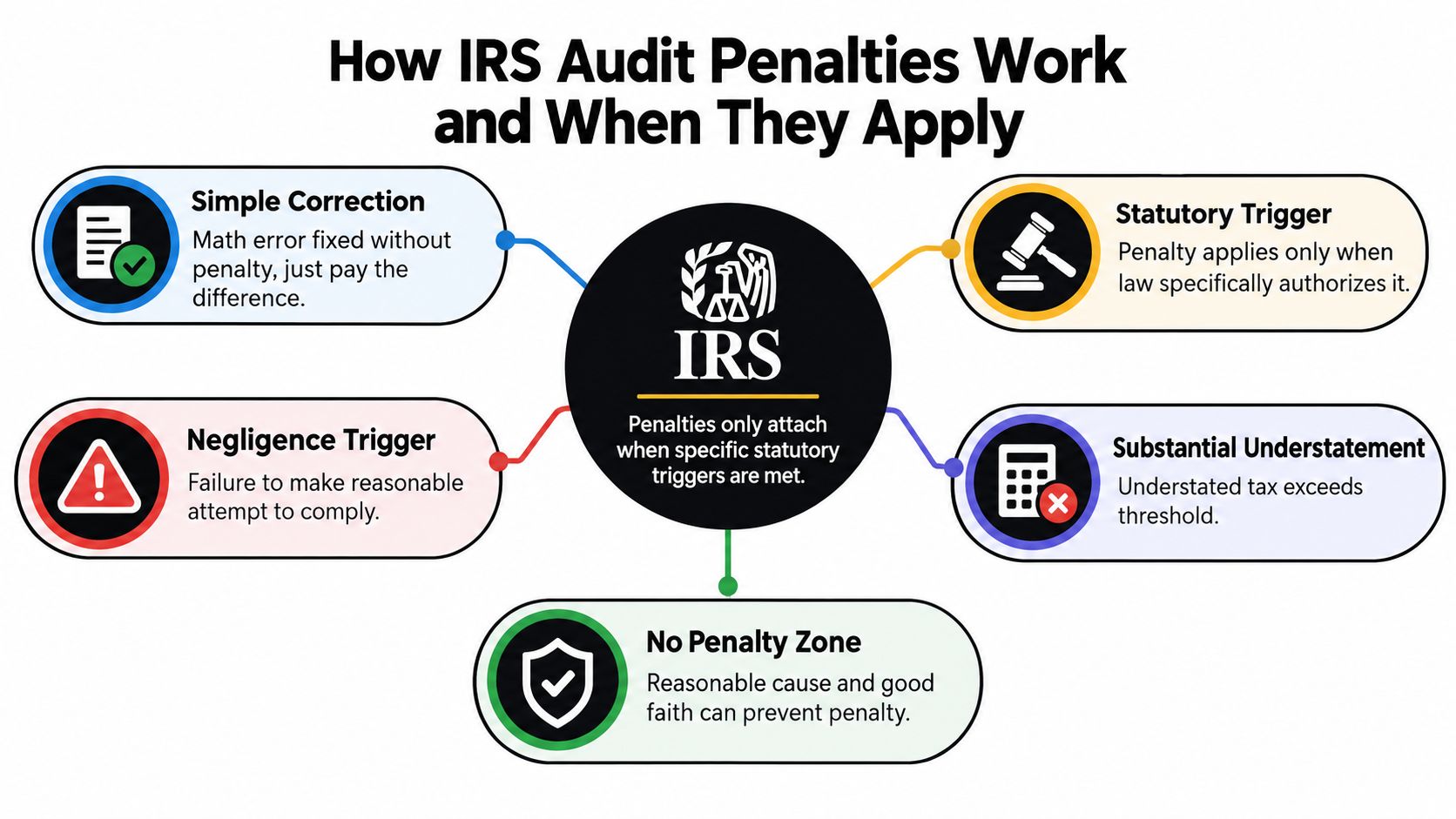
The IRS accuracy-related penalty under IRC §6662 is generally 20% of the portion of an underpayment attributable to negligence, disregard of rules, or a substantial understatement, and it applies only when the adjustment fits one of those statutory triggers, as the IRS explains on its accuracy-related penalty page. In plain English, the IRS doesn't get to add this penalty just because it won an adjustment.
Think of the penalty as a label, not just a bill
An audit adjustment answers one question: was the return wrong? A penalty asks a second question: why was it wrong?
If the IRS says you made a simple correction-level mistake, that may not produce a penalty. If the IRS says you failed to make a reasonable attempt to comply, ignored a rule, or substantially understated the tax, then the same adjustment can become more expensive.
A useful analogy is a traffic stop. Two drivers may be going the same speed, but the consequences differ if one has a valid license, current registration, and a credible explanation, while the other ignored prior warnings and has missing paperwork. In tax disputes, context matters the same way.
What the IRS looks for
The penalty analysis usually turns on the specific item that created the underpayment. That means the IRS asks questions like these:
- Was there negligence: Did the taxpayer fail to keep adequate records or claim something without a reasonable basis?
- Was there disregard of rules: Did the taxpayer ignore a clear filing or reporting requirement?
- Was there a substantial understatement: Did the understatement cross a statutory threshold?
The legal framework is detailed, but the practical point is simple. The penalty base is tied to the problematic item, not automatically to every dollar of difference across the return.
Where taxpayers often have a defense
The most important defense in many audit penalty cases is reasonable cause and good faith. That usually means showing you tried to comply, kept records, relied on information you reasonably believed was accurate, or acted in a way that was careful rather than careless.
Practical rule: A penalty case is often won or lost in the documents that show how you made the reporting decision at the time, not in the explanation you create after the audit begins.
That's why emails with a CPA, bookkeeping records, payroll reports, valuation materials, and internal notes can matter so much. They help answer the question behind many IRS audit penalties: not just what happened, but whether your conduct was reasonable.
The Main IRS Penalties You May Face After an Audit
A common post-audit shock goes like this. A business owner expects a bill for extra tax, then opens the notice and sees separate line items for penalties tied to how the IRS classified the problem. The numbers can look small in isolation, but each category has its own trigger, and more than one can apply to the same year.
That is why penalty labels matter. They are not just IRS vocabulary. They determine how much gets added, what defenses are available, and how quickly the balance can grow once interest starts running.
Common IRS audit penalties at a glance
| Penalty Type | Typical Rate and Trigger | Example Situation |
|---|---|---|
| Accuracy-related penalty | Often 20% of the underpayment tied to negligence, disregard of rules, or substantial understatement | A self-employed taxpayer deducts expenses without adequate support |
| Higher accuracy-related category | Sometimes 40% in more serious situations, including certain valuation and foreign asset issues | A valuation dispute involving a serious overstatement |
| Failure-to-file penalty | Applied when a required return was not filed on time | A business owner under audit never filed one of the years under review |
| Failure-to-pay penalty | Applied when tax shown or later assessed was not paid on time | A taxpayer filed but did not pay the balance due |
| Trust fund recovery penalty | Arises in payroll tax cases involving withheld employment taxes | An LLC with payroll tax debt fails to remit withheld amounts |
Accuracy-related penalties
For many audit clients, this is the first penalty that appears. Under the IRS manual discussion of penalty issues, the standard accuracy-related penalty is generally 20% of the portion of the underpayment tied to negligence, disregard of rules, or substantial understatement, and some more serious categories can rise to 40% under the same framework described in the IRS penalty guidance.
Here is the practical point. The IRS is not asking only, “Was the return wrong?” It is also asking, “Why was it wrong?” A weak recordkeeping case, an unsupported deduction, and a serious valuation overstatement may all produce extra tax, but they do not carry the same penalty risk.
The substantial understatement rules also catch taxpayers off guard. An adjustment does not have to feel dramatic to trigger penalty analysis. If the understatement crosses the statutory threshold for that taxpayer, a routine audit dispute can turn into a penalty case fast.
Filing and payment penalties
Some audits expose older compliance problems that were already sitting in the background. A late return, an unpaid balance, or both can create separate penalties apart from the audit adjustment itself.
That distinction matters because these charges can stack. One penalty relates to filing late. Another relates to paying late. An accuracy penalty can sit on top of those if the audit adjustment meets the legal test. The result is less like one traffic ticket and more like several fees added to the same account for different reasons.
Taxpayers with cash flow problems often fall into this pattern. They file late because they cannot pay, or they file on time and hope to catch up later. After an audit, the IRS account may treat those as separate failures, each with its own cost.
Payroll and trust fund problems
Payroll tax cases are different in a way that worries owners for good reason. If a business withheld taxes from employees and did not remit them, the IRS may assert the trust fund recovery penalty against individuals it considers responsible for collecting and paying over those amounts. If that issue is in play, this explanation of the trust fund recovery penalty shows how personal exposure can reach owners, officers, and others with authority over payroll decisions.
For readers who want a cross-jurisdiction comparison of how tax authorities describe penalty categories, Audit penalties explained for Sydney firms gives a helpful outside perspective on how audit penalties are framed in another system. The labels differ, but the lesson is familiar. Good records and timely compliance usually shape the outcome.
Why taxpayers often underestimate the bill
The confusion usually starts with one percentage. A taxpayer hears “20% penalty” and assumes that is the full add-on. In practice, the penalty category is only one layer of the bill. Late filing issues, late payment exposure, and payroll assessments can all exist in the same case, and interest does not wait politely on the sidelines while those issues get sorted out.
That stacking effect is what many penalty guides leave out. It also matters because relief rules are changing. Beginning in 2026, the IRS plans to shift from the old First-Time Abate framework to an Automatic Exemption model for some taxpayers, which may help in some situations but will not erase every type of audit penalty. Knowing which category the IRS used is the starting point for figuring out what can be reduced.
Why Penalties and Interest Stack Into a Bigger Bill
A self-employed consultant gets through an audit and focuses on the extra tax the examiner proposed. Then the IRS notice arrives, and the balance is much higher than the audit adjustment alone.
That surprise usually comes from layers. An IRS account can include the added tax, one or more penalties, and interest that keeps accruing while the balance stays unpaid, as explained in this guide on IRS penalties and interest.
The stacking problem
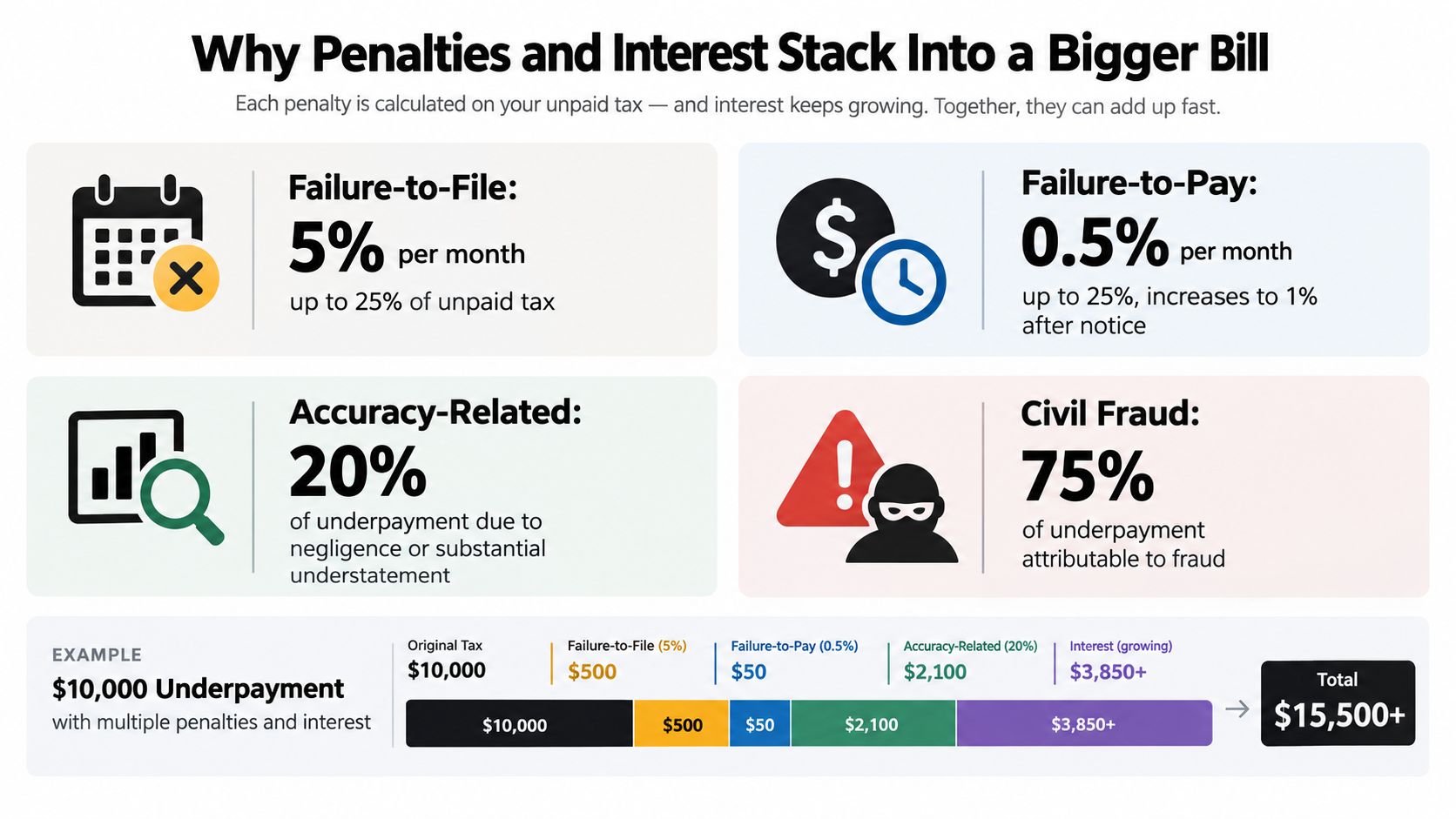
Penalties do not always arrive one at a time. In some cases, late-filing and late-payment penalties run during the same months. The IRS explains that the failure-to-file penalty is 5% per month or partial month up to 25%, and the failure-to-pay penalty is 0.5% per month up to 25%. If both apply in the same month, the combined monthly charge is 5%, because the filing penalty is reduced by the payment penalty under the IRS rules on failure-to-file and failure-to-pay.
That means a taxpayer can reach a maximum combined penalty burden of 47.5% before interest in a severe delinquency case.
Interest then keeps working in the background. A good mental model is a snowball on a slope. The audit adds the tax. Penalties add weight. Interest keeps rolling each day the balance is unresolved. By the time a taxpayer is ready to deal with the notice, the account may no longer resemble the original audit adjustment.
A plain-language example
Suppose an audit increases a sole proprietor's tax bill by $20,000. If the return was filed late, the tax was paid late, and the audit also supports an accuracy-related penalty, the final bill can include several separate charges tied to that same $20,000 problem.
The account may contain:
- The added tax from the audit
- A filing penalty
- A payment penalty
- An accuracy-related penalty if the facts fit the statute
- Interest that continues to accrue while the balance remains unpaid
That is why focusing on one percentage can be misleading. A taxpayer who hears "20% accuracy penalty" may assume the extra cost ends there. It often does not.
Looking only at the proposed tax deficiency can hide the real cost of an audit.
Why this hits small businesses especially hard
Small business owners and self-employed taxpayers often feel this more sharply because cash flow problems create timing problems. One missed deadline can lead to another. A late return becomes a late payment. A late payment keeps interest running. An audit adjustment then gets dropped onto an account that is already growing.
The result is less like a single fine and more like several meter charges running at once.
This point also matters because relief is changing. Beginning in 2026, the IRS is expected to shift some taxpayers from the older First-Time Abate framework to an Automatic Exemption model. That may help in some cases, but it will not erase every penalty category, and it does not stop interest from building while the matter sits unresolved. The practical lesson is simple. After an audit, you need to identify each layer of the bill separately, then check which charges can be challenged, reduced, or removed.
How Penalties Are Assessed and How to Contest Them
A penalty case usually turns on process, timing, and proof. Many taxpayers focus on the audit number itself and miss a separate question that matters just as much: how did the IRS attach the penalty, and did it follow the steps required to support it?
The procedural path
The process is usually less like a parking ticket and more like a file being built, piece by piece.
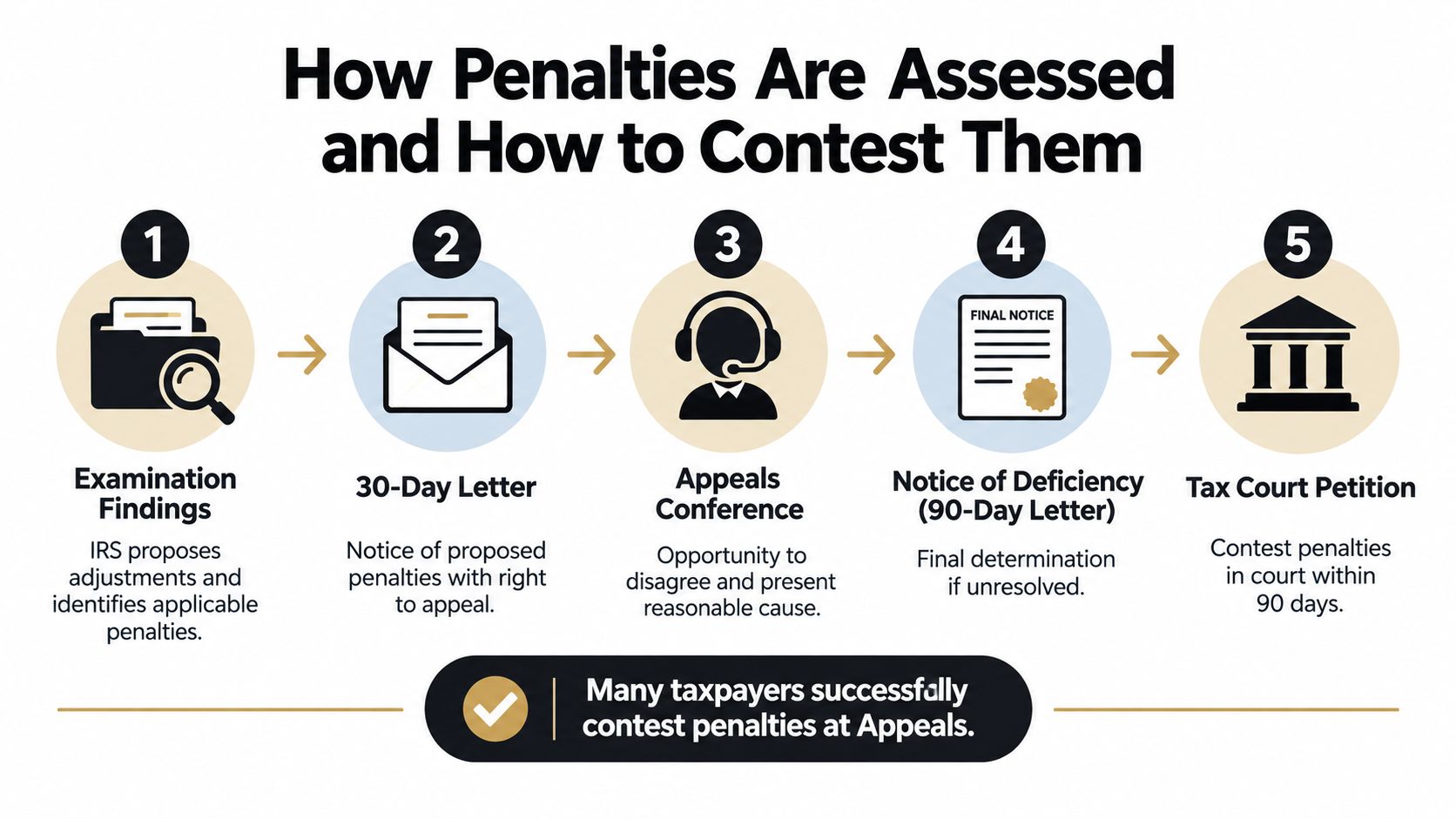
First, the examiner proposes an adjustment to tax. Then the examiner identifies which penalty section may apply to that adjustment, such as an accuracy-related penalty or a late-payment penalty. After that, the file may move through review channels inside the IRS before a formal notice is issued and the penalty is assessed.
At each stage, the IRS is supposed to connect the facts to the statute. That matters. A penalty is not valid just because an audit changed your return. The IRS still has to show why that specific penalty fits your conduct, your records, and the timing.
If you disagree, the contest usually follows this path:
- Examination findings: The IRS proposes changes to income, deductions, credits, or payroll treatment.
- Penalty determination: The examiner states which penalty provisions the IRS believes apply.
- Your response: You can submit records, explain the facts, and raise legal objections before the matter hardens into an assessment.
- Formal notice stage: The IRS issues the notices needed to preserve its right to assess and collect.
- Administrative appeal or court review: You can keep contesting the issue if the facts and law support it.
Some taxpayers do challenge proposed results, as noted earlier in the article. The practical lesson is simple. Do not treat a proposed penalty as final just because it appears in an audit report.
What evidence helps most
Penalty disputes are often won or lost on documents that show care, not just numbers.
If the IRS says you were careless, your goal is to show the opposite. If the IRS says you filed or paid late without a good reason, your goal is to show what happened, when it happened, and why a responsible person in your position could still have missed the deadline. The file should read like a timeline, not a plea for sympathy.
Useful evidence can include:
- Professional advice records: Emails, engagement letters, notes from calls, and drafts showing what advice you received and what facts you gave the adviser.
- Business records: Books, bank statements, invoices, payroll reports, and receipts that show you were trying to report items accurately.
- Timeline evidence: Medical records, disaster notices, insurance papers, or other records tying the compliance problem to a specific event.
- Correction efforts: Proof that you fixed the issue after discovering it, which can support a good-faith argument.
- Internal procedures: Checklists, accounting workflows, or calendar systems showing you had ordinary business controls in place.
For a basic comparison point on how late-filing penalty systems are explained outside the U.S., the Lighthouse Consultants penalty guide is a helpful plain-language reference. Different system, same lesson. Deadlines and documentation shape outcomes.
Where taxpayers lose ground
Delay causes problems. So does sending broad statements without records behind them.
A sentence like “I did my best” rarely carries much weight by itself. A stronger response sounds more like this: here is the return position, here are the records I relied on, here is the advice I received, and here is why that reliance was reasonable at the time.
That difference matters even more because penalty fights are really about future dollars, not just current percentages. A weak response can leave the penalty in place while interest keeps accruing on both the added tax and the unpaid penalty balance where the rules allow it. In other words, contesting a penalty is not just about principle. It is about stopping a growing account from becoming harder to resolve.
If your case is heading into review, this overview of IRS tax appeals explains how taxpayers can challenge proposed audit results through the administrative appeals process. Appeals officers often look closely at documentation quality, litigation risk, and whether the IRS can sustain the penalty if the case keeps going.
One final point causes confusion. The 2026 shift from First-Time Abate to an Automatic Exemption model may help some taxpayers later in the process, but it does not replace the need to contest a bad penalty determination on the front end. Relief programs can remove certain charges. They do not rewrite weak facts, and they do not erase interest that keeps running while the case sits unresolved.
Options to Reduce or Remove Penalties After an Audit
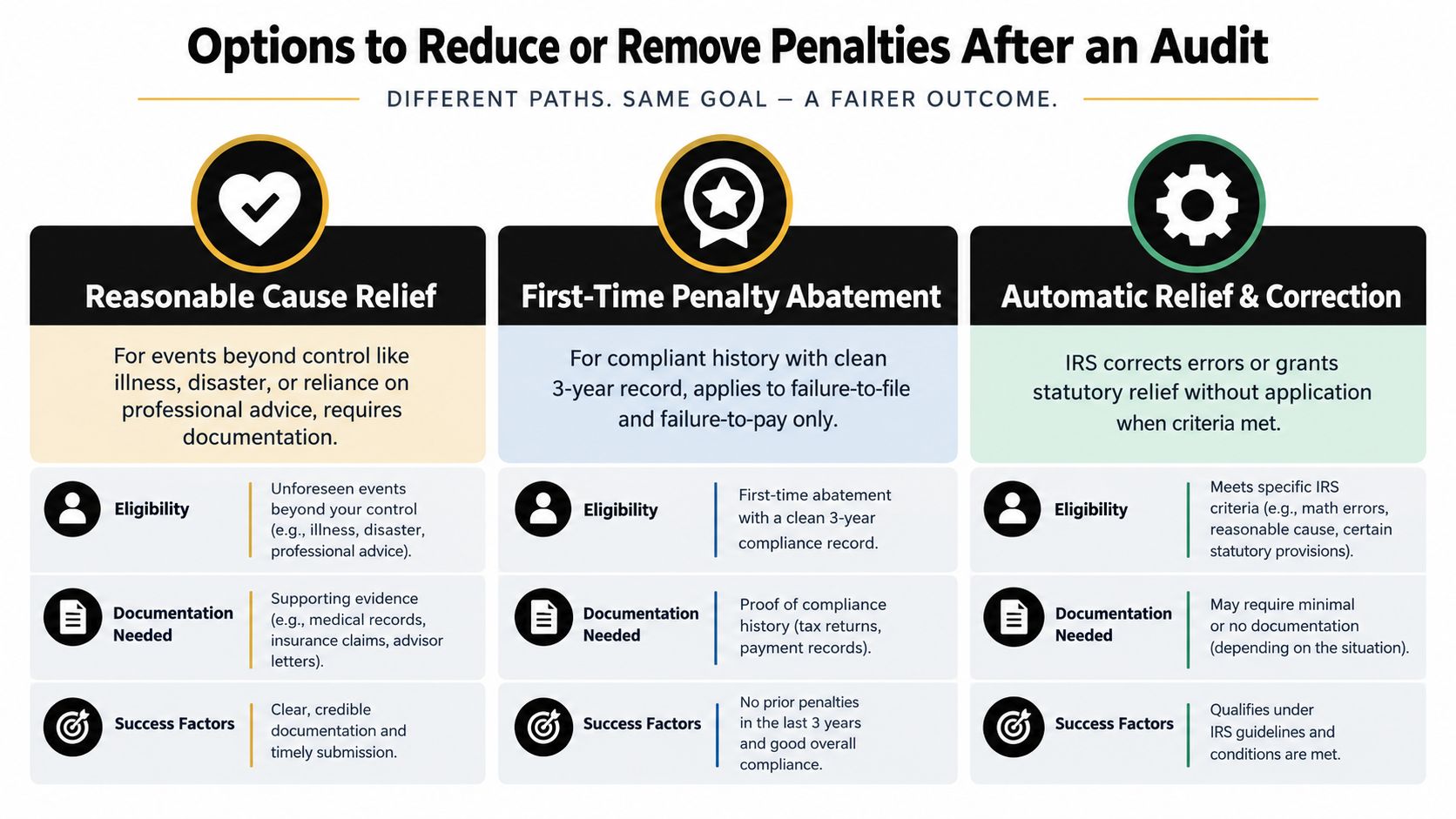
Once a penalty is on the table, the next question is not “can penalties ever be removed?” The better question is which relief path fits this penalty and these facts?
Reasonable cause relief
This is often the strongest route when the facts support it. The argument is that, despite the problem, you acted with ordinary business care and prudence or had a good-faith reason for what happened.
Good reasonable-cause presentations usually include a factual timeline, attached records, and a direct explanation of the connection between the event and the noncompliance. Vague hardship letters usually don't carry much weight.
First-time relief and the coming 2026 shift
Many taxpayers have heard of First-Time Abate, but older articles often stop there. A more current issue is that recent reporting says the IRS is replacing First-Time Abate with an Automatic Exemption from Penalty program beginning in summer 2026, covering common filing, payment, and deposit penalties for taxpayers with a clean three-year compliance history, according to this audit penalties and interest guide.
Because that change is future-dated, taxpayers should treat it as a reported upcoming shift, not a current rule already in force.
Side-by-side view
Here's how to think about the main relief paths:
- Reasonable cause: Best when you have a specific explanation supported by records.
- Clean-history relief: Best when the issue is isolated and your recent compliance history is strong.
- Statutory correction or automatic relief: Best when the IRS account itself reflects an error or when relief applies by rule without a full hardship showing.
If you want a deeper explanation of the mechanics, this article on penalty abatement lays out the relief concepts in more detail.
Choosing the right request
Taxpayers often make one of two mistakes. They file a generic abatement request without matching the legal standard, or they ask for the wrong kind of relief first.
A stronger approach is to decide the request based on the penalty type, the timing, and the proof available. In some cases, a tax controversy attorney, a CPA, or an enrolled agent can help frame that request. Tax Attorney Stephen A Weisberg is one example of a representative who handles IRS audit and penalty matters, including requests to reduce or remove penalties when the facts support relief.
Practical Steps to Minimize Penalty Exposure Going Forward
Penalty prevention is usually less dramatic than penalty defense. It's also cheaper.
A short checklist that matters
- File even if you can't pay: Filing on time can prevent one category of penalty from growing while you work on the payment problem.
- Separate bookkeeping from memory: Use contemporaneous records. A spreadsheet built after the audit starts is weaker than QuickBooks entries, invoices, receipts, and payroll reports made in real time.
- Match deductions to support: If you claim it, keep the document that proves it.
- Review notices fast: IRS deadlines don't slow down because the quarter is busy.
- Fix recurring issues early: Repeated payroll misses, missing estimated payments, or late-filed returns often make future audits more expensive.
- Ask about relief promptly: If you have a strong reasonable-cause story or a clean compliance history, don't wait until the account gets harder to unwind.
When to bring in a tax attorney
Some audit issues are manageable with an accountant and organized records. Others call for controversy counsel quickly.
Consider legal help when:
- The IRS is asserting penalties tied to negligence or substantial understatement
- Payroll tax exposure may extend to owners or managers personally
- You have several unfiled years or overlapping collection notices
- The facts are defensible, but the written record needs to be built carefully
A good representative won't just argue percentages. They'll help you define the issue, preserve documents, challenge unsupported penalty assertions, and pursue the right relief track.
If you're dealing with IRS audit penalties, the goal isn't panic or delay. It's to reduce uncertainty, protect your rights, and stop a tax adjustment from turning into a much larger problem than it needed to be.
If an IRS audit has turned into a penalty and interest problem, Tax Attorney Stephen A Weisberg helps individuals, business owners, and self-employed taxpayers analyze the exposure, respond to the IRS, and pursue the right penalty relief strategy. He works directly on audits, appeals, tax debt, and penalty abatement matters, and you can learn more or request help at Tax Attorney Stephen A Weisberg.


