IRS Audit Business: A Guide for Business Owners
Face an IRS audit business? Learn the triggers, documentation, and response steps to protect your company. Actionable guidance from a tax attorney.

In this article
- When the IRS Contact Comes Knocking
- Read the notice as a scope document
- How the IRS Selects Business Returns for Review
- Low volume doesn't mean low scrutiny
- Building the Defense With Essential Documentation
- Build a transaction trail
- Fix gaps without manufacturing evidence
- Responding to the IRS During an Examination
- Use the timeline strategically
- The Case for Professional Representation
- Representation changes the working dynamic
- Navigating Post-Audit Outcomes and Options
- Choose the path that matches the facts
- Separate tax liability from payment strategy
- Preparing for Future Audits and Compliance
- Turn compliance into a monthly process
You open the mail after a long workday and see the words “Internal Revenue Service.” Your first reaction is probably financial panic: How much will this cost? Did someone make a mistake? Should you call your accountant, respond immediately, or say nothing?
An IRS business audit is serious, but the notice itself isn't a verdict. It starts a structured examination. Your job is to understand the scope, meet the deadline, and give the IRS a clear evidentiary trail from the filed return to your books and source documents. Businesses that respond emotionally, send disorganized records, or volunteer explanations without a strategy often make a manageable examination harder than it needs to be.
When the IRS Contact Comes Knocking
The envelope arrives on Tuesday. It identifies the tax period, the return under examination, the items the IRS wants reviewed, and the date by which you must respond. That first letter matters because it tells you how the IRS is approaching the case. IRS business audits are generally selected by comparing a return with norms for similar returns, and the examination begins with written notice and requested documentation, not an open-ended interview. IRS examination guidance explains the basic process.
Don't ignore the letter while hoping the issue disappears. The IRS can conduct a correspondence examination by mail, an office examination at an IRS location, or a field examination at your business, tax professional's office, or another agreed location. A correspondence audit usually focuses on defined documents and specific line items. A field examination can involve broader review of books, bank records, invoices, receipts, and operating practices.
Read the notice as a scope document
Start by making a working copy of the notice. Mark every requested item, tax year, response date, and contact instruction. Then preserve the original and create a secure audit folder, preferably with separate subfolders for the return, accounting records, bank records, payroll, sales records, and communications.
The notice isn't asking you to prove that your entire business is perfect. It's identifying the points the examiner intends to verify. That distinction should shape your response. Give the IRS complete, relevant support for the requested items, but don't turn a narrow examination into an unstructured disclosure of every business document you possess.
If the letter involves collection activity rather than an examination, the process is different. Learn how a revenue officer interacts with IRS taxpayers before treating every IRS letter as an audit notice. When the notice is an examination, meet the deadline even if your records aren't ready. A written request for additional time is far safer than silence.
Practical rule: Confirm the notice, calendar the deadline, and have someone experienced review it before you send substantive records.
How the IRS Selects Business Returns for Review
The IRS doesn't need to select returns randomly. It can compare figures on a business return with statistical norms for similar returns and identify returns that deserve closer examination. That makes the right question less about whether a business is “unlucky” and more about whether its reported income, deductions, losses, and books tell a consistent story.
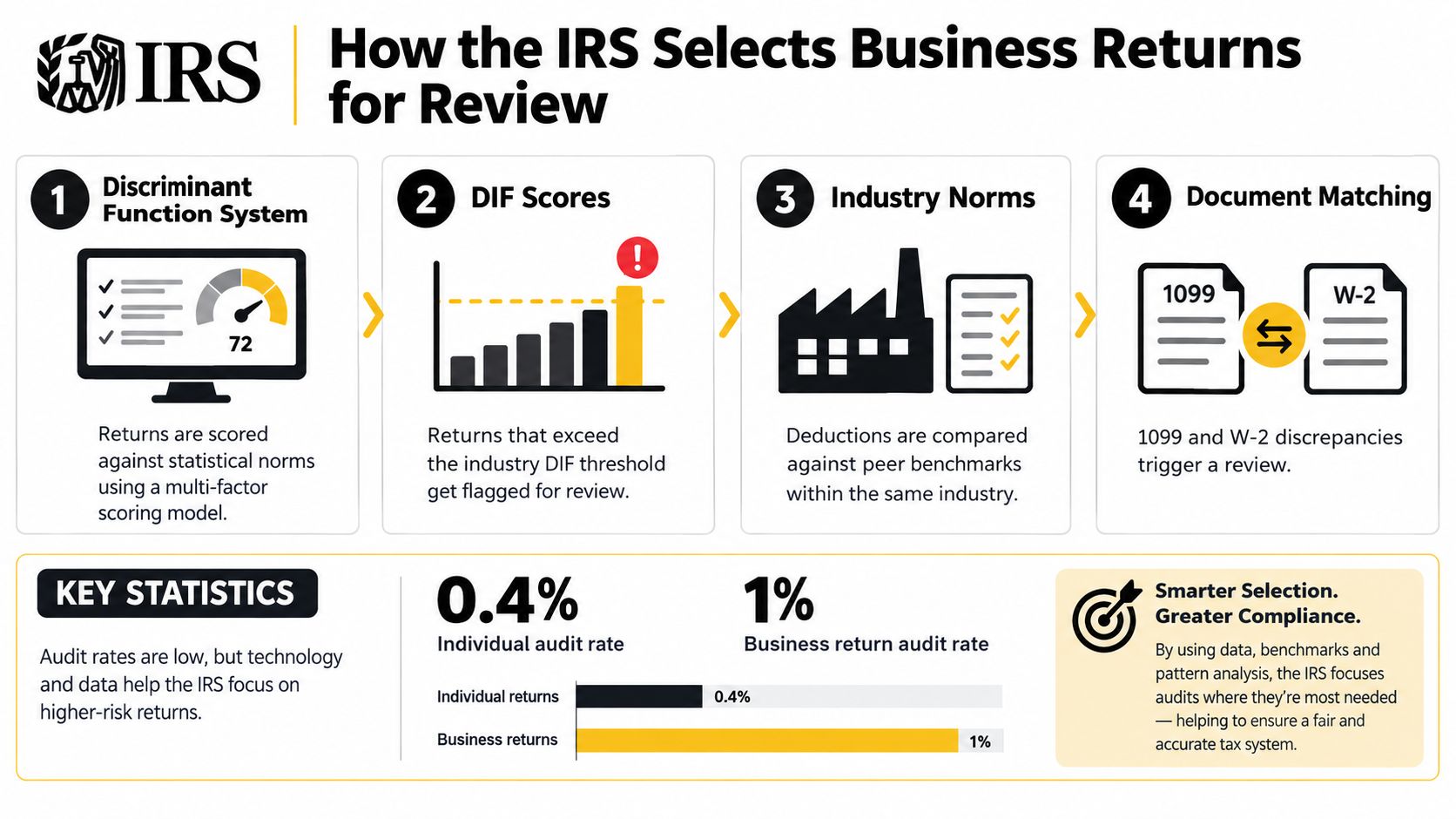
Enforcement also isn't uniform across taxpayers. In its strategic operating plan update, the IRS said it would keep audit rates for small businesses and taxpayers making under $400,000 at historically low levels while shifting enforcement toward high-income and large-entity taxpayers. The same update projected large corporate audit coverage would rise from 8.8% in tax year 2019 to 22.6% in tax year 2026, a projection rather than a report of completed examinations. It also explicitly stated that small business audit rates would not increase. The IRS strategic operating plan update describes those priorities.
Low volume doesn't mean low scrutiny
A small business may face a lower overall chance of examination than a large corporation, but a selected return can still receive focused attention. The examiner may concentrate on a mismatch between reported gross receipts and bank activity, unusually large deductions, unsupported losses, or figures that don't reconcile with information already available to the IRS.
That is why owners shouldn't rely on general audit-trigger lists. A deduction isn't indefensible merely because it looks unusual. It becomes a problem when the business can't show its purpose, amount, timing, and connection to the filed return.
A useful pre-filing review asks:
- Income consistency: Do sales records, payment processor reports, bank deposits, and information returns support the gross receipts reported?
- Expense logic: Can each material deduction be tied to a business purpose and source document?
- Ownership reporting: Do the business return, owner returns, distributions, and basis records agree?
- Book-to-return reconciliation: Can someone trace the return's line items back to the general ledger and supporting schedules?
Owners should also understand that selection isn't the same as wrongdoing. It means the return has been chosen for verification. Your response determines whether the examiner finds a clean explanation or a trail of unresolved inconsistencies. A focused review of what triggers a tax audit can help identify weak areas before the IRS asks about them.
Building the Defense With Essential Documentation
“Keep your receipts” is inadequate advice for a business audit. Receipts support individual expenses, but an examiner needs to understand how the transaction entered your books, how it reached the return, and whether the business records reconcile to the reported figures.
The IRS emphasizes organizing records by year and by income or expense type. That matters particularly for cash-intensive businesses. Neutral analysis cited in the IRS audit materials identifies a 55% misreporting rate among the most cash-intensive small businesses. IRS guidance on business audits underscores why a cash-heavy business needs more than a box of receipts.
Build a transaction trail
Reconstruct the return line by line. Start with the filed return and work backward through the trial balance, general ledger, bank statements, invoices, payroll reports, payment processor records, and original documents. If you find a difference, identify whether it came from timing, an omitted entry, a classification choice, or an actual error.
Your audit file should normally include:
- Filed returns and amendments: Include the complete federal return, state returns, schedules, extensions, and depreciation records.
- Income support: Assemble invoices, sales journals, merchant processor statements, deposit records, 1099 forms, and documentation for cash receipts.
- Bank and credit records: Reconcile business accounts and credit cards to the books. Explain transfers, owner contributions, loans, and personal items paid through business accounts.
- Expense support: Match invoices and receipts to ledger entries. Add the business purpose, date, payee, payment method, and account classification where the document doesn't make those facts clear.
- Payroll and contractor files: Organize payroll filings, wage reports, worker agreements, payment records, and year-end information returns.
- Asset and vehicle records: Preserve purchase documents, placed-in-service dates, depreciation schedules, mileage logs, and business-use explanations.
- Cash procedures: Document daily sales reports, cash counts, deposits, refunds, voids, and any reconciliation process.
Fix gaps without manufacturing evidence
If bookkeeping is incomplete, don't create replacement receipts or guess at amounts. Reconstruct the records from bank statements, merchant reports, vendor statements, calendars, contracts, appointment systems, and customer invoices. Label reconstructed records clearly and explain the method used.
For businesses that need a better expense workflow going forward, these Smart Receipts expense management tips offer practical guidance on capturing itemized transaction details. The tool or system matters less than consistent use. An examiner should be able to follow a transaction from the source document to the books and then to the return.
The strongest audit file doesn't contain the most paper. It contains the clearest chain of proof.
Responding to the IRS During an Examination
Once the records are organized, control the communication. Assign one person to manage the IRS relationship, keep a log of every call and submission, and send documents in a way that proves when they were delivered. Oral explanations can help, but written responses create a record and reduce the risk that an incomplete conversation will be misunderstood.
Answer the question asked. Don't volunteer unrelated tax theories, speculate about missing documents, or send entire accounting systems when the notice requests a defined schedule. A narrow, indexed production tells the examiner that you understand the scope and can support the return.
Use the timeline strategically
Most business audits start within a year of filing and finish in less than a year. The IRS generally has three years to begin an audit, a period that can extend to six years in certain substantial-omission cases and can be unlimited in cases involving fraud or certain foreign reporting failures. After findings, the IRS typically issues a 30-day letter, giving the taxpayer a decision point.
| Milestone | Typical Timeline | Action Required |
|---|---|---|
| Examination notice | At the start of the case | Confirm the tax year, scope, deadline, and requested records |
| Initial document response | By the date in the notice | Send an indexed, relevant production or request time in writing |
| Examination period | Most audits start within a year of filing and finish in less than a year | Track requests, respond accurately, and preserve submissions |
| IRS findings | After the examiner completes review | Analyze each proposed adjustment and supporting explanation |
| 30-day letter | After findings | Agree, partially agree, or appeal within the stated period |
These timing benchmarks come from Treasury and oversight materials on business return examinations. If a requested record doesn't exist, say so promptly and offer a credible reconstruction. Never imply that a document exists when it doesn't.
If the examination becomes difficult, get help before the response deadline rather than after a proposed adjustment. IRS audit help can provide context for deciding when professional involvement is appropriate.
The Case for Professional Representation
A business owner knows the business. That doesn't mean the owner should conduct the examination. An audit requires someone to separate relevant facts from distracting details, understand procedural choices, and present the evidence without creating new problems.
DIY handling can work when the notice is narrow, the records are complete, and the taxpayer understands exactly what the IRS is asking. It becomes risky when the books don't reconcile, the owner has mixed personal and business spending, payroll taxes are involved, or the examiner asks questions that reach beyond the original request.

Representation changes the working dynamic
A tax attorney or enrolled agent can review the notice, define the scope, prepare the production, and communicate with the examiner. With a valid power of attorney, the representative can handle much of the direct interaction, allowing the owner to focus on operating the business and reducing the chance of an improvised answer becoming part of the record.
Professional representation is particularly valuable when the examination touches payroll withholding, worker classification, sales tax, trust fund recovery penalties, pass-through allocations, or aggressive deduction positions. Those issues can affect the business and, in some circumstances, the owners personally.
The representative's role isn't to conceal facts. It's to frame them accurately. A weak explanation such as “that was just how we booked it” can become a proposed adjustment. A disciplined response identifies the transaction, cites the governing treatment, supplies the record, and concedes an error when the evidence requires it.
Compare the two approaches:
- DIY response: The owner gathers whatever documents are easy to find, answers each question personally, and discovers the underlying issue only after the IRS expands its requests.
- Professional response: The representative reviews the return first, reconciles the records, identifies unsupported items, and delivers a controlled response tied to the notice.
The benefits of hiring a tax attorney are clearest when the examination involves competing legal interpretations or consequences beyond the original tax amount. Representation isn't a luxury in those cases. It's risk management.
Navigating Post-Audit Outcomes and Options
An examination can end with no change, an agreed adjustment, or a disputed adjustment. Don't treat the first IRS conclusion as an instruction to pay immediately. Treat it as a decision point requiring a calculation of tax, penalties, interest, cash flow, and the strength of your evidence.
Choose the path that matches the facts
If the examiner's conclusion is correct, agreement can end the matter efficiently. Confirm the exact assessment, payment instructions, and any required amended returns or state filings. If only part of the adjustment is correct, a partial agreement may narrow the dispute and preserve your position on the remaining items.
If the IRS's position is wrong or the records support a different treatment, appeal. The IRS Office of Appeals provides an administrative forum for disputing findings without immediately going to court. A persuasive appeal identifies the disputed issue, states the legal position, cites the relevant facts, and organizes the supporting documents. Emotional objections don't replace evidence.
If the business accepts the liability but can't pay it in full, address collection separately from examination merits. Possible arrangements may include an installment agreement or another collection resolution, depending on the taxpayer's finances, filing compliance, and the nature of the liability. Don't let inability to pay cause you to concede an incorrect adjustment.
Separate tax liability from payment strategy
These are different questions:
- Was the return correct? Challenge unsupported adjustments.
- If not, what amount is owed? Recalculate tax, penalties, and interest.
- If the amount is owed, how can it be paid? Build a realistic payment plan based on current business cash flow.
- Are other periods exposed? Correct recurring bookkeeping or reporting failures before they affect another return.
A post-audit decision should be documented like any other important business decision. Compare the cost of appealing with the amount at stake, the quality of the records, the legal issue involved, and the effect on future filings. Sometimes agreement is efficient. Sometimes appealing a weak IRS position is the responsible choice.
Preparing for Future Audits and Compliance
After an examination, many owners promise to “keep better records” and then return to the same monthly habits. That promise isn't a system. A resilient business assigns responsibility, closes its books consistently, and reviews the return before filing.

Turn compliance into a monthly process
A business owner who waits until tax season to reconcile income and expenses is forcing an annual reconstruction. Instead, create a recurring close process:
- Reconcile accounts: Match bank and credit card activity to the books and investigate unexplained items.
- Review revenue: Compare invoices, merchant reports, deposits, cash logs, and information returns.
- Test deductions: Check that significant expenses have a business purpose and source document.
- Separate ownership activity: Record contributions, distributions, loans, and personal expenses correctly.
- Preserve records: Store documents by tax year and category in a secure, searchable system.
- Review before filing: Have the preparer compare the return with the final books and supporting schedules.
A cash-intensive business needs tighter daily controls than a business paid almost entirely by invoice. A partnership or S corporation needs reliable owner, basis, distribution, and allocation records. Compliance should reflect how the business earns money, pays people, and spends funds.
The current enforcement environment also rewards targeted preparation. The IRS has said small-business audit rates will remain historically low while enforcement shifts toward large entities and high-income taxpayers. That isn't permission to tolerate sloppy records. It means your preparation should focus on the issues your structure and operating model create, especially income reconciliation and substantiation.
Businesses operating across jurisdictions can also benefit from comparing practical compliance systems internationally. The discussion of Australian SME tax compliance offers a useful reminder that organized records and repeatable processes matter regardless of the tax system involved.
An audit-ready business isn't one with no unusual transactions. It's one that can explain them, document them, and connect them to the filed return without delay. Build that discipline before the next letter arrives, and the examination becomes a controlled business task rather than a crisis.
Tax Attorney Stephen A Weisberg helps businesses and owners respond to IRS audits, manage communications under power of attorney, and address related tax debt or state tax issues. Visit Tax Attorney Stephen A Weisberg to request a free Tax Debt Analysis and determine what support fits your examination.


