IRS Alternative Dispute Resolution: Your 2026 Guide
Navigate IRS alternative dispute resolution options for 2026. Learn how to resolve tax disputes with the IRS efficiently. Get your complete guide here.

In this article
- That IRS Letter Arrived Now What
- What people get wrong early
- Understanding IRS Alternative Dispute Resolution
- Where ADR fits in the IRS system
- How ADR differs from standard Appeals
- Why this matters for smaller taxpayers
- Exploring Your IRS ADR Options
- The main programs in practice
- Comparison of IRS ADR Programs
- Which option fits which problem
- What ADR does not fix
- The ADR Process Step by Step
- Step one, confirm fit and eligibility
- Step two, prepare the request carefully
- Step three, get everyone aligned before the session
- Step four, use the session to narrow and resolve
- Step five, document the result or preserve the next path
- ADR vs Traditional Appeals Weighing Your Choices
- Where ADR usually wins
- Where traditional Appeals may be stronger
- The real trade-off
- Preparing for Success in Your ADR Case
- Build a case file that tells a story
- Anticipate the IRS position honestly
- Is ADR only for large corporations
- What helps most in smaller cases
- When a Tax Attorney Is Your Strongest Asset in ADR
- Signs self-representation may be risky
- Common IRS ADR Questions and Pitfalls
- What if ADR does not lead to agreement
- Can ADR help with payroll tax or trust fund recovery issues
- Can you use ADR after Appeals has already started
- What is the biggest mistake taxpayers make
- Does asking for ADR make you look weak
- Are small businesses at a disadvantage
- Final pitfall to avoid
An IRS notice can make a routine week go sideways fast. A business owner opens a letter and sees proposed audit changes. An independent contractor learns the IRS disagrees with deductions. A company with payroll problems gets pushed into a collection dispute. Taxpayers often assume they have only two choices. Agree with the IRS, or gear up for a long fight.
That's usually not true.
In many tax disputes, IRS Alternative Dispute Resolution gives you a middle path. It's structured, official, and often far less painful than letting a case drag through the usual channels. You're not giving up your rights. You're using a process designed to help both sides work toward resolution sooner, with a neutral Appeals presence instead of pure positional combat.
For small businesses and individuals, that matters. Time hurts. Delay affects loans, sales, refinancing, partner disputes, divorce cases, and basic peace of mind. A tax controversy that sits unresolved doesn't stay neatly on paper.
That IRS Letter Arrived Now What
A common pattern starts like this. You read the notice once, then again, and it still feels like it was written for someone else. The issue may be technical, but the immediate problem is practical. You need to decide what to do next before a deadline passes or the matter hardens into a bigger dispute.
The first step isn't panic. It's control.
If you're dealing with an audit adjustment, a collection disagreement, or a penalty dispute, the key question is often whether this case belongs in a conventional IRS process or whether IRS Alternative Dispute Resolution could move it faster and with less friction. ADR is not a loophole and it's not an off-the-record favor. It's a formal set of programs the IRS uses to resolve disputes without forcing every disagreement through the slowest possible track.
What people get wrong early
Many taxpayers make one of two mistakes:
- They concede too early: They assume the IRS must be right because the notice sounds final.
- They escalate too fast: They talk as if every disagreement requires full Appeals or court.
Both mistakes can cost you an advantage. A better approach is to identify the kind of dispute you have, preserve your deadlines, and choose the process that fits the problem.
If the facts are still being discussed, ADR may be useful. If the case is mostly about making a legal record for court, it may not be.
Before you decide anything, get organized. Read the notice carefully, confirm response dates, and gather the documents tied to the IRS position. If you need a practical starting point, this guide on responding to IRS letters covers the first moves that help you avoid preventable damage.
Relief usually starts when the case stops feeling mysterious. Once you know what ADR is and where it fits, the decision becomes much easier.
Understanding IRS Alternative Dispute Resolution
A useful way to understand IRS Alternative Dispute Resolution is to view it as a settlement process inside the tax system, not a shortcut around it. The IRS and the taxpayer still have to deal with the facts, the law, and the procedural posture of the case. ADR changes how the disagreement is discussed. It brings in a neutral Appeals official to help both sides test their positions and see whether a practical resolution is available before the dispute hardens into a longer fight.
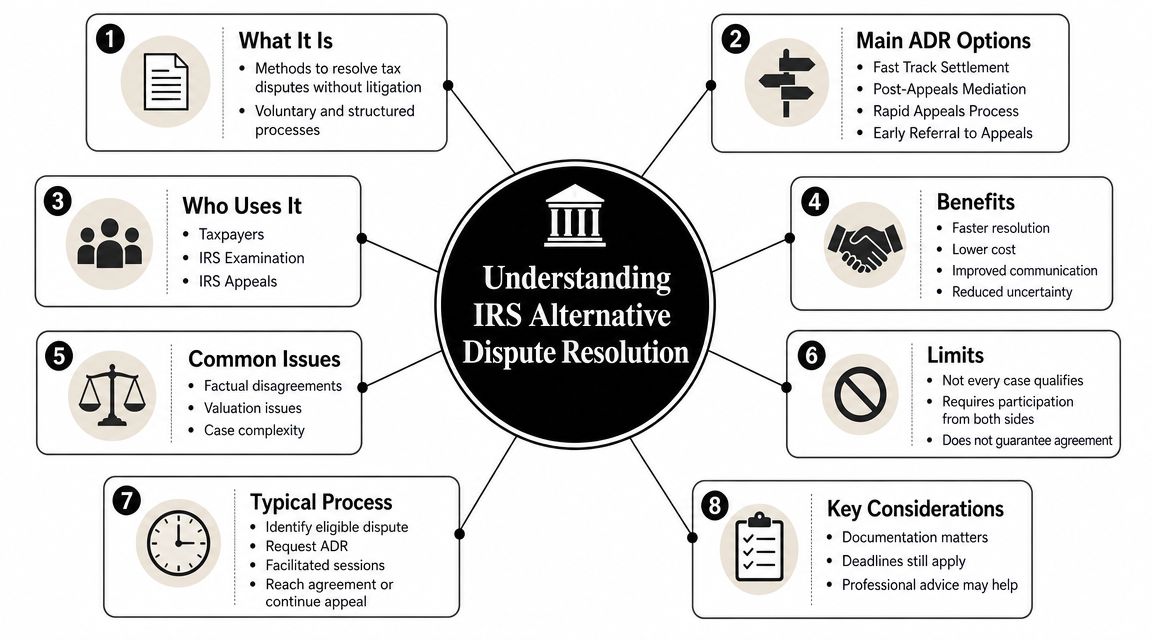
For many small businesses and individuals, that distinction matters. ADR is not reserved for large corporate taxpayers with sprawling controversies. In practice, the better screening question is simpler. Is there a genuine dispute, is the case developed enough to discuss seriously, and would a facilitated negotiation save time or cost compared with a standard appeal?
Where ADR fits in the IRS system
Congress pushed federal agencies, including the IRS, to expand formal dispute resolution tools in the 1990s. Since then, the IRS has used ADR programs to address certain examination, collection, and Appeals disputes through mediation or issue-focused settlement procedures.
That history matters less than the practical point. ADR is now an established part of the system, but it is still selective. The IRS will not use it for every case, and some disputes are poor candidates from the start, especially if one side needs a precedential legal ruling or the facts are still too thin to evaluate.
How ADR differs from standard Appeals
The main difference is not who is right. It is when and how the parties try to resolve the disagreement.
In a standard Appeals case, the dispute usually moves into a more traditional administrative review after the examining or collecting function has taken its position. ADR tries to intervene earlier or more actively, with a neutral helping the parties narrow issues, test hazards, and discuss settlement in a structured setting.
That can change the tone of the case. It also changes the preparation burden. A taxpayer who enters ADR without organized records, a clear explanation of the facts, and a realistic settlement range usually gets less value from the process.
Why this matters for smaller taxpayers
Smaller taxpayers often ask whether ADR is really meant for them. The short answer is yes, sometimes. I do not evaluate that question by the size of the file or the amount in dispute alone. I look at whether the case has enough substance to negotiate, whether delay is becoming expensive, and whether the client would benefit from a controlled discussion instead of a longer administrative path.
ADR can be a strong option if the dispute is business-disruptive, document-heavy, or headed toward an avoidable stalemate. It may be a poor fit if the taxpayer wants to argue broad legal principles, make a record for litigation, or is not ready to present the case coherently.
If you are comparing ADR with a conventional administrative challenge, it helps to understand the IRS tax appeals process first. The two are related, but they serve different strategic purposes.
Exploring Your IRS ADR Options
A small business owner in an audit usually does not need every ADR program. The key question is simpler. Which option fits the dispute you have now, and which one gives you a realistic chance to resolve it without adding cost or delay?
That answer turns on procedure as much as substance. I often see taxpayers focus on the fairness of their position, then miss the more practical issue: whether the case is in examination, collection, or Appeals, and whether the disputed issue is developed enough for a neutral to help.
The main programs in practice
Fast Track Settlement is often the first option to examine in an audit. It is designed for cases still in examination, where the facts and legal positions are developed enough for a serious settlement discussion but the file has not yet gone through the ordinary Appeals route. For many individuals and closely held businesses, this is the most practical ADR entry point because it can address a real impasse before the case hardens.
Fast Track Mediation Collection applies to collection disputes. That matters when the problem is not the amount of tax alone, but how the IRS is pursuing payment. A business dealing with lien, levy, or installment agreement disputes may get more value from this process than from arguing the underlying liability in the wrong forum.
Post-Appeals Mediation comes later, after Appeals discussions stall. It gives both sides one more structured chance to settle without going to court. That can be useful where the dispute is still negotiable, but the parties have stopped making progress on their own.
Early Referral is a case-management tool. It allows a developed issue to go to Appeals while the rest of the examination continues. In the right file, that keeps one difficult issue from delaying everything else, which can matter a great deal for a business trying to close its books, complete a sale, or reduce uncertainty.
Arbitration is available in limited circumstances, as noted earlier, but it is not where I start for most individuals or small businesses. It usually makes more sense for narrower disputes where both sides want a defined decision on a specific issue and are comfortable with the structure that comes with that choice.
Comparison of IRS ADR Programs
| Program Name | Best For | Typical Timeline | Outcome | Overseen By |
|---|---|---|---|---|
| Fast Track Settlement | Audit disputes during examination | Intended to move faster than the standard Appeals path | Usually a negotiated resolution if both sides agree | Examination with Appeals participation |
| Fast Track Mediation | Developed disputes suitable for mediation | Often handled on an expedited basis | Mediation based, generally nonbinding unless agreement is reached | IRS function involved with Appeals mediator role |
| Fast Track Mediation Collection | Collection disputes, including some high-stress collection matters | Often faster than traditional channels, but timing depends on case posture | Mediation based resolution if the parties reach agreement | Collection with Appeals mediator role |
| Post-Appeals Mediation | Cases stuck after Appeals settlement discussions | Depends on program acceptance and scheduling | Nonbinding mediation unless the parties settle | IRS Independent Office of Appeals |
| Early Referral | One or more developed issues that should go to Appeals early | Varies by issue and case management needs | Appeals consideration of selected issues | Examination and Appeals |
| Arbitration | Narrow disputes where a defined decision mechanism makes sense | Varies | Can differ from mediation in finality and structure | IRS program rules and case-specific approval |
Which option fits which problem
For an audit adjustment, Fast Track Settlement is usually the first ADR option to test.
For collection pressure, especially where the dispute concerns enforcement action or payment terms, Fast Track Mediation Collection is usually the better fit.
For a case that already reached Appeals and stalled, Post-Appeals Mediation may still be worth pursuing if both sides are close enough that a neutral can help close the gap.
A practical rule helps here: choose the program based on the case's current posture, not the result you want. The IRS will evaluate the request through that procedural lens first.
This is also where smaller taxpayers should be realistic. ADR is not reserved for large corporations with large-dollar controversies. A solo owner disputing an audit adjustment or a family business under collection pressure may benefit from ADR if the issues are defined, the records are organized, and there is room to negotiate. A modest case with a clear factual record often fits ADR better than a larger case built around broad legal arguments and thin documentation.
What ADR does not fix
ADR does not repair a weak file.
If the facts are still undeveloped, the documents are scattered, or the taxpayer has no realistic settlement range, the process usually produces frustration instead of progress. The same is true if ADR is being used as a delay tactic. IRS personnel see that quickly, and it usually hurts credibility.
The better question is not which program sounds fastest. It is which program fits this dispute, at this stage, with the proof you can present.
The ADR Process Step by Step
Once ADR looks like a fit, the process becomes less mysterious than commonly assumed. The mechanics vary by program, but the flow is usually recognizable. The stronger cases aren't always the loudest ones. They're the ones that enter the process with a clear theory, organized documents, and a realistic settlement goal.
Step one, confirm fit and eligibility
Start with diagnosis. What IRS function currently has the case? Is the dispute in examination, collection, or Appeals? Is the issue developed enough for a neutral to be useful?
This sounds basic, but it decides everything. Filing into the wrong process wastes time and can weaken momentum.
Step two, prepare the request carefully
Some ADR programs require a formal application or joint submission. For example, Fast Track Settlement often involves Form 14017. The form itself matters, but the case package matters more.
A solid submission usually includes:
- A short issue statement: What exactly is disputed.
- A factual summary: Dates, transactions, records, and any points that are not in dispute.
- A legal position: The taxpayer's best reading of the law, stated cleanly.
- A settlement frame: Not a rant. A practical explanation of where common ground may exist.
Step three, get everyone aligned before the session
The mediation or settlement conference is not the time to discover internal disagreement. If there are partners, spouses, shareholders, or advisors involved, someone needs final authority. The IRS will notice quickly if the taxpayer's side isn't coordinated.
That includes emotional preparation. ADR is collaborative, but it's still negotiation. You need to know what you can concede, what you can't, and which documents carry the case.
Go into ADR ready to explain your case in plain English. If the room can't understand your theory quickly, the room won't move toward your number.
Step four, use the session to narrow and resolve
In the actual session, the neutral's role is to facilitate movement. Some disputes settle because one key factual misunderstanding gets corrected. Others settle because each side finally sees the litigation risk clearly. Good ADR advocacy is part persuasion, part discipline.
Watch for these practical moments:
- Issue narrowing often matters more than immediate full settlement.
- Document clarification can change the tone fast.
- Credible flexibility helps. Desperation does not.
- Silence can be useful when the other side needs room to reassess.
Step five, document the result or preserve the next path
If the parties settle, the agreement has to be documented properly. If they don't, that doesn't mean the effort failed. ADR often clarifies the strongest and weakest parts of the case, which improves the next phase.
When no agreement is reached, the taxpayer may still move forward through ordinary Appeals procedures or litigation, depending on the program and posture. That's one reason ADR can be a smart strategic try. It may produce a deal. If it doesn't, it often still sharpens the case.
ADR vs Traditional Appeals Weighing Your Choices
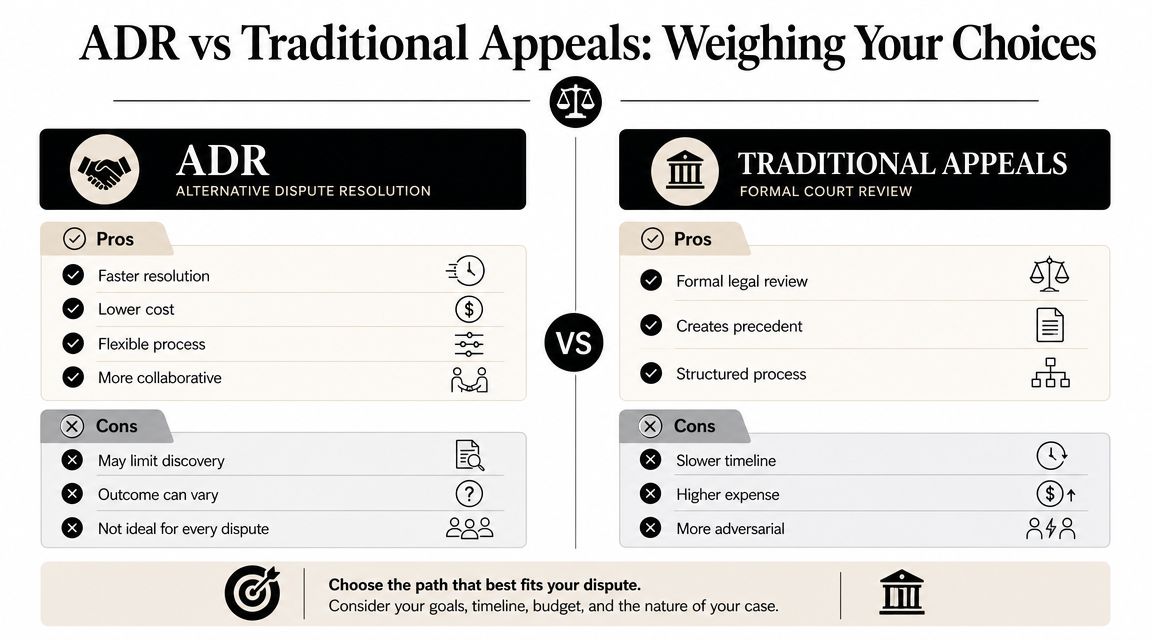
Choosing between ADR and a traditional appeal isn't only about speed. It's also about strategic advantage, cost, timing, and the kind of resolution you need. Some disputes benefit from a formal, fully developed Appeals process. Others get needlessly expensive and rigid if they aren't addressed earlier.
The strongest argument for ADR is often time. The Taxpayer Advocate Service reported that Fast Track Settlement has saved taxpayers and the IRS about 450 days per case compared with traditional Appeals processing, and that FTS and Fast Track Mediation Collection are often designed to resolve disputes within 60 days, according to the Taxpayer Advocate Service discussion of IRS ADR improvements.
Where ADR usually wins
For many small businesses and individuals, ADR has advantages that don't show up neatly in a docket sheet.
- Less procedural drag: Quicker movement can matter if a financing event, sale, licensing issue, or other business deadline is hanging over the dispute.
- More practical conversation: The process usually encourages direct discussion of the main sticking points.
- Preserved options: In many situations, trying ADR does not mean you've surrendered the right to keep fighting if the matter doesn't settle.
That last point matters. ADR is often worth considering precisely because it can be attempted without turning the case into an all-or-nothing bet. For a broader perspective on how administrative disputes can be handled, this discussion on mastering the IRS Office of Appeals gives useful context.
Where traditional Appeals may be stronger
ADR isn't always the better tool.
A formal Appeals path may be preferable when:
- The legal issue needs a more developed record
- The IRS function is too dug in for facilitated negotiation to help
- The taxpayer needs a more conventional administrative framework before court becomes realistic
Traditional Appeals can also be better when the dispute turns on a legal principle that the taxpayer wants considered in a more structured way, not just negotiated around.
The real trade-off
ADR trades some formal process for speed and flexibility. Traditional Appeals trades speed for a more established administrative path.
Neither route is automatically “right.” A well-chosen procedure can improve a mediocre case. A badly chosen one can bog down a strong case. The strategic question is simple. Do you need a neutral to help close a workable gap now, or do you need the full machinery of a conventional appeal?
Preparing for Success in Your ADR Case
The outcome in ADR usually turns on preparation long before the session begins. The taxpayers who do well aren't always the ones with the loudest objections. They're the ones who can present a clean factual record, identify the true dispute, and propose a settlement position that sounds grounded rather than reactive.

Build a case file that tells a story
Don't hand the IRS a pile of records and expect the mediator to find your theory for you. Organize your file so another person can understand the sequence quickly.
A useful preparation file often includes:
- A timeline: When the key transactions, filings, notices, and communications happened.
- A document index: Which records prove which facts.
- A disputed-issues sheet: What the IRS says, what you say, and where the gap is.
- A settlement range: What result is acceptable and why.
Anticipate the IRS position honestly
Many taxpayers weaken their cases by treating obvious weaknesses like they don't exist. That doesn't work in ADR. If there's a documentation gap, address it. If one deduction is harder to defend than the others, isolate it. If the IRS has a fair point on part of the case, say so and redirect attention to the stronger issues.
Good negotiation starts when your presentation becomes more credible than your frustration.
Is ADR only for large corporations
No, but that concern is understandable. Large taxpayers often have the resources to package disputes well and push for early resolution. The system has shown strong results in that environment. IRS material highlighted by the Taxpayer Advocate reported that in Large Business and International cases, 91% of Fast Track Settlement cases resulted in agreement, and IRS Appeals later announced a pilot to make Post-Appeals Mediation more attractive, signaling a push for earlier and more efficient resolution beyond only the largest cases, as described in this IRS Appeals update on ADR developments.
That doesn't mean every small taxpayer should expect the same outcome. It does mean ADR is not reserved by definition for giant companies. Smaller taxpayers can use it effectively when they bring the same things well-prepared taxpayers bring. Clear records, realistic arguments, and disciplined advocacy.
What helps most in smaller cases
For individuals and owner-run businesses, three habits make a major difference:
- Decide your objective early: Full concession, issue narrowing, payment-related flexibility, or a settlement range.
- Keep personalities out of it: ADR works better when the focus stays on facts, law, and risk.
- Use professional help when the case has real consequences: A concise, well-structured submission can change the entire tone of the process.
When a Tax Attorney Is Your Strongest Asset in ADR
A lot of taxpayers assume ADR is simple enough to handle alone because it is less formal than court. That assumption can get expensive.
ADR often turns on judgment calls. Which facts to emphasize. Which legal points to preserve. When to make a concession that builds credibility, and when a concession weakens a later position on a different year, entity, or related issue. Small businesses and individuals feel those mistakes more sharply because one bad statement can affect cash flow, financing, payroll, or personal exposure.
A tax attorney adds the most value when the dispute is not just about numbers on a notice, but about how the case is framed.
Signs self-representation may be risky
Representation deserves serious consideration if any of these are true:
- The IRS position is unclear: Unclear theories invite answers that fill gaps for the government.
- More than one tax year, entity, or owner is involved: A statement that helps one issue can create problems somewhere else.
- Payroll tax or trust fund recovery exposure is in play: Those matters can create personal liability and require careful factual development.
- You are negotiating toward a target outcome: ADR works better when someone is managing settlement range, issue order, and wording with discipline.
- Other advisers are already involved: CPAs, EAs, divorce counsel, bankruptcy counsel, and lenders often need a coordinated plan.
Good representation in ADR is rarely about paperwork alone. It is about building a factual record that supports resolution, protecting privileged communications where possible, controlling who says what to the IRS, and testing whether a proposed deal solves the broader problem. I often tell clients that the settlement number is only part of the analysis. The key question is whether the agreement closes the issue cleanly or creates a new problem six months later.
If you are weighing whether to hire counsel, this guide on how to find a good tax attorney is a useful starting point. Attorney Stephen A Weisberg is one example of a practitioner who offers a free Tax Debt Analysis to assess fit and discuss possible next steps before representation begins.
Common IRS ADR Questions and Pitfalls
What if ADR does not lead to agreement
That usually means the case continues in the ordinary path available for its posture. ADR is often worth trying because it can resolve the matter, but if it doesn't, taxpayers generally preserve the ability to keep pursuing administrative review or litigation where appropriate.
Can ADR help with payroll tax or trust fund recovery issues
It can, depending on the specific dispute and program fit. Collection-focused ADR may be relevant where the fight is about collection action or related IRS decisions. But these cases can also involve issues that require careful legal framing, especially when business and individual exposure overlap.
Can you use ADR after Appeals has already started
Sometimes. That's where Post-Appeals Mediation becomes important. If the case has already gone through Appeals discussions and reached an impasse, PAM may still offer a settlement opportunity short of court. The key is whether the case fits that program's requirements at that point in the process.
What is the biggest mistake taxpayers make
Treating ADR like an informal conversation.
It isn't. It's a structured negotiation process. Casual submissions, disorganized records, and emotional arguments usually waste the opportunity.
Does asking for ADR make you look weak
No. In many cases it shows the opposite. It shows that you understand the dispute well enough to choose a resolution tool strategically. The IRS uses these programs because negotiated resolution can be more efficient for both sides.
Are small businesses at a disadvantage
Sometimes they are, especially if they don't have the resources to prepare the case well. But the practical answer isn't to avoid ADR. It's to approach it with the same seriousness larger taxpayers do. A smaller case with a clean record and a focused argument can outperform a larger case that's badly managed.
Final pitfall to avoid
Don't choose a process just because the name sounds promising. Match the procedure to the dispute, the timing, and the record you can prove. That one decision often determines whether ADR becomes a shortcut to resolution or just another detour.
If you're dealing with an IRS dispute and need to decide whether ADR, Appeals, or another path makes sense, talking it through early can prevent expensive mistakes. Attorney Stephen A Weisberg represents individuals, business owners, and professionals with IRS controversies, audits, tax debt matters, and Appeals issues. You can learn more at Attorney Stephen A Weisberg.


