IRS 90 Day Letter: Your 2026 Action Guide
Received an IRS 90 Day Letter (Notice of Deficiency)? Don't panic! Our 2026 guide explains what it is, your deadlines, and how to protect your rights.

In this article
- That Certified Letter From the IRS Is Here Now What
- Start with the basics on the notice
- What Is an IRS 90-Day Letter Really
- It's not a bill
- It is your ticket to Tax Court
- Why taxpayers receive one
- The Critical 90-Day Deadline and Your Legal Rights
- What the deadline protects
- The expat address trap
- Don't confuse this with other IRS timing rules
- Your Three Core Response Strategies
- Comparing Your 90-Day Letter Response Options
- Path one, agree and move on
- Path two, petition Tax Court
- Path three, pay first and seek a refund
- Beyond the Petition Exploring Collection Alternatives
- Installment agreements and payment structure
- Offer in compromise and hardship status
- What usually works in practice
- Consequences of Inaction and When to Call a Pro
- There may still be a path after the deadline
- Signs it's time to stop handling it alone
You open the mailbox, see a certified envelope from the IRS, and your stomach drops. That reaction is normal. It's often assumed the letter means the tax is already fixed, the government has already won, and collection is about to start.
Usually, that's not where you are yet.
An IRS 90-day letter is serious, but it's also a structured legal notice with clear rules and defined response paths. If you handle it promptly, you still have choices. If you ignore it, the IRS gets to move from proposed change to assessed tax, and your options narrow fast.
I've seen taxpayers make the same early mistake again and again. They spend days worrying, then lose more time trying to “clear it up” informally before they understand the deadline. A better approach is simpler. Read the notice carefully, identify the mailing date, gather the return and supporting records for that tax year, and decide which lane you're in: agree, contest, or prepare for a post-assessment strategy.
That Certified Letter From the IRS Is Here Now What
The first practical step is to slow down and treat the envelope like a legal deadline, not like ordinary IRS mail. A certified notice means the IRS wants a record that it sent something important. That alone doesn't tell you whether the IRS is right, but it does tell you the matter needs immediate attention.
A lot of taxpayers reach for the phone first. That's understandable, but phone calls rarely solve the core issue by themselves. Before you call anyone, pull together the notice, the tax return for the year listed, any IRS correspondence that came before it, and the records tied to the items the IRS says are wrong.
For people who want a broader sense of how official tax review processes work, this survival guide for business tax checks is useful background. It isn't about U.S. deficiency procedure specifically, but it does a good job showing how document-driven tax reviews usually unfold and why fast, organized responses matter.
Start with the basics on the notice
Read the first pages looking for a few practical details:
- Mailing date: This is the date that controls your response window.
- Tax year involved: Make sure you know exactly which return is at issue.
- Proposed changes: The IRS should identify what it wants to change.
- Amount in dispute: Know what the IRS says the additional tax is.
- Response language: Look for whether the notice tells you to sign, respond, or petition.
If you're new to this kind of mail, a plain-language explanation of what a certified IRS notice usually means can help you orient yourself quickly. This article on a certified letter from the IRS is a good starting point.
Practical rule: Don't assume panic is strategy. Your advantage in the first day is organization, not speed for its own sake.
What Is an IRS 90-Day Letter Really
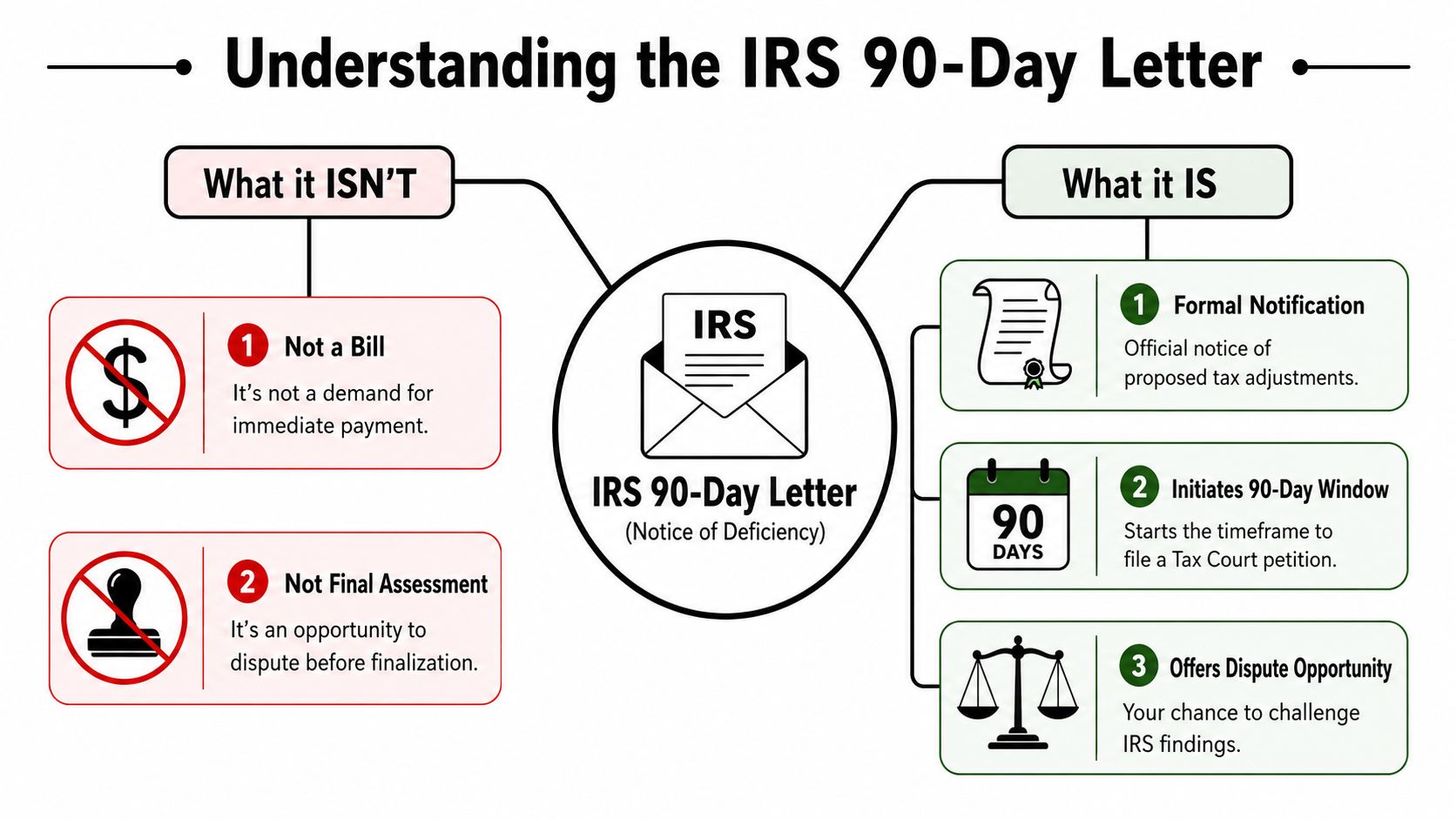
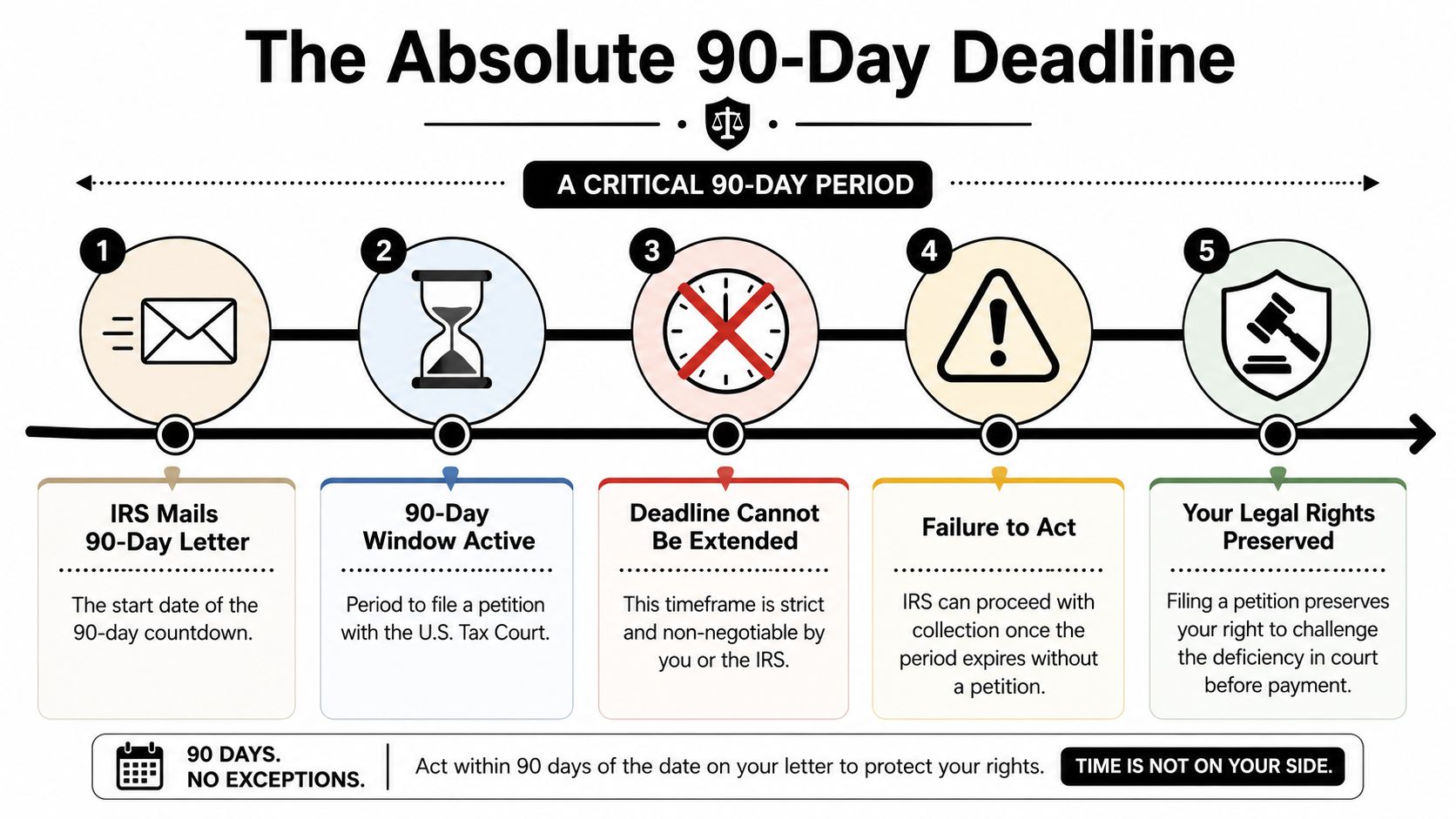
An IRS 90-day letter is the common name for a Notice of Deficiency. It may appear as CP3219N or Letter 3219, and it's a formal legal notice issued under 26 U.S.C. § 6212(a) that tells you the IRS determined additional tax, penalties, and interest may be due. It is sent by certified or registered mail to your last known address, and it gives you exactly 90 days from the mailing date, or 150 days if you reside outside the United States, to file a petition with the U.S. Tax Court. That deadline can't be extended by the IRS, and if you miss it, you lose the right to contest the assessment in Tax Court before paying, after which the IRS can assess and collect the proposed tax, as explained by Cornell Law's overview of the 90-day letter.
It's not a bill
Many taxpayers often get tripped up at this stage. The notice feels like a final demand because it includes proposed tax, often with penalties and interest. But legally, the notice is better understood as the IRS saying, “Here is our position, and here is your chance to challenge it before we assess it.”
That distinction matters. A bill assumes the amount is already due and enforceable. A Notice of Deficiency is still in the proposed stage.
It is your ticket to Tax Court
The most useful analogy is this: the notice is your admission ticket to the U.S. Tax Court. Without it, you generally don't get into that courtroom on a deficiency dispute. With it, you have a narrow but meaningful opportunity to ask a judge to review the IRS's position before you pay the disputed amount.
That makes the notice both a warning and a procedural right.
The worst first reaction is to treat the notice as either meaningless or final. It's neither. It's a formal opening in the process.
Why taxpayers receive one
In practice, these notices often appear after an examination disagreement or when the IRS thinks the return doesn't match information it received from other sources. Sometimes the issue is documentation. Sometimes it's unreported income. Sometimes it's a legal dispute over deductions, credits, basis, or filing position.
The notice itself should tell you the year involved and the changes the IRS proposes. That's where the analysis starts. Not with assumptions about what the IRS “must have meant,” and not with a rushed payment made out of fear.
The Critical 90-Day Deadline and Your Legal Rights
The most important fact about an IRS 90-day letter is simple. The clock runs from the mailing date on the notice, not the day you opened it, and the filing period is strict.
What the deadline protects
If you file a timely petition with the U.S. Tax Court, you preserve a valuable legal right. You get to challenge the proposed deficiency before paying the disputed amount. That changes the strategic posture of the case. It keeps the dispute in a pre-assessment setting instead of forcing you into a pay-first, litigate-later posture.
Miss the deadline, and that path is gone.
Taxpayers sometimes assume they can negotiate with the IRS first and decide about court later. That's risky. Efforts to work things out directly with the IRS don't stop the petition deadline. If the date passes, the IRS can move forward with assessment.
The expat address trap
One of the most overlooked issues involves taxpayers living abroad. People hear that those outside the United States get more time, and they stop there. The problem is that the IRS looks to the last known address on file, not just where you happen to be physically living.
If you live overseas but the IRS still has a U.S. address for you, you may get only 90 days, not 150 days. That nuance is discussed in this explanation of the Notice of Deficiency rules for expats and address issues. For many international taxpayers, that misunderstanding causes considerable damage.
Critical point: If you're abroad, don't assume you have the longer deadline until you confirm how the notice was addressed and what address the IRS had on file.
Don't confuse this with other IRS timing rules
Taxpayers often mix up deficiency deadlines with collection deadlines, audit timing, or the broader lifespan of IRS debt. Those are different issues. If you're trying to understand how this fits into the larger timing framework of an IRS case, this overview of the statute of limitations on IRS debt is helpful context.
For the 90-day letter itself, though, the practical advice is narrower. Count from the notice date. Verify the address issue immediately. Don't rely on calls, letters, or informal discussions to preserve your court rights.
Your Three Core Response Strategies
Once you know the deadline, the next question is tactical. What do you do?
The law gives you three main paths. According to Investopedia's summary of the 90-day letter process, you can agree with the IRS and sign Form 5564, which lets the IRS assess the tax and begin collection; you can disagree and file a petition with the U.S. Tax Court within the 90-day or 150-day window, which stops IRS enforcement while the case is pending; or you can disagree but skip Tax Court, allow assessment, pay the amount, and then pursue a refund claim through Form 1040X and possibly litigation in U.S. District Court or the U.S. Court of Federal Claims if needed. That same source also notes that trying to resolve the issue directly with the IRS doesn't extend the Tax Court filing deadline.
Comparing Your 90-Day Letter Response Options
| Response Path | Action Required | When You Pay | Key Advantage | Key Disadvantage |
|---|---|---|---|---|
| Agree with the IRS | Sign and return Form 5564 | After assessment and collection process begins | Fastest path if the IRS is correct | You give up the prepayment court challenge |
| Petition the U.S. Tax Court | File a timely petition within the notice period | You can contest before paying the disputed amount | Preserves court review and stops enforcement while the case is pending | Requires fast action and organized case preparation |
| Pay first and pursue refund route | Let assessment happen, then pay and file refund claim | Before refund litigation | Useful if Tax Court isn't available or strategic goals differ | Payment comes first, and the dispute forum changes |
Path one, agree and move on
Sometimes the IRS is right. The records aren't there, the income was omitted, or the claimed deduction can't be supported. In those situations, dragging the matter out usually doesn't help.
Signing the waiver can make sense when the issue is clear and your energy is better spent on damage control, payment planning, and fixing future compliance. What doesn't work is agreeing casually without checking whether the IRS misunderstood a simple fact that your records can prove.
Path two, petition Tax Court
This is often the cleanest route when you have a real dispute and need an independent forum without paying first. It's especially useful where the disagreement turns on legal interpretation, factual documentation, or credibility of the IRS adjustment itself.
A timely petition shifts the advantage. It also changes pace. The case moves into litigation procedure, and the IRS cannot assess and collect while that petition is pending.
This is where careful review matters. Not every issue belongs in court, but many taxpayers wait too long to find that out. If you're weighing this option, practical guidance on responding to IRS letters can help you organize the file and identify what has to happen first.
Path three, pay first and seek a refund
This is often the least intuitive option, but it has a place. Some taxpayers miss the petition window. Others choose not to use Tax Court for strategic reasons tied to evidence, forum, or settlement posture.
The trade-off is substantial. You lose the prepayment forum and move into a refund posture. That means the tax has to be paid before you can meaningfully push the case into refund procedures and possible refund litigation.
If you have a defensible case and cash flow is tight, the Tax Court route is often the more practical forum because it preserves the chance to fight before payment.
Beyond the Petition Exploring Collection Alternatives
Not every 90-day letter case is really about whether the tax is owed. Many are about whether the taxpayer can survive the payment process.
If you agree with the notice, or if the case ends with an assessed balance, the next problem is usually practical. How will this be paid, and what happens if full payment isn't realistic?

Installment agreements and payment structure
For many taxpayers, the right answer isn't a fight over liability. It's an orderly payment arrangement. An installment agreement can spread payments over time and reduce the pressure that comes from trying to solve the entire balance at once.
This option works best when current filing is up to date, future compliance is realistic, and the taxpayer can support a monthly amount that won't collapse after a few months. It doesn't work well when the proposed payment depends on optimism rather than actual cash flow.
Offer in compromise and hardship status
Some taxpayers won't be able to pay the full balance, even over time. In that setting, an Offer in Compromise or Currently Not Collectible status may be more realistic than a standard monthly payment plan.
These options require documentation and a grounded view of your finances. They're not shortcuts. They are structured collection alternatives for people whose balance and financial condition don't line up.
A useful starting point for understanding one collection-resolution framework is this overview of the IRS Fresh Start Program. It helps taxpayers see how payment alternatives fit into the broader IRS collection process.
What usually works in practice
The taxpayers who get traction are usually the ones who do three things early:
- Stay current going forward: The IRS is far more receptive when new returns and current obligations are being handled correctly.
- Use real financial numbers: Actual income, expenses, assets, and business conditions matter. Wishful budgeting causes problems later.
- Separate liability from collection: You can disagree with the tax and still think ahead about payment fallback options.
This is also the point in the process where some people choose outside help. One example is Attorney Stephen A. Weisberg, whose practice includes tax debt analysis and representation in IRS controversy matters. That kind of service is one option among several when a taxpayer needs help evaluating both dispute strategy and collection alternatives.
Consequences of Inaction and When to Call a Pro
Ignoring an IRS 90-day letter is usually the worst available strategy. If no timely petition is filed, the IRS can assess the proposed tax and move into collection. Once a balance is assessed, the conversation changes from “Do you owe this?” to “How will the IRS collect it?”
That can lead to escalating pressure, including liens, levies, and wage garnishment. By then, the easy procedural opportunity is gone, and the taxpayer is reacting instead of controlling the posture of the case.
There may still be a path after the deadline
Missing the deadline doesn't always mean every door is closed. The overlooked concept here is audit reconsideration. The Taxpayer Advocate Service explains that taxpayers who miss the petition window, or choose not to petition, may still have room to seek relief if they can present new evidence, and that IRS procedures may allow cash deposits to stop interest while pursuing reconsideration, as discussed in this guidance on the 90-day Notice of Deficiency and audit reconsideration.
That's not the same as preserving Tax Court rights. It's an administrative route, not a substitute for a timely petition. But in the right case, it can still matter a great deal.
New evidence can change an administrative case even after the classic petition window has closed. It just won't recreate the right you lost by missing the court deadline.
Signs it's time to stop handling it alone
Some taxpayers can manage a straightforward deficiency issue themselves. Others shouldn't try. You should strongly consider professional help when any of these are true:
- The issue is fact-heavy: You need to reconstruct records, trace deposits, prove basis, or document business expenses.
- The case involves a business: Payroll issues, flow-through entities, multi-owner records, or bookkeeping gaps raise the stakes fast.
- You're overseas or moved recently: Address questions can affect your deadline and your notice rights.
- You missed the deadline already: At that point, strategy matters more, not less.
- You're overwhelmed: Even a valid case can be lost through delay, poor organization, or the wrong procedural move.
A 90-day letter is serious. It is also manageable when you respond with discipline, documents, and a clear choice of forum.
If you received an IRS 90-day letter and aren't sure whether to agree, petition Tax Court, or pursue a post-deadline strategy, Attorney Stephen A. Weisberg offers a free Tax Debt Analysis through Weisberg Tax to determine whether he can help and what path makes sense before charging for representation.


