Your Guide to Internal Revenue Service ACS Support and Tax Debt
Facing an IRS notice? Our guide provides expert Internal Revenue Service ACS support to help you understand your options and resolve tax debt effectively.
In this article
- What Is the IRS Automated Collection System?
- Who the ACS Typically Contacts
- Why the IRS ACS Is Contacting You
- The Main Triggers for ACS Contact
- Common Reasons for IRS ACS Contact and Your First Action
- How to Prepare for a Call with the IRS ACS
- Gather Your Essential Documents
- Prepare Your Personal Information and Call Outline
- The Reality of Reaching an Overburdened System
- Why You Can Expect Delays
- Your Resolution Options with the IRS ACS
- Short-Term Extension to Pay
- Formal Installment Agreement
- Currently Not Collectible Status
- When to Hire a Tax Professional for Help
- Warning Signs You Need an Expert
- What a Pro Really Brings to the Table
- Frequently Asked Questions About the IRS ACS
- Can the IRS ACS Freeze My Bank Account?
- Is an ACS Notice the Same as a Tax Audit?
- What if I Cannot Afford a Tax Professional?
Getting a notice from the IRS is enough to make anyone’s stomach drop. But before you panic, it helps to understand who is actually on the other end of that letter. If it’s about a tax debt, chances are you’re dealing with the agency's Automated Collection System (ACS).
This system is the first line of defense for the IRS, handling millions of straightforward delinquent accounts through a series of letters and phone calls. It’s the standard starting point for Internal Revenue Service ACS support.
What Is the IRS Automated Collection System?

Think of the Automated Collection System as the IRS’s massive, nationwide call center for collecting tax debt. It’s a sophisticated, computer-driven system that manages a high volume of cases without ever sending an agent to your door. The whole point is to resolve less complicated tax issues efficiently.
Instead of a Revenue Officer making a personal visit, the ACS uses a predictable sequence of automated notices and phone calls to collect what’s owed. This approach is reserved for individuals and small businesses with tax balances the IRS feels can be cleared up through standardized procedures.
Who the ACS Typically Contacts
The ACS computer system is programmed to automatically flag accounts that fit a certain profile. You’re most likely to hear from the ACS if your situation falls into one of these common buckets:
- An Unpaid Balance: You filed a return on time but couldn't pay the full tax bill.
- Unfiled Tax Returns: The IRS has records showing you have one or more tax returns that are past due.
- Defaulted Payment Plan: You previously set up an Installment Agreement with the IRS but have since missed payments.
While an ACS notice is serious, it’s also a very common first step in the IRS collection process. The letters this system sends are a formal—and often intimidating—request for payment or a response. To get a better handle on what you might have received, it’s worth learning more about the different types of IRS collection notices and what each one means.
The ACS functions like an assembly line for tax debt resolution. Its goal is to move cases toward a conclusion—either payment in full, a payment plan, or another resolution—as systematically as possible. Understanding its role demystifies the process and empowers you to respond effectively.
Why the IRS ACS Is Contacting You
Getting a notice from the IRS Automated Collection System (ACS) can be jarring, but it’s never a random event. That letter or call didn't just appear out of the blue. It means a computer at the IRS has automatically flagged your account for a specific reason.
Think of it as a predictable tripwire. When a certain deadline is missed or a balance goes unpaid, the system is designed to automatically kick off the collection process. Understanding what tripped the wire for your account is the first and most important step to resolving the issue.
The Main Triggers for ACS Contact
While there are many potential tax problems, the vast majority of ACS cases boil down to just a handful of common issues. These are the bread and butter of the ACS system, forming the basis for nearly all the automated notices they send out.
Chances are, you're hearing from them for one of these reasons:
- An Unpaid Tax Balance: This is the big one. You filed your return on time, but you didn't pay the full tax bill by the deadline. The ACS is now following up to collect that original balance, plus any penalties and interest that have been piling up.
- Unfiled Tax Returns: The IRS has records from employers (W-2s) or clients (1099s) that show you earned income, but they have no record of you filing a tax return for that year. These notices are the first push to get you to file those missing returns.
- Defaulting on an Installment Agreement: At some point, you set up a payment plan with the IRS, but you've since missed payments or stopped paying altogether. This default automatically puts your account back into active collections, and the ACS is tasked with resuming the effort.
Pinpointing which of these situations applies to you is everything. It tells you exactly what information you need to pull together and what your next move should be. Your entire strategy for getting Internal Revenue Service ACS support hinges on correctly diagnosing the initial problem.
The table below breaks down these common triggers, showing the specific IRS notice you might have received and the immediate action you should take.
Common Reasons for IRS ACS Contact and Your First Action
| Reason for Contact | Common IRS Notice(s) | Recommended First Action |
|---|---|---|
| Unpaid Balance on Filed Return | CP501, CP503, CP504 | Review the notice for accuracy and verify the amount owed. Prepare to either pay the balance or propose a payment plan. |
| Unfiled Prior-Year Returns | CP59, CP63 | Gather all necessary documents (W-2s, 1099s) and immediately prepare and file the missing tax returns. |
| Defaulted Installment Agreement | CP523 | Contact the IRS immediately to discuss reinstating your agreement or negotiating a new one based on your current financial situation. |
Knowing where you stand gives you the power to act. By matching your notice to the reason above, you can stop feeling overwhelmed and start taking concrete steps toward a resolution.
How to Prepare for a Call with the IRS ACS
Getting a letter from the IRS is enough to make anyone's stomach drop. But here’s the thing I tell all my clients: a call with the IRS Automated Collection System (ACS) doesn't have to be a nightmare. The key to a successful, and far less stressful, conversation isn't luck—it's preparation.
Think of it this way: you wouldn't walk into a big meeting at work without your notes and a clear objective. This is no different. Going in organized shows the ACS agent you’re serious about fixing the problem and puts you in a much stronger position to get a good result.
So, why are they calling you? It almost always comes down to one of a few common reasons.
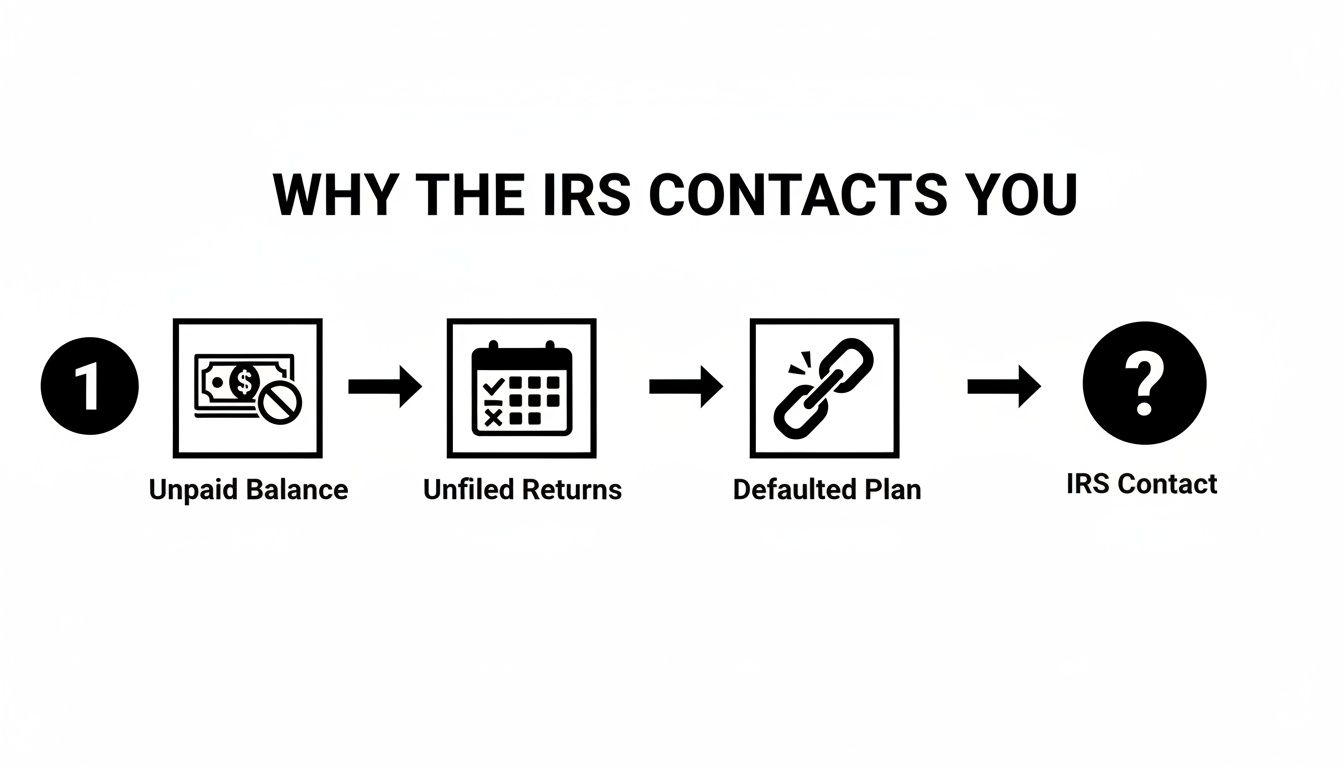
As you can see, the system typically flags an account because of an unpaid balance, unfiled returns, or because an existing payment plan went into default.
Gather Your Essential Documents
Before you even think about dialing that number, get your paperwork in order. This one step can be a total game-changer, preventing that frantic scramble for documents while the agent is waiting on the line.
Here’s your pre-call checklist:
- All IRS Notices: Find every letter the IRS has sent you and put them in order by date. The agent will need the reference number from the most recent one, like a CP504 or CP523 notice.
- Tax Returns: Have copies of the tax return(s) in question on hand. It’s also smart to have the last two years of filed returns available, just in case.
- Proof of Payments: If you’ve already sent money to the IRS for this debt, pull up the bank statements or canceled checks that prove it.
- Financial Information: The agent will want to know about your current financial situation to figure out your ability to pay. You can get a head start by filling out a Collection Information Statement. You can learn more about this by checking out our Form 433-F guide to resolving an IRS collection case.
Prepare Your Personal Information and Call Outline
Next, the ACS agent has to verify it’s actually you on the phone. This is a non-negotiable security step, so have the answers ready.
Be ready to provide: Your full name, Social Security Number (or ITIN), date of birth, and the address from your last tax return. If you filed a joint return, you'll probably need your spouse's information, too.
Finally, never call without a plan. Nerves can make you forget what you wanted to say, so a simple outline can keep you focused and in control.
Example Call Script Outline:
- Introduction: "Hello, my name is [Your Name], and I'm calling about the notice I received. The notice number is [Notice Number], and it's dated [Date of Notice]."
- State Your Goal: "I'm calling today to understand what my options are. My goal is to set up a payment arrangement for the balance I owe for tax year [Year]."
- Ask Questions: "Could you please confirm the total amount owed, with all penalties and interest included? What resolution options are available for me right now?"
This simple, structured approach helps you lead the conversation, ensuring you get the Internal Revenue Service ACS support you need to put this issue behind you.
The Reality of Reaching an Overburdened System
Alright, you’ve gathered your documents, you know what you need to ask for, and you're ready to make the call. Before you dial, it’s crucial to set the right expectations. Calling the Internal Revenue Service ACS support line is often a serious test of patience, and knowing what you’re up against can help you keep a level head.
The simple fact is the IRS is a massive agency stretched incredibly thin. You might see news reports about improved overall customer service, but those big-picture numbers don't always trickle down to specialized departments like the Automated Collection System (ACS). Long hold times, confusing phone menus, and getting bounced from one agent to another are still very much the norm.
This isn’t about you or your specific tax issue; it's a system-wide logistical problem. It’s frustrating, for sure, but understanding the strain on their resources can help you take it less personally.
Why You Can Expect Delays
So, why is it so hard to get through? The root of the problem lies in deep staffing cuts made over the last decade, particularly within the very division that handles collections—the Small Business/Self-Employed (SB/SE) division.
Think about this: between 2012 and 2023, the SB/SE division’s workforce was cut by a staggering 37.77%. It went from over 24,000 employees down to just 15,012. That statistic, from a National Taxpayer Advocate report, paints a clear picture. With far fewer people managing millions of collection cases, the entire system slows to a crawl.
When you have fewer agents handling a mountain of cases, wait times are going to be long. That’s why all the prep work we talked about is so important—it helps you make every second count once you finally get someone on the line.
The problem doesn't stop with phone calls, either. The IRS is also buried under a mountain of mail. Massive processing backlogs mean that even after you’ve had a successful call, it can take a long time for your account to reflect any changes. To get a better sense of this, you can learn more about the IRS's 44-day backlog impact on tax clients and how it creates these operational delays.
I’m not telling you this to discourage you. Just the opposite. Knowing the reality of the situation arms you with the right mindset: be patient, be persistent, and above all, be prepared. Your hard work organizing everything beforehand is what will turn a frustrating phone call into a productive step toward getting this resolved.
Your Resolution Options with the IRS ACS

Okay, you’ve made it through the hold music and have an ACS agent on the line. Now it's time to talk solutions. This is where all your preparation comes into play, allowing you to clearly explain your financial situation and work toward the best possible outcome.
Your main objective is to get your account back in good standing with a formal resolution. Doing so stops the flood of threatening notices and, more importantly, heads off aggressive collection actions like a bank levy or wage garnishment. For most taxpayers dealing with ACS, the solution will be one of three common arrangements.
Short-Term Extension to Pay
If you have the money to pay your tax bill in full but just need a little more time to pull it together, a short-term extension is your simplest option. The ACS can typically grant an extension of up to 180 days.
This is a great choice if you're waiting on a specific influx of cash, like a work bonus, a commission check, or the sale of an asset. Just be aware that this isn't a pause button on everything. Interest and penalties will keep piling up until you've paid the balance in full.
Formal Installment Agreement
Can't clear the debt in the next six months? A formal Installment Agreement (IA) is the most frequent solution. An IA breaks your total debt into manageable monthly payments over a longer timeline, often stretching up to 72 months.
The ACS agent will review your financial details to land on a monthly payment amount you can realistically afford. Once your IA is locked in, the IRS will halt all collection activity—as long as you stick to the payment schedule and stay current on all your future tax filings and payments.
Currently Not Collectible Status
For those facing true financial hardship, Currently Not Collectible (CNC) status might be an option. This doesn’t wipe away your tax debt, but it’s an official acknowledgment from the IRS that you simply don’t have the ability to pay right now.
To get this status, you have to prove it. You’ll need to provide financial documents showing that your income, assets, and necessary living expenses leave no room for tax payments. If you qualify, the IRS will temporarily stop collections, though interest on your debt will continue to grow. They'll also check in on your finances periodically to see if your situation has improved.
While the ACS is the right place to start, their power is really limited to these straightforward solutions. An agent can tell you about other programs, but they can't approve them.
If you're dealing with a larger or more complicated tax problem, you may need a more powerful solution. Some people, for instance, find relief by pursuing an Understanding IRS Offer in Compromise. An Offer in Compromise (OIC) is a completely separate and intensive process handled by a different IRS division. Be mindful that systemic delays can plague many IRS processes; as the National Taxpayer Advocate’s annual report noted, hundreds of thousands of identity theft victims faced average wait times of over 21 months for their cases to be resolved.
When to Hire a Tax Professional for Help
There comes a point when trying to solve an IRS problem on your own just isn't worth the stress and frustration. While you can certainly handle many simple tax issues yourself, some situations have clearly outgrown a DIY approach. If you feel like you're in over your head or just spinning your wheels with the Automated Collection System, it’s probably time to call for internal revenue service acs support.
Think of it this way: you know how to handle a minor cold with rest and some medicine from the drugstore. But for a serious illness, you’d go straight to a specialist. The same exact logic applies to your financial health when the IRS is involved.
Warning Signs You Need an Expert
Certain red flags are clear signals that your case has become too complex for the ACS process and requires a professional. If you recognize your situation in any of these, getting expert help isn't just a good idea—it’s a critical strategic move to protect your finances.
You should seriously consider hiring an expert if:
- Your tax debt is substantial. Once your balance climbs over $50,000, the IRS rulebook gets a lot thicker. A tax professional is trained to navigate that complexity.
- The IRS is threatening serious action. Have you received a Final Notice of Intent to Levy or a letter about wage garnishment? The clock is ticking, and an expert can often step in to halt these aggressive collection tactics before they start.
- Your case involves complex issues. Things like business payroll taxes, multiple unfiled returns, or trust fund recovery penalties are not simple matters. They require specialized knowledge that goes far beyond a typical balance-due notice.
If you feel like you're making zero headway, you're not alone. The system is incredibly hard to navigate. Recent data paints a grim picture: heading into the 2026 filing season, the IRS was struggling with a 25% workforce reduction. Secret shopper calls to 18 different support lines found average hold times soaring past 30 minutes. To make matters worse, FY 2024 data showed that 33% of calls were transferred, forcing people to start all over again with a new agent. You can see the full analysis of IRS backlogs and harder fixes on cpatrendlines.com.
What a Pro Really Brings to the Table
An experienced tax professional does a lot more than just give advice. They step in and take over all communications with the IRS, which is often a massive weight off your shoulders. They know the agency’s internal playbook and can negotiate solutions you might not even know are on the table, like an Offer in Compromise or penalty abatement. Should you need professional help, understanding the basics of hiring a lawyer on demand can help you find the right fit for your situation.
A good tax attorney or Enrolled Agent doesn't just represent you; they provide a strategic advantage by cutting through bureaucratic hurdles and fighting for the best possible outcome on your behalf.
Most reputable firms will offer a free, no-obligation consultation to review your case. This gives you a clear picture of your options and lets you decide if hiring a pro is the right move before you spend a dime. For more guidance, check out our article on how to find a good tax attorney.
Frequently Asked Questions About the IRS ACS
It’s completely normal to have questions swirling when you’re dealing with the IRS. Let's clear up a few of the most common concerns we hear about the Automated Collection System.
Can the IRS ACS Freeze My Bank Account?
The short answer is yes. The ACS can and will issue a bank levy, which is a legal order sent directly to your bank to freeze your funds and turn them over. This is a serious escalation, and it means the IRS has gotten tired of waiting.
But here’s the thing: this isn’t a surprise attack. The IRS gives you multiple warnings before a levy hits, starting with letters like the CP504 Notice and culminating in a Final Notice of Intent to Levy. The single best way to protect your bank account is to act on the very first notice you receive.
A levy is the IRS’s final move after repeated attempts to contact you have failed. The moment you see a notice mentioning a levy, the time for waiting is over—you must respond immediately.
Is an ACS Notice the Same as a Tax Audit?
No, these are two completely different things, and it's important to know which one you're facing.
An ACS notice is all about collection. It means the IRS computer system has flagged a tax debt that is past due, and its only job is to collect that money. Think of it as the IRS’s collections department calling.
An audit, however, is an examination of your tax return. The goal there is to verify if the numbers you reported are accurate. While an audit can lead to a tax bill, the ACS only gets involved after that bill is officially on the books and you haven't paid it.
What if I Cannot Afford a Tax Professional?
Even if hiring a professional feels out of reach, you have some excellent options for getting internal revenue service acs support. The Taxpayer Advocate Service (TAS) is an independent watchdog group inside the IRS. Their entire job is to help people who are in a financial bind or who can't seem to get their problem solved through normal channels.
You might also qualify for help from a Low Income Taxpayer Clinic (LITC). These are organizations that get grants from the IRS to provide free or low-cost representation. Many tax firms, including ours, also offer free initial consultations to help you understand your situation and lay out your options with no strings attached.
Navigating IRS collections can be complex, but you don't have to do it alone. Attorney Stephen A Weisberg and The W Tax Group start with a FREE Tax Debt Analysis to determine if and how we can help before you are charged a dime. Find out if we can resolve your IRS issues by scheduling your free analysis today.