Internal Revenue Manual Explained for Taxpayers
Learn how the Internal Revenue Manual affects your taxes and rights as a taxpayer or attorney in 2026.
In this article
- What the Internal Revenue Manual Actually Is
- A living record, not a static handbook
- Navigating the IRM Structure and Finding Relevant Sections
- Start with the IRS action, not the legal conclusion
- Match the part to the controversy
- Understanding the Legal Weight of IRM Provisions
- The argument is usually procedural
- IRM provisions, FAQs, and formal guidance aren't interchangeable
- How the IRM Creates Leverage in Audits and Collections
- The collection file tells the story
- TFRP cases have a separate pre-assessment gate
- Searching and Citing the IRM in Tax Disputes
- Build a contemporaneous research record
- Cite the provision, then explain the consequence
- Traps and Limitations Every Practitioner Should Know
- Dates can defeat an otherwise sound argument
- Using the IRM to Strengthen Your Tax Defense Strategy
The most popular advice about the Internal Revenue Manual is also the least useful: “Find the rule and force the IRS to follow it.” The IRM isn't tax law, and taxpayers usually can't enforce its provisions the way they enforce the Internal Revenue Code, regulations, or a court order. Used carefully, however, it can reveal whether an IRS employee followed the agency's own operating procedures, whether a required notice was properly issued, and whether a collection decision deserves closer review.
That distinction changes how a practitioner approaches an audit, levy, lien, appeal, or Trust Fund Recovery Penalty investigation. The IRM won't create a deduction or erase a valid assessment. It can, however, identify procedural gates, approval requirements, response windows, and factual standards that shape the IRS's actions. Those details often create the strongest negotiating advantage available before a case becomes harder to unwind.
What the Internal Revenue Manual Actually Is
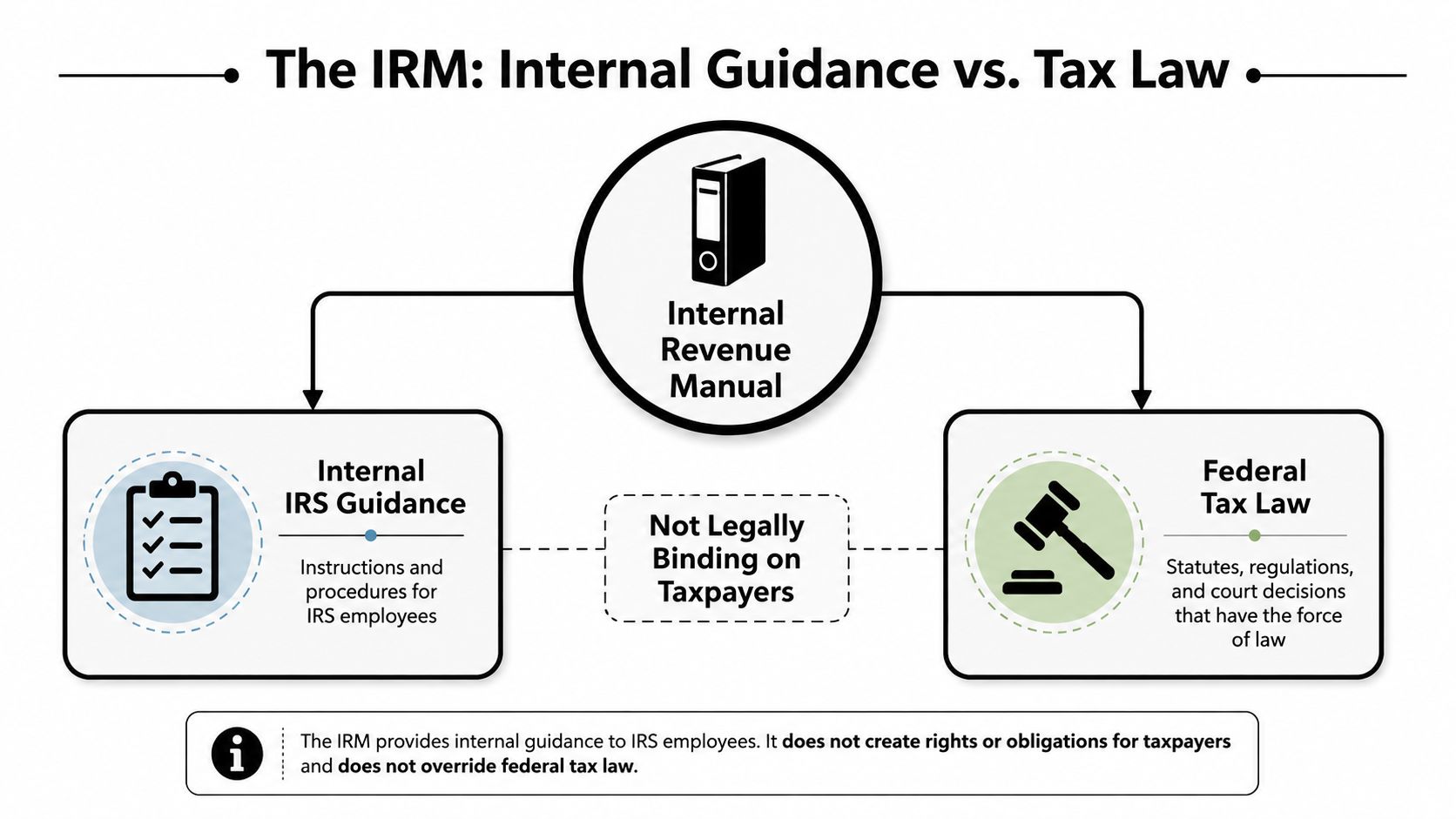
The Internal Revenue Manual is not a hidden tax code. It is the IRS's internal compilation of policies, procedures, and guidelines for employees, published on IRS.gov through the agency's FOIA Library. The IRS explanation of the IRM's public framework describes it as an operational record for administering tax law, not a substitute for the law enacted by Congress.
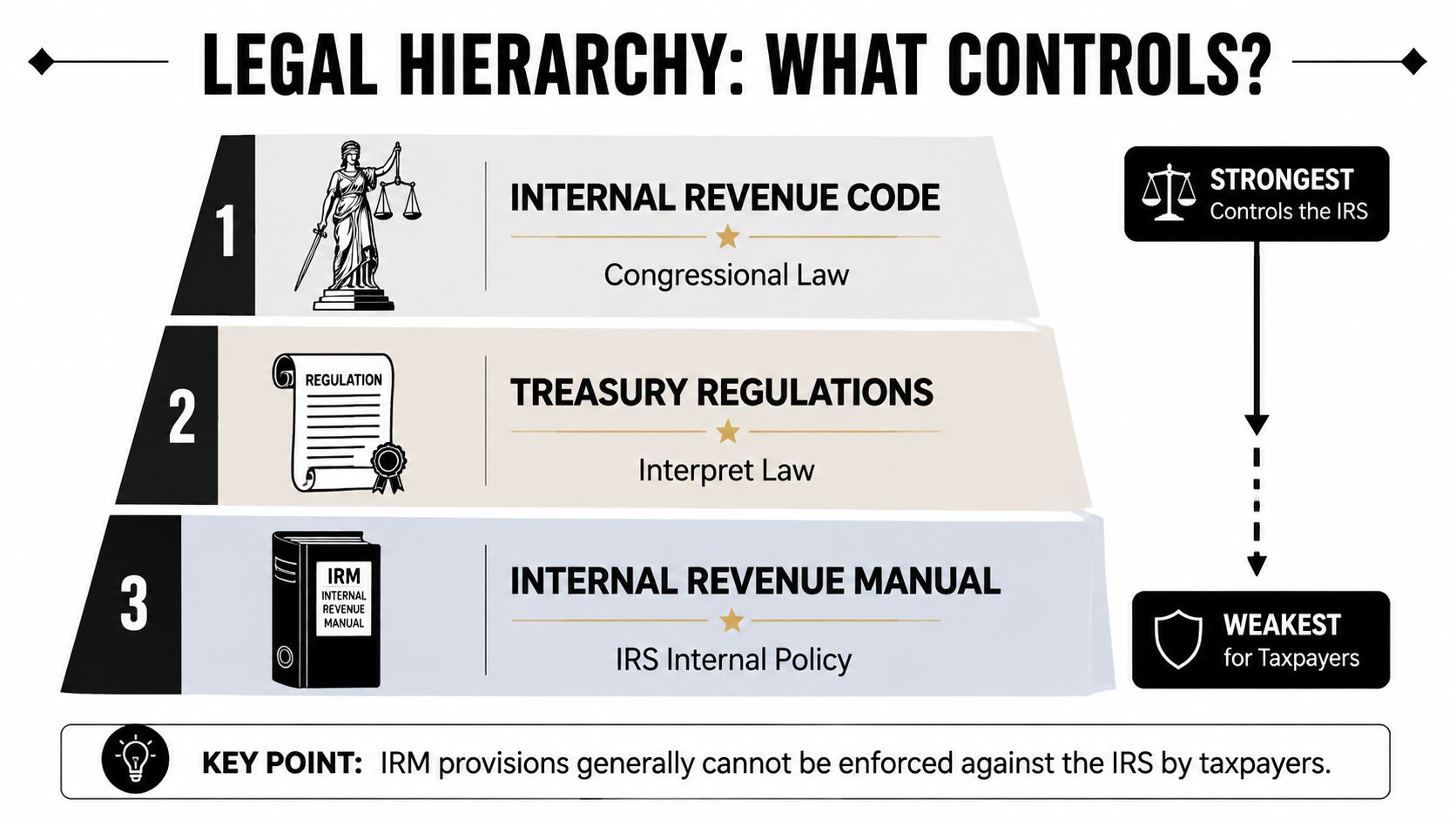
The working hierarchy is straightforward:
- Federal tax law determines what taxpayers owe and which rights Congress has created.
- Treasury Regulations and formal IRS guidance interpret or administer that law within their proper authority.
- The IRM directs IRS personnel in carrying out agency functions.
That third category gives practitioners something useful to examine. An employee's departure from an IRM procedure does not automatically invalidate an assessment or end a collection action. It can show, however, that the IRS skipped a required review, failed to document a decision, or exercised discretion without the support the agency's own process calls for.
In a collection dispute, that record can support reconsideration or a more focused Appeals argument. In a Trust Fund Recovery Penalty matter, it can raise questions about whether the investigation and approval steps were completed on the correct record. In a CDP hearing, it can help frame whether the settlement officer verified the required items and considered the taxpayer's proposed collection alternative. The IRM usually works as an advocacy tool, not as an independent claim for relief.
A living record, not a static handbook
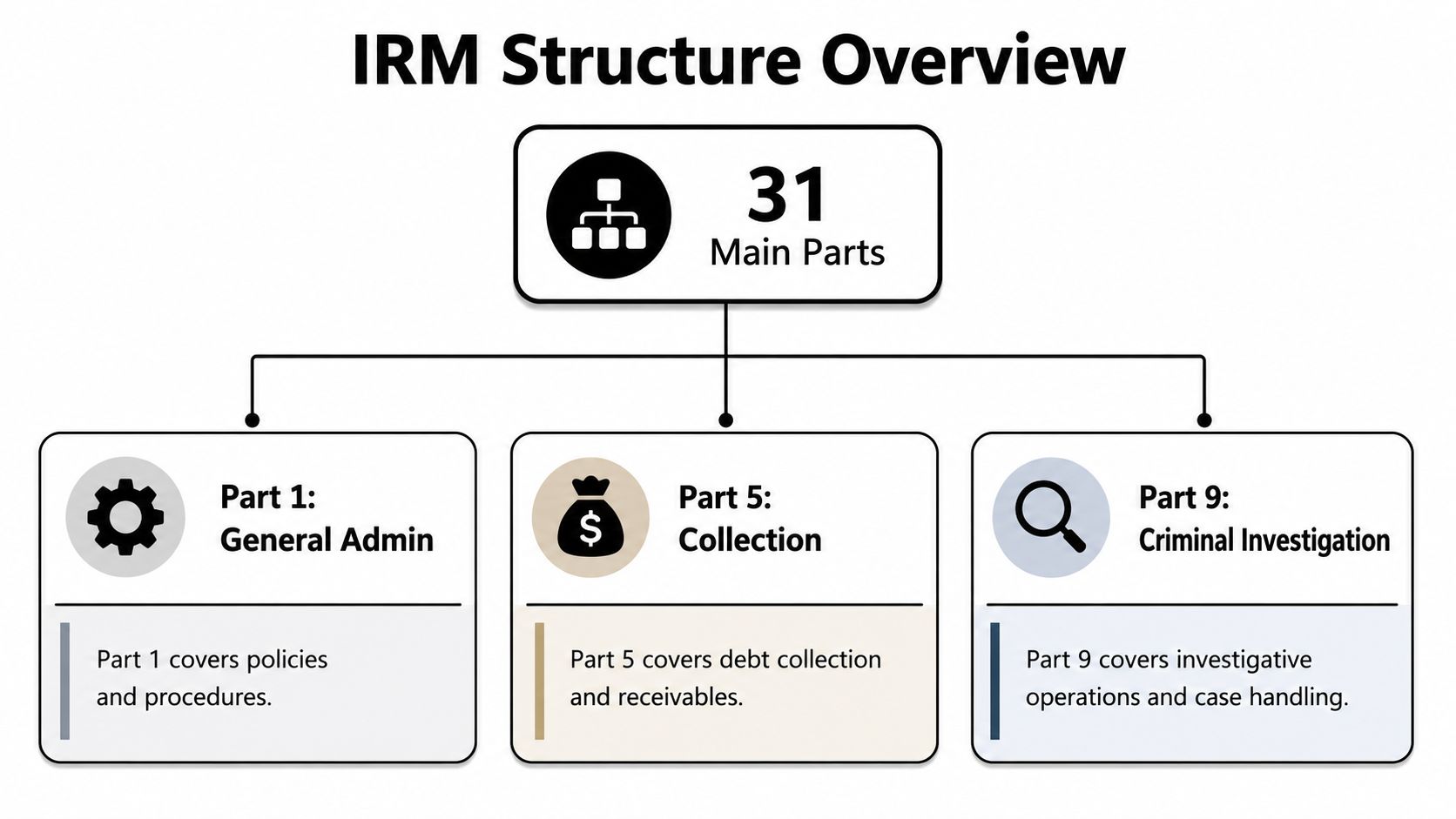
The public IRM framework is organized into 31 parts. 26 parts publicly available on IRS.gov and 5 parts restricted to authorized IRS officials because they contain deliberative or internal-use material. The framework also explains that the manual is reviewed at least annually and updated continuously as operational, legislative, and interpretive changes occur.
That revision history matters in controversy work. The applicable provision may depend on its effective date and on the facts present when the IRS acted. Citing only the current webpage can produce an argument that appears exact but relies on a later version.
Practical rule: Use controlling law to establish the taxpayer's position. Use the IRM to test whether the IRS followed its own process, including required reviews, approvals, documentation, and decision points.
Used with that discipline, the IRM can expose an omitted step or unsupported conclusion. It cannot turn internal guidance into binding taxpayer-facing law.
Navigating the IRM Structure and Finding Relevant Sections
The IRM becomes manageable once you stop searching for “the rule for my tax problem” and identify the IRS function involved. The manual is divided into numbered parts, chapters, and subsections. The citation itself tells you where the provision sits. For example, an IRM reference beginning with “8” points toward Appeals material, while a reference beginning with “8-025” directs you into the chapter addressing Trust Fund Recovery Penalty procedures.
Part 1 addresses broad administration and policy matters. Other parts deal with functions such as examination, collection, Appeals, and criminal investigation. A taxpayer facing an audit shouldn't begin with the same search terms as a business owner responding to a proposed responsible-person penalty.
Start with the IRS action, not the legal conclusion
Use the IRS notice, letter, or employee action as the search prompt. Useful terms may include:
- Collection Due Process: Search for the notice type, levy, lien, Form 12153, or CDP hearing.
- Payroll tax exposure: Search for Trust Fund Recovery Penalty, Letter 1153, Form 2751, responsible person, or willfulness.
- Audit procedure: Search for examination, taxpayer contact, documentation, protest, or Appeals referral.
- Appeals review: Search for collection determination, settlement officer, balancing, or verification.
The IRS.gov IRM pages provide navigation and search tools, but the first result isn't necessarily the provision that controls the issue. Read the surrounding subsections. Definitions, exceptions, managerial approvals, and cross-references often carry more practical significance than the sentence that initially matches the search term.
Match the part to the controversy
A collection case may require examination of procedures governing notices, levy action, financial analysis, and Appeals review. A TFRP case requires a different path because the Revenue Officer must investigate responsibility and willfulness, document the matter in the Automated Trust Fund Recovery program, and follow the formal notice process before assessment.
Write down the exact citation, subsection date, revision indicators, and cross-referenced forms. Then compare the procedure with the notice received and the case history. The useful question isn't merely, “Does this section help me?” It's, “Which required action should appear in the file, and what evidence shows whether it occurred?”
That approach turns the IRM from an intimidating archive into a targeted research tool. You're not reading all 31 parts. You're tracing the agency's path through the specific function involved in your case.
Understanding the Legal Weight of IRM Provisions
Tax controversy arguments fail when they confuse persuasive operational guidance with binding authority. The usual hierarchy begins with the Internal Revenue Code, followed by Treasury Regulations and then other formal authorities such as Revenue Procedures and Revenue Rulings, subject to each authority's scope and legal effect. The IRM occupies a different position. It tells IRS employees how the agency expects work to be performed, but it generally doesn't establish the taxpayer's substantive liability.
That limitation doesn't make the IRM irrelevant. It changes the argument you should make. Instead of asserting that an IRM paragraph independently grants relief, connect the procedure to a recognized legal issue, such as whether the IRS verified the required information, considered relevant facts, balanced collection against legitimate taxpayer concerns, or abused its discretion.
The argument is usually procedural
Suppose an Appeals employee reaches a collection decision without addressing a material proposal or without documenting a required verification step. The IRM may help show what the employee was expected to examine. The stronger argument is not that the taxpayer automatically wins because the manual was breached. It's that the agency's decision lacks a reliable administrative foundation or fails to show meaningful consideration of the relevant issues.
That distinction matters in CDP litigation and administrative review. A court or reviewing officer may examine whether the IRS acted arbitrarily or abused its discretion, but the IRM isn't a substitute for the governing statute. The same discipline applies when researching the statute of limitations on IRS debt. The controlling statutory framework must come first, while the IRM can help explain how IRS personnel are instructed to process related actions.
IRM provisions, FAQs, and formal guidance aren't interchangeable
The IRS itself warns that FAQs generally can't be relied upon in the same way as formal authority. The IRS overview of the Internal Revenue Manual and related guidance is useful because it highlights the difference between internal operating instructions and taxpayer-facing authority.
A practical comparison looks like this:
| Material | Primary function | How to use it |
|---|---|---|
| Internal Revenue Code | Establishes statutory rights, duties, and tax rules | Lead with it when asserting legal entitlement |
| Treasury Regulations | Interprets and implements statutory provisions | Use to define how the statute operates |
| Revenue Procedures and Revenue Rulings | Provide formal administrative guidance within their stated scope | Check applicability and procedural requirements |
| IRM provisions | Direct IRS employees through operational processes | Use to test procedure, documentation, and discretion |
| IRS FAQs | Offer general explanations | Treat cautiously and verify against formal authority |
A well-built protest or Appeals submission therefore cites the statute or regulation for the legal proposition, then cites the IRM to show the expected administrative process. That combination is more credible than presenting an IRM excerpt as though it were enacted law.
How the IRM Creates Leverage in Audits and Collections
The IRM becomes an advocacy tool when a taxpayer uses it to identify a decision point the IRS was required to handle correctly. Collection Due Process and Trust Fund Recovery Penalty matters illustrate this better than abstract discussions of the manual's legal status.
Consider a taxpayer who receives a lien or final levy notice. Under the IRM's CDP procedures, the IRS must advise the taxpayer of the right to request a hearing before levy action proceeds. The request generally uses Form 12153 or an equivalent written request containing the same information.
The practical advantage comes from timing. A timely CDP request can pause enforced collection and move the matter to the IRS Independent Office of Appeals. That hearing may preserve a chance to propose an installment agreement, challenge the collection action where permitted, or present collection-balancing arguments before the IRS proceeds further.
The collection file tells the story
In practice, I want to see the notice, proof of delivery, the taxpayer's response, and the IRS case history together. If the taxpayer filed a complete request and the IRS treated it as though no request existed, the procedural discrepancy deserves immediate attention. If the taxpayer missed the window, the case may move into a more constrained post-levy posture, and the available remedies can change.
That's why a taxpayer shouldn't wait until a levy has already occurred to look for the CDP language. The Automated Collection System discussion is relevant to understanding why communications with the IRS collection system need to be preserved and organized, not handled through informal calls alone.
TFRP cases have a separate pre-assessment gate
A business owner facing a Trust Fund Recovery Penalty investigation faces a different procedural sequence. Revenue Officers investigate responsibility and willfulness, document the case in the Automated Trust Fund Recovery program, and must properly deliver Letter 1153 and Form 2751 before assessment can proceed. That delivery opens a 60-day response period, or 75 days when the notice is addressed outside the United States, as stated in the IRM's TFRP procedures.
The notice and protest period are the principal pre-assessment challenge point. The defense should gather records addressing authority, control, signature power, payroll decisions, and willfulness. Managerial approval of the proposed assessment recommendation is another control point. It may affect whether the proposed penalty is sustained, narrowed, or delayed.
The mistake is treating Letter 1153 as routine correspondence. A missed response can move the matter toward assessment and later collection enforcement. A timely, evidence-based protest gives the Revenue Officer and manager a reason to distinguish the individual's actual role from the company's unpaid payroll taxes.
Searching and Citing the IRM in Tax Disputes
An IRM citation matters when it identifies a current or historically applicable instruction and connects that instruction to a specific procedural failure. Quoting a paragraph without showing what the IRS did, when it acted, and why the deviation matters rarely advances the case.
Search IRS.gov by the agency action, notice, form, or procedural phrase. Open the complete subsection instead of relying on a search preview. Read its definitions, exceptions, “see also” references, and nearby paragraphs addressing approvals, required documentation, supervisory review, or file entries. Those details often determine whether an apparent violation provides a practical argument or only a general complaint.
Build a contemporaneous research record
Save or print the relevant page and record:
- The complete citation, including part, chapter, section, and subsection.
- The subsection date, because substantive changes take effect when the subsection date changes.
- The action date, such as the date of the notice, interview, assessment recommendation, or Appeals determination.
- The factual event, including who acted, what was requested, and what the file shows.
- The controlling authority, usually the Code, regulations, or formal guidance that supplies the legal rule.
Compare the subsection date with the IRS action date. The IRS explains its IRM revision and effective-date process, and the current page may not describe the procedure in force when the employee acted. Preserve the historical version when available. It can support an argument that the agency departed from its instructions at the relevant time. A later revision may provide context, but it does not automatically establish what governed the earlier action.
Cite the provision, then explain the consequence
A useful citation identifies the rule, the event, and the requested response: “IRM Part 8, Chapter 22, Section 4, subsection [specific citation], instructs personnel to address the CDP request and related collection issues. The administrative file does not show that the submitted request was considered, and the Notice of Determination does not explain its rejection.”
That structure gives the reviewer a reason to act. Depending on the record, the requested remedy may be reconsideration, a remand to Appeals, correction of the file, or suspension of enforcement while the procedural issue is reviewed. The IRM does not replace the Code or regulations. It helps expose whether the IRS followed the process its employees were instructed to use.
IRM research should support the broader record in IRS tax appeals. Organize the facts and controlling legal authorities first, then use the manual to pinpoint the agency's procedural departure and explain the concrete effect on the taxpayer.
Traps and Limitations Every Practitioner Should Know
The IRM is useful precisely because it reveals how the IRS expects employees to work. It is also incomplete. The public version is redacted and excludes OUO content, while 5 of the framework's 31 parts remain restricted to authorized IRS officials because they address deliberative or internal-use matters. A taxpayer may identify a procedural gate without seeing every instruction that shaped the employee's decision.

Use that limitation carefully. Do not argue that a public page states the IRS's entire procedure when the agency has withheld related internal material. Identify what the accessible provision requires, compare it with the administrative record, and determine whether the missing material can be addressed through an applicable review or disclosure process. In a collection case, that distinction can keep a procedural argument credible rather than overstated.
Dates can defeat an otherwise sound argument
The manual changes section by section. The IRS states that substantive changes take effect when the subsection date changes, so a current citation may not describe the process in force when the IRS acted. Preserve the applicable version, record its date, and identify that date in correspondence and hearing submissions.
Internal guidance can also shift before public commentary catches up. The IRS described a March 2025 interim policy that suspended part of proposed AI governance guidance while it awaited further OMB and Treasury direction. The broader point applies to examination, collection, TFRP, and CDP procedures. Operational instructions can change while a dispute is already developing.
Avoid this mistake: Do not build the defense around a copied IRM paragraph. Verify the effective date, read every cross-reference, and anchor the argument in the Code, regulations, formal guidance, and documented facts.
FAQs present a separate problem. They may clarify IRS terminology, but the IRS says they generally do not carry the same reliance value as formal authority. The IRM may offer greater operational detail, yet its internal status limits how directly a taxpayer can enforce it. Its strongest use is often evidentiary and procedural: show the required step, show what the file contains, and explain the consequence of the omission.
Using the IRM to Strengthen Your Tax Defense Strategy
The IRM works best as part of a layered defense. Start with the taxpayer's legal position, then reconstruct the IRS's procedural path, and finally identify the point where the agency's work product doesn't match its governing authority or internal instructions.
For an audit, that means preserving notices, information requests, submissions, and conference records while comparing the examination steps with applicable law and procedure. Guidance on preparing for an IRS audit can help establish that factual foundation. For collections, it means identifying the notice that triggered CDP rights, confirming whether the request was timely and complete, and testing whether Appeals considered the taxpayer's proposal and relevant facts.
TFRP defense requires an even earlier intervention. The Revenue Officer's investigation focuses on responsibility and willfulness, while the notice and protest process provides the main opportunity to contest the proposed assessment before it becomes a collection liability. Evidence about bank access, payroll authority, ownership, signature power, and actual decision-making should be gathered before assumptions harden into an assessment recommendation.
The strongest IRM arguments usually do one of three things:
- Expose a missing procedural step, such as a required notice, review, or approval.
- Show an incomplete factual analysis, particularly where the employee ignored evidence relevant to collection alternatives or responsibility.
- Create a reason to pause and reconsider, because the administrative record doesn't support the action taken.
A tax attorney who understands the Internal Revenue Manual can use those points in discussions with Revenue Officers and Appeals Officers without overstating the manual's legal force. Tax Attorney Stephen A Weisberg offers a free tax debt analysis before charging clients to resolve IRS issues, and his practice addresses tax debt, audits, appeals, and related IRS controversies.
The right question isn't whether the IRM alone can win your case. It's whether the IRS followed the required path, whether the file proves it, and what legal or procedural remedy follows from any failure.
Tax Attorney Stephen A Weisberg reviews IRS collection, audit, appeal, and Trust Fund Recovery Penalty matters with attention to the procedures that can create meaningful advantage. Visit Tax Attorney Stephen A Weisberg to request a free tax debt analysis and determine whether an IRM-focused review can strengthen your next step.


