Installment Agreement for Payroll Taxes: How to Qualify
Get an installment agreement for payroll taxes: eligibility limits, required IRS forms, negotiation tactics, alternatives, and how to avoid default.

In this article
- Which Payroll Tax Installment Agreement Fits Your Balance
- What the express route requires
- Costs that don't show in the monthly payment
- Gather These Records Before You Call the IRS
- Assemble and reconcile the file
- Personal Liability Behind Unpaid Payroll Taxes
- What the IRS may examine
- How to Request an Installment Agreement Step by Step
- Negotiating the Monthly Payment and Its Real Cost
- Build the payment from operating cash
- Make a supportable proposal
- Alternatives When a Payment Plan Will Not Work
- Keep the Agreement Active and Choose Your Next Step
The most popular advice about payroll-tax debt is to pick a monthly payment the business can afford and ask the IRS to approve it. That skips the harder question: can the business make that payment while also filing returns and depositing current payroll taxes on time? A plan that drains cash needed for current deposits can create fresh tax debt and put the agreement at risk.
An installment agreement is a way to repay the balance, not a way to erase it or transfer all responsibility to the company. Before proposing terms, check which payment route fits, what the business can document, and whether the IRS may be assessing anyone personally for withheld taxes.
Which Payroll Tax Installment Agreement Fits Your Balance
Find the row that matches your balance and whether the business has employees. The IRS route also depends on filing and deposit compliance, the business's ability to pay, and how quickly the debt can be cleared.
| Situation | Likely Path | Key Requirement |
|---|---|---|
| Business with employees owes $25,000 or less, all returns filed, no outstanding federal tax deposits | In-Business Trust Fund Express installment agreement | Pay in full within 24 months or before the CSED, whichever comes first |
| Balance of $25,000 or less that can't be paid at once | Online payment agreement | Business can't pay the amount shown and can pay in full within 24 months |
| Balance above $25,000 | Full collection analysis | Form 433-B, plus Form 433-A for responsible individuals |
| Business can pay from current assets or income | Full payment requested | IRS expects full payment rather than installments |
| Can't pay in full before the CSED but has some income or equity | Partial payment installment agreement | Complete Form 433-B and/or Form 433-A with verified financials |
What the express route requires
For an operating business with employees, the In-Business Trust Fund Express Installment Agreement has a defined screening process. The balance is the aggregate unpaid balance of assessment, including assessed tax, penalties, interest, and other module assessments. The IRS generally requires timely filing of returns, no outstanding federal tax deposits, and full repayment within 24 months or before the collection statute expiration date, whichever comes first. See the IRS's In-Business Trust Fund Express agreement requirements.
A balance above the express limit, or a business that can't meet the repayment window, may require financial disclosure on Form 433-B. The IRS may also require Form 433-A for responsible individuals. An in-business case can involve a separate Trust Fund Recovery Penalty review, so a company's requested terms don't by themselves resolve a person's exposure.
Costs that don't show in the monthly payment
Penalties and interest continue to accrue until the balance is paid. A payment that looks manageable each month may therefore leave the business paying more in total than the original balance.
A user fee may apply, and the IRS may file a Notice of Federal Tax Lien. Consider those risks before treating the lowest possible monthly figure as the best outcome. If a partial-payment arrangement may fit, the guide to partial payment installment agreements can help you understand the trade-off between paying over time and the business's available income and equity.
Gather These Records Before You Call the IRS
Files often stall because the documents don't agree: the payroll reports show one balance, the books show another, or the financial statement leaves out an account. The IRS evaluates a business's ability to pay using financial disclosure, and it can request information about assets, liabilities, income, expenses, accounts, and recent profit-and-loss results. Its Form 433-B collection guidance also says the IRS should request full payment when an in-business taxpayer can pay from current assets or income.
| Document | What It Proves | Common Gap |
|---|---|---|
| Form 2848, Power of Attorney and Declaration of Representative | Lets your representative speak with the IRS | Wrong tax types or periods listed |
| Form 433-B, Collection Information Statement for Businesses | Business income, expenses, assets, and ability to pay | Blank sections or unverified figures |
| Form 433-A, Collection Information Statement for Individuals | Personal finances of responsible owners | Omitted even though it drives personal exposure |
| Bank statements for every business account | Cash flow and available equity | Forgotten or closed accounts |
| Forms 941 and 940 with deposit records | Current filing and deposit compliance | An unfiled quarter or missed current deposit |
| Profit-and-loss statement and balance sheet | Recent income and liabilities | Figures older than the request |
| IRS account transcripts | Balance history, penalties, and payments | Notices not reviewed before submission |
Assemble and reconcile the file
- Form 2848: Confirm that the form identifies the correct tax types and periods. A representative can't address periods the authorization doesn't cover.
- Forms 433-B and 433-A: Put the business's income, expenses, assets, and debts on Form 433-B; use Form 433-A when the IRS needs the personal finances of responsible individuals. These statements form the basis for negotiations. The Form 433-B guide explains the business disclosure in more detail.
- Accounts and payroll records: Include statements for every business account, even one that was closed or is rarely used. Comparing statements against deposits and payroll reports through a process such as reconciling business bank statements can reveal missing transactions before the IRS asks about them.
- Books and transcripts: Bring the recent profit-and-loss statement, balance sheet, and IRS account transcripts. Figures that don't reflect the period under review invite questions.
Before submitting anything, reconcile the books to Forms 941 and 940 and the deposit records. If those sources disagree, identify the reason and correct the records first rather than submitting numbers you can't explain.
Personal Liability Behind Unpaid Payroll Taxes
“Is the IRS looking at me personally?” is a different question from “Can my company get a payment plan?” A company installment agreement doesn't necessarily protect an owner or another responsible person from a Trust Fund Recovery Penalty assessment.
The IRS can assess the penalty against a person responsible for collecting, accounting for, or paying withheld employment taxes who acted willfully. It equals 100% of the unpaid trust-fund tax. Potentially responsible people can include officers, partners, sole proprietors, employees, trustees, or agents, not just the owner. The IRS describes the Trust Fund Recovery Penalty and who may be liable.

What the IRS may examine
The assessment isn't decided by job title alone. The IRS may consider who could sign checks, who controlled payroll decisions, who directed payments to other creditors, whether ownership or duties changed, and when each person learned that the taxes weren't paid. Those facts help shape the IRS's analysis, but they don't automatically settle it.
A Letter 1153 can propose the penalty, and a Form 4180 interview may ask about a person's duties and authority. Read the questions carefully and make sure any response accurately describes the person's role during the relevant periods.
A company payment arrangement and an individual investigation can proceed alongside each other. If the responsible-person determination appears wrong, agreeing to company payments shouldn't distract from reviewing the personal exposure. The company balance and the individual assessment need separate attention. For more detail on how the two can overlap, see this explanation of the Trust Fund Recovery Penalty.
Before signing a statement that describes your duties or role, review the personal exposure. Then decide the order of the business request and any individual response with the facts in front of you.
How to Request an Installment Agreement Step by Step
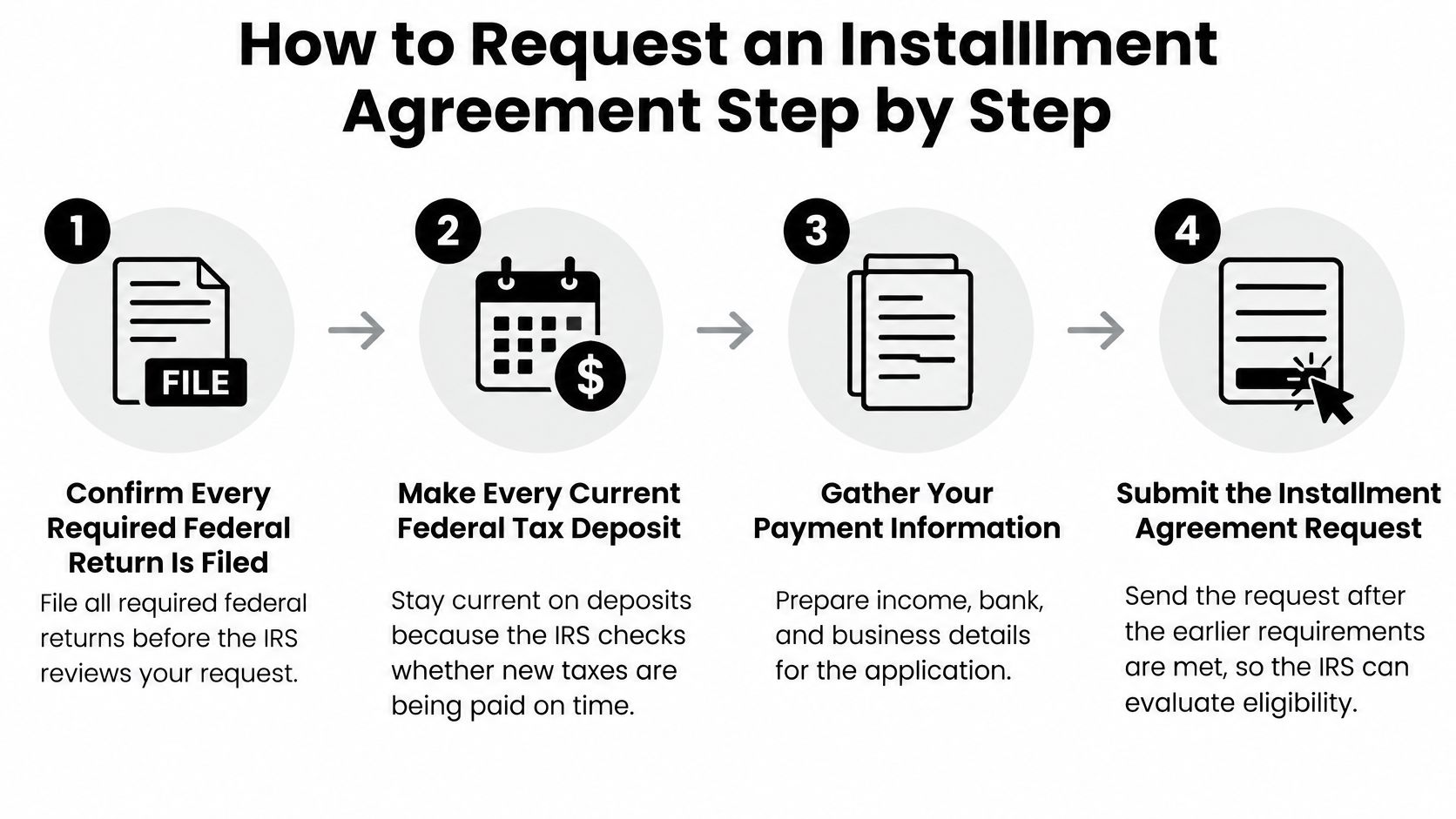
Follow the sequence rather than sending a payment proposal as soon as a notice arrives. The IRS needs a filed, current account and a supportable picture of the business's finances before a payment amount can be evaluated.
Confirm filings and current deposits. Check that every required federal return is filed and that current federal tax deposits are being made. A common mistake is submitting a request while returns are still missing, which can prevent the IRS from considering the proposed terms.
Pull IRS transcripts. Get transcripts for the business and any responsible individuals whose accounts may be involved. They help confirm the assessed balance, penalties, interest, payments, and relevant collection dates; don't assume the balance on one notice tells the whole story.
Calculate the full repayment picture. Add the assessed tax, penalties, and interest, then compare the proposed payoff period with the collection statute expiration date. Identify which tax periods include withheld trust-fund taxes so the personal-liability issue isn't lost in a company-only calculation.
Choose the route that fits. Use the balance, filing status, deposit status, and available cash to decide whether the online payment agreement, In-Business Trust Fund Express route, or a full Form 433-B analysis is appropriate. Don't force a simplified route when the business can't satisfy its conditions.
Authorize representation and submit the request. File Form 2848 if a representative will speak with the IRS, then make the request through the applicable online tool or Form 9465. A frequent slip is assuming the authorization itself creates an agreement; it only allows the representative to act within its scope.
Support the proposed payment. Complete the relevant financial statements and calculate what remains after the business covers current payroll and required deposits. A monthly amount based on a strong month, without supporting cash-flow information, may not be sustainable.
Get the approved terms in writing. If the IRS approves the arrangement, review Form 433-D, Installment Agreement, and consider direct debit to reduce the chance of a missed payment. Keep written confirmation of the due date and the conditions that could put the agreement in default.
If the IRS rejects the request or proposes different terms, ask for the reason in writing. Correct missing or inconsistent information, then request a manager review before the response deadline printed on the notice. An unexplained rejection is a prompt to fix the file, not a reason to send the same proposal again.
Negotiating the Monthly Payment and Its Real Cost
A low monthly payment isn't automatically a good deal. A restaurant might manage a strong payment during summer, then face a cash squeeze in January when payroll, current deposits, and the old balance compete for the same money. If it pays the old debt first and misses a current deposit, the business has traded a manageable old liability for a new compliance problem.
The IRS says penalties and interest continue during an agreement, and the business must keep filing returns and making required deposits. Its installment agreement procedures also describe the online option for a business that can't pay the amount shown on its return, owes no more than $25,000, and can pay in full within 24 months. The online route isn't a substitute for a cash-flow plan.
Build the payment from operating cash
Start with expected receipts, then subtract ordinary operating costs, payroll, and current tax deposits. Only the cash remaining after those obligations can support a payment toward the old balance. In a seasonal business, test the proposal against weaker months, not just the best month on the books.
Separate withheld trust-fund taxes from the employer's share of payroll taxes in your records and analysis. Withheld amounts create the distinct personal-liability concern for responsible people; either way, don't accelerate an old-balance payment if doing so will leave current deposits unpaid.
Make a supportable proposal
Use current financial statements and bank activity to show how the proposed amount fits the business's cash flow. Ask for the agreed payment terms in writing, including the due date and any conditions the business must continue to meet. If the first answer is unreasonable or doesn't account for the documented figures, ask for a manager meeting and explain the specific gap.
Practical rule: Cover current payroll and deposits first. The old balance should be paid from the cash the business can actually spare, not from money needed to stay compliant.
Alternatives When a Payment Plan Will Not Work
These are exits to evaluate, not a ranking of universally best choices. Each requires a clear view of the business's income, assets, liabilities, and ability to pay.
| Option | Best Fit | Main Trade-Off |
|---|---|---|
| Full payment or short-term payment plan | Business that can clear the balance now or within a short payment period | Lowest total cost, but interest accrues until paid |
| Installment agreement | Balance can be paid over time within the CSED | Penalties and interest continue, and a user fee applies |
| Partial payment installment agreement | Can't pay in full before the CSED but has income or equity | Complete Forms 433-A and 433-B; assets may need to be used |
| Offer in compromise | Liability exceeds realistic collection potential | Form 656 with Forms 433-A and 433-B; IRS tests collection potential |
| Currently not collectible | Paying would cause serious hardship | Collection pauses, but the balance remains owed |
| Bankruptcy | A balance where discharge eligibility needs legal analysis | Most payroll-tax debt isn't discharged |
Full payment or a short-term plan may fit a business with cash available to clear the debt without disrupting operations. It can reduce the period in which interest accrues, but using cash needed for payroll or current deposits creates a different risk.
A partial payment installment agreement may suit a business that can't pay in full before the collection statute runs out but can make some payments. The IRS reviews financial disclosure and may expect available assets or equity to be used. The currently not collectible status guide explains a separate hardship route.
An offer in compromise asks the IRS to accept less than the full liability and requires Form 656 with the relevant individual or business financial statement. The IRS evaluates the offer against its view of reasonable collection potential, so a preferred settlement amount isn't enough by itself.
Currently not collectible status may pause collection when paying would cause serious hardship. It doesn't forgive the balance, and the business should understand what happens if its financial condition changes.
Bankruptcy needs careful tax-specific analysis. Many tax debts aren't discharged, especially more recent liabilities or trust-fund payroll taxes. The practical test is straightforward: a business that can pay should compare full payment with a short-term plan; one with a temporary cash gap should assess installments; one that's structurally insolvent needs a broader review of hardship, settlement, and legal options.
Keep the Agreement Active and Choose Your Next Step
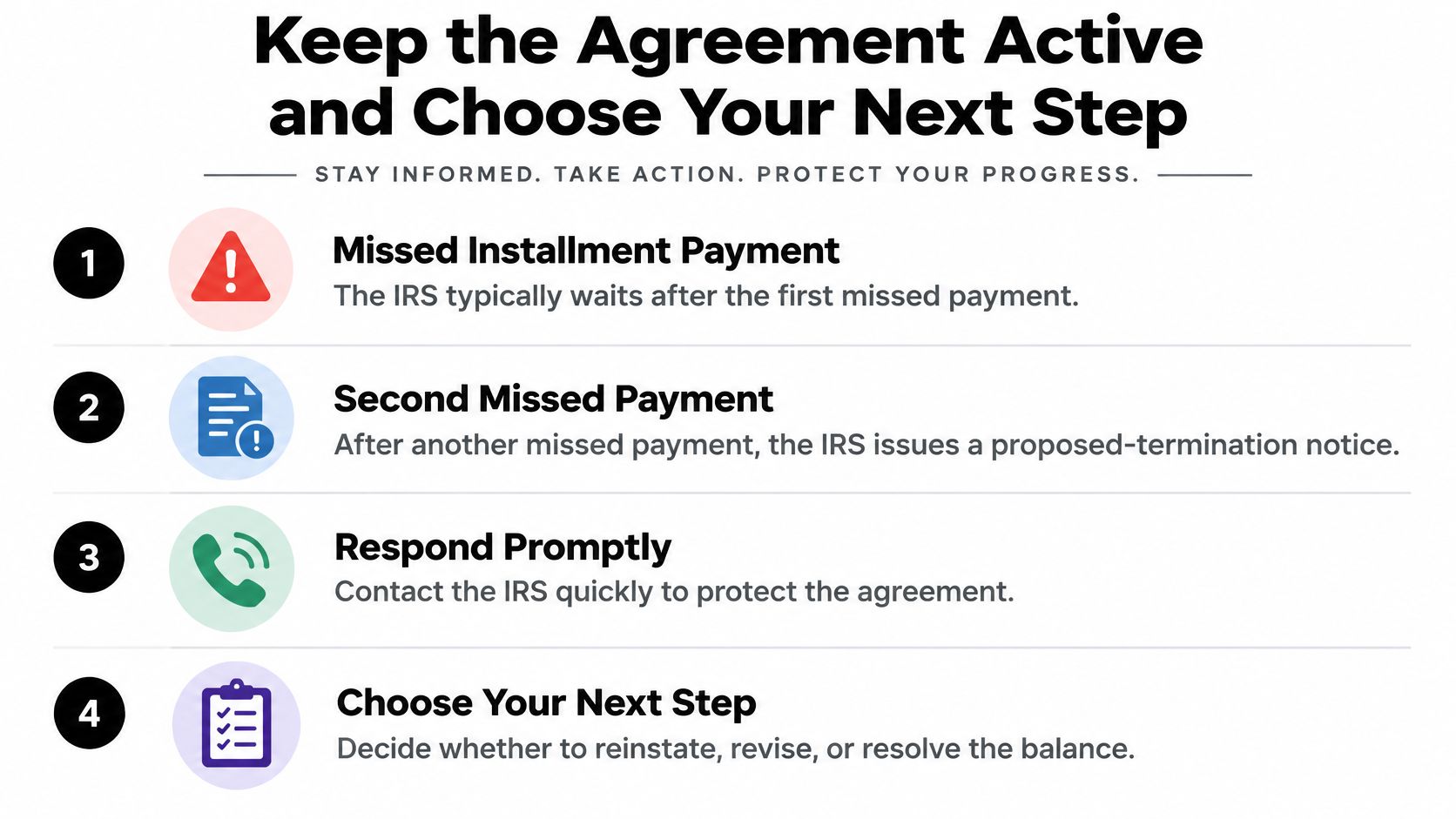
A missed installment can start a sequence that ends with collection resuming. IRS procedures allow a short window after an initial missed payment, then a proposed-termination notice if the problem continues. That notice sets its own response deadline, so read it for the exact date and answer before it passes. The IRS's installment agreement default procedures outline how termination and reinstatement work. Once an agreement defaults, enforced collection is back on the table.
With payroll taxes, the bigger threat is usually a new liability rather than the old balance. A payment plan that ignores current deposits will fail: missed trust-fund deposits can break the agreement and deepen the owner's personal Trust Fund Recovery Penalty exposure at the same time.
- Calendar every obligation: Track each installment payment, payroll deposit, and filing deadline in one system, and assign someone to confirm every payment cleared.
- Fund current deposits first: Current-quarter payroll deposits come before the back-tax installment, because a new delinquency can terminate the plan and create fresh personal exposure.
- Keep proof: Save confirmations and bank records for every installment and deposit. If the IRS account doesn't show a payment, proof helps you investigate the discrepancy.
- Refresh the financial picture: Update business financial records regularly so the cash-flow projection reflects current payroll, expenses, and available equity.
- Check transcripts: Review business transcripts for new balances, payments, or penalties. A new payroll liability can threaten an otherwise current arrangement.
- Respond to notices promptly: Identify the response deadline on every IRS notice and gather the records needed to answer it.
A business with a balance under $25,000 and clean filings may be able to start with the online route. A larger balance, a responsible-person question, or tight cash flow calls for a full financial review before submitting a proposal, and the firm can help identify an appropriate solution regardless of how much the taxpayer owes.
This week, pull the business transcripts and list every missing return, unpaid deposit, and business bank account. That inventory shows whether the first priority is getting current, choosing a payment route, or examining personal exposure.
Tax Attorney Stephen A Weisberg can review the business's IRS transcripts, financials, and payroll-tax exposure to help identify a workable resolution path. If you need help evaluating an installment agreement or the owner's potential personal liability, visit Tax Attorney Stephen A Weisberg to discuss the next step.


