Indiana Tax Warrant: What It Is and How to Clear It
Indiana tax warrant explained: how DOR and sheriffs enforce it, steps to protect your assets, payment options, and how to get the lien released.

In this article
- What an Indiana Tax Warrant Is and How Fast It Moves
- Indiana tax warrant timeline from first notice to lien
- DOR or the County Sheriff
- How a refinance gets delayed
- Immediate Steps to Take After a Warrant Is Filed
- Build the record before negotiating
- Make the first contact useful
- Resolution Options for an Indiana Tax Warrant
- Warrant resolution options compared
- Protect a dispute without assuming a collection hold
- Plan around payment processing
- Getting the Warrant Cleared From Your Records
- Clearance milestones and the proof to keep
- Request expungement as a separate form of relief
- Decide Whether to Handle It Yourself or Hire a Tax Attorney
- Pay for a defined legal task
You're getting ready to sell a property when the title company calls about an Indiana tax warrant. You remember a state tax letter addressed to your sole proprietorship, but you thought the balance was wrong or planned to deal with it after catching up on business expenses. Now the buyer wants a closing date, and you need to know whether paying the bill will clear the title.
The immediate job is to identify who's collecting, confirm what you owe, and find out what paperwork the title company needs. Those are related tasks, but they aren't interchangeable.
What an Indiana Tax Warrant Is and How Fast It Moves
An Indiana tax warrant is a collection instrument the Department of Revenue (DOR) can issue when a tax liability goes unpaid or unprotested. It isn't an arrest warrant, but filing it with a county clerk creates a public judgment lien against the taxpayer's property throughout Indiana.
For the sole proprietor facing a delayed sale, the problem may have started well before the title search. A disagreement with a bill doesn't preserve your rights unless you respond through the proper process.
According to the Indiana Department of Revenue's tax guidance, the initial response period is 60 days, followed by a Demand Notice allowing 20 days to pay or demonstrate reasonable cause; ignoring both can lead to a warrant in as little as 80 days, excluding mailing and processing time.
Indiana tax warrant timeline from first notice to lien
| Stage | What Happens | Timing | Your Move |
|---|---|---|---|
| First notice | DOR bills the liability | Initial response period stated in the notice | Pay or protest |
| Demand Notice | Final demand follows an unanswered initial notice | After the initial response period expires | Pay or show reasonable cause |
| Response window | Opportunity to respond before a warrant | Through the Demand Notice deadline | Pay or document reasonable cause |
| Warrant issued | DOR may authorize collection | After an unanswered Demand Notice | Respond in writing and request records |
| Warrant filed | Warrant goes to the circuit-court clerk | Promptly after issuance under the statutory filing rule | Check county records |
| Judgment lien | Statewide property lien becomes public | At filing | Identify affected property and transactions |
| Sheriff enforcement | Sheriff may levy, garnish, or sell property | After referral for enforcement | Contact the sheriff about resolution |
The warrant balance can include more than unpaid tax: penalties, interest, collection fees, clerk costs, and damages may be included. Don't compare the warrant total only with the tax shown on your original return and assume the difference is an error.
First move: Find the original notice, the Demand Notice, and their printed dates. Calendar the next live deadline before debating the balance.
Understanding what a state tax lien means helps separate the claim against property from the collection action that may follow. If business withholding contributed to the debt, Business Loan Warrior's explanation of who pays payroll taxes can help you distinguish employer obligations from amounts withheld from employees.
DOR or the County Sheriff
Paying DOR, arranging payments with the sheriff, and obtaining a recorded release are separate events. Before sending money, establish which office currently handles collection and which office can give you a complete payoff.
While the matter remains with DOR, work through DOR's collection process. If a sheriff file is open, contact that office as well: sending money elsewhere without coordinating the payment can leave an unresolved county balance or an enforcement instruction in place.
Indiana's Taxpayer Bill of Rights guidance describes sheriff payment arrangements of up to one year and warns that sheriff payments may take up to two weeks to clear with DOR, potentially involving additional service fees.
How a refinance gets delayed
Say a sole proprietor receives a refinance approval and mails DOR a check for the amount shown on an old notice. The borrower assumes the problem is finished, but the sheriff still has an open file, and the title company won't accept the check copy as evidence of lien clearance.
The check may have been applied correctly without covering every collection cost. Alternatively, the payment may still be moving through the agencies' records while the lender's closing deadline approaches.
Ask for an itemized payoff showing:
- Tax and additions: The underlying tax, penalties, and interest through the proposed payment date.
- Collection costs: Collection fees, sheriff costs, clerk costs, and any other assessed charges.
- Payment instructions: The correct recipient, accepted method, and warrant reference to include.
- Closing documents: The document that will establish satisfaction or release, and who will transmit it.
A lien and a levy also require different responses. A lien affects property rights and title; a levy reaches property or funds through collection, which is why understanding what a state tax levy does matters when an account is threatened.
Don't settle for “your payment is showing.” Ask whether collection is on hold, whether any balance remains, and what written evidence will reach the clerk.
Keep the answers from DOR and the sheriff together. If their figures conflict, request reconciliation rather than choosing the smaller amount.
Immediate Steps to Take After a Warrant Is Filed
Start by building a usable file, not by making promises you can't keep. You need the warrant identifier, the underlying tax periods, the collection contact, and the next required action.
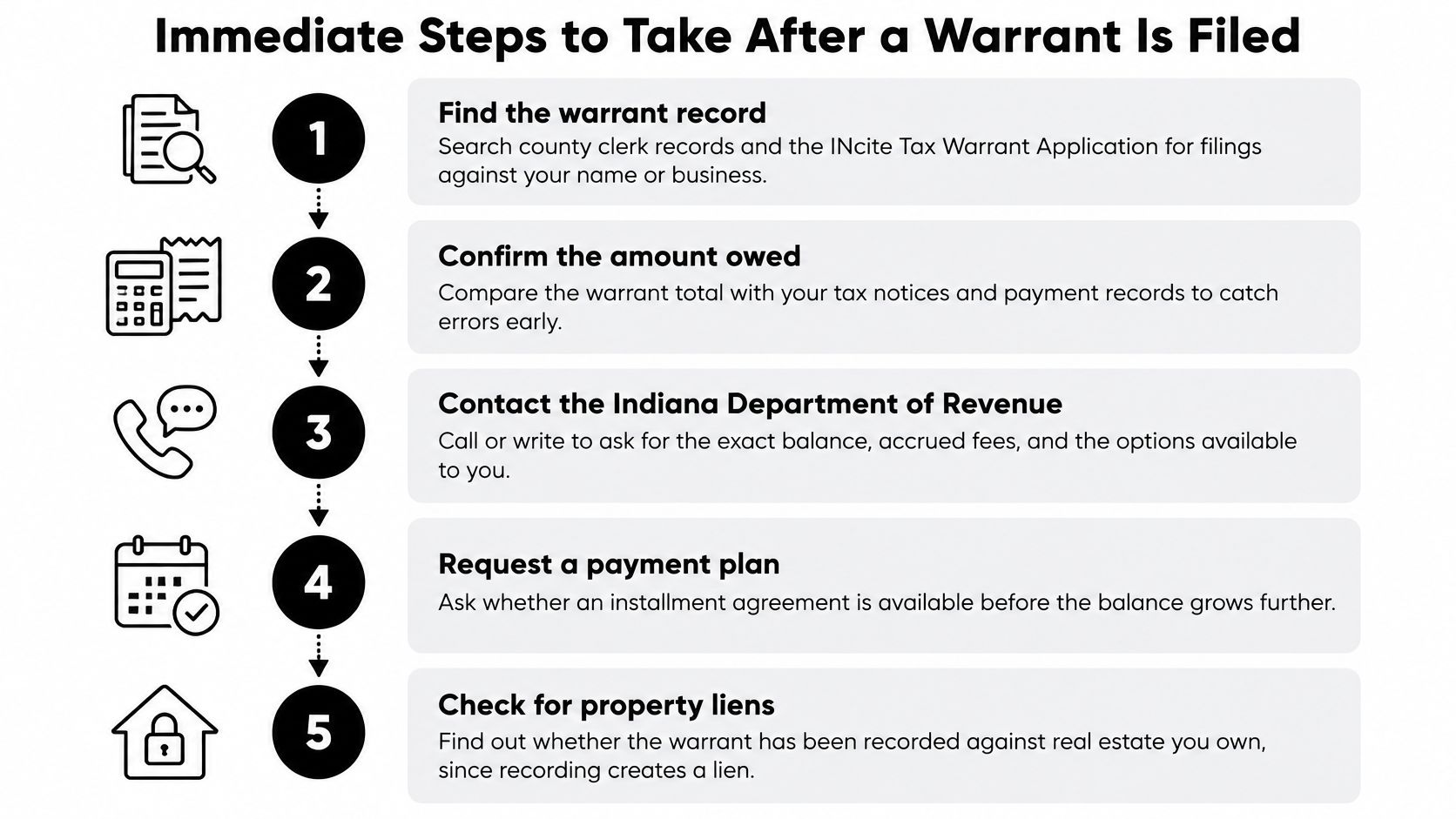
Build the record before negotiating
Find the warrant record. Search available county clerk records under your personal name, business names, and prior business names, and ask the clerk about INcite access if you can't locate a record. Indiana's court-administration tax warrant guide describes INcite records maintained by clerks in 79 Indiana counties and requires filing with the circuit-court clerk within 5 days after issuance.
Reconcile the assessment. Request DOR account transcripts, warrant copies, and copies of the underlying notices. Compare tax periods, returns, payments, and credits against your records so you can identify a missing payment separately from a disputed assessment.
Inventory exposed assets. List bank accounts, customer receivables, real estate, vehicles, and business equipment, noting the legal owner of each. Ownership matters, so don't assume every asset used by your business belongs to the same taxpayer named on the warrant.
Stop creating new balances. File missing returns and keep current tax payments and payroll deposits up to date. A proposed arrangement won't solve the problem if you continue adding liabilities you can't pay.
Leave asset transfers alone until you get advice. Moving equipment, money, or real estate to a relative or another entity during collection can create additional legal problems. Gather ownership documents instead of trying to place property beyond reach.
Notify transaction professionals early. Tell the lender, title company, or closing attorney when a sale or refinance is pending. Give them the actual warrant and collection contacts rather than a verbal assurance that you're handling it.
Calendar the live obligations. Record notice deadlines, document requests, agreed payment dates, and follow-up dates. Keep proof of delivery for written submissions and payment confirmations for money sent.
Make the first contact useful
When you call, have your identification information and warrant number ready. Ask the representative to identify the tax periods, current collector, available resolution routes, and any active enforcement.
Write down the representative's name and what they requested, then confirm important instructions in writing. A phone conversation can help you understand the file, but it doesn't replace a filed protest, an approved agreement, or a documented collection hold.
Resolution Options for an Indiana Tax Warrant
Warrant resolution options compared
| Option | Best When | What You Need | Effect on Collection |
|---|---|---|---|
| Full payment to DOR | You can pay the complete payoff | Current itemized payoff and correct payment instructions | Resolves the paid balance; record-clearing work remains |
| Sheriff payment plan | A sheriff file is open | Financial information and an approved schedule | Sheriff may hold enforcement under the agreement |
| DOR installment agreement | You need time to pay | Income, expenses, and current filings | Collection treatment follows the agreement; lien may remain |
| Offer in compromise | Full payment isn't realistic | Complete financial disclosure and filing compliance | Accepted terms may resolve the debt for less |
| Protest or appeal | You dispute the liability | Timely written submission and supporting evidence | Available review and collection protection require procedural compliance |
| Reasonable cause response | You have a documented explanation for nonpayment | Evidence establishing the cause and timing | May prevent issuance when accepted before the warrant stage |
| Lien release for low equity | A forced sale would produce little useful recovery | Valuation, secured debt, and estimated sale costs | DOR may consider release without treating the debt as paid |
Choose the route by answering practical questions: Can you pay the verified balance? Is the assessment correct? Would paying immediately leave you unable to meet current taxes and basic operating expenses?
Full payment is straightforward only when the payoff is complete and the recipient is correct. An installment agreement preserves cash, but you need a payment you can sustain alongside current obligations; use a tax payment plan preparation checklist to organize the financial information before proposing terms.
Protect a dispute without assuming a collection hold
Say a landlord disputes the tax underlying a sheriff's collection balance. The useful response is to identify the available review procedure, submit evidence before its deadline, and separately request confirmation of collection protection.
A timely protest or approved payment agreement may pause enforcement in the applicable circumstances. An application alone isn't a confirmed stay, and defaulting on an agreement can expose you to renewed collection under its terms.
An offer in compromise needs accurate financial disclosure, not merely a low proposed payment. Missing returns, omitted accounts, or unrealistic expense figures undermine the request. For low-equity property, document likely net proceeds after secured debt and sale costs, and distinguish releasing a lien from forgiving the liability.
Plan around payment processing
Indiana's tax warrant payment guidance describes electronic remittances effective January 1, 2025, with remittances due on the fifth and twentieth of each month, and warns that clearance may take up to 45 days.
That processing warning isn't a guaranteed county-update deadline. Payment submission, DOR receipt, electronic satisfaction, clerk updating, and a title examiner's acceptance are different checkpoints.
For a pending closing, ask the title company what it will accept before selecting the payment route. Attorney review is particularly useful when protest rights, settlement terms, or a requested enforcement hold could change the outcome.
Getting the Warrant Cleared From Your Records
Paid isn't the same as cleared. A payment confirmation proves you initiated a transaction; it doesn't establish that the correct warrant was satisfied or that a title company has removed its objection.
Track the paperwork until the office or professional relying on the record confirms the result. Don't assume that an account showing no amount due means every public record has changed.
Clearance milestones and the proof to keep
| Milestone | What Happens | Typical Lag | Proof to Keep |
|---|---|---|---|
| Payment submitted | Payment instructions are transmitted | Confirmation follows successful submission | Confirmation number and payment details |
| DOR receipt | Funds are applied to the warrant | After processing and account matching | Receipt or updated account transcript |
| Electronic satisfaction | Satisfaction information reaches the judgment record | After DOR processes the resolution | Satisfaction copy from the clerk |
| County record update | Clerk associates satisfaction with the original judgment | After receipt and processing by the clerk | Updated clerk search printout |
| Title search clearance | Title company accepts the lien resolution | After its review of the supporting documents | Written title confirmation |
| Expungement, if approved | Entry is removed from the judgment debtor's column | After approval and clerk implementation | Release of judgment and expungement order |
The lag column describes the sequence, not promised turnaround times. If a record remains unresolved, identify the missing handoff: payment application, satisfaction transmission, clerk processing, or title review.
Request expungement as a separate form of relief
The DOR Tax Advocate Office guide states that expungement review requires outstanding liabilities to be paid or otherwise resolved and filing compliance for the preceding five years; review may be appropriate when the warrant was issued in error, liabilities have been resolved, or expungement serves the state's interest.
Prepare the request in a deliberate sequence:
- Establish the record: Obtain account transcripts and copies of every affected warrant.
- Correct filing problems: Submit missing or inaccurate returns before presenting the request.
- Document each resolution: Include payment, abatement, compromise, or other evidence addressing every liability.
- Explain the basis: Provide filing-compliance proof and the facts supporting expungement review.
- Confirm clerk action: Verify that DOR sends the release of judgment and expungement order to each affected circuit clerk.
A satisfaction records that a judgment has been resolved and is combined with the original judgment. Approved expungement requires removal from the judgment debtor's column, which is a different result.
Closing safeguard: Ask the title company to review the actual clerk documents well before closing. Keep its written acceptance with the warrant, payoff, receipts, satisfaction, and any expungement order.
Decide Whether to Handle It Yourself or Hire a Tax Attorney
Handling the matter yourself can work when the balance is affordable, the assessment is correct, filings are current, and no sheriff enforcement or property transaction complicates the file. You still need to follow the payment through to the required records.
Bring in a tax attorney when the issue involves disputed liability, payroll or trust-fund taxes, active collection, multiple county records, or a closing deadline. Correcting old returns while pursuing expungement also calls for more coordination than merely paying a bill.
Pay for a defined legal task
An attorney should identify the available procedure, control deadlines, prepare evidence, and obtain written resolution documents. Review when hiring a tax attorney makes sense with those tasks in mind, rather than assuming every warrant requires full-service representation.
Before retaining anyone, ask:
- Scope: Will the engagement cover DOR, the sheriff, and clerk follow-up?
- Urgency: Which deadline or collection action needs attention first?
- Outcome: What documents will establish that the agreed work is complete?
Collect every notice, request the transcript, and list the affected counties and deadlines. That file lets an attorney evaluate the actual problem instead of spending the initial consultation reconstructing it.
Tax Attorney Stephen A Weisberg offers a free Tax Debt Analysis to determine whether he can help and which approach fits before charging for resolution work. If an Indiana tax warrant is threatening your bank account, business, or property closing, visit Tax Attorney Stephen A Weisberg to discuss the liability, collection status, and paperwork needed to clear it.


