Independent Contractor vs Employee: Legal Compliance 2026
Clarify independent contractor vs employee status. Our guide details legal tests, tax implications, and penalties for 2026 compliance. Avoid costly mistakes.
In this article
- The High-Stakes Decision Every Business Makes
- What business owners usually miss
- The Three Legal Tests That Define Worker Status
- IRS common law analysis
- Department of Labor economic realities analysis
- The ABC test in stricter states
- Comparing the Financial and Tax Implications
- Employee and contractor comparison
- The practical cost difference
- Employer Liability and Penalties for Misclassification
- Tax exposure is only the first layer
- Labor and benefits issues can hit next
- What makes these cases expensive
- Navigating State Rules and Common Red Flags
- Red flags that attract scrutiny
- A better self-audit question
- A Practical Guide to Compliance and Remediation
- Start with a year-by-year file review
- Build the correction plan before anyone starts talking
- Use Form SS-8 carefully
- Where the VCSP may fit
- Build an audit-defense file now
- When to Stop Guessing and Consult a Tax Attorney
You hire a bookkeeper, designer, installer, or salesperson because work is piling up and payroll feels premature. The quick move is to call that person a contractor, pay by invoice, issue a 1099 later, and keep moving.
That decision often gets treated like paperwork. It isn't. In practice, the independent contractor vs employee question is a tax, labor, and audit-defense issue that can follow a business for years after the first payment goes out.
I see the same pattern repeatedly. A business owner wasn't trying to game the system. They just used the label that seemed normal in their industry, then built the relationship like an employment arrangement. Fixed schedule. Company systems. Ongoing work. Close supervision. By the time someone asks whether the setup is defensible, the primary problem isn't classification in the abstract. It's cleanup.
If you're already worried you may have gotten this wrong, treat that concern the same way you'd treat an unfiled return or a payroll tax notice. Early action usually gives you more options than waiting does. If you need a broader year-round compliance framework, start with a small business tax checklist and then come back to worker classification with fresh eyes.
The High-Stakes Decision Every Business Makes
A first hire rarely feels like a legal event. It feels like survival.
A contractor relationship looks simpler on day one. No payroll setup. No withholding. No employee handbook. No benefit questions. For a founder trying to close jobs and preserve cash, that simplicity is attractive.
The problem is that classification doesn't turn on what feels convenient. It turns on how the relationship operates. If your "contractor" works like part of your staff, the label won't save you when the IRS, a state agency, or the worker starts asking questions.
What business owners usually miss
Most owners focus on onboarding speed. They don't focus on the file they'll need later if someone audits the arrangement. That file matters.
When a classification decision is weak, the business often faces two problems at once:
- Tax exposure that can reach back into prior periods
- Labor exposure tied to wage-and-hour rules, unemployment, and benefits issues
Practical rule: If you'd be uncomfortable handing an auditor the contract, invoices, payment records, and written explanation for why the worker was treated as independent, you don't have a classification strategy. You have a hope strategy.
The right question isn't "Can I pay this person on a 1099?" The right question is "If I had to defend this classification next year, what facts would I rely on?"
That shift in thinking changes how you hire, document, supervise, and pay people. It also changes what you should do today if the relationship already exists and the facts aren't great.
The Three Legal Tests That Define Worker Status
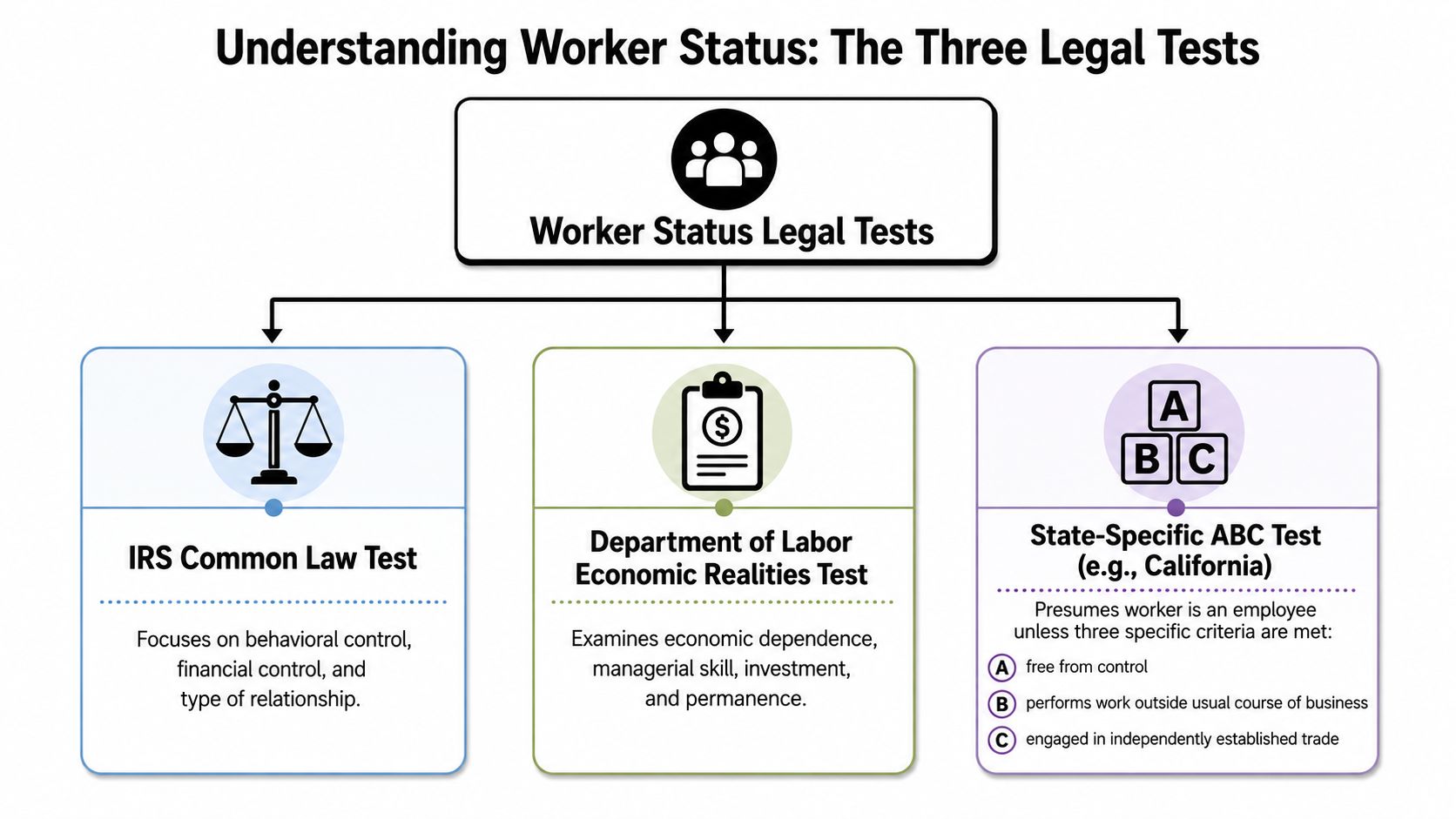
The independent contractor vs employee issue doesn't have one universal rule. Different agencies and states use different frameworks. That's why business owners get tripped up when an arrangement looks fine under one lens and risky under another.
A useful starting point is this: the law usually asks whether the worker is running an independent business or functioning as part of yours.
A policy analysis citing U.S. Department of Labor audit findings estimated that about 10% to 30% of audited employers misclassified at least one worker, which is one reason the law looks at the entire relationship, not just title or contract label (policy research discussing the Department of Labor analysis).
For businesses that rely heavily on freelancers, it also helps to keep up with practical IRS rules for freelancers, because classification facts often overlap with recordkeeping and reporting mistakes.
IRS common law analysis
The IRS generally groups the analysis into behavioral control, financial control, and the relationship of the parties.
Behavioral control asks who decides how the work gets done. If you train the worker, require internal procedures, set detailed methods, or supervise the process closely, that points toward employee status.
Financial control asks whether the worker has a real business of their own. A contractor usually has room for profit or loss, bears unreimbursed business expenses, invests in tools or systems, and can market services to others. A worker who depends mainly on one company and gets paid in a staff-like pattern looks less independent.
The relationship category looks at how the arrangement fits into the business. Long-term, indefinite relationships, employee-type benefits, and work that looks embedded in the company all increase risk.
Department of Labor economic realities analysis
For wage-and-hour issues, the Department of Labor focuses more directly on economic dependence. The central question is not only who sets the schedule. It's whether the worker is in business for themselves or economically dependent on the company.
That analysis weighs factors such as:
- Profit or loss opportunity tied to managerial skill
- Investment by the worker in their own business
- Permanence of the relationship
- Control over the work
- Whether the work is integral to the business
- Skill and initiative in an independent sense
Many online summaries get this wrong. Flexibility alone doesn't create contractor status. A person can choose when to work and still be economically dependent on one business.
A flexible schedule doesn't automatically mean independent contractor status. Legal independence and practical flexibility aren't the same thing.
The ABC test in stricter states
Some states use an ABC test for certain purposes, and that can be much harder on the business. The usual structure is simple but demanding. The worker is presumed to be an employee unless the business can satisfy each required element.
In plain English, the business typically has to show the worker is free from control, performs work outside the usual course of the company's business, and is engaged in an independently established trade or business.
That middle point creates trouble. If you run a marketing agency and classify a marketer as a contractor, or run a delivery business and classify drivers as contractors, you're already in dangerous territory under many ABC-style frameworks.
Comparing the Financial and Tax Implications
For day-to-day operations, the biggest difference between an employee and an independent contractor is who carries the tax and compliance burden.
A worker treated as an employee has withholding handled through payroll. A worker treated as a contractor is paid gross and must manage tax payments personally. That isn't just an administrative detail. It affects cash flow, reporting, and audit exposure.
The core tax distinction is straightforward: employees have income tax and their share of FICA withheld by the employer, while independent contractors are responsible for their own income tax and the full 15.3% self-employment tax through estimated payments (SurePayroll overview of employee and contractor tax treatment).
Employee and contractor comparison
| Factor | Employee (W-2) | Independent Contractor (1099) |
|---|---|---|
| Tax withholding | Employer withholds federal and state income tax, plus employee-side payroll tax | Worker generally receives gross pay without withholding |
| Payroll tax burden | Employer handles payroll administration and employer-side FICA obligations | Worker generally handles estimated taxes and self-employment tax |
| Payment process | Payroll system, wage reporting, regular payroll compliance | Accounts payable or contractor payment workflow, plus information reporting |
| Benefits expectations | More likely to raise benefit, leave, and policy issues | Usually governed by contract, not employee benefit structure |
| Work structure | More likely integrated into company operations | Should operate with meaningful independence |
| Audit posture | Payroll records usually support treatment if setup is correct | Contractor file must support true independent business status |
The practical cost difference
From the company's perspective, contractor treatment feels lighter because you avoid payroll mechanics. From the worker's perspective, contractor treatment often means a harder tax year.
That mismatch causes friction. A worker who thought "1099" just meant flexibility may be surprised by estimated tax obligations and self-employment tax. If the relationship later gets challenged, both sides may start blaming each other for the tax result.
Insurance is part of the practical comparison too. A true contractor should usually carry their own business coverage, especially in fields with client property, professional advice, or injury risk. If you're evaluating what a genuine independent business arrangement should look like, this overview of essential insurance for 1099 professionals is a useful supplement to the tax analysis.
For solo operators and LLC owners, the broader tax picture matters beyond classification alone. This self-employed tax guide is helpful if the worker on one side of the relationship is trying to understand how contractor treatment affects filings, deductions, and payment timing.
Employer Liability and Penalties for Misclassification
Misclassification cases rarely stay narrow. Once an agency decides a worker should have been treated as an employee, the issue tends to spread across payroll tax, withholding, unemployment, wage-and-hour compliance, and internal records.
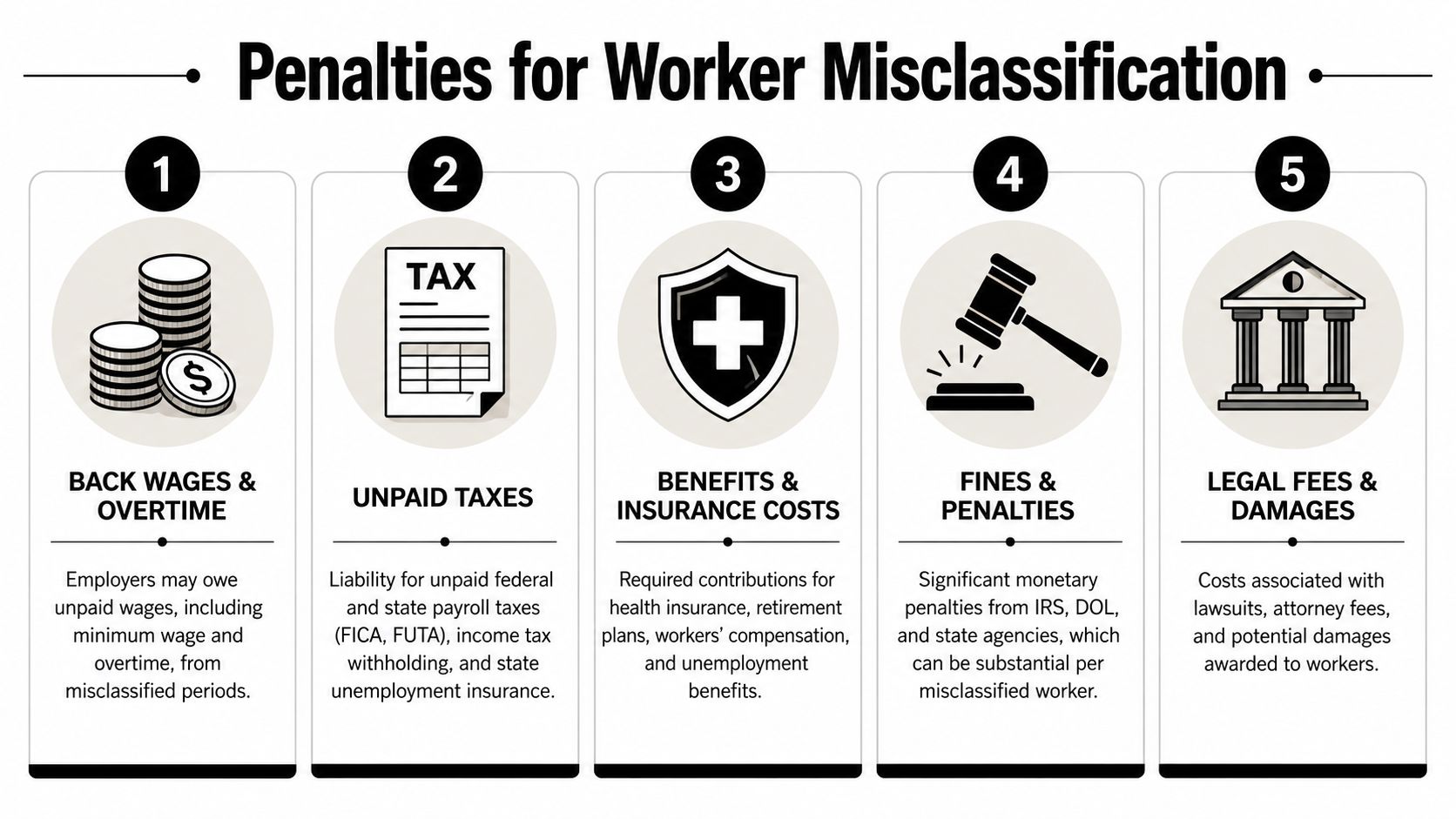
The business may need to deal with unpaid withholding obligations, payroll tax issues, and employment-law claims arising from the same set of facts. The classification decision you made in onboarding can turn into a multi-agency problem later.
Tax exposure is only the first layer
A business that loses the classification argument can face liability for payroll taxes that should have been handled through wages. It may also have to deal with interest and penalties attached to those amounts.
Then there is process risk. Once records are examined, agencies often ask for contracts, invoices, payment history, communications about supervision, schedule requirements, and proof of how the relationship operated in practice. If your documents conflict with daily reality, the paper file won't carry much weight.
If payroll taxes are involved and a business has deeper employment-tax problems, owners should also understand how personal exposure can arise in serious cases. This overview of the Trust Fund Recovery Penalty is worth reading because classification disputes sometimes uncover broader payroll failures.
Labor and benefits issues can hit next
Tax agencies aren't the only concern. A worker who should have been an employee may claim overtime, minimum wage protection, unemployment-related rights, or benefits-related losses depending on the facts and the governing law.
The hidden danger is accumulation. A business owner may think, "We only used a few contractors." But if those workers handled core functions for a sustained period, the factual pattern can support more than one kind of claim.
If your contractor file would read like an employee personnel file to an outside reviewer, assume the business has a defense problem.
What makes these cases expensive
Misclassification matters because cleanup is labor-intensive even before liability is calculated.
You may need to:
- Reconstruct records from invoices, bank data, and communications
- Correct information reporting and payroll treatment going forward
- Respond to multiple agencies asking overlapping but different questions
- Handle worker communications carefully to avoid admissions that make the file worse
The legal bill often rises because the business waited too long, not because the issue was impossible to manage earlier.
Navigating State Rules and Common Red Flags
Federal analysis is only part of the story. State rules can be stricter, and they often apply in ways business owners don't expect.

A company can feel comfortable under its federal understanding and still have a state-law problem, especially where ABC-style rules apply or where unemployment agencies take a narrow view of contractor status.
For readers who operate internationally or compare staffing models across jurisdictions, this essential guide for UK SME owners offers a useful reminder that casual worker arrangements create classification issues outside the U.S. as well, even though the legal tests differ.
Red flags that attract scrutiny
Some facts show up again and again in weak contractor files:
- Core business work. The worker performs the same service your company sells to customers.
- Company tools and systems. You provide the equipment, software stack, email address, or workspace.
- Set hours. The worker follows a schedule that looks like staff scheduling.
- Long-term exclusivity. The worker stays tied to your business instead of maintaining an outside client base.
- Manager approval. Time off, pricing, workflows, or day-to-day decisions require internal signoff.
- No separate business footprint. The worker has little evidence of operating an independent enterprise.
One red flag won't always decide the issue. Several together usually tell a clearer story.
A better self-audit question
Don't ask whether your contract says "independent contractor." Ask whether the worker would look independent to someone who never met either of you.
That means reviewing:
| File item | What you want to see |
|---|---|
| Agreement | Clear project scope and business-to-business terms |
| Invoices | Regular invoicing from the worker, not payroll-style processing |
| Communication | Direction focused on deliverables, not minute-by-minute supervision |
| Public footprint | Evidence the worker offers services beyond your company |
If your review turns up weak facts, don't try to fix the past by rewriting old agreements. Build a remediation plan based on what happened.
A Practical Guide to Compliance and Remediation
A contractor file rarely falls apart all at once. It usually starts with one worker who was brought in for a project, then stayed, took on regular duties, got folded into company systems, and kept being paid on a 1099. By the time anyone asks whether the classification still works, the problem often spans multiple tax years.
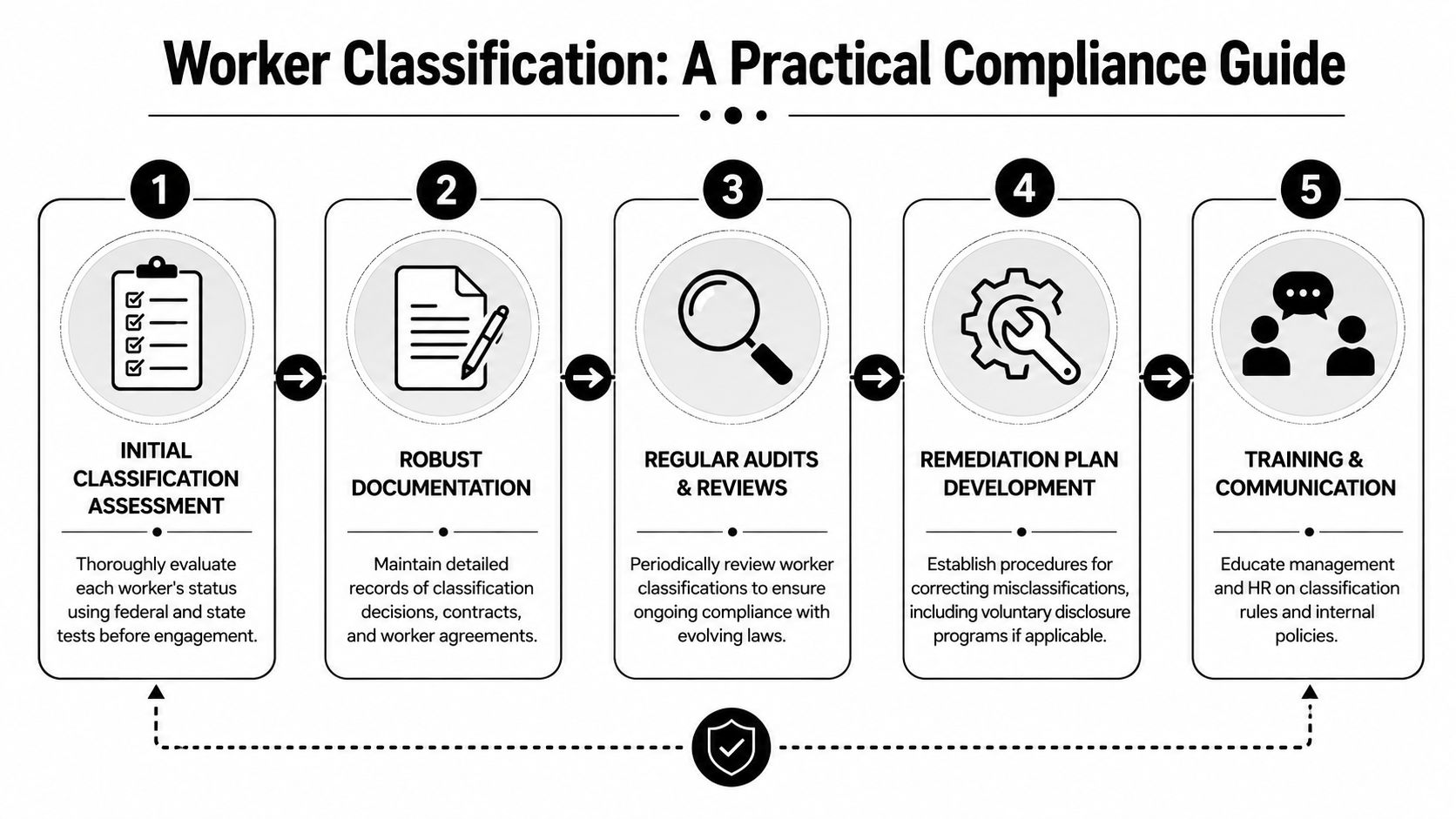
At that point, the job is to reduce exposure and build a file you can defend. That means identifying which relationships are still supportable, which ones need to change, and whether a voluntary correction path makes business sense. It also means resisting the common impulse to "clean up" old facts with new paperwork. Agencies look at what actually happened.
Start with a year-by-year file review
Pull the agreements, invoices, payment records, onboarding materials, email instructions, system-access logs, and any policies the worker was expected to follow.
Then sort each worker into three buckets:
- Defensible as currently structured
- Needs prospective reclassification
- Unclear and needs legal review
Review by year, not just by worker. A relationship that began as legitimate project work can shift into employee status over time. If the facts changed in year two or year three, your remediation plan should reflect that timeline instead of treating the entire relationship as one uninterrupted category.
A good internal review also answers a practical audit question: what documents can you produce quickly, and what gaps will hurt you if an agency asks for the file next month?
Build the correction plan before anyone starts talking
Once the review shows weakness, decide how the company will fix it before managers make off-the-cuff statements to workers, payroll staff, or outside accountants. Casual explanations create inconsistent records. In a dispute, those inconsistencies get used against you.
A workable remediation plan usually includes:
- Prospective reclassification for workers whose current facts no longer support contractor treatment
- Document preservation so relevant emails, contracts, and payment history are retained
- A controlled communication plan for HR, finance, and the managers involved
- Privilege-based legal review if prior-year exposure could be material
- State-law review if wage, unemployment, or workers' compensation exposure may be larger than the federal tax issue
Many businesses often lose control of the situation by fixing payroll going forward but leaving the past undocumented, leaving managers unsupervised in their explanations, and failing to evaluate whether one bad classification decision affects a broader group.
Use Form SS-8 carefully
Some businesses consider Form SS-8 to get an IRS determination on worker status. That can be appropriate in a narrow set of cases. It can also create problems if the actual need is a broader remediation strategy.
An SS-8 filing is not just an academic request for guidance. It puts the classification question in front of the IRS in a formal way. Before using that process, determine what answer is likely, what years and workers could be affected, and whether another correction path gives you more control.
Where the VCSP may fit
The IRS Voluntary Classification Settlement Program, or VCSP, can be useful for businesses that want to reclassify workers prospectively under an IRS framework. It is often overlooked until the company is already worried about an audit.
VCSP is not automatically the right answer. Eligibility matters. Timing matters. State exposure matters. The larger question is whether the program fits your facts and your risk profile.
For the right business, VCSP can limit federal employment tax exposure while allowing an orderly shift to payroll treatment. For the wrong business, it may solve only part of the problem. It does not eliminate the need to assess wage-and-hour claims, state agency exposure, or whether the contractor model failed in ways that reach beyond federal tax reporting.
Build an audit-defense file now
If there is any chance this issue will be reviewed later, prepare the defense file while the facts are still easy to collect.
Useful materials include:
- Classification analyses prepared close in time to the working relationship
- Contracts that match real operations, not aspirational terms copied from templates
- Invoices, business records, and public-facing evidence showing the worker operated an independent business
- Records of periodic review showing the company revisited status when duties changed
- A written remediation timeline showing when the company identified the issue and what it did next
The strongest file usually looks ordinary. It shows a business that examined the relationship, made decisions on actual facts, corrected weak arrangements, and preserved records before an agency forced the issue.
If legal help is needed, Attorney Stephen A Weisberg handles IRS controversy and business tax matters, including worker-classification problems where earlier reporting decisions have created current audit exposure.
When to Stop Guessing and Consult a Tax Attorney
Some classification issues are manageable internally. Others aren't.
You should stop treating this as a DIY project when the relationship involves long-term workers doing core business functions, when a state-law standard looks stricter than your federal analysis, or when you already suspect prior-year reporting doesn't match reality.
Legal advice becomes especially important when:
- An agency has already contacted you about worker status, payroll, or wage issues
- You're considering a large-scale reclassification that affects multiple workers or years
- You received or are considering an SS-8-related determination path
- Your contractor model is central to the business, not incidental
- Internal records are messy, inconsistent, or incomplete
The reason is simple. By that point, you're not asking a theoretical classification question. You're making judgment calls about admissions, scope, timing, and remediation.
A good tax attorney won't just tell you the rule. They should help you decide what to fix first, what to document, when to speak, when to stay quiet, and whether a voluntary path like VCSP helps or hurts your position.
If your business relies on contractors and you're concerned the facts may no longer support that treatment, Attorney Stephen A. Weisberg can help assess the exposure, review remediation options, and develop an audit-defense strategy before the issue turns into a payroll tax or wage claim problem. Learn more at Attorney Stephen A Weisberg.


