Independent Contractor Misclassification Penalties Explained
Independent contractor misclassification penalties include back taxes, FLSA damages and state fines. See the exposure, audit triggers and how to correct it.
In this article
- Federal and State Penalties at a Glance
- What to assemble before you estimate anything
- How Penalties Stack in a Real Enforcement Case
- What the dollar total leaves out
- Audit Triggers and Red Flags to Watch
- How Each Agency and State Tests Worker Status
- Relief Programs That Reduce Exposure
- What the settlement program actually settles
- How to Correct a Misclassification Step by Step
- Where the sequence goes wrong
- Next Steps for Contractors and When to Get Help
$1,195,349. That's the combined sum in a federal consent judgment the U.S. Department of Labor announced in April 2024 against a Virginia concrete contractor: back wages, an equal amount in liquidated damages and a civil penalty for willful violations, spread across 81 affected workers. Per worker, it comes to about $14,800. Nothing about the underlying conduct was exotic. The company had treated employees as independent contractors and hadn't paid the overtime they were owed.
That case is why independent contractor misclassification penalties need a structural explanation rather than a list. One worker triggers assessments from three systems that count in different units, on different clocks, with different appeal routes. Tax runs per pay period. Wages run per hour. State penalties run per violation. Any estimate built from a single agency's numbers understates the bill.
Federal and State Penalties at a Glance
Three systems react to the same set of facts. The Internal Revenue Code asks whether the relationship was employment and, if it was, taxes each reclassified pay period as wages with withholding attached. The Fair Labor Standards Act asks whether the worker was economically dependent on the business and, if so, prices the unpaid hours. State law adds its own penalties, its own wage remedies and its own coverage obligations, and it doesn't wait for the federal answer.
The Department of Labor's guidance for small entities is direct about how those layers combine: an employer may owe unpaid wages under the FLSA, an equal amount in liquidated damages, civil money penalties and attorneys' fees, while state agencies may separately assess unemployment contributions, workers' compensation costs and wage penalties. Each line has a different trigger, which is why a business can negotiate one down while another grows.
| Exposure | Agency | What It Covers | Reference Figure |
|---|---|---|---|
| Employment taxes (withholding, FICA, FUTA) | IRS | Taxes due on reclassified pay in each period | Per-period liability plus interest |
| Interest and penalties | IRS | Accrues on underreported amounts | Runs from each quarter's due date until paid |
| Back wages for minimum wage and overtime | DOL (FLSA) | Unpaid wages owed to each worker | $563,938 in Village Concrete case |
| Liquidated damages | DOL (FLSA) | Additional amount equal to back wages | Equal to back wages |
| Civil money penalties | DOL (FLSA) | Willful violations | $67,473 in Village Concrete case |
| Willful misclassification penalty | California Labor Code 226.8 | Civil penalty per violation | $5,000 to $15,000; $10,000 to $25,000 for a pattern or practice |
| Unemployment insurance penalty | California EDD | Penalty on UI deficiency | 15% of the deficiency |
| State wage, overtime and workers' comp remedies | State agencies | Additional employee-rights remedies | Assessed separately from the federal claim |
What to assemble before you estimate anything
Four inputs decide whether you're looking at a five-figure correction or a seven-figure one. Gather them before anyone quotes you a number.
- Worker count by classification date. A worker misclassified for two years and a worker misclassified for six produce very different exposure on identical facts.
- Pay periods and quarterly totals. Tax liability accrues quarter by quarter, and each quarter carries its own due date for interest purposes.
- Hours over 40 per workweek. The wage claim is built from overtime hours, not from total pay.
- State footprint. Where the worker performed the work determines which state test, which unemployment account and which penalty schedule apply.
How Penalties Stack in a Real Enforcement Case
The Village Concrete judgment is the cleanest worked example available because the Department of Labor published each component separately. Two counts sit inside it, and they aren't interchangeable. The finding named 29 employees misclassified as independent contractors who had not received legally required overtime. The back wages and liquidated damages, however, covered 81 affected employees, because the remedy reached every worker whose pay fell short, not only the group named in the finding. Keep that distinction intact when you model your own case: the misclassified group drives the finding, the affected group drives the money.
The dollars arrived in three layers. Back wages of $563,938 went to the 81 affected employees. Liquidated damages added an equal $563,938, which the FLSA attaches automatically once wages are found owing, so it isn't a separate finding of bad faith. Civil money penalties of $67,473 followed for willful violations. Stack them and the judgment totals $1,195,349, or roughly $14,800 per affected worker.
Model it in this order: workers, then overtime hours per worker per week, then pay periods. The product of those three is the wage base, and every other figure in the case scales off it, including the doubling.
The stacking matters more than any individual line. Back wages alone describe half the wage exposure, because liquidated damages mirror them. The civil penalty then sits on top of both, and it's the only component that responds to how the employer behaved rather than to how many hours went unpaid.
What the dollar total leaves out
The judgment also barred the company from future FLSA violations. That injunction costs nothing on the balance sheet and constrains every staffing decision afterward, including how quickly the business can scale crews. Payroll taxes on the same reclassified wages were never part of that number, because the FLSA claim and the tax claim run through different agencies on different timelines. The mechanics of how FICA obligations are calculated and settled across payroll quarters follow the payroll calendar, not the litigation calendar, which is why a wage settlement rarely closes the file.
The investigation also ran alongside a change in the federal standard: effective March 11, 2024, the Department of Labor's final rule revised how the agency determines whether a worker is an employee or an independent contractor under the FLSA. Employers who sized their risk under the earlier framework were measuring against a test that no longer applied.
Three questions decide your own number. How many workers were paid on a 1099 in the open periods? How many hours over 40 did each one work in a typical week? Across how many pay periods did that pattern hold? Answer those, and the rest is arithmetic.
Audit Triggers and Red Flags to Watch
Most examinations start with a relationship that looks like employment on paper or in practice, and the signals are visible from inside the business long before an agency writes. The image below captures the document review that usually begins the process.

- A full-year 1099 with a fixed schedule. A contractor who works set hours under a supervisor reads as an employee to every agency that looks.
- A contractor with one client. Economic dependence is the whole question under the FLSA test, and a single revenue source answers it.
- A claim for unemployment or a status determination. One former worker filing is often what converts an internal question into an agency file.
- Records that don't reconcile. Payroll totals, 1099 filings and the payment ledger telling three different stories is the fastest route to a full-period review.
- Contractors performing the core work. The more central the function, the harder the classification is to defend, especially in states using an ABC test.
- A uniform workforce. Twenty people in the same role on the same contract terms looks like a policy, and policies get tested.
The scale of that exposure isn't theoretical. An IRS strategic initiative examining 3,331 employers for tax year 1984 found that nearly 15% had misclassified employees as independent contractors, and later employment-tax audits covering 11,380 examinations from fiscal 1988 through 1994 produced proposed assessments totaling $751 million and the reclassification of 483,000 workers, according to the IRS's review of the misclassification problem.
Section 530 is the federal safe harbor, and it requires three things at once: a reasonable basis for contractor treatment, substantive consistency in how similar workers were treated, and consistent Forms 1099. Miss any one and an examination can produce employment-tax assessments, penalties and interest.
Section 530 is a tax defense. It has never been a wage-and-hour defense.
What you keep before an audit decides how it ends: the written contract, business licenses and insurance in the worker's name, evidence the worker controlled methods rather than receiving direction, expenses the worker bore, a list of other clients, and a classification policy applied the same way across the workforce. Several of these overlap with the general triggers that draw an IRS examination, which is why a routine inquiry into one worker so often becomes an assessment covering all of them.
How Each Agency and State Tests Worker Status
A single worker can receive different classifications under tax, wage-and-hour, and state law. Each agency applies its own test, so a result under one system does not settle the others.
| Agency or State | Test Applied | Central Question | Penalty Area |
|---|---|---|---|
| IRS (federal employment tax) | Common-law control test | Who controls how, when and where the work is done? | Employment taxes, interest, penalties |
| DOL (FLSA) | Economic reality test | Is the worker economically dependent on the business? | Back wages, liquidated damages, civil penalties |
| California (Labor Code 2775) | ABC test | Is the worker free from control, outside the usual business and independently established? | Labor Code 226.8 penalties, wages, UI |
| Other states | State statute, often an ABC or multi-factor test | Does the state's own test reach the same result as the federal analysis? | State wages, UI contributions, workers' comp coverage |
California shows how state penalties can add to federal exposure. Under Labor Code section 226.8, willful misclassification means voluntarily and knowingly treating an employee as an independent contractor. Continuing that treatment after legal advice, an agency letter or an operational signal points to employee status can increase the risk of a penalty. Separately, California's unemployment insurance code provides for a penalty equal to 15% of an unemployment-insurance deficiency when the employer's conduct reflects negligent or intentional disregard of reporting requirements. These state amounts can sit alongside wage claims and federal payroll-tax assessments.
Federal enforcement guidance has also shifted. After the 2024 rule, the Department of Labor directed investigators on May 1, 2025, not to apply it in matters where no back-wage or civil-penalty payment had yet been made, returning them to Fact Sheet #13 and a 2019 opinion letter, as described on the agency's misclassification enforcement page. Meanwhile, state wage, unemployment and workers' compensation agencies apply their own tests. Several states have recently proposed or passed misclassification laws, adding to the risk that one worker's status will produce different outcomes across jurisdictions.
A contractor agreement is evidence of intent. It does not, by itself, establish worker status.
Relief Programs That Reduce Exposure
Relief can reduce some costs without resolving every liability. The distinction is whether an option changes worker treatment going forward, addresses past federal employment taxes, or seeks to reduce penalties. Those outcomes are separate, and the available route depends on the employer's circumstances and records.
| Option | Best For | What It Reduces | Key Condition |
|---|---|---|---|
| Voluntary Classification Settlement Program | Employers treating workers as employees going forward | Partial federal employment-tax liability | Consistent 1099 filing and no employment-tax audit in progress |
| Section 530 relief | Employers with a reasonable basis for contractor status | Federal employment-tax liability for those workers | Reasonable basis and consistent treatment |
| Reasonable-cause penalty abatement | Employers with a documented reason for noncompliance | IRS penalties | Reasonable cause, such as illness or incorrect professional advice |
| Prospective reclassification | Employers seeing rising exposure | New liability from future pay periods | Reclassification before an audit begins |
| Form SS-8 status request | Workers or businesses seeking a federal status determination | Clarifies status, not past liability | Filed with the IRS by the worker or the business |
What the settlement program actually settles
The Voluntary Classification Settlement Program permits prospective employee treatment and provides partial federal employment-tax relief. As IRS guidance on classifying workers explains, it does not release an employer from every historical liability. Section 530 relief can also affect the outcome: if it is unavailable, an examination may result in employment-tax assessments, penalties and interest.
Eligibility depends on meeting the program's conditions. Consistent prior 1099 treatment and no employment-tax audit in progress are threshold requirements. A later explanation cannot substitute for records showing how the business treated workers and why.
Reasonable-cause abatement addresses penalties, not worker status or the underlying tax. IRS penalty abatement for reasonable cause may reduce or eliminate penalties when illness or incorrect professional advice led to noncompliance. Supporting records matter: the case is stronger when documentation shows the reason for the failure and the steps taken in response.
For a business with no open examination, prospective reclassification can limit new exposure, while the settlement program may address some federal employment-tax liability. A business already under examination should first calculate the amount by worker and quarter, then assess which forms of relief may apply.
How to Correct a Misclassification Step by Step
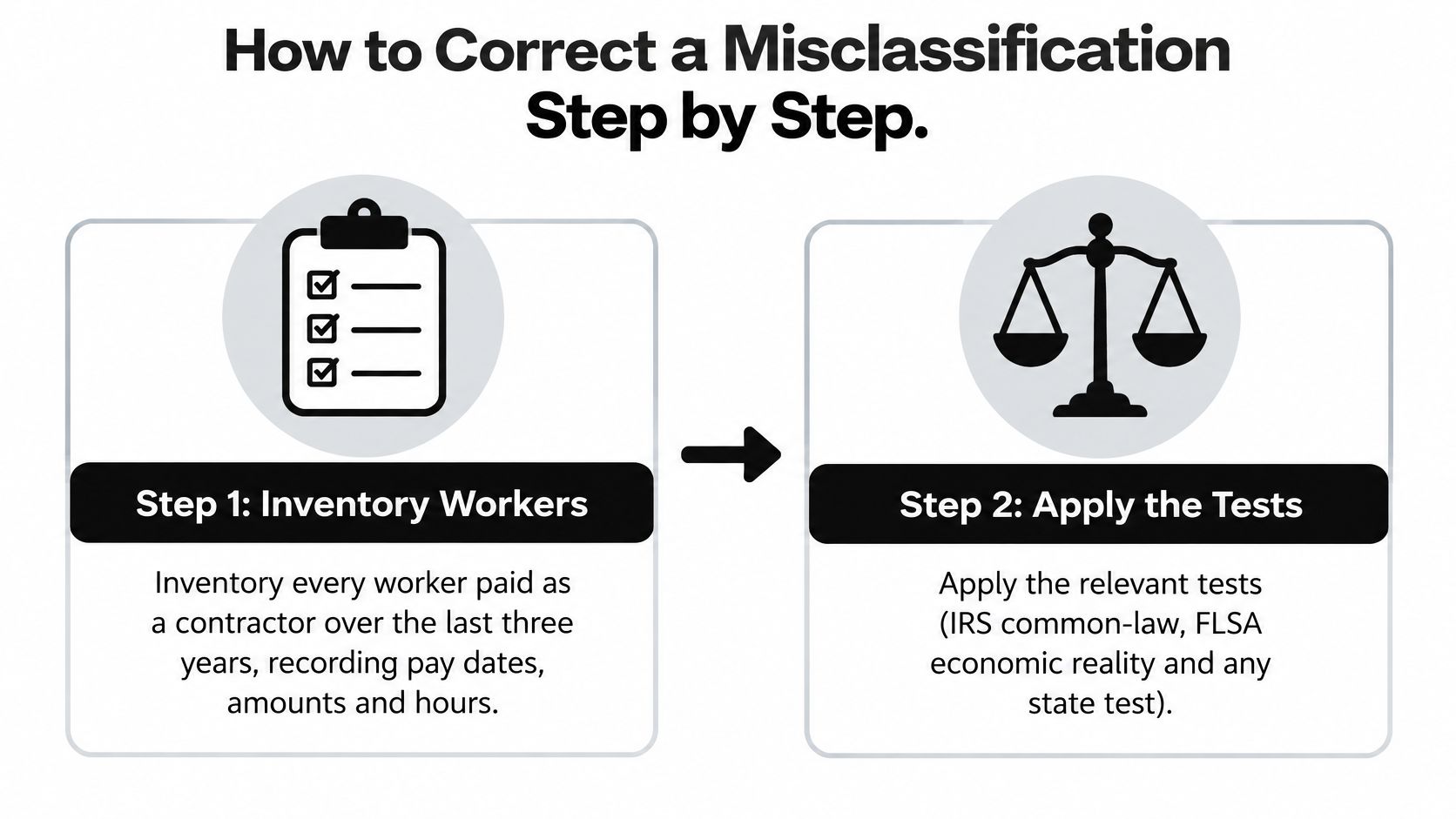
Inventory every contractor payment across all open periods. Three years is a common starting window for wage claims, and tax periods can run longer. Record pay dates, amounts and hours, because the same worker can be time-barred on one claim and fully live on another.
Apply each test separately to each worker. The IRS control test, the FLSA economic reality test and the state test answer different questions. Running one and calling it done is the mistake that produces the worst estimates.
Steps one and two carry most of the diagnostic weight, so they're worth mapping before any numbers are calculated.
Reconcile contractor payments against payroll, 1099 filings and unemployment records. Discrepancies are what an examiner finds first, and an unreconciled 1099 total becomes the opening question of the interview.
Quantify by worker, by quarter and by tax type. Put employment taxes, back wages, liquidated damages and state penalties in separate columns. A single blended number hides which portion is negotiable and which isn't.
Assemble the status evidence and read it against yourself. Contracts, licenses, insurance certificates, client lists and expense records. Then mark the facts that cut toward employee status, especially control over methods and scheduling, so you see them before anyone else does.
Choose the path and write down why. Prospective reclassification, a relief program, or both. Date the memo, because intent gets assessed much later by someone reading your file with no memory of the reasoning.
Convert to payroll from the first affected pay period. Set up withholding, confirm overtime and recordkeeping compliance, and adopt a written classification policy with an annual review so the same question doesn't reopen next year.
Where the sequence goes wrong
Two errors account for most of the damage. The first is reviewing a single year when several periods remain open, which understates exposure and invites a second assessment later. The second is treating the fix as a paperwork correction. Correcting a Form 1099 doesn't automatically cure wage-and-hour violations, and reissuing forms without changing the working relationship leaves the same facts in place for the next examiner.
Next Steps for Contractors and When to Get Help
Contractors who believe they were misclassified should gather their 1099s, invoices, work schedules, messages showing who directed the work, and any record of required hours, tools or equipment. Compare that file against the IRS common-law test and the test used in their state. Where status remains unresolved, Form SS-8 requests an IRS determination, and Form 8919 is the route to reporting the uncollected employee share of Social Security and Medicare tax on wages.
Employers should quantify before they act, because sequencing determines which relief survives. Calculate the per-worker, per-quarter and per-tax-type amounts first, then choose between prospective reclassification, a relief program, or both.
Professional help becomes necessary when liability spans several agencies, when a Department of Labor or IRS examination is already open, when the total approaches the scale of the judgment above, or when an IRS revenue officer has been assigned. Hiring a tax attorney is advisable when tax debt exceeds $5,000, when a criminal investigation is underway, or when large liability exposure puts assets at risk. An attorney can model the exposure and decide the order of operations, which is also what representation in an IRS audit is built around.
This week, pull the full worker list and the pay records for every open period. Nothing else can be decided until that inventory exists.
Tax Attorney Stephen A Weisberg works with business owners, independent contractors and the tax professionals who advise them on exactly this problem: measuring exposure across agencies before choosing how to correct a classification. The practice obtains IRS and state transcripts to reconstruct every penalty, every payment and how long each period stays open, then sequences the options so the relief you still qualify for stays available. If the per-worker math above looks like your own payroll, start with a Tax Debt Analysis at Tax Attorney Stephen A Weisberg and get the number before you file anything.


