Independent Contractor Income Tax: What You Owe in 2026
Independent contractor income tax explained: self-employment tax, 1099-NEC, Schedule C, quarterly estimates, deductions and audit triggers for 2026.

In this article
- What You Owe Each Year as an Independent Contractor
- Separate the tax layers
- Start with profit, not deposits
- How the IRS Decides Whether a Worker Is a Contractor
- Compare the working arrangements
- Don't solve classification by guessing
- The Forms That Report Contractor Income and Expenses
- Follow the paperwork through the return
- Reconcile discrepancies before filing
- Deductible Expenses and the Records That Prove Them
- Match each deduction to its evidence
- Build records you can actually retrieve
- How to Calculate Your Federal Tax Bill Step by Step
- Build the calculation in order
- Turn the result into a cash requirement
- Estimated Tax Deadlines and the Safe Harbor Rules
- Put the payment calendar in your cash forecast
- Choose a payment target deliberately
- Reserving Money When Your Income Swings from Month to Month
- Calculate the gap before choosing a transfer
- Match the approach to the income pattern
- Replace the missing withholding habit
- Audit Triggers and When to Call a Tax Attorney
- Read the notice before deciding what help you need
- Prepare for a useful consultation
The client payments have arrived, your business account looks healthy, and you're deciding how much you can transfer to your personal account. Then your tax preparer asks what you've paid toward taxes. You've covered software, equipment, and rent, but nothing has gone to the IRS.
That's the cash-flow trap behind independent contractor income tax. The money in your account includes money you can spend, money needed to run the business, and money you'll eventually owe in federal and state taxes. A workable system separates those amounts before you treat the balance as take-home pay.
What You Owe Each Year as an Independent Contractor
Say a freelance designer finishes a busy year with steady client payments and no tax withheld. The designer has mistaken deposits for disposable income and reaches filing season without enough cash to pay the bill. The problem isn't necessarily poor earnings. It's that nobody separated taxes from those earnings along the way.
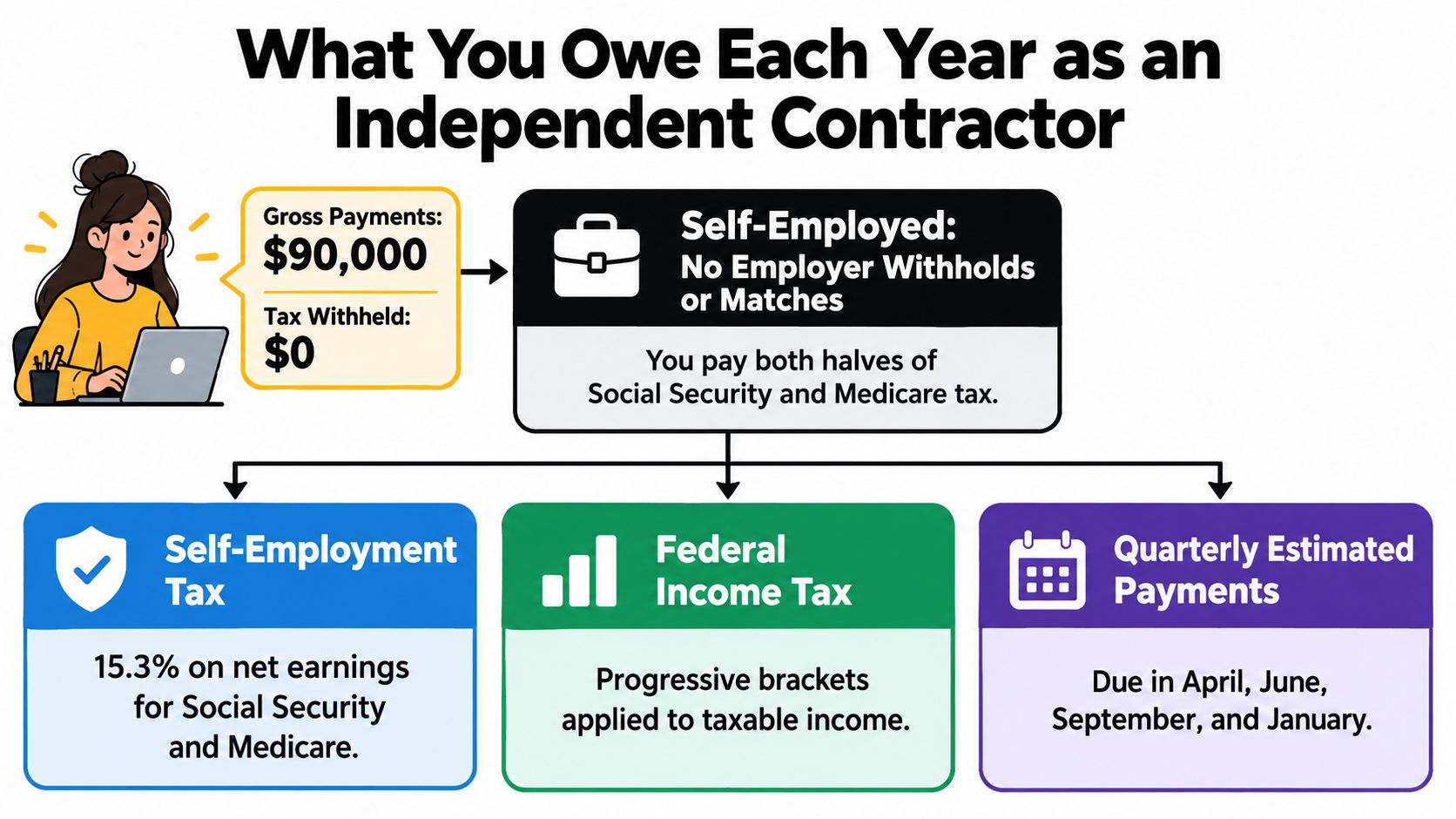
An employee receives a paycheck after the employer has withheld taxes, and the employer separately pays its share of payroll taxes. A contractor generally receives the full payment and must handle both the income-tax obligation and the Social Security and Medicare obligations.
For federal purposes, contractors generally operate as self-employed taxpayers. The IRS guidance on independent contractors says most self-employed individuals owe self-employment tax when net earnings reach $400 or more, so even modest business earnings can create a filing obligation.
Separate the tax layers
Income tax and self-employment tax are different calculations. Federal income tax considers your taxable income, filing status, deductions, and credits. Self-employment tax primarily funds Social Security and Medicare and generally includes the portions an employee and employer would otherwise share.
The federal and state tax layers a contractor pays
| Tax layer | Based on | Rate | Where it is reported |
|---|---|---|---|
| Federal income tax | Business profit combined with other income, after applicable deductions | Progressive brackets determined by filing status and taxable income | Schedule C with Form 1040 |
| Self-employment tax | Adjusted net earnings from self-employment | Social Security and Medicare rates, with applicable limits and coordination rules | Schedule SE with Form 1040 |
| Additional Medicare Tax | Covered earnings above the threshold for your filing status | Additional Medicare rate when the filing-status threshold is exceeded | Form 8959 with Form 1040 |
| State income tax | State taxable income | Your state's brackets or flat-rate rules; some states impose no individual income tax | State return and state estimated payments |
State taxes need their own reserve. Don't assume the federal calculation also covers your state, or that your state treats every deduction the same way.
Start with profit, not deposits
Your business account balance isn't your taxable profit. Deposits may include transfers or borrowed money, while unpaid bills and upcoming equipment purchases affect what you can safely withdraw.
Planning rule: Build the tax calculation from business income minus documented deductible expenses, then account for household income, deductions, credits, and state obligations.
That starting point prevents a low-margin contractor from reserving taxes on money already committed to business costs. It also stops a high-margin contractor from treating nearly every deposit as spendable.
How the IRS Decides Whether a Worker Is a Contractor
Before calculating contractor taxes, confirm that you're really a contractor. A contract describing you as independent, an LLC registration, or a client's decision to issue an information return doesn't settle worker classification.
The IRS examines the working relationship, including the business's right to direct and control the work. Organize your review around these categories:
- Behavioral control: Who decides how the work gets done? Instructions about methods, mandatory training, supervision, and detailed procedures can indicate employment.
- Financial control: Who provides tools, pays unreimbursed expenses, negotiates compensation, and bears the risk of losing money? An independently operated business usually has meaningful financial decisions to make.
- Relationship: Consider benefits, permanence, written agreements, and whether the services are a central part of the hiring business's operations.
Compare the working arrangements
A driver who chooses assignments, operates through several platforms, and makes independent business decisions has facts supporting contractor status. A driver who follows detailed dispatch instructions, receives ongoing supervision, and must comply with company operating procedures has facts pointing toward employment.
Neither choosing routes nor wearing company branding decides the result alone. Platform work also isn't automatically independent contracting for every legal purpose.
The same distinction applies to consultants. A consultant who negotiates project scope, serves unrelated clients, and controls delivery methods looks different from a staff member working indefinitely under a manager's daily direction. Company email and a fixed schedule can support an employment finding, but the whole relationship matters.
Don't solve classification by guessing
Misclassification can expose the hiring business to employment-tax assessments and other obligations. Workers may also need to correct how they reported compensation or resolve a dispute over who should have handled payroll taxes.
If the facts are unclear, Form SS-8 provides a route to request an IRS determination of worker status for federal employment-tax purposes. State agencies may apply different standards, so a federal answer doesn't necessarily resolve a state dispute.
Use this checklist to identify questions worth taking to a professional:
- Work methods: Can you choose how to deliver the result, or must you follow the client's detailed process?
- Business independence: Can you market your services, negotiate terms, and work for other customers?
- Financial exposure: Do your management decisions affect whether an engagement produces a profit or loss?
- Ongoing relationship: Are you selling a defined service, or filling an indefinite staff position?
- Documentation: Does the written agreement match what happens in practice?
Don't tally these as a mechanical score. Some facts carry more weight than others, and a strong contract won't repair an arrangement that operates like employment.
The Forms That Report Contractor Income and Expenses
A client's reporting form is only one record of what you earned. The IRS instructions for information returns explain the general $600 Form 1099-NEC threshold that applied before 2026. The reporting threshold changes for payments made in 2026, but the linked prior-year instructions do not establish the new amount. In either case, the payer's reporting duty does not determine whether your business income is taxable.
Build your income total from your books, not just from forms that arrive. A client may not have a reporting obligation, a form may contain an error, and different payment records may refer to the same transaction. With no tax withheld from contractor payments, an incomplete or double-counted ledger can throw off the cash you reserve for your tax bill.
Follow the paperwork through the return
Forms a contractor gives, receives or files
| Form | Who sends or files it | What it reports | Where it goes |
|---|---|---|---|
| Form W-9 | You give it to a client requesting your tax information | Your name, taxpayer identification number, and tax classification | Kept by the client for information reporting |
| Form 1099-NEC | The client sends it to you and the IRS when reporting rules apply | Reportable nonemployee compensation meeting the applicable threshold | Reconciled with business income reported on Schedule C |
| Schedule C | You file it with Form 1040 | Gross receipts, deductible business expenses, and net profit or loss | Attached to Form 1040; profit generally feeds the self-employment-tax calculation |
| Schedule SE | You file it with Form 1040 when required | Covered net earnings and self-employment tax | Attached to Form 1040; the deductible employer-equivalent portion flows through Schedule 1 |
| Form 1040-ES | You use it to plan and make estimated payments | Estimated-tax worksheet and payment vouchers | Used to calculate payments; paper vouchers accompany mailed payments when applicable |
Schedule C establishes your business result. Schedule SE applies self-employment-tax rules to that result, while the deductible employer-equivalent portion becomes an income adjustment through Schedule 1. It is not another business expense to subtract on Schedule C. Deducting it in both places would understate income.
Other forms support specific deductions. Form 8829 generally handles the actual-expense home-office calculation, and Form 4562 handles depreciation and certain equipment-expensing elections. This guide to self-employed tax forms can help you identify which supporting schedules may apply to your return.
Reconcile discrepancies before filing
If an information return differs from your records, identify the reason. Check for processing fees, refunds, duplicate reporting, incorrect taxpayer information, or payments assigned to the wrong reporting period.
Ask the payer for a corrected form if the original is wrong. Keep the original form, your correction request, invoices, bank statements, and a reconciliation that explains the difference.
Do not add every information return to every bank deposit automatically. A payment processor's report and a client's report may overlap, and a bank deposit may already reflect fees. Report income based on the underlying transactions, and keep enough detail to explain your treatment if the IRS asks.
A complete income ledger should capture every payment once, without omissions or double counting. That gives you a reliable starting point for the return and for setting aside cash from irregular payments.
Deductible Expenses and the Records That Prove Them
Legitimate business expenses generally reduce the profit used in both federal tax calculations. But a deduction doesn't reimburse you for the purchase. Spending money you don't need to spend still leaves you with less cash, even when the expense is deductible.
The strongest deduction is an ordinary and necessary business cost supported by records created when the transaction happened. Mixed personal and business expenses require a defensible allocation.
Match each deduction to its evidence
Common deductible expenses and the proof to keep
| Expense | What qualifies | Proof to keep |
|---|---|---|
| Home office | Qualifying regular, exclusive business use, using an available calculation method | Floor plan, square footage, photographs, and relevant household bills |
| Vehicle | Eligible business travel under the standard-mileage or actual-expense method | Mileage log with date, destination, purpose, and miles; operating receipts when relevant |
| Self-employed health insurance | Eligible premiums, subject to coverage eligibility and income limitations | Premium statements and coverage records |
| Retirement contributions | Eligible SEP IRA or solo retirement-plan contributions within applicable limits | Plan documents, statements, and deposit records |
| Software and subscriptions | Business-use share of tools and applications | Invoices, subscription records, and payment statements |
| Business meals | Qualifying business meals, subject to applicable deduction limits | Itemized receipt, attendees, and business purpose |
| Equipment | Eligible costs expensed or depreciated under the applicable rules | Purchase invoice, placed-in-service records, and Form 4562 when required |
| Phone and internet | Documented business-use portion | Bills and a reasonable usage allocation |
Health-insurance and retirement deductions generally operate as income adjustments rather than ordinary Schedule C expenses. They follow their own eligibility rules and generally don't reduce self-employment tax the way a Schedule C business expense does.
Build records you can actually retrieve
Use a separate business bank account and card, then reconcile them with your bookkeeping each month. Attach digital receipts to transactions and add a short business-purpose note while you still remember why you paid the expense.
For a practical filing system, Fintrack explains how to organize receipts for tax filing. Whatever software you choose, make sure you can export the records and retrieve an individual receipt without searching your entire inbox.
A card statement proves payment, but it may not establish what you bought or why it was deductible. Keep the itemized receipt as well.
A deduction should come with an explanation you can give plainly, supported by a document you can find quickly.
For a home office, document the space and its use before claiming household costs. The home-office deduction requirements help distinguish a qualifying workspace from a room that also serves personal purposes.
Retain records through the applicable assessment period, and keep asset records longer when they support depreciation, basis, or a later sale. Missing returns, omitted income, and unresolved disputes can change how long records remain important.
How to Calculate Your Federal Tax Bill Step by Step
A useful calculation starts with a clean profit-and-loss statement, not a guessed percentage of deposits. You also need your filing status, other household income, available deductions, credits, and payments already made.
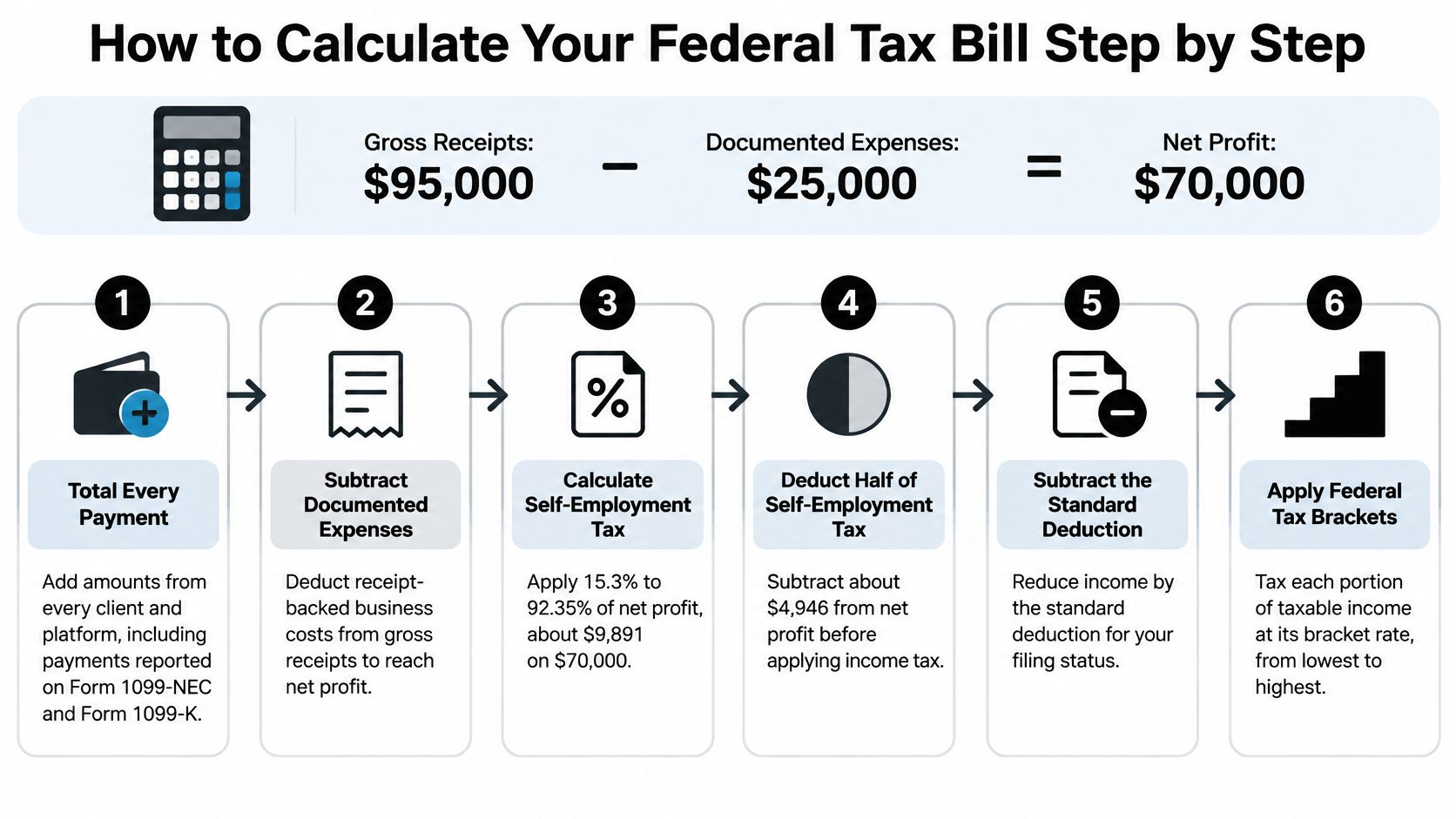
The IRS explanation of contractor taxes states that self-employment tax is generally calculated using 92.35% of net profit. That adjustment is why the self-employment-tax base isn't identical to Schedule C profit.
Build the calculation in order
Total business income. Combine your sales ledger, client payment records, platform statements, and cash receipts. Reconcile them to deposits, excluding transfers and loan proceeds while accounting for fees withheld before payout.
Subtract allowable business expenses. Use documented expenses assigned to the correct categories and tax year. The result is your Schedule C profit or loss, subject to any adjustments required by the return.
Calculate self-employment tax. Enter the business result into Schedule SE and apply its net-earnings adjustment, Social Security limitations, and Medicare rules. If you also earn employee wages, include them where requested so the calculation coordinates your earnings correctly.
Claim the deductible employer-equivalent portion. Carry the allowable adjustment from Schedule SE to the appropriate income-adjustment schedule. This reduces income for the income-tax calculation; it doesn't mean you get to subtract the same amount from the self-employment-tax bill.
Calculate taxable income. Combine business income with other taxable household income, then apply eligible adjustments and the standard or itemized deduction. Evaluate the qualified business income deduction separately because eligibility and limitations can change the result.
Apply income-tax brackets and add other taxes. Use the brackets for your filing status, then include self-employment tax and any additional taxes that apply. Your highest bracket isn't a rate applied to every dollar you earn.
Subtract credits and payments. Account for applicable credits, withholding, and estimated payments already credited to the tax year. The remaining balance is what you still need to pay, while an excess may be refundable or available for application to another year.
The illustration below shows the calculation sequence. Treat its example as a teaching aid rather than a complete return or a personalized estimate.
Turn the result into a cash requirement
Keep separate figures for projected annual tax, payments already made, and the remaining amount to fund. Otherwise, you can mistake the full annual liability for the amount still due or assume that cash sitting in savings has already been paid to the IRS.
A spreadsheet works well when it has clearly labeled inputs and you update it consistently. Tax-preparation software or a professional projection is more appropriate when you have employee wages, substantial investment income, multiple businesses, additional Medicare exposure, or complicated deductions.
Run the federal calculation alongside a state projection. A federal refund doesn't cancel a state balance, and a deduction accepted on the federal return may receive different state treatment.
The final number should answer a practical question: after covering business costs and the remaining tax requirement, how much cash can you safely withdraw? That's more useful than knowing only your marginal income-tax bracket.
Estimated Tax Deadlines and the Safe Harbor Rules
The IRS Self-Employed Individuals Tax Center says individuals generally must consider estimated payments when they expect to owe at least $1,000 after withholding and refundable credits, and lists the standard deadlines as April 15, June 15, September 15, and January 15 of the following year. Estimated payments cover income tax and self-employment tax together.
The federal system expects payment as you earn income. Saving enough by filing season doesn't necessarily protect you from an underpayment penalty if required installments were late.
Put the payment calendar in your cash forecast
Federal estimated tax due dates for 2026
| Payment | Due date |
|---|---|
| Q1 | April 15, 2026 |
| Q2 | June 15, 2026 |
| Q3 | September 15, 2026 |
| Q4 | January 15, 2027 |
These are estimated-tax payment deadlines, not evenly spaced calendar quarters. Confirm the applicable income periods and any relief affecting your circumstances before preparing an installment calculation.
Set reminders before the deadlines so you have time to reconcile income and move funds. The quarterly tax payment deadline guide provides a practical reference for planning those payments.
Choose a payment target deliberately
Federal safe-harbor rules generally offer a current-year route and a prior-year route. The current-year approach uses a required portion of your projected tax; the prior-year approach uses the applicable amount of your previous year's tax, with a higher-income rule that can increase that target.
Use the current Form 1040-ES instructions to determine the applicable requirement, including eligibility conditions and filing-status rules. Don't assume that matching last year's payment amounts automatically satisfies the rule.
- Current-year approach: Useful when you can reasonably forecast lower taxable income and want to avoid tying up unnecessary cash.
- Prior-year approach: Often easier to budget when earnings are rising or unpredictable, provided you calculate the required target correctly.
- Annualized-income approach: Worth evaluating when earnings arrive unevenly and regular installments don't reflect when you earned the money.
A safe harbor can protect against an estimated-tax penalty without paying your entire eventual tax bill. Keep reserving for the balance.
A late catch-up payment can limit further exposure, but it generally doesn't erase an earlier underpayment. The calculation considers when required amounts were paid, not just the final annual total.
Pay through IRS Direct Pay or another authorized payment channel, select the correct tax year and payment type, and save the confirmation. Check state deadlines separately rather than assuming the federal schedule controls them.
Reserving Money When Your Income Swings from Month to Month
A payment arrives after a strong month, but the next few weeks may bring little work. Set aside money as each payment comes in, because no tax is withheld automatically from contractor income. A flat percentage is easy to automate, but it is only a starting point: business expenses reduce taxable profit, and federal and state obligations depend on your circumstances. A contractor with substantial material costs should not reserve on the same basis as a low-overhead consultant.
Calculate the gap before choosing a transfer
Use this working formula:
Required reserve = projected unpaid federal tax + projected unpaid state tax − money already held specifically for those taxes.
Compare the result with the remaining profit you reasonably expect to collect. That gives you a transfer target based on your expected income and costs, rather than an arbitrary industry rule.
If expected receipts won't cover the target, recognize the shortfall early. Raising the transfer percentage cannot solve a cash deficit when there is not enough income left to transfer.

Match the approach to the income pattern
When income falls late in the year, update your annual projection before making another payment based on an outdated growth forecast. A prior-year safe harbor may offer a more predictable target, but it can require more cash than a valid current-year calculation. Check which approach fits before continuing to reserve toward a higher target.
When several platforms pay you, combine their activity in one business ledger. Reconcile gross activity, refunds, platform fees, and payouts before calculating profit. One platform cannot show your complete tax picture.
When a large contract pays near year-end, separate newly earned income from an earlier unpaid obligation. A timely payment connected to late-arriving earnings may fit an annualized-income calculation using Form 2210, Schedule AI. It does not excuse installments that were already insufficient for income earned earlier.
Replace the missing withholding habit
The GAO report on gig-worker tax compliance found that Treasury and the IRS had not implemented voluntary withholding for eligible sole proprietors and platform workers. You generally need a substitute you control.
Use a dedicated tax savings account and transfer money after each payment, accounting for the business costs tied to that revenue. Reconcile the balance against an updated projection before each estimated payment and after a major change in work.
For personal budgeting around variable earnings, Peaceful Mindful Pocket's irregular income guide can help you separate income that fluctuates from recurring commitments. Keep emergency savings separate from tax savings, so a slow month does not consume money already reserved for taxes.
Audit Triggers and When to Call a Tax Attorney
Information-return mismatches can prompt IRS questions. Repeated business losses, unusually large deductions, unsupported allocations, and incomplete cash-income records also deserve careful review before filing, but none automatically proves wrongdoing.
Round-number deductions aren't improper on their own, and a home-office claim isn't automatically suspicious. The concern is whether your records support the amount and establish that you qualify. A discussion of what can trigger a tax audit can help you distinguish a documentation problem from a broader reporting dispute.
Read the notice before deciding what help you need
A notice may request information, propose an adjustment, or demand payment. Those are different situations with different response procedures.
Read the stated deadline and identify exactly what the IRS wants. Don't assume every notice allows the same response period, and don't send an amended return just because you disagree with a proposed adjustment.
Consider specialist help when you face:
- Unaffordable tax debt: You can't pay the balance without jeopardizing necessary living expenses or business operations.
- An audit or proposed assessment: The disputed facts, legal position, or potential liability require representation.
- A classification dispute: A client or agency challenges whether compensation belongs under employment or self-employment rules.
- A state tax problem: Residency, work across state lines, or inconsistent state treatment complicates the return.
- Payroll-tax exposure: Your business has employees and unpaid employment taxes that could create personal liability.
Prepare for a useful consultation
A CPA or enrolled agent can help with bookkeeping, return preparation, projections, and many representation matters. A tax attorney may be appropriate when legal disputes, collection exposure, or potentially serious reporting issues require legal advice.
Tax Attorney Stephen A Weisberg offers a free Tax Debt Analysis to determine whether assistance is appropriate and how to proceed before charging resolution fees, and works alongside CPAs and enrolled agents.
Before calling, gather the complete notice, information returns, bank statements, prior-year return, and proof of payments. Add a short explanation of what happened and what you can currently afford. Clear records let the professional evaluate the actual problem rather than reconstruct it from memory.
If contractor income has left you with unpaid taxes, an audit notice, or a balance you can't manage, a free Tax Debt Analysis can help identify whether representation would be useful and what options deserve consideration. Visit Tax Attorney Stephen A Weisberg to discuss your federal or state tax problem before committing to resolution services.


