Imputed Income for Domestic Partners: A Practical Guide
Learn how imputed income for domestic partners works, what gets reported on W-2, and how to avoid costly mistakes on federal and state taxes.
In this article
- A Pay Surprise That Should Not Be a Surprise
- What Jordan should ask first
- What Imputed Income Actually Means in Plain English
- The dependency question controls the result
- How the Taxable Amount Gets Calculated
- A simple calculation
- Why employees see different numbers
- Where Imputed Income Lands on the W-2 and Payroll
- What to inspect
- Reconcile before issuing the W-2
- State Differences and the Community Property Wrinkle
- Why community property matters
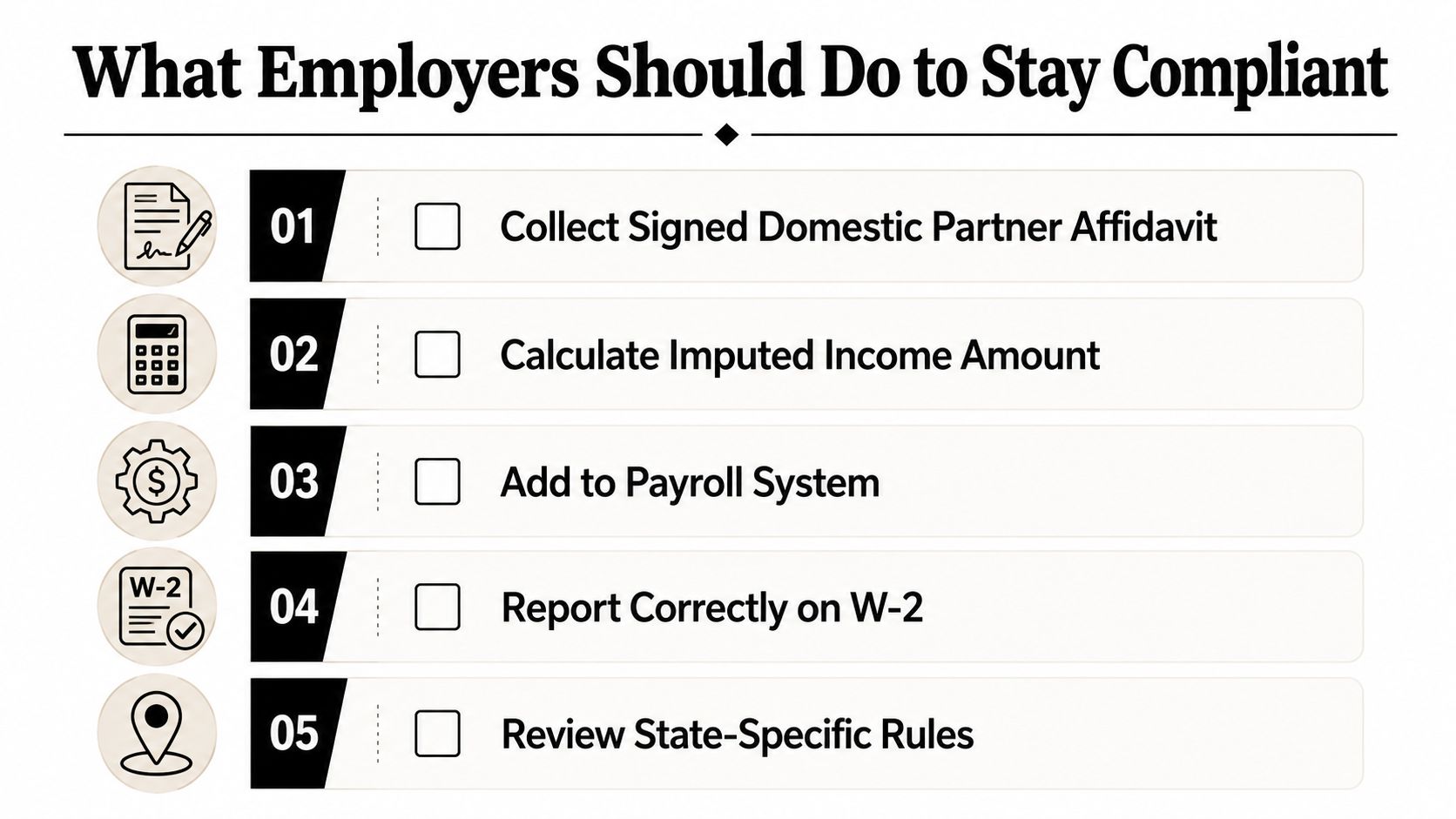
- What Employers Should Do to Stay Compliant
- A workable control checklist
- Common Mistakes and How to Fix Them
- Match the correction to the error
- Don't ignore prior years
- Quick Answers to Questions People Actually Ask
- Is imputed income subject to Social Security and Medicare taxes?
- Can paying more for coverage eliminate imputed income?
- Can the employee deduct the imputed amount on a federal return?
- Can a corrected W-2 produce a refund for an earlier year?
Jordan enrolled their domestic partner in the company health plan because the employer paid the partner's coverage. The benefit looked free. Then the first pay stub arrived with an unexpected taxable-benefit line, lower take-home pay, and a question nobody in HR had answered clearly: why was Jordan being taxed on insurance they never received as cash?
That question is the practical heart of imputed income for domestic partners. Employer-paid coverage is generally taxable unless the partner qualifies as the employee's tax dependent under Internal Revenue Code Section 152. The dependency determination, not the label “domestic partner,” can change the payroll result from taxable to excluded.
For employees, the issue affects withholding and Form W-2 reporting. For employers, a blanket rule that treats every domestic partner benefit as taxable can be just as problematic as failing to report the benefit at all. The right approach starts with the partner's tax status, then moves through valuation, payroll, state treatment, and correction procedures.
A Pay Surprise That Should Not Be a Surprise
Jordan's employer offered domestic partner health coverage during open enrollment. HR confirmed that the partner could join the plan, Jordan completed the enrollment paperwork, and the employer paid its share of the premium. Nobody warned Jordan that plan eligibility and tax-free treatment were separate questions.
At year-end, payroll added the employer-paid value of the partner's coverage to Jordan's wages. Jordan didn't receive extra cash, but the amount appeared as taxable compensation and increased the taxes taken from pay. That outcome follows the federal framework described in the domestic partner imputed income explanation, unless the partner qualifies as a tax dependent.
The practical rule: A benefit can be available under the employer's health plan and still create taxable income for the employee.
The surprise usually comes from a reasonable assumption. If the employer pays for a spouse's coverage, the value generally receives favorable tax treatment. A domestic partner may be eligible for the same insurance, but federal tax law doesn't automatically treat that person as a spouse. Domestic partners also can't file a joint federal return, which creates a different federal reporting structure.
What Jordan should ask first
Jordan shouldn't begin by disputing the payroll entry. The first question is whether the partner met the Section 152 dependency test during the relevant tax year. If the answer is yes, the employer may have overreported taxable wages. If the answer is no, the next questions concern the valuation method, after-tax contributions, and whether payroll reported the amount consistently.
An employer facing this situation should review the enrollment record, the partner's dependency documentation, the plan's valuation method, and the payroll configuration. Treating every domestic partner as taxable without checking dependency is an easy default, but it isn't always the correct result.
What Imputed Income Actually Means in Plain English
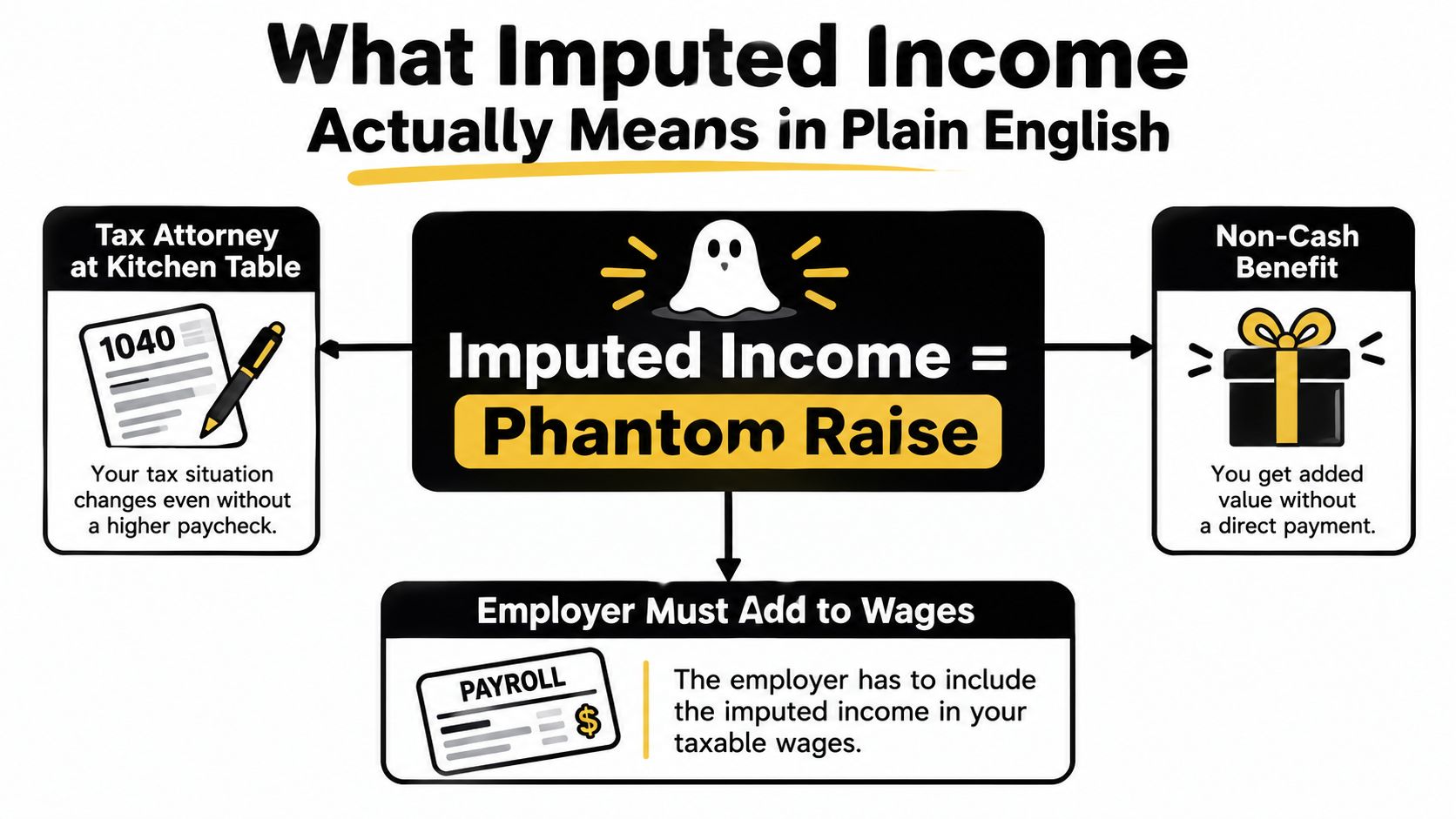
Imputed income is a non-cash benefit treated as taxable wages. Think of it as a phantom raise. The employer doesn't hand the employee money, but the tax rules require payroll to assign a value to the benefit and include that value in taxable compensation.
For domestic partner health coverage, the key question is whether federal law provides an exclusion. Employer-paid health coverage generally receives tax-favored treatment for an employee, a spouse, or a qualifying tax dependent. A domestic partner who isn't a spouse and doesn't satisfy Section 152 is outside that exclusion.
The mechanics are straightforward:
- The employer provides health coverage for the domestic partner.
- Payroll determines the taxable value of that coverage.
- The employee's after-tax contribution, if any, reduces the taxable value.
- Payroll adds the remaining amount to wages and withholds applicable taxes.
The federal rule is summarized in California Controller guidance on domestic partnerships, which explains that fair market value is included in gross income and reported on the employee's W-2 when the domestic partner isn't a tax dependent. The guidance also addresses coverage for a domestic partner's children when those children don't qualify as the employee's tax dependents.
The dependency question controls the result
Many payroll departments make a common mistake. “Domestic partner” is an enrollment category. “Tax dependent” is a federal tax classification. The first may establish access to the plan, while the second determines whether the employer-paid coverage can be excluded from wages.
The employee should gather the facts needed to evaluate Section 152 before open enrollment or payroll processing. That includes support, household, income, and competing dependency facts. HR shouldn't make a casual determination based on relationship length or shared residence alone, and employees shouldn't assume an affidavit for benefits proves tax dependency.
The right question isn't “Can my partner join the plan?” It's “Does my partner qualify for the federal exclusion?”
How the Taxable Amount Gets Calculated
Once taxable treatment applies, valuation becomes the next pressure point. Employers need a defensible method for determining the value of coverage attributable to the domestic partner, and employees need to know what number payroll used.
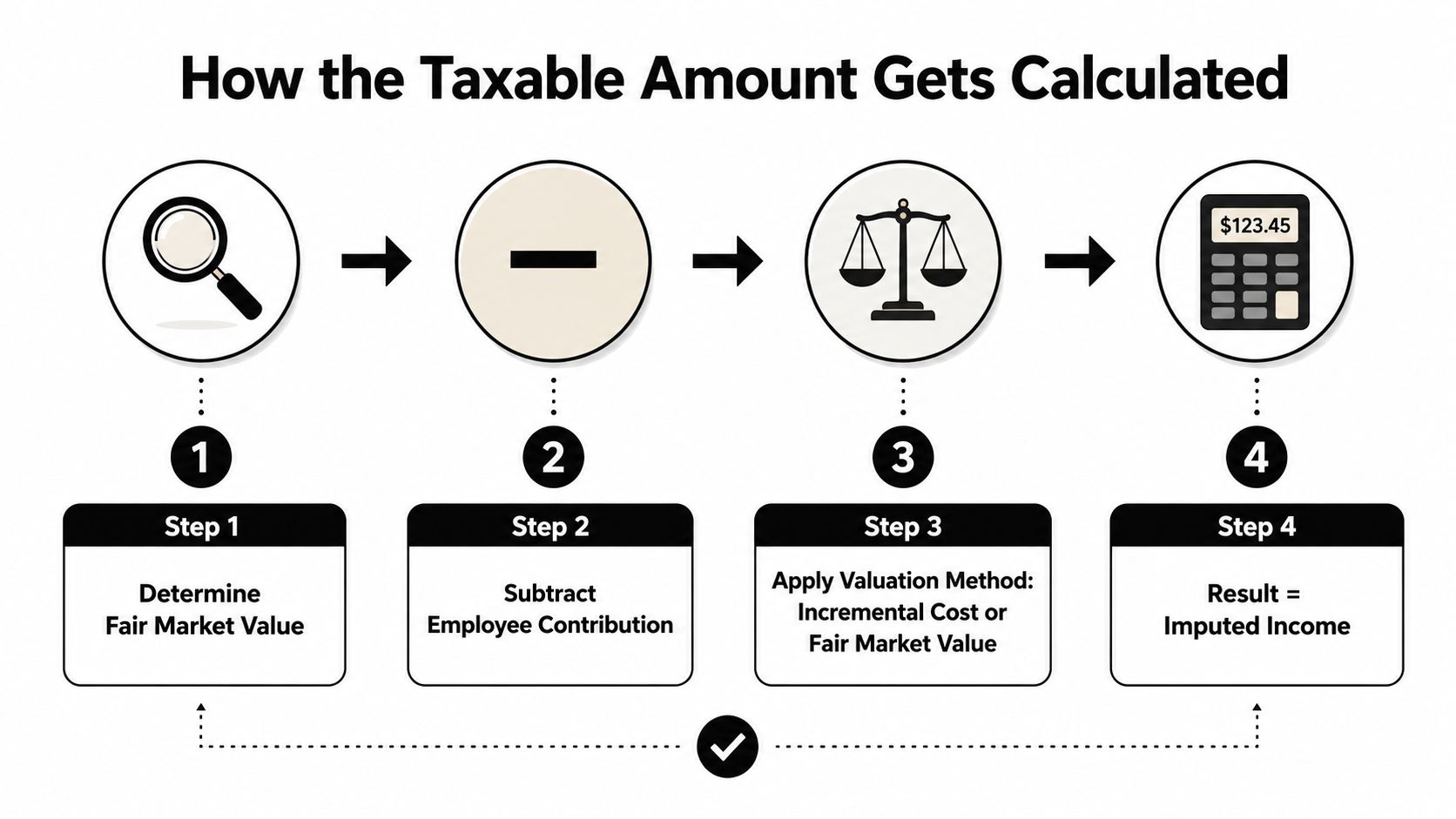
Two approaches commonly appear in employer benefit materials. The first is an incremental cost method, which looks at the difference between employee-only coverage and coverage that includes the partner. The second uses fair market value, meaning the value assigned to the partner's coverage under the plan's pricing or valuation framework. Plan design can make the results differ.
A simple calculation
Assume an employer determines that the partner's coverage has a fair market value of $900 for the applicable payroll period, and the employee pays $250 of that cost with after-tax dollars. The taxable imputed amount is $650.
The arithmetic is:
- Determine the assigned value: Use the employer's documented incremental-cost or fair-market-value method.
- Subtract after-tax contributions: Reduce the assigned value by the employee's contribution attributable to the partner.
- Report the balance: Add the remaining amount to taxable wages.
The source for the federal framework explains that the taxable amount is the fair market value of employer-paid coverage less any after-tax employee contribution. That distinction matters. Payroll shouldn't tax the same coverage value twice, and an employee shouldn't accept a W-2 amount without checking whether their partner-specific contribution was applied.
Why employees see different numbers
Two employees on the same health plan may have different imputed income because their elections, contribution amounts, and covered dependents differ. An employee covering a partner and the partner's child may also face separate valuation questions if the child doesn't qualify as a tax dependent.
Ask payroll for three items: the valuation method, the coverage value assigned to the partner, and the after-tax contribution credited against that value. If those records don't reconcile, use a detailed step-by-step guide to calculating tax liability as a framework for organizing the numbers, then have payroll or a tax professional review the result.
Where Imputed Income Lands on the W-2 and Payroll
Imputed income becomes real payroll activity even though the employee never receives the benefit as cash. The employer adds the taxable amount to wages, calculates the associated withholding, and reports the result through year-end wage reporting.
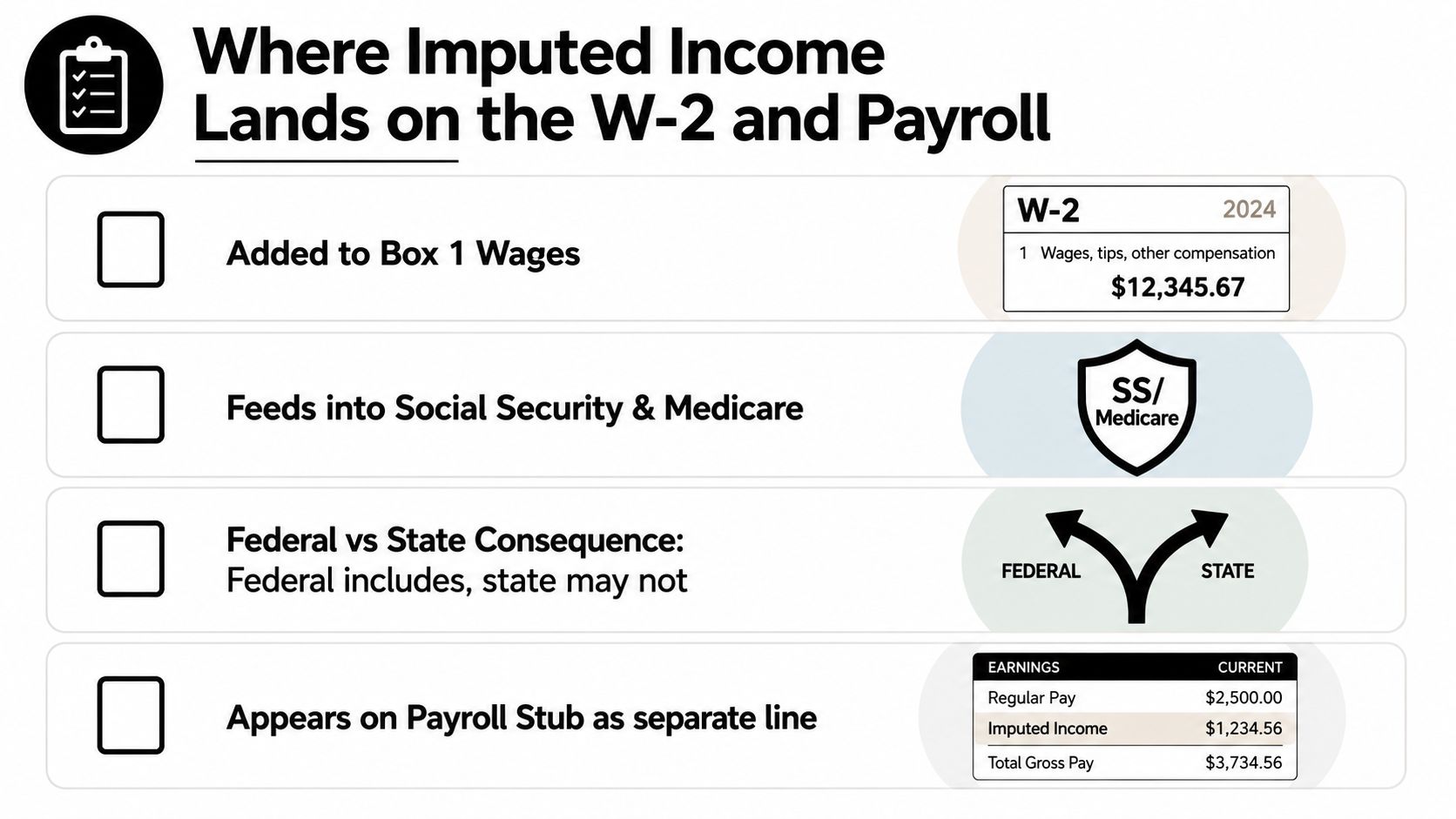
For federal purposes, the amount generally increases Box 1 wages on Form W-2. It also feeds Social Security and Medicare wages, which are reported through the applicable wage boxes, and the employee sees the tax effect through payroll withholding. Many employer materials also treat the amount as subject to state tax reporting, but state treatment must be reviewed separately.
Payroll consequence: Non-cash compensation can create an actual withholding obligation in the pay period when payroll records the benefit.
What to inspect
Start with the pay stub. The imputed amount may appear as an employer-paid benefit, taxable benefit, or separate informational earnings line. The label varies by payroll system, but the taxable wage totals should reflect the amount when federal taxation applies.
Then compare the stub with the W-2:
- Box 1: Check that federal wages include the taxable partner coverage.
- Social Security and Medicare wage boxes: Confirm that the amount was included when FICA applies.
- Box 12: Review any code used by the employer to identify the benefit or related reporting.
- State wage and withholding boxes: Determine whether the state followed the federal result or required a different adjustment.
FICA deserves special attention because it includes both Social Security and Medicare taxes. A payroll team that adds the amount only to federal taxable wages but omits it from FICA wages has created a reporting error, not a harmless formatting difference. Employers can review broader payroll obligations through this guide to FICA taxes and payroll responsibilities.
Reconcile before issuing the W-2
At year-end, payroll should compare enrollment records, valuation worksheets, employee contributions, taxable-benefit entries, and wage reports. If the employee's dependency status changed during the year, the employer should identify the affected pay periods rather than applying a rough annual adjustment.
State Differences and the Community Property Wrinkle
Federal treatment doesn't answer every state payroll question. Some states recognize registered domestic partners more like spouses for state tax purposes, while federal payroll still treats the partner's coverage as taxable unless Section 152 applies. That split can require federal inclusion alongside a different state treatment.
California is a leading example of the divergence. State guidance explains the federal inclusion rule and the W-2 reporting requirement, while California's broader treatment of registered domestic partners can create separate state filing considerations. New York may also require careful coordination between state recognition and payroll withholding. Texas, by contrast, doesn't use the same community-property framework for registered domestic partners described in the federal guidance.
| State | Domestic Partner Status | State Tax Treatment | Community Property | Employer Imputed Income |
|---|---|---|---|---|
| California | Registered domestic partners receive specific state-law recognition | State treatment may differ from federal treatment | Community-property issues may affect reporting | Federal inclusion generally remains unless the partner qualifies as a dependent |
| New York | State rules can recognize domestic partnership arrangements differently from federal law | Review state withholding and reporting separately | Facts and registration status matter | Employer must apply the federal dependency analysis |
| Texas | State treatment doesn't automatically convert a partner into a federal spouse or dependent | Federal rules remain central for the benefit | Texas is commonly described as a community-property state for marital property, as discussed in this Texas community-property overview from the Law Office of Bryan Fagan, PLLC | Federal imputed income may apply unless Section 152 excludes it |
Why community property matters
The IRS explains that registered domestic partners and individuals in civil unions can face household-income allocation rules that affect federal reporting. Those rules don't automatically make employer-paid partner coverage tax-free, but they can complicate how income is allocated and reported.
Don't merge these questions. First determine whether the benefit is federally taxable. Then determine how the employee's state handles the amount and whether community-property or registration rules affect filing. Changes in residence, registration, or relationship status can require payroll review, much like other major family-law events discussed in this overview of divorce tax implications.
What Employers Should Do to Stay Compliant
Employers need a written process, not a payroll default. The process should distinguish plan eligibility from tax dependency, document the valuation method, and preserve enough information to explain the W-2 if the employee challenges it.
Start with a domestic partner affidavit if the plan requires one, but don't treat that affidavit as conclusive proof of Section 152 status. Request a separate dependency certification and supporting records when an employee claims the exclusion. Protect sensitive information and apply the same substantiation standard consistently.
A workable control checklist
- Separate the coverage pieces: Identify the employer-paid portion, the employee's after-tax contribution, and any amount attributable to children.
- Document the valuation: Record whether payroll uses incremental cost or fair market value, and preserve the plan-specific calculation.
- Update midyear changes: Recalculate when coverage begins, ends, or changes, and revisit dependency status when the facts change.
- Reconcile payroll: Compare benefit records with taxable wages before W-2 forms are finalized.
- Correct promptly: Use the appropriate correction process when payroll included or omitted the wrong amount.
HR teams often need a broader system for storing signed affidavits, certifications, and payroll acknowledgments. A structured set of workplace compliance forms can help, provided the employer adapts the forms to the actual plan and tax process.
Cafeteria-plan deductions require separate attention. If the partner isn't a tax dependent, the employee's share attributable to that partner generally needs after-tax treatment. Employers should review the plan document, payroll coding, and carrier billing together, not in isolation. For related employer obligations, use this small-business payroll tax guide as a starting point for the payroll review.
Common Mistakes and How to Fix Them
The most expensive mistake is assuming the default rule is always safe. Employers sometimes tax every domestic partner benefit without asking whether the partner qualifies as a Section 152 dependent. That approach can overstate wages, increase withholding, and produce an incorrect W-2.
The opposite error is more obvious but just as serious. Payroll may treat coverage as tax-free because the partner is enrolled in the plan, or it may use a family-rate formula without confirming that the formula reflects the plan's defensible valuation method. A small discrepancy repeated through payroll can become a wage-reporting problem.
Match the correction to the error
If the employer discovers an incorrect W-2, the normal correction path may involve a Form W-2c and, where employment tax returns are affected, Form 941-X. The employee may then need an amended federal return using Form 1040-X, depending on whether the original wage and withholding information changed the filed return.
- Overreported imputed income: Recalculate the partner's eligibility and valuation, correct the wage report, and address over-withheld federal and payroll taxes.
- Underreported imputed income: Correct the payroll reporting and evaluate additional employee withholding, employer tax, and return consequences.
- Dependency changed during the year: Identify the exact period affected. Don't apply the new status backward or forward without analyzing when the facts changed.
- Employee failed to adjust withholding: Review Form W-4 elections and estimated tax exposure after payroll determines the correct taxable wages.
Don't ignore prior years
A corrected W-2 doesn't automatically finish the job. The employer may need to amend employment tax filings, while the employee may need to amend an income tax return or pursue a refund for over-withheld amounts. Keep the valuation worksheet, dependency analysis, payroll reports, and correspondence together.
Employees should challenge unexplained entries before filing. Employers should investigate before dismissing the issue as immaterial. The correct question is whether the reported wages match the tax facts, not whether the amount feels small.
Quick Answers to Questions People Actually Ask
Is imputed income subject to Social Security and Medicare taxes?
Generally, yes. Employer-paid domestic partner coverage that is taxable under the federal rule is generally included in wages for federal income tax and FICA purposes. That means the employee can see the effect through both income-tax withholding and Social Security and Medicare taxes. Review the W-2 and payroll mechanics described above rather than relying only on the pay-stub label.
Can paying more for coverage eliminate imputed income?
No, not automatically. An after-tax employee contribution reduces the taxable value of employer-paid coverage, but it doesn't change the partner's tax status by itself. A Section 125 cafeteria-plan election also requires careful treatment because pre-tax coverage is generally tied to the employee, spouse, or qualifying tax dependent. The dependency question remains the first decision.
Can the employee deduct the imputed amount on a federal return?
Generally, no. Imputed income is a wage-reporting treatment, not a standalone deduction. The employee should first determine whether the partner qualified as a tax dependent and whether payroll reported the benefit correctly. A tax professional can then analyze any separate medical-expense or filing issue without assuming that the imputed amount itself is deductible.
Can a corrected W-2 produce a refund for an earlier year?
Yes, potentially. If the employer corrects an overreported benefit with Form W-2c, the employee may need an amended return, and the employer may need Form 941-X. Refund treatment depends on what was overreported, what taxes were withheld, and whether the employee already filed a return using the incorrect wage information.
The one question every employee and HR manager should ask before open enrollment is: Does the domestic partner qualify as the employee's tax dependent under Section 152, and has payroll documented that conclusion? If the answer is unclear, resolve it before the first pay period rather than waiting for a surprise W-2.
Tax Attorney Stephen A Weisberg helps individuals, small-business owners, and payroll teams address IRS and state tax problems, including incorrect wage reporting and payroll tax issues. Visit Tax Attorney Stephen A Weisberg to request a focused review of your domestic partner benefit reporting and determine what correction steps make sense.


