How to Write a Letter to the IRS That Gets Results
Learn how to write a letter to the IRS with our expert guide. Discover actionable tips, templates, and common mistakes for tax debt and audit responses.

In this article
- Why a Letter to the IRS Is Often Your Strongest Move
- The Trouble with Calling the IRS
- Building Your Letter: The Essential Components
- Your Core Identifying Information
- Required Information Checklist for Your IRS Letter
- Referencing the Specifics of Your Case
- Getting Your Message Across: Tone and Wording
- How to Structure Your Letter for Impact
- The Opening: A Direct Statement of Purpose
- The Body: Laying Out the Facts
- The Closing: Your Call to Action
- Practical Templates for Common IRS Scenarios
- Framework for a Penalty Abatement Request
- Responding to a CP2000 Audit Notice
- Proposing an Installment Agreement
- IRS Letter Template Quick Guide
- Sending Your Letter and Navigating the Wait
- Finding the Correct Mailing Address
- Setting Realistic Expectations for a Response
- Knowing When to Escalate to a Tax Professional
- High-Stakes Scenarios Demanding an Expert
- Questions We Hear All the Time About IRS Letters
- How Long Until I Hear Back?
- Should I Mail My Original Documents?
- Can I Just Email My Letter to the IRS?
When you're dealing with the IRS, your first instinct might be to pick up the phone. But in my experience, writing a letter is almost always the smarter, more effective strategy for getting your issue resolved. It creates a formal record, lays out your case clearly, and ensures your problem gets the serious attention it deserves.
A phone call can be a dead end. A letter, on the other hand, creates a legal paper trail and forces the agency to provide a written response, which is absolutely critical for sorting out complex tax matters.
Why a Letter to the IRS Is Often Your Strongest Move

In a world of instant messages and emails, sending a physical letter might feel a bit old-school. But when you’re up against a bureaucratic giant like the IRS, it’s your most powerful tool. Phone calls often lead to endless hold music, frustrating miscommunications, and worst of all, no verifiable record of what was said.
A well-written letter changes the game. It transforms your issue from a passing phone call into a formal case that requires a documented review and an official response. I've seen it time and again with my clients—this simple step cuts through the red tape, bypasses the frustration of dropped calls, and gets your issue routed to the right department for real consideration.
The Trouble with Calling the IRS
Let's be realistic: the IRS is overwhelmed with phone calls. During a recent filing season, their phone lines were hit with a staggering 38.6 million calls, but agents only managed to answer 11.0 million of them. Think about that. The odds are not in your favor.
If you're a small business owner, an independent contractor, or running an S-corp with tax debt, you can't afford to waste hours on hold. A structured letter cuts right through that noise. It lands on the desk of someone who has to address it. For a deeper dive into these delays, check out the National Taxpayer Advocate's annual report.
This written approach is non-negotiable for situations that require detailed explanations or legal arguments, such as:
- Penalty Abatement Requests: You have the space to thoroughly explain your case for "reasonable cause" without being cut off.
- Audit Responses: It lets you present your documents and a clear, organized rebuttal to their findings.
- Installment Agreements: A letter formally proposes a payment plan and includes all the necessary financial details to back it up.
- Responding to an IRS Notice: You create a direct, traceable answer to a specific inquiry. To learn more, see our guide on decoding common IRS letters and notices.
A letter isn’t just an alternative to calling—it's a deliberate action to take control of your tax situation. It signals to the IRS that you are serious, organized, and expect a formal resolution.
Ultimately, writing to the IRS is a strategic decision. It forces a systematic review of your case and gives you a concrete record of every step you've taken, which is priceless if things ever need to be escalated.
Building Your Letter: The Essential Components

I've seen it countless times: a well-intentioned letter to the IRS gets completely ignored simply because it's missing key information. Think of the IRS as a massive sorting facility. If your letter doesn't have the right "labels," it's likely to end up in a black hole, causing frustrating delays.
To get your letter into the right hands and onto the right desk, there are a few non-negotiable pieces of information you have to include right up front. Nailing this part signals that you're organized and serious, setting a professional tone from the moment an agent picks it up.
Your Core Identifying Information
The very top of your letter is prime real estate. This is where you need to state, clearly and concisely, who you are so an agent can pull up your file in seconds. Don't make them hunt for it.
Make sure these details are listed at the top of the page:
- Your Full Name and Current Address: Use the exact name and address that appear on the tax return you're writing about.
- Your Social Security Number (SSN) or ITIN: If it's a joint return, you must include both spouses' names and SSNs. Always list the primary taxpayer (the person listed first on the return) first.
- Your Employer Identification Number (EIN): For any business matter, from payroll tax issues for an S Corp to a partnership audit, the EIN is the most critical identifier.
This simple step is the single most effective thing you can do to avoid having your letter get lost in the shuffle.
To prevent any confusion or delays, I've put together a quick checklist. Before you even think about sealing the envelope, run through this table to make sure you've got all your bases covered.
Required Information Checklist for Your IRS Letter
| Information Element | What to Include | Example / Placement Tip |
|---|---|---|
| Full Name(s) | Your legal name(s) as shown on the tax return. | John A. Doe & Jane B. Doe (Place at the very top left of the letter) |
| Current Mailing Address | The full, current address where you receive mail. | 123 Main Street, Anytown, USA 12345 |
| Taxpayer ID Number(s) | Social Security Number (SSN) or Individual Taxpayer Identification Number (ITIN). | SSN: XXX-XX-1234 (List both for joint returns) |
| Business ID Number | Employer Identification Number (EIN), if applicable. | EIN: XX-XXXXXXX (Use this for any business-related correspondence) |
| Contact Information | A daytime phone number where you can be reached. | (555) 123-4567 |
| Tax Year/Period | The specific calendar year or quarter in question. | Re: Tax Year 2023 or Quarter ending 3/31/2024 |
| Tax Form | The form number related to your issue (e.g., 1040, 941, 1120-S). | Regarding: Form 1040, U.S. Individual Income Tax Return |
| IRS Notice/Letter Number | The number in the top right corner of the IRS notice (e.g., CP2000). | In response to: Notice CP2000 dated May 15, 2024 |
Having this information clearly laid out not only helps the IRS but also helps you frame the rest of your letter with clarity and purpose.
Referencing the Specifics of Your Case
Once you’ve established who you are, you need to point the agent directly to the issue at hand. Vague letters get vague answers—or none at all. To get a resolution, you have to be precise.
Immediately after your personal information, state the reason for your letter by referencing these key details:
- The Tax Year(s) in Question: Clearly state the calendar year or tax period, like "Regarding Tax Year 2023."
- The Tax Form Number: Mention the specific form your issue relates to, whether it's a Form 1040 for personal taxes or Form 941 for payroll.
- The Notice or Letter Number: This is crucial if the IRS contacted you first. Look in the top right corner of their letter for a number like CP2000 or Letter 105-C. Citing this number is like giving the postal service a zip code—it routes your response directly to the right department.
Pro Tip: I always tell my clients to write their name and SSN or EIN on the top of every single page they send, including all attachments. It's a simple habit that can save you a massive headache if pages get separated during processing, which happens more often than you'd think.
Getting Your Message Across: Tone and Wording

With all your documents in hand, it's time to start writing. How you say something in a letter to the IRS is just as important as what you say. Think about the person on the other end—an agent who sifts through hundreds of letters a day. A professional, clear, and fact-based letter is a breath of fresh air and is far more likely to be taken seriously.
Leave the emotion out of it. Angry rants or heartfelt personal pleas rarely get you anywhere and can actually hurt your case. The goal is to be persuasive, and that comes from a calm, respectful tone. Stick to the facts, present your case logically, and show them you're serious.
This all comes down to effective written communication skills. The best approach is always the simplest: keep your sentences short, avoid tax jargon, and be direct.
How to Structure Your Letter for Impact
The most effective letters I've seen all follow a simple, logical flow. Think of it as a three-act play: the opening, the explanation, and the resolution. Each part has a specific job, guiding the IRS agent through your situation and making it easy for them to understand what you need.
A winning structure always includes:
- A Direct Opening: Get right to the point in your very first sentence.
- A Factual Body: Lay out your case with a chronological, evidence-based story.
- A Clear Closing: Tell them exactly what you want them to do.
This framework isn't just about good formatting; it's about making your letter easy for a busy agent to process and, more importantly, act on.
The Opening: A Direct Statement of Purpose
Never make the agent guess why you're writing. Your opening paragraph needs to answer that question immediately. It provides instant context and gets your letter into the right hands faster.
A weak, vague start like, "I am writing to you about an issue with my tax account," is a non-starter.
Instead, be laser-focused. A much more powerful opening sounds like this: "I am writing in response to Notice CP2000, dated May 15, 2024, to request an abatement of penalties for the 2023 tax year due to reasonable cause."
See the difference? That second example is specific, professional, and gets straight to the point.
A letter to the IRS is a business communication, not a personal story. Its effectiveness depends on clarity, conciseness, and a professional tone that respects the process while firmly stating your position and desired outcome.
The Body: Laying Out the Facts
This is where you build your argument. Present the facts of your situation in a logical order, usually chronologically. To keep it clean and easy to read, dedicate a separate paragraph to each main point or event.
As you introduce a piece of evidence, refer to it directly in the text. For example: "As you can see from the enclosed hospital records (Attachment A), I was hospitalized from March 1 to March 20, 2024, which made it impossible for me to file my return by the deadline."
The Closing: Your Call to Action
Your final paragraph might just be the most critical part of the entire letter. This is where you tell the IRS exactly what you expect them to do. A vague closing like, "I hope you can help me," leaves the outcome to chance.
You need to be direct and state precisely what you're asking for.
- "I respectfully request a 60-day extension to pay the outstanding balance of $2,500."
- "Please reverse the assessed failure-to-file penalty of $450 based on the information provided."
- "I request that you accept this documentation and reconsider the proposed changes to my 2023 tax return."
A clear, confident closing leaves no room for confusion. It gives the agent a specific action to take, which is the fastest way to get your issue resolved.
Practical Templates for Common IRS Scenarios
Knowing the essential components of an IRS letter is one thing, but actually putting pen to paper for your specific situation is another beast entirely. The trick is to adapt the core structure to fit your unique circumstances. Let's walk through some frameworks for the most common reasons you might find yourself writing to the IRS, focusing on the strategy behind the words and the evidence you absolutely need to include.
Think of these less as rigid, copy-and-paste templates and more as strategic roadmaps. Your job is to fill in the blanks with the specific facts of your case, building a clear and compelling story that logically leads the IRS to the conclusion you want.
Framework for a Penalty Abatement Request
When you're asking for a penalty to be waived, you're making a case for "reasonable cause." In plain English, this means you had a legitimate, often unavoidable, reason for not filing or paying on time. Your letter needs to tell a clear, chronological story that your evidence backs up at every turn.
- Get Straight to the Point: Open by stating exactly what you want. Something like, "I am writing to respectfully request an abatement of the failure-to-file penalty, totaling $XXX, which was assessed on my 2023 Form 1040 return. This request is based on reasonable cause."
- Tell Your Story: This is the core of your letter. Explain what happened, when it happened, and how it directly stopped you from meeting your tax obligations. Were you dealing with a sudden, serious illness? Was your home or business hit by a natural disaster? Lay out the timeline clearly.
- Show, Don't Just Tell: This part is non-negotiable. You must attach copies of documents that prove your story. This could be anything from hospital records and insurance claims to official government notices. Don't just attach them; reference them directly in your letter. For example, "As documented in Attachment A, I was hospitalized from [Date] to [Date]..."
- Wrap It Up: End by clearly restating your request. "Based on these unavoidable circumstances, I believe I have demonstrated reasonable cause and kindly ask that the assessed penalties be abated."
A key takeaway here: The IRS is looking for a direct, undeniable link between the event you describe and your inability to file or pay. A well-written letter makes that connection crystal clear.
Remember that IRS processing times can be incredibly long, especially during peak tax season. For business owners with tax debt, a well-crafted abatement request is crucial for preventing refund holds or offsets while the IRS works through its massive backlog. For more context, you can explore official IRS filing season statistics on IRS.gov.
Responding to a CP2000 Audit Notice
Getting a CP2000 notice can be intimidating, but it's not a full-blown audit. It’s simply a proposal from the IRS to adjust your tax return because their records don't match what you reported. Your response letter must be direct, factual, and leave no room for ambiguity.
If you disagree with their proposed changes, your letter should look something like this:
- Acknowledge the Notice: Start by referencing the specific document you received. "This letter is my formal response to the CP2000 Notice dated June 1, 2024, concerning my 2023 tax year."
- State Your Position Clearly: Don't beat around the bush. "I disagree with the proposed changes that suggest I have unreported income from Form 1099-MISC."
- Provide a Factual Rebuttal: Explain precisely why the IRS is incorrect. For instance, "The income reported on that 1099-MISC was a non-taxable return of capital, not earned income. I have enclosed a corrected Form 1099-MISC from the payer (Attachment B) along with a letter from the company explaining their reporting error (Attachment C)."
- Request a Specific Action: Tell them exactly what you want them to do. "Please review the enclosed documentation and correct my account to show that no additional tax is due."
Your response to an IRS notice is a critical move. Keep in mind that a similar notice, the CP504, indicates a much more urgent situation—an intent to levy your assets. It's worth understanding the difference, and you can learn more by decoding the IRS CP504 notice to see what's at stake.
Proposing an Installment Agreement
When you know you owe but simply can't pay the full tax debt at once, a letter proposing an installment agreement is how you formally ask for a payment plan. Honesty and realism are your best friends here. You need to present your financial situation accurately and propose a monthly payment you can genuinely afford.
Your letter should include these key elements:
- The Ask: "I am writing to request an installment agreement for my outstanding tax liability of $X,XXX for the 2023 tax year."
- The Proposal: "Based on my current financial situation, I am able to pay $XXX per month, starting on [Date]."
- The Justification: You don't need to write a novel, just briefly explain why you can't pay in full. A simple statement like, "Due to a recent and unexpected reduction in my income, I am currently unable to pay the full balance," is usually enough.
- Supporting Forms: In most situations, you'll need to include Form 9465, Installment Agreement Request. If your debt is significant, you may also need to file Form 433-F, Collection Information Statement, which gives the IRS a full snapshot of your finances. Be sure to mention in your letter that you've attached these forms.
IRS Letter Template Quick Guide
Navigating the different types of IRS correspondence can be confusing. Each letter serves a distinct purpose and requires a specific set of information and proof. This table breaks down the essentials for the most common scenarios.
| Letter Type | Primary Goal | Key Information to Include | Crucial Supporting Documents |
|---|---|---|---|
| Penalty Abatement | To convince the IRS you had a valid reason ("reasonable cause") for failing to file or pay on time. | A clear, chronological story of the event, the exact dates, and how it directly prevented compliance. | Hospital records, insurance claims, official disaster declarations, death certificates, court documents. |
| CP2000 Response | To agree or disagree with the IRS's proposed changes based on a mismatch of income/deduction information. | A direct statement of agreement or disagreement, with a point-by-point factual explanation for any dispute. | Corrected 1099s/W-2s, letters from payers, bank statements, receipts, proof of basis for assets sold. |
| Installment Agreement | To formally request a monthly payment plan for a tax debt you cannot pay in full immediately. | The total tax liability, the proposed monthly payment amount, and a brief, honest reason for needing the plan. | Form 9465 (Installment Agreement Request), Form 433-F (Collection Information Statement), proof of income/expenses. |
Ultimately, choosing the right framework and providing the right evidence is the difference between a quick resolution and a prolonged back-and-forth with the IRS.
Sending Your Letter and Navigating the Wait
Once your letter is polished and ready, the next step is just as critical: getting it securely into the hands of the IRS. Simply dropping it into a standard mailbox is a surprisingly common—and risky—mistake. You need an undeniable legal record, and that's your best defense if the IRS ever claims they never received your correspondence.
This is exactly why I tell every single client to use USPS Certified Mail with a return receipt. It's non-negotiable. This service gives you a tracking number and, more importantly, a signature confirmation when the IRS receives your package. That little green postcard you get back in the mail is your golden ticket—irrefutable proof of delivery, stamped with the exact date your case officially landed on their desk. To get the full rundown on this, check out our comprehensive guide to using Certified Mail for IRS success.
Finding the Correct Mailing Address
Another frequent pitfall I see is sending a perfectly written letter to the wrong place. This one mistake can easily cause months of delays. The IRS isn't a single office; it's a massive organization with dozens of processing centers, and where you send your letter depends entirely on the specific form, notice, or issue you're addressing.
Don't ever guess or use a generic P.O. Box you found online. Here’s how to find the right destination every time:
- Check the IRS Notice: If you're responding to a letter from the IRS (like a CP2000 notice), the correct mailing address is almost always printed right on it. Look for it in the top left or bottom section.
- Consult the Form Instructions: Filing a specific form, like a Form 1040-X amended return? The official IRS instructions for that form will list the exact mailing addresses, often broken down by state.
- Use the IRS Website: As a last resort, the IRS website has pages dedicated to addresses for different types of correspondence. It can be a bit tricky to navigate, but the information is there.
Setting Realistic Expectations for a Response
After you've sent your letter, the waiting game begins. I can't stress this enough: you have to be patient. While the IRS officially says to allow 60 to 90 days for a response, my real-world experience tells a different story. It often takes four to six months, and for more complex cases like a tricky penalty abatement, it can be even longer.
The most important thing you can do is confirm your letter was delivered using your Certified Mail receipt and then wait. Calling the IRS repeatedly or sending follow-up letters too early won't speed things up; it just clogs an already overloaded system. I usually advise clients to mark their calendars for the 90-day point. If you haven't heard a peep by then, that's a reasonable time to consider a polite follow-up.
Remember, the IRS is processing a staggering volume of paper. Millions of returns and letters land on their desks, all requiring manual review, which naturally creates significant backlogs. Using the right mailing method ensures your correspondence doesn't just get lost in the shuffle. And on the rare occasions you're permitted to send documents digitally, always keep common email attachment size limits in mind to ensure your files actually go through.
Knowing When to Escalate to a Tax Professional
While a well-crafted letter can work wonders for many common tax issues, some situations are just too high-stakes to handle on your own. Knowing when to hand the reins over to a professional isn't admitting defeat; it’s a smart, strategic move to protect your financial well-being.
Let’s be clear: certain IRS notices aren’t friendly requests for information. They are serious legal actions that demand a professional response. Recognizing these red flags is the first step in avoiding a much bigger problem.
High-Stakes Scenarios Demanding an Expert
Some IRS communications signal that the game has changed. When you're facing one of these, a letter from you probably won't cut it. You need immediate, specialized expertise.
Here are a few situations where you should stop writing and start calling a tax attorney:
- A Final Notice of Intent to Levy: This is the IRS's last warning shot. It means they are legally cleared to seize your assets—your bank accounts, your wages, your property.
- A Trust Fund Recovery Penalty (TFRP) Assessment: This is one of the most serious penalties the IRS can impose. It holds you personally liable for a business's unpaid payroll taxes, and the financial fallout can be devastating.
- A Complex or In-Person Audit: If an audit goes beyond simple documentation and delves into complex legal interpretations or multiple years of business records, you're out of your depth. You need someone on your side who speaks the IRS's language fluently.
In these cases, an experienced tax attorney does more than just offer advice. They can step in to represent you, handle all communications, and negotiate directly with the IRS on your behalf. If you're ready to have a professional act for you, our guide on completing Form 2848 Power of Attorney walks you through the process of granting them that authority.
When the IRS threatens your assets or your livelihood, the conversation has changed. This is the point where a professional doesn't just offer advice; they become your legal shield.
As we covered earlier, getting your letter physically to the right place is half the battle. This simple flowchart breaks down the critical mailing steps.
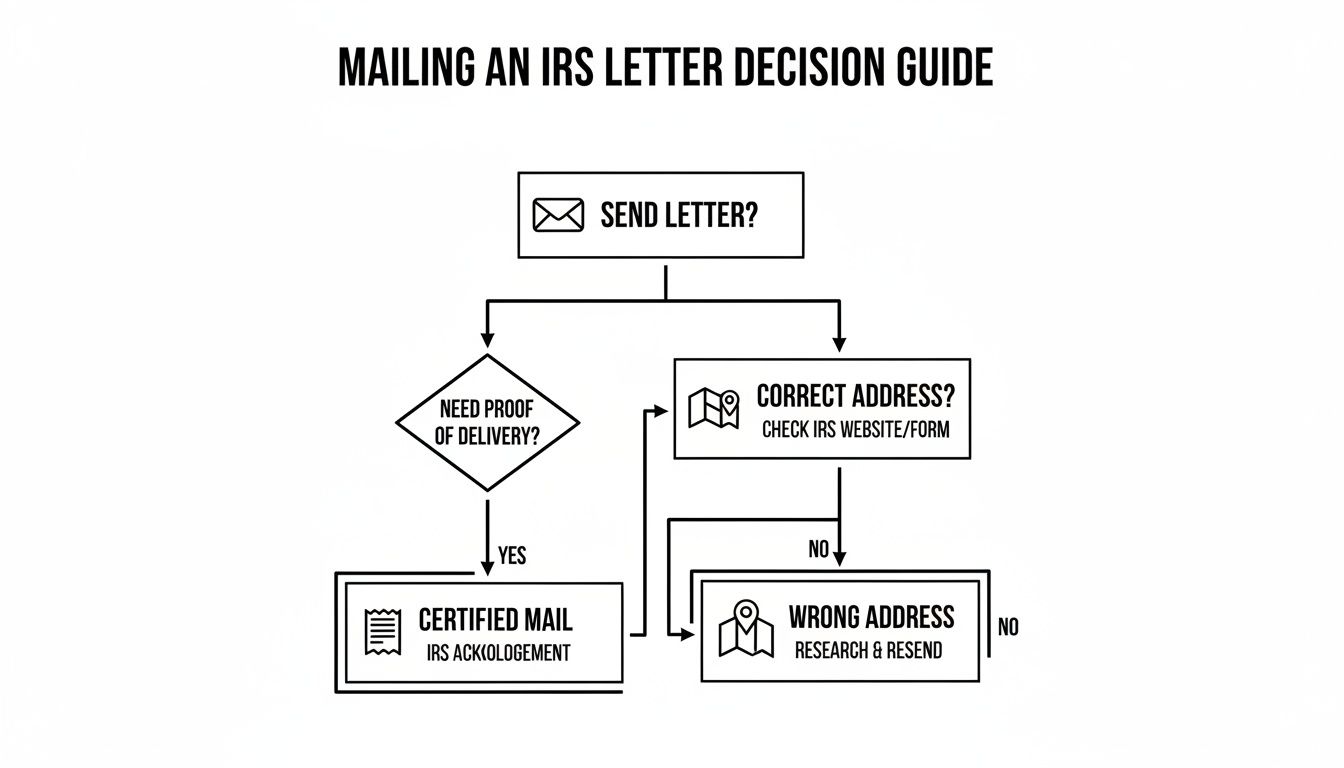
The key takeaways here are simple but non-negotiable: always double-check the mailing address on your notice and always use Certified Mail. These are the foundational steps to ensure your letter gets there and you can prove it.
Questions We Hear All the Time About IRS Letters
When you're figuring out how to write a letter to the IRS, a few questions always seem to come up. Here are some quick, practical answers to the things taxpayers ask us most often.
How Long Until I Hear Back?
This is where you’ll need some serious patience. The IRS officially says to allow 60 to 90 days for a response, but based on what we see every day, it's more realistic to expect a wait of four to six months. Sometimes even longer for more complicated issues like penalty abatements.
This long wait is precisely why we stress sending your letter via Certified Mail. It gives you legal proof that they received it and officially starts the clock, no matter how long their internal processing takes.
A key takeaway: Don't assume silence means your letter got lost or ignored. The IRS is dealing with a massive backlog, so delays are completely normal. Your Certified Mail receipt is your proof that you’ve done your part and your request is in the system.
Should I Mail My Original Documents?
Absolutely not. Never send your original documents to the IRS. You should only ever provide clean, easy-to-read copies of your supporting evidence, whether that’s receipts, bank statements, or other important papers.
Think about it—the IRS is a huge organization, and things can get misplaced. Keep your original records safe and sound. On the rare occasion they need to see an original, they will make a specific, formal request for it.
Can I Just Email My Letter to the IRS?
Unfortunately, no. For security and privacy reasons, the IRS does not accept formal letters—like a penalty abatement request or an audit response—from taxpayers through email.
You have to send it the old-fashioned way: through the mail. While they might have a secure online portal or a fax number for very specific forms or payments, a standard letter must go through the postal service. And as we've said, using a tracked method like Certified Mail is always the smartest move.
Dealing with IRS letters can be a lot to handle, but you don’t have to go it alone. At Attorney Stephen A Weisberg, we offer a FREE Tax Debt Analysis to show you exactly how we can help before you make any decisions. Contact us today to get the clarity and professional support you deserve.