How to Write a Letter to IRS: how to write a letter to irs for better results
Learn how to write a letter to irs with practical templates and tips to respond to notices and resolve tax issues faster.

In this article
- Why a Letter to the IRS Is Often Your Best Bet
- The Power of a Paper Trail
- The Right Tool for the Job
- When a Formal Letter to the IRS Is Your Best Move
- Getting Your IRS Letter Right: The Essential Components
- Your Header and Contact Information
- The Subject Line: Your Letter's GPS
- Crafting a Clear and Concise Body
- The Closing and Enclosures List
- Tailoring Your Letter to Common Tax Scenarios
- Disputing a Proposed Tax Increase
- Requesting Penalty Abatement
- Proposing a Payment Plan
- Asking for an Audit Reconsideration
- Assembling Your Supporting Documents Checklist
- Tailoring Evidence to Your Situation
- Pro Tips for Presenting Your Evidence
- Sending Your Letter and Managing the Wait
- Always Use Certified Mail. No Exceptions.
- The Waiting Game: Setting Realistic Timelines
- How to Follow Up The Right Way
- Keep a Detailed Log
- When It's Time to Call in a Tax Attorney
- The Big Red Flags: Signs You Need an Expert
- Answering Your Top Questions About Writing to the IRS
- How Long Until I Hear Back from the IRS?
- Can't I Just Shoot Them an Email?
- What's the Single Biggest Mistake People Make?
That envelope from the IRS sitting in your mailbox can make your heart sink. It's a feeling I've seen countless times with clients. But here’s the thing: while your first instinct might be to panic or ignore it, responding in writing is often your most powerful move. A well-crafted letter does more than just check a box for compliance; it's a strategic tool that builds an official record and lets you formally state your case, whether you're asking for penalty relief, proposing a payment plan, or challenging an audit.
Why a Letter to the IRS Is Often Your Best Bet

Sure, picking up the phone seems easier. You hope for a quick conversation and a fast resolution. But when the stakes are high, a phone call is fleeting. There's no concrete record of what was said, and misunderstandings happen all the time. I’ve seen it firsthand—a clear, professional letter can completely change the dynamic of a serious tax problem, stop a minor issue from snowballing into a major penalty, and ultimately, protect your interests.
This guide is designed to take the fear out of that IRS envelope. We're going to treat this not as a problem, but as a process—a proactive step toward getting things sorted out.
The Power of a Paper Trail
Putting your thoughts on paper forces you to slow down, gather your documents, and build a logical, evidence-backed argument. This simple act alone strengthens your position immensely.
More importantly, it creates a permanent record. An IRS agent might forget or misremember a phone call, but your letter is a tangible document. It can be referenced by you, by another agent, or by a tax professional if the situation escalates. You can learn more about how to interpret different types of IRS letters and notices in our detailed guide.
Key Takeaway: A written response turns a forgettable phone call into an official, time-stamped record. This paper trail becomes your best defense if there's ever a dispute about deadlines, what information you provided, or what agreements were made.
The Right Tool for the Job
Not every situation requires a formal letter, but for complex or high-stakes issues, it's non-negotiable. Phone calls are fine for quick questions, but when you need to formally dispute something, provide detailed evidence, or make a specific request, writing is the only way to ensure your message is received and documented correctly.
The table below breaks down common scenarios where a letter is not just a good idea—it's essential.
When a Formal Letter to the IRS Is Your Best Move
| Situation | Why a Letter is Essential | Risk of Not Writing |
|---|---|---|
| Responding to a CP2000 Notice | You need to provide a detailed explanation and documents to dispute proposed changes to your tax return. | The IRS may automatically adjust your return and bill you for the additional tax, penalties, and interest. |
| Requesting Penalty Abatement | A "reasonable cause" argument requires a thorough, persuasive narrative supported by evidence. | Your request will likely be denied without a well-documented, compelling reason. |
| Proposing a Payment Plan | Formalizes your request and outlines your financial situation clearly on forms like the 9465. | Verbal agreements can be misinterpreted; a formal request ensures your proposal is officially reviewed. |
| Audit Reconsideration | This is a formal process that requires you to submit new information you didn't provide in the original audit. | Without a formal written request, the original audit findings will stand, and you'll miss your chance to appeal. |
| Identity or Address Verification | Provides a secure and official way to send sensitive documents like utility bills or your driver's license. | Sending personal information through unsecure channels is risky; verbal confirmation may not be sufficient. |
For anything involving a formal request, a dispute, or detailed evidence, a letter provides the clarity and official record you need to protect yourself and resolve the issue effectively.
The goal here is to shift your mindset from anxiety to action. With the right approach, you can take control of the conversation and steer your tax issue toward a successful resolution.
Getting Your IRS Letter Right: The Essential Components
When you're writing to the IRS, every detail matters. The goal is simple: make it incredibly easy for the agent on the other end to understand your situation, find your file, and do what you're asking. A sloppy or incomplete letter is a one-way ticket to delays and more headaches.
Think of your letter as a roadmap for the agent. Each section has a specific job, and getting it right means your request gets handled efficiently. To keep things professional and easy for the IRS to process, it's always a good idea to stick to a standard business letter format.
Your Header and Contact Information
This is the very first thing the agent will see, so make it count. Your header needs to be clean, professional, and have all the key details right at the top. Don't make them dig for it.
Start with your full name, current mailing address, and phone number at the top left of the page. Right below that, add the date you’re writing the letter.
Next, you'll add the IRS's mailing address. This is critical: use the exact address shown on the notice you received. The IRS has countless departments all over the country, and sending your letter to the wrong one is a guaranteed detour. Always double-check the address on your specific notice before you seal the envelope.
The Subject Line: Your Letter's GPS
If there's one part of the letter that can make or break how quickly it gets to the right person, it's the subject line. This needs to be bold, clear, and packed with specific information.
Your subject line is no place for a vague summary. It absolutely must include:
- The tax year(s) in question (e.g., "Tax Year 2023")
- Your Social Security Number (SSN) or Employer Identification Number (EIN)
- The specific notice number you are responding to (e.g., "Response to Notice CP2000")
- The form number, if it's relevant (e.g., "Form 1040")
A Tip from Experience: Put your name and SSN or EIN in the header or footer of every single page of your letter and on every document you attach. Mail rooms are busy places, and if pages get separated—which happens more than you'd think—this little step ensures they can be put back together with your file.
Crafting a Clear and Concise Body
Once you’ve set the stage, the body of the letter is where you make your case. Keep your tone factual and professional. This isn’t the place for emotion; stick to the point.
Kick things off with a direct opening sentence that states your purpose clearly. For example, "I am writing in response to Notice CP2000, dated May 15, 2025, which I have enclosed." This immediately tells the agent what they're looking at.
From there, organize your thoughts into short, logical paragraphs. If you're disputing a change the IRS made, state exactly what you disagree with and explain why. If you're asking for something like penalty abatement, you need to explain your circumstances and formally request it. For help with this, our guide on https://www.weisberg.tax/articles/irs-reasonable-cause-examples offers some powerful frameworks you can adapt.
As you build your case, make sure you refer to your supporting documents right in the text. Use phrases like, "As shown in the enclosed bank statement (Exhibit A)..." This creates a direct link between your argument and your proof.
The Closing and Enclosures List
Wrap things up as professionally as you started. A simple "Sincerely," or "Respectfully," followed by your handwritten signature in ink, is perfect. It’s also standard practice to type your full name just below your signature.
Finally, at the very bottom, add an "Enclosures" or "Attachments" line. Here, you should list every single document you are including with your letter. This serves as a helpful checklist for both you and the IRS agent, confirming exactly what was sent and what should be in the file.
Tailoring Your Letter to Common Tax Scenarios
The basic letter format we've discussed is your starting point, but what you actually say is what gets the job done. The message inside is everything. Different tax problems demand different approaches. Your tone, the details you include, and what you’re asking for will change dramatically depending on whether you're fighting a tax bill or asking for a break on penalties.
Let’s dig into how to handle some of the most common situations you’re likely to face.
Getting this right is more important than ever. The IRS is buried in a mountain of paperwork, and much of it has to be processed by a real person. As of April 18, 2025, the agency was still working through 5.7 million unprocessed tax returns. A staggering 4.4 million of those were paper returns that require manual handling. When you realize your letter is joining a queue millions of documents deep, it drives home just how critical it is to be clear, direct, and well-supported. Your goal is to make it easy for them to say "yes." For a deeper dive into these backlogs, the Taxpayer Advocate Service offers some great insights.
Disputing a Proposed Tax Increase
So, you’ve opened your mail to find a CP2000 (Proposed Changes to Your Tax Return) or, more seriously, a Statutory Notice of Deficiency (CP3219A). The IRS thinks you underpaid your taxes, and they want more money. This isn't the time to apologize or make excuses. Your job is to present a calm, factual, and evidence-based case for why they're wrong.
Your letter should be assertive but always professional. Get straight to the point.
Start with a clear statement like, "I am writing to dispute the proposed tax increase outlined in Notice CP2000, dated [Date]." This sets the stage immediately. From there, tackle each of their proposed changes one by one.
- Get Specific: Vague statements get you nowhere. Don't just say, "That income isn't mine." Instead, be precise: "The notice claims I failed to report $5,000 from ABC Corp. This is incorrect. As you can see from the enclosed Form 1099-MISC (Exhibit A) and my corresponding bank statement (Exhibit B), the correct amount I received was $2,500."
- Back It Up with Proof: For every single point you dispute, reference a piece of evidence you've included. This is how you transform your argument from an opinion into a fact they can't ignore.
- Tell Them What You Want: End with a clear call to action. For instance, "Based on the evidence provided, I request that you reverse the proposed assessment and accept my tax return as it was originally filed."
A Word of Warning: If you receive a Notice of Deficiency (CP3219A), a clock starts ticking. You have a strict 90-day deadline to respond or file a petition with the U.S. Tax Court. Your letter is a crucial part of this formal process. If you miss that deadline, you forfeit your right to argue your case in Tax Court before paying the bill.
Requesting Penalty Abatement
Sometimes, the tax bill itself is correct, but the penalties the IRS has tacked on feel unfair. Maybe a serious life event got in the way. This is when you can request a penalty abatement for "reasonable cause." Unlike a factual dispute, this letter is all about telling your story—a true, documented, and compelling story.
Your goal is to show the IRS that you acted responsibly but were simply unable to file or pay on time due to circumstances you couldn't control.
Structure your letter to build a persuasive case.
- Acknowledge the Penalty: Start by clearly identifying the penalty you want removed. For example, "I am requesting an abatement of the failure-to-pay penalty for the 2023 tax year."
- Explain Your "Reasonable Cause": This is where you lay out your story. Detail what happened. Was it a sudden, severe illness? A death in the family? A house fire that destroyed your records? Be specific with dates and explain exactly how these events made it impossible to meet your tax obligations.
- Highlight Your Good History: If you've always been a compliant taxpayer, now is the time to mention it. A simple sentence like, "Prior to this difficult period, I have a 10-year history of timely filing and payment," can make a huge difference. It shows this was an anomaly, not a habit.
- Provide Hard Evidence: A good story needs proof. Attach hospital bills, insurance claims, a death certificate, or a letter from a doctor. These documents validate your claims and give the IRS agent the justification they need to grant your request.
Your tone here should be sincere. You're not demanding anything; you're respectfully asking for consideration.
Proposing a Payment Plan
What if you agree you owe the money but just can't pay it all right now? Your goal is to propose a structured Installment Agreement. While you can do this with Form 9465, Installment Agreement Request, a well-written cover letter provides important context and shows you’re being proactive.
The key is to prove that your proposed plan is realistic and you're serious about paying off your debt.
Your letter should project financial responsibility.
- State Your Intention: Be direct. "I am writing to acknowledge my tax liability for 2023 and to formally request an Installment Agreement."
- Propose a Realistic Payment: Offer a specific monthly payment amount you know you can afford. It’s helpful to provide a brief reason, such as, "Due to a recent job loss, I am unable to pay the full balance of $8,500 at this time, but I can realistically afford to pay $150 per month."
- Show You Understand the Rules: It shows good faith to mention that your proposed payment will resolve the debt within the standard timeframe (usually 72 months). This tells the IRS you've thought it through.
Asking for an Audit Reconsideration
An audit reconsideration is a long shot, but it's a valuable tool if you have new information that wasn’t available during your original audit. You're essentially asking the IRS to reopen a closed case and look at it again with fresh evidence.
Your message has to be razor-sharp and focused only on the new proof. Don't waste time re-arguing old points.
Let's walk through an example.
Imagine the IRS audited you because a 1099-K from a payment app showed you received $20,000. You knew half of that was just friends paying you back for concert tickets and dinners, but you couldn't find the records to prove it during the audit. The IRS assessed tax on the full $20,000.
Six months later, you find the old bank statements and app transaction histories that clearly separate your business income from personal reimbursements.
Your audit reconsideration letter would get straight to the point: "I am requesting an audit reconsideration for the 2022 tax year. At the time of my audit, I was unable to provide documentation separating my business income from non-taxable personal reimbursements on my Form 1099-K. I have since located these records, which I have enclosed for your review."
The rest of the letter acts as a roadmap for the agent, pointing out exactly what the new documents prove and how they change the original audit’s conclusion. You're making it as easy as possible for them to see the mistake and fix it.
Assembling Your Supporting Documents Checklist
Your letter lays out the argument, but the documents you send are the proof. It’s one thing to say you had a medical emergency or that a 1099 was wrong; it’s another thing entirely to provide the evidence that backs it up. You have to think like you're building a legal case—every claim you make needs a corresponding exhibit.
This isn't just about proving your point. When you send a well-organized, thoroughly documented package to the IRS, it tells the agent reviewing your case that you're serious, organized, and have a legitimate position. Frankly, it makes their job easier, and that can only help you get a faster, better outcome.
Tailoring Evidence to Your Situation
The documents you need are completely dependent on why you're writing. Tossing a random pile of papers in the envelope is a waste of time. Your evidence has to be a direct match for the claims in your letter.
Here’s what that looks like in a few common scenarios:
- For a Penalty Abatement Request: You're trying to establish "reasonable cause," so your documents need to tell that story. Think hospital admission records, a detailed doctor's note explaining a serious illness, a death certificate for an immediate family member, or homeowner's insurance claims from a fire or natural disaster.
- For Disputing a CP2000 Notice: Here, you're correcting an error in their records. Your proof has to be financial and specific. This means sending copies of corrected 1099 or W-2 forms, bank statements that show the actual deposits, or brokerage statements that clarify the real capital gains or losses.
- For an Audit Reconsideration: The key is providing new information that wasn't available during the original audit. This could be receipts for business expenses you found after the fact, detailed mileage logs you reconstructed, or bank records that clearly separate business income from personal reimbursements. For complex financial tracking, you might find our guide to understanding IRS Form 433-F useful for organizing your financial data.
Pro Tips for Presenting Your Evidence
I can't stress this enough: how you present your documents is almost as important as what's in them. A disorganized, confusing stack of papers is a surefire way to have your argument dismissed or delayed.
Crucial Reminder: Never, ever send original documents to the IRS. You might never see them again. Always send clear, high-quality photocopies.
First, get organized. Label every single document as an exhibit—"Exhibit A," "Exhibit B," and so on. This simple step elevates your submission from a jumble of papers to a professional, easy-to-follow package of evidence.
Next, connect the dots for the IRS agent. In the body of your letter, reference each exhibit directly. For instance, you might write, "As you can see from my hospital admission form (please see Exhibit A), I was incapacitated from March 1st to March 15th." This creates an undeniable link between your claim and your proof.
Sometimes, you might need to create supplementary forms or schedules to present your information clearly. Knowing how to create fillable PDF forms can be a huge help here. It ensures everything you submit is neat, professional, and easy for the IRS to process, which adds another layer of credibility to your case.
Sending Your Letter and Managing the Wait
You've done the hard work of drafting a clear, persuasive letter and gathering all your supporting documents. Now it's time to get it into the right hands at the IRS. This isn't just about dropping a letter in a mailbox and hoping for the best; how you send it is a critical part of the process.
Always Use Certified Mail. No Exceptions.
I tell every single one of my clients this: you must send your correspondence using USPS Certified Mail with a Return Receipt. Think of it as your insurance policy. This method gives you a stamped receipt proving you mailed it on a specific date and, more importantly, you get a signature card back (the little green card) that serves as legally binding proof the IRS received it.
If you're ever up against a deadline and the IRS claims they never got your letter, that green card is your ace in the hole. It's definitive, undeniable proof. For a deeper dive, check out our guide to successfully using certified mail with the IRS.
The Waiting Game: Setting Realistic Timelines
Once your letter is on its way, the waiting begins. And honestly, this can be the most frustrating part. The IRS is dealing with massive backlogs, so it's completely normal to wait 90 to 180 days—sometimes even longer—for a response. A long silence doesn't mean your letter vanished; it just means it's sitting in a very, very long queue.
To give you some perspective on these delays, recent data from the IRS shows that as of February 14, 2025, they had processed 34.3% fewer direct deposit refunds than they had by the same time in 2024. These kinds of systemic slowdowns affect everything, not just refunds. Keeping this context in mind can help you stay patient and frame any follow-up you might need to do.
How to Follow Up The Right Way
Patience is a virtue, but you also need a plan for following up. Calling the IRS too early is a waste of your time; the agent on the other end won't have any record of your letter yet. Here’s a better approach:
- Mark Your Calendar: Wait at least 90 days from the date your certified mail receipt shows your letter was delivered. Don't call before then.
- Get Your Ducks in a Row: Before you pick up the phone, have all your paperwork in front of you. You'll need a copy of the letter you sent, your certified mail tracking number, and the original IRS notice you were responding to.
- Be Clear and Professional: When you finally get an agent on the line, state your purpose clearly. For example: "Hi, I'm calling to follow up on a letter I sent about Notice CP2000 for the 2023 tax year. It was delivered by certified mail on [Date], and I have the tracking number if that helps."
This approach immediately shows the agent you're organized and serious. Giving them the certified mail details can sometimes help them track down your case in their system and provide a real status update.
The process of preparing your documents is all about being methodical. You copy, label, and reference everything so your submission is crystal clear.
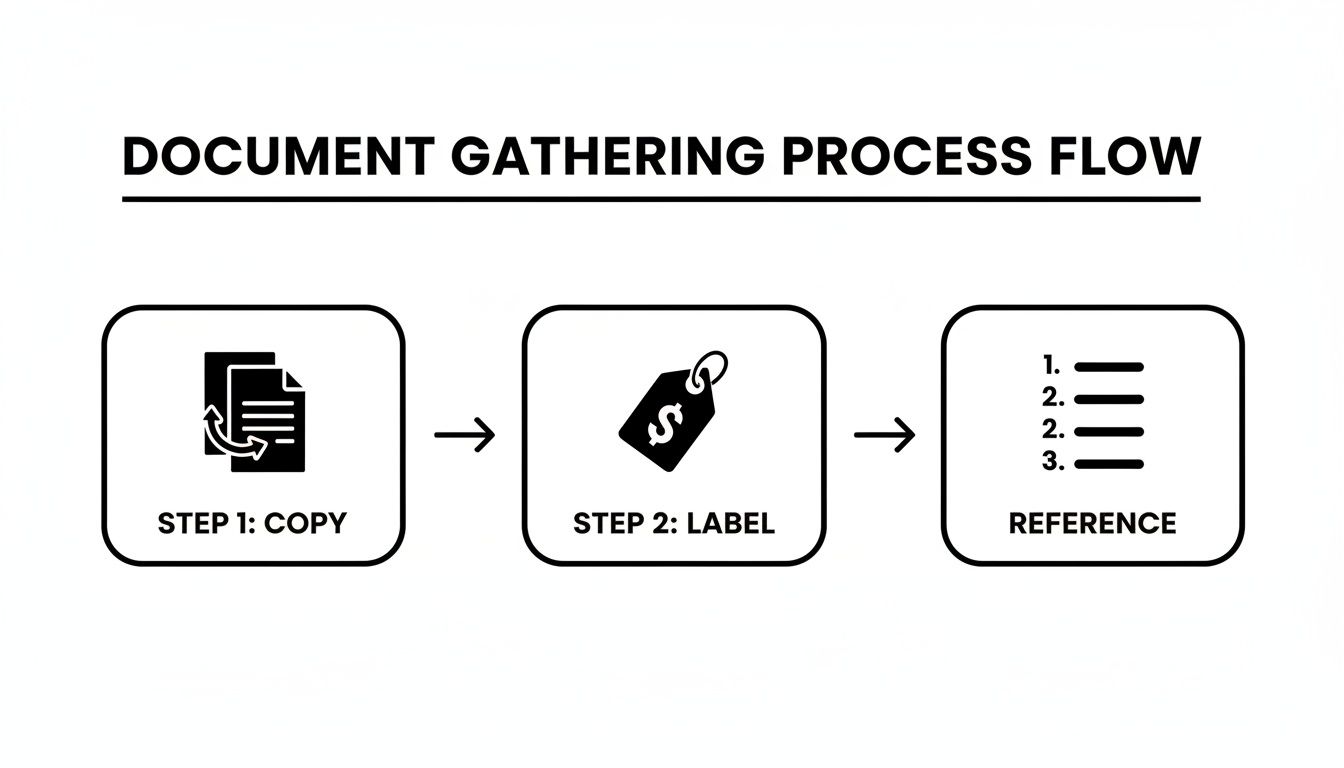
This simple workflow makes your package easy for an IRS agent to understand and process, which can only help your case.
Keep a Detailed Log
One of the best pieces of advice I can give is to document every single interaction. Keeping a simple log can be a lifesaver if your case drags on or gets complicated.
Here’s a straightforward template you can use to track your communications with the IRS.
| IRS Correspondence Tracking Log | | :--- | :--- | :--- | :--- | :--- | | Date Sent | Letter Subject/Notice # | Sent Via (e.g., Certified Mail #) | Follow-up Date | Notes/Response | | | | | | | | | | | | | | | | | | |
This log becomes your official record. Note the date you sent the letter, when you called to follow up, the name and badge number of any agent you spoke with, and a quick summary of what was discussed. Trust me, you'll be glad you have it.
When It's Time to Call in a Tax Attorney
Sometimes, a well-written letter is all you need to resolve an issue with the IRS. But there are definitely moments when the DIY approach becomes risky and you need to bring in a professional. Recognizing these red flags is crucial for protecting yourself.
Think of it this way: certain IRS notices aren't just requests for information; they are formal, legal steps. If you don't spot the difference, you can accidentally miss deadlines that slam the door on your appeal rights.
The Big Red Flags: Signs You Need an Expert
If the IRS assigns a Revenue Officer to your case, the game has changed. This isn't just a faceless agent in a call center anymore; it’s an individual whose job is to collect from you, often in person. Their involvement signals that the IRS is getting much more serious and aggressive. This is your cue to get professional help.
Another critical moment is when you receive a Statutory Notice of Deficiency. You might see it called a "90-day letter," and that name is no joke—it starts a legal countdown. You have precisely 90 days from the date on that letter to file a petition with the U.S. Tax Court. This isn't just another IRS form; it's a hard legal deadline. If you miss it, you lose your right to challenge the tax in court before you have to pay it.
Beyond those, here are a few other situations where you absolutely need an attorney:
- You're Facing a Trust Fund Recovery Penalty: This is a nasty one. It means the IRS is trying to hold you personally responsible for a business's unpaid payroll taxes. The financial stakes are huge, and the legal arguments required to fight it are incredibly complex.
- Your Tax Debt is Over $50,000: Once you cross this threshold, the IRS collection process gets more complicated. An experienced professional knows the advanced negotiation strategies required for large-balance cases.
- You're Under Criminal Investigation: If you even suspect a criminal investigation is underway—or you've been directly notified—stop everything. Do not talk to the IRS. Do not send any more letters. Your first and only move should be to hire an experienced tax defense attorney.
These aren't just administrative hiccups. They involve complex legal procedures, unforgiving deadlines, and potential court action where you need someone who knows the system inside and out. A tax attorney can navigate these waters in a way a letter simply can't.
If you find yourself in any of these scenarios, it's time to put down the pen and pick up the phone. The potential cost of trying to handle these high-stakes situations alone is far too great.
Answering Your Top Questions About Writing to the IRS
When you're dealing with the IRS, a few questions always seem to pop up. Knowing what to expect can make the whole process feel a lot less intimidating.
How Long Until I Hear Back from the IRS?
This is the big one, and the answer requires patience. A lot of it. With the agency's current backlogs, you should brace yourself for a wait of 90 to 180 days for an official response. For anything complicated, it can take even longer.
Just because you haven't heard anything doesn't mean your letter vanished. This is exactly why sending it via certified mail is so crucial—it gives you legal proof that you responded on time, so you can rest easy knowing you've done your part.
Can't I Just Shoot Them an Email?
It’s a tempting thought in our digital world, but no, you absolutely cannot email the IRS for official business. Email is not considered a secure way to send the kind of sensitive, personal information that’s in your tax files.
When you're responding to a notice, asking for a penalty to be waived, or disputing something on your account, old-fashioned physical mail is the only way to go. Using USPS Certified Mail is non-negotiable; it creates that all-important legal paper trail and keeps your private data safe.
What's the Single Biggest Mistake People Make?
Hands down, the most common and costly mistake I see is people writing letters driven by emotion. A frustrated, rambling letter that’s full of complaints but short on facts will get you nowhere. In fact, it's the quickest way to have your request pushed to the bottom of the pile.
Treat this letter like any other professional business communication. It needs to be:
- Direct and factual. Clearly explain the problem and state exactly what you want the IRS to do.
- Backed by proof. Every single point you make should be supported with documentation. Make sure your attachments are clearly labeled and referenced in your letter.
- Polite and professional. Skip the angry tone, the blame game, and any personal stories that don't directly support a "reasonable cause" argument.
Your mission is to make it incredibly easy for the IRS agent reviewing your case to understand your situation, follow your logic, and say "yes" to your request.
At the office of Attorney Stephen A Weisberg, I guide clients through these tricky IRS communications to get them the best possible results. If you're dealing with a tax problem that feels overwhelming, I offer a FREE Tax Debt Analysis to see exactly how I can help. Contact me today to get started.