How to Stop IRS Levy on Wages Before the Next Paycheck
Learn how to stop IRS levy on wages fast. Step-by-step guidance on hardship releases, CDP appeals, installment plans, and timelines that actually work.
In this article
- What a Wage Levy Actually Does to Your Paycheck
- Why the next pay period matters
- Your First 72 Hours After the Levy Notice
- Day one, identify the documents
- Day two, call the right IRS contact
- Day three, build the file
- Using the Collection Due Process Window to Pause the Levy
- File Form 12153 before the deadline
- Understand what the filing does
- Four Legal Grounds That Force the IRS to Release the Levy
- Economic hardship
- An approved installment agreement
- Expiration of the collection period
- Payment of the liability
- Building a Hardship Release Packet That Gets Approved
- Start with a complete financial statement
- Send the packet for action, not just review
- Resolving the Underlying Tax Debt to End the Withholding
- Installment agreements
- Offer in compromise
- Currently not collectible status
- Penalty abatement
- When a Tax Attorney Is Worth It and What to Expect
- Situations where self-representation can work
- What counsel changes
Your next paycheck is only days away. Then your employer tells you payroll has received IRS Form 668-W, and the amount deposited into your account suddenly drops. Calling payroll may confirm what happened, but payroll cannot ignore a federal levy. The IRS has directed your employer to withhold wages, and only the IRS can formally release that instruction.
The fastest way to protect the next paycheck is to treat the levy as an urgent legal and payroll problem, not merely an unpaid tax bill. You need to identify the notice, preserve any appeal deadline, contact the IRS, prepare financial proof, and make sure the IRS sends the release directly to payroll. The sequence matters because a promise to resolve the debt later won't necessarily stop the next withholding.
What a Wage Levy Actually Does to Your Paycheck
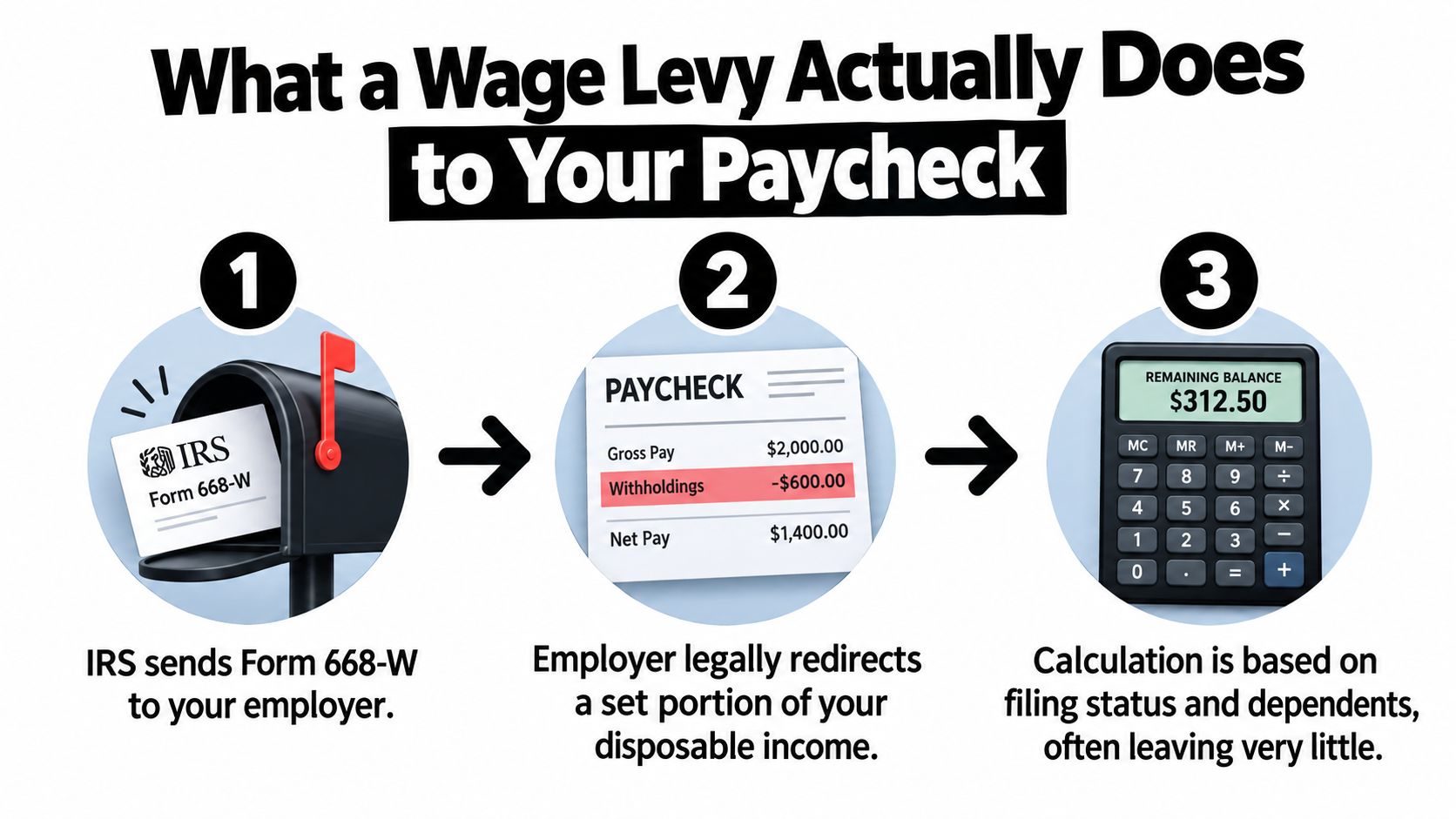
I once spoke with a self-employed client who opened an envelope from the payroll department expecting a routine benefits notice. Instead, the envelope contained a copy of Form 668-W, the IRS wage levy instruction. The employer wasn't threatening her, and payroll hadn't made a mistake. The IRS had served the employer, and the company was required to calculate the exempt amount and redirect the rest of her disposable wages.
A federal wage levy differs from a bank levy. A bank levy generally reaches funds held in an account when the bank receives the IRS instruction. A wage levy applies continuously to future paychecks, so it can affect every pay period until the IRS releases it, the tax debt is paid, or collection ends. The IRS explanation of wage levies states that withholding continues until the taxpayer makes other arrangements, pays the overdue taxes in full, or obtains a release.
Payroll doesn't choose a convenient withholding amount. The employer uses the levy form and its calculation rules, including information about filing status and dependents, to determine the amount protected from levy. The remaining disposable wages are subject to the IRS instruction. Your payroll office may be sympathetic, but it can't substitute its own hardship decision for the IRS's release.
Why the next pay period matters
The levy is served once, but it reaches future wages. That makes delay expensive in practical terms. If payroll has already entered the instruction into its system, the employer usually needs a formal IRS release, commonly sent to the payroll department, before it can stop the withholding.
You may also have a Collection Due Process window tied to the IRS Final Notice, such as LT11 or Letter 1058. The strongest procedural protection generally comes from filing Form 12153 within the applicable 30-day window, as explained by the IRS levy-release guidance. The date printed on the notice matters more than the date you first discover that your employer has received Form 668-W.
For a practical explanation of the payroll calculation, review this IRS wage levy formula guide. The immediate objective isn't to persuade payroll to bend the rules. It's to create a legally recognized reason for the IRS to issue Form 668-D or another release instruction before the next payroll cutoff.
Your First 72 Hours After the Levy Notice
The first three days should produce a documented action trail. Don't begin with a vague request to “fix the levy.” Begin by identifying exactly what the IRS issued, when it was issued, which tax periods it covers, and whether payroll has already processed the instruction.
Day one, identify the documents
Gather every document from both the IRS and your employer. Look for LT11, Letter 1058, a notice of intent to levy, or a copy of Form 668-W, 668-W(ICS), or 668-W(ACS). These documents serve different functions. The final notice can create a right to request a Collection Due Process hearing, while Form 668-W tells the employer how to administer the wage levy.
Ask payroll three precise questions:
- Implementation status: Has the levy already been entered into the payroll system?
- Payroll cutoff: Has the next paycheck been calculated or transmitted?
- IRS communication: Will payroll accept a release fax directly from the IRS?
Don't ask payroll to interpret your tax case. Ask for the payroll contact, fax number, and cutoff information so the IRS knows exactly where to send the release.
Day two, call the right IRS contact
Use the direct revenue officer or collection contact shown on the notice whenever one is provided. State the balance, tax periods, employer name, next payroll date, and the specific legal basis for relief you're requesting. If the levy prevents payment of basic living expenses, say that clearly and request a hardship review rather than just asking for “more time.”
If you received a CP504 or related notice before the levy, this CP504 notice explanation can help you understand how the notice sequence fits together. Keep the call focused. The IRS employee needs a defensible reason to recommend a hold or release, not a general account of how stressful the situation feels.
Day three, build the file
Create a chronological file containing:
- Call records: date, time, number called, employee identification number, and outcome.
- Submission proof: fax confirmations, upload receipts, and mailing records.
- Financial evidence: pay statements, bank records, housing costs, utilities, medical bills, and transportation expenses.
- Payroll details: employer contact, fax number, payroll cutoff, and whether withholding has already occurred.
Practical rule: A release request is stronger when the IRS can verify the hardship, approve the action, and send the instruction to the right payroll department without another round of questions.
If the IRS agrees to relief, ask what document will be sent, when it will be sent, and whether the IRS employee will fax it directly to payroll. Then call payroll to confirm receipt. A verbal assurance from the IRS or your employer isn't the same as a formal release.
Using the Collection Due Process Window to Pause the Levy
A timely Collection Due Process request is often the most powerful procedural move available after a final levy notice. The notice date controls the deadline. Don't calculate from the day your employer handed you Form 668-W, because the IRS may have started the appeal clock earlier.
File Form 12153 before the deadline
Complete Form 12153, Request for a Collection Due Process or Equivalent Hearing, using the notice information exactly as shown. Identify the tax periods, explain that a levy has been issued or is imminent, and request a hearing with the Independent Office of Appeals. Select a specific issue rather than writing only that you can't afford the withholding.
Potential issues can include:
- Installment agreement: You're proposing a payment arrangement that should prevent the levy from continuing.
- Economic hardship: The withholding leaves you unable to pay basic living expenses.
- Collection statute expiration: The IRS issued the levy after the collection period had expired.
- Improper action: The IRS failed to follow required notice or collection procedures.
- Spousal or identity issue: The liability isn't properly attributable to you or requires a legally recognized defense.
The IRS tax appeals resource provides additional context on the appeal process. Attach enough information to identify the issue, but don't delay filing while assembling a perfect financial packet. Preserve the deadline first, then supplement the request and financial evidence.
Understand what the filing does
A timely CDP request generally suspends levy action while the hearing is pending. That procedural pause can reach a wage levy already in the employer's hands, but payroll still needs an IRS instruction to change its withholding. Ask the IRS to confirm that the levy suspension or release has been transmitted to the employer.
An Appeals Officer may consider an installment agreement, hardship, or another collection alternative. Appeals won't erase a valid liability just because the levy is inconvenient. Your submission must connect the requested alternative to accurate financial information and current compliance.
The verified IRS guidance identifies the following release grounds:
| Factor | Collection Due Process, Form 12153 | Equivalent Hearing |
|---|---|---|
| Filing basis | Proper final notice and timely request | Usually used when the CDP deadline was missed |
| Levy effect | Can suspend levy action while Appeals considers the case | Doesn't provide the same automatic CDP protection |
| Hearing forum | Independent Office of Appeals | Appeals process, subject to different consequences |
| Judicial review | A determination may support a Tax Court petition | Generally lacks the same CDP judicial path |
| Best use | Preserve rights and stop collection action promptly | Seek review after a missed deadline |
If you miss the CDP deadline, file an equivalent hearing request when appropriate, but understand the difference. It may provide a review opportunity without restoring every protection that a timely CDP request would have created.
Four Legal Grounds That Force the IRS to Release the Levy
The IRS doesn't release a wage levy merely because a taxpayer asks politely or promises to pay later. The request must fit a recognized legal or administrative basis. IRS Publication 594 and the agency's levy-release guidance identify grounds that include payment, expiration of the collection period, a levy that helps payment, and economic hardship.
Economic hardship
Hardship is the most urgent ground when the next paycheck is at risk. You need to show that withholding prevents payment of basic living expenses, not merely that your budget has become uncomfortable. Housing, utilities, food, medical care, and necessary transportation should be supported with records.
An approved installment agreement
An installment agreement can support release when its terms don't permit the levy to continue. Don't assume that submitting a payment-plan request ends the levy. The IRS must approve the arrangement and issue the appropriate release or modification instruction.
Expiration of the collection period
If the IRS collection statute expired before the levy was issued, the levy may be legally defective. This requires careful account transcripts, assessment dates, suspension periods, prior collection activity, and other records. A taxpayer's estimate of the expiration date isn't enough.
Payment of the liability
Full payment ends the underlying collection problem, but the payroll instruction still has to be released administratively. Send proof of payment to the IRS and confirm that the release document has gone to payroll.
| Release Ground | Typical Timeline | Key Document | Approval Likelihood |
|---|---|---|---|
| Economic hardship | Depends on the urgency and completeness of the submission | Form 433-F or equivalent financial evidence | Strong when basic expenses are clearly documented |
| Approved installment agreement | Depends on approval and release processing | Agreement request and approval confirmation | Depends on eligibility and accurate financial information |
| Expired collection period | Depends on transcript and statute analysis | Account transcripts and collection-history evidence | Strong only when the legal expiration is established |
| Full payment | After payment clears and IRS processing occurs | Payment confirmation and account records | Strong when the payment covers the required balance |
The IRS's legal release grounds are summarized in its levy release rules. The practical lesson is simple: choose the ground you can prove fastest. A weak argument wastes the payroll cycle you're trying to save.
Building a Hardship Release Packet That Gets Approved
A hardship packet should let a revenue officer answer one question quickly: Will the levy prevent this taxpayer from paying basic living expenses? General financial distress isn't enough. The packet must connect the withholding to specific expenses and show what happens after the levy is applied.
Start with a complete financial statement
Use Form 433-F or an equivalent collection information statement. List income from employment, self-employment, business activity, and other sources. Then document recurring expenses with current records instead of relying on rounded estimates.
Include:
- Income proof: Recent pay statements and records of variable self-employment income.
- Bank evidence: Recent statements for every account, including business accounts when relevant.
- Essential expenses: Lease or mortgage records, utilities, medical costs, insurance, and necessary transportation.
- Levy impact: A pay statement showing the withholding or a payroll calculation showing what the next check will contain.
- Household facts: Filing status, dependents, and any expense that makes the household's situation unusual.
The narrative should be short and factual. Explain that the levy leaves insufficient funds for rent, utilities, food, medical treatment, or transportation to work. Avoid framing the request around lost savings, reduced discretionary spending, or the desire to maintain a preferred lifestyle.
For help organizing the written explanation, this hardship letter guide from Voicedial.ai can provide a useful drafting structure. Adapt the language to your actual records. A template can't replace evidence, and unsupported statements can slow the review.
Send the packet for action, not just review
Call the IRS before transmitting the documents and obtain the correct fax or upload destination. Put the taxpayer identification information, tax periods, employer name, and the requested action on the first page. State that the next payroll cycle is imminent and ask the revenue officer to review the packet for levy release.
The Form 433-F collection guide explains the financial-information process in greater detail. After sending the packet, confirm receipt and ask whether the IRS will fax the release directly to payroll.
Payroll reality: Your employer can't act on your hardship narrative. The IRS must issue the release instruction, and payroll must receive it before the withholding changes.
Common problems include omitted accounts, unexplained deposits, inconsistent income figures, and expenses that aren't supported by records. Correct those problems before submission. If the IRS approves hardship relief, follow up with both the IRS and payroll until the release has been received and applied.
Resolving the Underlying Tax Debt to End the Withholding
Stopping the next deduction and resolving the tax balance are related but separate tasks. A payment arrangement may address the debt, while a hardship request addresses the immediate effect of the levy. The right strategy depends on whether you can pay something monthly, need temporary protection, or have no realistic ability to pay the full balance.
Installment agreements
An installment agreement works when you can make a sustainable monthly payment and remain current with future filing and payment obligations. Requesting one can support levy release, but don't treat an online submission or pending application as a guaranteed payroll stop. Confirm approval and the IRS release instruction.
A payment amount that looks generous on paper can fail if it leaves too little for essential expenses. Use accurate income and expense information, particularly if your earnings fluctuate or you operate a small business.
Offer in compromise
An offer in compromise may fit a taxpayer who can't fully pay through available assets and income. The IRS reviews financial information closely, so an offer isn't a shortcut around documentation. It can be appropriate when an installment agreement doesn't reflect the taxpayer's actual ability to pay, but it generally isn't the fastest response to a paycheck due within days.
Currently not collectible status
Currently Not Collectible status can provide relief when paying anything would prevent basic living expenses. It doesn't eliminate the tax debt, and interest and penalties can continue. The IRS may review the financial situation later, so treat CNC as breathing room, not a permanent resolution.
Penalty abatement
First-time penalty abatement may reduce the balance for a taxpayer with a qualifying compliance history. It doesn't, by itself, create an automatic wage-levy release. Its value is strategic. A lower balance may make another resolution option more workable, but the levy still requires its own release action.
| Resolution Path | Approval Odds | Days to Levy Release | Best For |
|---|---|---|---|
| Installment agreement | Depends on eligibility and complete financial information | Depends on approval and IRS transmission | Taxpayers able to make a sustainable payment |
| Offer in compromise | Depends on verified ability to pay and financial analysis | Usually unsuitable for an emergency payroll cutoff | Taxpayers unable to fully pay through other means |
| Currently Not Collectible | Depends on proof of inability to pay basic expenses | Depends on revenue officer review and release processing | Temporary financial crisis with no available payment |
| Penalty abatement | Depends on the taxpayer's history and facts | Doesn't independently stop the levy | Reducing the balance to support another resolution |
Don't submit every possible request without a sequence. If the next paycheck is endangered, lead with hardship or a timely CDP request. Then pursue the debt-resolution path that matches the financial record.
When a Tax Attorney Is Worth It and What to Expect
Professional help is valuable when the levy is moving faster than the IRS's ordinary correspondence system. It's less valuable when the account is simple, the balance is manageable, and you can supply accurate information without an active revenue officer.
Situations where self-representation can work
DIY resolution may be reasonable when you have a single uncomplicated balance, stable W-2 income, no other levies or asset issues, and no history of missed compliance obligations. In that situation, you may be able to file the appropriate request, establish a payment arrangement, and monitor payroll communication yourself.
It becomes a poor choice when the account involves multiple years, business payroll exposure, trust fund penalty risk, an assigned revenue officer, or a levy that consumes a substantial share of take-home pay. Those cases require transcript analysis, financial modeling, and direct negotiation rather than a series of general customer-service calls.
What counsel changes
A tax attorney can file Form 2848, communicate with the assigned IRS employee, frame a hardship request around the collection standards, and escalate a rejected request with supporting evidence. Counsel can also preserve a CDP position through Form 12153 and coordinate the release transmission with payroll.
The benefit isn't a guarantee that the IRS will agree. The benefit is disciplined sequencing, a complete record, and a representative who understands that a release isn't complete until payroll receives the instruction. If your law practice needs help managing intake while you handle the substantive tax work, legal intake services for law firms may help organize prospective-client communications.
| Situation | DIY Outcome | With Tax Attorney | Fee Range |
|---|---|---|---|
| Simple balance and stable wages | You may complete the request and monitor the account | Counsel confirms the correct path and paperwork | Varies by scope |
| Active revenue officer | Calls may produce limited progress without a coherent proposal | Attorney communicates directly and presents a release basis | Varies by complexity |
| Business or trust fund exposure | Financial and legal issues can overlap | Counsel analyzes responsible-person and collection risks | Varies by complexity |
| Immediate hardship and imminent payroll | Delay or incomplete evidence can cost the next cycle | Counsel coordinates the IRS packet and payroll release | Varies by urgency |
Ask any professional whether they regularly handle IRS collection cases, whether a CPA or enrolled agent is involved, whether an attorney is admitted to a state bar, and whether the fee is flat, hourly, or contingent on a defined stage. Ask what the engagement includes before paying. Tax Attorney Stephen A Weisberg offers a free tax debt analysis before charging clients to determine whether representation is appropriate and what approach may fit the account.
Tax Attorney Stephen A Weisberg helps individuals, self-employed taxpayers, and small businesses address IRS wage levies, hardship claims, payment arrangements, and collection appeals. Visit Tax Attorney Stephen A Weisberg to request a tax debt analysis and discuss the steps needed to protect an approaching paycheck.


