How to Read Tax Return Transcripts a Pro's Guide
Learn how to read tax return transcript from the IRS. This guide deciphers codes, explains key sections, and helps you navigate your financial history.

In this article
- Your IRS Transcript: Unlocking the Story Behind Your Taxes
- Why This Document Matters So Much
- How to Get Your IRS Transcript Fast
- Getting Through the ID.me Verification Gauntlet
- What If You Can't Get In Online?
- Breaking Down Your Tax Transcript, Section by Section
- Your Account Information Header
- The Return Information Section
- The Transaction Code List
- Key Sections of an IRS Tax Return Transcript Explained
- Decoding the Most Common IRS Codes
- Spotting Codes That Signal Trouble
- Finding Red Flags and What They Really Mean
- The Dreaded Mismatch Notice
- Unexpected Balance Due or Missing Credits
- Flags for Identity Theft and Fraud
- Why Your Transcript Is Your Best Defense
- What to Do When Your Transcript Shows a Problem
- How Serious Is It?
- Should You Handle It Yourself or Call a Pro?
- How a Tax Attorney Can Help
- Got Questions About Your Tax Transcript? You're Not Alone.
- What’s the Difference Between a Tax Return Transcript and an Account Transcript?
- I See a Code on My Transcript I Don't Recognize. What Now?
- Why Are the Numbers on My Transcript Different From the Return I Filed?
- How Long Should I Hang On to My Tax Transcripts?
Reading your IRS tax return transcript isn't about just glancing at the numbers. It's about knowing where to look and what you're looking for. The real story of your tax year is hidden in the details—the account summary, the income details, and especially the transaction codes. Once you can spot key codes, like Code 150 for your filed return or Code 846 for a refund, you'll be able to see exactly what's happening with your account in a matter of seconds.
Your IRS Transcript: Unlocking the Story Behind Your Taxes
It's a common misconception that a tax transcript is just a copy of your Form 1040. In reality, it’s the IRS’s official internal record of your account. Think of it as a running ledger that tracks every single interaction for a given tax year: payments you made, adjustments the IRS applied, and any penalties or interest tacked on.
This one document is incredibly powerful. It’s what you’ll use to prove your income for a mortgage, see what the IRS is looking at before an audit, or figure out a strategy for dealing with tax debt.

This guide is designed to cut through the confusing government jargon. We’ll translate those cryptic codes and line items into simple, practical insights. Learning how to properly read your tax return transcript is a skill every taxpayer should have.
Why This Document Matters So Much
The importance of a tax transcript goes way beyond just keeping good records. It's often the key piece of financial proof you need for some of life's biggest moments. When you apply for a mortgage, for instance, lenders almost always ask for your transcript directly from the IRS. Why? Because it’s an unaltered, official record of your income, which they trust more than a return you prepared yourself.
Getting comfortable with your transcript gives you the power to:
- Verify Your Income: Need a mortgage or a small business loan? Your transcript provides lenders with undeniable proof of your Adjusted Gross Income (AGI).
- Get Ready for Audits: You can spot potential red flags or discrepancies on your transcript long before the IRS ever sends a notice. This gives you a crucial head start to gather your documents and prepare a response.
- Solve Tax Problems: When you're dealing with back taxes, a transcript is the only way to accurately track your payments, see how penalties are calculated, and understand the interest being charged.
- Confirm Your Identity: In cases of identity theft, a transcript is your best tool. It shows every transaction posted to your account, making it easier to pinpoint fraudulent activity. With the IRS flagging over 1.9 million returns for potential identity theft last year alone, this has become more critical than ever.
Key Takeaway: Your transcript is the unfiltered truth of your tax situation from the IRS's perspective. When you master reading it, you stop just reacting to IRS notices and start proactively managing your financial life.
Because this document contains so much sensitive personal information, it's vital to handle it securely. The same principles of data protection apply here as they do for something like HIPAA compliant transcription services. By the time you finish this guide, you’ll have the confidence to pull your own transcript, understand what it says, and use that knowledge to your advantage.
How to Get Your IRS Transcript Fast
When a lender asks for your tax records or you just need to see what the IRS has on file, waiting around for weeks isn't an option. The good news is the IRS has an online system that's incredibly fast, but you have to know how to navigate it.
The quickest route, by far, is the IRS "Get Transcript" online tool. This is a self-service portal where you can view, print, or download any transcript for the current year and the three prior years instantly. It's wildly popular—in a recent filing season, IRS.gov had over 868,140,000 visits, with a huge chunk of that traffic heading straight for this tool. You can dig into more of those stats over at efile.com.
Of course, there's a catch. Before you get access, you have to prove you are who you say you are by going through the ID.me verification process. This is where most people get stuck.
Getting Through the ID.me Verification Gauntlet
ID.me is the secure gateway the IRS uses to protect your sensitive data from fraudsters. Think of it as a digital bouncer. To get past the velvet rope, you'll need a few things handy.
Have these ready before you start:
- A government-issued photo ID (driver's license, passport, or state ID)
- Your Social Security number
- A smartphone with a camera or a computer with a webcam (you'll need to take a "selfie")
- Access to a financial account in your name, like a credit card or mortgage, for an extra layer of verification.
Pro Tip: If the automated system keeps rejecting your selfie or document scan, don't give up. The best-kept secret is to request a video call with a live ID.me agent. You might have to wait a few minutes in a virtual line, but it’s the most reliable way to clear up any snags and get verified.
Once you're in, your transcripts are available immediately. For business owners, just know that the process is a bit different. We've covered that in detail in our guide on the new and improved business tax account.
What If You Can't Get In Online?
Sometimes the online system just won't work for you, or maybe you'd rather not deal with it. The IRS still has a couple of old-school options, but be prepared to wait.
Get Transcript by Mail You can use the Get Transcript by Mail feature on the IRS website. It doesn't require an account, but you'll need your SSN, birth date, and the exact mailing address from your last tax return. The transcript will show up in your mailbox, but it usually takes 5 to 10 calendar days. This is a solid backup if you're not in a huge rush.
File Form 4506-T If you need a transcript sent directly to a third party, like a mortgage lender, you'll need to file Form 4506-T, Request for Transcript of Tax Return. You can mail or fax it in. This is definitely the slowest method, often taking a few weeks to process, so it's best reserved for situations where a third party requires it or you need transcripts for older tax years that aren't available online.
Picking the right delivery method is only half the battle. You also need to know which type of transcript you need. A Return Transcript is usually what lenders want to see for income verification. But if you're trying to solve a tax problem, you’ll need an Account Transcript, which shows all the activity on your account—payments, penalties, and IRS adjustments. Asking for the right one from the start will save you a ton of time and frustration.
Breaking Down Your Tax Transcript, Section by Section
Opening a tax transcript for the first time can feel like you're trying to read a foreign language. It's a dense document, packed with lines, dates, and codes that don't seem to make much sense. The key is to stop seeing it as one overwhelming page and start looking at it as a series of smaller, distinct sections. Each one tells a specific part of your tax story.
Once you know what you're looking at, you can quickly verify your income, confirm payments, and spot potential issues before they turn into major headaches. Think of this as your guided tour. I'll walk you through the document's main components, translating the IRS jargon into plain English so you know exactly what’s going on.
This quick visual breaks down the different types of transcripts available, which is a great starting point to make sure you’ve even requested the right document in the first place.
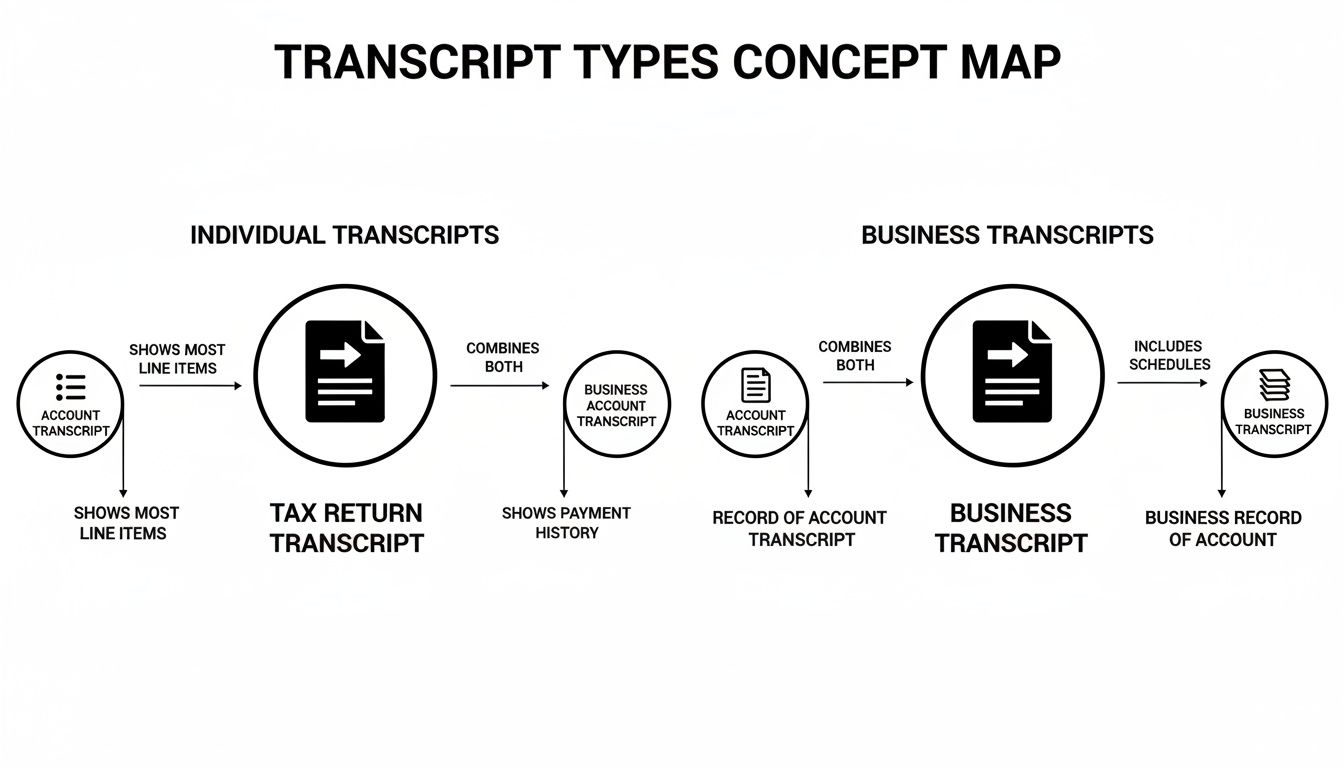
As you can see, a Return Transcript focuses on the numbers you filed, while an Account Transcript tracks the financial back-and-forth. Knowing the difference is crucial.
Your Account Information Header
Right at the very top, you'll find the basics. This section is your first checkpoint to ensure you're looking at the correct document for the right person and tax period. It’s a simple but vital step.
This header always includes:
- Your Name and Address: This should match what the IRS has on file from your latest return.
- Social Security Number (SSN): For your security, only the last four digits are shown (e.g., XXX-XX-1234).
- Filing Status: Shows whether you filed as Single, Married Filing Jointly, Head of Household, etc.
- Tax Period: Pay close attention here. This shows the year the transcript applies to, like "Dec. 31, 2023."
Always give this header a quick scan. Grabbing the wrong tax year is a surprisingly common mistake that can cause real confusion, especially when you're trying to give documents to a mortgage lender.
The Return Information Section
This part of a Return Transcript is a summary of the key financial figures from the Form 1040 you filed. From my experience, this is the section lenders care about most because it's a clean summary of your income and tax liability, straight from the source.
Here, you'll find line items that mirror your tax return, including:
- Adjusted Gross Income (AGI): This is the number that gets the most scrutiny. Lenders use it to calculate your debt-to-income ratio, so it's critical that the AGI on your transcript matches what you put on your loan application.
- Taxable Income: Your AGI after subtracting deductions.
- Total Tax: The amount of tax you were on the hook for before any payments or credits.
- Payments: This line shows any withholdings and estimated tax payments you made.
Think of this section as the IRS confirming, "Yep, this is what the taxpayer told us." If the IRS adjusted your return during processing, you'll see two columns: one for your "per return" figures and another for the "per computer" (IRS-adjusted) amounts.
The Transaction Code List
Now we get to the heart of an Account Transcript: the transaction code list. This is a chronological log of every single activity that happened with your tax account for that year. Each entry has a date, a short description, and a three-digit code that signifies a specific action.
Learning to decipher these codes is the most powerful skill you can have when it comes to understanding your transcript. They tell the complete story of your tax year, from the moment you filed to the day your refund went out.
To help you get started, this table breaks down the most important sections you'll encounter.
Key Sections of an IRS Tax Return Transcript Explained
| Transcript Section | What It Shows | Why It's Important for You |
|---|---|---|
| Account Information | Your name, SSN, address, filing status, and the tax year. | This is your first check. It ensures you have the correct document for the right person and period, preventing simple mix-ups. |
| Return Information | A summary of key figures from your filed return, like AGI and total tax. | Lenders and financial institutions rely on this section to verify the income you reported on your applications. |
| Transaction Codes | A chronological list of all actions on your account, from filing to refund. | This is where the story unfolds. Understanding these codes tells you if your return is processed, on hold, or under review. |
| Per Computer Values | The IRS's final, adjusted figures for your tax return. | If these numbers differ from your "per return" figures, it means the IRS changed something. This is a critical area to review. |
This table provides a high-level overview, but the real details are in those transaction codes. Let's dive into the most common ones you'll see.
Decoding the Most Common IRS Codes
While there are hundreds of codes, you'll see a handful on almost every transcript. Get a handle on these, and you'll have a clear picture of your account's status.
- Code 150 (Tax Return Filed): This is the big one. It's the first and most important code, confirming the IRS has received and processed your return. This officially establishes your tax liability for the year.
- Code 806 (W-2 or 1099 Withholding): This shows the total federal income tax withheld from your paychecks or other income sources.
- Code 766 (Credit to Your Account): You'll see this for refundable credits like the Child Tax Credit or the Earned Income Tax Credit.
- Code 846 (Refund Issued): This is the one everyone hopes to see. It means your refund is on its way. The date next to this code is when the IRS scheduled your direct deposit or mailed your check.
When you see these codes in order—150, 806, and finally 846—it’s a great sign that everything went smoothly.
Spotting Codes That Signal Trouble
Not all codes are good news. Some act as red flags, pointing to a delay, a review, or a problem that needs your attention. Spotting these early can give you a crucial head start.
- Code 570 (Additional Account Action Pending): This is a very common code that simply means your refund is on a temporary hold. It doesn't automatically signal a crisis; the IRS might just be verifying something. But it’s a sign to keep a close eye on your transcript and your mailbox.
- Code 971 (Notice Issued): This code almost always follows a Code 570. It confirms the IRS has mailed you a letter explaining the hold or a proposed change. With the IRS processing over 69 million returns in a recent season, this 'Notice Issued' code is a frequent flyer, often signaling adjustments in over a million cases each year.
- Code 420 (Examination of Account): This is the one no one wants to see. It’s the official indicator that your account has been pulled for an audit. If you see this, it’s a strong signal that you need to prepare for a much closer look from the IRS.
Seeing a Code 420 is definitely alarming, but don't panic. Understanding what triggers a tax audit can help you assess your situation and figure out your next steps. Once you master these core sections and codes, your tax transcript goes from being a confusing document to a clear and actionable report on where you stand with the IRS.
Finding Red Flags and What They Really Mean
Think of your tax transcript as an early warning system. It can show you potential problems long before an official IRS notice ever lands in your mailbox. Learning to spot these red flags is like having an insider's view, letting you get ahead of issues instead of just reacting to them. This isn’t about causing panic; it’s about empowering you to identify and handle things on your own terms.
We’ll dig into the subtle clues and outright warnings that pop up on your transcript. Understanding these signs is a massive part of learning how to read a tax return transcript effectively and gives you a crucial head start.

The Dreaded Mismatch Notice
An income mismatch is probably one of the most common red flags I see, especially for freelancers and independent contractors. The IRS computers are incredibly good at one thing: matching the income reported on Forms W-2 and 1099 with what you report on your return. If those numbers don't line up, a flag goes up instantly.
You might see a Code 971 (Notice Issued) on your transcript. Often, this appears right after another transaction code showing an IRS-generated adjustment. This means the system has automatically "corrected" your return to match its records and has already sent you a bill for the difference, usually with penalties and interest tacked on.
Unexpected Balance Due or Missing Credits
So, you filed expecting a nice refund, but your transcript shows you owe money or that your refund is way smaller than you thought. This is a dead giveaway that the IRS has changed something significant. You need to look closely at the transaction codes to figure out what happened.
A few common culprits for this are:
- Disallowed Credits: The IRS might have removed a tax credit you claimed, like the American Opportunity Tax Credit or the Child Tax Credit, if their records suggest you weren't eligible.
- Math Errors: It happens. The IRS's computers automatically correct simple math mistakes, and that can change your final numbers.
- Missing Payments: Maybe an estimated tax payment you sent in wasn't applied to the right tax year or was posted under the wrong Social Security number.
Expert Insight: An unexpected balance due is often the very first sign of trouble. Before you panic, check the transaction log for any adjustment codes. If the IRS is proposing changes that could lead to a significant debt, it's wise to understand what a notice like a CP504 means and how to respond. You can learn more here: https://www.weisberg.tax/newsletter/decoding-the-irs-cp504-notice-mcfmm-dgf6n-prcg7
Flags for Identity Theft and Fraud
Identity theft is a massive headache, and it hits millions of taxpayers every year. In fact, the IRS flagged nearly 2 million returns for potential identity theft in the 2024 filing season alone. Your transcript is one of the best places to catch it early.
Be on the lookout for these tell-tale signs:
- You see a Code 150 (Return Filed) on your transcript, but you haven't even filed yet. This is a classic indicator that someone has used your SSN to file a fraudulent return.
- The transcript lists wages from an employer you’ve never heard of.
- You spot an address or filing status that you didn't authorize.
If you see any of these, you have to act fast. Report the identity theft to the IRS immediately to protect your account.
Why Your Transcript Is Your Best Defense
Getting comfortable with scrutinizing your transcript is a fundamental skill for managing your taxes. While it isn't a legal contract, the principles of careful review are universal. For anyone looking to get better at this, there are great strategies for reviewing complex documents and spotting red flags that apply here, too.
The key is to use this information proactively. Spotting an income mismatch lets you gather your 1099s and prepare a response before the official notice even shows up. Identifying a missing payment gives you time to track it down with your bank records. When you regularly review your transcript, you turn it from a static record into a powerful diagnostic tool, putting you back in control of your relationship with the IRS.
What to Do When Your Transcript Shows a Problem
Finding something wrong on your tax transcript can send a jolt of anxiety through anyone. But don't panic. Discovering the issue is just the first step; how you respond is what really matters.
Some issues are no big deal. The IRS might correct a simple math error, and you'll see the adjustment on your transcript before you even get a notice in the mail. If you agree with their fix, you probably don't need to do anything. But other red flags demand a much more careful approach.
How Serious Is It?
Not all transcript problems are created equal. You need to figure out if you're looking at a routine adjustment or a sign of a much deeper issue that could have serious financial consequences.
A minor issue might be:
- An IRS-corrected math error that you can double-check and verify.
- A small change to a credit or deduction that makes sense to you.
On the other hand, some codes or changes are major red flags that need your immediate and careful attention. These include:
- Transaction Code 420 (Examination of Account): This is the IRS’s internal signal that your return has been flagged for an audit. It’s not a maybe; it’s happening.
- A large, unexpected balance due: If your transcript suddenly shows you owe thousands more than you thought, the IRS has made a significant change to your tax liability.
- Signs of a Trust Fund Recovery Penalty (TFRP): This is one of the most severe penalties the IRS can assess. It’s aimed at business owners or responsible persons who failed to pay payroll taxes.
- Evidence of identity theft: You might see that a tax return was filed using your Social Security number before you ever submitted yours.
My Advice: If the problem involves a big chunk of money, a potential audit (Code 420), or complex penalties like the TFRP, trying to handle it yourself is almost always a mistake. Those first conversations with the IRS can set the direction for the entire case, for better or worse.
Should You Handle It Yourself or Call a Pro?
For minor discrepancies you genuinely understand, a direct response can work. If you disagree with a small adjustment, you can gather your receipts and records and get ready to respond to the official IRS notice when it arrives. Knowing how to dispute a tax assessment is crucial even in these smaller cases.
However, when you see one of those serious red flags, the stakes are just too high to go it alone. This is the moment when calling a tax attorney isn't an overreaction—it's a smart, strategic move. An experienced professional can step in and manage all communication with the IRS, which is critical for preventing you from saying something that could unintentionally hurt your case.
How a Tax Attorney Can Help
When you bring in a tax attorney, they do a lot more than just make phone calls. They’ll look at your entire financial situation to build a solid strategy for resolving whatever problem showed up on your transcript. This is especially important when you’re facing a substantial tax debt.
An attorney knows all the resolution options—many of which the average taxpayer has never heard of or wouldn't know how to navigate. They can professionally pursue solutions like:
- Offer in Compromise (OIC): This involves negotiating with the IRS to settle your tax debt for less than you owe. It’s a powerful tool, but it's typically reserved for people in legitimate financial hardship.
- Installment Agreement: We can set up a structured, long-term payment plan. This breaks down a daunting tax bill into manageable monthly payments over time.
- Currently Not Collectible (CNC) Status: If you can prove you don’t have the income or assets to pay your basic living expenses and your tax bill, the IRS may temporarily pause all collection efforts.
- Penalty Abatement: We can formally request the removal of penalties if you have a valid reason, like a serious illness, a natural disaster, or another circumstance beyond your control.
Ultimately, finding a problem on your transcript is your cue to act. By correctly sizing up the situation and knowing when to bring in a professional, you can turn that initial jolt of anxiety into a clear plan for a lasting solution.
Got Questions About Your Tax Transcript? You're Not Alone.
After staring at a tax transcript for a while, it’s completely normal to have more questions than answers. It's a dense document, packed with codes and figures that aren't always self-explanatory. Let's walk through some of the most common sticking points I see in my practice and clear things up.
What’s the Difference Between a Tax Return Transcript and an Account Transcript?
This is easily the number one point of confusion, and getting it wrong can cause major headaches. The distinction is actually quite simple.
Think of a Tax Return Transcript as a summary of what you originally filed. It pulls most of the key line items from your Form 1040, like your Adjusted Gross Income (AGI). This is almost always the document a mortgage lender or student loan officer wants to see.
An Account Transcript, on the other hand, tells the whole story of that tax year. It’s a running log of all activity—your initial filing, any payments you made, refunds issued, penalties and interest tacked on, and any changes the IRS made after the fact. If you're trying to figure out why you owe money or where your refund is, this is the one you need.
For the most comprehensive view, you can pull a "Record of Account Transcript," which handily bundles both documents into one.
I See a Code on My Transcript I Don't Recognize. What Now?
Seeing a strange code can be alarming, but many are just standard processing notes. For instance, Code 150 just means "Return Filed"—totally normal. The trouble is, other codes are genuine red flags.
A couple you need to take seriously:
- Code 570 (Additional Liability Pending): This is a big one. It means the IRS has put a temporary freeze on your account, which almost always holds up your refund while they review something.
- Code 420 (Examination of Account): This is the internal code signaling your return has been flagged for an audit.
The IRS does publish a master list of codes, but trying to decipher the serious ones on your own can be risky. Interpreting a code incorrectly could lead you down the wrong path. If you see a code that worries you, it’s always a good idea to get a professional opinion before you pick up the phone to call the IRS.
Why Are the Numbers on My Transcript Different From the Return I Filed?
If the figures on your transcript don’t match the tax return you sent in, it’s almost certain the IRS changed something. This is a common discovery and it demands your attention.
Usually, this happens because of an automated IRS process. The most frequent culprits are simple math errors or a mismatch between the income you reported and the W-2s and 1099s the IRS has on file from your employers or clients. Your transcript will often show your "as-filed" numbers right next to the IRS's "as-adjusted" figures, making the change obvious.
You should receive an official notice in the mail (like a CP2000) explaining what they changed and why. If you believe their adjustment is wrong, that notice is your cue to gather your documents and prepare a response.
My Advice: Never ignore a discrepancy between your records and the transcript. The IRS isn't always right, but the ball is in your court to prove it. You absolutely have the right to challenge any changes as long as you have the paperwork to back up your original numbers.
How Long Should I Hang On to My Tax Transcripts?
You’ve probably heard the general rule to keep tax records for three to seven years. With tax transcripts, I recommend a different approach. These documents are the IRS’s official history of your financial life, and they take up zero physical space.
My recommendation is simple: download a PDF copy for every year you can access and save them indefinitely in a secure digital folder. They are your permanent, irrefutable proof of filing and income, which can be a lifesaver for future loan applications or if an old tax issue suddenly reappears years down the line.
If you've looked over your transcript and uncovered a problem that feels too big to handle on your own, Attorney Stephen A. Weisberg can help. I don't start with a big retainer; I start with a FREE Tax Debt Analysis to map out the best strategy for your unique situation. Visit https://weisberg.tax to get the clarity and expert guidance you need.


